Leningradskiy Ice Cap Snowcover Vanishes in 2020 More Thinning, Svernaya Zemlya

Leningradskiy Ice Cap  north to south strip in 2000 and 2020 Landsat images illustrating thinning leading to separation of parts of the ice cap at Point 1 and 4 and expansion of bedrock leading to merging bedrock regions at Point 1 and 2. R=snow/firnpack saturated with meltwater and consequent potential refreezing. S=superimposed ice development from surface refreezing.

Leningradskiy Ice Cap is oriented east to west across Bolshevik Island in the Svernaya Zemlya Archipelago of the Russian Arctic. Annual snowfall on the ice caps is limited ~0.4-0.5 m (Sharov and Tyukevina, 2010).  During the brief summer melt season from June-late August, much of the melt is refrozen within the snow/firnpack or as superimposed ice (Bassford et al 2006).  The low snowpack makes the glaciers vulnerable to warm summer conditions. The summer of 2020 has been remarkably warm in the Russian High Arctic leading to high melt rates and surface mass balance loss as shown by Xavier Fettweise MAR model. Here we examine Landsat images from 2000 to 2020 to identify a pattern of thinning on the northern margin of the ice cap.

In 2000 the glacier has a well established glacier runoff stream at yellow arrow. Point 1 is a nunatak amidst a peripheral segment of the ice cap. Point 2 is an area of bedrock separated by a narrow section of ice cap from adjacent bedrock. Point 3 and 4 are locations where the ice cap is thick enough to spillover in to an adjacent basin.  There is little visible snowpack on the ice cap, but a significant area of azure blue indicates snow/firnpack (R) that is saturated with meltwater, some of which will refreeze. There are zones of superimposed ice development(S)  where meltwater is refreezing on top of the cold surface ice. In 2018 there an area of unsaturated snowpack, white area, and saturated snow/firnpack (R) azure blue and areas of superimposed ice development (S).

On August 3, 2020 the ice cap has lost its snowcover with limited areas of firn, limiting the ability of meltwater to refreeze except on the surface as superimposed ice (S).  The lack of snow/firnpack at the surface will lead to a more negative balance as meltwater is not retained. At Point 1 this peripheral glacier area has been cutoff from the main ice cap as thinning has exposed more of the encircling ridge.  At Point 2 bedrock areas have expanded and merged together. At Point 3 there is some spillover still but thinning has led to a reduction and consequent retreat and thinning of this terminus. At Point 4 the ice cap no longer spillovers into the adjacent basin due to thinning. Each location indicates significant thinning that is hard to recover given the slow flow and limited accumulation on these glaciers. On Aug. 22 2020 the surface of the ice cap is frozen, leading to a whiter surface.

The lack of retained snowcover in 2020 was also seen at Hochstetter Ice Cap in Franz Josef Land.  In both cases the high summer temperatures led to more meltwater, and the lack of snowpack to retain leads to more escaping the system. Bassford et al (2006) describe this process “Intense surface melting in the accumulation zone during warm summers prevents the buildup of a thick firn layer by rapid transformation of firn to ice through refreezing and by removing
mass through runoff.”

Leningradskiy Ice Cap  north to south strip in 2018 and 2020 Landsat images illustrating changing distribution of melting (R) and superimposed ice development (S)
Dzhikiugankez Glacier, Russia Persistent Limited Retained Snowpack 2013-2020

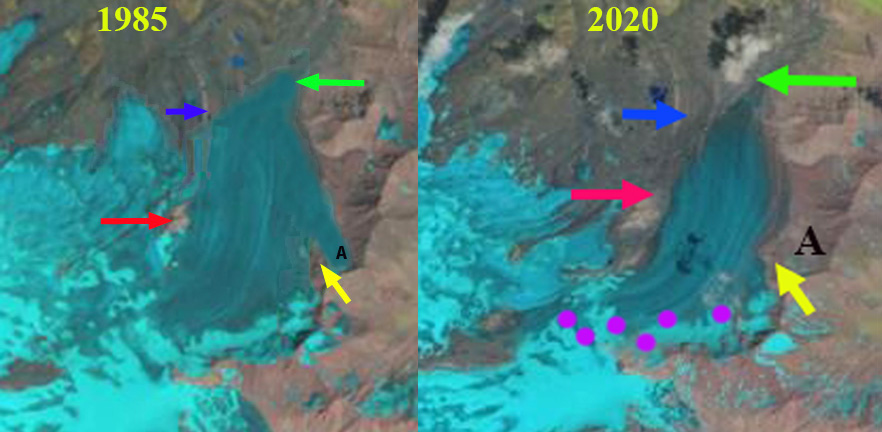
Dzhikiugankez Glacier in 1985 and 2020 Landsat images with the snowline shown by purple dots. A tributary at Point A has disappeared and tributary at the red arrow has separated.  Thinning and marginal retreat is emphasized by blue and green arrows.

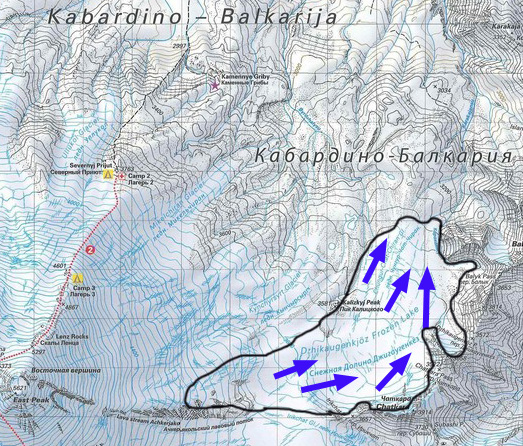
Dzhikiugankez Glacier (Frozen Lake) is a large glacier on the northeast side of Mount Elbrus, Caucasus Range. The primary portion of the glacier indicated in the map of the region does not extend to the upper mountain, the adjoining glacier extending to the submit is the Kynchyr Syrt Glacier. The glacier is 5 km long extending from ~4000 m to 3200 m.  Shahgedanova et al (2014) examined changes of Elbrus glaciers from 1999-2012 and found a 5% area loss in this short period, with accelerattion retreat from the 1987-2000 period.  Of the glaciers on Elbrus over 10 km2 in area Dzhikiugankez Glacier experienced a high rate of reduction, the relative loss was 27% between 1960 and 2014 (Tielidze and Wheate, 2018). This is driven by a persistent lack of retained snowcover, here we examine Landsat imagery to illustrate that. This post is inspired by the frequent imagery of Caucasus glacier change posted on Twitter by @LevanTielidze.

In 1985 the glacier connects beneath the subsidiary rock peak at the red arrow, a tongue of ice extends on the east side of the rock rib at the yellow arrow, Point A. The transient snow line is at 3550 m and less than 30% of the glacier is snowcovered. The medial moraine at the blue arrow is just beyond the glacier terminus, green arrow. In 2013 a wide zone of bare rock extends up to the subsidiary peak at the red arrow and the glacier has separated from the western tributary.  The medial moraine, blue arrow is exposed all the way to its origin near the red arrow.  In 2013 the tongue of ice at Point A, is gone.  This glacier is retreating faster on its lateral margins than at the terminus, a 20% reduction between red and yellow arrows from 1985 to 2013. In 2013 the snowline is at 3600 m, with several weeks of the melt season left.

In 2018 the transient snowline near the end of the melt season is at 3900 m, leaving less than 10% of the glacier snowcovered. In 2019 the transient snowline is at 3800 m near the end of the melt season leaving 10-15% of the glacier snowcovered. In mid-July 2020 the transient snowline is already at 3600 m with at least 6 weeks left in the melt season. It is evident from the Landsat images from the 2013 to 2020 period that  Dzhikiugankez Glacier consistently has the lowest percent of overall snowcover on Elbrus and too small of an accumulation zone to persist. The limited snowcover and glacier separation in also seen at Azaubashi Glacier  on Mount Elbrus


Dzhikiugankez Glacier in 2013, 2018 and 2019 Landsat images with the snowline shown by purple dots. 

Map of northeastern side of Mount Elbrus, summit on left. Dzhikiugankez Glacier (Dzhikaugenkjoz) is outlined in black.

Franz Josef Islands Separate due to Glacier Retreat

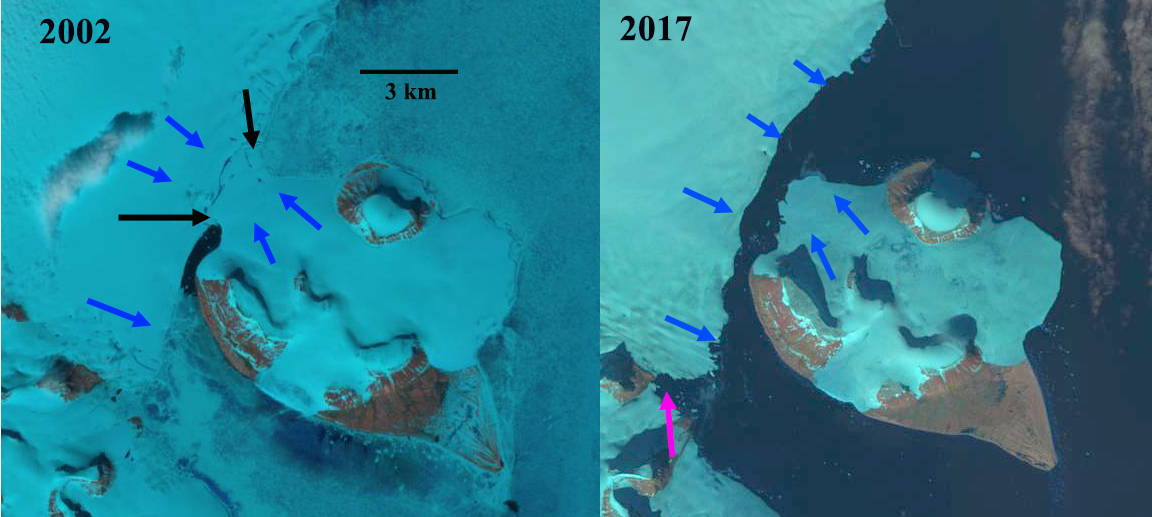
Hall Island (left) and Littrow Island (right) in 2002 and 2017 Landsat images.  The islands are connected by glacier in 2002 between the black arrows.  The blue arrows indicate glacier flow.  In 2017 the glacier connection has failed and Nordenskjold Strait has formed. 

Hall and Littrow Island are two islands in the southern part of Franz Josef Land, Russia that have until 2016 been connected by glacier. Sharov et al (2014) generated a map with the MAIRES Project illustrating the glacier connection was failing, see below. Sharov and Nikolskiy (2017) further report on the failure of this glacier connection.  Here we utilize Landsat imagery from 2000-2017 to illustrate the change.

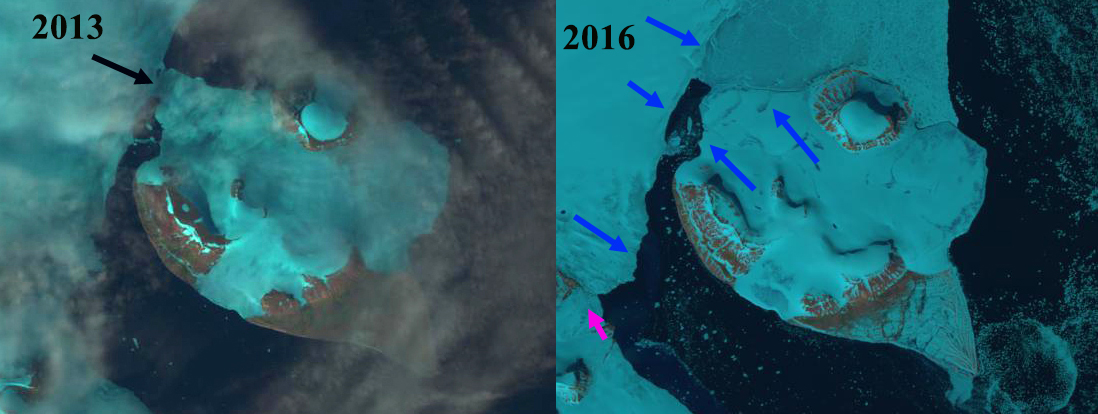
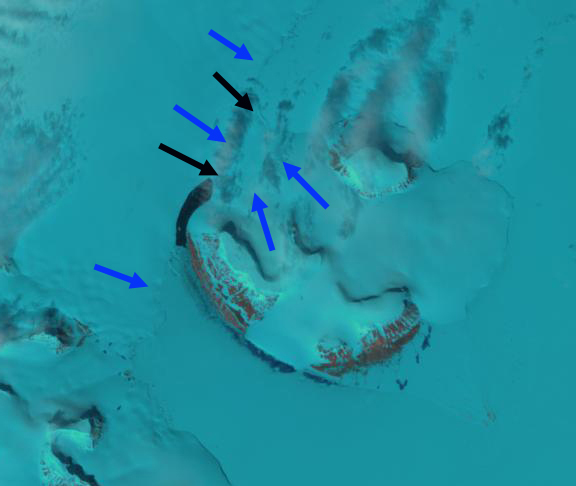
In 2000 the island are surrounded by considerable sea ice and there is a 3 km wide glacier connection, black arrows.  In 2002 the island are again surrounded by considerable sea ice that is distinguishable from the glacier ice.  The glacier connection between the island remains 3 km wide, black arrows, with blue arrows showing the direction of ice movement.  By 2013 the connection has narrowed to 0.7 km and there is no sea ice.  In 2016 the glacier connection is gone between hall and Littrow Island and Nordenskjold Strait has formed.  There is sea ice on the northern shore of Littrow Island reaching to Hall Island. To the southwest the pink arrow indicates where the Sonklar Glacier connects with an unnamed glacier in 2016.  In 2017 there again is no sea ice and the open water between Littrow Island and Hall Island is more apparent. The inlet averages 800 m in width.  The connection between Sonklar Glacier and the neighboring glacier, at the pink arrow, has failed. The lack of sea ice in the region is exposing the marine margins of the ice caps in Franz Josef Land to enhanced melting.  This has and will lead to more coastal changes and island separations.

Hall Island and Littrow Island in 2013 and 2016 Landsat images.  The black arrow indicates a narrow connection in 2013.  In 2016 the glacier connection has failed and Nordenskjold Strait has formed.

Map from MAIRES (Monitoring Arctic Land and Sea Ice from Russian and European satellites) showing the changing connection between islands. 

2000 Landsat image indicating connection between islands at black arrows.


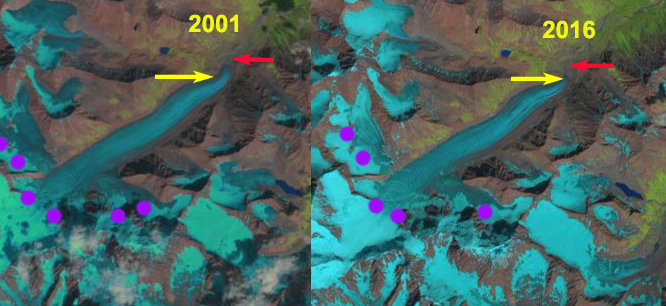
Mensu Glacier, Siberia Russia Retreat 1994-2016

Mensu Glacier, Russia in comparison of 1994 and 2016 Landsat images.  Red arrow is the 1994 terminus, yellow arrow 2016 terminus, purple arrow a tributary and purple dots the snowline. 

Mensu Glacier (Lednik Mensu) drains northeast from Gora Belukha in the Russian Altai.  The glacier drains into the Ob River and then the Arctic Ocean.  This glacier has not been the focus of detailed research to date. Khromova et al (2014) report that at the end of the century the glacier degradation in Russian mountain ranges strengthened including glacier area loss of 13% in the Tien Shan, 19% in the Altai and 22.3% in the Polar Urals.  The icecap draining west from Gora Belukha was cored to look at longer term climate records (Fujita et al 2004).  The core at 4500 m is high enough so that significant melt events affecting the record were rare. Shahgedanova et al (2010) noted that the retreat has largely been driven by summer warming. 

In 1994 the glacier terminates at the red arrow at 2150 m.  The glacier has an icefall from 3200 m to 2700 m that generates annual ogives, note Google Earth image below. The snowline in the 1994 Landsat  image averages 3000 m.  There is a tributary joining the main glacier at the purple arrow.  A neighboring glacier terminates in a proglacial lake at the orange arrow.  By 2001 the glacier has retreated and the snowline is at 3100 m. By 2016 the glacier terminates at 2200 m and has retreated 600  m to the yellow arrow.  The tributary at the purple arrow has separated from the main glacier.  This illustrates substantial glacier thinning  6 km above the terminus. The glacier at the orange arrow  no longer reaches the proglacial lake. In August 2016 below the snowline is at 3100 m in September 2016 the snowline has descended to 2800 m.  The lowest 800 m of the glacier has few crevasses, appears stagnant and will be lost to retreat.

Retreat is similar to the nearby Potanin Glacier, Mongolia. 

Mensu Glacier, Russia in comparison of 2001 and 2016 Landsat images.  Red arrow is the 1994 terminus, yellow arrow 2016 terminus, purple arrow a tributary and purple dots the snowline. 

Google Earth image indicating the snowline at the top of the icefall and the ogives beginning at the bottom near the orange arrow.


Terminus of Mensu Glacier in 2013 note lack of crevassing.

Lednikovoye Glaciers, Novaya Zemlya 1999-2016 retreat

lenikovoye compare

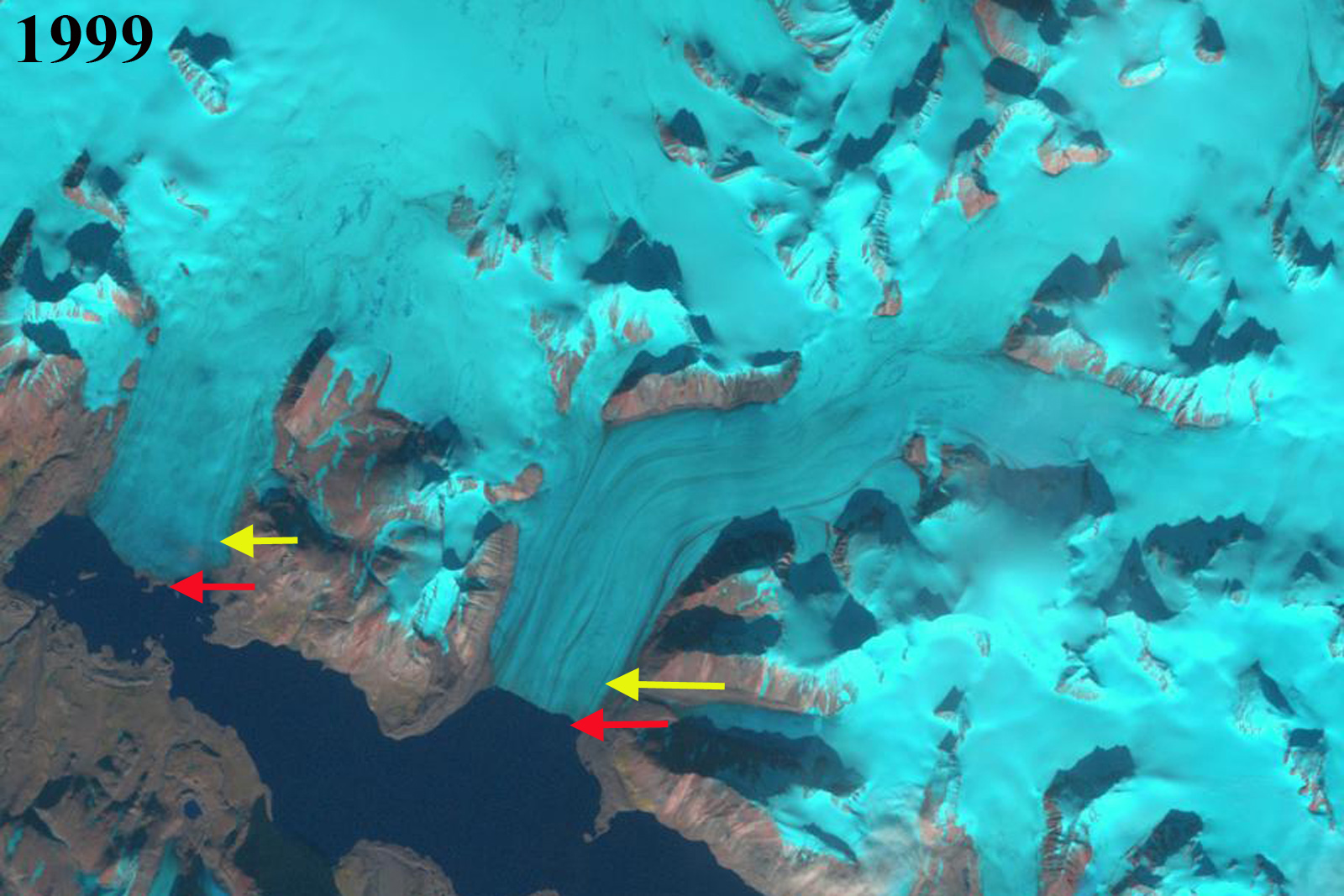
Comparison of glaciers terminating in Lednikovoye Lake in central Svalbard in 2000 and 2016. Red arrow is the 2000 terminus location and yellow arrows the 2016 terminus location.

Lednikovoye Lake in central Novaya Zemlya has four glaciers terminating in it. Here we examine the two unnamed glaciers that discharge into the northwest portion of the lake. The glaciers are retreating like all tidewater glaciers in northern Novaya Zemlya, though they are not specifically tidewater (LEGOS, 2006). LEGOS (2006) identified a 2.7 square kilometer reduction in area of the two glaciers from 1990-2000.  Carr et al (2014) identified an average retreat rate of 52 meters/year for tidewater glaciers on Novaya Zemlya from 1992 to 2010 and 5 meters/year for land terminating glaciers.Here we use Landsat images to examine changes from 1999 to 2016.

In 1999 and 2000 the western Lednikovoye Glacier ended on an island, the eastern Lednikovoye Glacier extended past the exit of a glacier filled valley entering from the east.  By 2016 the western terminus had retreated 800 meters from the newly developed island.  The eastern terminus had retreated a similar amount now ending near the center of the valley entering on the east.  The glacier in that eastern valley has retreated 600 m from 1999 to 2016. The snowline in 2000 and 2016 is at ~500 m, with a significant remaining accumulation zone.  There is limited upglacier thinning suggesting that retreat will not become rapid.  The reduced rate of retreat of the Lednikovoye Glacier’s versus tidewater glacier of Novaya Zemlya suggests the importance of both sea ice reduction and sea surface temperature increase to the retreat rate of the latter such as Krayniy Glacier, Tasija Glacier and Chernysheva Glacier.

ledknikovoye 1999

lednikovoye 2015

Kronotsky Peninsula, Kamchatka Glacier Fragmentation/Retreat

kamtchatka ge

The Kronotsky Peninsula is on the east coast of Kamchatka and has an small concentration of alpine glaciers.  A recent paper by Lynch et al (2016) indicates a significant recession during the start of the 21st century in Kamchatka.  They note a 24% loss in area, leading to fragmentation and an increase in the number of ice masses that could be considered glaciers.  Lynch et al (2016)  further note that the primary climate change has been a recent significant rise in summer temperature.  It is interesting how few and small the glaciers are in Kamchatka versus similar latitudes of Alaska.

kronotsky compare

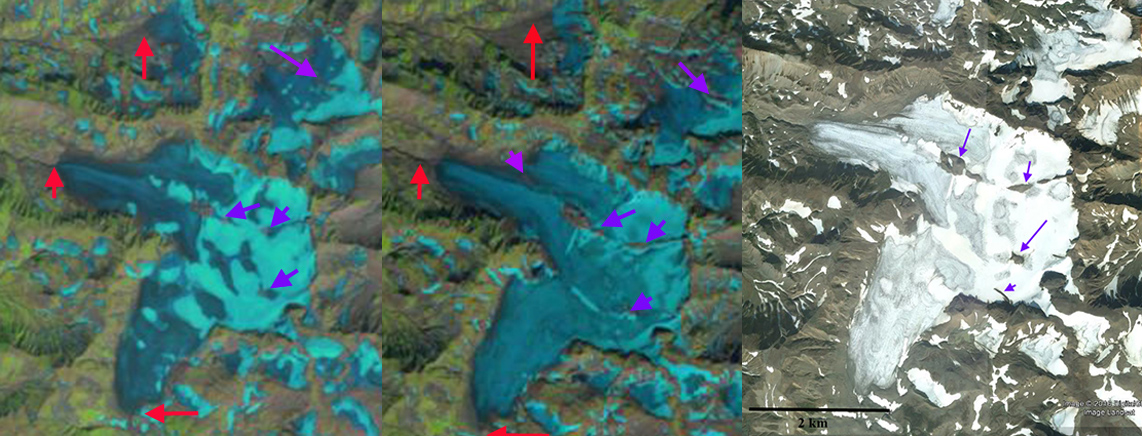
The red arrows indicate the 2000 terminus position.  Purple arrows indicate areas of bedrock expansion within the 2000 glacier region.  Google Earth image is same 2013 image. 

A comparison of 2000 and 2015 Landsat images indicates the retreat of several glaciers and the expansion of bedrock glaciers within the previous accumulation zone areas. The snowcovered area in Sept. of 2000 is 35%, in Sept. 2015 the snowcovered area is 15%.  Summer temperature anomalies for Kamchatka have been high in June and July of 2016 (NOAA, 2016).  The result is that in August, 2016 despite the cloud cover it is evident that snowcover is less than 10% with time left in the melt season. September is one of the least cloudy months and if better imagery becomes available I will update this image here. The elevation of the glaciers is 2400-3700 m, relatively high. The termini of all three glaciers have retreated 200-400 m, which given the short time span and small size of the glaciers is significant. The lack of retained snowcover in recent years indicates that these glaciers lack a persistent accumulation zone and cannot survive (Pelto, 2010). A closeup of the terminus of the glaciers indicate all have low slopes, limited crevassing, and are poised more further retreat.  Of the three termini the southern one indicates a recsssional moraine set (R). The western glacier concentric crevasses that indicate subsidence of terminus area (C).  The northern glacier has significant supraglacial stream channels that took multiple years to develop, indicative of limited development (B).

kamchatka 2016

2016 Landsat image of Krontosky Peninsula Glaciers

[ngg_images source=”galleries” container_ids=”34″ display_type=”photocrati-nextgen_basic_imagebrowser” ajax_pagination=”1″ template=”/nas/wp/www/sites/blogsorg/wp-content/plugins/nextgen-gallery/products/photocrati_nextgen/modules/ngglegacy/view/imagebrowser-caption.php” order_by=”sortorder” order_direction=”ASC” returns=”included” maximum_entity_count=”500″]