Ryan Glacier, South Georgia Retreats from Tidewater

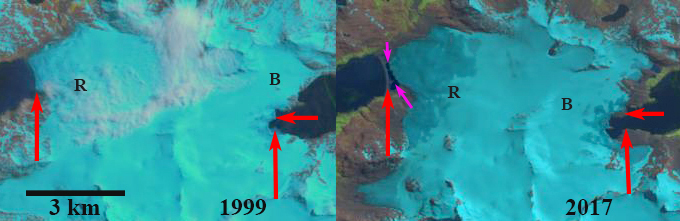
Ryan (R) and Brunonia Glacier (B) in 1999 and 2016 Landsat images.  Red arrows indicate the 1999 terminus and pink arrows a new proglacial lake. 

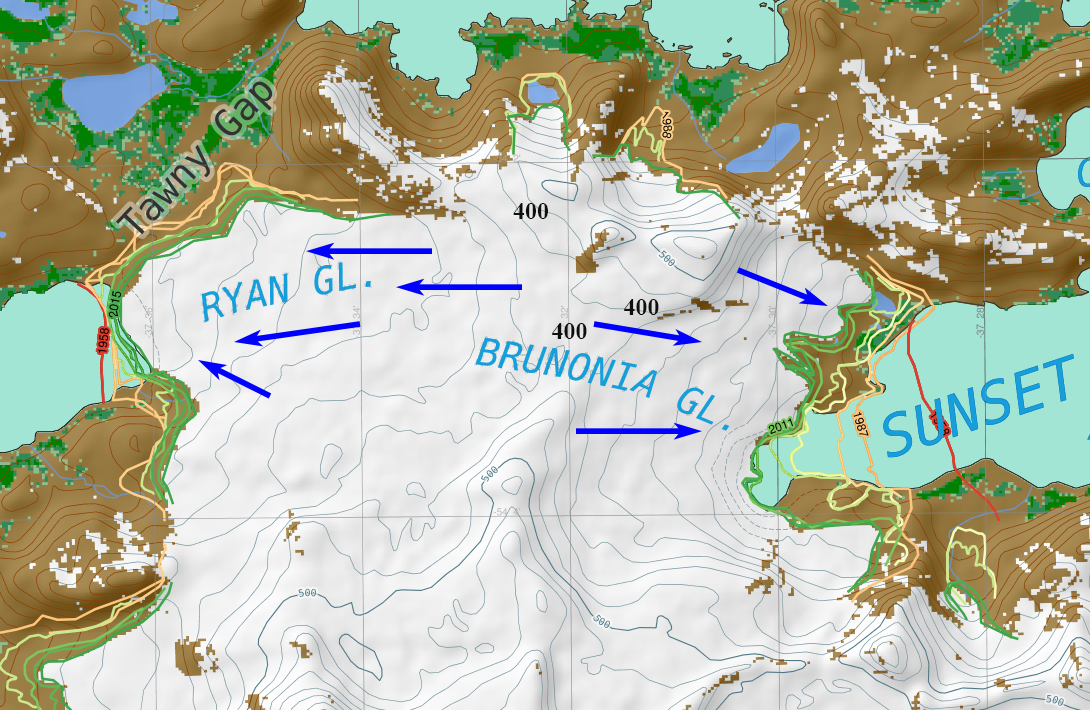
Ryan Glacier and Bunonia Glacier span the width of South Georgia near its northwestern tip.  Brunonia Glacier flow east and terminates in Sunset Fjord and Ryan Glacier flows to the west into Ice Fjord, which seems more viable as a “Sunset” Fjord.  The glacier divide is a very low 400 m.  The British Antarctic Survey (BAS) has generated an excellent online map of South Georgia that includes many layers including glacier frontal change since 1958 in this region.  BAS work by Cook et al (2010) and Gordon et al (2008) have emphasized that there is a island wide pattern of calving glaciers having faster retreat.  Gordon et al., (2008) observed that larger tidewater and calving outlet glaciers generally remained in relatively advanced positions from the 1950’s until the 1980’s. After 1980 most glaciers receded; some of these retreats have been dramatic a such as Hindle and Neumayer.   Here we examine 1999-2016 Landsat imagery to identify glacier change. 

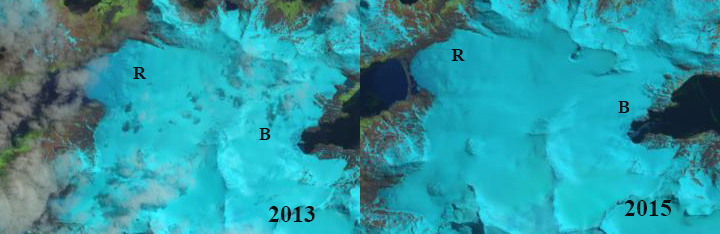
In 1999 Ryan Glacier reaches tidewater across a 1.2 km glacier front.  Brunonia Glacier terminates in Sunset Fjord pinned on what is a bedrock prominence under the ice. In 2013 and 2015 Landsat imagery from early in the melt season indicates the melt zone is below 200 m. In 2015 it is evident that Ryan Glacier no longer reaches tidewater.  In 2016 Ryan Glacier is separated from Ice Fjord by a barrier beach and a narrow developing proglacial lake, pink arrow.  The glacier has retreated 200 m since 1999.  Brunonia Glacier has experienced a 400 m retreat exposing 2 new peninsulas.  The first is on the north side of the fjord and the other is mid glacier. Both had been under the ice in 1999. The snowline in 2016 on Ryan Glacier is also higher reaching 250 m in mid-February.  Retreat of Ryan Glacier from 1958 to 1999 was 100 m, while the retreat on Brunonia in the same period was 700-800 m.

British Antarctic Survey map of frontal change 1958-2015.

Ryan and Brunonia Glacier in 2013 and 2015 Landsat images. The 2015 image indicates Ryan Glacier is no longer tidewater. 


Hindle Glacier Rapid Retreat Continues, South Georgia

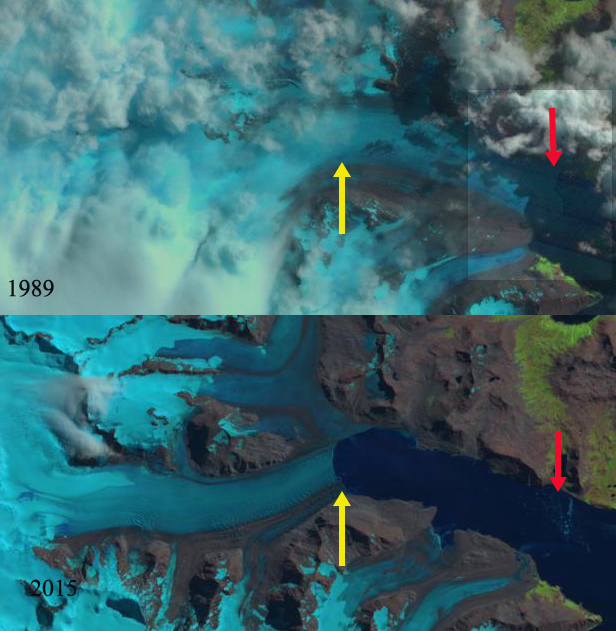
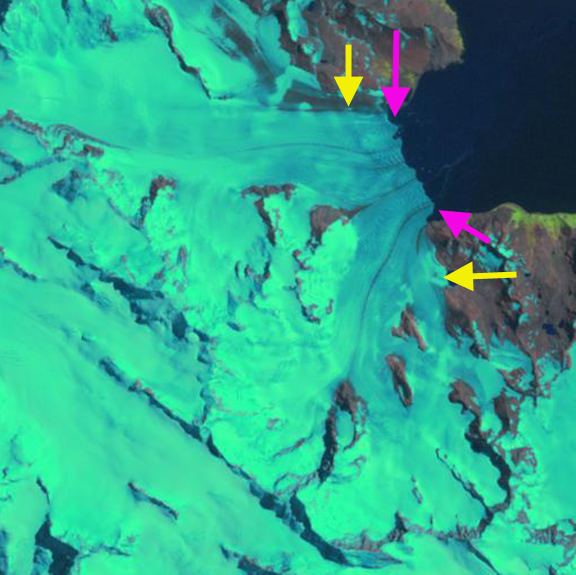
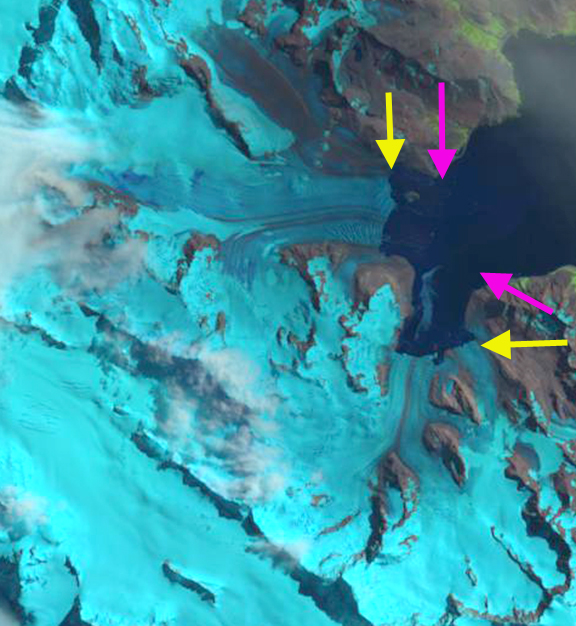
Hindle Glacier comparison in 1989, 2015 and 2017 Landsat images.  Red arrow is 1989 terminus, pink arrow the 2015 terminus and red arrow the 2017 terminus location. 

South Georgia is south of the Polar Front preventing any truly warm season from persisting. The cool maritime climate leads to numerous glaciers covering a majority of the island and quite low equilibrium line altitudes.  Hindle Glacier enters Royal Bay on the east coast of South Georgia Island.  The British Antarctic Survey (BAS) has been the principal research group examining glacier change on South Georgia Island.  Cook et al (2010) and Gordon et al (2008) have emphasized that there is a pattern island wide with many calving glaciers having faster retreat.  Gordon et al., (2008) observed that larger tidewater and calving outlet glaciers generally remained in relatively advanced positions from the 1950’s until the 1980s. After 1980 most glaciers receded; some of these retreats have been dramatic and a number of small mountain glaciers will soon disappear.   The change in glacier termini position have been documented by Alison Cook at British Antarctic Survey in a BAS retreat map, she identified that 212 of the Peninsula’s 244 marine glaciers have retreated over the past 50 years and rates of retreat are increasing.   Here we examine Landsat imagery from 1989 to 2017 to identify the rapid retreat rate. NASA Earth has piggy backed on this assessment, with excellent imagery.

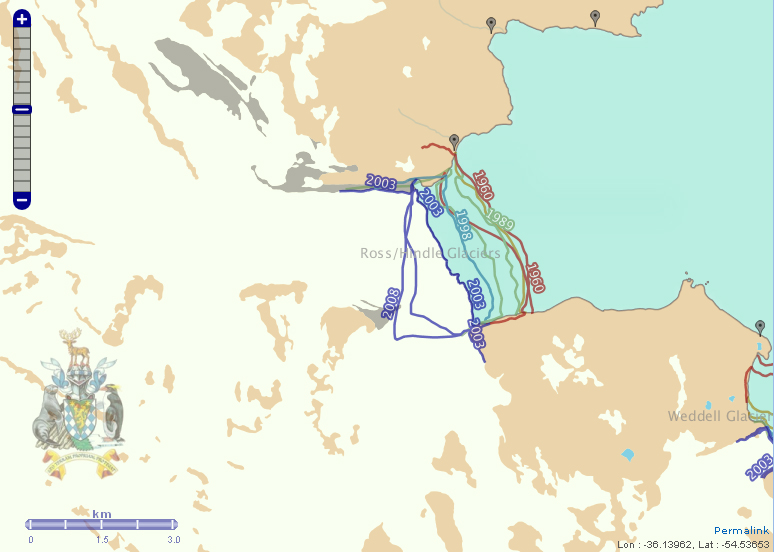
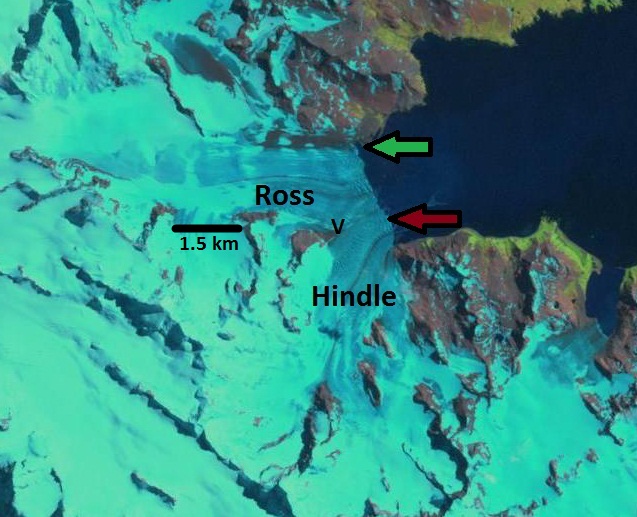
For Ross-Hindle the retreat was minimal from 1960 to 1989 with the glaciers joined   In 1989 the glaciers joined 2.5  km from the terminus. The glacier spanned Royal Bay with a 3.2 km wide calving front.  By 2002 the glacier front had retreated 800 m, but they were still joined. By 2008 the glaciers had separated due to an additional retreat of  1.4 km. The front was now retreating south up a separate embayment from Ross Glacier.  The calving front in 2008 was 1.6 km wide.  By 2015 further retreat led to the separation of Hindle from an eastern Tributary at the first prominent headland in the fjord, a 1.6 km retreat in seven years.  By 2017 an additional 600 m of retreat had occurred with total retreat of  4.4 km in 28 years.  This is a rate of over 150 m/year, which is an exceptional rate.  The exceptional retreat rate of Hindle Glacier suggests that Ross Glacier acted as a pinning point stabilizing the terminus reach of the glacier.  The low surface slopes in 2017 for the lowest 3 km of the glacier suggest the fjord head is at least 3 km south of the present terminus and  the calving retreat will continue until the head of the fjord is reached. This location is close to the origin of the medial moraine that runs right to the glacier front currently. This embayment will open up new areas for Gentoo Penguins and elephant seals to immigrate into.  Levy et al (2016) discuss the shift and dispersal of colonies in the region, that climate change is an important driver of.

Map of terminus retreat of Ross and Hindle Glacier from the BAS.  Green Pin Locations are Gentoo Penguin colonies. 

2002 Landsat image of Hindle Glacier.  Red arrow is 1989 terminus and yellow arrow the 2017 terminus location. 

Hindle Glacier 2016 Landsat image.  Red arrow is 1989 terminus and red arrow the 2017 terminus location. 

Location of South Georgia versus atmospheric and ocean circulation features (From South Georgia Future Science). 

Neumayer Glacier, South Georgia, 5.6 km retreat 1999-2016


neumayer 2016

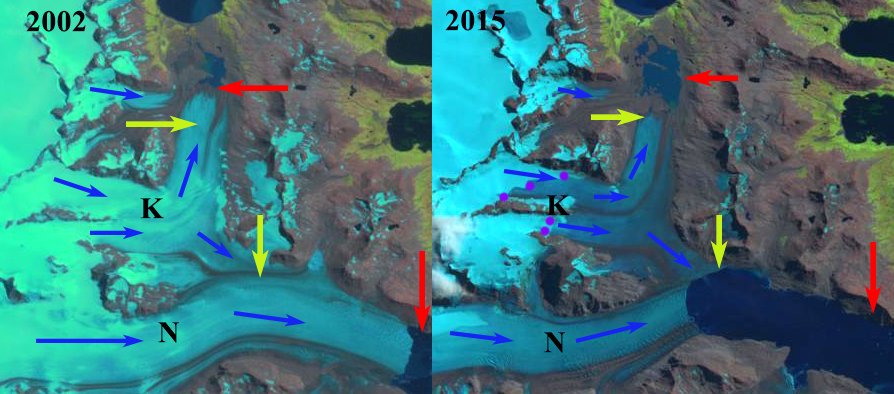
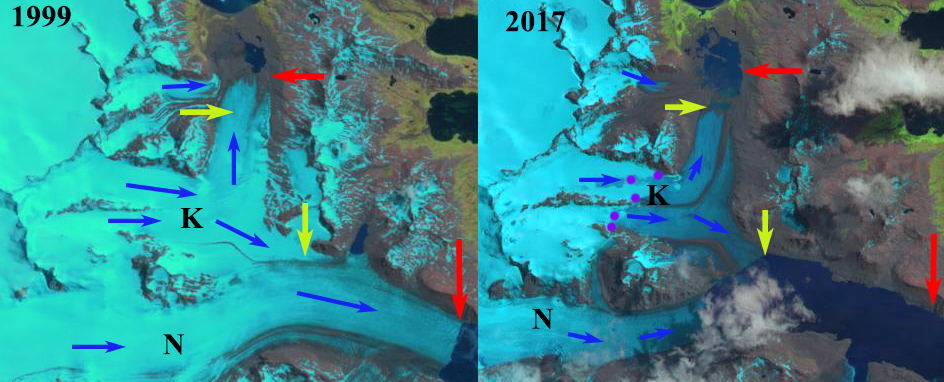
Comparison of Neumayer Glacier in 1999 and 2016 Landsat images; red arrow indicates 1999 terminus locations, yellow arrows 2016 terminus locations. Purple arrows indicate upglacier thinning.

South Georgia sits amidst the circum Antarctic westerlies and its maritime climate leads to numerous glaciers. This region is famous for the endless march of storms parading around Antarctica . The island is south of the Antarctic Convergence, preventing any truly warm season from persisting. The cool glaciers covering a majority of the island and quite low equilibrium line altitudes. Neumayer Glacier is one of the largest tidewater glaciers on South Georgia. Sugden, Clapperton and Pelto (1989) noted the ELA of Neumayer Glacier at 550 m.

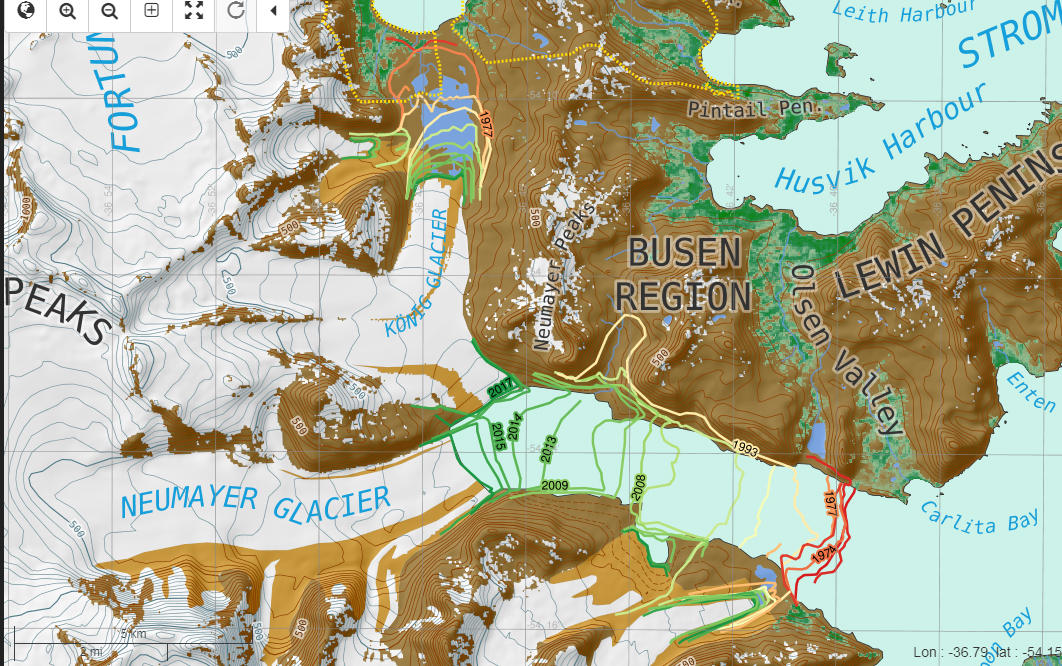
The BAS has a mapping function that provides glacier front positions since early in the 20th century. For Neumayer Glacier the 1938 position is 3.5 km down fjord from the 2006 position. There was essentially no retreat up to 1974 and limited retreat up to 1993. Gordon et al., (2008) observed that larger tidewater and sea-calving valley and outlet glaciers generally remained in relatively advanced positions until the 1980s. After 1980 most glaciers receded; some of these retreats have been dramatic.

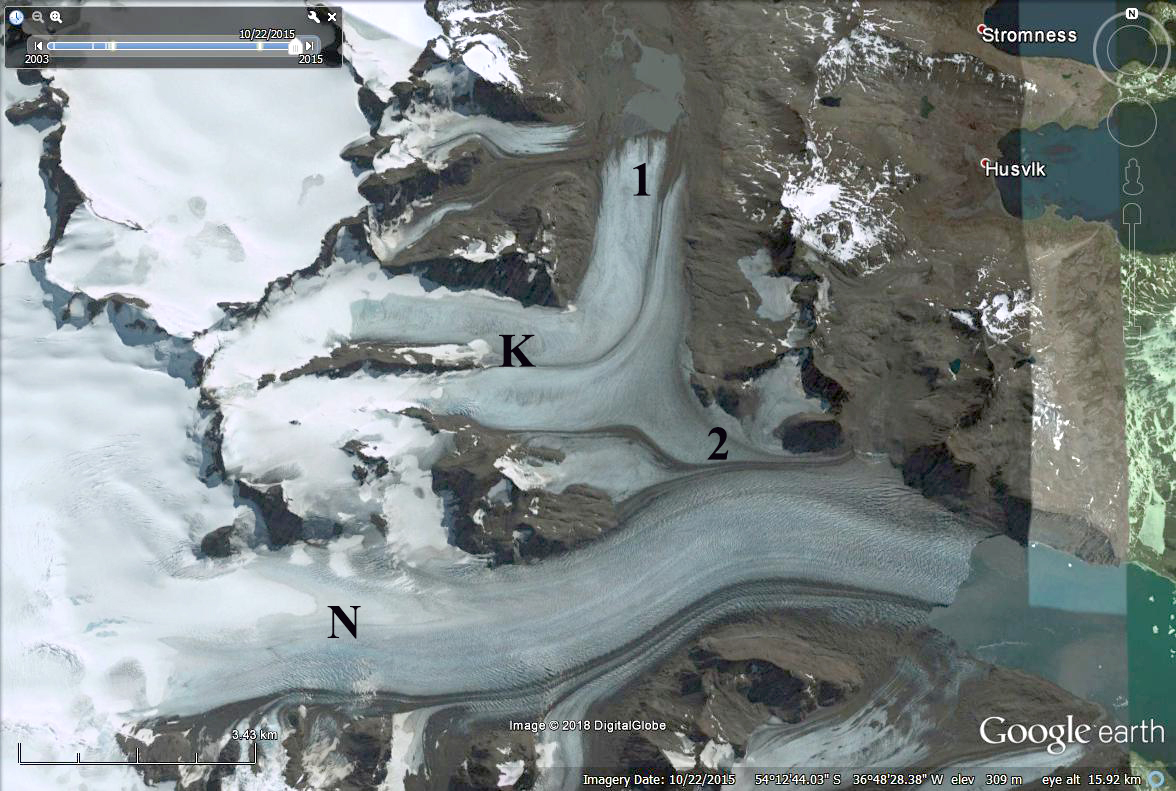
Landsat Images from 1999 to 2016 indicates retreat of 5600 m from the red to the yellow arrow, this is 350 m/year. A glacier dammed lake along the north shore of the fjord no longer exists in 2016. The glacier appears to have retreated into a deeper section of the fjord then where it ended from 1970-2002. The glacier is on the verge of separation into two main tributaries. This will enhance calving from the glacier, and promote additional mass loss and retreat. This retreat will impact Konig Glacier to the north, which is connected to the Neumayer Glacier. Below the comparison of terminus location from 1989 to 2015 indicates a retreat of 6700 m.  NASA Earth has piggy backed on this assessment, with excellent recent imagery. Calving rate increases with water depth.  Calving rate increases with water depth and the degree of glacier flotation. Flotation depends on water depth, ice thickness and the number of pinning points. Pelto and Warren (1991) provided an expanded version of the water depth/calving relationship first quantified by Brown and others (1982). In the you would have never guessed it category, is the glacier retreat has been an aid to the rat population, as the glacier tongues used to corner populations.

BAS Glacier front map

neumayer compare

Comparison of Neumayer Glacier in 1989 and 2015 Landsat images; red arrow indicates 1989 terminus locations, yellow arrows 2015 terminus locations.


Hindle Glacier, Accelerating Retreat, South Georgia

hindle 89-15

Landsat Image of Ross Hindle Glacier 1989 left and 2015 right.  Something changed.

South Georgia sits amidst the furious if not screaming fifties latitude belt, the circum Antarctic westerlies. This region is famous for the endless march of storms parading around Antarctica. The island is south of the Antarctic Convergence, preventing any truly warm season from persisting. The cool maritime climate leads to numerous glaciers covering a majority of the island and quite low equilibrium line altitudes.  Ross-Hindle Glacier enters Royal Bay on the east coast of South Georgia Island has now separated into the Ross and Hindle Glaciers. Hindle Glacier could do well  in a new international Olympic event, “Fastest Retreating Glacier” The tidewater glaciers of South Georgia in general maintained fairly advanced positions unitl 1980. Gordon et al., (2008) observed that larger tidewater and sea-calving valley and outlet glaciers generally remained in relatively advanced positions until the 1980s. For Ross-Hindle the retreat was minimal from 1960 to 1989. The change in glacier termini position have been documented by Alison Cook at British Antarctic Survey in a BAS retreat map.  By 2008 the glaciers had separated. Here we examine Landsat imagery from 1989 to 2015 to identify recent change.

hindle area2

Region of Hindle Glacier on South Georgia.

BAS map of glacier front change.

In 1989 the glacier extends to the green arrows with a joint terminus that is three kilometers long. This is quite close to the 1960 terminus location. By 2003 the glacier has retreated  800 m with the south side nearly reaching a Point where the Hindle Glacier turns south  By 2008 the glaciers have separated, with a further retreat  of 1.5 km along the southern margin of Ross Glacier and western margin of Hindle Glacier. Retreat is much less on the northern side of Ross Glacier and the eastern side of Hindle Glacier.  By 2015 a new fjord has opened, as Hindle Glacier retreats south 1.7 km on the east margin and 2.1 km on the west side in just seven years.Ross Glacier continues to retreat west with a retreat of 600-700 m since 2008.

In Google Earth by 2010 there is  added crevassing near the ice front of Hindle Glacier that indicates an acceleration of the glacier. This suggests the Ross Glacier was impeding its flow previously and that Hindle is in a rapid retreat mode.The rapid recent retreat parallels that of Neumayer Glacier and Twitcher Glacier during the 1989-2014 period. The BAS research effort on glacier front retreat has been documented by Alison Cook . Her comparison of glacier fronts from old aerial photographs and comparing them with satellite images — she identified that 212 of the Peninsula’s 244 marine glaciers have retreated over the past 50 years and that rates of retreat are increasing.

hindle 1989

1989 Landsat Image

ross hindle 2003

2003 Landsat Image


2008 Landsat Image

ross Hindle 2015

2015 Landsat Image