Index of posts 2009-Jan. 2012

Glacier Index List
Below is a list of the individual glacier posts examining our warming climates impact on each glacier. This represents the first 2.5 years of posts, 166 total posts, 152 different glaciers. I have worked directly on 39. The others are prompted by fine research that I had come across, cited in each post or inquiries from readers and other scientists. I then look at additional often more recent imagery to expand on that research. The imagery comes either from MODIS, Landsat, Geoeye or Google Earth.

North America
Columbia Glacier, Washington
Lyman Glacier, Washington
Boulder Glacier, Washington
Ptarmigan Ridge Glacier, Washington
Anderson Glacier, Washington
Milk Lake Glacier, Washington
Paradise Glacier, Washington
Easton Glacier, Washington
Redoubt Glacier, Washington
Honeycomb Glacier, Washington
Vista Glacier, Washington
Rainbow Glacier, Washington
Daniels Glacier, Washington
Colonial Glacier, Washington
Quien Sabe Glacier, Washington
Mazama Glacier
Fairchild Glacier, Washington
White Glacier, Washington
Banded Glacier, Washington
Borealis Glacier, Washington
Hinman Glacier, Washington
Lower Curtis Glacier
McAllister Glacier, Washington
Lewis Glacier, Washington
Kennedy Glacier, Washington
Bridge Glacier, British Columbia
Washmawapta Glacier, British Columbia
Bubagoo Glacier, British Columbia
Hector Glacier, Alberta
Helm Glacier, British Columbia
Melbern Glacier
Warren Glacier, British Columbia
Castle Creek Glacier, British Columbia
Hoboe Glacier, British Columbia
Tulsequah Glacier, British Columbia
Decker and Spearhead Glacier, British Columbia
Columbia Glacier, British Columbia
Freshfield Glacier, British Columbia
Apex Glacier, British Columbia
Devon Ice Cap, Nunavut
Penny ice Cap, Nunavut
Minor Glacier, Wyoming
Grasshopper Glacier, Wyoming
Fremont Glacier, Wyoming
Grasshopper Glacier, Montana
Harrison Glacier, Montana
Sperry Glacier, Montana
Hopper Glacier, Montana
Old Sun Glacier, Montana
Yakutat Glacier, Alaska
Grand Plateau Glacier, Alaska
Eagle Glacier, Alaska
Gilkey Glacier , Alaska
Gilkey Glacier ogives, Alaska
Lemon Creek Glacier, Alaska
Taku Glacier, Alaska
Bear Lake Glacier, Alaska
Chickamin Glacier, Alaska
Okpilak Glacier, Alaska
Sawyer Glacier, Alaska
Antler Glacier, Alaska
Field Glacier
East Taklanika Glacier, Alaska
Brady Glacier, Alaska
Brady Glacier Retreat lake expansion 2004-2010
Thiel Glacier, Alaska

New Zealand
Tasman Glacier
Murchison Glacier
Donne Glacier
Mueller Glacier, NZ
Gunn Glacier, NZ
Africa
Rwenzori Glaciers

Himalaya
Zemu Glacier, Sikkim
Theri Kang Glacier, Bhutan
Zemestan Glacier, Afghanistan
Khumbu Glacier, Nepal
Imja Glacier, Nepal
Gangotri Glacier, India
Milam Glacier, India
Satopanth Glacier, India
Kali Gandaki Headwaters, Nepal
Menlung Glacier, Tibet
Boshula Glaciers, Tibet
Urumquihe Glacier, Tibet
Sara Umaga Glacier, India
Dzhungharia Alatau, Kazakhstan
Petrov Glacier,Kyrgyzstan
Hailuogou Glacier, China

Europe
Mer de Glace, France
Dargentiere Glacier, France
Grand Motte and Pramort Glacier Tignes Ski area, France
Saint Sorlin, France
Sommelier Glacier
Obeeraar Glacier, Austria
Ochsentaler Glacier, Austria
Pitzal Glacier, Austria
Dosde Glacier, Italy
Maladeta Glacier, Spain
Presena Glacier, Italy
Triftgletscher, Switzerland
Rotmoosferner, Austria
Stubai Glacier, Austria
Ried Glacier, Switzerland
Cavagnoli Glacier, Switzerland
Chuebodengletscher and Ghiacciaio-del-Pizzo-Rotondo
Forni Glacier, Italy
Peridido Glacier, Spain
Engabreen, Norway
Midtdalsbreen, Norway
TungnaarJokull, Iceland
Gigjokull, Iceland
Skeidararjokull, Iceland
Kotlujokull, Iceland
Lednik Fytnargin, Russia
Rembesdalsskaka, Norway
Hansbreen, Svalbard
Nannbreen, Svalbard
Hornbreen and Hambergbreen, Svalbard
Roze and Sredniy Glacier, Novaya Zemyla
Irik Glacier, Mount Elbrus, Russia

Greenland
Mittivakkat Glacier
Ryder Glacier
Humboldt Glacier
Petermann Glacier
Kuussuup Sermia
Jakobshavn Isbrae
Umiamako Glacier
Kong Oscar, Glacier
Upernavik Glacier
Sortebrae Glacier, Greenland

South America
Colonia Glacier, Chile
Artesonraju Glacier, Peru
Nef Glacier, Chile
Tyndall Glacier, Chile
Zongo Glacier, Bolivia
Llaca Glacier, Peru
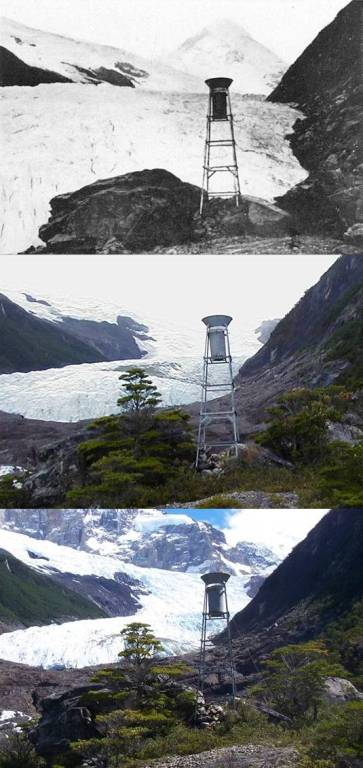
Seco Glacier, Argentina
Onelli Glacier, Argentina
Quelccaya Ice Cap, Peru
Glacier Gualas, Chile

Antarctica and Circum Antarctic Islands
Pine Island Glacier
Fleming Glacier
Hariot Glacier
Amsler Island
Stephenson Glacier, Heard Island
Neumayer, South Georgia
Ampere, Kerguelen
Nordenskjold Coast, Antarctic Peninsula
Prospect Glacier, Antarctic Peninsula
Ross Hindle Glacier, South Georgia
Vega Island Ice Cap

North Cascade Glacier Climate Project Reports

Forecasting Glacier Survival
North Cascade Glacier Mass Balance 2010
Columbia Glacier Annual Time Lapse
North Cascade Glacier Climate Project 2009 field season
28th Field Season Schedule of the North Cascade Glacier Climate Project
North Cascade Glacier Climate Project 2011 Field Season
BAMS 2010
2011 Glacier mass balance North Cascades and Juneau Icefield
Taku Glacier TSL Paper

Columbia Glacier Past, Present and Future

For the last 27 years the first week of August has found me on the Columbia Glacier in the North Cascades of Washington. Annual visit pictures up to 2008 can be seen at bottom of post.

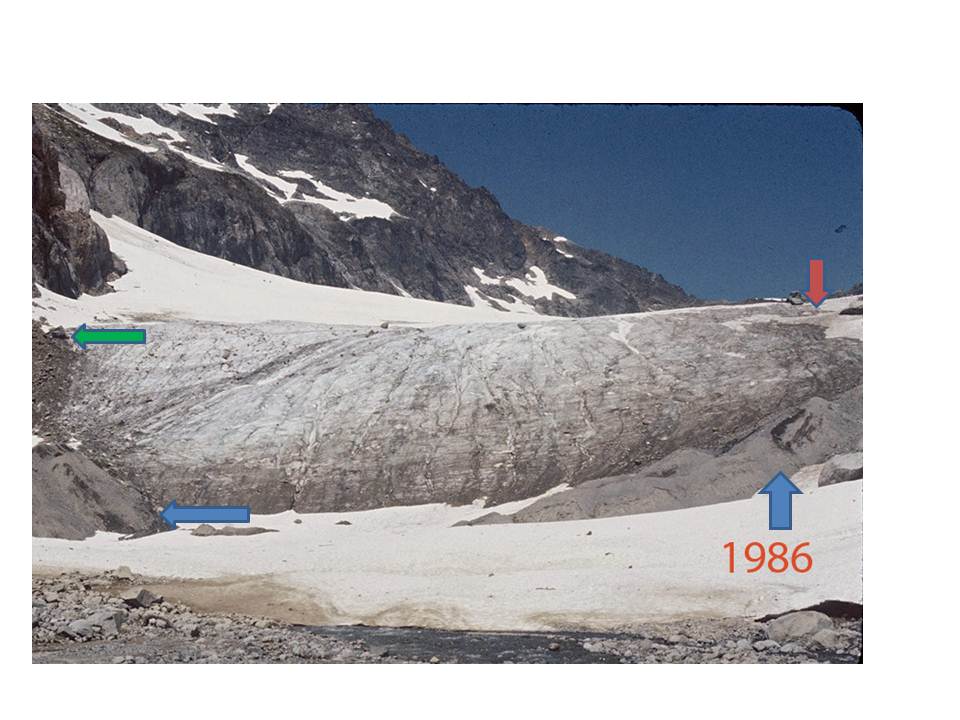
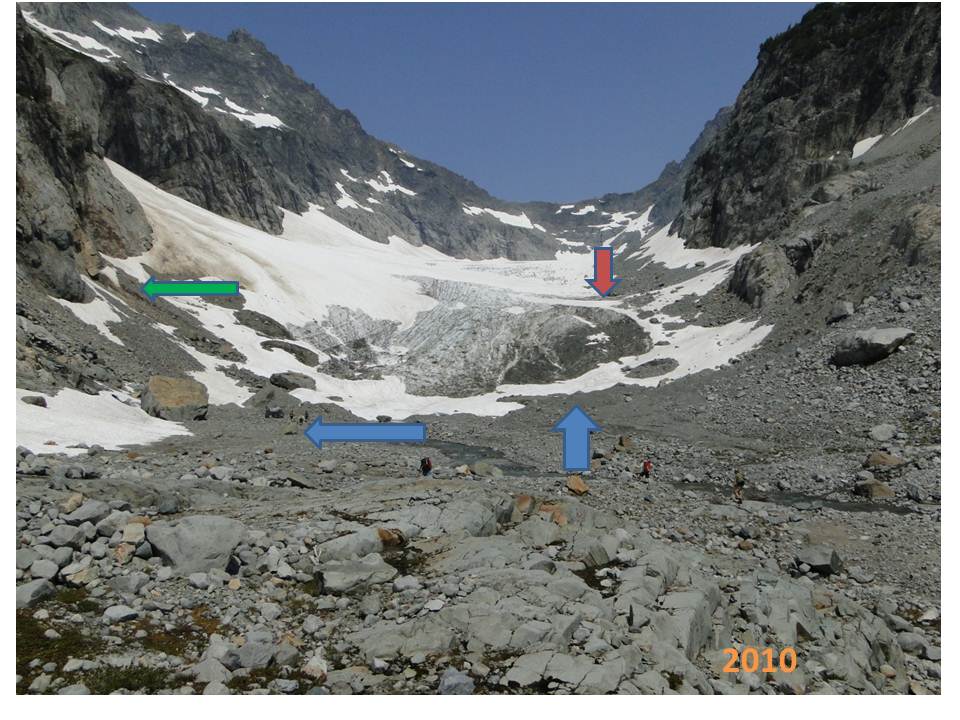
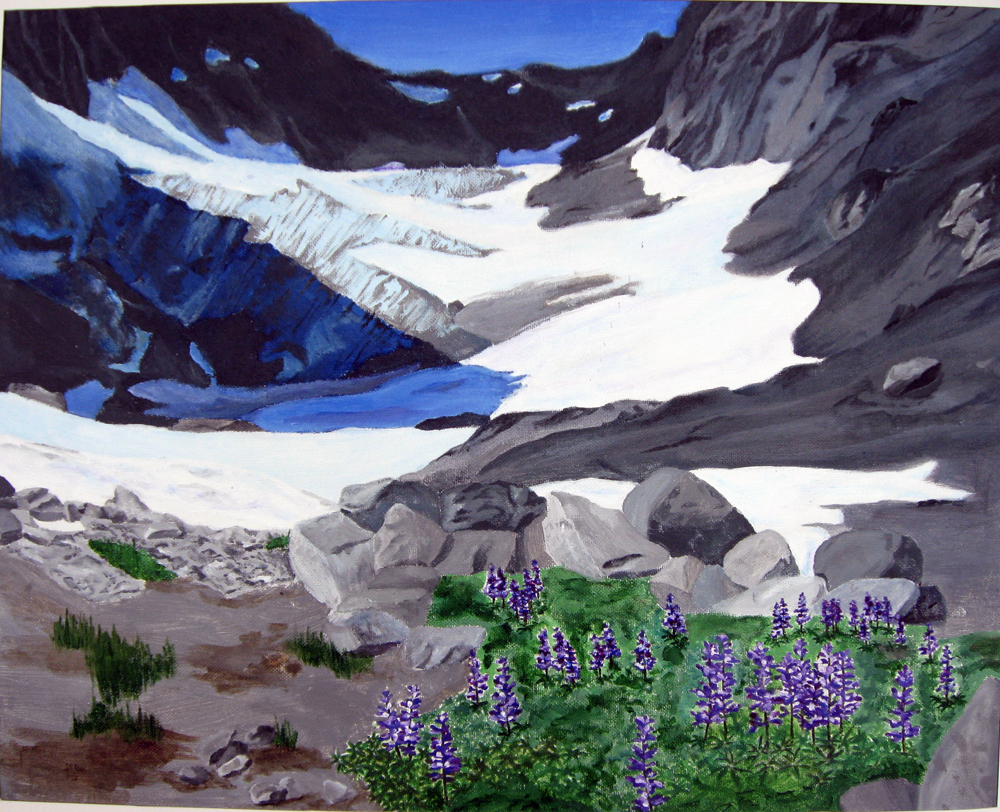
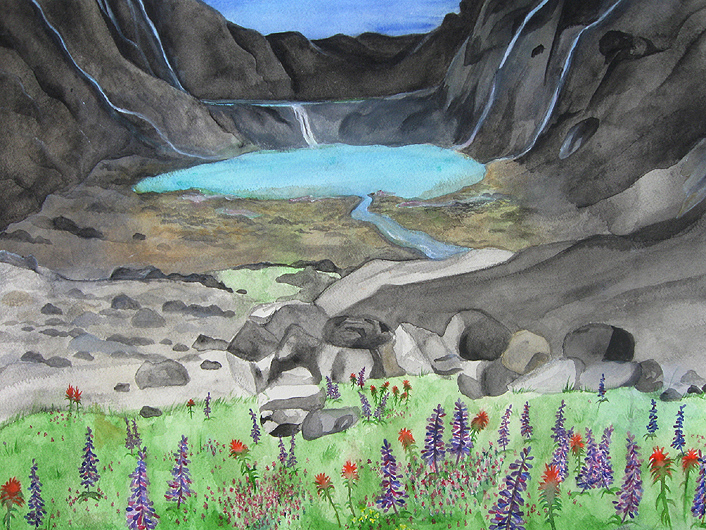
This is the lowest elevation large glacier in the North Cascades. Columbia Glacier occupies a deep cirque above Blanca Lake and ranging in altitude from 1400 meters to 1700 meters. Kyes, Monte Cristo and Columbia Peak surround the glacier with summits 700 meters above the glacier. The glacier is the beneficiary of heavy orographic lifting over the surrounding peaks, and heavy avalanching off the same peaks. Over the last twenty seven years the annual mass balance measurements indicate the glacier has lost 14 meters of thickness. Given the average thickness of the glacier of close to 75 meters in 1984 this represents a 20% loss in glacier volume. During the same period the glacier has retreated 135 meters, 8% of its length. Most of the loss of volume of this glacier has been through thinning not retreat. The glacier remains thick, but cannot survive current climate, which has left the glacier without any snowpack by the end of the summer in five of the last 10 years. This lack of persistence is the sign of a glacier than cannot survive. We can look at the past of the Milk Lake Glacier near Glacier Peak in 1988, 30 miles northeast of Columbia Glacier, and the present of Milk Lake without the glacier. The green arrow points to the forming lake filled with by both icebergs and the still evident glacier. The upper margin of the glacier is indicated by the red arrow. The lake in 2009 still is a nice jade green from glacier erosion. This lake will slowly become more azure in color as no new glacier sediment is added. In the same respect we can look at the past and present of Columbia Glacier comparing a 1986 and 2010 photograph. The blue arrows indicate moraines that the glacier was in contact with in 1986, and now are 100 meters from the glacier. The green arrow indicates the glacier active ice margin in 1986 and again that same location in 2007 now well off the glacier. The red arrow indicates the same location in terms of GPS measurements, this had been in the midst of the glacier near the top of the first main slope in 1986. In 2007 this location is at the edge of the glacier in a swale.. To look to the future Jill Pelto, (see marvelous destiny blog) my daughter painted the glacier as it was in 2009 (top) and then what the area would like without the glacier in the future, at least 50 years in the future (middle), and Jill at the sketching location (bottom), turned 180 degrees to view Blanca Lake. The lake is colored by the glacier flour from Columbia Glacier to the gorgeous shade of jade. Clearly the area will still be beautiful and we will gain two new alpine lakes with the loss of the glacier. After making over 200 measurements in 2010 we completed a mass balance map of the glacier. This summer we will be back again for the 28th annual checkup.
Presena Glacier Italy, Needs a Blanket

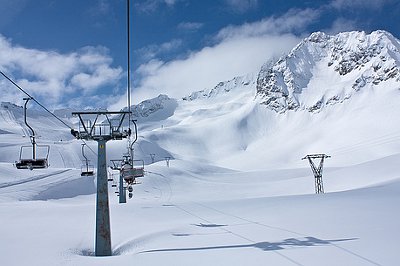
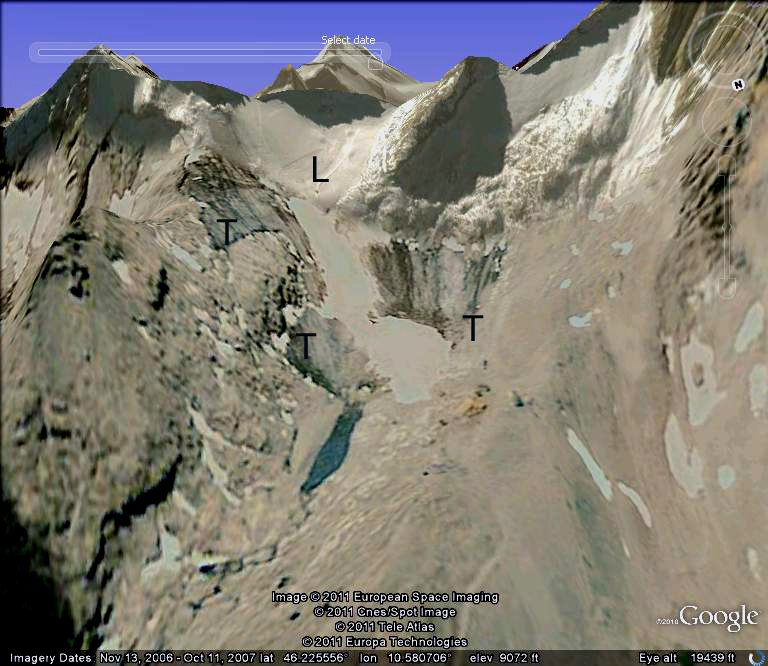
The Presena Ski Resort in Italy utilizes the Presena Glacier for its upper lifts and to extend its season. The warm summer of 2012 has been hard on this glacier. In 2008 this resort followed the example of Stubai, Austria and Les Arcs, France in utilizing an insulating blanket to reduce melting. Presena Glacier has lost a third of its volume since 1993. This led to adoption of wrapping the glacier in a 4 mm thick blanket of polypropylene matieral that in a test at the area reduced melt by 60%. The insulated blanket is apparent particularly along the lift in the image below. In 2012 the areas that were not protected by the blanket or groomed preferentially are evident as bare glacier ice. The insulating blanket is supposed to cover 90,000 square meters. The plan is to leave the blanket in place through the summer until mid-September. The entire glacier lost its snowcover in 2003 and 2005. The lower section of the glacier has separated into several thin sections that are rapidly melting away. In the photograph below the three separate terminus areas that are nearly completely detached from the upper glacier are noted with a T. The Lift (L) goes up the center of the upper glacier this area has lost its snowpack frequently as well by summer’s end in recent years. The Presena Glacier is responding to the warming climate in the same way as other Italian glaciers Forni Glacier and Dosde Glacier, and as the Italian Glacier Committee has noted observing that of glaciers observed in Italy in 2009 95 of the 111 glacier observed are retreating, 11 stationary and two advancing. The mass balance of Italian Glaciers in 2010 was again negative due to the high summer temperatures.

Seco Glacier Retreat in Southern Patagonia, Argentina

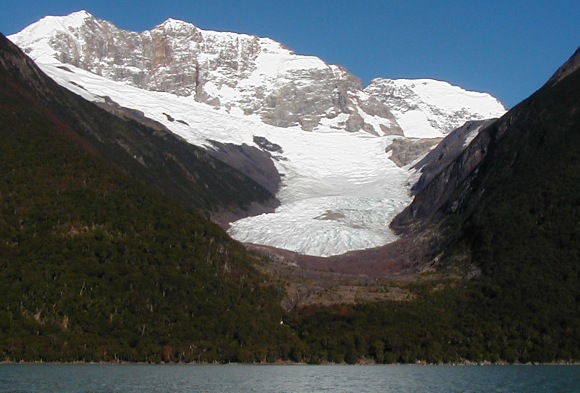
Seco Glacier descends magnificently towards Lago Argentina and is a site enjoyed by many visitors to the region from boats. A new website is being developed on the Glaciers of Argentina that features this view. The glacier has retreated 1050 meters in the last century exposing a still barren rock landscape. The terminus is still heavily crevassed indicating considerable movement at the tongue. The recently deglaciated terrain that extends one kilometer beyond the terminus abruptly ends in forest. A series of photographs from the Glaciers of Argentina indicate the retreat of this glacier from 1953 to 2009. Also note the development of vegetation around the precipitation gage. The rate of development of vegetation on newly deglaciated terrain is the ecesis rate. In a wet temperate climate such as this with seed sources simply uphill of the deglaciated terrain on the valley walls usually leads to incipient trees developing within 20 years of deglaciation. . The glacier front is still actively crevassed, indicating considerable flow, this is not a stagnant rapidly melting glacier tongue. The glacier ends at 450 meters, its top elevation is at 2300 meters. The snowline is at 1300 meters. In the images from 1953 to 2009 there is a rock outcrop in the upper right near the snowline that has expanded relatively little. This indicates that the accumulation zone at this elevation and above is maintaining its thickness. . This is a glacier that is retreating due to regional warming, but it not a glacier that is in danger of disappearing with current climate.

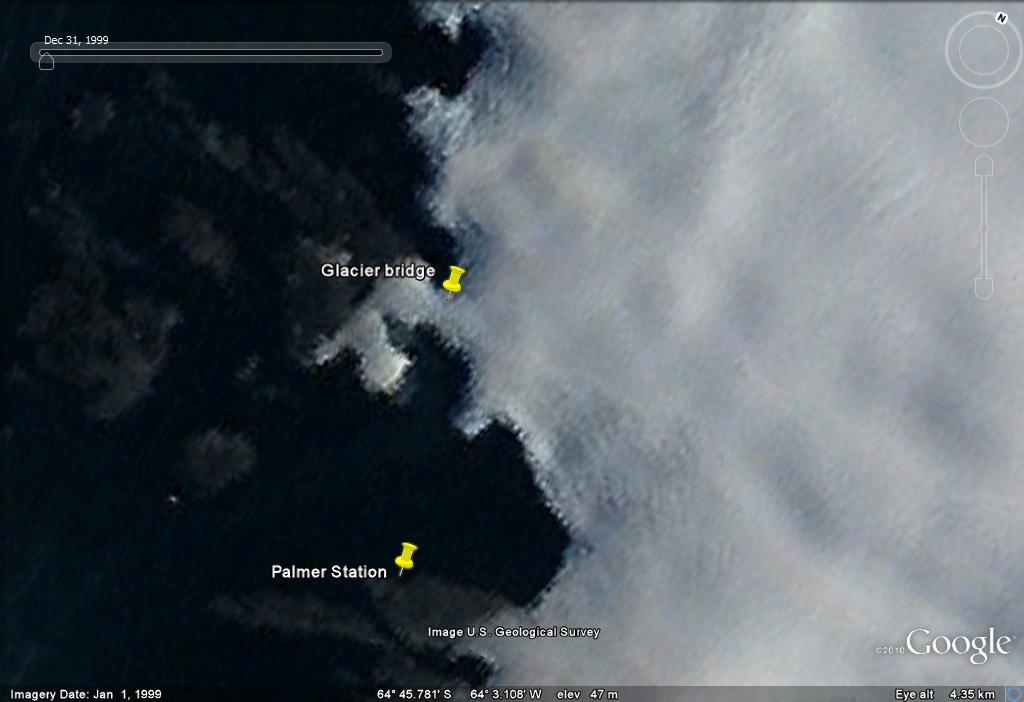
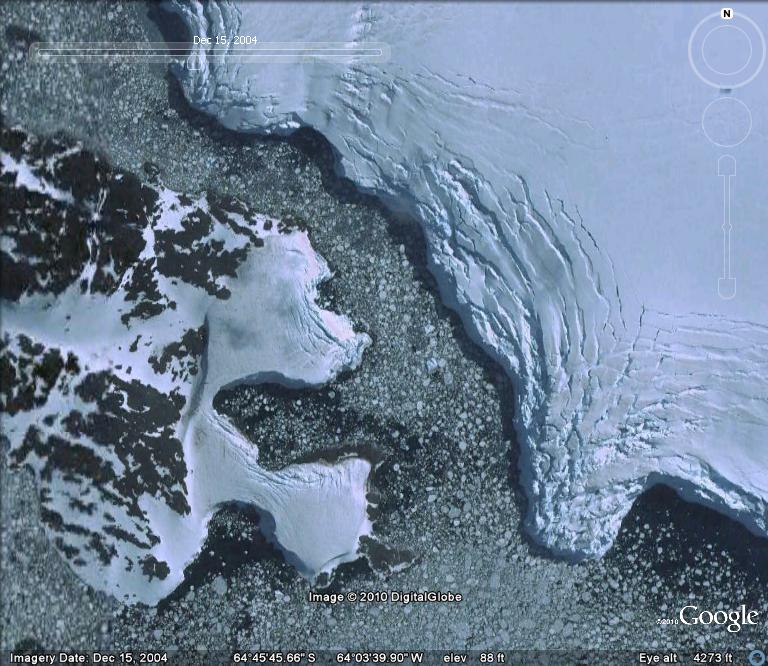
Glacier Retreat creates Amsler Island Palmer Station Antactica

In mountain ranges around the world glacier retreat is leading to the formation of new lakes. In the Antarctic and Greenland retreat is leading to the formation of some new islands. Palmer Station on Anvers Island just off the Antarctic Peninsula is largely surrounded by glaciers. It has been called ground zero for climate change. Hard to argue, except I have seen that term applied to many other locations, that are also hard to argue with. To the north of the base a new island formed in 2004. Amsler Island was named in 2007, it used to be just part of Norsel Point. Below is a 1999 image and a 2004 image from Google Earth. The channel now connects Arthur Harbor to Loudwater. The channel is now over 200 meters wide. The ice front is quite heavily crevassed. The crevasses indicate a terminus ice cliff that is not currently in a stable position and additional calving should lead to continued channel expansion. There are still a couple of small ice patches on Amsler. This change lacks the magnitude of those seen on Fleming Glacier.

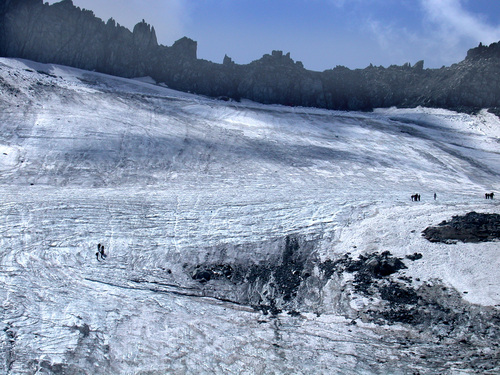
The Lower Curtis Glacier on Mount Shuksan advanced from 1950-1975 and has retreated 150 meters from 1987-2009. A longitudinal profile up the middle of the glacier indicates that it thinned 30 meters from 1908-1984 and 10 m from 1984-2008. Compare the 1908 image taken by Asahel Curtis (glacier named for him) in 1908 and our annual glacier shot in 2003. The thinning has been as large in the accumulation zone as at the terminus, indicating no point to which this glacier can retreat and achieve equilibrium with the present climate. However, the glacier is quite thick, and will take 50-100 years to melt away. This glacier is oriented to the south and fed by avalanches from the Upper Curtis Glacier and the southwestern flank of Mt. Shuksan. This allows it to survive in a deep cirque at just 5600 feet. Because of its heavy accumulation via avalanching the glacier moves rapidly and is quite crevassed at the terminus. Image below is a 2009 sideview, note the annual dark layers in the ice. The number of crevasses in the nearly flat main basin of the glacier has diminished as the glacier has thinned and slowed over the last 20 years. The glacier lost nearly all of its snowcover in several recent years 2005, 2006 and 2009. In one month we will back on this glacier investigating its mass balance and terminus position. It is a key glacier this year, as the winter was quite warm yet wet, spring was not. Thus, snowpack was much below average below 5000 feet and likely above average above 7000 feet, where the transition will be is the key. In the google earth images below Lower Curtis Glacier is in the left center. The terminus is exposed bare glacier ice and is heavily crevassed. Typically the terminus loses its snowcover in mid-June. Below the terminus there are frequent ice and rock falls, so it is best not to go below the terminus. For our measurements we need to, but we always finish by 9 am. .

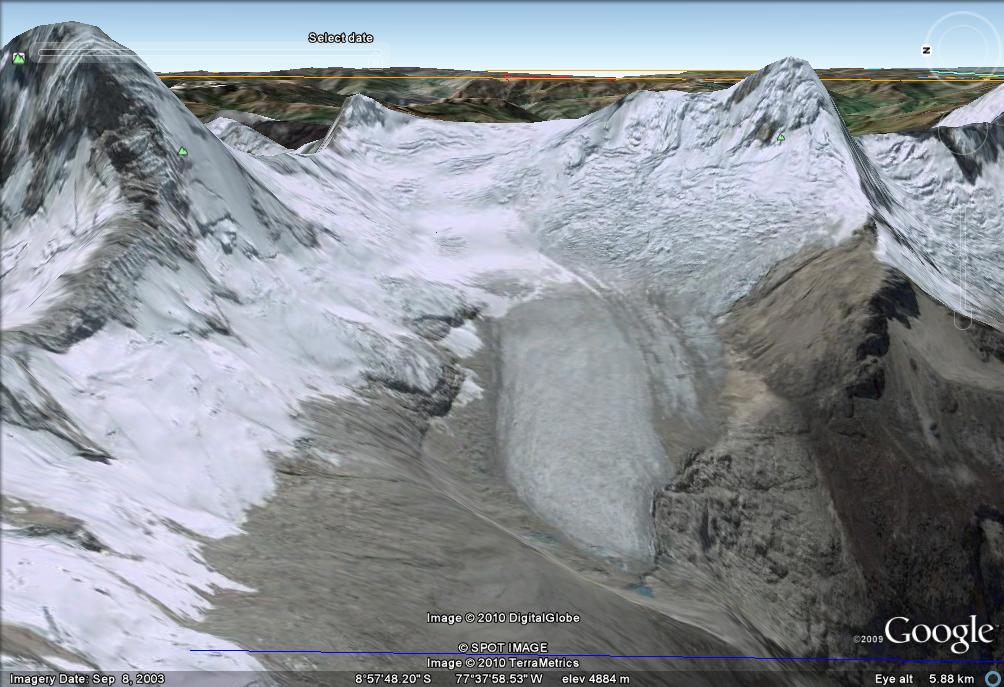
Impact of Artesonraju Glacier, Peru Retreat

Artesonraju Glacier is a 3.3 km long glacier in the Cordillera Blanca of Peru drains west from Nevado Artesonraju.Updated July 2015 at

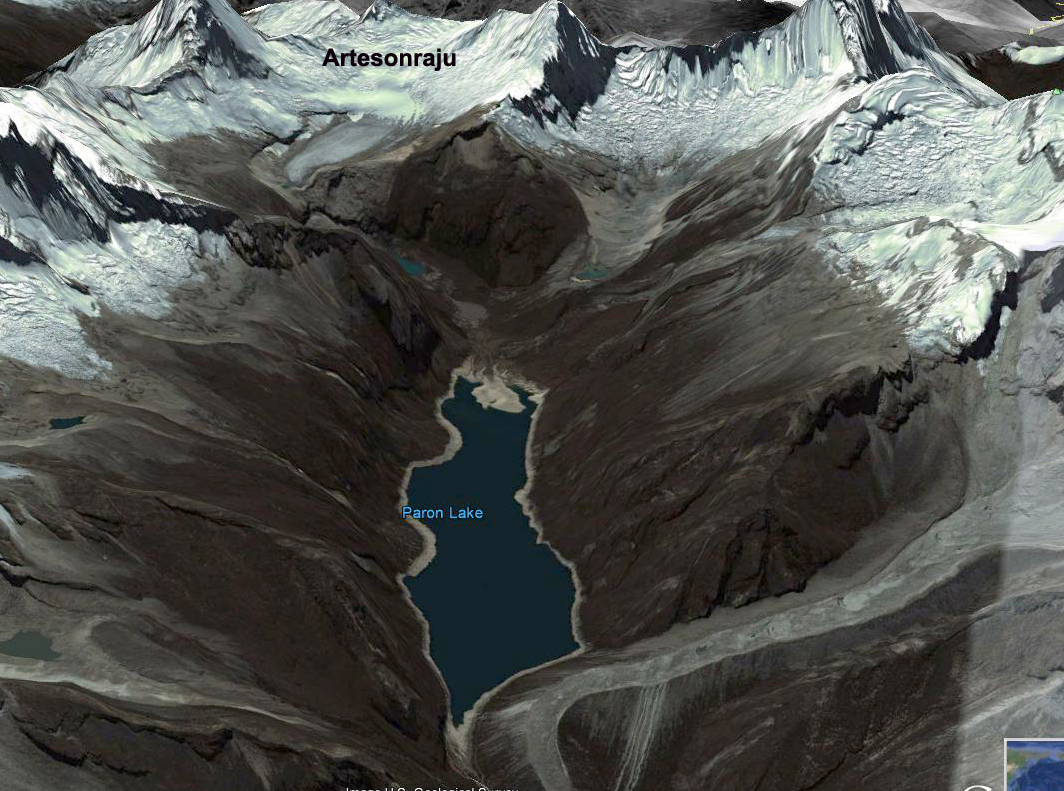
The glacier feeds both Lake Artesonraju, a new lake that formed after 1930 and Lago Paron. The two lakes are dammed by glacier moraines and together have posed a hazard of a glacier dammed lake outburst. In 1951 an outburst of water and alluvium traveled from the upper Artesonraju Lake into Lago Paron, raising the water level in Paron causing downstream flooding and concern about the strength of its moraine dam. artesonraju dam

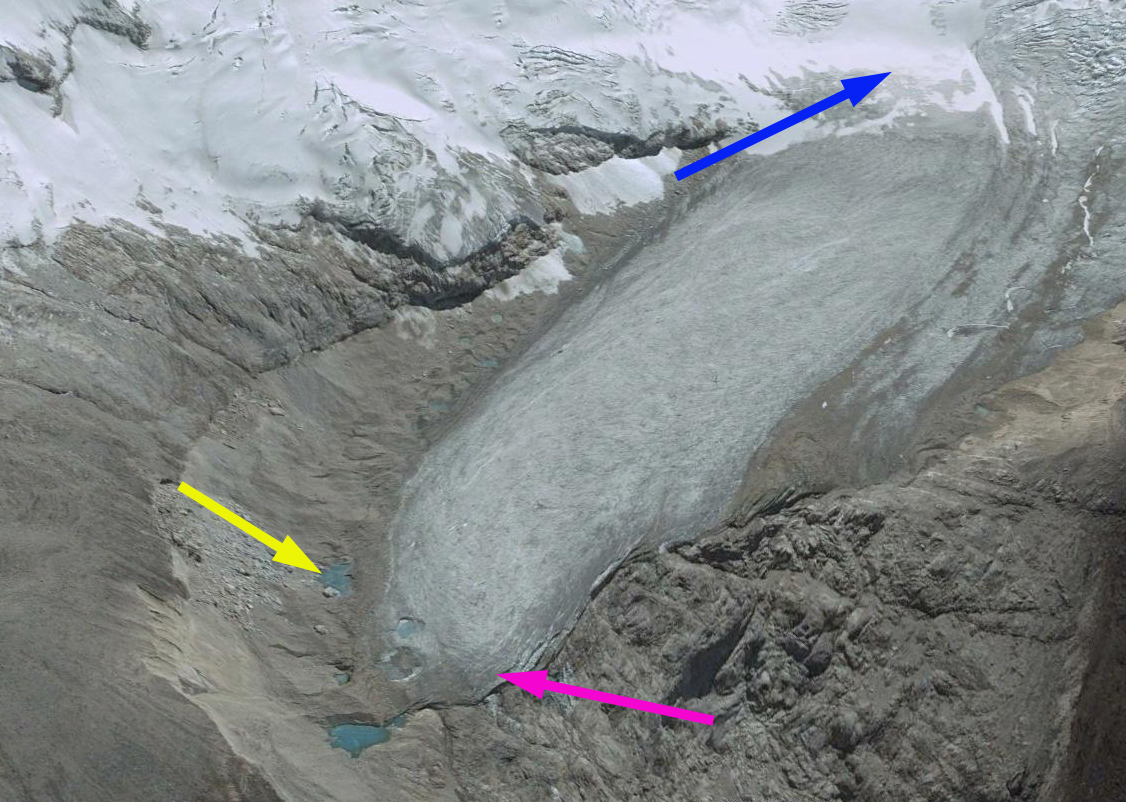
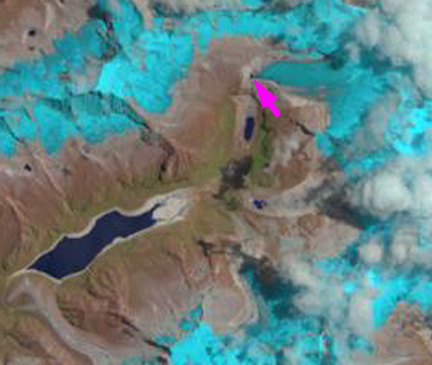
There are numerous moraine dammed lakes in Peru, the dams are just comprised of gravel, sand and clay dumped by the glacier. High water levels caused by upstream floods, avalanches or landslides can cause failure of these moraine dams and down stream flood damage prompted the Peruvian government to develop a strategy to address the problem. They began in the by building tunnels, concrete pipes, through the moraine to allow drainage to a safe level, they then rebuilt the moraine over the drainage system and strengthened it. Since development these systems have worked preventing serious flood issues from the lakes. At Lago Paron a hydropower project has been built that is fed by the tunnel drainage system and Lago Paron has been partially drained to service the hydropower facilities needs. The hydropower faility is owned by Egenor, owned largely by Duke Energy. The lake level has declined substantially by 2003 as the trimline indicates in the image above. This had led to a battle over water resources with local farmers. This Artesonraju Glacier that is the principal feeder to the two lakes retreated 1140 meters from 1932-1987 and by 2004 had retreated another 200 meters. From 2003 to 2013 the glacier continued to retreat and the terminus to narrow. An expanding lake at the terminus is evident in the Google Earth images of 2003 and 2012, pink arrow. A melt pond has also drained at the yellow arrow as the glacier thinned. In the 2013 Landsat image the terminus has further narrowed.
artesonraju 2003
2003 Google Earth image

artesonraju 2012
2012 Google Earth image

artesonraju 2013
2013 Landsat Image

This is 30% of its length gone in the last 75 years.The lower section of the glacier is flat, uncrevassed and is continuing to thin and melt. The upper reaches of the glacier are heavily crevassed indicating continued vigorous flow fed by healthy accumulation on the flanks of Nevado Artesonraju and Nevado Piramide. The equilibrium line of this glacier is at 5150 m, investigations by the Tropical Glaciology Group, Innsbruck, Austria and Hydrology Resources and Glaciology group in Huarez, Peru. In 2005, the surface on many parts of the flat tongue showed that sublimation is important to the mass balance when short wave radiation is limited, and short wave radiation dominates melting during the day.
A new book by Mark Carey, In the Shadow of Melting Glaciers, examines the history of the impact of these glaciers on Andes towns in the Cordillera Blanca.

Satopanth Glacier Retreat-Debris Cover and Hydropower

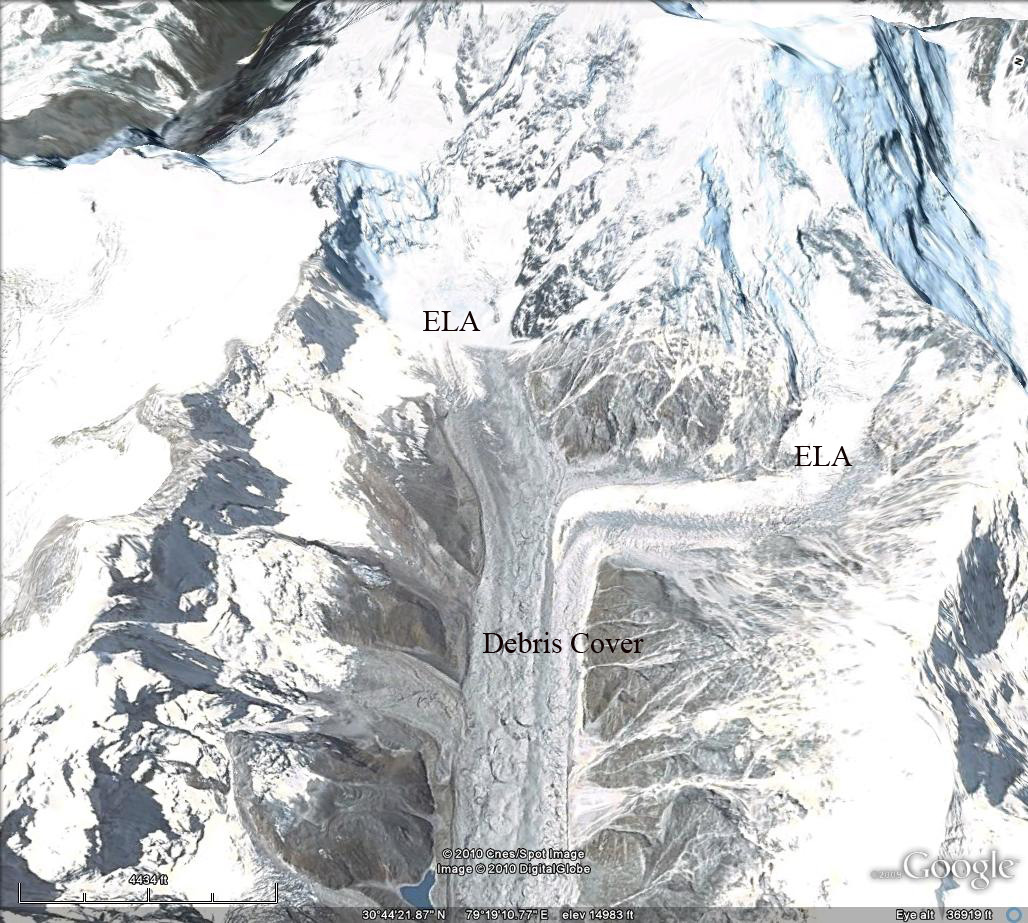
Satopanth and Bhagirath Kharak glaciers are located at the headwaters of the Alaknanda River, Uttarakhand, India. Satopanth glaciers has been assessed for the 1962-2006 period by Nainwal and others 2008 . This is accomplished through a comparsion of the 1962 Survey of India map and a total station survey completed in 2006 since 1962. Examination of satellite imagery indicates a retreat of 1900 meters from the Little Ice Age moraine that is evident. Satopanth Glacier has retreated continuously during this period. The total recession of the terminus which is at 3870 meters ranges from 1160 meters to 880 meters depending where on the glacier front retreat is measured, the average rate is reported as 22 meters per year (Nainwal and others, 2008), , for a total average retreat of 970 meters. The image of the terminus below is from the work of Nainwal and colleagues at Garhwal University.(Nainwal and others, 2008) . The glacier has an equilibrium line altitude of 4800 meters, below 4700 meters the glacier is dominantly debris covered, the mean elevation of the glacier is, above the ELA, at 4900 meters. This debris cover is thick enough to retard ablation and also prevent black carbon from enhancing ablation on this section of the glacier. This glacier has a similar behavior, but a more limited accumulation zone than Gangotri Glacier or Khumbu Glacier. The transition zone where the glacier is not debris covered and there is significant melting comprises 20% of the glacier. The remaining 30% of the glacier is in the dry snow zone, where melting is limited and hence black carbon again has a limited role. The recession of this glacier is slowed by the debris cover. An alpine glacier needs a minimum of 50% of its area to be in the accumulation zone to be in equilibrium, this glacier has 40% of its area in the accumulation zone, hence retreat will continue. The debris covered area is illustrated in the first image below, the ELA in the second image and the accumulation zone in the third image. It is apparent that the zone of melting (ablation) is significantly larger than the accumulation zone.Run of river hydropower projects to yield 140 MW have been proposed for the upper Alaknanda River basin. Satopanth Glacier will be a key contributor to this project.

Brady Glacier, Alaska begins a substantial retreat

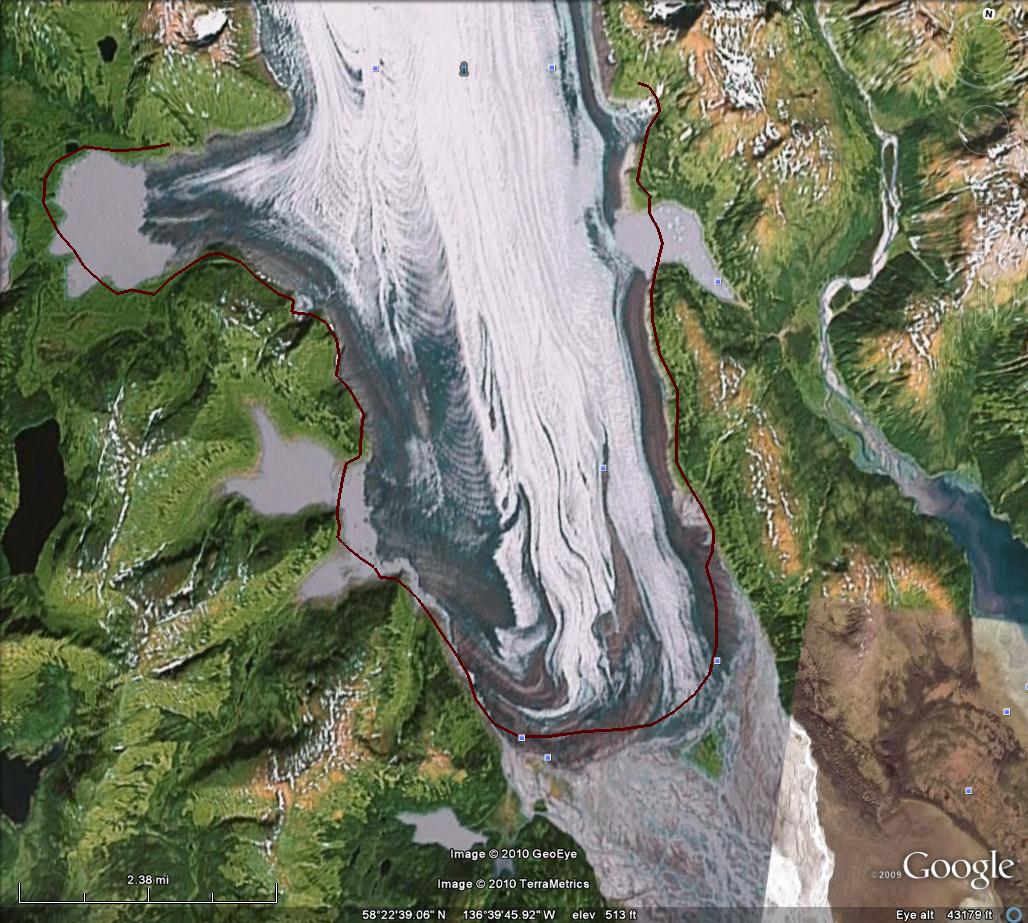
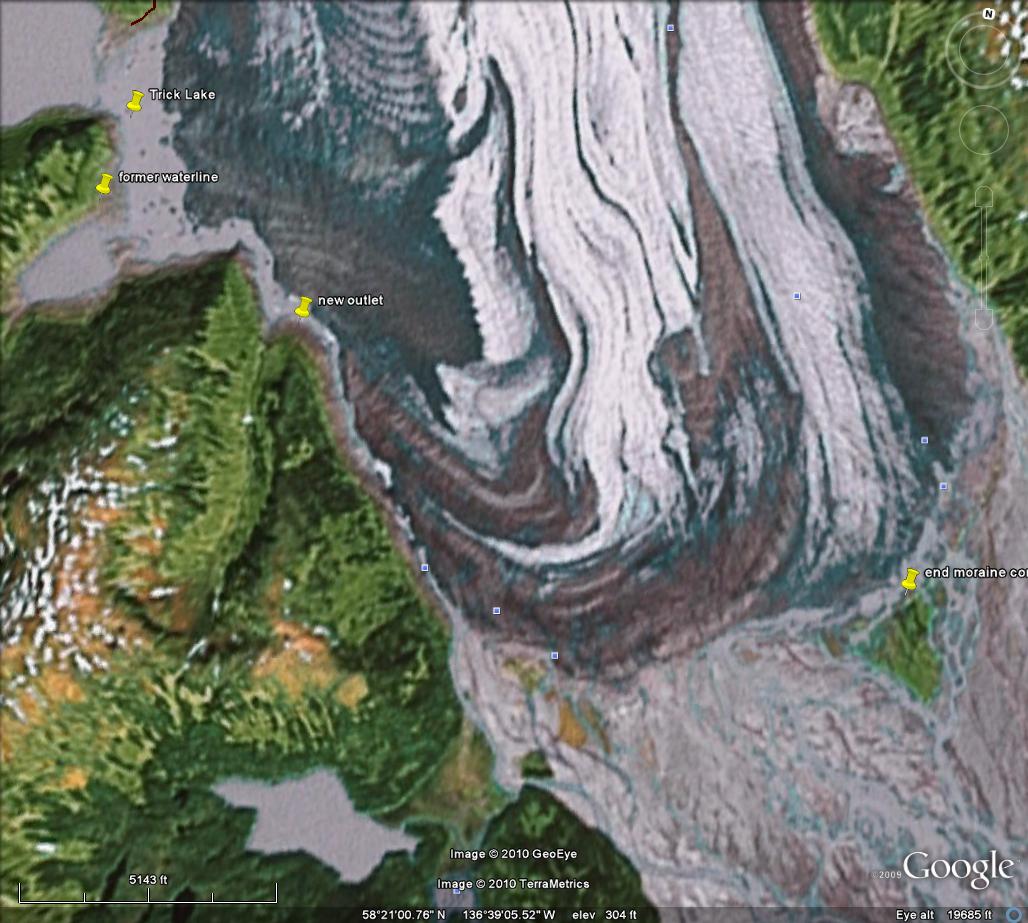
Brady Glacier is a large glacier at the south end of the Glacier Bay region, Alaska. When first seen by George Vancouver it was a calving tidewater glacier in 1794 filling Taylor Bay with ice. Brady Glacier ceased calving and advanced approximately 8 km during the 19th century (Klotz, 1899). As Bengston (1962) notes, the advance is likely another example of an advance following a change from tidal to non-tidal status rather than that of a more positive mass balance. Bengston (1962) further notes that the massive outwash plain at the terminus is primarily responsible for Brady glacier maintaining itself well other glaciers in the Glacier Bay region retreat. The ELA on this glacier is 800 m, the line above which snow persists even at the end of the average summer, this is one of the lowest in Alaska. The main terminus was still advancing in the 1960’s and 1970’s and has managed a 250-300 meter advance since the USGS map of the 1950’s. The main terminus is not advancing any longer and has begun to retreat, the retreat to date is less than 200 meters. The image below is the 1950’s map of the glacier. Brady Glacier is a complex glacier with many subsidiary termini. Echelmeyer, Arendt, Larsen and Harrison from the University of Alaska noted a thinning rate in the mid 1900’s of about 1 meter per year on the Brady Glacier complex. A comparison of 1950’s USGS maps and 2004-2006 satellite imagery indicate all six main subsidiary termini are retreating. The retreat ranges from 200 m in Abyss Lake, 200 m in Trick Lake to 1200 meters in North Deception Lake. The image below is the 2006 satellite image. Compare to the map, Deception has increased in size several fold. North Trick and South Trick Lake are now joined, Trick Lake. Of further interest is the stream draining Trick Lake that sneaks down the west margin of the glacier. This has enabled the water level in the glacier dammed Trick Lake to decline. Note the brown grey “Bath Ring” so to speak above the lake level. The outlet has also been marked in the image below. Pelto (1987) noted that the percentage of the glacier in the accumulation zone was right at the threshold for equilibrium. Subsequent warming of the climate in southeast Alaska and reduced glacier mass balance in the region has initiated this retreat.These termini are all closer to the equilibrium and would respond first to changes in mass balance due to recent warming and consequent measured thinning. This entire line of reasoning must be explored. The glacier is thinning substantially and would appear to be poised for a substantial retreat of the main termini, not just the subsidiary termini.
References not linked:
Bengston, K. recent behavior of Brady Glacier, Glacier Bay National Monument, Alaska. IAHS, 58, 59-77.
Klotz O. 1899: Notes on glaciers of southeast Alaska and adjoining territories. Journal of Geography, 14, 523-534.
Pelto, M. 1987. Mass balance of southeast Alaska and northwest British Columbia glaciers from 1976 to 1984: Methods and Results”. Annals of Glaciology 9: 189–193.

Rotmoosferner Retreat and Dynamic Change

There are currently 51 glaciers in the Ötztal Nature Park. Right now, glaciers cover 27% of the total area of the Ötztal Nature Park. All have been retreating, from 1987-2006. Detailed mapping of these glaciers and Rotmoosferner by Abermann and others (2009), University of Innsbruck provide interesting results. Ötztal glaciers lost 8 % of their total area. One of the glaciers that has a long record of observation is Rotmoosferner. This glacier has retreated 2.1 km since the Little Ice Age and 600 meters since 1969, 15 meters per year. A detailed map of Rotmoosferner from Abermann and others (2009) University of Innsbruck indicates that in 1975 it was joined to the Wasserfallferner, but in 2005 it separated. In the image above the Rotmoosferner is to the lower left and the Wasserfallferner above and to the right. Compare this image to one taken four years later at the end of the post. In the last decade new rock outcrops have emerged in the middle of the Rotmoosferner. These outcrops are noted in the google earth image below. The annotated image also indicates the former zone of connection to the Wasserfallferner. A map of the outline of the glaciers clearly identifies the new outcrops and the separation of the glaciers. The map is based on satellite imagery and older aerial photographic based maps by Abermann and others (2009) from 1969, 1997 and 2006. The retreat from 1969-1997 occurred across a relatively flat foreland. The current retreat is up a steeper slope, since 2001 retreat has averaged 18 m per year. The appearance of the rock outcrops in the mid-section of the glacier as the map shows, indicates little contribution to the tongue of the glacier, and that retreat of this lower section will continue to be rapid. The glacier still does appear to have an accumulation zone most years and is thus not forecast to disappear with current climate.
The picture below is from September of 2008 from Jakob Abermann, Institute of Meteorology and Geophysics, University of Innsbruck. Note the change versus the first picture from four years earlier. The exposed rock area has expanded amazingly and is nearly cutting off the lower tongue.

Yakutat Glacier Rapid Retreat, Alaska

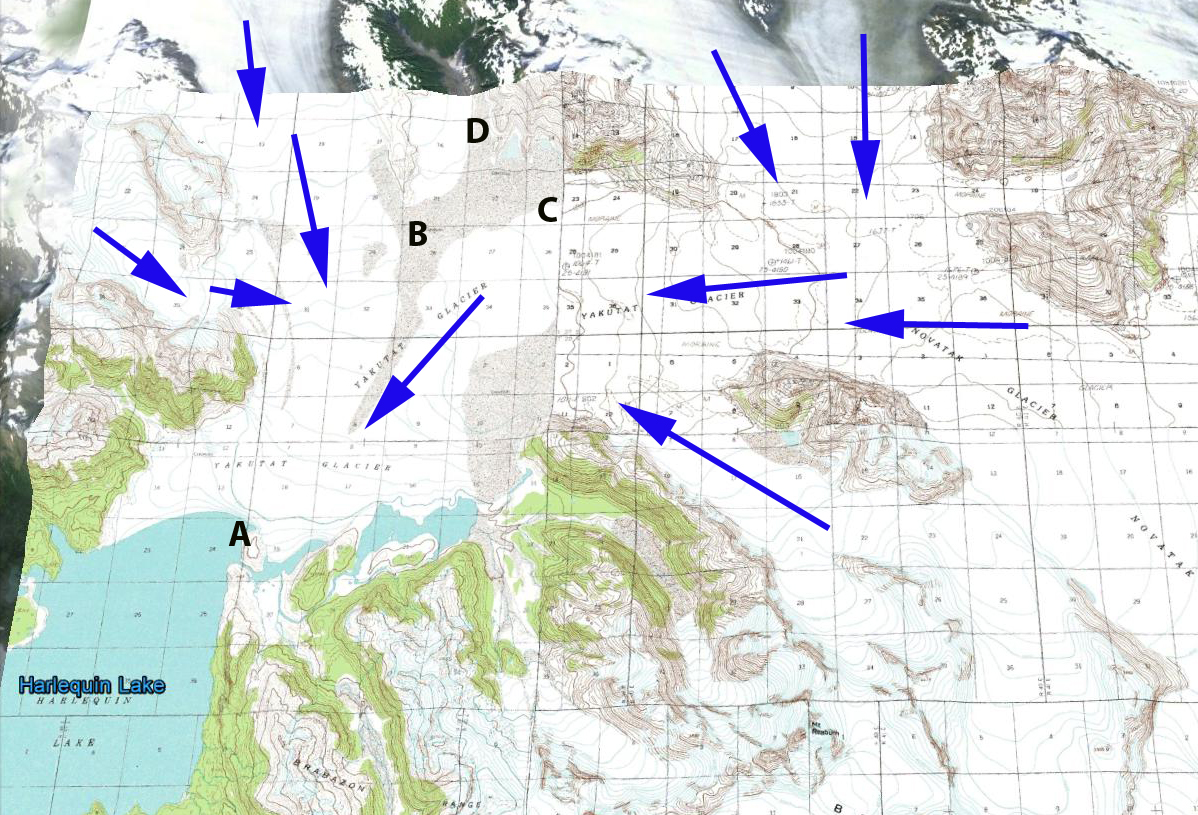
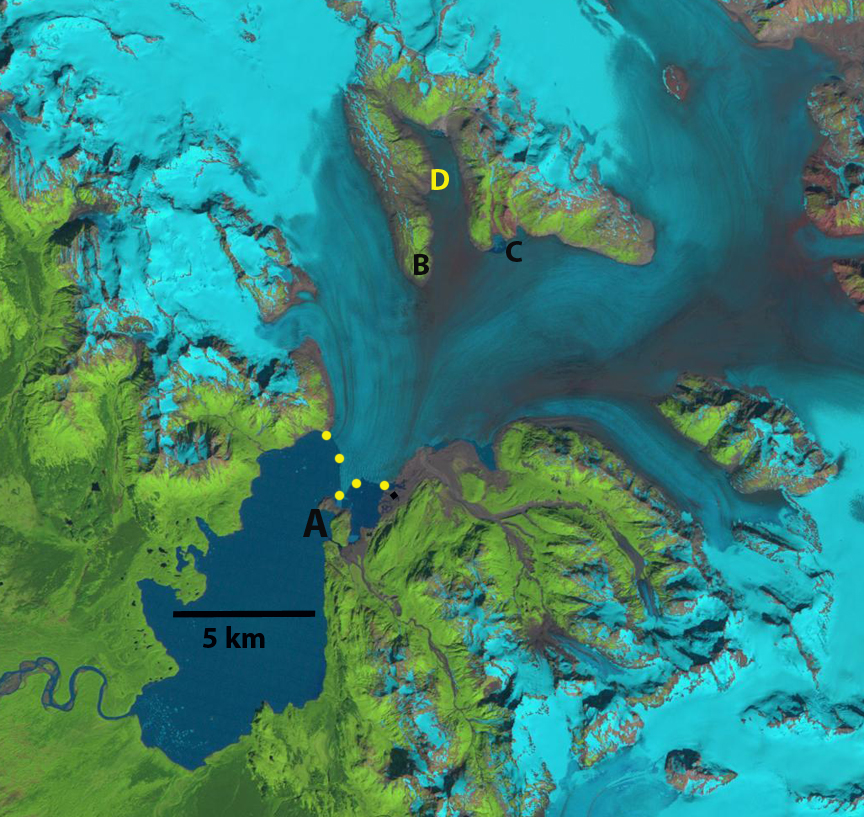
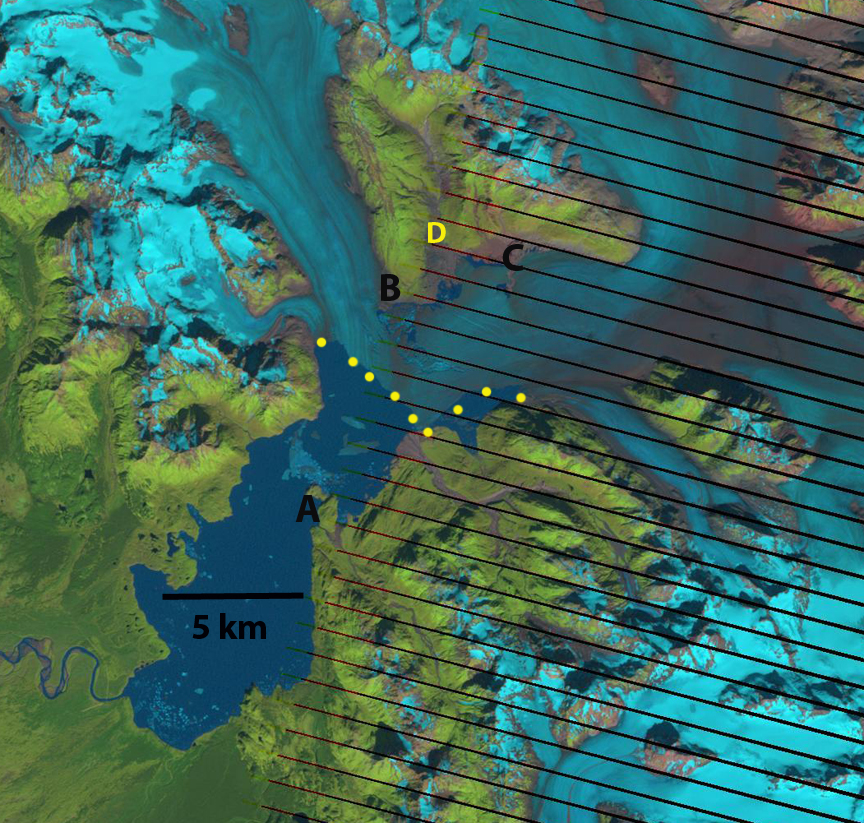
The Yakutat Glacier during the 1894-1895 Alaskan Boundary Survey ended near a terminal moraine on a flat coastal outwash plain. By 1906 the glacier had retreated from the moraine and a new lake was forming. Harlequin Lake. Surveys of the terminus of the glacier indicated a retreat of 1 kilometer in that decade. From 1906-1948 the glacier retreated an additional 5 km. From 1948-1958 the glacier retreated 3.6 km. The retreat is evident in comparing the Yakutat B-3 quadrangle, from 1958 photography, and Landsat imagery from 1984, 2010 and 2013. Points A-D are the same in each image and the yellow dots are the terminus. In 1984 the terminus was just retreating from a peninsula marked A, the valley at D was filled with ice, there was no break in the surface at C and B was well inland of the terminus. By 2010 the glacier had retreated from A, the valley at D was deglaciated, a small strip of bedrock-sediment was exposed at C from what had been beneath the glacier, and B was still well inland of the terminus. By 2013 the northern arm of the glacier had retreated 6.4 km from the peninsula at A toward the peninsula at B. The central arm of the glacier toward C had retreated 7.5 km and the retreat on the southern edge of the glacier was 6.5 km. The glacier had retreated on average more than 6.6 km in 30 years, a rate of 220 m/year. The retreat was most rapid from 2010-2013, when the glacier retreated 3 km.yakutat map
Yakutat terminus map

yakutat 1987
1987 Landsat image

yakutat 20102010 Landsat image

yakutat 2013
2013 Landsat image.

Today the glacier is the focus of a study by the University of Alaska, led my Roman Motyka, Martin Truffer and Chris Larsen
They have set up a time lapse camera to record frontal changes. The goal is to understand the controls on calving into Harlequin Lake of this glacier. More amazing than the retreat has been the observed thinning of the glacier. The glacier has thinned by more 200 m on average according to the preliminary thickness change maps from the UAF project (Truessel et al 2013). The Yakutat Glacier does not have a high accumulation zone and the recent increase in the snowline elevation and thinning of the glacier have led to a substantial shrinking of the accumulation zone and thinning of the glacier in the accumulation (Truessel et al 2013). This glacier does not have a persistent significant accumulation zone and cannot survive (Pelto, 2010). For a calving glacier to be in equilibrium it needs to have at least 60 % of its area snowcovered at the end of the summer. The glacier is in the midst of a large ongoing retreat. The retreat rate and calving mechanism is similar to that of Grand Plateau Glacier, Bear Lake Glacier and Gilkey Glacier. However, unlike these Yakutat Glacier lacks an accumulation zone, a better analog is East Novatak Glacier, which also has a lower elevation accumulation zone.

Grasshopper Glacier, Montana-nearly gone

Grasshopper Glacier, the largest is located about 19 km. north of Cook, Montana within Custer National Forest. The glacier on Iceberg Peak occupies a north facing cirque at nearly 3300 m. (11,000 ft.). In 1940, it was about 1.6 km. wide and on its northwest side terminated in a 15-m. cliff. In 1966, seen below, the glacier had an area of 0.42 square kilometers. The name of the glacier is derived from the myriads of grasshoppers that were embedded in the ice. These grasshoppers either were downed by sudden storms or were carried over the glacier by strong air currents, where the cold forced them onto the ice surface. The grasshoppers are an extinct type of Rocky Mountain grasshoppper Melanoplus spretus. They perished here, were buried by new snow and preserved. At the time the glacier ended in a small lake. Progressively the glacier has retreated. By 1966 it was 0.6 km long, in 1994, seen below, 0.36 km long and in 2006 0.27 km long.

In 2005 this glacier has ceased to exist as a glacier, there are a few remnant perennial snow and ice patches the largest with an area of 0.05 km2. In the majority of recent summers the glacier has lost all of its snowcover. Glacier survival is dependent on consistent accumulation retained on the glacier each summer, this glacier will not survive. The glacier has continued its rapid recession and the further segmentation into small disconnected segments, heralds the end of an active glacier. We do have a gorgeous new alpine lake in its place. Notice the basin is still largely devoid of plant life and the surface still has the color of newly exposed-deposited sediments.