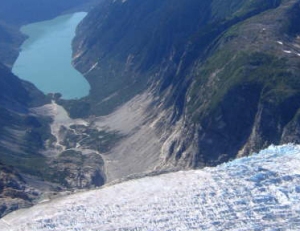
East Novatak Glacier Retreat, Alaska

Novatak Glacier and a large unnamed south-flowing glacier to the east, here designated as East Novatak Glacier, were connected when first mapped by the International Border Commission in the 1906-08 period. By the 1950’s maps indicated the Novatak and East Novatak Glacier have separated, with a lake (A) developing between them. Here we examined 1984-2013 Landsat images to determined changes over the last 30 years.
east novatak map
Map of East Novatak Glacier area.

east Novatak ge
Google Earth image

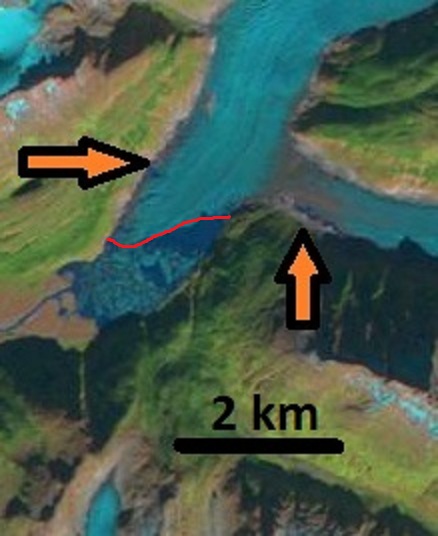
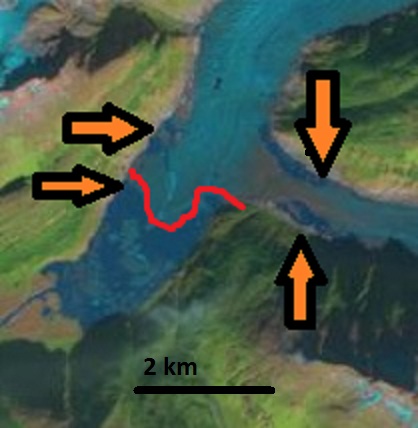
East Novatak Glacier ended in a lake (B) in 1984, this lake then drained a short distance south to the Alsek River. The glacier was separated from the main Novatak Glacier by 3.5 km. In each image the 1984 terminus is marked by red arrow and 2013 image by yellow arrow, N marks the location of a nunatak that develops after 1984. In 1987 glacier retreat has connected the northern and southern half of B Lake. Lake A is still getting glacier runoff leading to a lighter blue color. By 2010 A Lake is no longer getting much glacier runoff and the water color is much darker than B Lake. A nunatak has emerged as well due to thinning ice. East Novatak Glacier has retreated out of the lake basin on the low lying plain, and into the mountain valley. In 2013 the terminus has narrowed and has retreated 2.5 to 3 km since 1984. The glacier is now separated from the retreating Novatak Glacier by 6 km. The tributary that used to connect to the main glacier and is partly obscured by the red arrow, now ends well short of the East Novatak Glacier. Most of the East Novatak Glacier is below 1000 m in elevation, which has been the recent snowline elevation. The retreat of this glacier like that of nearby Yakutat Glacier, indicates how suscpetible the Alaskan glaciers in the region with lower elevation accumulation zones are to our warming climate (Truessel et al, 2013). The retreat is similar to Grand Plateau Glacier, but that glacier does have high elevation accumulation areas, that will allow that glacier to survive.east novatak 1984

east novatak 1987

east novatak 2010

east novatak 2013

Juneau Icefield Glacier Terminus Change from Landsat 5 1984 to Landsat 8 2013

The Juneau Icefield Research Program (JIRP) has been examining the glaciers of the Juneau Icefield since 1946. Until the NASA Landsat program began field measurements and aerial observations were the only means to observe the glaciers of the icefield. For more than 40 years it was Maynard Miller, U of Idaho, who led this expedition that has trained so many of today’s glaciologists, today it is Jeff Kavanaugh, U of Alberta. Given the difficult weather conditions that produce the 4000+ square kilometers of glaciers, this was not a task that could be done comprehensively. Here we examine the changes from the August 17, 1984 Landsat 5 image to the June 21, 2013 image from newly launched Landsat 8. Landsat 5 was launched in 1984, Landsat 8 launched in 2013. The Landsat images have become a key resource in the examination of the mass balance of these glaciers (Pelto, 2011). The August 17th 1984 image is the oldest Landsat image that I consider of top quality. I was on the Llewellyn Glacier with JIRP on the east side of the icefield the day this image was taken. On June 21, 2013 JIRP’s annual program had not begun, but the field season is now underway once again observing fin and reporting from the field across this icefield.
Post reblogged at NASA

First we have the two reference images of the entire icefield that indicate the location of the 12 main glaciers we focus on here. Followed by a chart indicating the amount of terminus change, 14 glaciers have retreated and one has advanced.
This is followed by 12 closeup glacier by glacier comparisons of the terminus, with the 1984 image always on the left and 2013 on the right, the 1984 margin is marked with red dots and the 2013 with yellow dots. This is an update to an examination of the Juneau Icefield terminus changes from 1948 to 2005. There are also links to more detailed discussions for each glacier, as the focus here is on the 1984 to 2013 changes visible in the images here. The images were first overlain in ArcGIS and the terminus change based on three measurements one at the glacier terminus midpoint, one each halfway to the margin from the mid-point. The exception is the Taku Glacier which is based on the JIRP field measurement mean and the Llewellyn where three measurements are made on each of the two termini, the average is then rounded to the nearest 100 m. The ongoing retreats reflects the long term negative mass balance of the glaciers with the exception of the Taku Glacier. The ongoing warming of our globe will continue to lead to retreat. The glaciers are all fed from the central portion of the icefield that always has a large snow covered area even at the end of recent warm summers.
juneau icefield 1984
August 17, 1984 Landsat 5 image: N=Norris, L=Lemon Creek, M=Mendenall, H=Herbert, E=Eagle, G=Gilkey, A=Antler, F=Field, LL=Llewellyn, Tu=Tulsequah, TW=Twin and T=Taku.

Juneau icefield 2013
June 21, 2013 Landsat 8 image

JIF terminus
1984-2013 chart of terminus change of individual glaciers from 1984 to 2013, see individual images below for the observed changes.
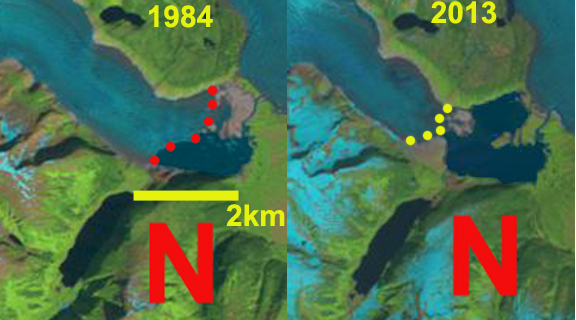
norris glacier change
From 1984 to 2011 Norris Glacier has retreated 1100 m. The glacier terminus that has been ending in a proglacial lake for the last 40 years is now mostly grounded. Since 1984 the northern half of this lake has formed and the long term lake development is discussed in a more detailed discussion on Norris Glacier.
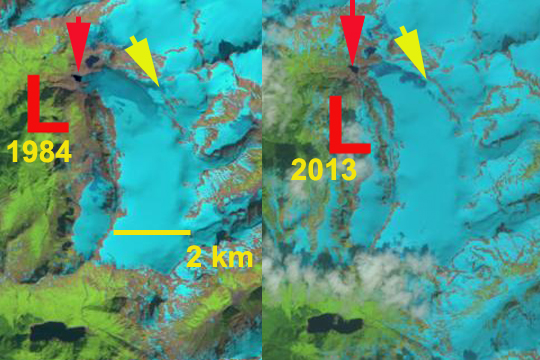
lemon glacier change
In 1984 Lemon Creek Glacier (L) has pulled back 300 m from a small lake it reached in 1984. Lemon Creek Glacier has a long term mass balance record that indicates more than 15 m of thinning from 1984 to 2012. This thinning is more dramatic than the 300 m retreat that has occurred. The yellow arrow indicates a tributary that no longer connects to the glacier.

mendenhall glacier change Mendenhall Glacier is the most visited and photographed terminus in the region. The glacier in 1984 ended at the tip of a prominent peninsula in Mendenhall Lake. By 2013 the terminus has retreated 1200 m, with an equal expansion of the lake. The red arrows indicate a tributary that decreased dramatically in width and contribution to the main glacier. This is the location of Suicide Basin, where a lake has formed the last two summers and then rapidly drained. A nice set of images of the glacier are provided by Matt Beedle.

herbert glacier change
Herbert Glacier has retreated 600 m since 1984. The width of the terminus has also declined. The red arrow indicates a tributary that no longer feeds the main glacier.
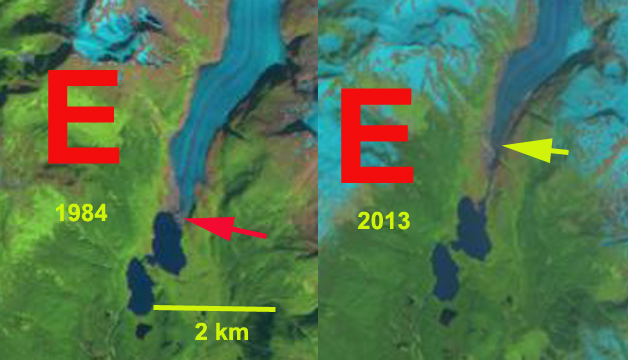
eagle glacier change Eagle Glacier has retreated from the edge of a lake in 1984. The retreat of 1100 m is rivaled by the width reduction of the glacier in the lower 3 km. Eagle Glacier‘s ongoing retreat is examined in more detail.
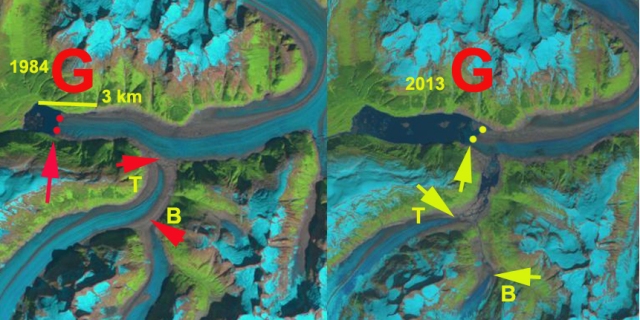
gilkey glacier change Gilkey Glacier had begun to retreat into a proglacial lake by 1984, the lake was still just 1 km long. A short distance above the terminus the Gilkey was joined by the sizable tributaries of the Thiel and Battle Glacier. By 2013 the glacier has retreated 3200 m, the lake is now 4 km long. Thiel and Battle Glacier have separated from the Gilkey Glacier and from each other. Thiel Glacier retreated 2600 m from its junction with Gilkey Glacier from 1984-2013 and Battle Glacier 1400 m from its junction with Thiel Glacier
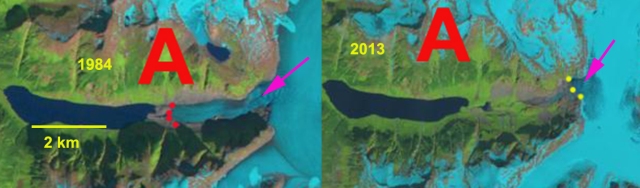
antler glacier 2013 Antler Glacier is actually a distributary glacier of the Bucher Glacier, which in turns joins the Gilkey Glacier. As this glacier has thinned, less ice has overtopped the lip of the valley that Antler occupies. In 1984 Antler Glacier was 3 km long descending the valley to end near a proglacial lake, that it had recently occupied. By 2013 the glacier was just 400 m long, having lost 2600 m of its length.
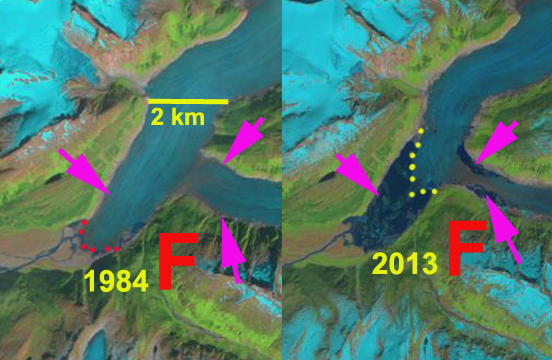
field glacier change Field Glacier in 1984 ended at the edge of an outwash plain with a few glimpses of a lake developing near its margin. By 2013 a substantial lake has formed at the terminus and the glacier has retreated 2300 m. A lake has also developed at the first terminus joining from the east, most of the width of this glacier has been lost. It is clear that the two lakes will merge as the retreat continues.

lewellyn glacier change The second largest glacier of the icefield is the Llewellyn Glacier which is in British Columbia. The glacier has several termini, here we examine two of them that have retreated 900 m from 1984-2013. Hoboe Glacier is another terminus that has been examined, but not in this post. This has led to formation of new lakes, and water level changes in existing lakes. Matt Beedle has examined the recent changes at the terminus.
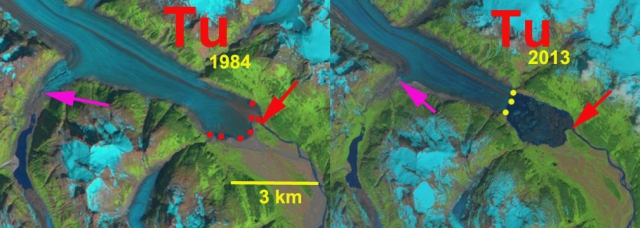
tulsequah glacier change Tulsequah Glacier in 1984 ended at an outwash plain with a small marginal lake beginning to develop, red arrow. By 2013 a large proglacial lake has developed due to the 2500 m retreat. A side valley down which a distributary tongue of the glacier flowed in 1984 has retreated out of the valley by 2013, pink arrow.

twin glacier change The East and West Twin Glacier are receding up separate fjords, though they are fed from a joint accumulation zone. The East Twin is a narrower glacier and has retreated 900 m. The West Twin has retreated 600 m, at an elbow in the fjord. Elbows like this are often good pinning points that are a more stable setting, once the glacier retreats out of the Elbow retreat should speed up.

taku Glacier change Taku Glacier is the largest glacier of the icefield and unlike all the others it has been advancing non-stop over the last century. The sustained positive mass balance from 1946-2012 has driven this advance (Pelto, 2011), this led to the glacier thickenning along its entire length. Since 1950 observations of velocity near the snowline of the glacier by JIRP indicates that the glacier has had a remarkably steady flow over the past 50 years (Pelto et al, 2008). Since 1988 the glacier has not been thickening near the snowline as mass balance has declined. We have been able to observe the snowline movement in satellite images to help determine the mass balance. The changes at the glacier front are quite variable as the glacier advances. JIRP measurements of the terminus indicate this from 2001-2008 with an interactive map from Scott McGee, indicating advances in some area, minor retreat in others and back and forth in others. In 2012 JIRP was back at the terminus creating the map below. There is no change at the east and west side of the margin since 2008 and 55 to 115 m of advance closer to the center.

TakuTerminusSurvey2012

Riggs Glacier Retreat from the Sea, Alaska

Riggs Glacier for most of the 20th century was a tributary to the Muir Glacier in Glacier Bay Alaska. The two glaciers separated between 1960 and 1963 as noted by the USGS in their detailed research led by Bruce Molnia . The USGS chronicled the changes of this glacier from 1940 to 2004 with pictures from the same location by Bruce Molnia. The Muir and Riggs are still joined in 1950 and the Riggs Glacier is retreating out of sight into its own valley by 2004. 1950_muir_glacier

2004_muir_glacier
Dan Lawson in a 2004 National Park Service brochure noted that Riggs Glacier was about 1.2 km wide at the terminus, had a 40 to 90 feet high ice face and was 15 miles long. The terminus that had been calving into Muir Inlet for the entire 20th century became mostly terrestrial during the mid-1980,s as an outwash delta built at the southern margin. In 2004 tidewater only reached the terminus during higher tides on either side of the bedrock knob that separates the glacier into two ice tongues. Riggs Glacier has been thinning progressively over the past two decades and is expected to continue thinning and slowly receding. Ice recession has been averaging about 20 to 30 feet per year for the last 5 years. This post examines changes as seen in Landsat images from 1990 to 2011.

In 1990 the two terminus tongues are still connected at the black arrow, and a prominent knob is just being exposed by retreat of the western terminus, red arrow. The terminus still reaches tidewater on the very northern margin. There is no vegetation evident on the knob separating the ice tongues. A tributary from the east at the orange arrow just reaches the Riggs Glacier. By 1999 the termini are separated the prominent knob is now fully exposed by retreat of the western terminus and the glacier is no longer tidewater except briefly at high tide. Vegetation has become to develop on the rock knob that separates the two ice tongues. By 2009 the glacier has retreated well back from tidewater. The delta building in front of the eastern terminus has expanded into the inlet some. Vegetation has spread over most of the rock knob that separates the two ice tongues. In 2010 in a late summer images the snowline of the glacier is at 975 m. The tributary from the east at the orange arrow has retreated 1 km from the Riggs Glacier. By 2011 the western terminus has retreated 600 meters since 1990 and the eastern terminus has retreated 800 meters from the black arrow where it used to connect to the main glacier. Examination of the snowline elevation on Riggs Glacier indicates that it now typically it is typically between 950 and 1050 m. This recent increase in the snowline is similar to the increase seen on Brady Glacier. This has led to the glacier retreat and it no longer reaching the sea. riggs glacier 1990
riggs glacier 1999

riggs glacier 2009

Riggs glacier 2010
riggs glacier 2011

Field Glacier, Alaska Retreat, Lake expansion, tributary separation

field glacier change
Above is a paired Landsat image from 1984 left and 2013 right, indicating a 2300 m retreat in this period, below is further detailed examination.
The Field Glacier flows from the northwest side of the Juneau Icefield, and is named for Alaskan glaciologist and American Geographical Society leader William O. Field. Bill also helped initiate the Juneau Icefield Research Program, which Maynard Miller then ably managed for more than 50 years. The JIRP program is still thriving today. In 1981, as a part of JIRP, I had my first experience on this glacier. It was early August and there was new snowfall everyday that week. Jabe Blumenthal, Dan Byrne and myself undertook a ski journey to examine the geology on several of the exposed ridges and peaks, note the burgundy line and X’s on image above. This was truly a remote area. The glacier begins from the high ice region above 1800 meters, there are several icefalls near the snowline at 1350 meters, and then it descends the valley ending at 100 meters. The runoff descends the Lace River into Berners Bay. This post focuses on the significant changes occurring at the front of the Field Glacier. The development of a proglacial lake at the terminus is accelerating and spreading into the main southern tributary of the glacier. This lake is going to quickly expand and develop a second arm in that valley. The USGS map from 1948 imagery and the 1984 imagery indicate little change in the terminus position, with only a small lake at the terminus. . After 1984 the mass balance of the Juneau Icefield became more negative, this was apparent from the rise in the snowline elevation on all the glaciers and by the increasing losses and resultant thinning typified by the Lemon Creek Glacier (Miller and Pelto, 1999). The Field Glacier by 2006 had developed a proglacial lake at the terminus that averaged 1.6 km in length, with the east side being longer. There are several small incipient lakes forming at the margin of the glacier above the main lake, each lake indicated by black and orange arrow. In 2009 the lake had expanded to 2.0 km long and was beginning to incorporate the incipient lake on the west side of the main glacier tongue. By 2011 the main lake has nearly reached the southern tributary lakes. The lake has expanded to 2.6 km long, with the west side having caught up with the east side, and an area of 4.0 square kilometers. In addition the main lake has joined with the fringing lake on the south side of the south tributary. There is also a lake on the north side of this tributary. This lake should soon fill the valley of the south tributary and fully merge with the main, as yet unnamed lake at the terminus, maybe this should be Field Lake. Below in order is the 2006, 2009 and 2011 Landsat images. This glacier is experiencing retreat and lake expansion like several other glaciers in the icefield, Gilkey Glacier, Eagle Glacier, and Antler Glacier.

Chickamin Glacier, Alaska Extensive Retreat

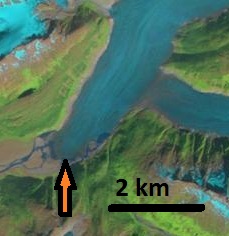
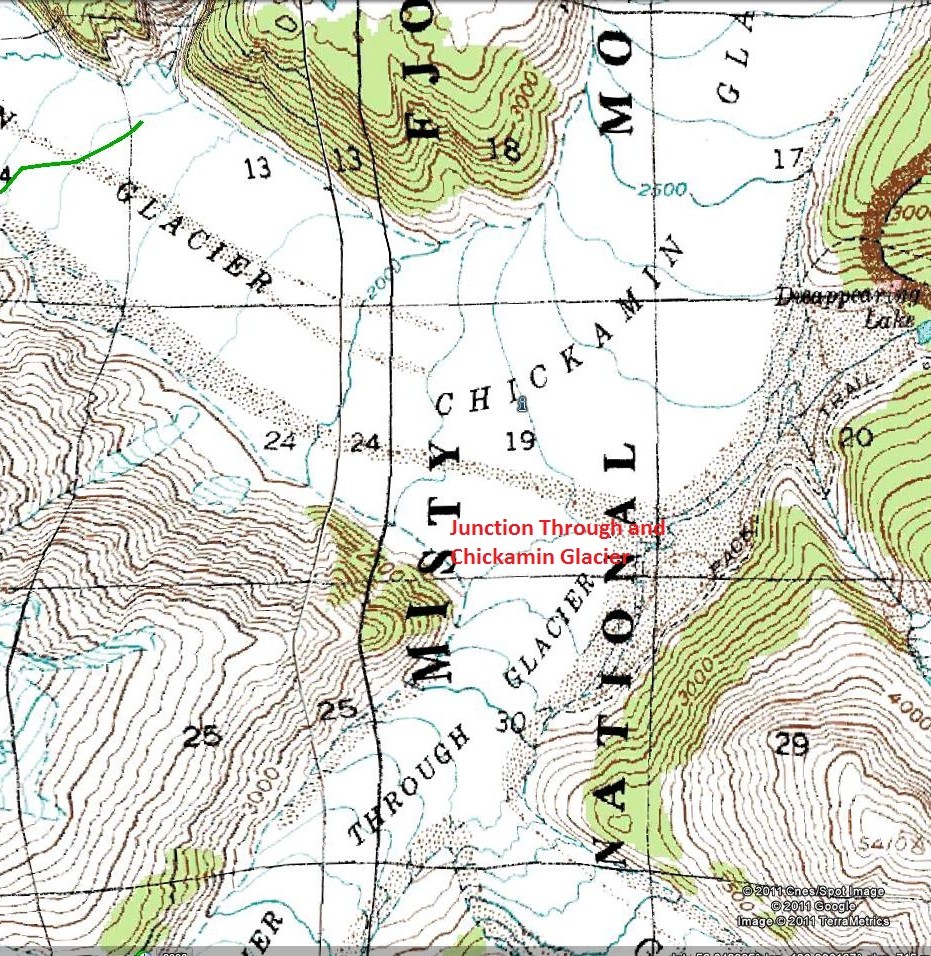
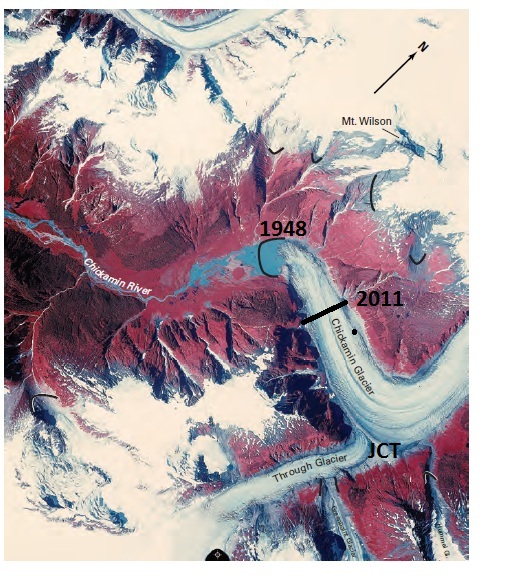
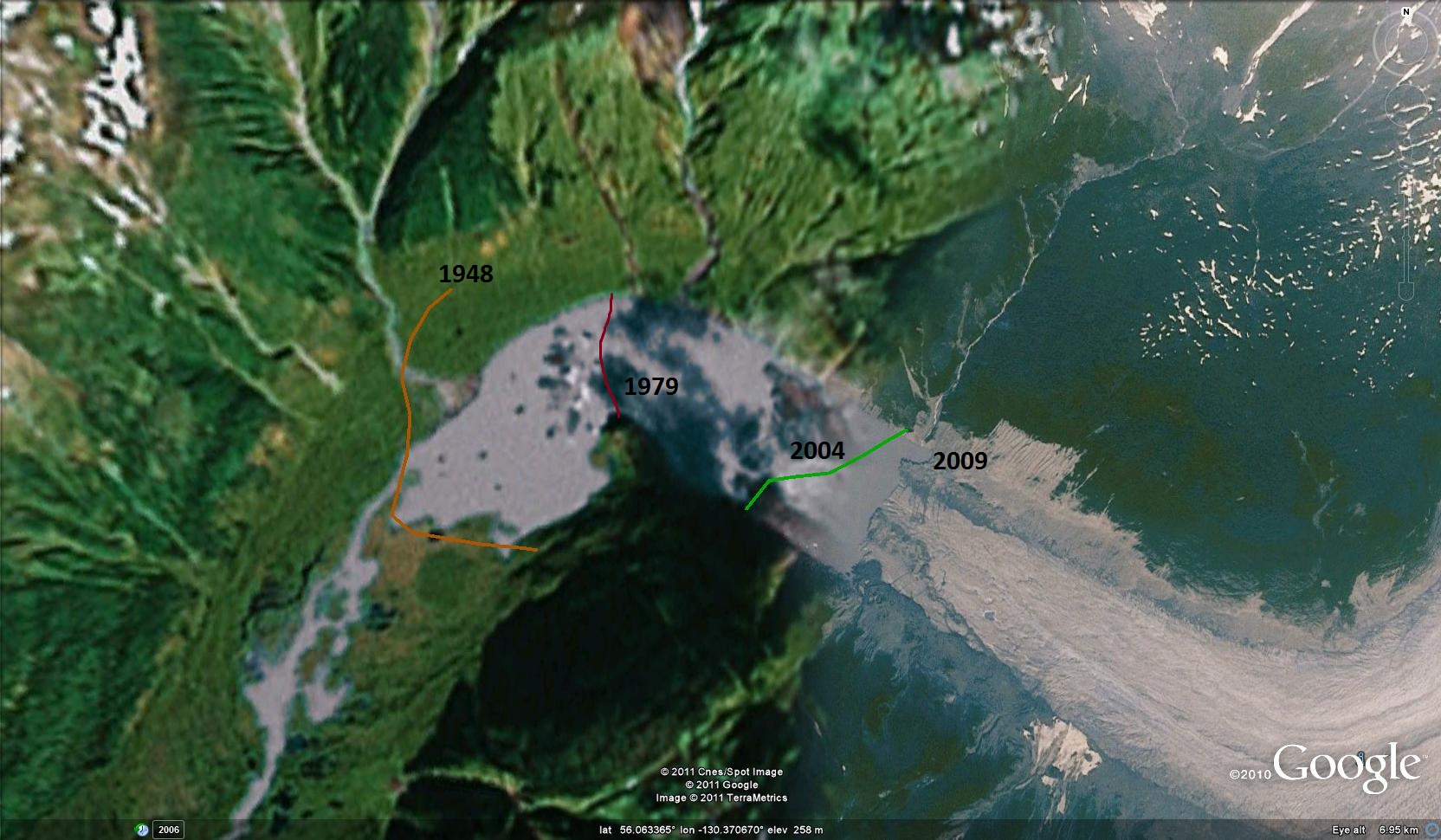
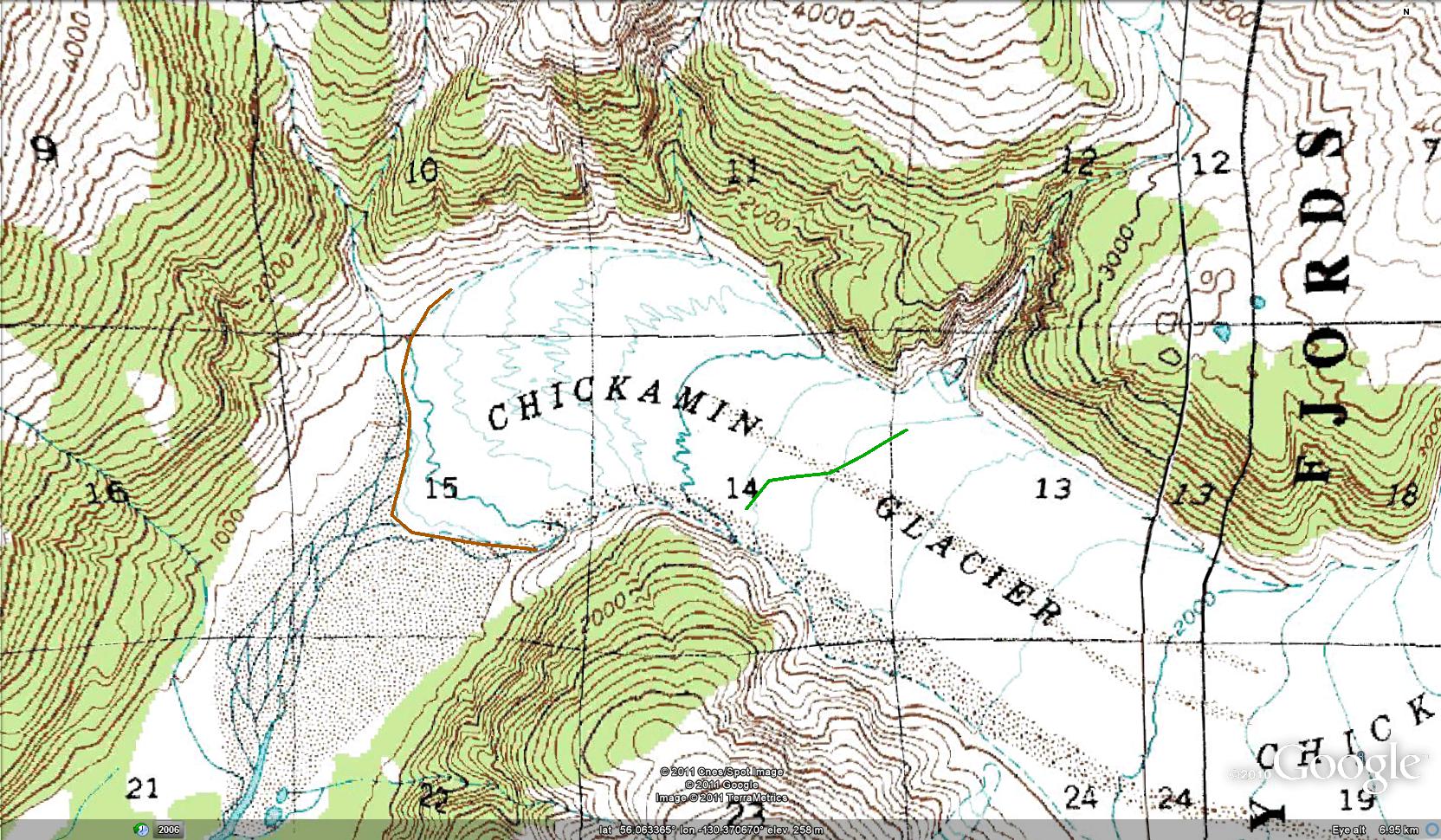
Chickamin Glacier in southeast Alaska has undergone a 3 kilometer retreat since 1955. The glacier drains south from an icefield near Portland Canal and straddling the border with British Columbia. The glacier ended on an outwash plain in 1955 at 250 meters. The Through Glacier at this time is a large tributary feeder joining Chickamin at the elbow where it turns west, (bottom image) Shortly thereafter a lake began to form, and by 1979 a Landsat image indicates a lake that is 1300 meters long. A this point the Through Glacier is just barely in contact with Chickamin Glacier. . By 2004 in an Ikonos image the glacier has retreated 1400 meters from the 1979 position, top image. This image is from the USGS and has been further annotated. In a 2009 Geoeye image the glacier has receded an additional 300 meters, 3000 meters since 1955. Just as impressive is the retreat of Through Glacier that now terminates 1500 meters from its former Junction with Chickamin Glacier. This separation and retreat has occurred during a period of higher snowlines in the region. The snowline of the glacier has averaged 1200 meters in recent years, 100 meters higher than before, and the summit of the glacier is at 2000 meters. The retreat and thinning of this glacier follow that of Sawyer Glacier, Gilkey Glacier and Lemon Creek Glacier. The current terminus region indicates considerable rifting in the lower 500 meters indicating this will be rapidly lost, note the red arrow. The blue arrow indicates a zone below which the glacier appears stagnant with no active crevasse features. The green arrow indicates the transition to a zone of active flow and crevassing. At meters kilometers above the terminus a basin has developed, orange arrow, this is filled periodically becoming a lake, which then drains beneath this glacier. This lake and basin will continue to expand.

Saywer Glacier, Alaska Retreat

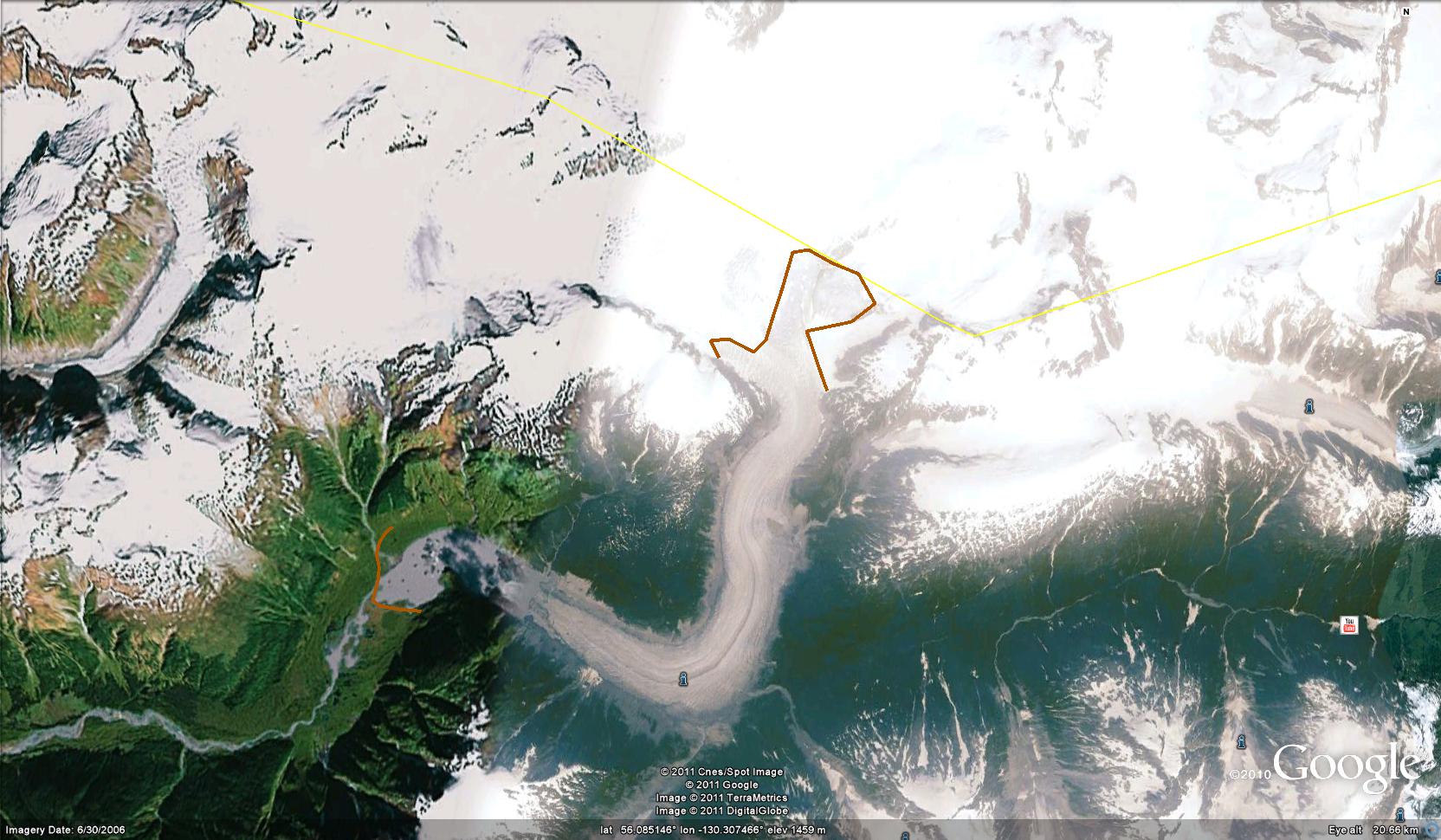
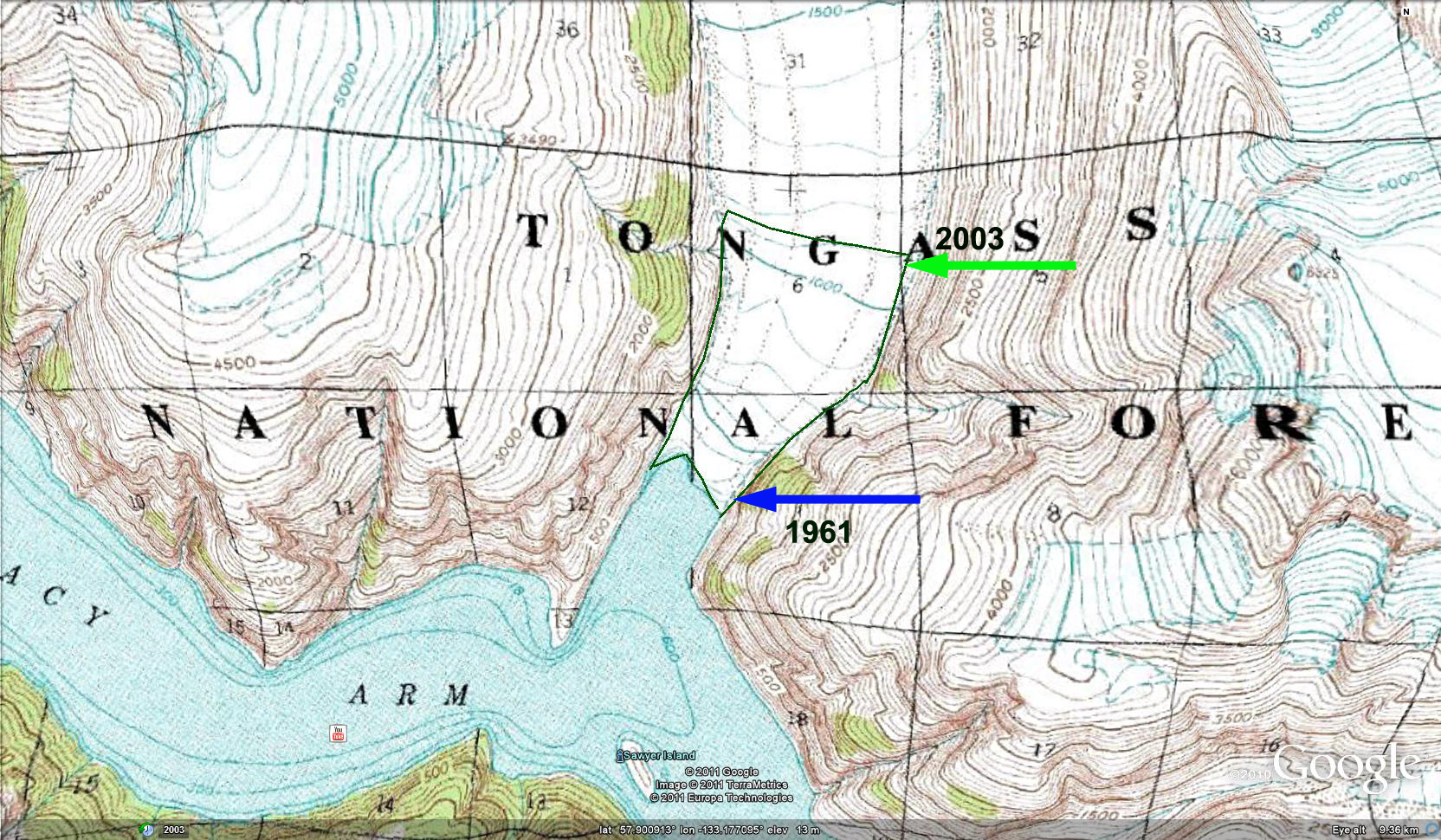
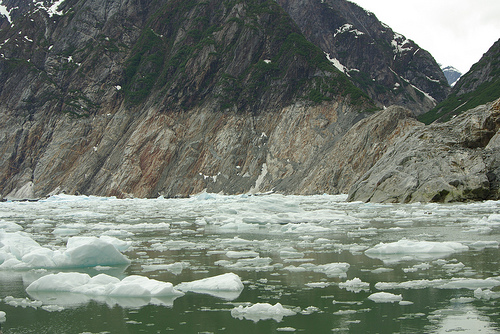
Sawyer Glacier is an Alaskan glacier that many people have observed the retreat of. It is one of three glaciers that calves into Tracy Fjord, that is often visited by cruise ships. The 2.3 km retreat over the last 50 years has made approach to the actual terminus difficult for larger cruise ships. The terminus of the glacier was almost to the main arm of the fjord in 1961, USGS map, blue arrow. The 2003 Google Earth images indicates a 2.3 km retreat, green arrow. sawyer glacier 2003

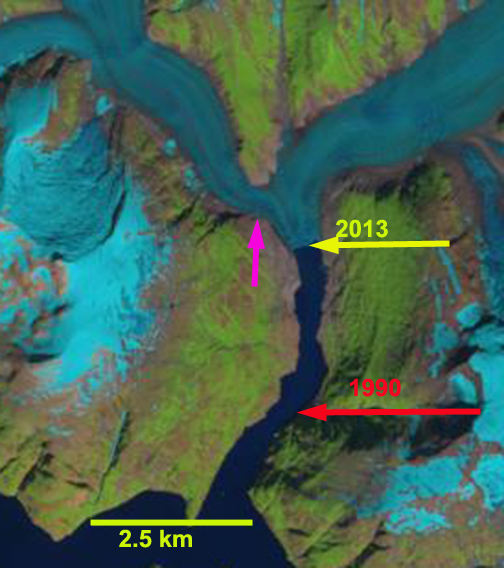
sawyer glacier map The green line down fjord marks the 1961 terminus, the upfjord line is at the 1100 foot contour of the USGS map and is parallel with the current terminus location. The snowline of the glacier was noted to be at 1125 meters by Pelto (1987), using Landsat images. At the time usable images were rare. Today images are acquired daily by MODIS and if the weather is clear, which is not common, the snow line is evident. Recent satellite images from 2006 and 2009 indicate the snow line still in the 1100 to 1200 meter elevation region, however, the 300+ meter thinning at the terminus has led to thinning upglacier and the location of the 1100 meter contour has shifted 1-1.5 kilometers upglacier. The snowline is evident in the 2003 Google Earth image. Landsat images from 1990 to 2013 indicate extensive retreat. The retreat from the 1990 terminus, red arrow, to the 2013 terminus, yellow arrow is 2.8 km, 120 m per year. The western feeder just above the terminus has narrowed at the pink arrow from 1 km wide in 1990 to 500 m wide in 2013. This suggests that retreat will soon lead to separation of Sawyer Glacier with the western arm and eastern arm both continuing a retreat. The 300 meter thinning in the last 50 years has left a sharp trimline beyond the current terminus marking the former ice height, that is well above the current fjord. The glacier is losing mass and retreating as is the nearby North Dawes Glacier.

sawyer Glacier 1990

sawyer glacier 2013 The thinning combined with the rising snowline has resulted in a smaller accumulation zone. At the same time the retreat has reduced the calving rate as the terminus has narrowed and entered shallower water. The calving rate is related to water depth on these glaciers, Pelto (1991) . The reduced calving leads to a more positive mass balance, the increased snow line and reduce height of the glacier surface leads to reduced mass balance. This is equivalent to your bank account when you finish paying off your mortgage, but at the same time your income is declining. It will be interesting to observe the balance point of these two opposite forces. The University of Alaska Fairbanks began periodic altimeter surveys of the glaciers in the Sawyer Glacier region in 2000 and have noted a sharp decrease in surface elevation from the terminus to 1000 meters for the 2000-2009 period (Larsen et al, 2009).

Grand Plateau Glacier Retreat, Alaska

Grand Plateau Glacier drains southwest from Mount Fairweather in southeast Alaska. The glacier advanced during the Little Ice age to the Alaskan coastline. Early maps from 1908 show no lake at the terminus of the glacier. The 1948 map shows three small distinct lakes at the terminus of the main glacier and a just developing lake at the terminus of the southern distributary terminus (D). By 1966 the glacier had retreated enough for the formation of one lake. The distance from the Nunatak N to the terminus was 12 km in 1948. The lake at D is 400 m wide.gp-terminus

gptribmap
USGS map displayed in Google Earth-1948 base images.

Landsat images from 1984, a Google Earth Mosaic of the 2003-2009 period and a Landsat image from 2013 indicate the substantial changes that have occurred. Here both the main terminus and a distributary (D) terminus draining south are examined. The main reference points in each image are the Nunatak, N, and and Island, I. The retreat from 1984-2013 is evident with the yellow arrows indicating the 1984 terminus and pink arrows showing the 2013 terminus location. The distance from the Nunatak to the terminus is 9.6 km in 1984, 6.8 km in the Google Earth image and 3.5 km in 2013. A six kilometer retreat at the glacier center in 30 years. On the north shore of the lake the retreat between arrows is 2.7 km from 1984-2013. From the island the glacier retreated 3.3 km from 1984-2013. The distributary tongue (D) retreated 2.2 km from 1984-2013. The offset of the terminus is 300-350 m indicating a five year retreat rate of 75-90 meters per year. The retreat has been driven by higher snowlines in recent years, the snowline had been reported at 3400 feet in the 1950’s. Satellite imagery of the last decade indicates snowlines averaging 1500 m, red arrows. The glacier snowline is evident in Landsat imagery in 2009 and 2013 red arrows. The combination of higher snowlines and increased calving into the terminus lake will continue to lead to retreat of this still mighty river of ice. This retreat parallels that of nearby Yakutat Glacier, Norris Glacier and Melbern Glacier
grand plateau 1984
1984 Landsat image

grand plateau 2013
2013 Landsat image

grand plateau ge
Google Earth images

Thiel Glacier Alaska ongoing retreat

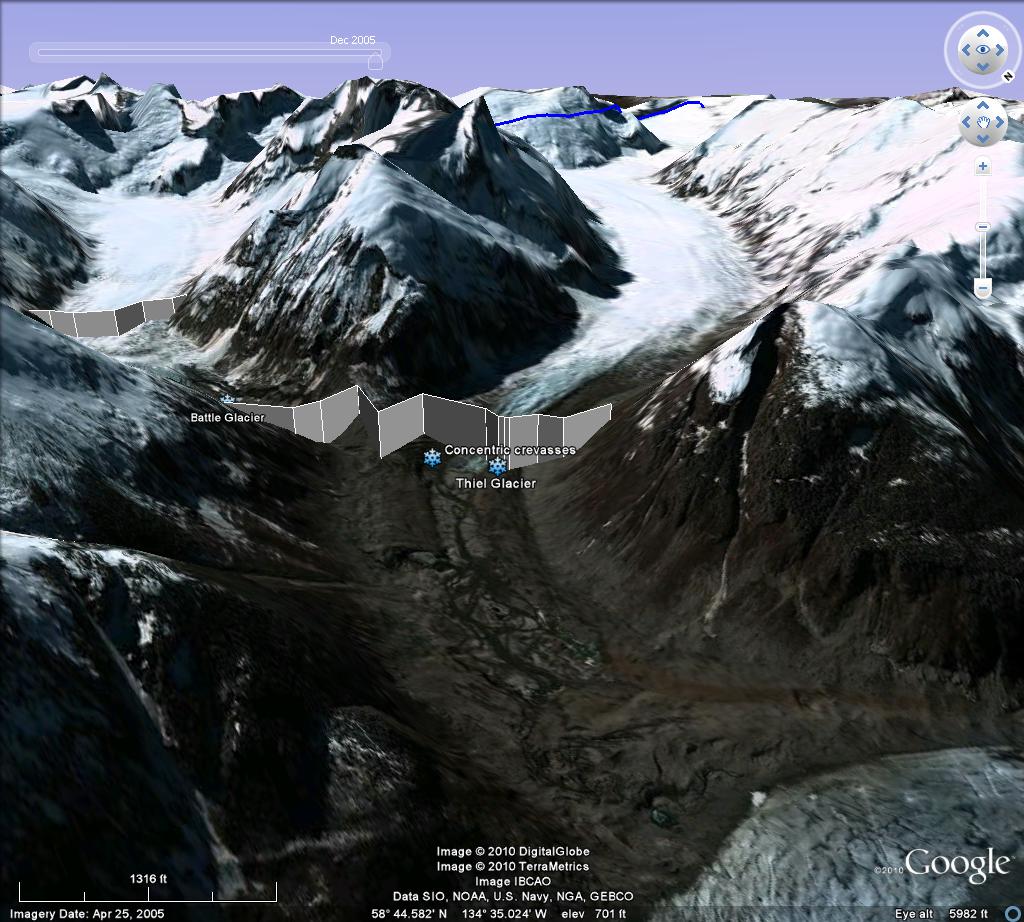
Thiel Glacier is a valley glacier in the Juneau icefield of Alaska. The glacier was a tributary of the Gilkey Glacier and is shown as such in USGS maps. From 1948-2005 the glacier has retreated 2100 meters from its former junction with the Gilkey Glacier. Below is the USGS map of the area showing the junction of the Battle, Gilkey and Thiel Glacier. The same view from the 2005 Google Earth imagery indicates the separation of the three glaciers and the emergence of a new deglaciated valley section. In 1984 looking down at the glacier from its highest elevation, it was clear that the glacier had too small of an accumulation area to support the long, low elevation valley tongue of the glacier. From that vantage I could not see the terminus. The snowline at the end of the summer typically is at 4000-4500 feet at the end of the melt season, leaving only 45% of the glacier in the accumulation zone. For a glacier to be in equilibrium at least 60% of the glacier needs to be in the accumulation zone. The upper margin of the glacier is outlined in blue and the snowline indicated with blue arrows in the image below. The current glacier terminus is stagnant and the retreat is ongoing. At the terminus a close examination of the 2005 imagery forth indicates a series of concentric crevasses at the terminus. Such crevasses typically are the indicative of a collapse feature. Usually it is a subglacial lake that drains that had supported the terminus to some extent. Above this point the ice is stagnant lacking tranverse crevasses that would indicate movement. The surface of the glacier has a rough cross profile as a result without active movement to even out the profile. Areas of debris generally are prominent as the debris is insulating the ice underneath. The 2005 terminus is at 650 feet, compared to the same location in the USGS maps of 1500 feet. This nearly 900 feet of thinning is depicted by the surface wall overlay added to Google Earth, the top of this wall is at 1500 feet. In the foreground is the Gilkey Glacier which the Thiel formerly joined and the new deglaciated valley. This glacier will continue to retreat rapidly with the current climate much like the nearby Hoboe Glacier and Tulsequah Glacier and Lemon Glacier

Okpilak Glacier Retreat, Brooks Range, Alaska

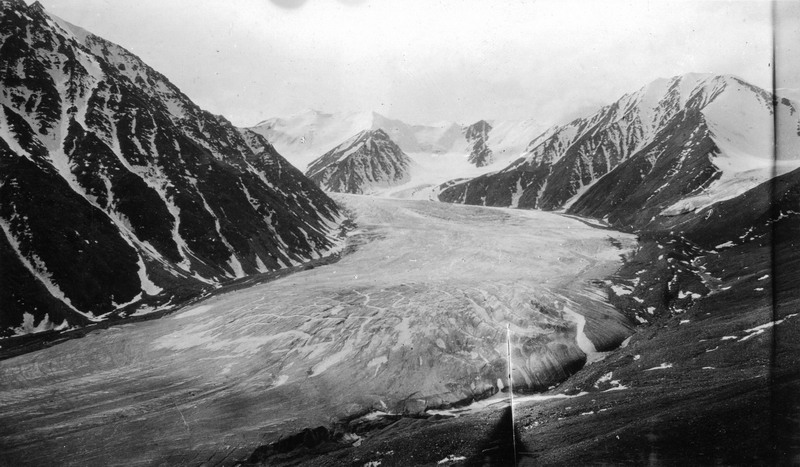
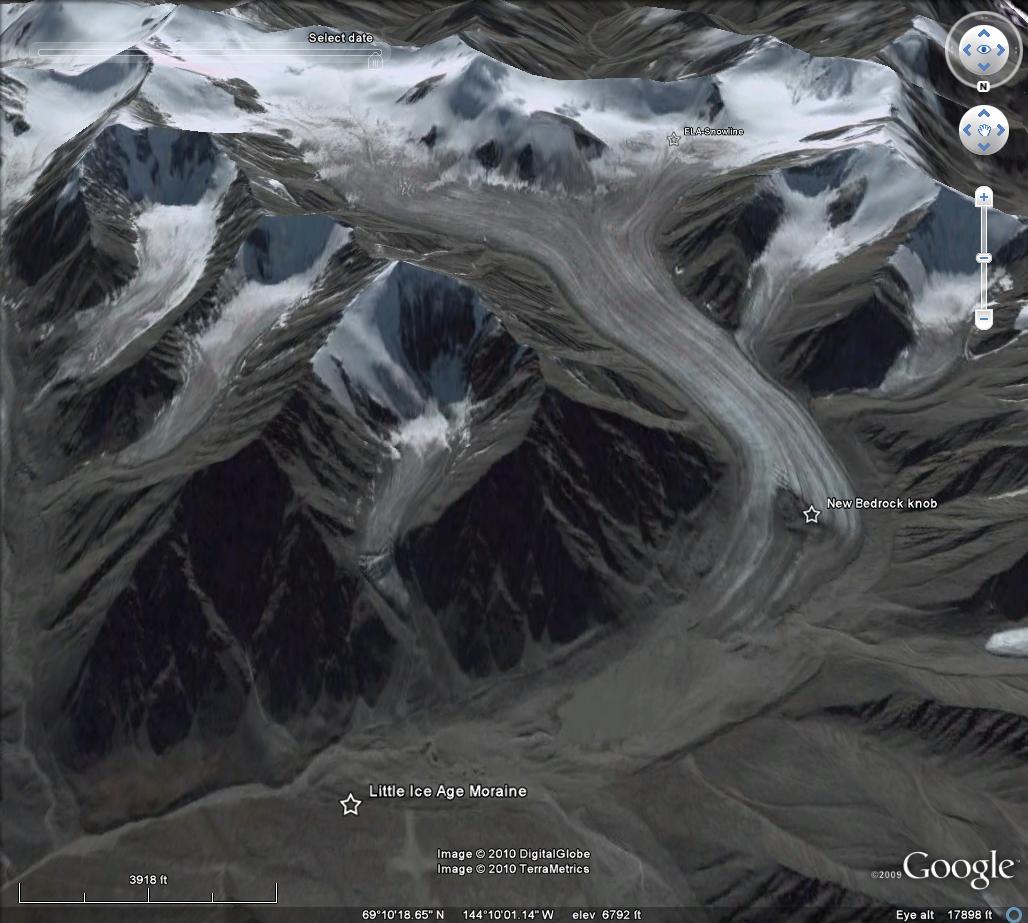
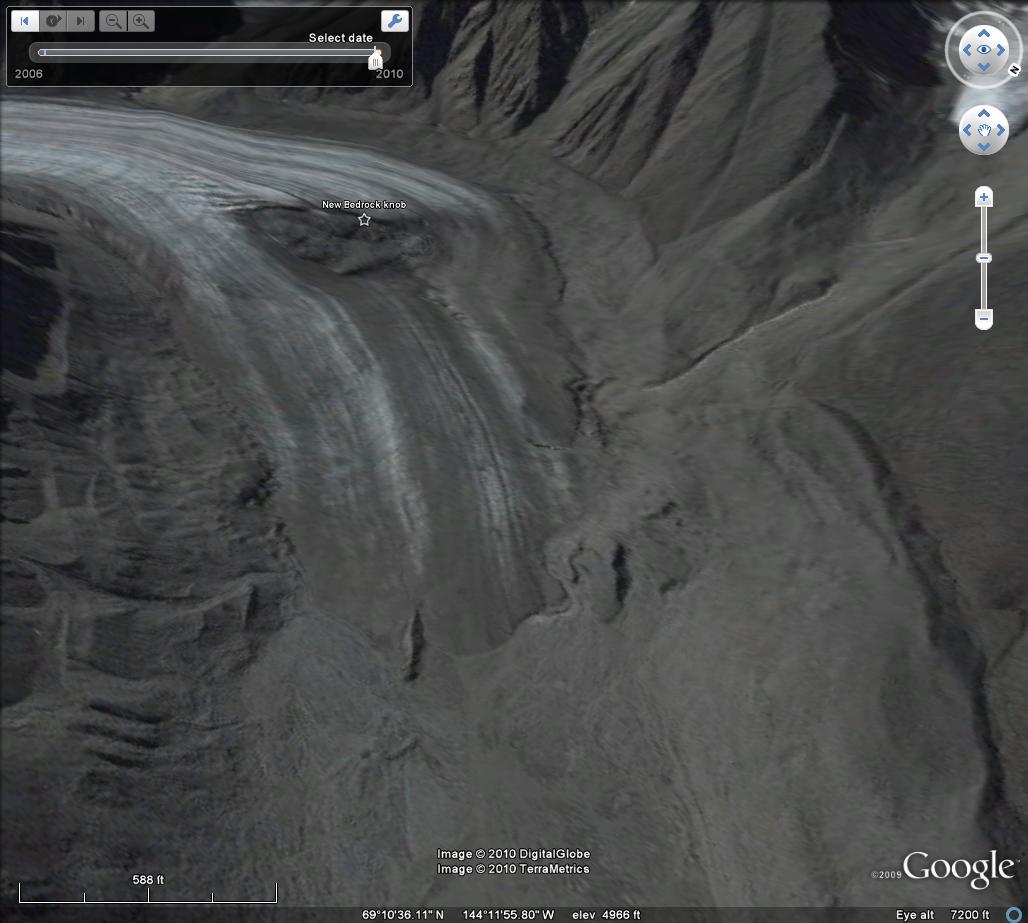
The Brooks Range of Alaska contains many alpine glaciers. You hear little about them as there are no large ones and none that can be seen from a cruise ship as in southern Alaska. Though I have worked on many Alaskan glaciers for extended periods, it has always been in southeast Alaska on the larger Juneau Icefield. Hey one month until my 30th field season. The climate is much different as well, with the Arctic Ocean instead of the Pacific Ocean having a more dominant role. The Beaufort Sea Gyre is the nearest major ocean current feature. The Okpilak Glacier drains into the Arctic Ocean and is a large glacier by Brooks Range standards. Matt Nolan at the University of Alaska-Fairbanks has done a beautiful of duplicating a picture taken by Ernest Leffingwell in 1906 with pictures he has taken in 1994, 2004 and 2007. Below is the 1906 picture and the 1994 image, and the 2006 Google Earth view of the glacier. The large retreat is evident, the lateral moraine from the Little Ice Age today stands high above the glacier on the mountain side. The glacier was still near its Little Ice Age maximum when Leffingwell took his picture. By 2006 the glacier had retreated just over 2 kilometers, note the Little Ice age moraine in the Okpilak Glacier image from Google Earth. There is a bedrock knob apparent in both the 1994 and 2006 image, though the ice thickness around the knob is much reduced by 2006. Also the lake at the end of the glacier in 1994 is quickly filling in with glacier sediment and by 2006 is not as prominent. Bernhard Rabus and Keith Echelmeyer-Univ. Alaska-Fairbanks had reported in 1998 that this glacier had retreated 420 meters between 1973 and 1993, 5% of its length and a rate of 20 meters per year. This is larger than the rate of 6-7 meters per year from 1907 and 1958 reported by Ed Sable, who photographed and surveyed the glacier in 1958. The rate of retreat has remained rapid. The 2006 image illustrates the problem, the ELA-snowline is too high and leaves only a small percentage of the glacier snowcovered at the end of the summer. This has been the pattern in recent decades and has led to a loss in average thickness of 30-40 cm per year. This loss though it is in a different climate region is remarkably similar to the losses observed on Lemon Creek Glacier. A view of the terminus of the glacier in 2006 from Google Earth indicates a bedrock knob that is 800 meters upglacier of the terminus. Below this knob there is little crevassing, the ice is thin, both suggesting stagnation and that this section of the glacier will soon be lost. As the sea ice to the north diminishes this area will be interesting to observe, as the potential is there for increased snowfall, while the open water will clearly lead to more warming as well.

Brady Glacier, Alaska begins a substantial retreat

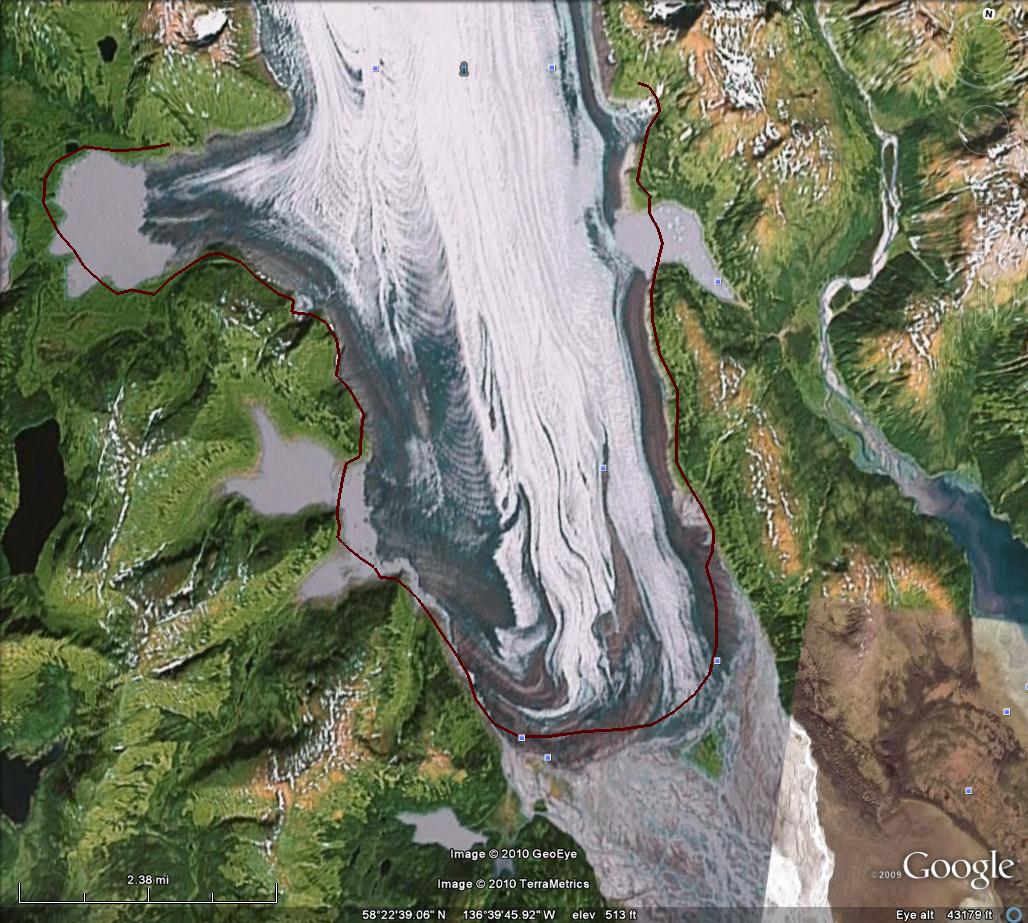
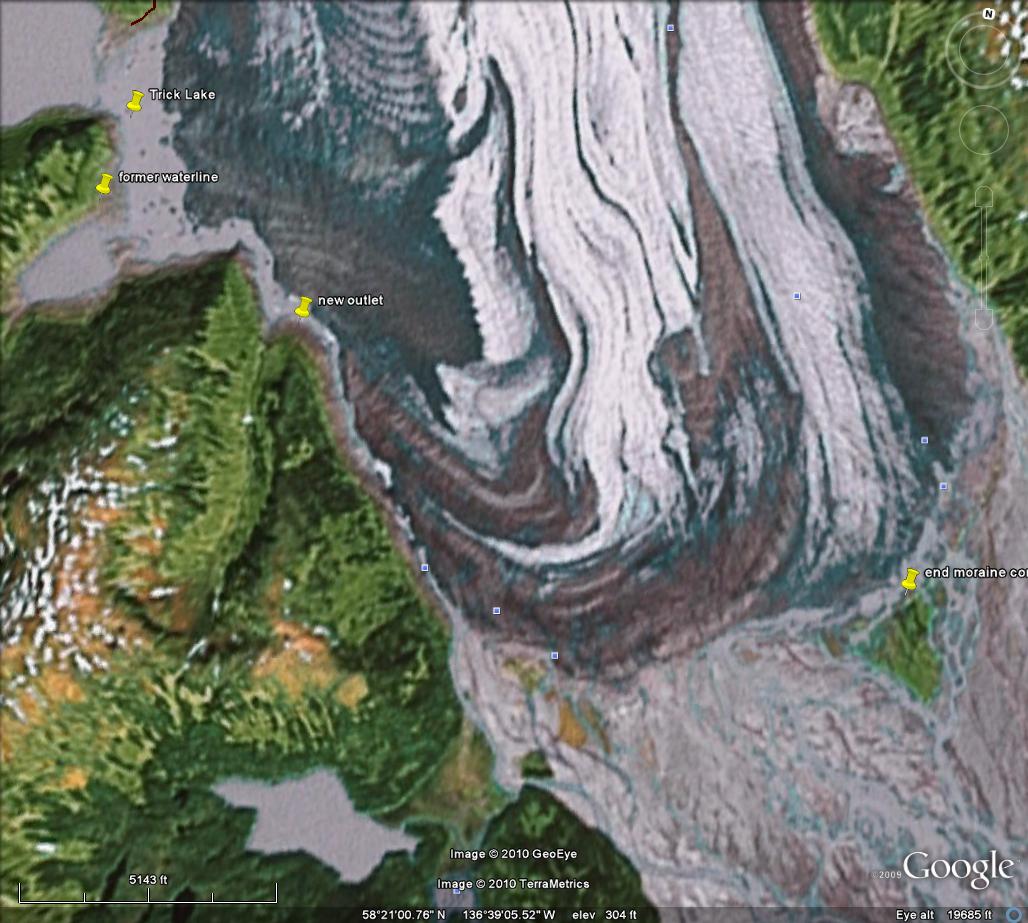
Brady Glacier is a large glacier at the south end of the Glacier Bay region, Alaska. When first seen by George Vancouver it was a calving tidewater glacier in 1794 filling Taylor Bay with ice. Brady Glacier ceased calving and advanced approximately 8 km during the 19th century (Klotz, 1899). As Bengston (1962) notes, the advance is likely another example of an advance following a change from tidal to non-tidal status rather than that of a more positive mass balance. Bengston (1962) further notes that the massive outwash plain at the terminus is primarily responsible for Brady glacier maintaining itself well other glaciers in the Glacier Bay region retreat. The ELA on this glacier is 800 m, the line above which snow persists even at the end of the average summer, this is one of the lowest in Alaska. The main terminus was still advancing in the 1960’s and 1970’s and has managed a 250-300 meter advance since the USGS map of the 1950’s. The main terminus is not advancing any longer and has begun to retreat, the retreat to date is less than 200 meters. The image below is the 1950’s map of the glacier. Brady Glacier is a complex glacier with many subsidiary termini. Echelmeyer, Arendt, Larsen and Harrison from the University of Alaska noted a thinning rate in the mid 1900’s of about 1 meter per year on the Brady Glacier complex. A comparison of 1950’s USGS maps and 2004-2006 satellite imagery indicate all six main subsidiary termini are retreating. The retreat ranges from 200 m in Abyss Lake, 200 m in Trick Lake to 1200 meters in North Deception Lake. The image below is the 2006 satellite image. Compare to the map, Deception has increased in size several fold. North Trick and South Trick Lake are now joined, Trick Lake. Of further interest is the stream draining Trick Lake that sneaks down the west margin of the glacier. This has enabled the water level in the glacier dammed Trick Lake to decline. Note the brown grey “Bath Ring” so to speak above the lake level. The outlet has also been marked in the image below. Pelto (1987) noted that the percentage of the glacier in the accumulation zone was right at the threshold for equilibrium. Subsequent warming of the climate in southeast Alaska and reduced glacier mass balance in the region has initiated this retreat.These termini are all closer to the equilibrium and would respond first to changes in mass balance due to recent warming and consequent measured thinning. This entire line of reasoning must be explored. The glacier is thinning substantially and would appear to be poised for a substantial retreat of the main termini, not just the subsidiary termini.
References not linked:
Bengston, K. recent behavior of Brady Glacier, Glacier Bay National Monument, Alaska. IAHS, 58, 59-77.
Klotz O. 1899: Notes on glaciers of southeast Alaska and adjoining territories. Journal of Geography, 14, 523-534.
Pelto, M. 1987. Mass balance of southeast Alaska and northwest British Columbia glaciers from 1976 to 1984: Methods and Results”. Annals of Glaciology 9: 189–193.

Dramatic Retreat of Antler Glacier, Alaska

antler glacier 2013
Above is a pair of Landsat images from 1984 and 2013 indicating the 2600 m retreat of Antler Glacier in that period. Below is a detailed analysis of the glacier.
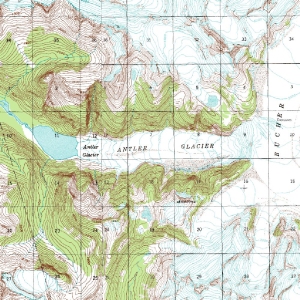
The Antler Glacier is an outlet glacier of the Juneau Icefield. It is actually a distributary glacier of the Bucher Glacier. It splits from the Bucher Glacier 8.5 km above where the Bucher Glacier joins the Gilkey Glacer as a tributary. In 1948 it spilled over the lip of the Antler River valley from the Bucher Glacier and flowed 6 kilometers downvalley to end in a proglacial lake. The glacier was 6200 m long in 1948. Note the comparison of the USGS map based on 1948 photographs and the 2005 satellite image below. Antler_Glacier mapantler glacierMy only chance to see this glacier in person was in August, 1981 scouting the geology along the Bucher Glacier. Antler Glacier disappeared downvalley into the fog and light snow flurries. The terminus not in site, and icefall to daunting to wish to descend. By 2005 the glacier has retreated almost to the lip of the valley, a 5400 m retreat which is 85-90% of it total length. The Lake -Antler Lake- has expanded from a length of 1.6 km to 4.2 km. The lake is a gorgeous sight, and the valley once filled by the glacier is now nearly devoid of glacier input. Antler_Lake_The retreat is largely a result of reduced flow from the thinning Bucher Glacier which no longer spills over the valley lip significantly. As the Bucher Glacier continues to thin, the Antler Glacier will cease to exist. This thinning is due to increased melting (ablation) of the glacier. The neighboring glaciers Field and Gilkey Glacier have also thinned and retreated considerably.