Mendenhall Glacier, Alaska Accumulation Zone Shrinks

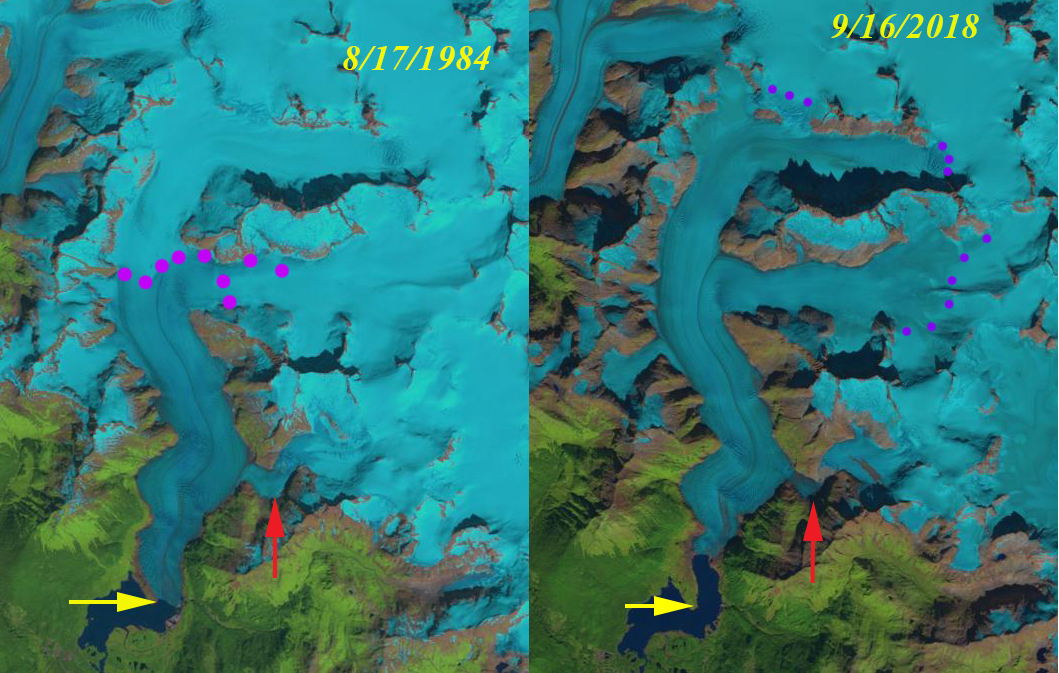
Mendenhall Glacier in Landsat images from 1984 and 2018.  Yellow arrows indicates 1984 terminus location, read arrow the Suicide Basin tributary and the purple dots the snowline.

Mendenhall Glacier is the most visited and photographed terminus in the Juneau Icefield region. The glacier can be seen from the suburbs of Juneau.  Its ongoing retreat from the Visitor Center and the expansion of the lake it fills is well chronicled.  Here we document the rise in the snowline on the glacier that indicates increased melting and reduced mass balance that has driven the retreat.  The change in snowline from 1984-2018 and the associated retreat are documented. The snowline as July begins in 2019 is already in the end of summer range.  In 1984 I had a chance to ski across the upper portion of this glacier. Photo736861842897_inner_76-402-615-387-84-752-620-741
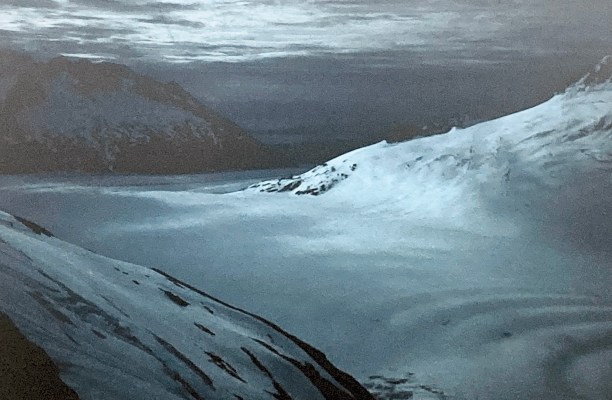
Top of the Mendenhall Glacier at 1500 m looking towards ocean in 1984.

Mendenhall Lake did not exist until after 1910, in 1948 it was 2.2 km across and by 1984 the lake was 2.7 km across.  Boyce et al (2007) note the glacier had two period of rapid retreat one in the 1940’s and the second beginning in the 1990’s, both enhanced by buoyancy driven calving. The latter period has featured less calving particularly in the last decade and is a result of greater summer melting and a higher snowline by the end of the summer, which has averaged 1250 m since 2003 vs 1050 m prior to that (Pelto et al, 2016).  In 2005, the base of the glacier was below the lake level for at least 500 m upglacier of the terminus (Boyce et al (2007).  This suggests the glacier is nearing the end of the calving enhanced retreat.  It is likely another lake basin would develop 0.5 km above the current terminus, where the glacier slope is quite modest.
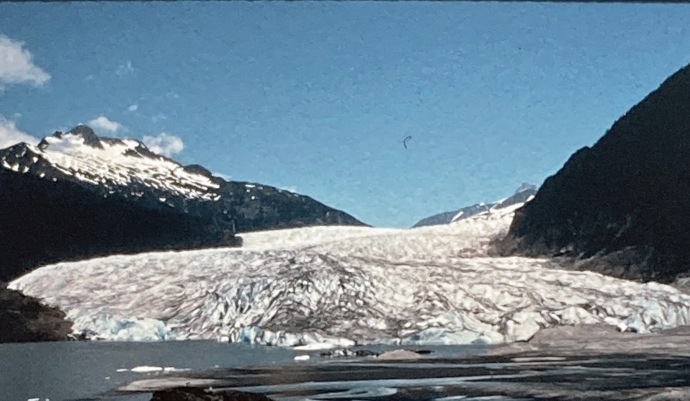
Photo736861827670_inner_51-268-606-268-57-633-606-633

Terminus of Mendenhall Glacier before the 1982 field season on the Juneau Icefield.

The glacier in 1984 ended at the tip of a prominent peninsula in Mendenhall Lake. The snowline is at 950 m. In 1984 with the Juneau Icefield Research Program we completed both snowpits and crevasse stratigraphy that indicated retained snowpack at the end of summer is usually more than 2 m at 1500-1600 m. The red arrow indicates a tributary that joins the main glacier, where Suicide Basin, currently forms. In 2014 the snowline in late August  is at 1050 m.  The terminus has retreated to a point where the lake narrows, which helps reduce calving. In 2015 the snowline is at 1475 m.  In  2017 the snowline reached 1500 m.  There is a small lake in Suicide Basin. In September 2018 the snowline reached 1550 m the highest elevation the snowline has been observed to reach any year.  In Suicide Basin the lake drained in early July. In 2018 Juneau Icefield Research Program snowpits indicates only 60% of the usual snowpack left on the upper Taku Glacier, near the divide with Mendenhall Glacier. On July 1. 2019 the snowline is already as high as it was in late August of 1984.  This indicates the snowline is likely to reach near a record level again.  The USGS and NWS is monitoring Suicide Basin for the drainage of this glacier melt filled lake. In 2019 the lake rapidly filled from early June until July 8, water level increasing 40 feet.  It has drained from July 8 to 16 back to it early June Level. The high melt rate has thinned the Mendenhall Glacier in the area reducing the elevation of the ice dam and hence the size of the lake in 2019 vs 2018.

The snowline separates the accumulation zone from the ablation (melting) zone and the glacier needs to have more than 60% of its area in the accumulation zone.  The end of summer snowline is the equilibrium line altitude where mass balance at the location is zero. With the snowline averaging 1500 m during recent years this leaves less 30% of the glacier in the accumulation zone. This will drive continued retreat even when the glacier retreats from Mendenhall Lake. The declining mass balance despite retreat is evident across the Juneau Icefield (Pelto et al 2013).  Retreat from 1984-2018 has been 1900 m.  This retreat is better known, but less than at nearby Gilkey Glacier and Field Glacier.

Mendenhall Glacier in Landsat image from 2014.  Yellow arrows indicates 1984 terminus location and the purple dots the snowline.

Mendenhall Glacier in Landsat image from 2015.  Yellow arrows indicates 1984 terminus location and the purple dots the snowline.

Mendenhall Glacier in Landsat image from 2017.  Yellow arrows indicates 1984 terminus location and the purple dots the snowline.

Mendenhall Glacier in Landsat image from 2019.  Yellow arrows indicates 1984 terminus location and the purple dots the snowline.

Pedersen Glacier, Alaska Rapid Retreat 1994-2015

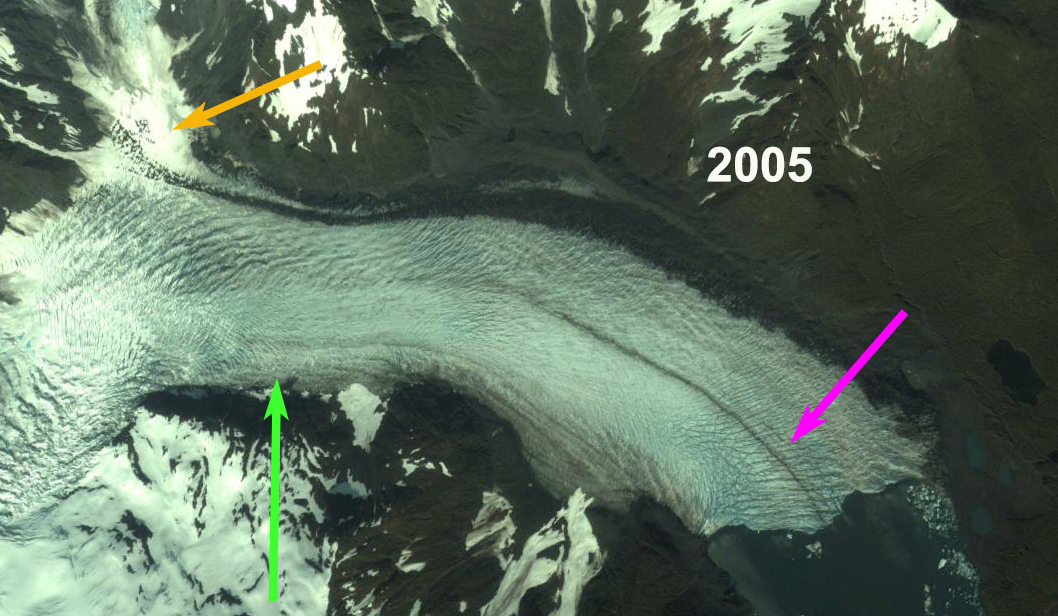
Pedersen Glacier Kenia Peninsula, Alaska retreat from Landsat images in 1994 and 2016. The red arrow indicates 1994 terminus, yellow arrow is 2016 terminus, orange arrow indicates northern tributary and purple dots indicates snowline. 

Pedersen Glacier is an outlet glacier of the Harding Icefield in Kenai Fjords National Park near Seward, Alaska. The glacier drops quickly from the plateau of the icefield through a pair of icefalls terminating in a lake at 25 meters above sea level.  The Harding Icefield glaciers that drain east are in the Kenai Fjords National Park, which has a monitoring program.  Giffen et al (2014) observed that from 1950-2005 all 27 glaciers in the Kenai Icefield region examined retreated.  Giffen et al (2014) observed that Pedersen Glacier retreated slow but steady from 1951-1986 at 706 m (20 m/a) and 434 m (23 m/year) from 1986-2005. Here we compare a 1994, 2013, 2015 and 2016 Landsat imagery illustrating a rapid increase in retreat rate from the previous periods.

In 1994 the terminus proglacial lake at the terminus is small and much of the terminus is on land.  The snowline in 1994 is at 550 m.  The tributary entering from the north, orange arrow, is 400 m wide as it reaches Pedersen Glacier.  In 2005 the Google Earth image below indicates extensive terminus crevassing, indicating substantial terminus velocity, and that the retreat is driven by calving.  In 2005 the lake is now 1.1 km long on its center axis.  By 2015 the glacier has retreated 2600 m since 1994, a rate of 125 m/year, much faster than before.  The snowline is average 800 m.  The northern tributary is now barely reaching the main glacier and has a width of 150 m. Note there was a medial moraine separating the tributary from the main glacier in 1994 and now this is merely a lateral moraine. This tributary is not particularly impacted by calving losses and indicates a rising snowline is also a source of mass loss for the glacier. A comparison of the 2013, 2015 and 2016 terminus indicates the recession has remained rapid.  The glacier is approaching the base of an icefall that would represent the inland limit of the lake and the end of rapid retreat.  The snowline in 2013 averages 850 m and is at 800 m on Sept. 30 2016. The glacier follows the pattern of nearby Bear GlacierYakutat GlacierHarris Glacier and the inital phase of retreat on Brady Glacier.

Pedersen Glacier Kenia Peninsula, Alaska retreat from Landsat images in 2013 and 2015. The red arrow indicates 1994 terminus, yellow arrow is 2015 terminus, green arrow indicates 2016 terminus and purple dots indicates snowline. 

Pedersen Glacier in 2005, note crevassing at the terminus, pink arrow. The northern tributary is indicated by orange arrow and green arrow indicates 2016 terminus position. 

Herbert Glacier Retreat, Alaska 1984-2016

herbert compare 2016

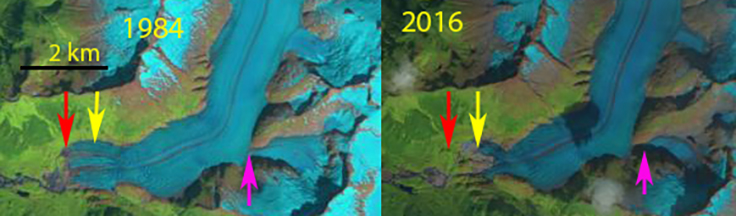
Comparison of Herbert Glacier terminus position in Landsat images from 1984 and 2016. Red arrow 1984 terminus, yellow arrow 2016 terminus and pink arrow a tributary that has separated. 

Herbert Glacier drains the west side of the 4000 square kilometer Juneau Icefield in Southeast Alaska.  It is the glacier just north of the more well known Mendenhall Glacier and just south of Eagle Glacier.  It is also the first glacier I ever visited, July 3, 1981 during my first field season with the Juneau Icefield Research Program.  Here we examine the changes from the August 17, 1984 Landsat 5 image to a Sept. 1, 2016 Landsat 8 image.

The glacier descended out of the mountains ending on the coastal plain in 1948.  In 1984 we examined the terminus of this glacier, which was in the small proglacial lake at 150 m.  Herbert Glacier has retreated 600 m since 1984.  The width of the terminus has also declined. The pink arrow indicates a tributary that no longer feeds the main glacier.  The retreat has not been enhanced by iceberg calving as is the case at Mendenhall Glacier. The overall retreat is also less than Eagle Glacier. In the Google Earth images below from 2005 and 2013 the retreat is 200 m, the terminus has fewer crevasses in 2013 suggesting a reduced velocity and faster retreat to come. The annual equilibrium line on the glacier has averaged 1150 m from 2003-2016. By contrast in August 1984 I skied to the top of the icefall and could see the snowline was at 1000 m. This leaves the glacier with an AAR of 0.45, too low to sustain equilibrium, retreat will continue. In 2015 and 2016 the snowline rose to over 1400 m by the end of the melt season, indicating two years of large mass loss, which will drive further retreat. The higher snow line elevation has been observed across the icefield Pelto et al (2013).herbert tsl

Transient snow line in Early Sept. of 2015 and 2016.  The snow line is at the top of the icefalls, at 1400-1450 m. 

herbert 2005

2005 Google Earth Image, red line is 2005 margin, yellow line is 2013.

herbert 2013 ge

2005 Google Earth Image, red line is 1984 margin, yellow line is 2005.herbert glacier 2012

Herbert Glacier Terminus in 2012