Vern Ritchie-Battle Glacier, British Columbia Retreat, Lake Growth, Snowline Rise

Vern Ritchie (VR) and Battle Glacier (B) in 1987 and 2019 landsat images.  Three proglacial lakes have expanded at Points 2-5. WN=West Nunatak Glaier, Y=Yakutat Glacier N=Novatak Glacier, purple dots indicate snowline and green arrows indicate glacier flow direction.

Vern Ritchie and Battle Glacier flow from the Alaska/Canada border of the St. Elias Mountains towards the Alsek River. In 1987 the two glaciers that share both an accumulation zone and a terminus area terminated in small proglacial lakes at 240 m.  The main flow path of  Battle Glacier connects to West Nunatak Glacier and Novatak Glacier, Alaska at a low elevation saddle at 750-800 m. The Vern Ritchie Glacier is 45 km long and extends north parallel to the border to an elevation of 1800 m. A portion of this higher elevation accumulation is separated by a nunatak at Point 1  at ~850 m and joins the Battle Glacier 20 km from the terminus. Here we utilize Landsat images from 1987-2019 to identify the impact of climate change on these two glaciers. Trussel et al (2015) noted an extremely high thinning rate of 4.4 m/year on the adjacent Yakutat Glacier from 2000-2010, and it retreated 7 km losing 45 km2, of area from 2000-2018 (Pelto, 2018). Glaciers of the Glacier Bay region lost ~0.6 m/year from 1995-2011 (Johnson et al 2013).

Un 1987 Vern Rithcie Glacier’s northern terminus near Point 4 rested on an outwash plain. The southern terminus near Point 3 terminated in a 2.5 km2, proglacial lake. Battle Glacier terminated in a narrow fringing proglacial lake with an area of less than 1 km2.  The divide between Battle Glacier and West Nunatak Glacier was in the ablation zone.  The connection at Point 6 to Novatak Glacier is km wide. The snowline in 1987 on Vern Ritchie Glacier was at 1000 m.  In 1998 both lakes had expanded significantly as thinning and retreat accelerated.  The snowline is at 800 m in early August on Vern Ritchie Glacier and is at 750 m on Battle Glacier covering the divide with West Nunatak Glacier. At Point 6 the connection to Novatak Glacier remains wide. By 2015 a proglacial lake had formed at the northern terminus at Point 4 with an area of ~2 km2. The southern terminus glacial lake has expanded to ~6 km2, and has several large icebergs evident. Battle Glacier at Point 5 now terminated in a ~5 km2 lake that has a few icebergs. The snowline is at 1100 m on Vern Ritchie Glacier.

In 2018 and again in 2019 record snowline elevations since 1946 were noted at Taku Glacier near Juneau, AK (Pelto 2019).  In 2018 the nearby Lowell Glacier exhibited a substantial snow swamp (NASA, 2019).  The snowline was the highest observed on Vern Ritchie Glacier at 1340 m. At Point 6 the connection to Novatak Glacier continues to narrow.  The Vern Ritchie northern terminus lake has expanded to 2.7 km2.  The southern terminus lake in 2019 has an area of ~7 km2, a 225% increase since 1987, and again has several icebergs.  Battle Glacier has receded to Point 2 a retreat of 3800 m since 1987 and the lake now has an area of ~6 km2 . The lake also has several significant icebergs.

The main portion of Battle Glacier is fed by flow from the divide region with West Nunatak and Novatak Glacier, which is no longer retaining accumulation on a consistent basis and this portion will melt away.  The connection to Vern Ritchie at Point 1 remains wide, but there is a sill here, that is becoming more evident indicating a reduction in flow.  Vern Ritchis continues to retain snowpack on the upper reaches of the glacier. The retreat of this glacier is less spectacular than nearby Melbern Glacier or Yakutat Glacier.
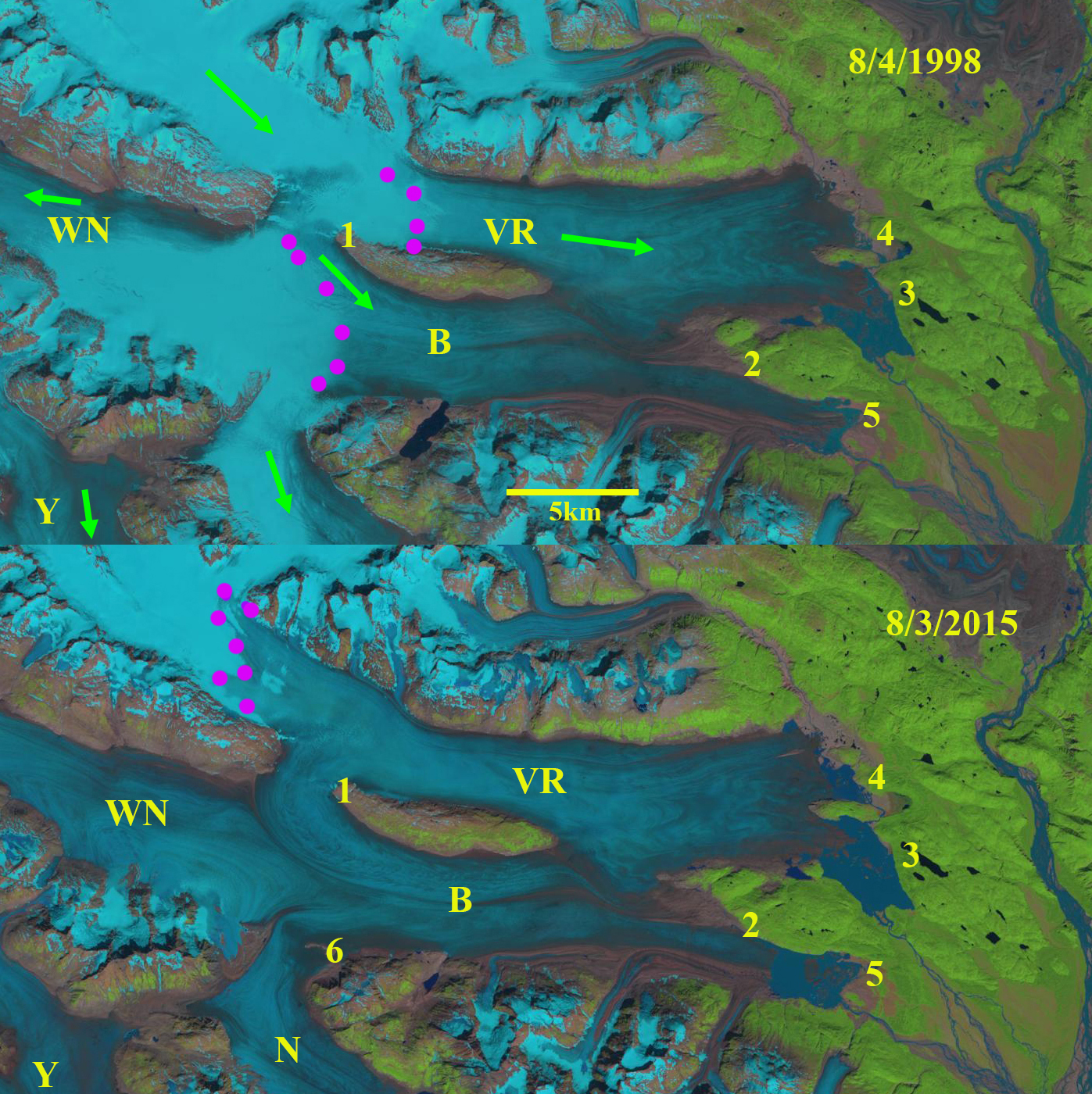
Vern Ritchie (VR) and Battle Glacier (B) in 1998 and 2015 landsat images.  Three proglacial lakes have expanded at Points 2-5. WN=West Nunatak Glaier, Y=Yakutat Glacier N=Novatak Glacier, purple dots indicate snowline and green arrows indicate glacier flow direction.

Canada Topographic map of the terminus region from Atlas of Canada 

Alsek Glacier, Alaska Retreat & Glacier Separation

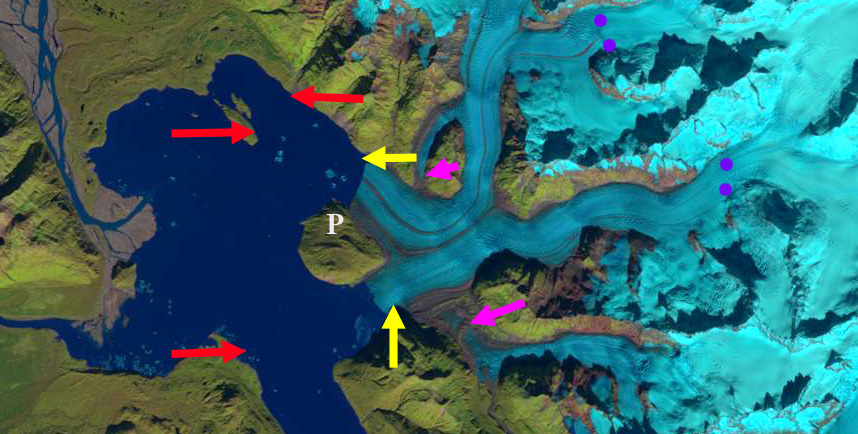
Alsek Glacier in a 1984 Landsat image and 2017 Sentinel image.  Red arrows indicate 1984 terminus, yellow arrows 2017 terminus location, pink arrows tributaries that joined the glacier in 1984 and purple dots the snowline.  AR=Alsek River, G=Gateway Knob and P=Prow Knob.

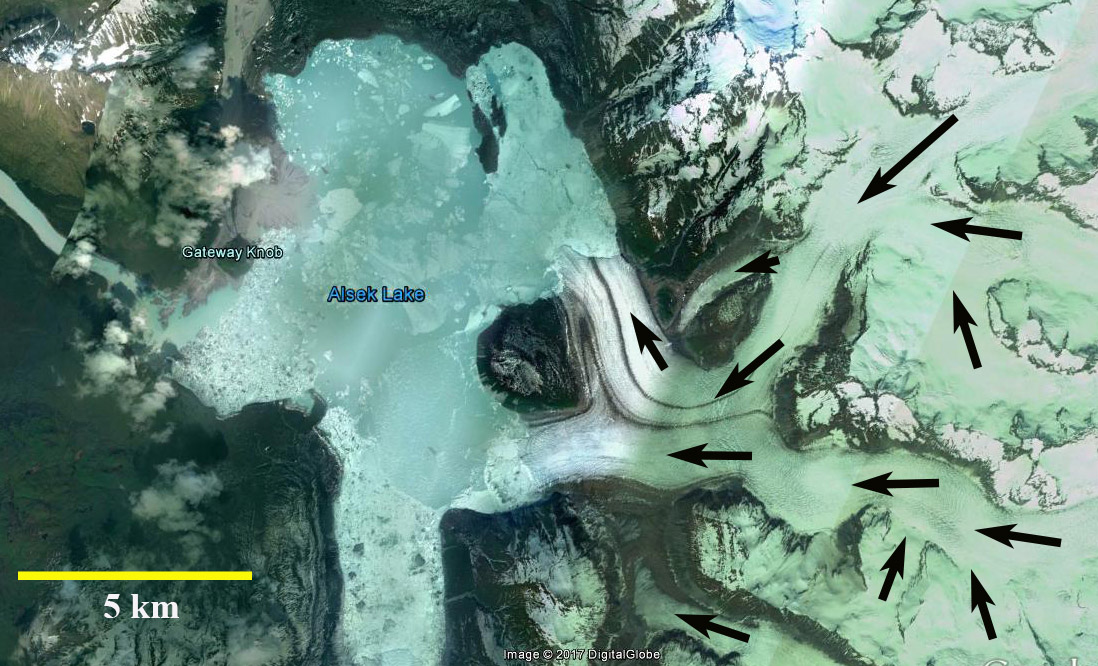
Alsek Glacier descends from the Fairweather Range terminating in Alsek Lake on the coastal plain. The glacier terminated at Gateway Knob (G) near the outlet of Alsek River from Alsek Lake in the early part of the 20th century (Molnia, 2005). At that time it had a joint terminus with Grand Plateau Glacier. The glacier retreated 5-6 km by 1984 along the central margin from Gateway Knob. The glacier remained connected with the Grand Plateau Glacier in 1984. In 1960 the glacier had a single terminus joining downstream of an unnamed island in Alsek Lake, that Austin Post told me reminded him of a boats prow. This “Prow Knob” (P) much like Gateway Knob a century ago stabilizes the terminus. Retreat from this knob will lead to an increase in retreat of Alsek Glacier. Here we examine the change from 1984-2017 with Landsat and Sentinel imagery.

In 1984 the terminus location is denoted with red arrows it has separated into two termini on either side of “Prow Knob”. The northern terminus tongue is located on a narrow island on the north side of Alsek Lake. The southern tongue merges with the northern arm of Grand Plateau Glacier. Two tributaries at the pink arrows merge with the main glacier. In 1984 the snowline is at 900 m. By 1999 the northern tongue has retreated from the narrow island, which exposes the terminus to enhanced calving. The southern terminus has separated from the Grand Plateau Glacier. In 1999 the snowline is at 900 m. By 2013 the northern terminus has retreated almost to the northern end of “Prow Knob” and the southern terminus is directly south of “Prow Knob” in a 1.8 km wide channel. By 2016 two tributaries of Alsek Glacier are fully detached from the glacier, pink arrows. In 2017 the northern terminus tongue has retreated 3.7 km since 1984 into the 2.0 km wide channel on the northeast side of “Prow Knob”. The center of the southern terminus has retreated 3.0 km since 1984 and remains in the channel on the south side of “Prow Knob”. The length of the calving front has declined from an 8 km long calving front in 1984 to a 4 km calving front in 2017. In both 2016 and 2017 the snowline is at 1200 m, at this elevation the mass balance of the glacier will be significantly negative driving further retreat. Larsen et al (2007) indicate thinning in the lower Alsek Glacier of 3+m/year in the last half of the 20th century, indicating the glacier is a in a long term adjustment to climate change.  The retreat of this glacier is similar to that of Walker Glacier and North Alsek Glacier, and less than that of the northern arm Grand Plateau Glacier to which it was connected in 1984 or Yakutat Glacier a short distance north.   

Alsek Glacier in a 1999 Landsat image .  Red arrows indicate 1984 terminus, yellow arrows 2017 terminus location, pink arrows tributaries that joined the glacier in 1984 and purple dots the snowline.   P=Prow Knob.

Alsek Glacier in 2014 Google Earth Image,indicating flow directions. 

Alsek Glacier in a 2016 Landsat image .  Red arrows indicate 1984 terminus, yellow arrows 2017 terminus location, pink arrows tributaries that joined the glacier in 1984 and purple dots the snowline.   P=Prow Knob.


North Fork Grand Plateau Glacier, Alaska-Spectacular 3 km Retreat 2013-15

south alsek glacier compare

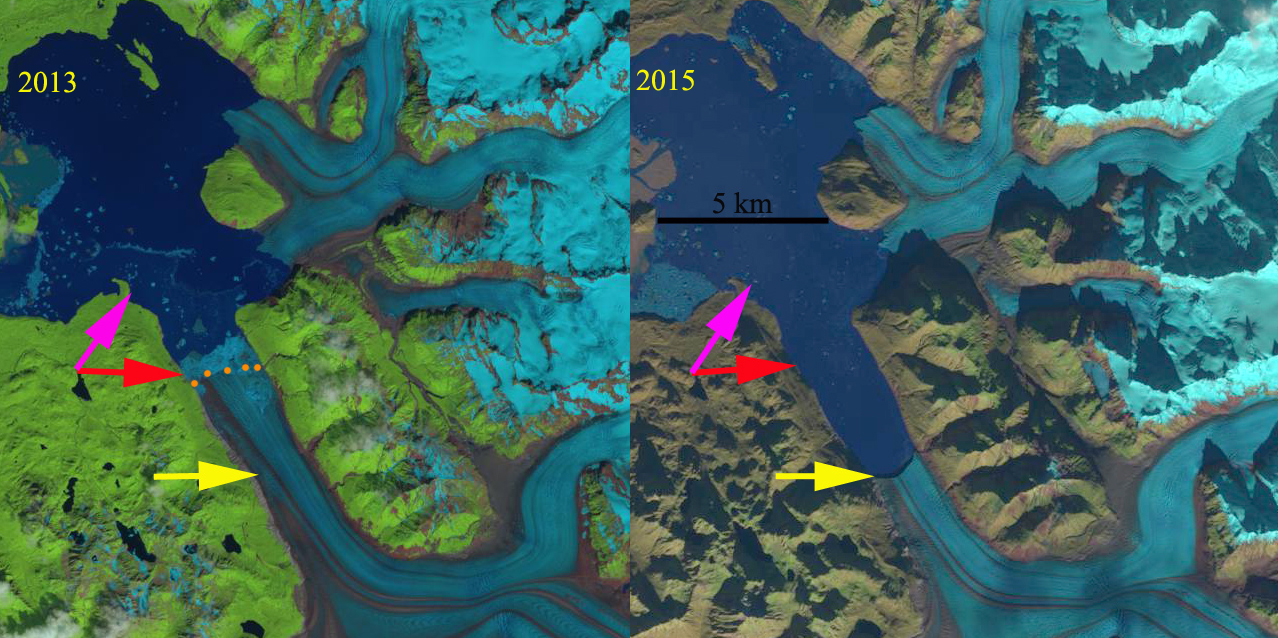
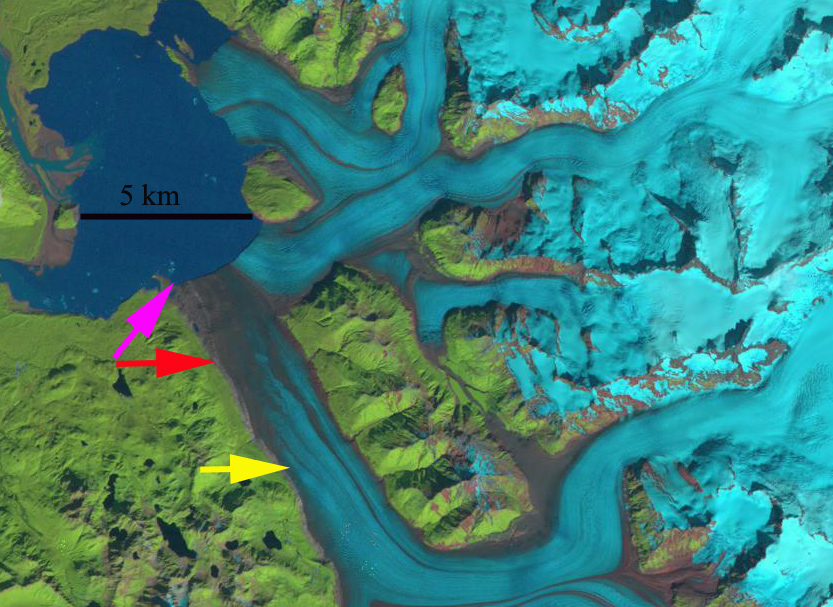
North Fork Grand Plateau Glacier comparison in 2013 and 2015 Landsat images.  Illustrating the rapid retreat and lake expansion in just two years. Pink arrow is 1984 terminus, red arrow is the 2013 terminus and yellow arrow 2015 terminus. The orange dots are the 2013 terminus. 

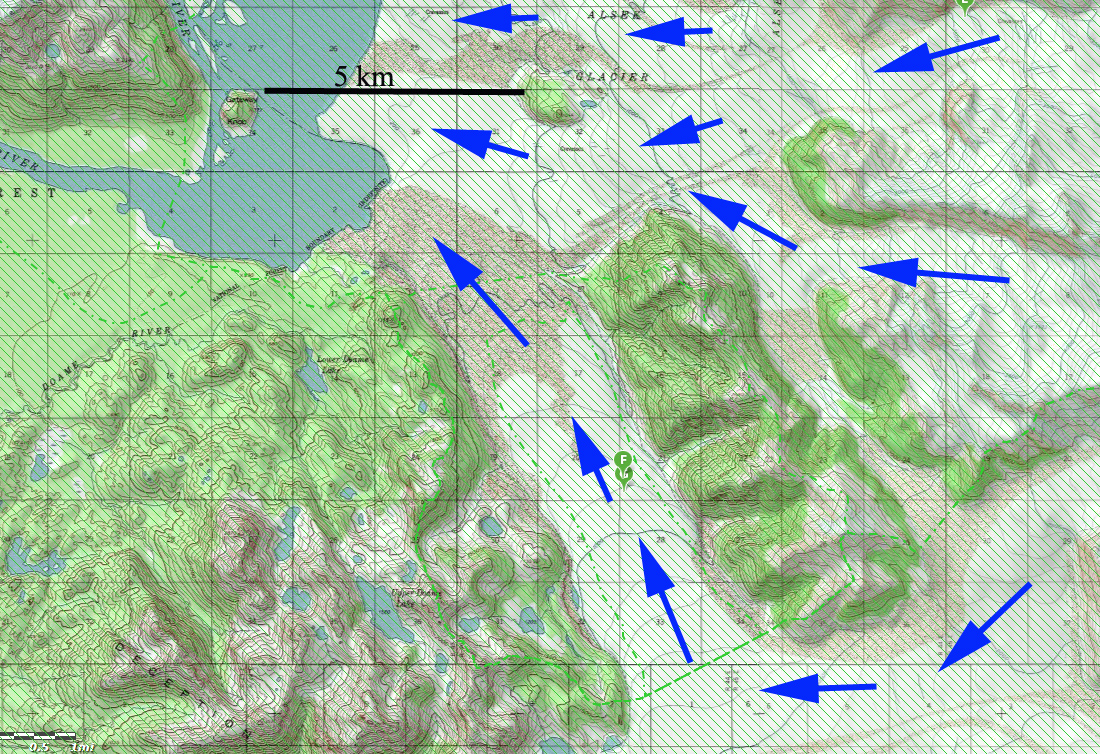
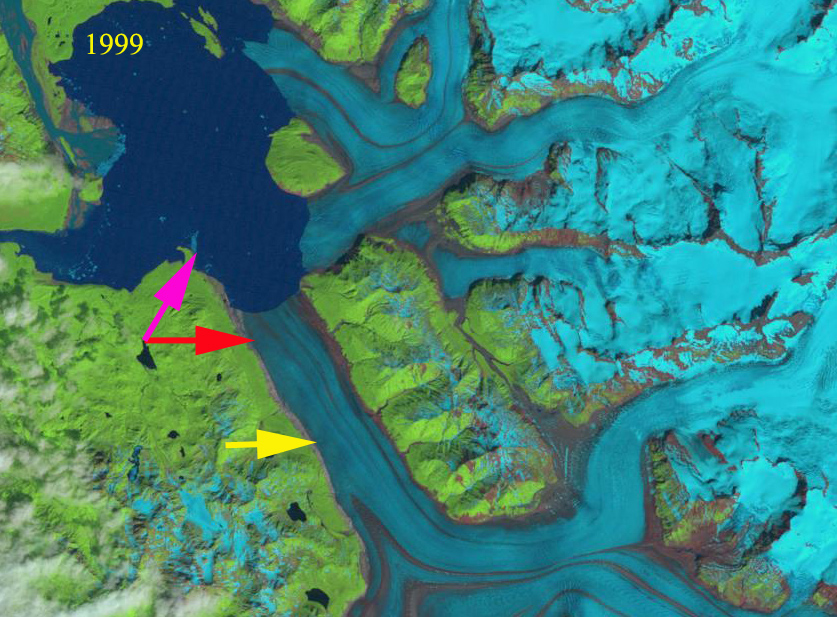
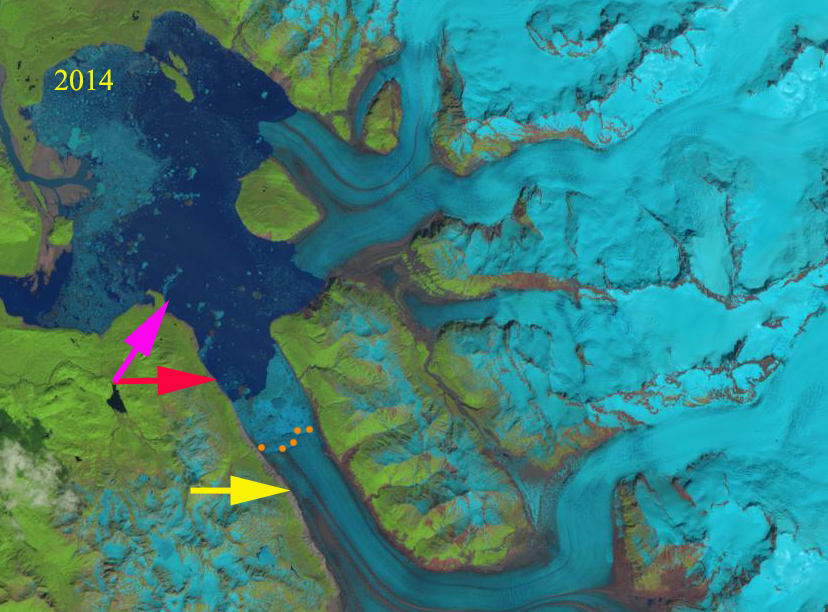
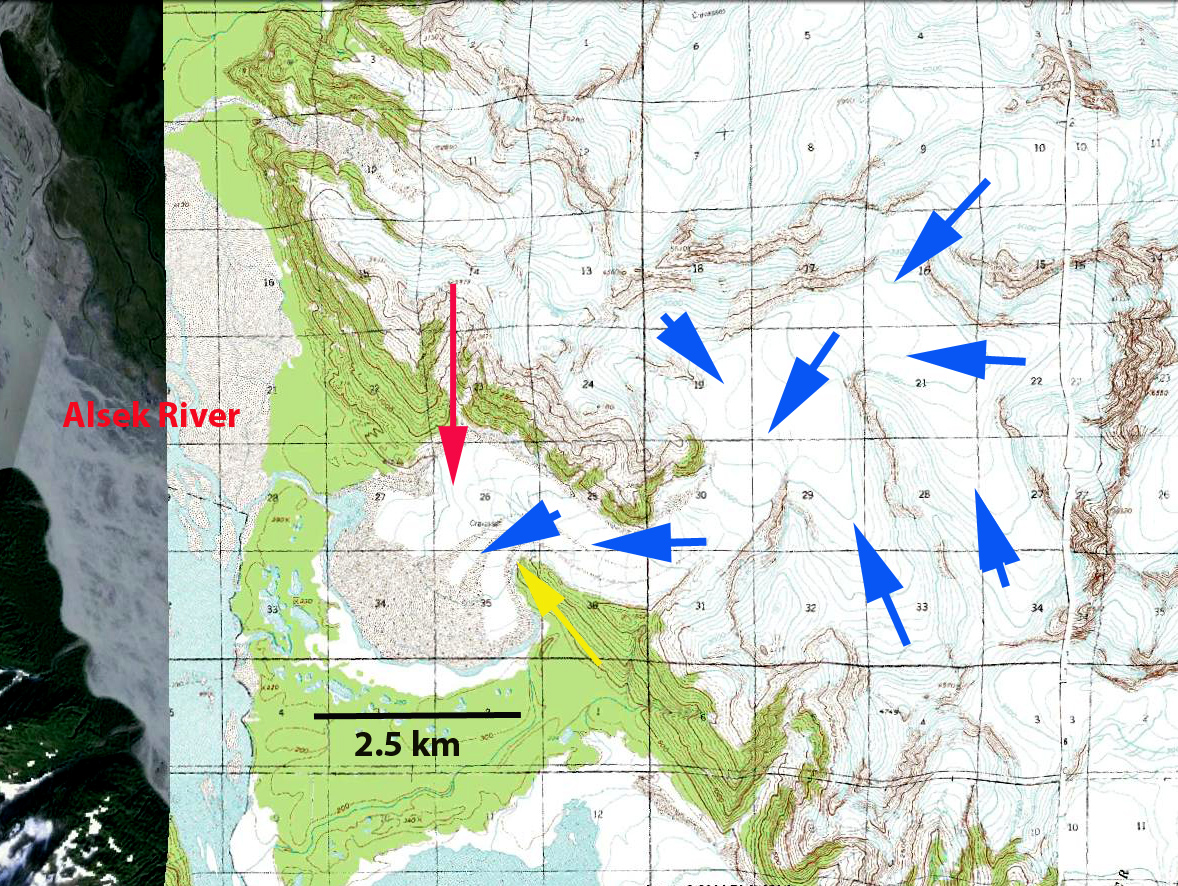
The Alsek Glacier is a large glacier draining into Alsek Lake and the Alsek River in southeast Alaska  Its neighbor the Grand Plateau Glacier has one fork  flows north and joins the Alsek Glacier terminating in Alsek Lake. The USGS topographic map compiled from a 1958 aerial image indicates a piedmont lobe spread out into a proglacial lake that is less than 3 km wide, with a combined ice front of the Alsek Glacier and North Fork Grand Plateau Glacier.. There is a 10.5 km wide calving front in the lake.  By 1984 the glacier had separated into a northern and southern calving front on either side of an island and had a 13 km wide calving front.   Here we focus on the southern lobe, which is comprised of a lobe of  the Alsek Glacier and a the North Fork Grand Plateau Glacier that merges with Alsek Glacier.  From 1984 and 1999 the two lobes separated as the North Fork retreated 2.2 km.  From 1999 to 2013 the North Fork retreated 1.5 km up a newly forming southern arm of Alsek Lake.  The retreat over the 30 period of 3.7 kilometers averaged ~120 meters/year. Landsat imagery in 2013 and 2014 indicate extensive calving from the North Fork Grand Plateau Glacier.  From 2013 to 2015 the terminus has retreated 3.0 km, 1.5 km/year.  This is likely the fastest retreat rate in recent years of any Alaskan glacier. The calving front in Alsek Lake has been reduced to 5.4 km in three separate sections.

The retreat has been similar in timing to nearby Alsek River watershed glaciers Walker GlacierEast Novatak Glacier and North Alsek Glacier..  The rapid retreat is enhanced by calving in proglacial lakes, a common issue increasing area loss of Alaskan glaciers.  Yakutat Glacier is an example of rapid lake expansion. In the case of Yakutat Glacier unlike the Alsek or Grand Plateau Glacier the glacier lacks any high elevation accumulation zone and cannot survive without an accumulation zone (Trüssel et al 2015).  Grand Plateau Glacier and Alsek Glacier both have large accumulation areas above 2000 m, that are well above the snowline at all times.  The Alsek River is a destination for sockeye salmon fishing and river rafting, see Chilkat Guides or Colorado River and Trail Expeditions.  Continued expansion of lake area as glaciers retreat in the watershed, is changing the nature of the Alsek River.

alsek map

USGS Topographic map of region from 1958 aerial images indicating merging of Alsek Glacier and North Fork Grand Plateau Glacier. 

alsek 1984

1984 Landsat image indicating terminus locations. Pink arrow is 1984 terminus, red arrow is the 2013 terminus and yellow arrow 2015 terminus.

alsek 1999

1999 Landsat image indicating terminus locations. Pink arrow is 1984 terminus, red arrow is the 2013 terminus and yellow arrow 2015 terminus.

alsek 2014

2014 Landsat image.  indicating terminus locations. Orange dots indicate the ice front. Pink arrow is 1984 terminus, red arrow is the 2013 terminus and yellow arrow 2015 terminus.

North Alsek Glacier Retreat-Lake Formation, Alaska

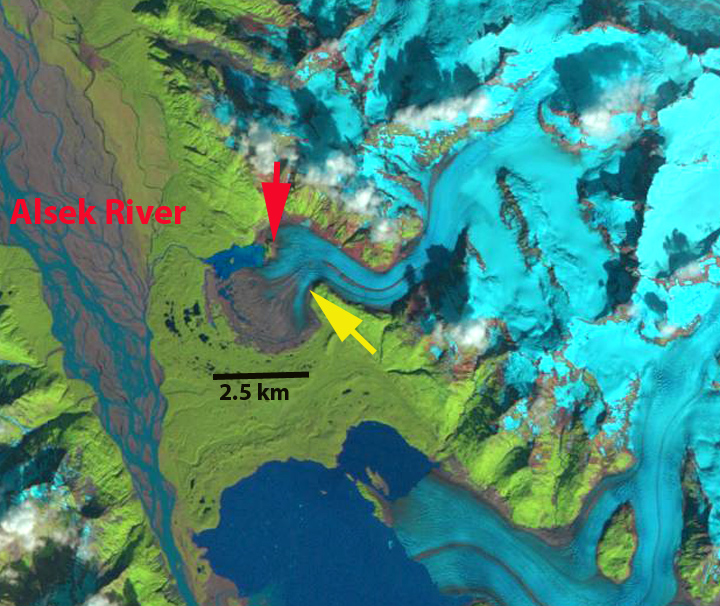
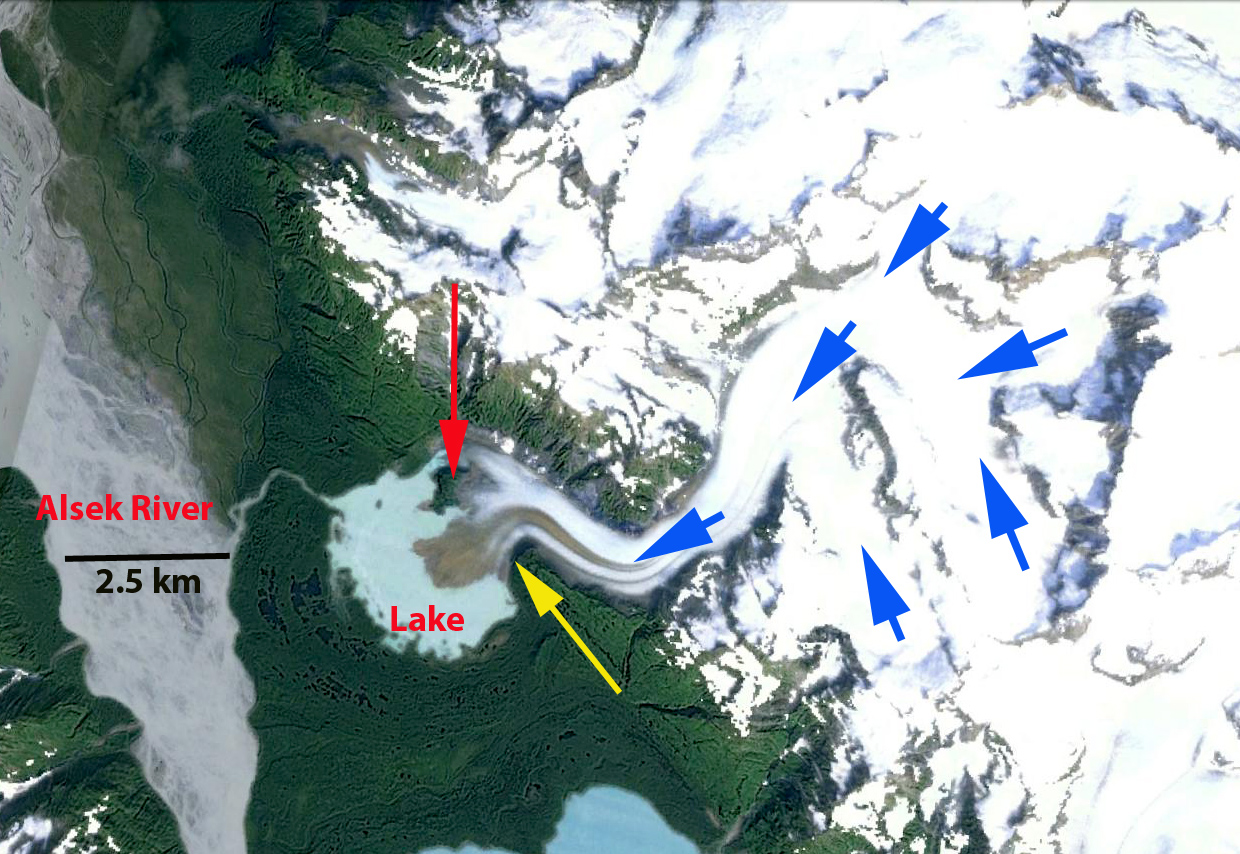
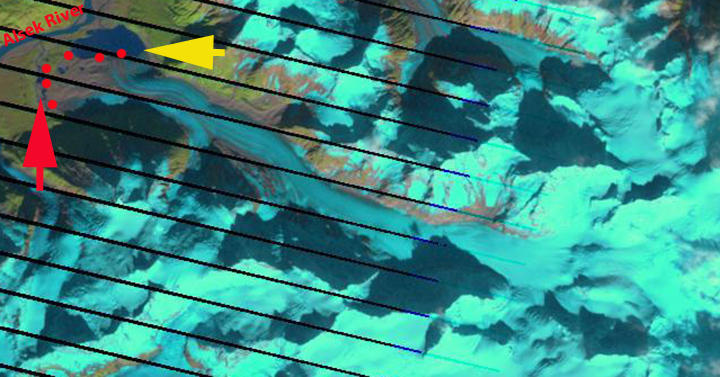
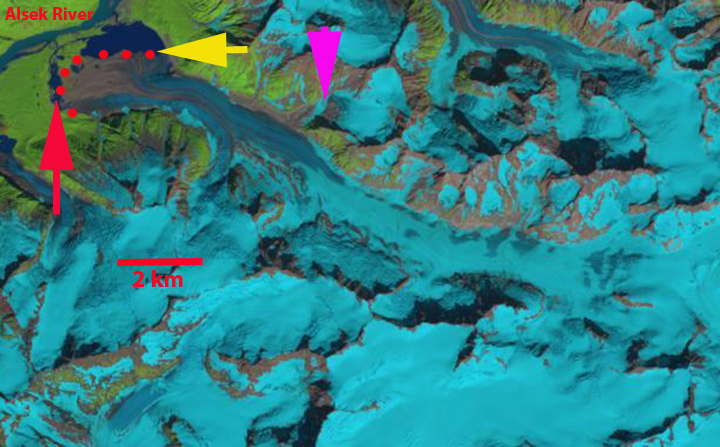
The Alsek Glacier is a large glacier draining into Alsek Lake and the Alsek River. The first glacier upriver of Alsek Glacier flowing from the east and ending on the Alsek River valley floor is an unnamed glacier, here named North Alsek Glacier. The USGS topographic map compiled from a 1958 aerial image indicates a piedmont lobe spread out on the Alsek River lowland, without a lake, and a series of moraine ridges between the glacier terminus and the Alsek River. This glacier drains a series of peaks of 2000 m in elevation and drains directly west toward the Alsek River, blue arrows indicate glacier flow.

alsek north ge
USGS map indicating no lake at end of glacier.

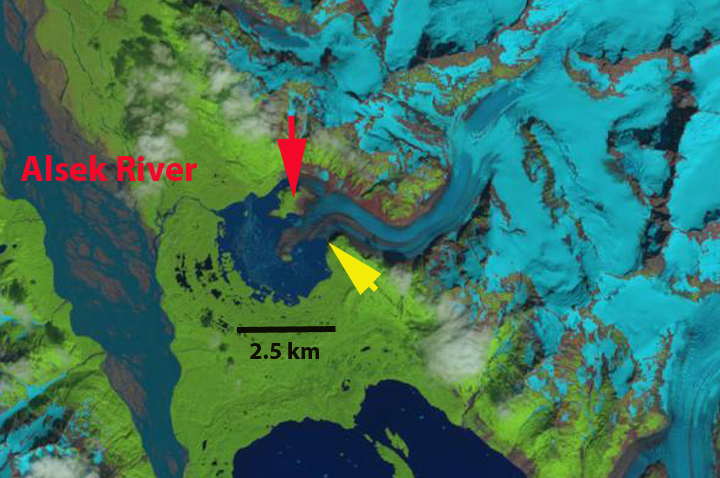
Here we examine Landsat imagery to identify the change in terminus position of the glacier from 1984-2013. In 1984 a small lake has developed along the north shore of the lake that is 1000 m by 500 m. The glacier has retreated to a newly exposed knob, possilby and island, at the red arrow. The red arrow in each image indicates the location of this knob, the yellow arrow indicates the 2013 terminus location on the south side of the glacier near the end of a peninsula. There is no lake downglacier of the yellow arrow in 1984. By 2011 the glacier retreat has led to development of a substantial lake that is 2.5 km north to south and 1.1 to 1.5 km side from east to west. In 2013 the central tongue of the glacier has continued to thin and breakup. The northern margin has retreated 2300 m from 1958 to 2013, the central margin 1500 m and the southern margin 1400 m. The majority of the retreat at the northern margin occurred between 1958-1984, while nearly all the retreat occurred after 1984 for the central and southern portion of the glacier. The glacier will continue to retreat out of the lake basin. The retreat has been nearly identical to nearby Walker Glacier that also had a piedmont lobe, but less than the nearby East Novatak Glacier and Yakutat Glacier.

alsek north 1984
1984 Landsat image

alsek north 2011
2011 Landsat image

alsek north 2013
2013 Landsat image

alsek north gei
Google Earth image from 2007

Walker Glacier Retreat and Lake Development, Alaska

Walker Glacier terminates adjacent to the Alsek River, a popular rafting river route. Many rafting trips visit Walker Glacier since it is close to river, has a low slope and few crevasses.
walker glacier ge
Google Earth Image

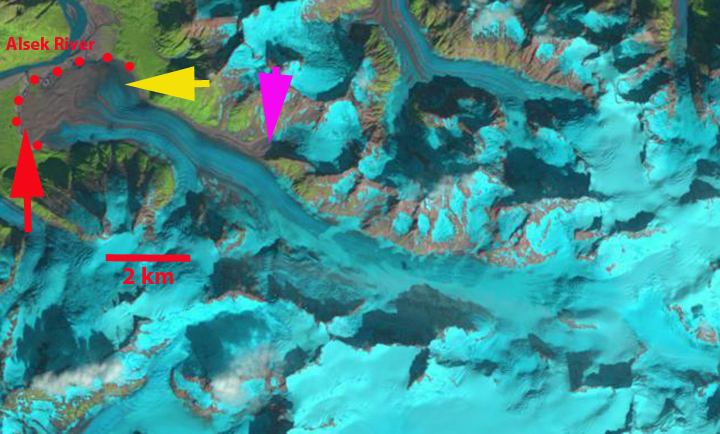
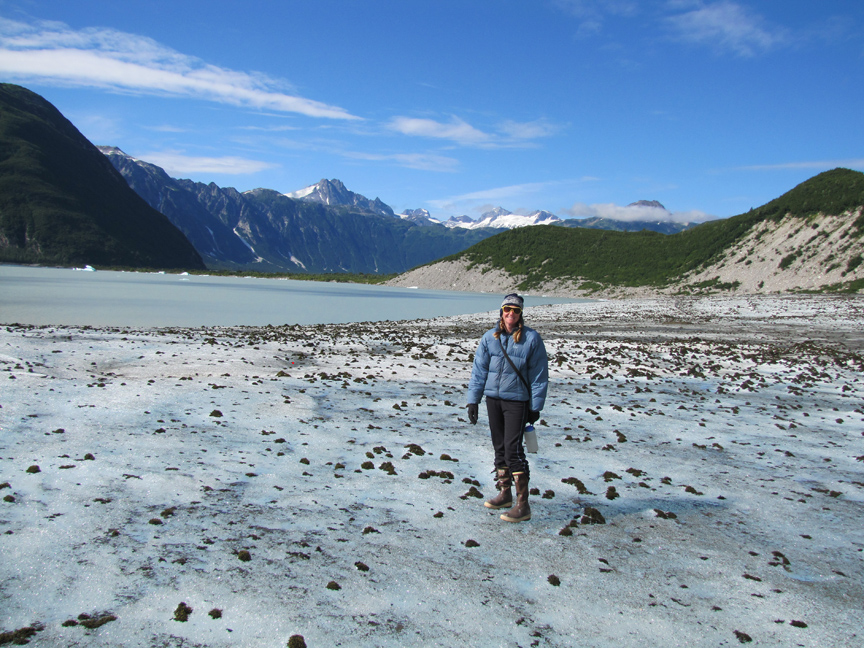
In 1984 the glacier ended as a piedmont lobe separated from the river by meters. Today the terminus has retreated into a lake basin at the terminus. Here we examine Landsat imagery from 1984, 2011 and 2013 to identify retreat and lake development. In 1984 there is no lake at the terminus, red dots indicate glacier margin. The terminus particularly on the northwest side is debris covered. The yellow and red arrows indicate locations where the terminus is in 2013 and where new lakes have developed. The pink arrow indicates the end of a tributary that has fed the Walker Glacier. By 2004 the Google Earth imagery indicates a lake that is 400 m wide and 1500 m long. By 2011 the lake on the north side of the terminus is well developed, yellow arrow, but on the west side of the terminus no lake exists, red arrow. By 2013 the new lake is 750 m wide and 1800 m long. The glacier has retreated 800 m since 1984 on the north side, yellow arrow. A narrow lake has now developed on the west side. The combination of lakes indicates that the entire terminus lobe in the lake basin will soon be lost. The terminus remains quite debris covered, has a gentle slope and is relatively uncrevassed; hence, it is stagnant and will collapse-melt away. The last image is from Colorado River & Trail Expeditions , that shows low glacier slope looking north across new lake. This is similar to the collapse of glacier termini in proglacial lakes such as nearby East Novatak Glacier, Grand Plateau Glacier and Yakutat Glacier. walker glacier 1984
1984 Landsat image

walker glacier 2011
2011 Landsat image

walker galcier 2013
2013 Landsat image

walker glacier terminus
Google Earth image from 2004

Walker glacier lake
Colorado River & Trail Expeditions image-note low glacier slope looking north across new lake.

East Novatak Glacier Retreat, Alaska

Novatak Glacier and a large unnamed south-flowing glacier to the east, here designated as East Novatak Glacier, were connected when first mapped by the International Border Commission in the 1906-08 period. By the 1950’s maps indicated the Novatak and East Novatak Glacier have separated, with a lake (A) developing between them. Here we examined 1984-2013 Landsat images to determined changes over the last 30 years.
east novatak map
Map of East Novatak Glacier area.

east Novatak ge
Google Earth image

East Novatak Glacier ended in a lake (B) in 1984, this lake then drained a short distance south to the Alsek River. The glacier was separated from the main Novatak Glacier by 3.5 km. In each image the 1984 terminus is marked by red arrow and 2013 image by yellow arrow, N marks the location of a nunatak that develops after 1984. In 1987 glacier retreat has connected the northern and southern half of B Lake. Lake A is still getting glacier runoff leading to a lighter blue color. By 2010 A Lake is no longer getting much glacier runoff and the water color is much darker than B Lake. A nunatak has emerged as well due to thinning ice. East Novatak Glacier has retreated out of the lake basin on the low lying plain, and into the mountain valley. In 2013 the terminus has narrowed and has retreated 2.5 to 3 km since 1984. The glacier is now separated from the retreating Novatak Glacier by 6 km. The tributary that used to connect to the main glacier and is partly obscured by the red arrow, now ends well short of the East Novatak Glacier. Most of the East Novatak Glacier is below 1000 m in elevation, which has been the recent snowline elevation. The retreat of this glacier like that of nearby Yakutat Glacier, indicates how suscpetible the Alaskan glaciers in the region with lower elevation accumulation zones are to our warming climate (Truessel et al, 2013). The retreat is similar to Grand Plateau Glacier, but that glacier does have high elevation accumulation areas, that will allow that glacier to survive.east novatak 1984

east novatak 1987

east novatak 2010

east novatak 2013