Cape Longing, Antarctica Transitioning to Island via Glacier Retreat

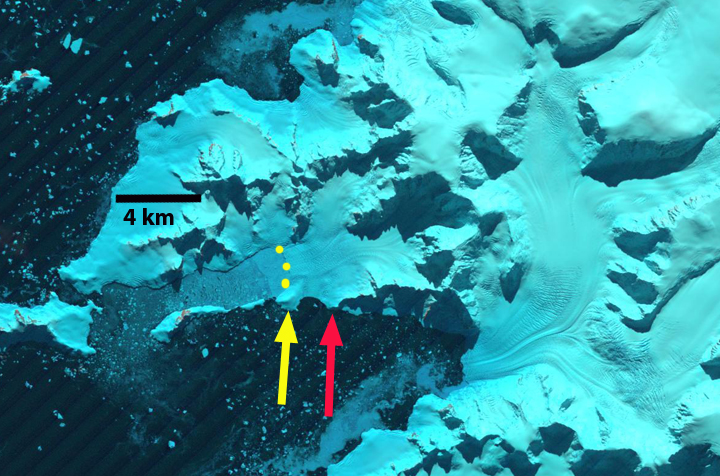
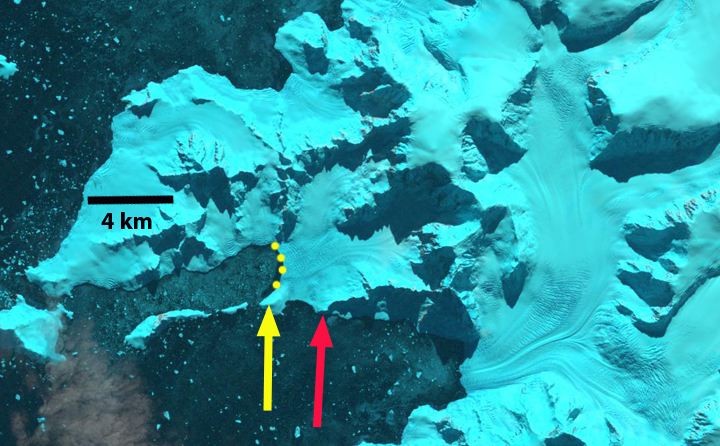
Cape Longing, Antarctica in 2001 and 2018 Landsat images. Point A-G are at specific locations. Yellow dots mark the margin of the glacier connecting the Cape to the main Antarctic Peninsula.

Cape Longing is on the Antarctic Peninsula between Larsen Inlet and Prince Gustav Channel.  Larsen Inlet along the south shore of Cape Longing was covered by the Larsen A Ice Shelf until its collapse in 1995. The Prince Gustav Ice Shelf extended across the channel from the north shore of Cape Longing until the 1980’s.  This 1600 square kilometer ice shelf disintegrated in the mid-1990’s and was gone by 1995 (Cook and Vaughan, 2010).   Here we examine changes in the glacier connecting Cape Longing to the Antarctic Peninsula from 2000 to 2018 using Landsat imagery.

In 2000 the glacier connecting Cape Longing with the main peninsula extended along a front from Point F to Point E. Northeast of Point G there is an area of rifted ice indicative of ice that had been grounded going afloat. On the southern margin the ice front extends southwest from Point A.  The glacier from the northern to the southern margin is ~9 km across.  In 2001 the southern margin has not changed, but the northern margin indicates an expanded ice melange between the active glacier and the ice front, making the exact terminus difficult to pinpoint.  By 2017 the northern ice margin has retreated to a line between Point B and Point G.  The southern margin extends west from Point A.  In 2018 it is 3.5 km from the northern to southern margin, more than 60% of this glacier connection to Cape Longing has been lost since 2000.  This connection appears to have a below sea level bed though the glacier is grounded.  This grounding should lead to a slower retreat. The ice shelf/glacier retreat at Cape Longing is significant though much less than the more dynamic nearby Sjogren Glacier.

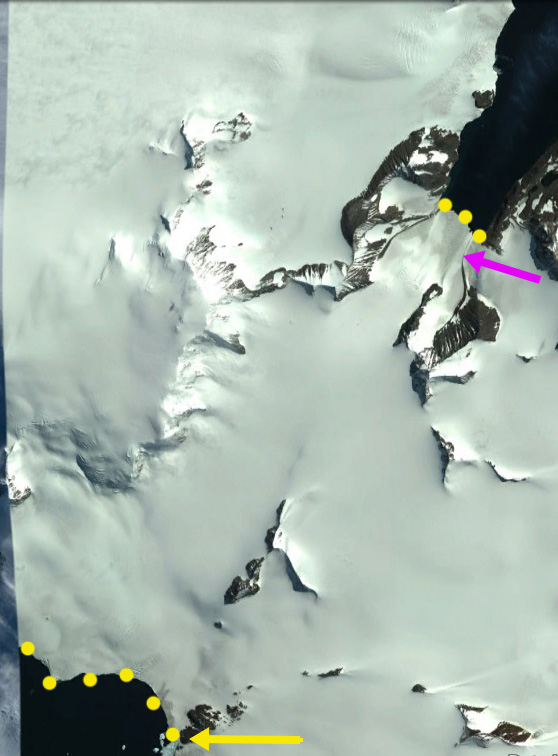
View of Cape Longing in REMA Antarctic Explorer, which is the 2000 Landsat image.

Cape Longing, Antarctica in 2000 and 2017 Landsat images. Point A-G are at specific locations. Yellow dots mark the margin of the glacier connecting the Cape to the main Antarctic Peninsula.


Depot & Mondor Glacier Retreat, Antarctic Peninsula

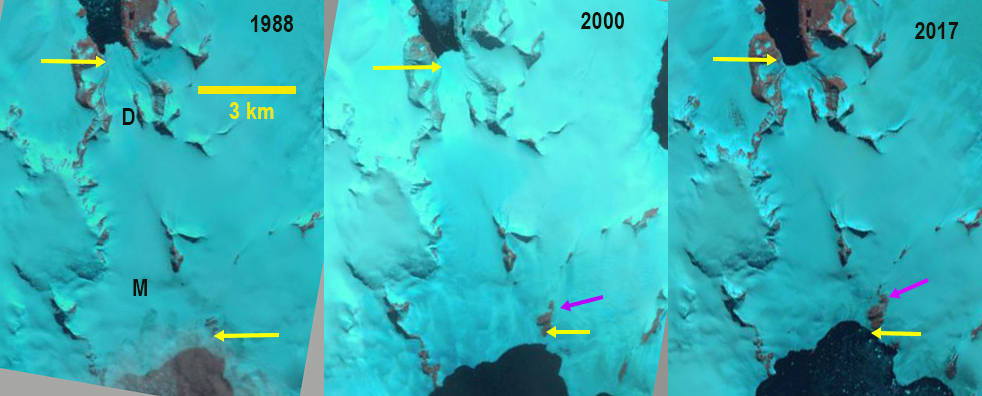
Mondor and  (M) and Depot Glacier (D) at the tip of the Antarctic Peninsula in Landsat imagers from 1988, 2000 and 2017.  Yellow arrows indicates the 2017 terminus location of each.  The purple arrow indicates a bedrock ridge that has been expanding.

On the Trinity Peninsula,which is the region at the tip of the Antarctic Peninsula, are Depot and Mondor that flow north and south from the same accumulation zone emptying into Hope Bay and Duse Bay respectively. The Argentine Research Station, Esparanza is on Hope Bay. This region experienced some of the greatest warming on Earth from 1950-1990’s, but no additional warming since the 1990’s (Turner et al, 2016). This climate change has led to a rapid glaciological response, with 87% of glaciers around the Antarctic Peninsula now receding Davies et al (2012) . The most dramatic response has been the collapse of several ice shelves, Jones, Prince Gustav, Wordie, Larsen A and Larsen B. The Prince Gustav Ice Shelf connecting James Ross Island to the Trinity Peninsula collapsed after 1995 (Glasser et al 2011). There is limited surface melting on Antarctic glaciers, as a result almost all of the mass loss is from bottom melting under ice shelves and calving. These processes have led to and continue to drive dramatic retreat, thinning and acceleration of glaciers that feed ice shelves and the ice shelves, such as Rohss Bay and Coley Glacier Here we examine a glacier that is grounded, which limits the impact of enhanced melting from warmer ocean temperatures. Esparanza Base has a long term climate record with only December and January having a mean temperature above 0 C, at 0.4 and 0.5 C respectively. The record high temperature in Antarctica was recorded at Esparanza Base on March 24, 2015 at 17.5 C (Skansi et al, 2017). Specific anomalously warm days are when most mass balance losses occur. Barrand et al (2013) note a strong positive and significant trend in melt conditions in the region, driving the retreat.

In 1988 Depot Glacier terminus was north of a tributary entering on the west side of Depot Glacier. By 2000 the glacier terminus has receded and is adjacent to the northern side of this tributary.  By 2017 the terminus has retreated further and is nearly at the southern edge of the tributary glacier, a retreat of 500 m. Mondor Glacier in 1988 terminates south of bedrock ridge on the east margin of the glacier, yellow arrow. In 2000 the bedrock ridge has expanded and is closer to the terminus. By 2017 the bedrock rib has further extended north, purple arrow, indicating glacier thinning. The overall retreat of the terminus is 400 m from 1988 to 2017. The retreat rate increased after 2000, which is what Davies et al (2012) reported for the region. The rate of retreat is limited as the grounded glaciers have limited calving, and there is limited surface melt. The melt zone is not significant in any of the images on Mondor Glacier. On Depot Glacier there is a melt zone  below 200 m evident in both Goggle Earth images, purple arrows and the 2017 Landsat image. The limited changes of this glacier underscores that it is ocean warming that has been the key to date in glacier retreat in the region.  There has been a significant temperature rise, but it remains too cold for substantial surface melt.

Google Earth image from 2013 of Mondor Glacier terminus, black dots bottom and Depot Glacier black dots top.  Purple arrow indicates area of melting where snowpack has been lost. Yellow arrow a bedrock ridge on east side of Mondor Glacier.

Google Earth image from 2015 of Mondor Glacier terminus, black dots bottom and Depot Glacier black dots top.  Purple arrow indicates area of melting where snowpack has been lost. Yellow arrow a bedrock ridge on east side of Mondor Glacier.


Leroux Bay Glacier Retreat-Island Formation, Antarctic Peninsula

Leroux Bay is on the west coast of the Antarctic Peninsula in Graham Land.  Numerous glacier drain from the Antarctic Peninsula into the ocean along this coast, and as they retreat the coastline is changing.    Air temperatures rose by 2.5°C in the northern Antarctic Peninsula from 1950 to 2000, which has led to recession of 87% glaciers and ice shelves on the Peninsula in the last two decades (Davies et al.,2012). Most spectacularly has been the collapse of Jones, Larsen A, Larsen B, Prince Gustav and Wordie Ice Shelves since 1995 (Cook and Vaughan, 2010). This has opened up our ability to examine sediments that had accumulated beneath the floating ice shelves.   The LARISSSA Project has been pursuing this option and utilized the Korean icebreaker ARAON to explore and map the bathymetry of Leroux Bay.  Last week Antarctica recorded its highest temperature at  the Argentine Base Esperanza on March 24th, 2015 located near the northern tip of the Antarctic Peninsula reported a temperature of 17.5°C (63.5°F). Here we examine the changes from 1990 to 2015 of glacier on the north side of Leroux Bay. 

LARSEN

Location of Glacier examined from USGS Map.

leroux bay ge

Google Earth image indicating glacier flow directions, blue arrows, island yellow arrow and glacier terminus red arrow.

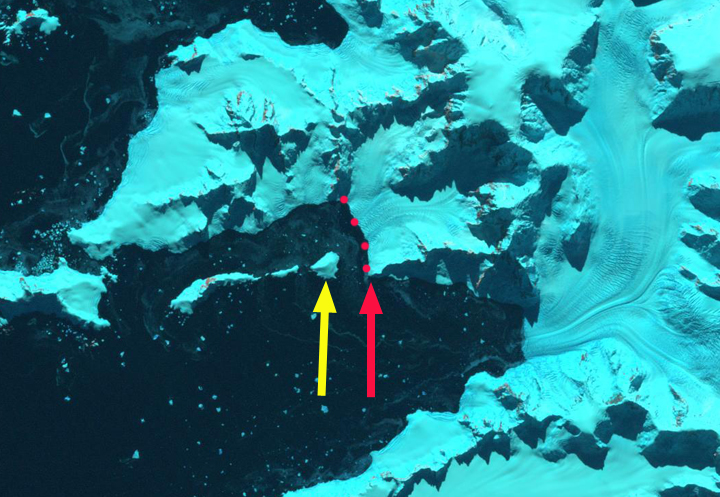
In 1990 and 1991 the Leroux Bay Glacier extended to the yellow arrow, which is an island connected by the glacier to the mainland and acts as a stabilizing point for the glacier. The ice front is marked with yellow dots in both cases. The terminus region of the glacier is floating, making this a small ice shelf, fed by three tributaries, one from the north, one from the east and one from the northeast.  By 2001 the glacier front has retreated to the red arrow, losing most of the floating area, and the northern tributary now has an independent calving front.  The red arrow also points to the tip of a peninsula, another stabilizing point, the ice front is marked by the red dots for 2001 and 2015. The yellow arrow indicates the new island that is detached from the mainland. The two images from January 2015 and Late February 2015 indicate limited retreat an the north and south sides of the terminus, but retreat in the glacier center has led to a concave shaped calving front. Retreat from 1990 to 2015 averages 2.1 kilometers. The USGS map (Blue Line) indicates the terminus in the 1960’s was 3 km beyond the 1990 terminus location. The calving front remains active with extensive crevassing.  It is not clear simply from Landsat imagery if any of the glacier is afloat, if so it would likely be the southern half of the eastern tributary, There is limited melting in this region, so volume loss can occur via basal melt via ocean water or calving.  Even in a warm summer there is little visible evidence of surface melting in 2015. The widespread loss of mass from ice shelves in Antarctica is mainly via basal melting (Paolo et al, 2015). An examination of the coast in the region illustrates numerous other examples where glacier retreat has led to separation of islands, such as with the loss of the Jones Ice Shelf.

leroux bya 1990
1990 Landsat image

leroux bay 1991
1991 Landsat image
leroux bay 2001
2001 Landsat image
leroux bay 2015 early
January 2015 Landsat image
leroux bay 2015 late
Feb. 2015 Landsat image