Sulztalferner Retreat, Austria Bedrock Expansion Mid-Glacier

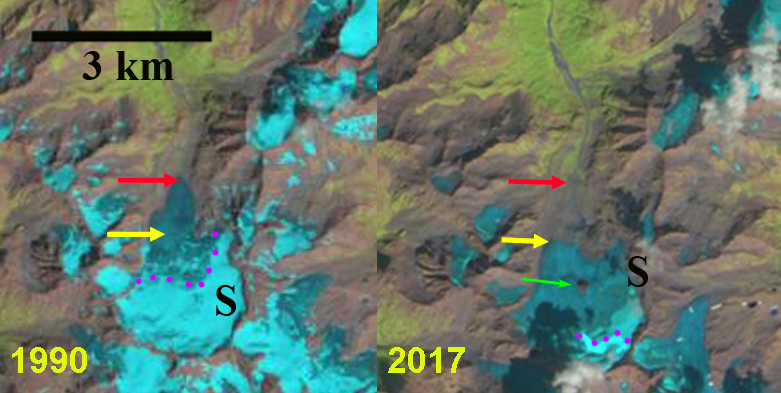
Sulztalferner in Landsat images from 1990 and 2017.  Red arrow is the 1990 terminus, yellow arrow the 2017 terminus, purple dots the snowline and the green arrow an area of emergent bedrock amidst the glacier. 

Sulztalferner is a glacier in the Subaier Alps of Austria. The glacier begins at 3200 m below Daunkogel Peak and descends north from the peak.  Schlicker (2006) identified that between 1969 and 2003, 14 of the 88 glaciers in this range disappeared. The area of the glaciers was to 54.1 km2 in 1969, increased slightly to 54.4 km2 in 1985, decreased to 47.2 km2 in 1997 and the a rpaid decline to 36.9 km2 in 2003. Schlicker (2006) observed that the area of Sulztalferner, one of the largest glaciers in the region, decreased from 4.16 km2 in 1969 to 3.51 km2 in 2003. This fits the pattern of all Austrian glaciers  Fischer et al (2015).    Fischer and Kuhn (2012) measured the thickness of the glacier finding the average was 42 m and the maximum was 131 m.  The glacier terminus fluctuations are examined annually and reported by the Austrian Alpine Club  Fischer (2016) and Fischer (2017), with all 11 glacier in the Stubaier area retreating in 2015 and 2016 and Sulztalferner retreating 14 m each year.

In 1990 the glacier descended a steep icefall at the yellow arrow and terminated at 2430 m at the red arrow, the glacier was 3050 m long.  By 1999 the glacier retreat and thinning made the icefall more pronounced.  By 2015 the glacier terminated near the top of the a steep bedrock step that had caused the icefall to exist. An area of bedrock had also emerged just below the snowline. In 2017 the glacier is 2100 m long extending from an elevation of 3200 m to 2730 m.  Retreat from 1990-2017 has been 950 m, a mean of 35 m/a.  That is more than 1% of the glacier length lost per year. In 2017 in late August only 10% of the glacier has retained any snowcover indicating substantial volume losses will occur in 2017, which will drive further retreat.  This glacier is following the pattern of Bachenfallenferner just to the north. This glacier is just to the west of the Stubai Glacier and the Stubai ski area that has utilized a protective by blanket on the glacier The Stubai Glacier Ski Area opens for the 2017/18 season this Saturday 9/16 after a couple of snowstorms that have blanketed Sulztalferner and Stubai Glacier with some fresh snow.


Sulztalferner in Landsat images from 1990 and 2017.  Red arrow is the 1990 terminus, yellow arrow the 2017 terminus, and purple dots the snowline.

Digital Globe image from 2015 indicating the bedrock exposed in the midst of Sulztalferner.  It measures 250 m long and 150 m wide.  Note  the thin nature of the retreating terminus.
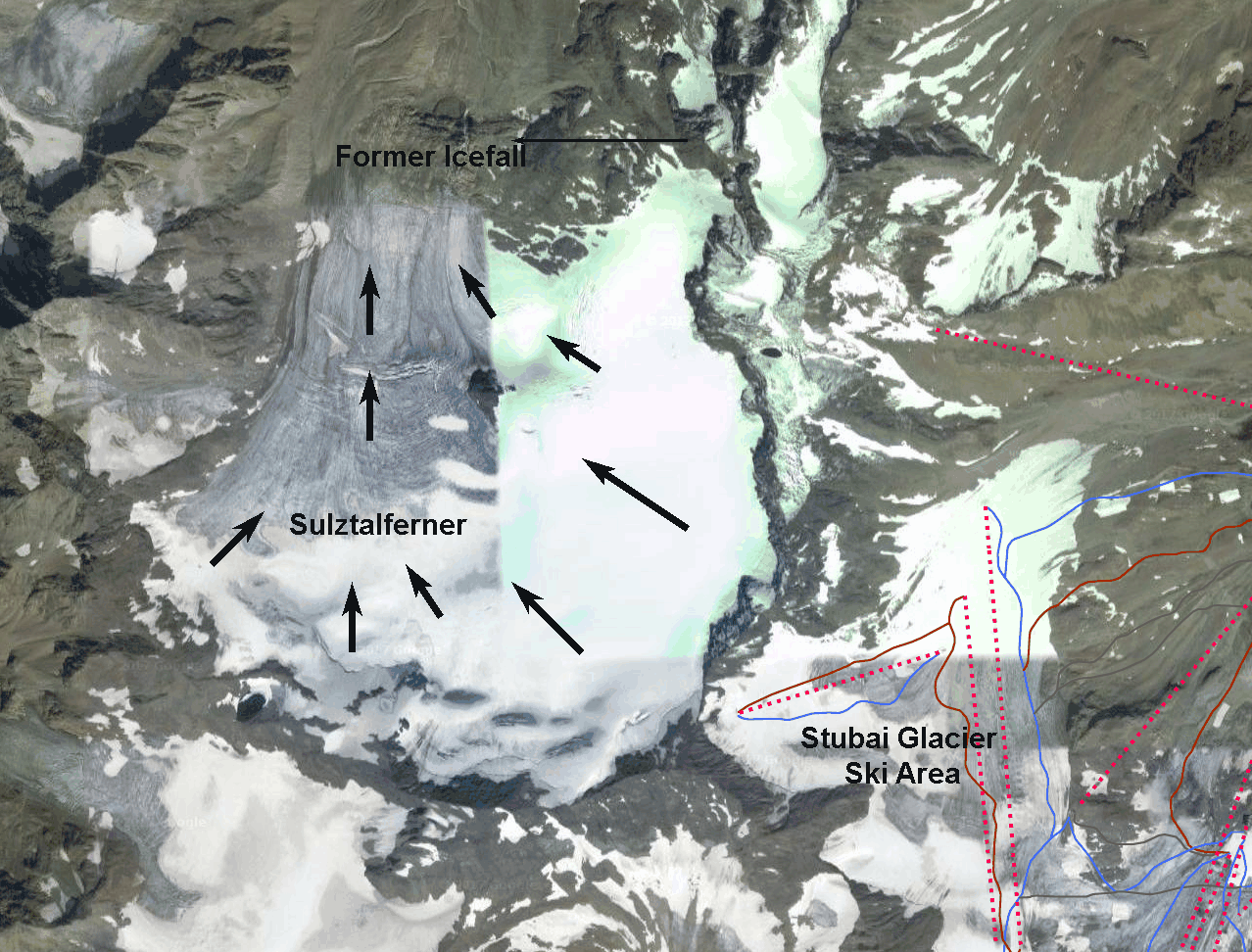
 

Sulztalferner Digital Globe image from 2015.  Note adjacent ski area and deglaciated icefall reach.


Hallstatter Glacier, Austria retreat

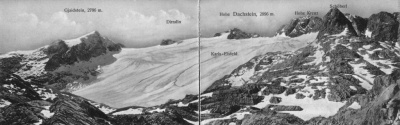
The Hallstatter Glacier (also sometimes called Dachstein Glacier along with the Gosau Glacier) is on the north slope of Dachstein an area of heavy recreational use. The result is good photographic records of glaciers change. This record combined with a recent cooperative project between University of Innsbruck, Blue Sky Weather Analysis and Energie AG Upper Austria provides a good snapshot of glacier change in northern Austria. The glacier begins at 2800 meters and descends to 2200 meters, image below from University of Innsbruck. This project has compiled the annual terminus change of the glacier from 1950-2007, in the image below. The retreat from 1950-1975 averaged 8 meters per year. A period of minor readvance from 1977-1991 occurred, followed by increasingly rapid retreat from 1992-2007 averaging over 10 meters per year in the last decade. Total retreat has been 350 meters from 1950-2007. Over the last century the change is chronicled in the two images, 1900 and 2007, from the Dachstein Project and the 2009 margin is traced in a Google Earth Image, blue line. This project was undertaken because of the importance of the glacier runoff to hydropower production along the Traun and Gosau Watersheds in particular. The change in terminus via mapping from 1969-2002 is evident in the Innsbruck image (2002), the Google Earth image is from 2009. There is thinning particularly of the width of the two main terminus tongues.The mass balance of the glacier has been measured since 2007, every year has had negative balances. In 2011 the snowline was again high, snowpack very limited at the end of the melt season which persisted into October. An Ikonos image from October 2, 2011 indicates that 30-35 percent of the glacier is snowcovered, this is the AAR and it needs to be at 60 for equilibrium.

Ochsentaler, Austria Rapid Glacier Retreat

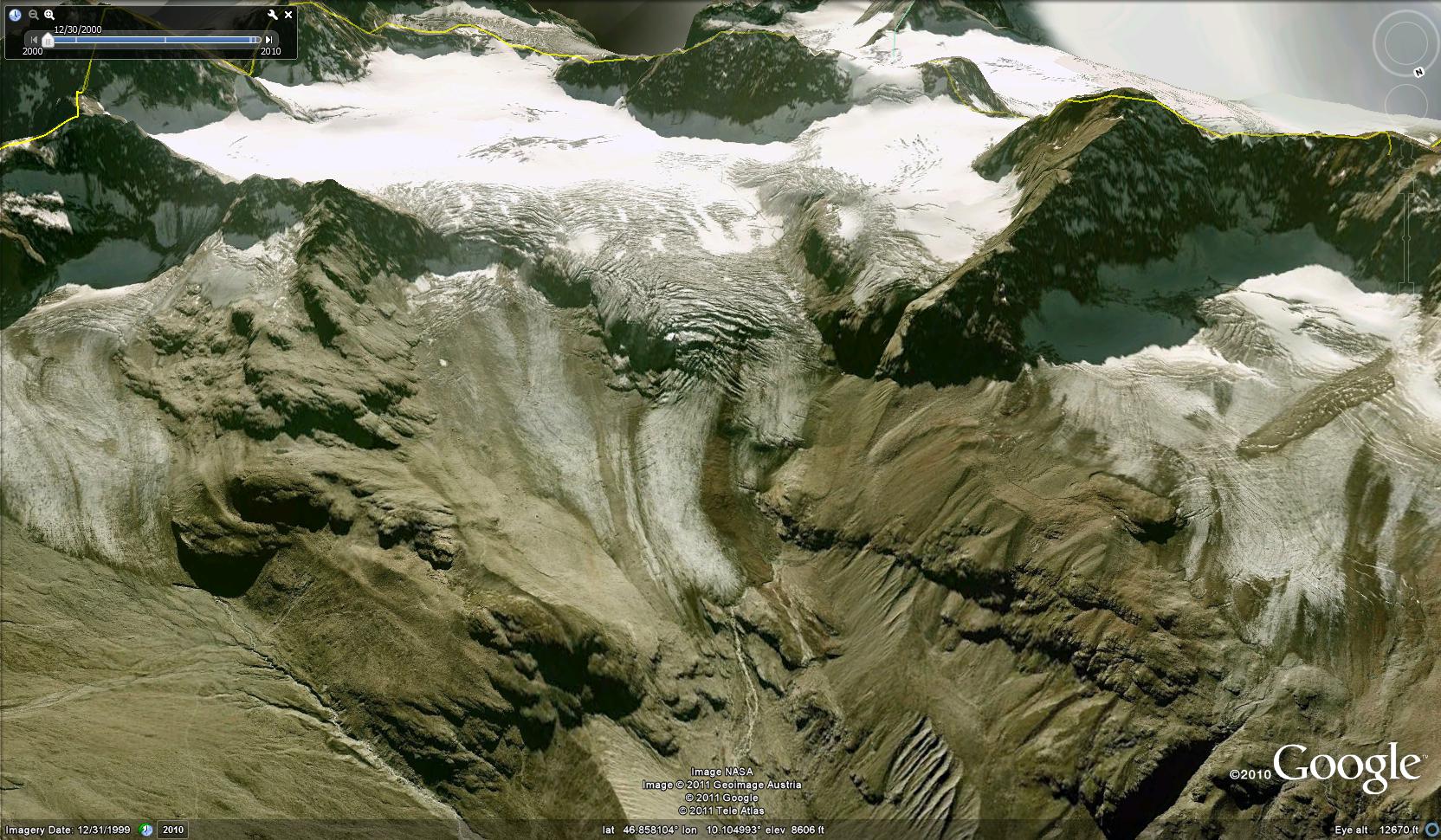
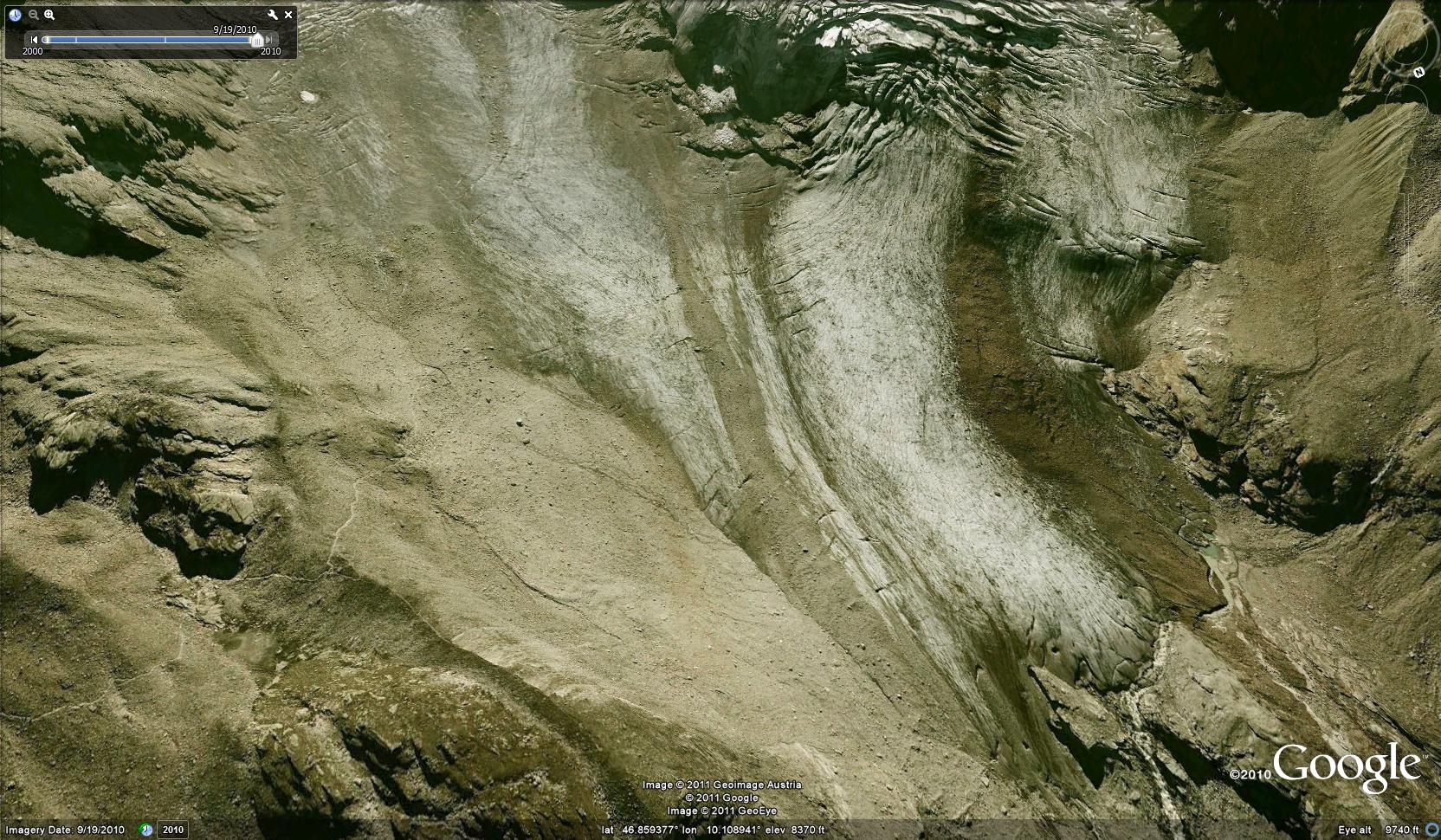
Ochsentaler is a glacier in the Silvretta group of southwest Austria. From 1990 to 1995 the glacier retreated 75 meters, from 1995-2000 85 meters, and from 2000-2005 180 m. The accelerating retreat has been driven by substantial negative mass balances. Dyugerov and others (2009) assessed the mass balance of the glacier as averaging -0.5 meters per year lost, from the percentage of snowcovered area remaining at the end of the summer. Measurements on the neighboring Jamtalferner in Austria indicate 15 m of loss from 1990-2009, about 0.75 meters per year. Mass balance losses on Silvretta Glacier, Switzerland indicate a 13 m loss during that same period. Examination of the glacier today indicates an uncrevassed, thin stagnant glacier tongue that is 600 meters long, that is and should continue to rapidly melt. At the head of this section of the glacier is an icefall. The newly exposed bedrock areas at the crest of the icefall indicate reduced iceflow and thinning at this point. The contrast in this icefall region is apparent in the image pair from Christian D. from 1995 and 2011 and the latter image 2009 in Google Earth.
. Ochsnetaler is a popular climb and the upper section of the glacier above the icefall still has a considerable snow covered extent. This glacier is certainly healthier than Stubai Glacieror Presena Glacier and similar to Rotmoosferner.

Rotmoosferner Retreat and Dynamic Change

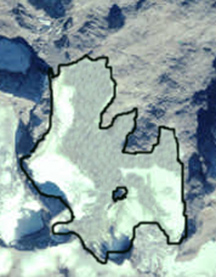
There are currently 51 glaciers in the Ötztal Nature Park. Right now, glaciers cover 27% of the total area of the Ötztal Nature Park. All have been retreating, from 1987-2006. Detailed mapping of these glaciers and Rotmoosferner by Abermann and others (2009), University of Innsbruck provide interesting results. Ötztal glaciers lost 8 % of their total area. One of the glaciers that has a long record of observation is Rotmoosferner. This glacier has retreated 2.1 km since the Little Ice Age and 600 meters since 1969, 15 meters per year. A detailed map of Rotmoosferner from Abermann and others (2009) University of Innsbruck indicates that in 1975 it was joined to the Wasserfallferner, but in 2005 it separated. In the image above the Rotmoosferner is to the lower left and the Wasserfallferner above and to the right. Compare this image to one taken four years later at the end of the post. In the last decade new rock outcrops have emerged in the middle of the Rotmoosferner. These outcrops are noted in the google earth image below. The annotated image also indicates the former zone of connection to the Wasserfallferner. A map of the outline of the glaciers clearly identifies the new outcrops and the separation of the glaciers. The map is based on satellite imagery and older aerial photographic based maps by Abermann and others (2009) from 1969, 1997 and 2006. The retreat from 1969-1997 occurred across a relatively flat foreland. The current retreat is up a steeper slope, since 2001 retreat has averaged 18 m per year. The appearance of the rock outcrops in the mid-section of the glacier as the map shows, indicates little contribution to the tongue of the glacier, and that retreat of this lower section will continue to be rapid. The glacier still does appear to have an accumulation zone most years and is thus not forecast to disappear with current climate.
The picture below is from September of 2008 from Jakob Abermann, Institute of Meteorology and Geophysics, University of Innsbruck. Note the change versus the first picture from four years earlier. The exposed rock area has expanded amazingly and is nearly cutting off the lower tongue.