Coronation Glacier New Island Development-Baffin Island

coronation-glacier-island-development-scaled

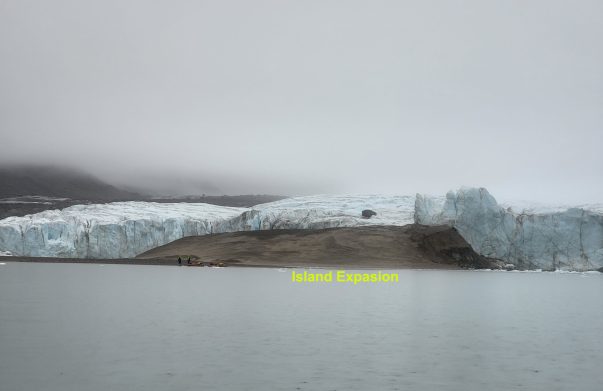
This is a portion of the island emerging from beneath the terminus with the 20-50 m high ice front in July 2023, the main portion of the island extends to the left and then out from the glacier. (Bischke/Biner/Bessen/Klemmensen)

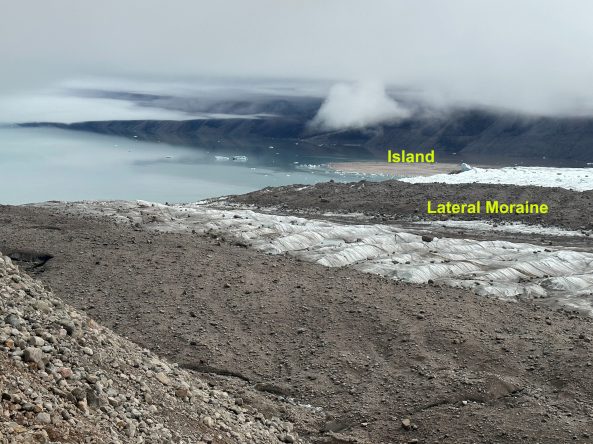
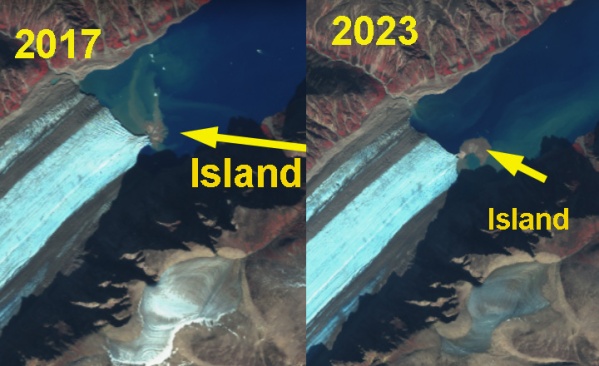
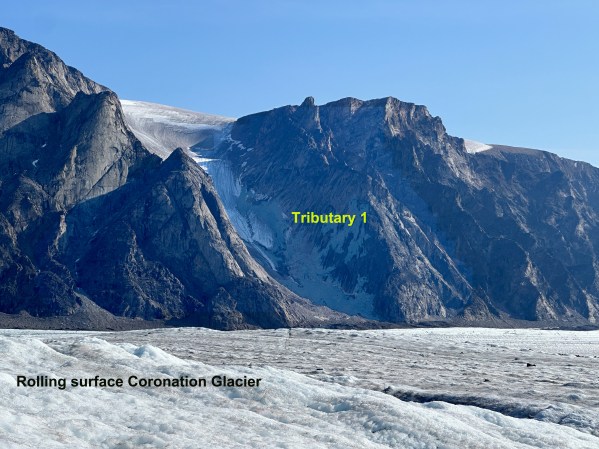
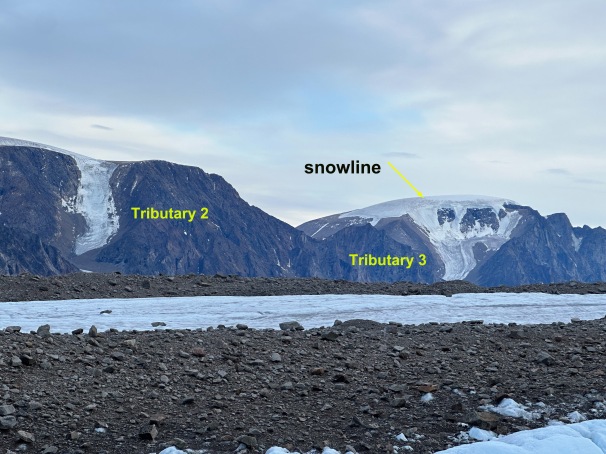
Coronation Glacier is the largest outlet glacier of the Penny Ice Cap on Baffin Island. The glacier has an area of ~660 square kilometers and extends 35 km from the edge of the ice cap terminating in Coronation Fjord. Retreat from 1989 to 2023 has been 1050 m on the northern side of the fjord and 900 m on the south side of the fjord. The average retreat of 975 m in 33 years is ~30 m/year, much faster than the 1880-1988 period. Locations 1-9 are tributaries that have each narrowed or retreated from the main stem of the glacier. I reported on a new island forming at the terminus in 2016, and I have been hoping to identify someone who would visit the island. The island now has an area of 0.25 km², its character is evident in images below. Amanda Bischke reached out on behalf of a four person climbing team heading into the area this summer. In mid-July the team had reached the front of the glaciers and over the next 20 days explored the glacier and its tributary. Here I analyse images taken by the team of Amanda Bischke, Shira Biner, Noah Bessen and James Klemmensen in conjunction with Sentinel images. One striking aspect of the Sentinel image from August 16, 2023 is how the snowline is on the ice cap feeding tributary 1-3 at 1500 m. This has become a common theme, and is resulting in less flow from the ice cap down these tributaries leading to detachment. Tributary 1, 3 and 6 have separated from the main glacier, while Tributary 2,4,7 and 9 have detachments nearly or completely severing the glacier enroute to the main glacier.

I appreciate the collaboration with the climbing party who have posted an initial report, I will update when further reports are published. Of their four first ascents, The Drawbridge was a visually compelling line to me. If you are heading out into a seldom visited glaciated area on a climbing expedtion reach out and see what would be valuable to observe. We can see overall changes from satellite imagery, but not the details. Two examples here are what the surface of the island is composed of, sand and small rocks in this case, or a developing detachment such as at the chasm are not evident from satellite imagery.

coronation glacier 2017-2023

As the glacier retreats the Island continues to expand from 2017-2023. The tributaries I hoped the climbing team  could document where possible if they were still attached.
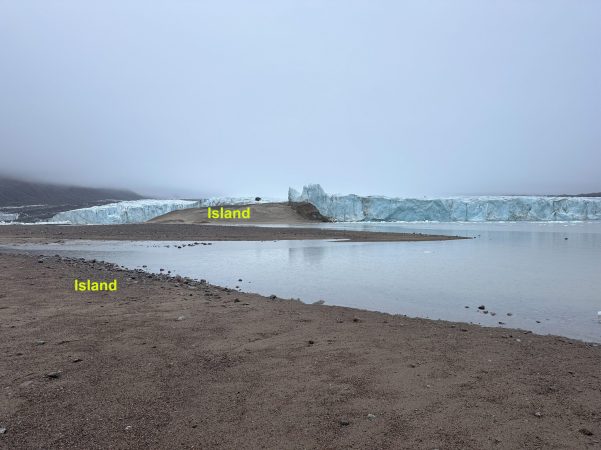
coronation-terminus-from-island-scaledThe climbing team visiting the oldest part of the island looking toward newest part (Bischke/Biner/Bessen/Klemmensen)
island-from-coronation-glacier-scaled

A view of the island from the north side of Coronation Glacier (Bischke/Biner/Bessen/Klemmensen)
island 2017-2023

Sentinel image of the expanding island at the Coronation Glacier terminus in Sentinel images.
tributary 1c

Tributary 1 detached from main glacier, note high snowline (Bischke/Biner/Bessen/Klemmensen)
tributary 2 and 3

Tributary 2 has a detachment point before the main glacier, though relict ice below still connects.  Note snow is only retained at very top of ice cap with a month of melt season left. (Bischke/Biner/Bessen/Klemmensen)
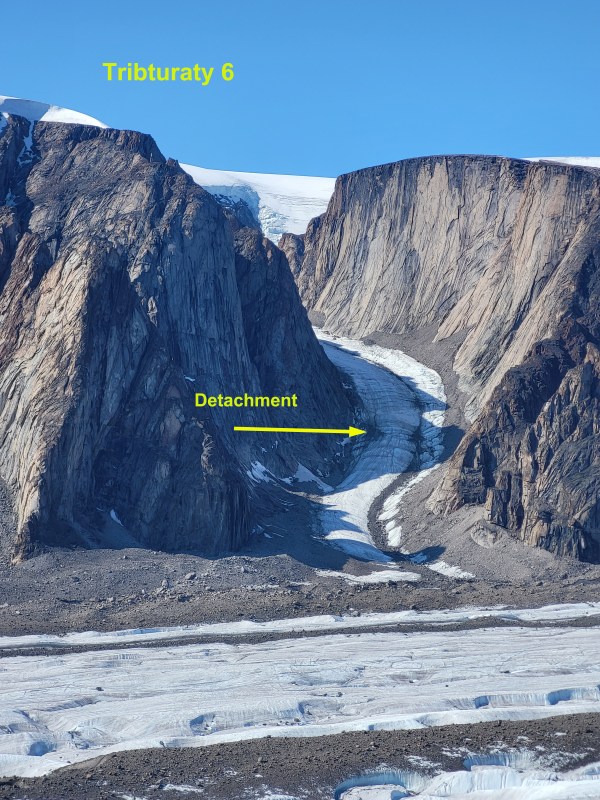
tributary 6a

Tributary 6 is still connected all the a detachment is occurring halfway from ice cap to main glacier. (Bischke/Biner/Bessen/Klemmensen)
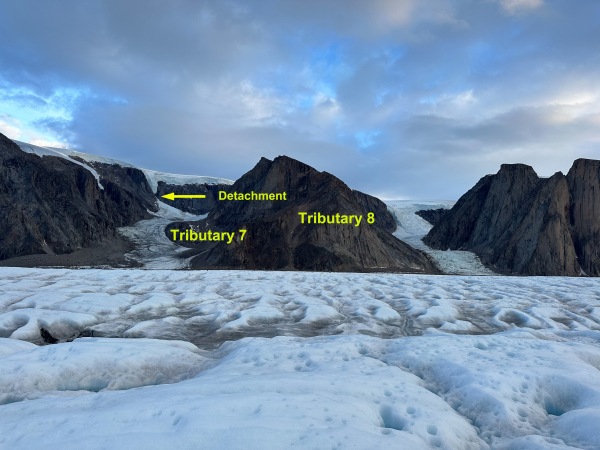
tributary 7 and 8bTributary 7 and 8 are still connected, though 7 has a detachment now (Bischke/Biner/Bessen/Klemmensen)
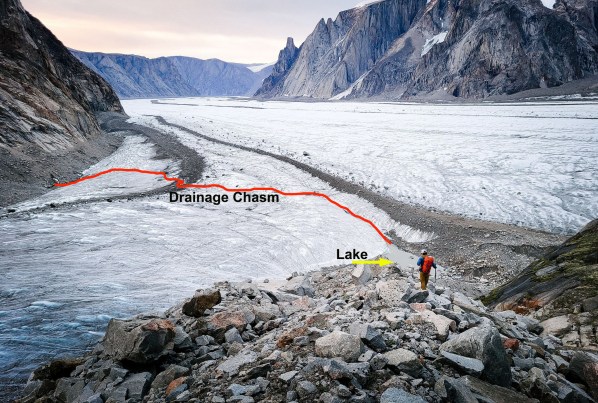
Chasm Line

Triburary 9 had an interesting barrier to the climbers a deep chasm carved by an outlet stream draining meltwater, some of which had pooled in the lake shown. (Bischke/Biner/Bessen/Klemmensen)

Hall Peninsula Ice Cap, Baffin Island Retains No Snowcover in 2023 Fosters Fragmentation

Hall Peninsula Ice Cap east of Popham Bay is snow free on 8-14-2023. Comparison of Landsat images from 2014 and 2023 arrows indicate four locations where the ice cap is fragmenting and at each Point D is an emerging/expanding bedrock area amidst the ice cap.

Hall Peninsula is host to many glaciers and ice caps, almost all unnamed. Here we examine the largest ice cap on the Peninsula using Landsat and Sentinel images. This ice cap is shrinking like Grinnell Ice Cap and Terra Nivea Ice Cap due to limited retained snowcover most years.

The center of the ice cap is just over 1000 m in elevation. By early August in 2023 the ice cap had lost all snowcover. The emergence and expansion of a dozen bedrock areas amidst the ice cap indicates the ice cap is thinning across most of its extent. At Arrow C and E the ice cap has fragmented. At Arrow A and B the fragmentation is nearly complete. Given the lack of any retained snowcover in several recent years, this ice cap will not survive current climate conditions.

Hall Peninsula Ice Cap on 8-6-2023 in Sentinel images. Arrows indicate locations of fragmentation. Point D marks expanding bedrock areas amidst the ice cap.

Terra Nivea Ice Cap Expanding Bedrock Outcrops and Proglacial Lakes

Terra Nivea Ice Cap in Sentinel false color images from 2017 and 2022. Point A=bedrock outcrops expanding. Point L=expanding proglacial lakes. Red arrow=supraglacial stream chanels, yellow arrow=annual layers, green arrow=location where ice cap will separate.

Terra Nivea Ice Cap is the southern most Ice Cap in North America, on the Terra Incognita Peninsula of Baffin Island. Mercer (1956) noted that the ice cap accumulation during most years was via superimposed ice, though some years snow did endure at the top of the ice cap. Paspodoro et al (2015) observed a 34% reduction in ice cap area from 1958-2014 with an acceleration after 2007. Here we note a lack of retained snow, firn or superimposed ice on the northern portion of the ice cap in 2017 and 2022. The lack of retained accumulation as snow or ice results in rapid thinning that is leading to bedrock expansion within and at the margin of the ice cap and the expansion of peripheral proglacial lakes.

Point A marks specific locations where bedrock areas amidst the ice cap are expanding. This expansion will lead to separation of the ice cap at the green arrows soon. The ice cap was 1.9 km wide at this point in 2017 and 1.5 km in 2022. Point L marks locatsions of proglacial lake expansion. The yellow arrows indicate annual layers even at the summit area, which would not be visible if superimposed ice was forming. The red arrows indicate supraglacial stream channel that lead all the way to the summit region. For an ice cap retaiining firn or superimposed ice, the channels would begin below that margin. This illustrates that during the the 2017-2022 there was no retained accumulation on Terra Nivea Ice Cap. This is true of the rest of the ice cap as well. Here in order to better visualize change, the focus is just on the northern portion.

This same story is playing out on Grinnell Ice Cap.

Terra Nivea Ice Cap in Sentinel false color images from 2017 and 2022 illustraing separation region. Point A=bedrock outcrops expanding. Point L=expanding proglacial lakes.  Green arrow=location where ice cap will separate.


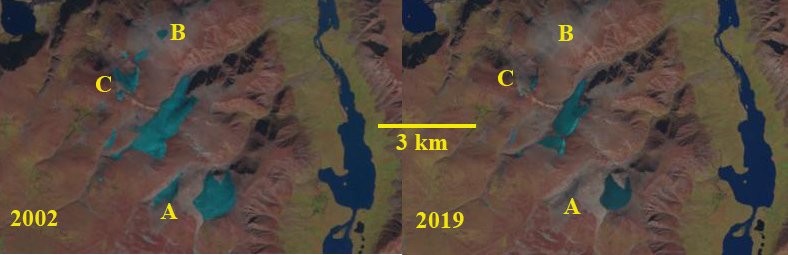
The Disappearance of Multiple Baffin Island Glaciers 2002-2019

Glaciers at Point A and B have melted completely away.

The commemoration of a single disappearing glacier in Iceland, Okjokull has brought attention to what is quite a common event this decade, glacier disappearance. Here we report on a number of glaciers in the southern part of the Cumberland Peninsula, Baffin Island  that have either disappeared or separated into several parts  from 2002-2019. Way (2015) noted that on the next peninsula to the west, Terra Nivea and Grinnell Ice Cap had lost 20% of their area in the last three decades. The retreat and disappearance of ice caps in the area have led to a INSTAAR project at UColorado-Boulder examining vegetation that had been buried and is now being exposed.  This year the high snowlines by early June have led to the near complete loss of snowpack across glaciers of the region.  The melt rate of the exposed ice is higher than that of the snowcovered portion of the glaciers.

In the first image a small valley glacier at Point A has melted completely away.  At Point B a small plateau glacier is gone.  At Point C a remanent is left, though it cannot survive long now.  Below  the slope glacier at Point F is gone.  The plateau glacier at point G is gone.  The niche glacier at point E has separated into three small parts.

Glaciers at Point F and G have melted completely away.

Glacier at Point H has melted completely away.

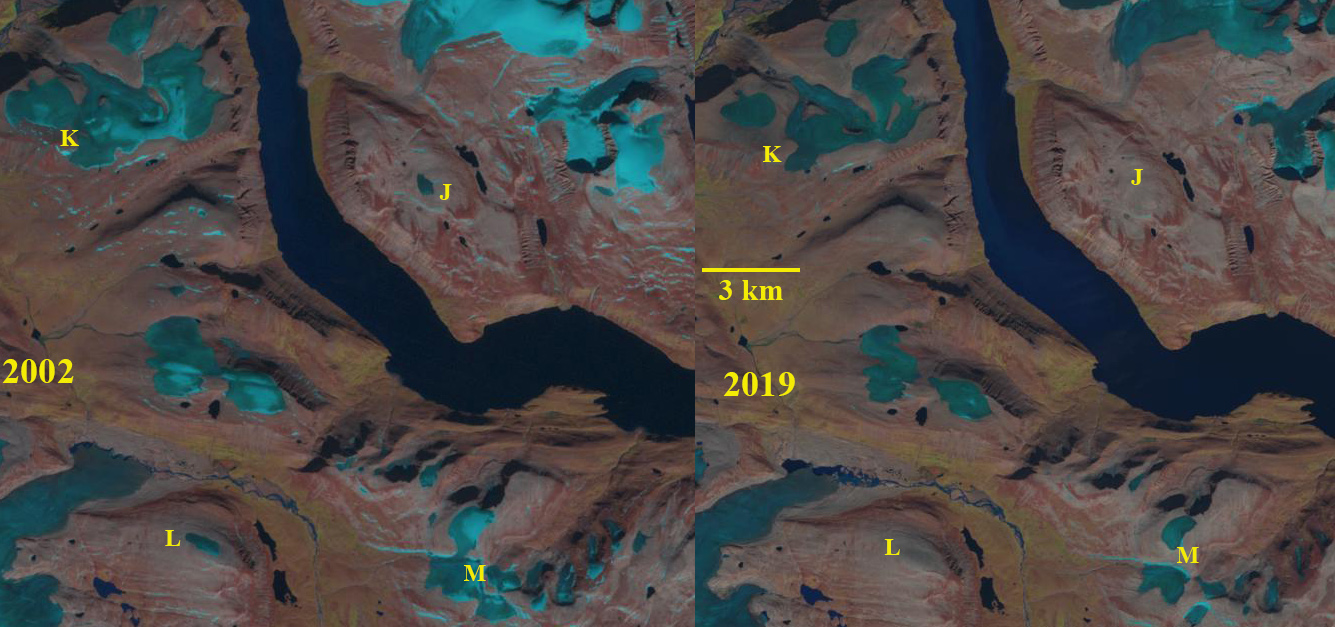
At Point H a plateau glacier has been lost. At Point I two interconnected glaciers have separated into five smaller glaciers. Below the plateau glaciers at Point J and L have been lost.  At Point K a combination icecap-valley galciers has now separated into three parts.  At Point M an interconnected ice cap now consists of of six small glacier parts. The plateau glacier an Point N has been lost.  The slope glacier at Point O has been lost.  The disintegration and separation has been noted at other locations in the region such as Coutts Ice Cap and Borden Peninsula.

Glaciers at Point J and L have melted completely away.

Glaciers at Point N and O have melted completely away.

Fork Beard Glacier, Baffin Island High June 2019 Temperatures and Snowline

Fork Beard (F) and Nerutusoq Glacier (N) Baffin Island on June 1, 2019,  June 18, 2019 Sentinel images and June 30 Landsat image. Purple dots indicate the snowline. 

Fork Beard Glacier (F) is an outlet glacier of a mountain glacier complex just southeast of Penny Ice Cap on Baffin Island.  Nerutusoq Glacier  (N) also drains from the same complex. Here we examine the rapid rise of the snowline from June 1 to June 30, 2019.  This 30-day period at nearby Pangnirtung featured four days with record temperatures for that date June 5 (15.1), June 11 (13.5) and June 12 (13.6), and June 19 (14.4). There were 14 days with a maximum temperature above 10 C. Landsat images are utilized to identify the retreat and separation of Fork Beard Glacier and Nerutusoq Glacier and several neighboring glaciers from 1990-2018.  Gardner et al (2012) and Sharp et al (2011) both note that the first decade of the 21st century had the warmest temperatures of the last 50 years in the region, the period of record, and they identified that the mass loss had doubled in the last decade versus the previous four for Baffin Island. This has led to fragmentation of Coutts Ice Cap and loss of snowpack at Borden Ice Cap and disappearance of ice caps near Clephane Bay all on Baffin Island.

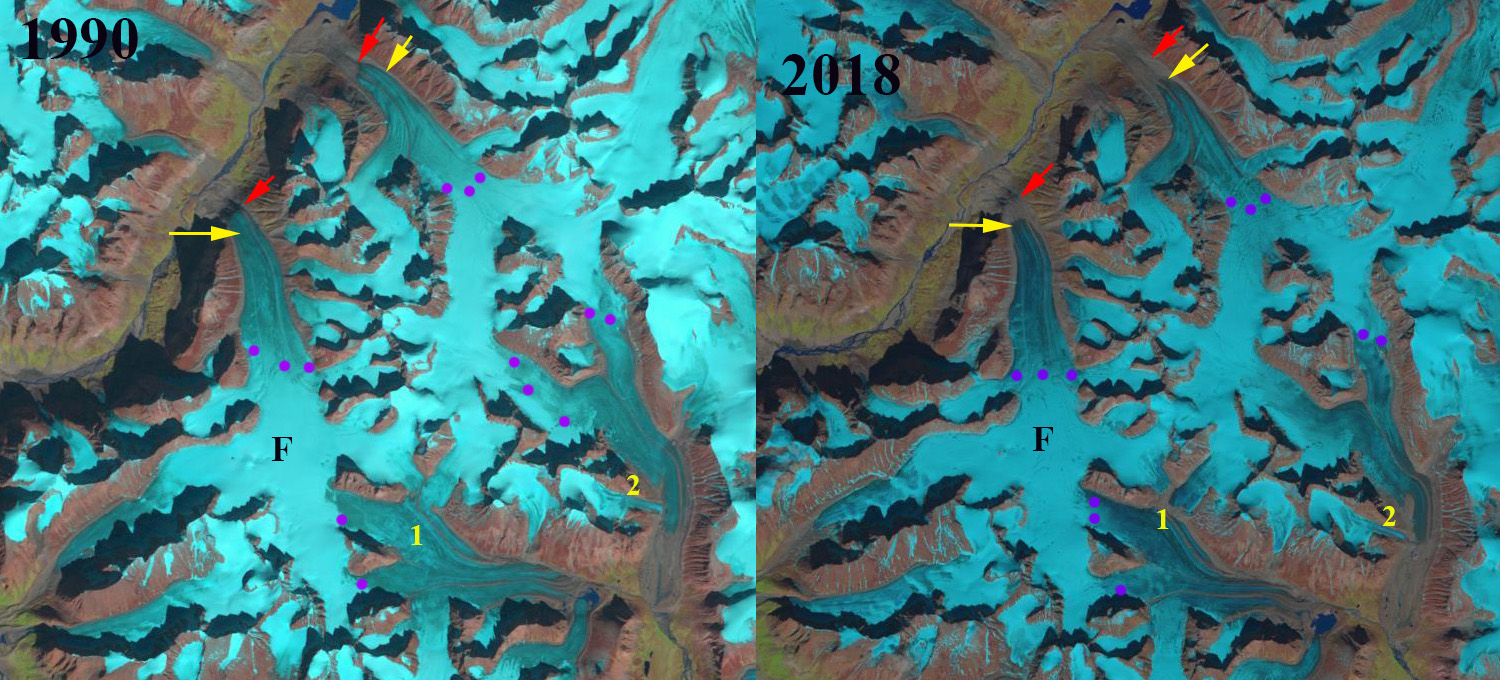
In late July of 1990 Fork Beard Glacier terminates near the top of a steep slope at 650 m, red arrow. At Point 1 and 2 tributaries connect to the main stem of two unnamed glaciers adjacent to Fork Beard Glacier. Nerutusoq Glacier terminates at 700 m. The snowline in mid August of 1990 on Fork Beard and its adjacent glacier to the southeast is 1050 m. In 2000 at Point 1 and 2 the tributaries still connect.  The terminus of Fork Beard and Nerutusoq Glacier have retreated 200-300 m since 1990. The snowline in this mid-August image is at 1150 m. By 2018 Fork Beard Glacier has retreated 600-700 m and now terminates at an elevation of 750 m. Nerutusoq Glacier has retreated 600-700 m and now terminates at an elevation of 825 m. In this late July image the snowline on Fork Beard and the adjacent glacier to the southeast (S) is again at 1050 m.  At Point 1 and 2 tributary glaciers have separated from the main stem glaciers. In Sentinel images from 2019 the snowline on Fork Beard Glacier and Nerutusoq Glacier  is at 800 m on June 1 rising rapidly to 1100 m by June 18.  On June 30 the snowline has risen to 1150 m. from This is a higher elevation than typically seen a month or two months later in the melt season during other years.  The retreat in  the region is driven by warmer temperatures and rising snowlines.  The glacier of Baffin Island are already primed for another poor year in 2019.

Fork Beard (F) and Nerutusoq Glacier (N), Baffin Island in 1990 and 2018 Landsat images. Red arrow indicates 1990 terminus, yellow arrow 2018 terminus, purple dots the snowline. 


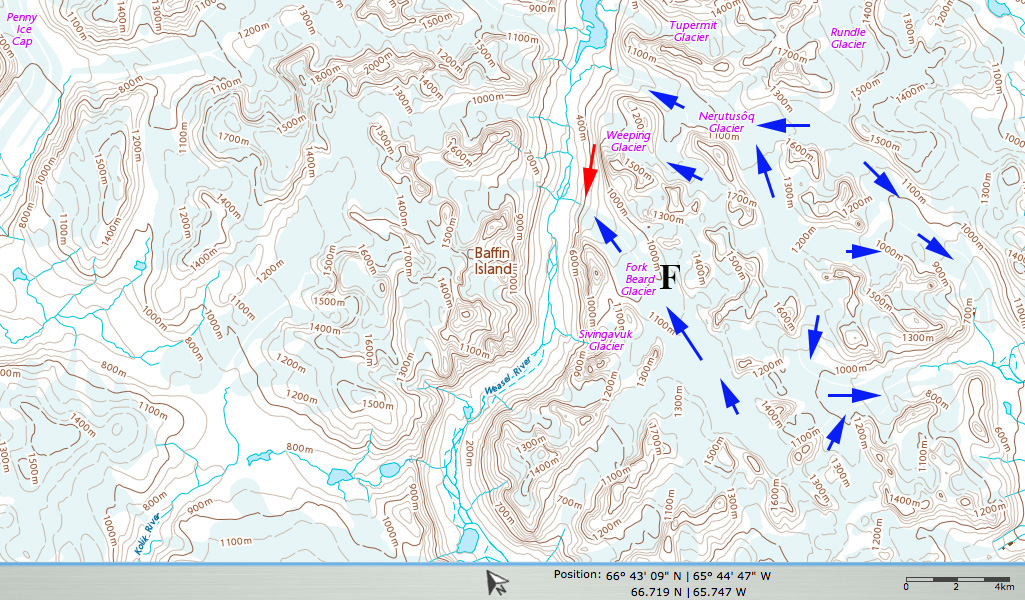
Map of the region indicating flow on Fork Beard, Nerutusoq and two unnamed adjacent glaciers. Red arrow indicates 1990 terminus of Fork Beard at top of steep bench.

Fork Beard (F) and Nerutusoq Glacier (N), Baffin Island in 2000 Landsat image. Red arrow indicates 1990 terminus and purple dots the snowline. 

Coutts Ice Cap, Baffin Island Fragmentation

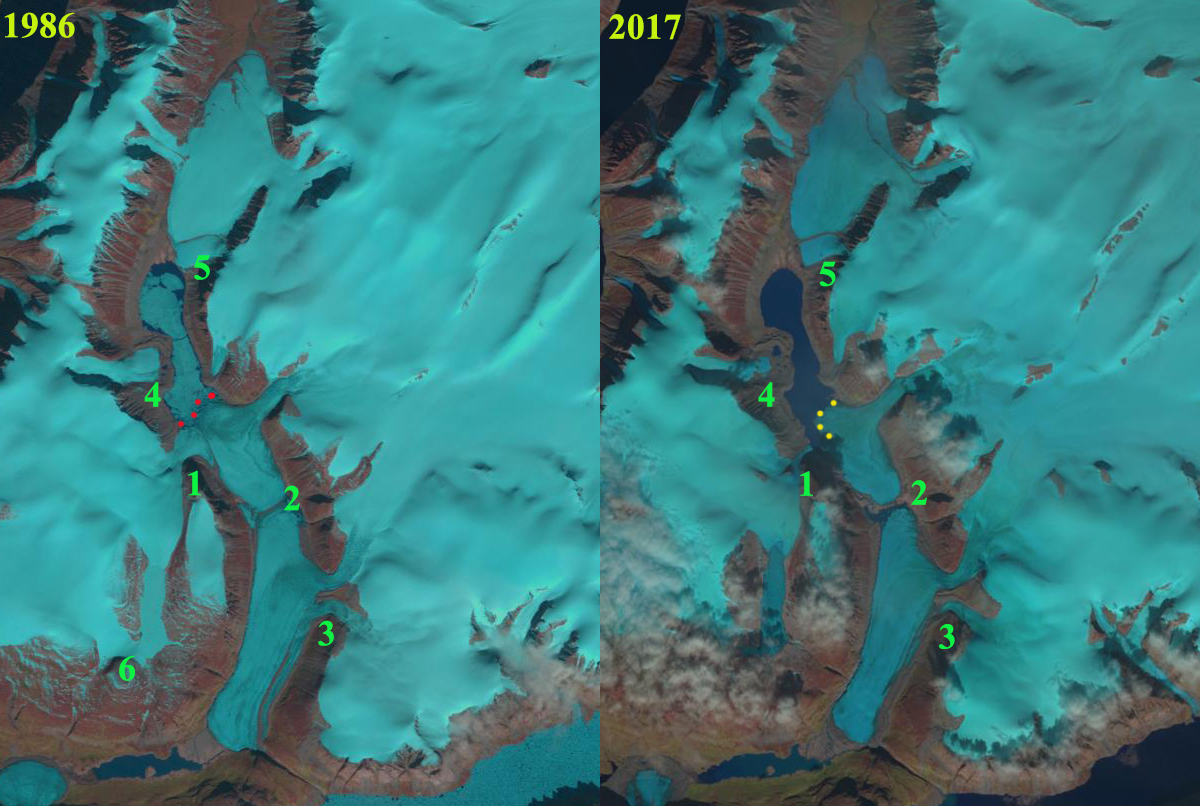
Coutts Ice Cap in  Landsat images from 1986 and 2017.  The terminus location of the main glacier terminating in the large lake is indicated by dots.  Tributary Glaciers 1-6 represent locations where glaciers have separated or a glacier has retreated from a lake. 

Coutts Ice Cap is on between Coutts Inlet to the west and Buchan Gulf to the east on the north shore of Baffin Island near its northeastern tip (see map below).  Here we are focused on a group of glacier that descend into a basin, that I refer to as Coutts Basin and Coutts Basin Lake. Gardner et al (2012) and Sharp et al (2011) both note that the first decade of the 21st century had the warmest temperatures of the last 50 years in the region, the period of record, and they identified that the mass loss had doubled in the last decade versus the previous four for Baffin Island. This led to surface lowering of up to 1 m/year on all ice masses on Baffin Island and Bylot Island between 1963 and 2006 (Gardner et al. 2012).

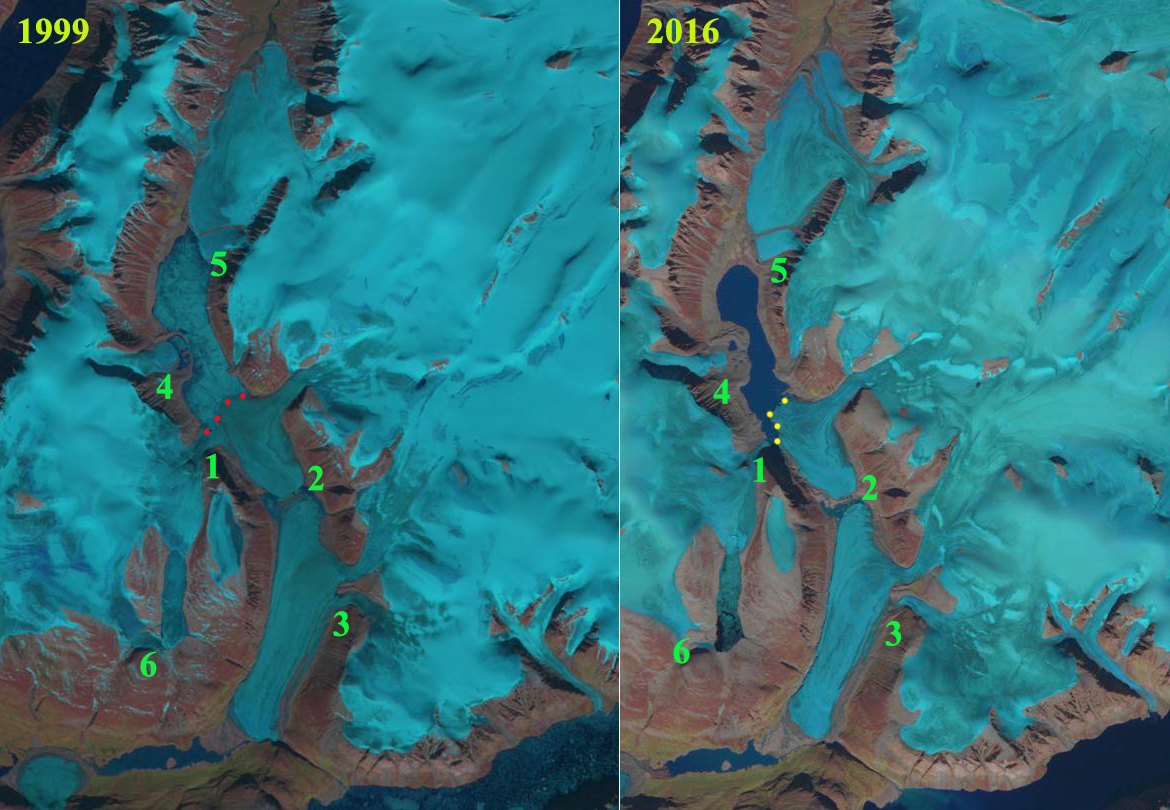
In 1986 the Tributary Glacier 1 (TG1), flows into the Coutts Lake basin joining with TG2.  TG3 feeds into the Coutts Basin glacier system.  TG4 has a significant piedomont lobe but terminates short of the Coutts Basin Lake. TG5 reaches the northern shore of Coutts Basin lake. TG6 drains into a secondary lake above the main Coutts Basin.  The main terminus of the Coutts Basin Glacier, red dots extends east to west across the lake. In 1999 the snowline is higher and there are minor changes, but retreat is limited and none of the glaciers have separated.  In 2016 the snowline is very high at 1500 m, leaving only a small part of the ice cap with snowcover. The high snowline in August 2016 have observed on Borden Ice Cap and Penny Ice Cap and have driven thinning and retreat there as well. TG1 no longer merges with TG2.  There is a separation of the glacier lobes at TG2.  TG3 no longer substantially feeds the Coutts Basin.  TG4 has thinned and retreated from near the short of Coutts Basin Lake. TG5 has receded from the lake shore.  TG6 has retreated from the upper lake. In 2017 the margin of the main Coutts Basin Glacier no longer extends across the lake, yellow dots. The snowline in August 2017 is at 1100 m lower than 2016.

Way (2015) noted that summer temperatures have warmed more than 1 C after 1990 on the Cumberland Peninsula at the south end of Baffin leading to a 18-22% decline of  Grinnell and Terra Nivea Ice Cap.

Coutts Ice Cap in  Landsat images from 1999 and 2016.  The terminus location of the main glacier terminating in the large lake is indicated by dots.  Locations 1-6 represent locations where glaciers have separated or a glacier has retreated from a lake. 

Map of the region indicating Cape Jameson (CJ), Coutts Inlet (CI), Buchan Gulf (BG), North Arm (NA), Coutts Basin Lake (CBL) and Coutts Ice Cap (CIC).