Shie Glacier, Bhutan-China Retreat Reduces Lake Contact

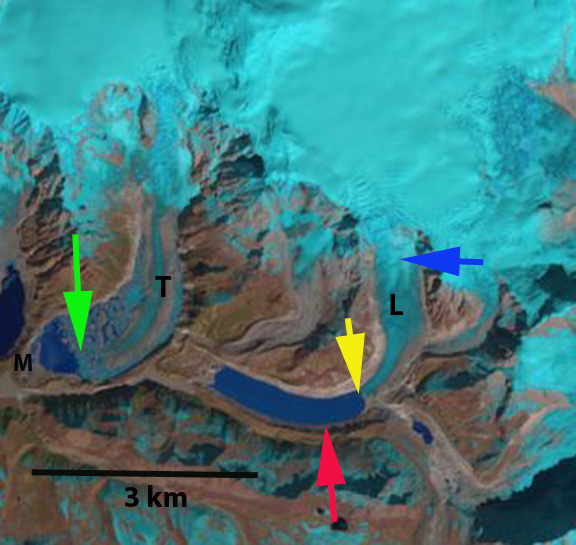
Shie Glacier Bhutan-China in Landsat images from 1996 and 2019.  Red arrow is the southern terminus location in 1996, yellow arrow the 2019 terminus location and red dots the margin of the eastern terminus in contact with the lake in 1996.

Shie Glacier terminates in a lake on the northern flank of the Bhutan Himalaya draining north from Kangphu Kang, in a region that is claimed by both China and Bhutan.  Here we examine 1996-2019 Landsat imagery to identify glacier change. Bajracharya et al (2014) reported a 23% loss in glacier area from 1980-2010.  This retreat led to a 20% increase in the number of glacier lakes in the region  (Che et al, 2014)

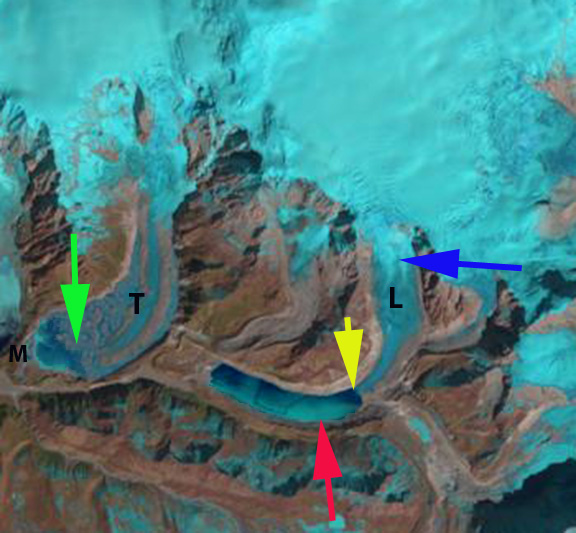
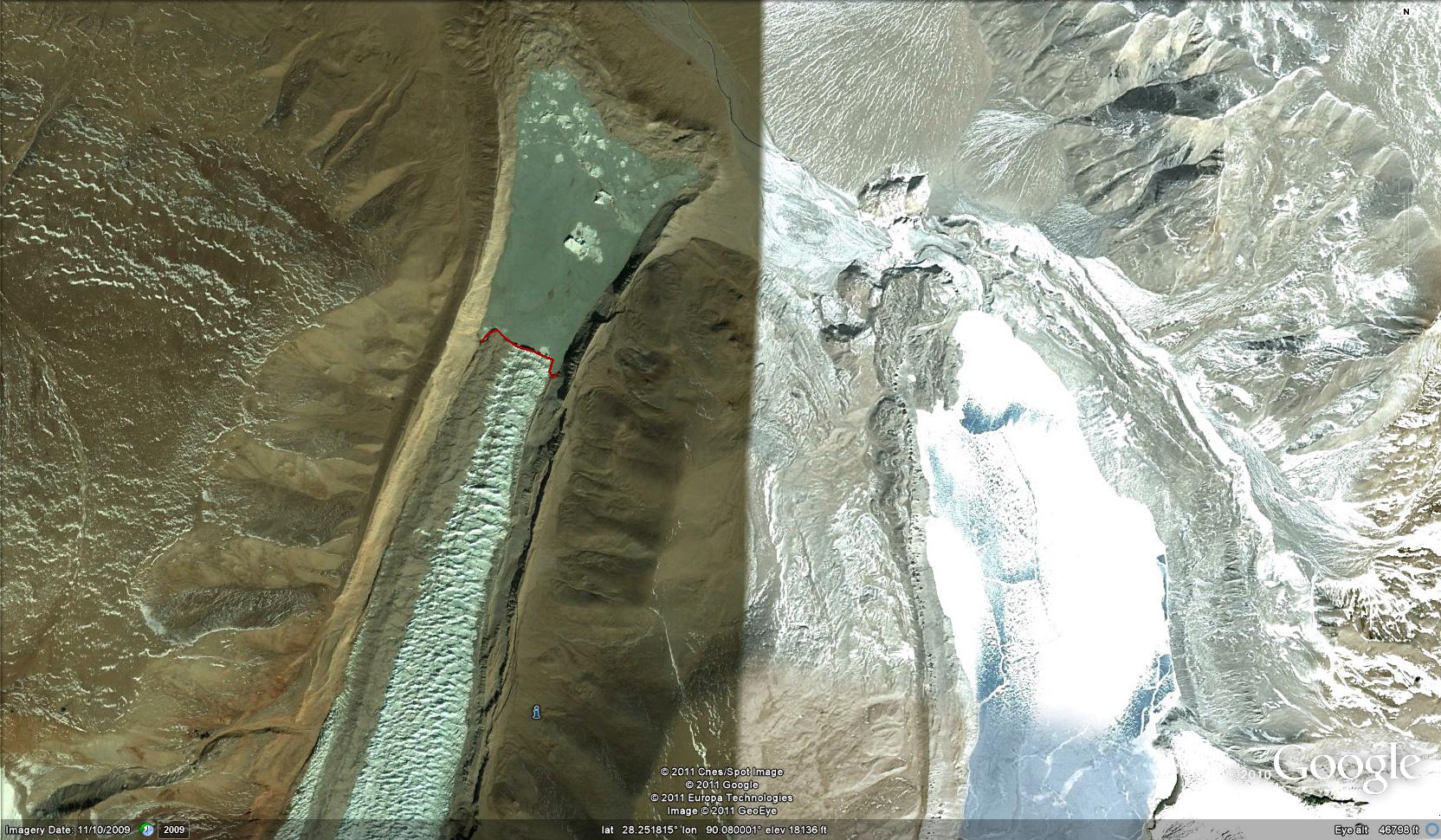
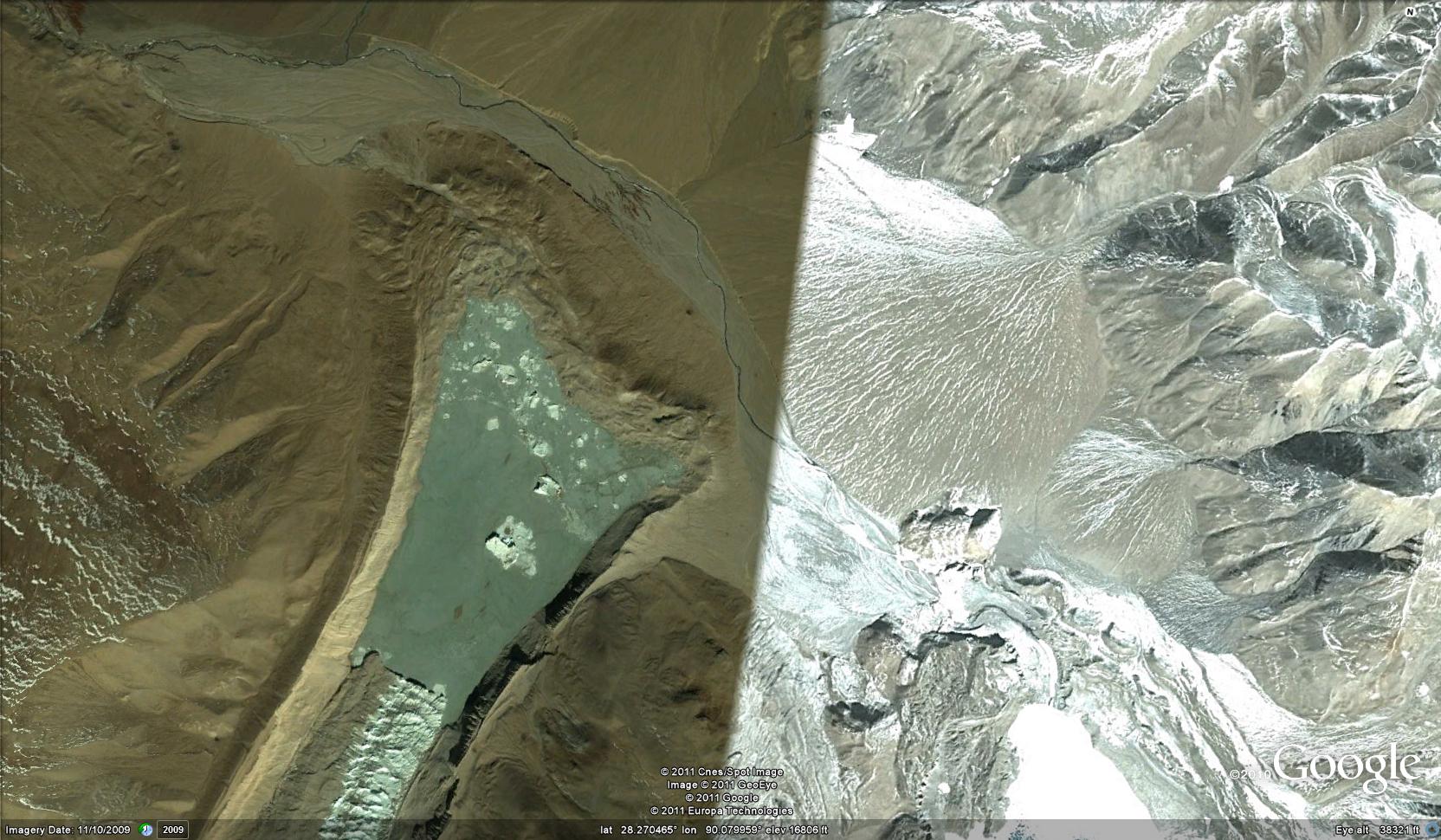
In 1996 the glacier had two prominent termini ending the lake. The eastern terminus had a 1300 m wide front in the lake and the southern terminus a 400 m wide front.  The southern are terminated 800 m up a narrow inlet.  In 2000 there was a minor retreat of less than 100 m of both terminus locations since 1996.   in 2011 both glaciers had an active calving front in the lake, with the eastern terminus, between Point A and B, reduced to 800 m of front in contact with the lake. The southern terminus between Point C and D has retreated 350-400 m since 1996.

By 2018 the southern terminus had retreated 600 m further up the inlet. In 2018 the eastern glacier front reached the lake on a front less than 100 m wide. In 2019 the eastern terminus does not reach the lake on a measurable front.  The eastern terminus has retreated 400 m on the northern margin, 350 m in the glacier center and 800 m on the southern margin. The southern terminus has retreated 700-800 m since 1996.  The reduced connection of the glacier to this lake will alter the nutrient flux to the lake.  The lake has had a consistent water level during the entire period and the terminal moraine that helps impound the lake is deeply incised.  The combination along with reduced frontal suggests the GLOF threat is low

High snowlines in recent years will continue to drive retreat here and on adjacent Theri Kang and Lugge Glacier.

2011 Digital Globe image of Shie Glacier terminus, eastern terminus between Point A and B, southern terminus between Point C and D.

Shie Glacier Bhutan-China in Landsat images from 2000 and 2018.  Red arrow is the southern terminus location in 1996, yellow arrow the 2019 terminus location and red dots the margin of the eastern terminus in contact with the lake in 1996.

High Glacier Snow Line Post-Monsoon 2018 on Bhutan-China Border

Angge Glacier (A) and Bailang Glacier (B) in China and Chubda Glacier (C) in Bhutan in Post Monsoon 1995 and 2018 Landsat images indicating the snowline purple dots is exceptionally high in 2018.  Red arrow is the 1995 terminus location and yellow arrows the 2018 terminus location. Point 1-3 are glacier passes from China into Bhutan.

The end of the monsoon season leads to finally some clear satellite images of snowlines and glaciers in the Himalaya.  A Landsat image from September 12, 2018 along the China-Bhutan  indicates high snowlines (5500 m) that reach the top of some glaciers and the glacier divide between nations on other glaciers.

Bailang Glacier and Angge Glacier, China are adjacent to the Chubda Glacier, Bhutan.  A These glaciers drain north and south from near Chura Kang on the Bhutan/China border.  Despite being in different nations on different flanks of the Himalaya, the retreat and resultant lake expansion is the same. These are all summer accumulation type glaciers that end in proglacial lakes.  All three lakes are impounded by broad moraines that show no sign of instability for a potential glacier lake outburst flood.  The number of glacier lakes in the region has increased 20%  (Che et al, 2014)   The Chubda Glacier terminates in Chubda Tsho, a glacier moraine dammed lake, Komori (2011) notes that the moraine is still stable and the lake is shallow near the moraine, suggesting it is not a threat for a glacier lake outburst flood.  Jain et al., (2015) noted that in the last decade the expansion rate of this lake has doubled. The glacier feeds the Chamkhar Chu Basin.

Here we examine 1995-2018 Landsat images from the post monsoon period to identify both retreat and the anomalously high snowlines in 2018.  In 1995 the highest observed snowline is at 5300 m, purple dots, Point 1 -3 are glacier passes from China into Bhutan that are snowcovered.  The glaciers terminate at the red arrows.  In 2000 the highest observed snowline is 5250-5300 m. There is limited retreat since 1990. In 2017 the highest observed snowline is at 5300-5350 m.  In 2018 the highest observed snowline is at 5500-5550 m.  The glacier passes at Point 1 and 2 lack any snowcover.  The glaciers at Point 3 have no retained snowcover despite top elevation above 5400 m.  Bailang Glacier has retreated 900 m from 1995 to 2018 that has led to lake expansion.   A retreat 1995-2018 retreat of 800 m of Angge Glacier has led to lake expansion.  A retreat of Chubda Glacier of 800 m  has led to lake expansion from 1995-2018 has led to lake expansion. 

2000 Landsat image from the post monsoon indicating the snowline purple dots.  Red arrow is the 1995 terminus location  Point 1-3 are glacier passes from China into Bhutan.

2017 Landsat image from the post monsoon indicating the snowline purple dots.  Red arrow is the 1995 terminus location  Point 1-3 are glacier passes from China into Bhutan.

Sept. 12 2018 Landsat image indicating the snowline purple dots is exceptionally high in 2018.  Red arrow is the 1995 terminus location and yellow arrows the 2018 terminus location. Point 1-3 are glacier passes from China into Bhutan.

Chubda Glacier Retreat, Bhutan 1995-2015

chubda glacier compare

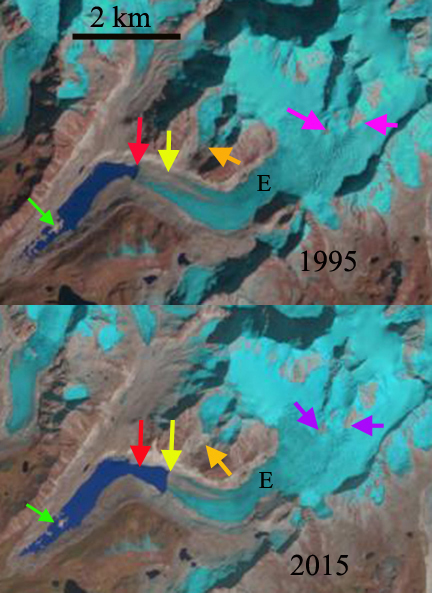
Chubda Glacier comparison in 1995 and 2015 images.  Red arrow indicates 1995 terminus location and yellow arrow is 2015 terminus location.  Pink arrows indicate areas upglacier of expanding bedrock. Green arrow indicates moraine areas amidst the lake.  The orange arrow indicates a secondary glacier.

Chubda Glacier, Bhutan drains south from Chura Kang on the Bhutan/China border.  The glacier terminates in Chubda Tsho, a glacier moraine dammed lake, Komori (2011) notes that the moraine is still stable and the lake is shallow near the moraine, suggesting it is not a threat for a glacier lake outburst flood. Mool et al, (2001) indicate the glacier was 3.4 km long and 0.3 km wide in the late 1990’s. Jain et al., (2015) noted that in the last decade the expansion rate of this lake has doubled. The glacier feeds the Chamkhar Chu basin which has a proposed 670 MW hydropower project under consideration. Here we examine changes in the Chubda Glacier from 1995 to 2015 with Landsat imagery.

In 1995 Chubda Glacier terminated at the red arrow and there was considerable ice cored moraine remaining in the southern portion of Chubda Tsho, green arrow.  The glacier is 700 m wide at Point E and has limited exposed bedrock areas just above the snowline above 2100 m, pink arrows.  A pair of secondary glacier have a joint terminus at the orange arrow In 2001 there are only minor changes from 1995.  In 2014 the snowline is at 2100 m, bedrock areas have expanded at pink arrows, and the amount of lake area at the southern end has expanded as ice cored moraine has melted out. In 2015 the glacier terminus has retreated 600 m since 1995, the lake area has expanded by ~2 square kilometers.  In 2015 the southern end of Chubda Tsho remains shallow and the wide moraine dam stable. The snowline is again at 2100 m and the glacier is only 500 m wide at Point E.  This indicates a continued decline in glacier flow into the terminus zone, which will lead to continued retreat. The secondary glaciers have now separated significantly, orange arrow.  The retreat of this glacier is similar to that of other glaciers such as Lugge and Thorthomia Glacier and just across the range in China, Zhizhai Glacier and Gelhaipuco Glacier.

chubde ge

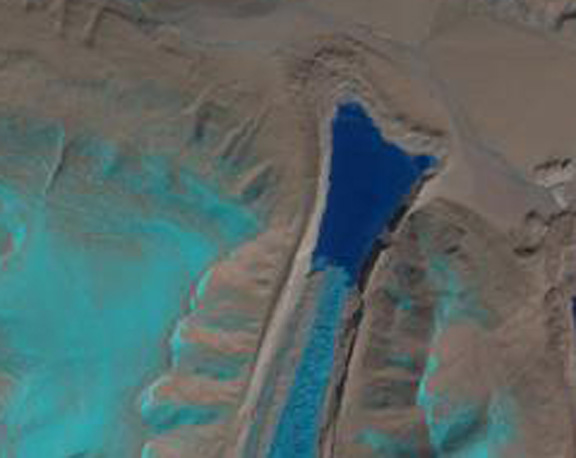
Google Earth image of Chubda Glacier. Blue arrows indicate flow, brown arrow indicates wide moraine dam, green arrow indicates shallow moraine areas. 

chubde galcier 2001

Chubda Glacier 2001 Landsat image.  Red arrow indicates 1995 terminus location and yellow arrow is 2015 terminus location.  Pink arrows indicate areas upglacier of expanding bedrock. Green arrow indicates moraine areas amidst the lake.  

chubde glacier 2014

Chubda Glacier Landsat image in 2014.  Red arrow indicates 1995 terminus location and yellow arrow is 2015 terminus location.  Pink arrows indicate areas upglacier of expanding bedrock. Green arrow indicates moraine areas amidst the lake.  


Himalayan Glacier Change Index

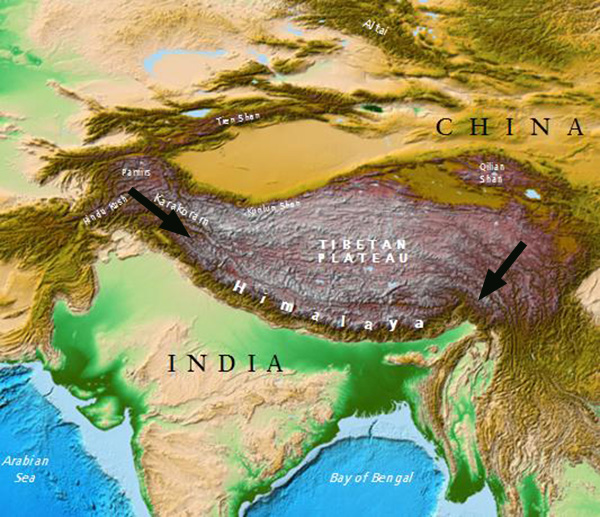
Himalaya Range Glacier Change Below is a list of individual glaciers in the Himalaya that illustrate what is happening glacier by glacier. In addition to the individual sample glaciers we tie the individual glaciers to the large scale changes of approximately 10,000 glaciers that have been examined in repeat satellite image inventories. In the Himalayan Range, stretching from the Karokaram Range in NW India east south east to the border region of Bhutan and China,  detailed glacier mapping inventories, from GLIMS: (Global Land Ice Measurements from Space), ICIMOD (International Centre for Integrated Mountain Development), ISRO ( Indian Space Research Organisation) and Chinese National Committee for International Association of Cryospheric Science (IACS) of thousands of glaciers have indicated increased strong thinning and area loss since 1990 throughout the the Himalayan Range. The inventories rely on repeat imagery from ASTER, Corona, Landsat, IKONOS and SPOT imagery. It is simply not possible to make observations on this number of glaciers in the field.  This is an update to the assessment by Pelto (2012) in the BAMS State of the Climate, which was the source of a Skeptical Science article as well

Kali Gandaki Headwaters, Nepal——–Ngozumpa Glacier, Nepal

Khumbu Glacier, Nepal ————         West Barun Glacier, Nepal 

Imja Glacier, Nepal ——–                       Nobuk Glacier, Nepal

Lumding Glacier, Nepal———-

Milam Glacier, India————                Samudra Tupa, India

Ratangrian Glacier, India———–       Khatling Glacier, India

Satopanth Glacier, India———-         Durung Drung Glacier, India

Gangotri Glacier, India————         Warwan Basin, India

Sara Umaga Glacier, India—–          Malana Glacier, India 

Jaonli Glacier, India——–                  Kalabaland Glacier, India  

Jaundhar Barak, India———–         Burphu Glacier, India

Changsang Glacier, Sikkim—–     Zemu Glacier, Sikkim 

South Lhonak Glacier, Sikkim——North Lhonak Glacier, Sikkim

Theri Kang Glacier, Bhutan———-Luggi Glacier, Bhutan

Mangde Chu Glacier, Bhutan——–Thorthormi Glacier, Bhutan

Menlung Glacier, Tibet———-       Yejyumaro Glacier, Tibet

Lumding Glacier, Tibet—-             Rongbuk Glacier, Tibet

Sepu Kangri, China———–          Longbasba Glacier, Tibet

Jiongla Glacier, Tibet———-        Bode Zanbo Headwaters, Tibet

Zayul Chu Headwaters, TibetBoshula Glaciers, Tibet

Matsang Tsanpo Gl, Tibet—–    Reqiang Glacier, Tibet 
Himalaya-Small

In Garhwal Himalaya, India, of 58 glaciers examined from 1990-2006 area loss was 6% (Bhambri et al, 2011). They also noted the number of glaciers increased from 69 (1968) to 75 (2006) due to the disintegration of ice bodies. Examination of 466 glaciers in the Chenab, Parbati and Baspa Basin, India found a 21% decline in glacier area from 1962 to 2004 (Kulkarni, 2007). Glacier fragmentation was also observed in this study, which for some fragments represents a loss of the accumulation area, which means the glacier will not survive (Pelto, 2010). The India glacier inventory (ISRO, 2010) identified glacier area losses and frontal change on 2190 glaciers and found an area loss rate of 3.3% per decade and 76% of glaciers retreating. (Kulkarni, 2014) reports on Indian Himalyan glaciers  that 79 of 80 with terminus change records have been receding.

In the Nepal Himalaya area loss of 3808 glaciers from 1963-2009 is nearly 20% (Bajracharya et al., 2011). The Langtang sub-basin is a small northeast-southwest elongated basin, tributary of Trishuli River north of Kathmandu and bordered with China to the north. The basin contained 192 km2 of glacier area in 1977, 171 km2 in 1988, 152 km2 in 2000 and 142 km2 in 2009. In 32 years from 1977 to 2009 the glacier area declined by 26% (Bajracharya et al., 2011). In the Khumbu region, Nepal volume losses increased from an average of 320 mm/yr 1962-2002 to 790 mm/yr from 2002-2007, including area losses at the highest elevation on the glaciers (Bolch et al., 2011).  The Dudh Koshi basin is the largest glacierized basin in Nepal. It has 278 glaciers of which 40, amounting to 70% of the area, are valley-type. Almost all the glaciers are retreating at rates of 10–59 m/year and the rate has accelerated after 2001 (Bajracharya and Mool, 2009).  ICIMOD (2013) completed an inventory of Nepal glaciers and found a 21% decline in area from the 1970’s to 2007/08.  ICIMOD has developed an  map viewer application for examining the changes through time.

An inventory of 308 glaciers in the Nam Co Basin, Tibet, noted an increased loss of area for the 2001-2009 period, 6% area loss (Bolch et al., 2010). Zhou et al (2009) looking at the Nianchu River basin southern Tibet found a 5% area loss. 1990-2005. In the Pumqu Basin, Tibet an inventory of 999 glacier from the 1974 & 1983 to 2001 indicated the loss of 9% of the glacier area and 10% of the glaciers disappeared (Jin et al, 2005). The high elevation loss is also noted in Tibet on Naimona’nyi Glacier which has not retained accumulation even at 6000 meters. This indicates a lack of high altitude snow-ice gain (Kehrwald et al, 2008).

A new means of assessing glacier volume is GRACE, which cannot look at specific changes of individual glaciers or watersheds. In the high mountains of Central Asia GRACE imagery found mass losses of -264 mm/a for the 2003-2009 period (Matsuo and Heki, 2010). This result is in relative agreement with the other satellite image assessments, but is at odds with the recent global assessment from GRACE, that estimated Himalayan glacier losses at 10% of that found in the aforementioned examples for volume loss for the 2003-2010 period (Jacobs et al, 2012). At this point the detailed glacier by glacier inventories inventories of thousands of glaciers are better validated and illustrate the widespread significant loss in glacier area and volume, though not all glaciers are retreating. This page will continue to be updated as new inventory data is published and new individual glaciers are examined herein. Yao et al (2012) in an examination of Tibetan glaciers observed substantial losses of 7090 glaciers.  Bolch et al (2012) in a report on the “State and Fate of Himalayan Glaciers” noted that most Himalayan glacier are losing mass and retreating at rates similar to the rest of the globe.  ICIMOD has also developed an application illustrating changes of glaciers in Bhutan.

Lugge and Thorthormi Glacier Retreat, Bhutan

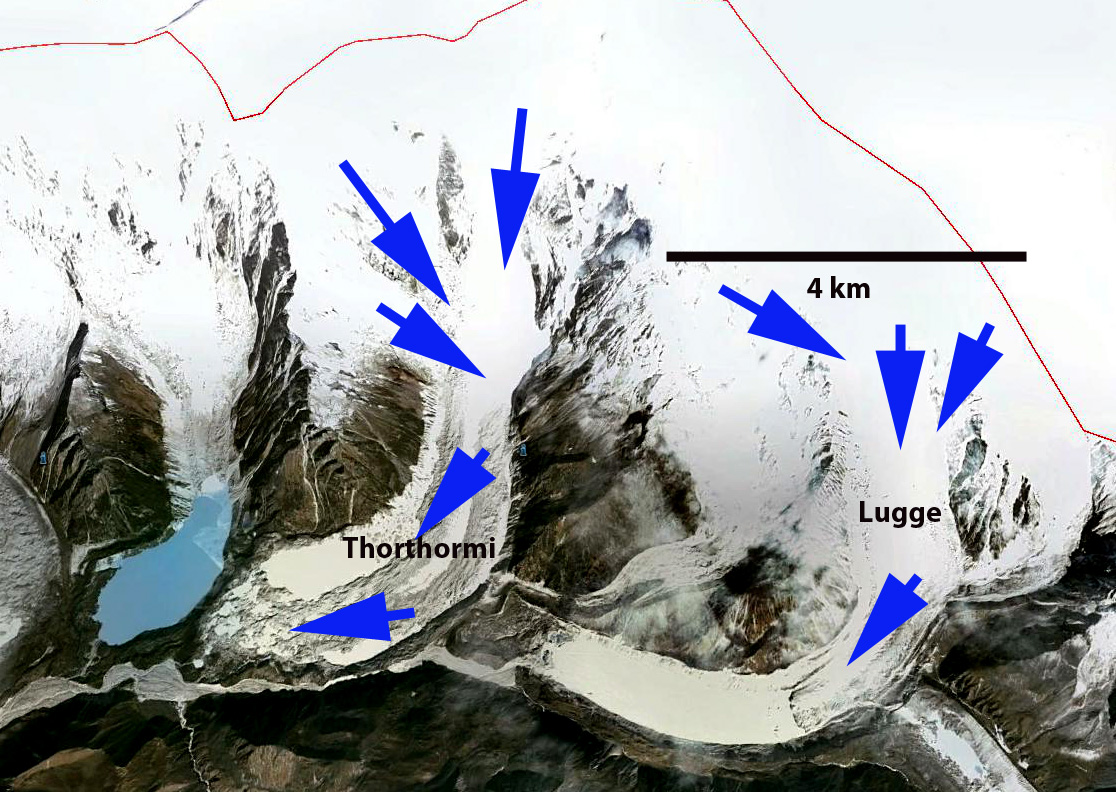
Luge and Thorthormi Glacier drain south from the border with China into the Pho Chu River in Bhutan. Both glaciers end in expanding glacier lakes that are prone to outburst floods, which sweep down the Pho Chu. Osti et al (2012) reported in detail on the nature of these floods, noting there are eight dangerous lakes including the two at the terminus of Lugge and Thorthormi Glacier, Thorthormi Cho and Lugge Cho. In 1994 Lugge Cho experienced a glacier lake outburst flood GLOF which incurred huge damage in the Pho Chu basin. The 1994 GLOF event had a peak discharge of about 2539 cubic meters/s and extended 200 km downstream as a flood wave Osti et al (2012) . The GLOF occurred after rapid retreat of Lugge Glacier from 1988-1993 of 160 m/year. pho chu ge
Google Earth Image
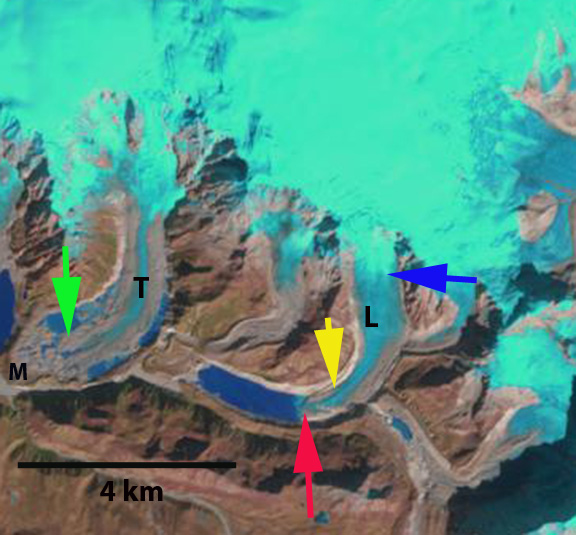
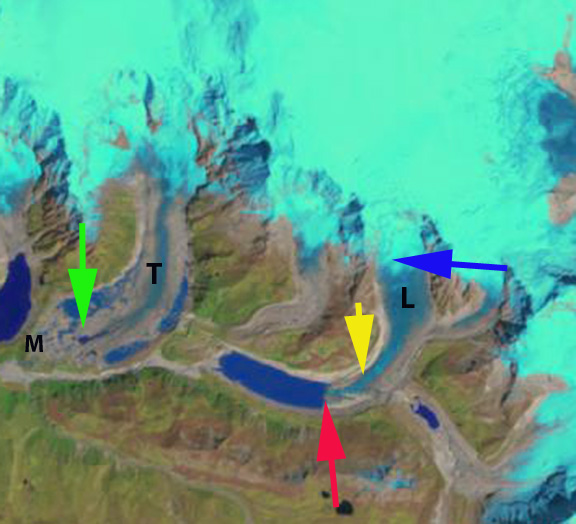
Here we examine the retreat of both glaciers in Landsat imagery from 2000-2014. In each image the red arrow indicates the 2000 terminus, the yellow arrow the 2014 terminus, the blue arrow the snowline on Lugge Glacier and the green arrow the center of the Thorthormi Glacier terminus in 2013. In 2000 the Lugge Glacier ends in a 2 km long Lugge Cho. The Thorthormi Glacier has pockets of proglacial lake in 2000, but also a debris covered terminus that extends across the lake basin to the Little Ice Age moraine (M). The two images from 2000 are from the start of October and late December. Note the snowline remains near 5100-5200 m in both images. The glaciers of Bhutan are summer accumulation type glaciers, in which the main accumulation season is during the summer monsoon. The snowline tends to rise from October into December with limited snowfall. By 2013 Lugge Glacier has retreated 1 km from the 2000 position, and Lugge Cho is now 3 km long. The terminus of Lugge Cho is not stagnant and it is not clear how much longer the deep basin extends under the glacier. If the basin does not extend much further retreat will soon be reduced. Thorthormi Glacier debris covered terminus connection to the moraine (M) has melted away and a lake extends across the full width of the glacier basin. The contiguous lake now has an area of over 1 square kilometer. The retreat of Thorthormi has been 700 m since 2000. The lowest 1 km of the glacier is stagnant and melt should be enhanced by calving into the lake, hence the retreat should remain quick in the next decade. The snowline in the Late November 2013 and early February 2014 image indicate the snowline at close to 5300 m in both. The retreat of these glaciers is leading to expansion of proglacial lakes much like the nearby Theri Kang and many other across the region Changsang Glacier, Sikkim, Lumding Glacier, Nepal Matsang Tsanpo, Tibet .
lugge 2000
2000 Landsat image
lugge 2000a
2000 Landsat image

lugge 2013
2013 Landsat image

lugge 2014
2014 Landsat image

Theri Kang Glacier Retreat Bhutan

One of the glaciers draining north from Theri Kang in Bhutan terminates in proglacial lake, that is a lake at the glacier front. This is an unnamed glaciers like its neighbors, we will refer to it as the Theri Kang Glacier. The glacier has retreated 1700 meters from the moraine complex that impound the lake. The terminus is at 5200 meters, the snowline is at 5800 meters and the summit of the glacier is near 6700 meters. The vegetation adjacent to the glacier is indicative of the overall dry climate in the region. This is also a cold climate with permafrost in the areas adjacent to the glacier. The lake is not in evidence in maps of the region from the 1960’s. Kääb (2005) in Figure 7b examined the velocity of this glacier using ASTER imagery he found that most of the lower glacier extending from where the tributaries join to the terminus moved at a velocity of 50 m per year. A comparison of this 2001 image overlain in Google Earth and the more recent 2009 imagery indicate this glacier has retreated 300 meters in eight years. The 2001 image is from NASA.The red line in the 2001 image indicates the 2009 terminus. The lake has expanded from 1500 meters in length to 1800 meters and now encompasses nearly 2 square kilometers. Often there is concern about glacier lake outburst floods from lakes dammed either by a glacier or impounded, as in this case, by its moraine. For the Theri Kang the moraine complex appears quite wide, and stable and is not of great concern. The 2013 Landsat image does not show significant retreat after 2009. theri kang 2013
2013 Landsat Image
The lower portion of the glacier is debris covered along the lateral margins, but the clean ice portion has an interesting pattern, that is typical of a glacier in a drier climate where sublimation is an important element of the ablation process, dominating over melting. Sublimation is the direct transfer of solid ice to water vapor without melting. That is the crevasse pattern becomes a series of prominent crests almost waves that persists in the absence of the crevasses that formed them. This persistence would not occur in a zone dominated by melting. Though the setting is much different the response to climate is the same as almost all Himalayan glaciers from the Zemu Glacier in Sikkim, to Lugge Glacier, Bhutan, to Imja Glacier in Nepal