Shie Glacier, Bhutan-China Retreat Reduces Lake Contact

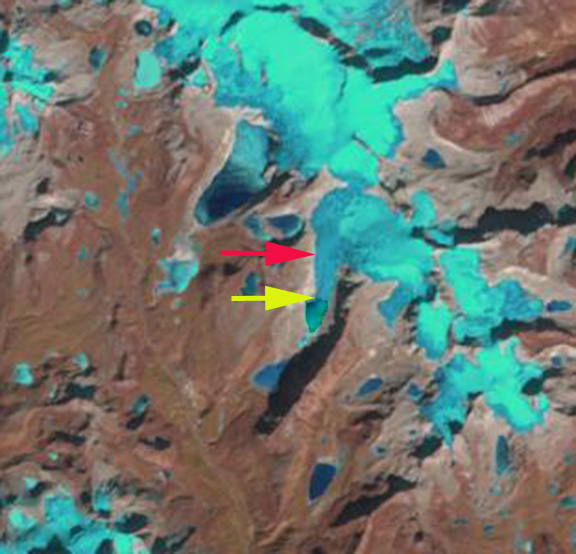
Shie Glacier Bhutan-China in Landsat images from 1996 and 2019.  Red arrow is the southern terminus location in 1996, yellow arrow the 2019 terminus location and red dots the margin of the eastern terminus in contact with the lake in 1996.

Shie Glacier terminates in a lake on the northern flank of the Bhutan Himalaya draining north from Kangphu Kang, in a region that is claimed by both China and Bhutan.  Here we examine 1996-2019 Landsat imagery to identify glacier change. Bajracharya et al (2014) reported a 23% loss in glacier area from 1980-2010.  This retreat led to a 20% increase in the number of glacier lakes in the region  (Che et al, 2014)

In 1996 the glacier had two prominent termini ending the lake. The eastern terminus had a 1300 m wide front in the lake and the southern terminus a 400 m wide front.  The southern are terminated 800 m up a narrow inlet.  In 2000 there was a minor retreat of less than 100 m of both terminus locations since 1996.   in 2011 both glaciers had an active calving front in the lake, with the eastern terminus, between Point A and B, reduced to 800 m of front in contact with the lake. The southern terminus between Point C and D has retreated 350-400 m since 1996.

By 2018 the southern terminus had retreated 600 m further up the inlet. In 2018 the eastern glacier front reached the lake on a front less than 100 m wide. In 2019 the eastern terminus does not reach the lake on a measurable front.  The eastern terminus has retreated 400 m on the northern margin, 350 m in the glacier center and 800 m on the southern margin. The southern terminus has retreated 700-800 m since 1996.  The reduced connection of the glacier to this lake will alter the nutrient flux to the lake.  The lake has had a consistent water level during the entire period and the terminal moraine that helps impound the lake is deeply incised.  The combination along with reduced frontal suggests the GLOF threat is low

High snowlines in recent years will continue to drive retreat here and on adjacent Theri Kang and Lugge Glacier.

2011 Digital Globe image of Shie Glacier terminus, eastern terminus between Point A and B, southern terminus between Point C and D.

Shie Glacier Bhutan-China in Landsat images from 2000 and 2018.  Red arrow is the southern terminus location in 1996, yellow arrow the 2019 terminus location and red dots the margin of the eastern terminus in contact with the lake in 1996.
Mangde Chu Glacier Retreat, Bhutan

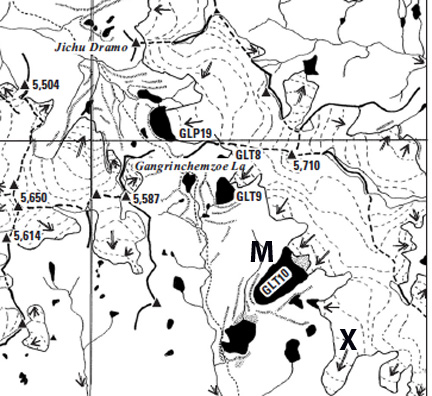
The Mangde Chu Basin in Bhutan is home to many alpine lakes, and the number is increasing as glacier retreat leads to both new lakes and expanding lakes. Many of these alpine lakes are impounding by glacial moraines of varying stability. Some of the glacial lakes are capable of outburst floods (GLOF), the resulting hazard has led to an inventory of these lakes in Bhutan and this watershed in a joint effort between Bhutan and EROC in Japan. Here we examine the development of a new lake not shown in the USGS map of the region from a 1993 SPOT image. This glacier is marked by an X and is just south of the Methatshota Tsho (M).
mande chu map
USGS Map

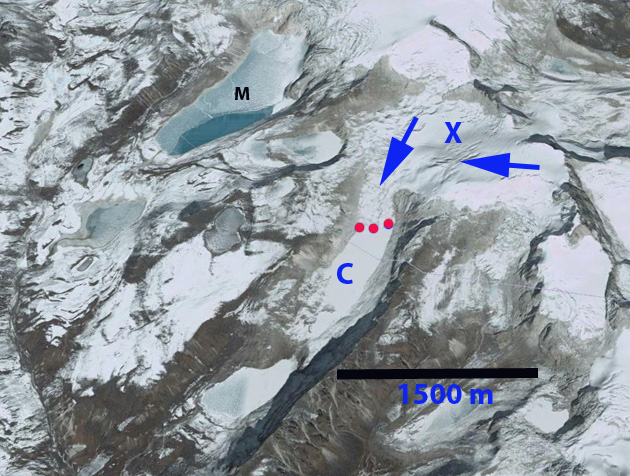
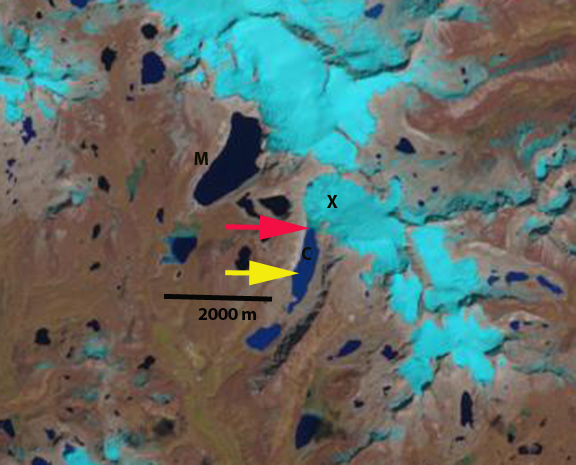
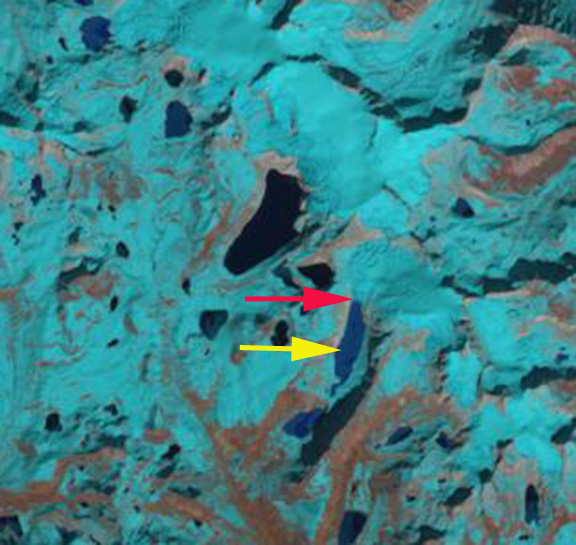
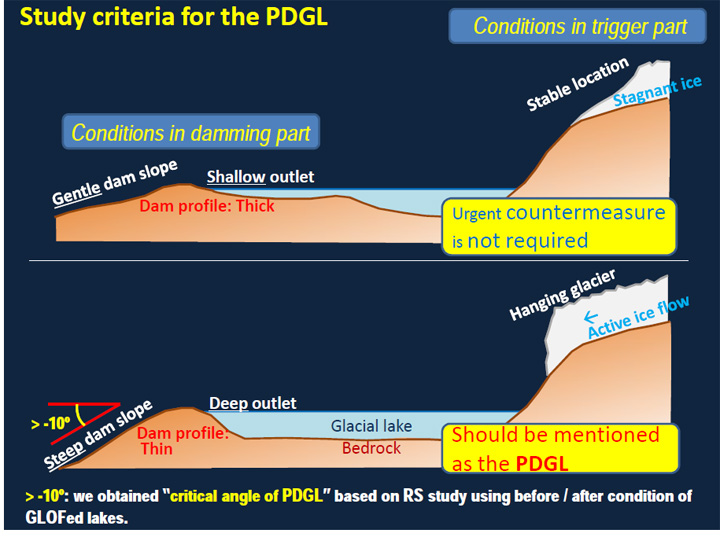
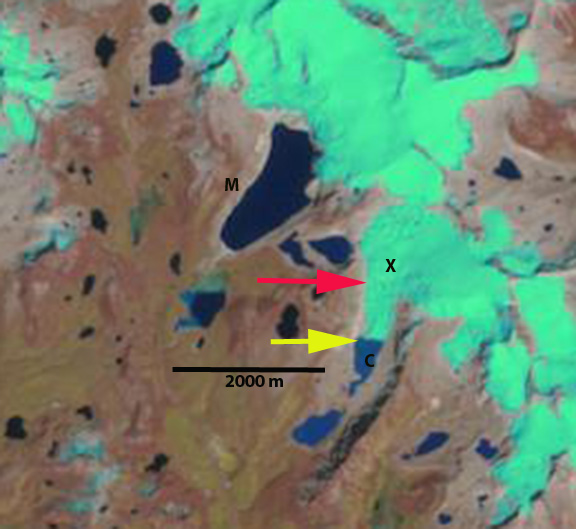
In a pair of Landsat images from October and December of 2000 the lake (C) has formed and the glacier terminates at the yellow arrow, red arrow is 2013 terminus. The lake is 550 m long. By 2006 in the Google Earth image the lake is 850 m long, terminus red dots. In 2013 Landsat images from October and December indicate the lake has expanded to a length of 1400 m. The glacier has retreated 1400-1500 m since 1993 and 850 m since 2000. Just above the red arrow the lake to the west of the glacier is not as close to the glacier, this indicates thinning of the upper sections of this glacier and marginal retreat in the accumulation zone. This is typically a sign that a glacier cannot survive current climate (Pelto, 2010). The lake is not impounded by a substantial terminal moraine, and does not appear to be prone to a substantial GLOF. This is what the joint Bhutan-Japan study indicates as not requiring urgent counter measures as the moraine dam is thick and the slope is not too high either of the moraine or the glacier leading into the lake, note last figure. The channel leading out of the lake is immature and will likely downcut through the glacial sediments, reducing the lake area somewhat. The glacier surface rises quickly just above the current terminus, indicating that the lake will not grow much longer, and glacier retreat will then slow as the terminus pulls out of the lake. This glacier is retreating as are the nearly all glaciers in the region such as Lugge Glacier, Thorhormi Glacier and Theri Kang Glacier all a short distance north. mangde chu 2000a
2000 Landsat image
mangde chu2000
2000 Landsat image
bhutan cho ge
2006 Google Earth Image
mangde chu 2013
2013 Landsat image
mangde chu 2013a
2013 Landsat image
mangde chu moraine
2006 Google Earth Image
mangde chu glof
Image from Kumori