Todd Icefield, British Columbia Retreat and Separation

Todd Icefield in 1987 and 2020 Landsat images illustrating retreat and separation. Red arrows indicate 1987 terminus location, Point A indicates location where the glacier has separated. Point B and C are locations of expanding bedrock high on the icefield. Point D is further glacier separation.

Todd Icefield is an icefield 30 km northeast of Stewart BC at the head of Portland Canal, with Todd Glacier being the main outlet glacier draining north to Point A and Erickson Glacier draining south near Point B. Glaciers of this icefield retreated and downwasted significantly from 1974-1997, with retreat rates of 9-76 m/year (Jackson et al 2008).  Menounos et al (2019) indicate mass loss averaging -0.5 m/year from 1985-2018 in this region.

In 1987 Todd Glacier terminates in a small proglacial lake 1 km beyond a glacier junction at Point A.  At Point B and C there are small bedrock outcrops. It is also worth noting that you could hike from the end of Todd Glacier on the northside across the icefield divide to the Erickson Glacier on the south side without crossing any snowcover. By 1997 Todd Glacier has retreated from the now 0.5 km long proglacial lake, with the two glacier tributaries joining just before the terminus. Again the snowline is above the Todd Icefield divide.

In 2013, 2014, 2015, 2018 and 2019 the snowline again rose above the icefield divide, leading to continued thinning even at the divide leading to increased bedrock exposure at Point B and C in 2018-2021. By 2020 Todd Glacier has retreated m since 1987 and separated from the main tributary at Point A. In 2018-2021 it is evident that Erickson Glacier is terminating in two new expanding proglacial lakes (0.2 km2) that may merge, and Todd Glacier is also now terminating in a new proglacial lake.

Retreat of Todd Glacier has been 2.4 km from 1987-2021, which is 30-40% of it entire length. The retreat is in line with that observed at nearby Bromley Glacier and Chickamin Glacier.

Todd Icefield in 1997 and 2021 Landsat images illustrating retreat and separation. Red arrows indicate 1987 terminus location, Point A indicates location where the glacier has separated. Point B and C are locations of expanding bedrock high on the icefield. Point D is further glacier separation.

Todd Icefield in 2018 and 2019 Sentinel images, note the dirty ice extends across the icefield divide in both years, yellow arrows indicate proglacial lakes developing.

Pashleth Glacier, BC Retreat Driven Fragmentation 1987-2021

Pashleth Glacier in 1987 Landsat and 2021 Sentinel image. Red arrow is 1987 terminus location, yellow arrow 2021 terminus location. Point B-D mark locations where separation has or is occurring along the main glacier and Point A on the western arm.

Pashleth Glacier, British Columbia drains into Pashleth Creek a tributary to the Machmell River, Owikeno Lake and then River Inlet on the British Columbia Coast. Here we examine the glacier retreat and fragmentation that has occurred from 1987-2022. The Machmell River is an important salmon spawning area in its lowest 20 km, particularly for sockeye, with chinook, coho, pink and chum salmon up to the cascades just downstream of junction with Pashleth Creek (Hillaby, 1998). The Rivers Inlet fjord had the third largest run in the province with annual returns of up to 3.1 million sockeye from 1948 to 1992 (Hakai, 2021). The Rivers Inlet sockeye stock has recently received much attention because of a dramatic decline in total abundance from the with an estimated 94% decline in sockeye salmon equilibrium population size (from 3,115,000 to 200,000) hitting a low of under 10,000 in 1999 (Adams et al 2021). In the 1980’s Machmell River escapement numbers averaged 20,000, dropping to 5000 in the 1990’s  (Rutherford et al 1998). Harvest rates were reduced in the 1980’s and the commercial fishery closed in 1996.  The commercial fishery has remained closed since 1996, with  a small amount of fishing permitted by the Wuikinuxv First Nation maintain a modest food, social, and ceremonial harvest. The Rivers Inlet sockeye salmon stock has experienced limited recovery consistently exceeding ~100,00o, and averaging ~250,000 in the last two decades (Adams et al 2021). The study also examined the decline in grizzly bear population and the connection to salmon decline.  They observed grizzly bear diet finding the percentage of the diet from salmon declined from ~70% pre-collapse to 23% in the 1990’s and rebounding today with fewer grizzly bears to 64%.

In 1987 Pashleth Glaciers main terminus was at 1000 m and the west terminus at 1100 m, with the snowline at 1700 m. By 2000 significant retreat has occurred and tributaries at Point A-D are all feeding the main glacier. The snowline is at 1800 m in 2000. In 2014 tributaries A-D are still feeding the main glacier. The snowline is at 2000 m in 2014. In 2020 Brian Menounos and Ben Pelto (UNBC) visited the accumulation area of this glacier at 2300 m and found 4.2 m of snow remaining, see below. This area has retained accumulation each and every year. In 2021 tributaries at Point A and B have separated from the main glacier, while the tributary at Point C is on the verge of separation, likely will happen in 2022. At Point D this region is developing a rock rib that indicates contribution from this small triburary is limited and will cease in the near future. The snowline in late August is at 1950 m. The main terminus has retreated 1250 m from 1987-2021 and the west arm 1700 m.

Pashleth Glacier is a large glacier that will continue to supply a large magnitude of summer glacier runoff.  The challenge for the salmon will continue to be in the ocean.  The neighboring Klippi Glacier retreated 1400 m from 1987-2016, with the two main branches having separated and also feeds the Machmal River. Draining the same icefield to the south Klinaklini Glacier is also rapidly retreating (The Tyee, 2021).

Pashleth Glacier in 1987 and 2014 Landsat image Red arrow is 1987 terminus location, yellow arrow 2021 terminus location. Point B-D mark locations where separation has or is occurring along the main glacier and Point A on the western arm.

Brain Menounos, UNBC probing snowpack on the upper glacier. Searching for a potential measurement station high on the glacier (Image from Ben Pelto).

Crevasse stratigraphy indicates the depth of retained accumulation on upper glacier ( (Image from Ben Pelto)

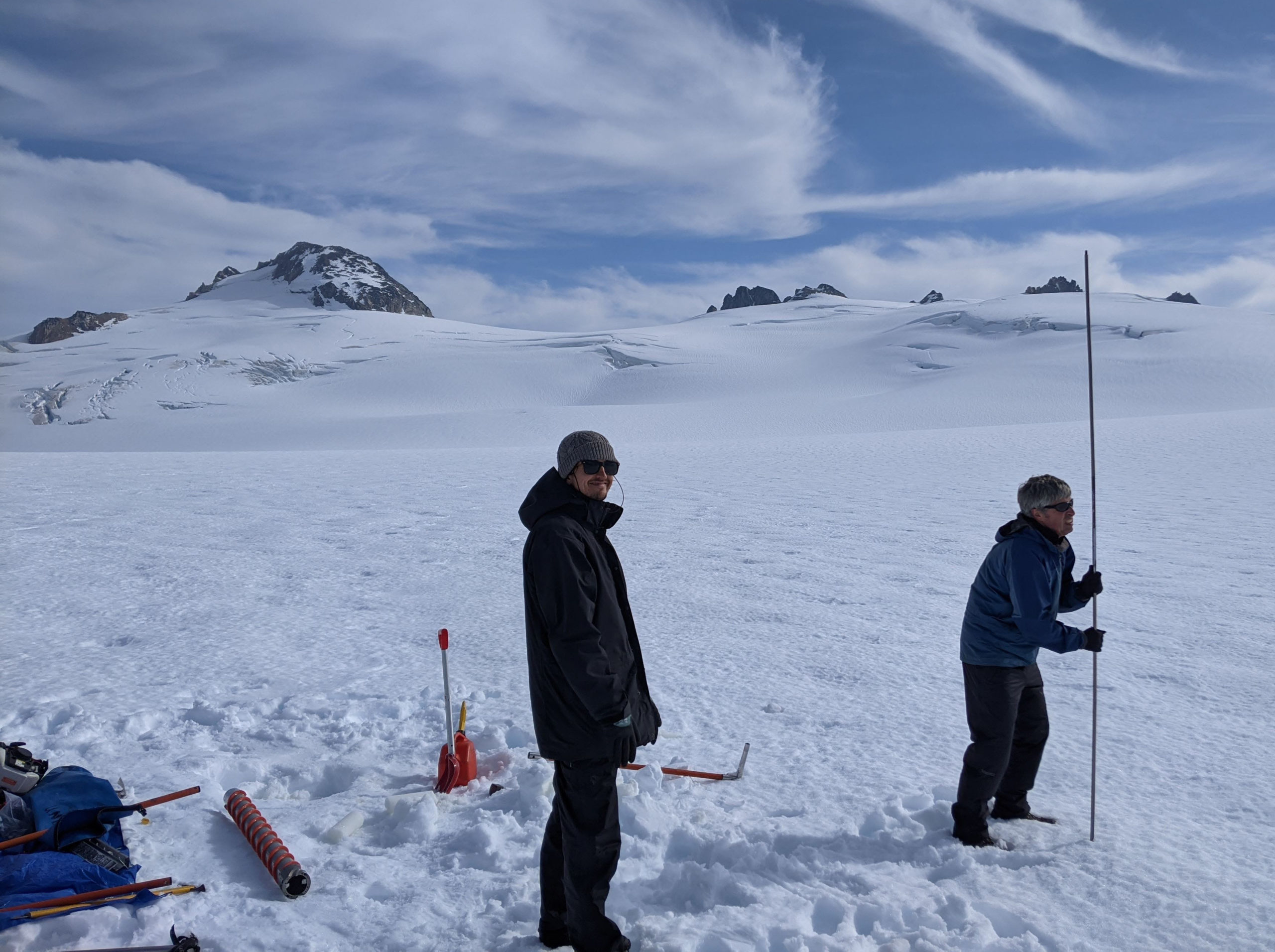
Braithwaite Icefield, British Columbia Fragments, Proglacial Lakes Develop and Accumulation Zone is Lost

East Creek Glacier, a Braithwaite Icefield glacier in Sentinel images from 2018, 2019 and 2021 illustrating the at Point A and B  where the glacier has disconnected from other glaciers of the icefield . Point C is a the terminus of one icefield outlet glacier that develops a proglacial lake. Point D is adjacent to the ice divide where ice flows both north and south from.  Note the area is snow free in 2018, 2019 and 2021. The ice divide has ~12 annual layers exposed as rings.

The Braithwaite Icefield is east of Hobson Lake is in the Columbia Mountains an interior range of British Columbia. Our focus here is on a glacier at the headwaters of East Creek, “East Creek ” Glacier. This glacier has experienced changes that exemplify the recent changes of glaciers across western Canada. An extensive western Canada glacier inventory of the 1984-2020 period using optical satellite imagery noted an accelerated area loss Bevington and Menounos (2022).  Specifically they quantified glacier fragmentation accelerated from 26  to 88  occurrences per year. They note that about 1141 glaciers disappeared from the inventory falling below the 0.05 km2 detection limit. The retreat also led to proglacial lake area formation accelerating from ~9 km2/year to 49 km2/year.

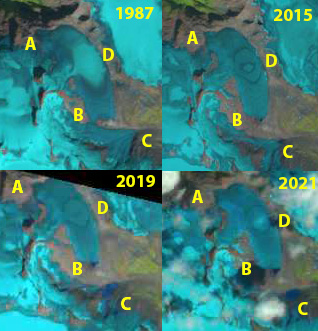
In 1987 East Creek Glacier accumulation zone adjacent to Point D drains north and south to separate terminus areas. In 1987 the outlet glacier that terminates at Point C is connected at Point B to the East Creek Glacier at its southern terminus.  Adjacent to its northern terminus it is connected at Point A to another icefield glacier.  By 2015 the glacier has separated at Point B from the outlet glacier terminating at Point C. There is not retained accumuluation at the glacier divide adjacent to Point D. This exposes a ring of ~12 annual layers preserved in glacier ice, from former annual accumulation layers that had been retained. In the ensuing summers of 2016, 2017, 2018 2019 and 2021 all of the snowpack was lost. Two proglacial lakes have formed, the area of the lake at the East Creek southern margin is 0.03 km2, the area of the lake at Point C is now 0.1 km.

The persistent lack of an accumulation zone indicates the glacier cannot survive (Pelto, 2010).  The glacier still has an area of 2.5 km2, that will allow it to endure for several decades. Ben Pelto,  and Menounos a(2021) reported that the mass balance of Zillmer Glacier, due east in the same range, had a mean negative balance of ~-0.7 m/year from 2014-2018, with an average ELA of 2465 m. The glacier had a mean altitude of 2380 m and a high elevation of 2860 m. The mean elevation of Zillmer Glacier is higher than the divide on East Creek Glacier, which along with a relatively steep mass balance gradient of 5 to 8 mm w.e. m-1, leads to the glacier maintaining an accumulation zone.  The retreat is not as substantial as many glaciers in the region, note Kiwa Glacier or Franklin Glacier, but the overall changes are profound.

East Creek Glacier a Braithwaite Icefield glacier in Landsat images from 1987, 2015, 2019 and 2021 illustrate the changes. Point A and B are points where the glacier is connected to other glaciers of the icefield that separate-fragment during this period. Point C is a the terminus of one icefield outlet glacier that develops a proglacial lake. Point D is adjacent to the ice divide where ice flows both north and south from.  Note the area is snow free in 2015, 2019 and 2021.