Chickamin Glacier, Alaska Retreat Generates Separation and Lake Expansion

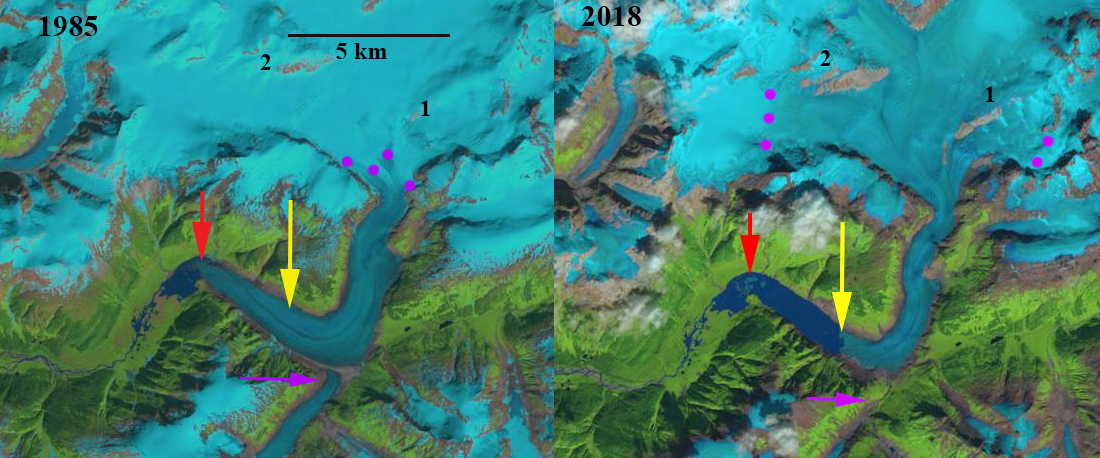
Chickamin Glacier, Alaska in 1985 and 2018 Landsat images indicating the 3.5 km retreat and associated lake expansion. Red arrow is 1985 terminus location, yellow arrow is the 2018 terminus location, pink arrow is former junction area with Through Glacier.  The purple dots indicate the snowline.  Point 1 and 2 are locations of bedrock expansion above the equilibrium line altitude. 

Chickamin Glacier in southeast Alaska glacier drains south from an icefield near Portland Canal and straddling the border with British Columbia. The glacier ended on an outwash plain in 1955 at an elevation of 250 meters.  Shortly thereafter a lake began to form, and by 1979 a Landsat image indicates a lake that is 1300 meters long and a retreat of ~2.5 km from 1902-1979 (Molnia, 2008). The glacier at that time was fed by a substantial tributary entering from the south ~5 km above the terminus, Through Glacier-pink arrow. Here we examine Landsat images from 1985-2018 to identify the response to climate change.

In 1985 the glacier terminated at an elbow in the lake where the lake both narrows temporarily and turns east, red arrow. The glacier had terminated close to this location for 30 years. The snowline is at 1150 m, and Through Glacier still connects to Chickamin Glacier.  At point 1 and 2 the area of exposed bedrock is limited. In 1994, the glacier has retreated 500 m from the elbow.  Through Glacier has separated from Chickamin Glacier. The snowline in 1994 is at 1125 m.  In 2013, Through Glacier has retreated 1600 m from Chickamin Glacier. Chickamin Glacier has retreated 2 km since 1985 and the snowline is at 1250 m.  By 2018 Chickamin Glacier has retreated 3.5 km since 1985 a rate of just over ~100 m/year, yellow arrow. The terminus is currently at a point where the lake narrows, which should reduce the retreat rate.  In 2018, the snowline reached 1525 m, leaving only 10-15% of the glacier in the accumulation zone.  The exceptionally high  snowline in 2018 was also noted at Taku Glacier. The snowline from 2014-2018 has persistently been above 1350 m, which indicates substantial negative mass balance for the glacier that will drive continued retreat. The persistent snowline elevation above 1250 m is indicated by the expansion of bedrock areas at Point 1 and 2 from 1985 to 2018, which both are located in what was the typical accumulation zone prior to that time.

The sustained mass balance losses follow that of Lemon Creek Glacier, which has a a long term record from 1953-2018 indicating a loss of  ~-0.5 m/year (Pelto et al. 2013).  The retreat and lake expansion has become a chorus with more than 20 coastal Alaskan glaciers having at least a 2 km lake expansion due to retreat since 1984, documented individually in previous posts at this blog.

Chickamin Glacier, Alaska in 1994 and 2013 Landsat images indicating the 3.5 retreat and associated lake expansion. Red arrow is 1985 terminus location, yellow arrow is the 2018 terminus location, pink arrow is former junction area with Through Glacier.  The purple dots indicate the snowline.  Point 1 and 2 are locations of bedrock expansion above the equilibrium line altitude. 

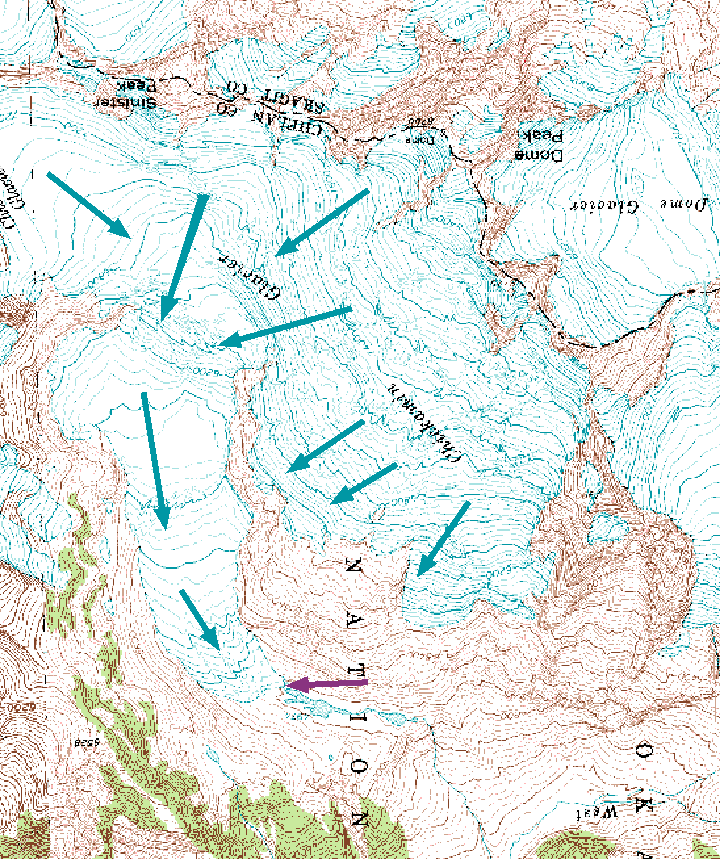
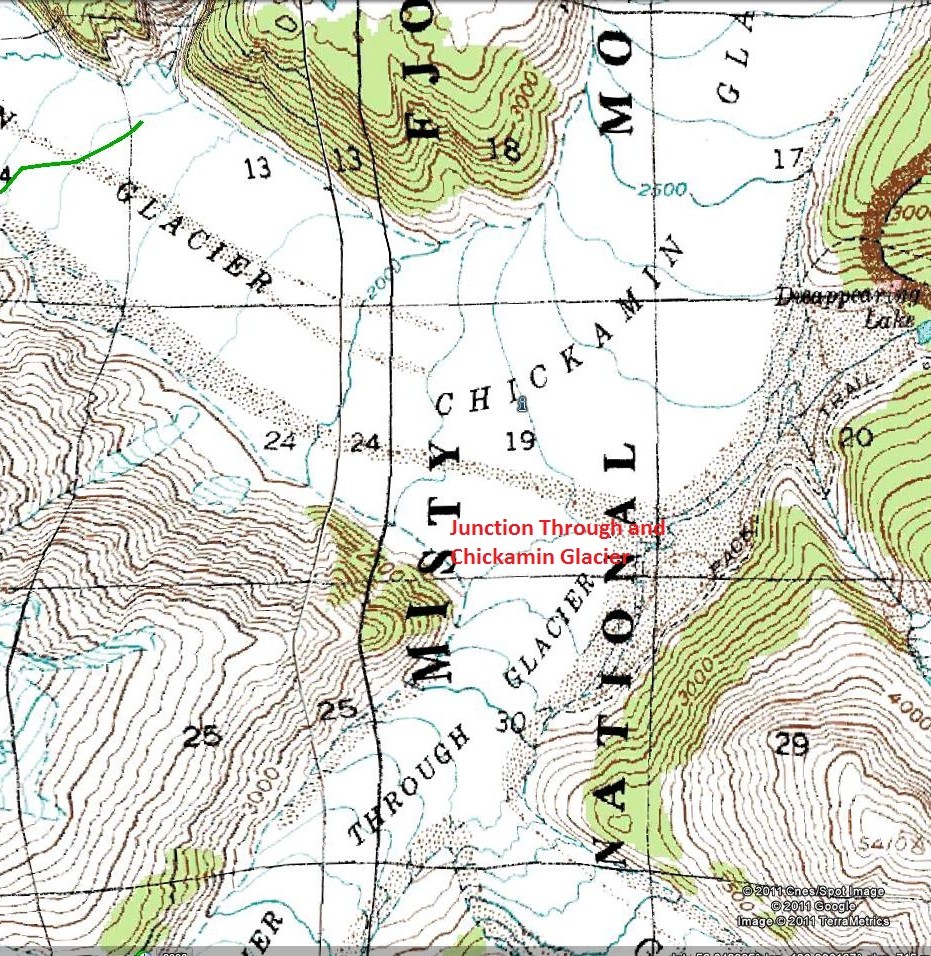
USGS map of Chickamin Glacier based on 1948 aerial photographs
Chickamin Glacier Retreat, North Cascade Range, Washington

Chickamin Glacier covers the north slope of Sinister Peak in the North Cascade Range of Washington.  The glacier has a valley tongue that descends to an outwash plain.  Here we examine retreat of the glacier from 1979 to 2012. The glacier had advanced from 1955-1975, before commencing retreat.

CHICKAMIN_GLACIER05
Chickamin Glacier (Tom Hammond)

chickamin map

USGS Map of Chickamin Glacier

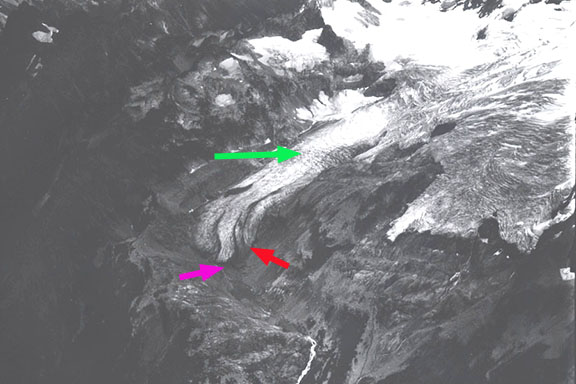
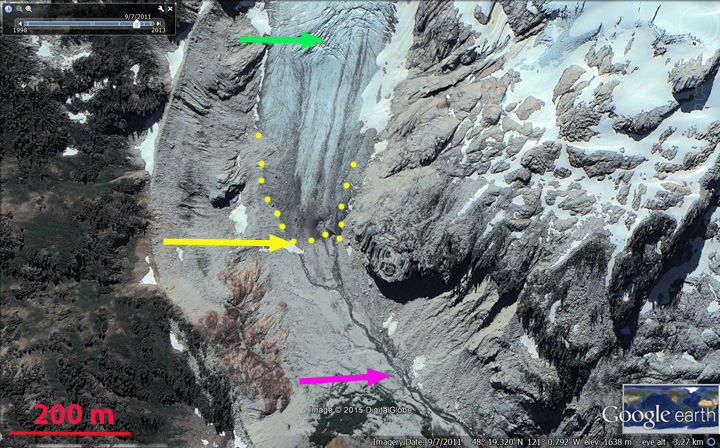
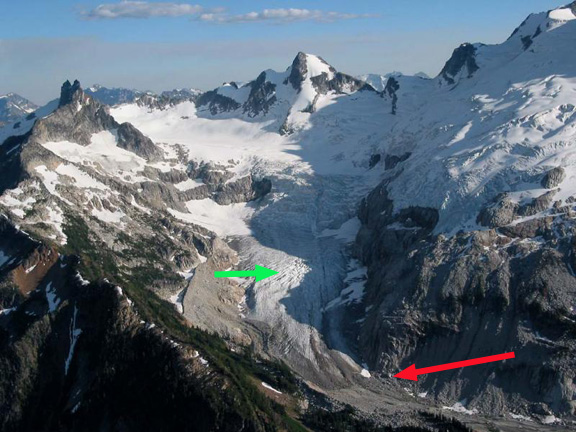
In 1979 the glacier terminus was at the pink arrow, several hundred meters beyond a prominent buttress, red arrow, where the glacier turns west.  The lowest icefall is indicated by a green arrow. In 1991 the glacier has retreated from the pink arrow, but still is turning the corner beyond the buttress.  The lower icefall is still extensively crevassed.  By 1998 in a Google Earth image the terminus is outlined with yellow dots and has retreated 230 m from the 1979 position.  The lower icefall is still crevassed.  By 2005 in a photograph from Tom Hammond (North Cascades Conservation Council), the glacier has retreated to the buttress. in a 2006 Google Earth image the terminus position is indicated by yellow dots, with a retreat of 50 m since 1998.  The lower portion of the glacier has limited crevassing.  In the 2012 image the glacier terminus no longer reaches the buttress and has retreated 360 m since 1979. We observed exceptional ablation conditions in the North Cascades in 2013 and 2014, which combined with exceptionally low snowpack in 2015 will lead to a continued significant retreat of this glacier.  The crevassing in the lowest icefall has declined and is now superficial. All 47 glaciers observed by the North Cascade Glacier Climate Project have been retreating and four have disappeared (Pelto, 2011). This glacier is similar in size and retreat to Boston Glacier and Honeycomb Glacier.

chickamin79

Chickamin Glacier 1979 (Austin Post)chickamin glacier1991

1991 Chickamin Glacierchickamin 1998 geterminus

1998 Google Earth image

CHICKAMIN_GLACIER05

2005 Chickamin Glacier (Tom Hammond)chickamin 2006 geterminus

2006 Google Earth imagechickamin 2012 geterminus

2012 Google Earth Image

Chickamin Glacier, Alaska Extensive Retreat

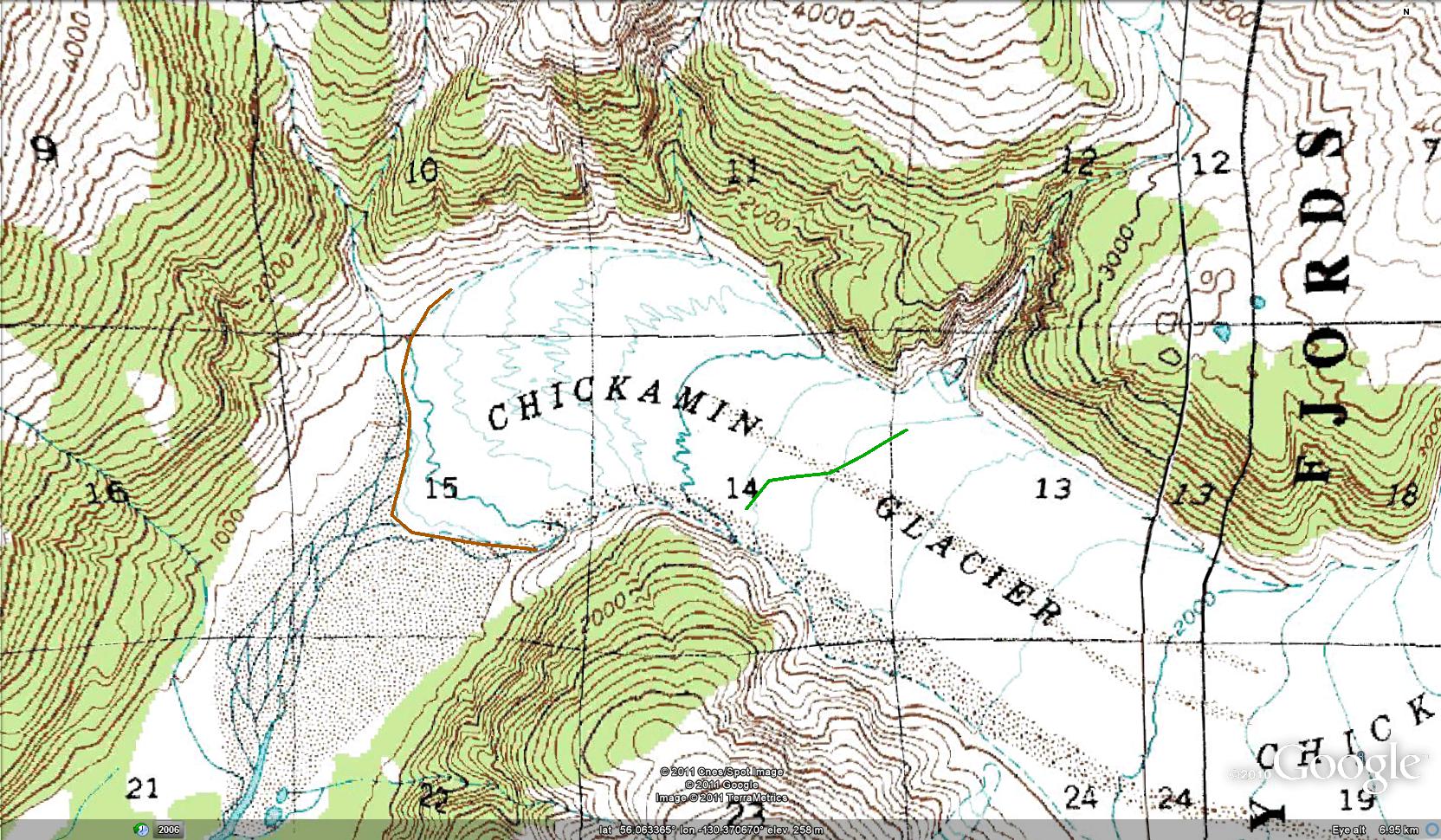
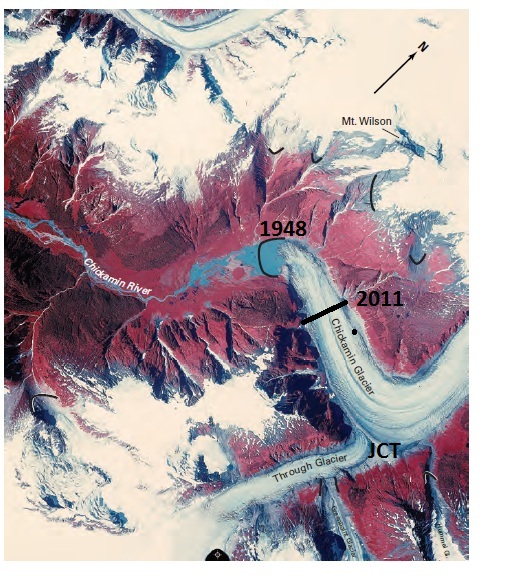
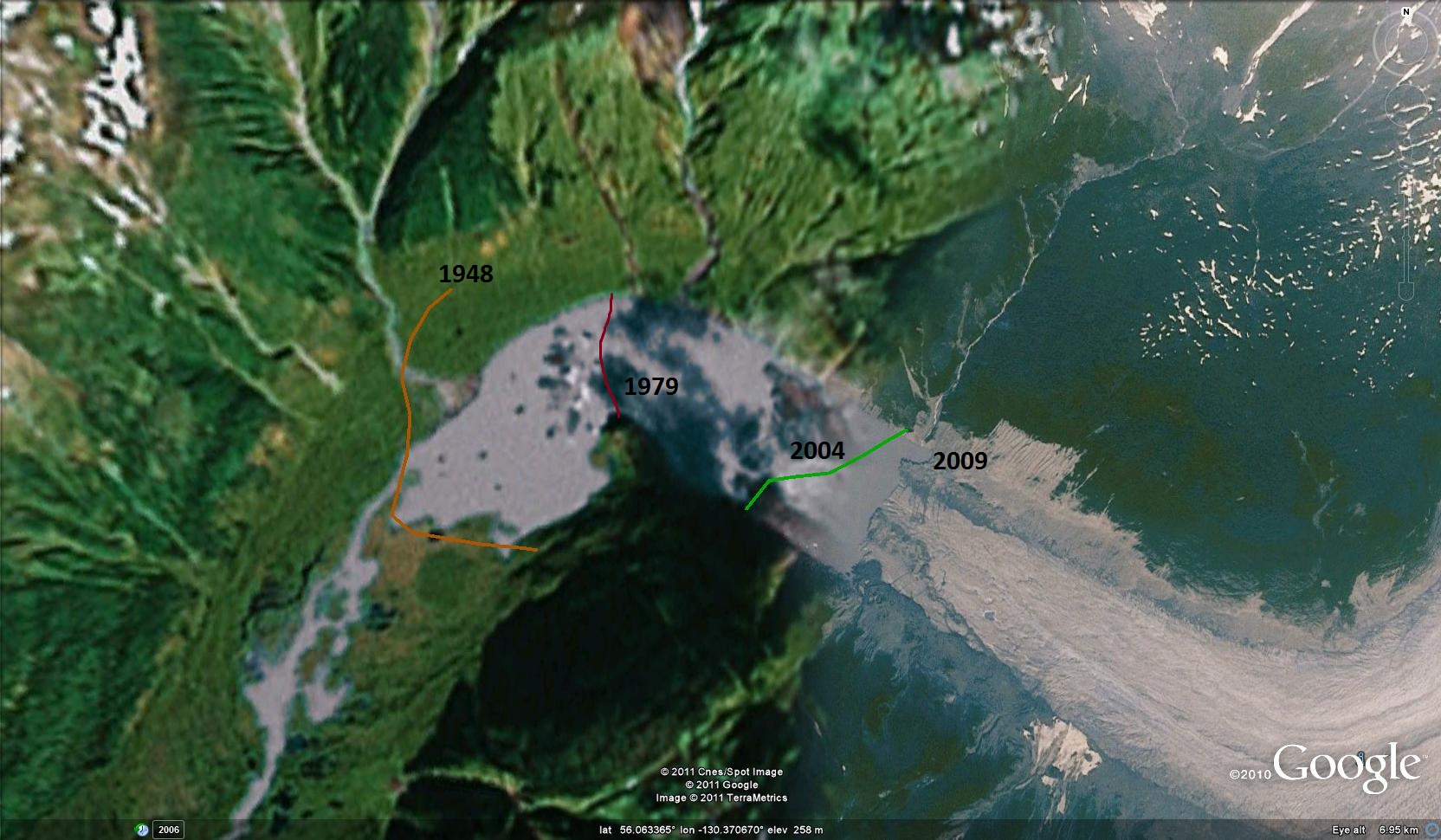
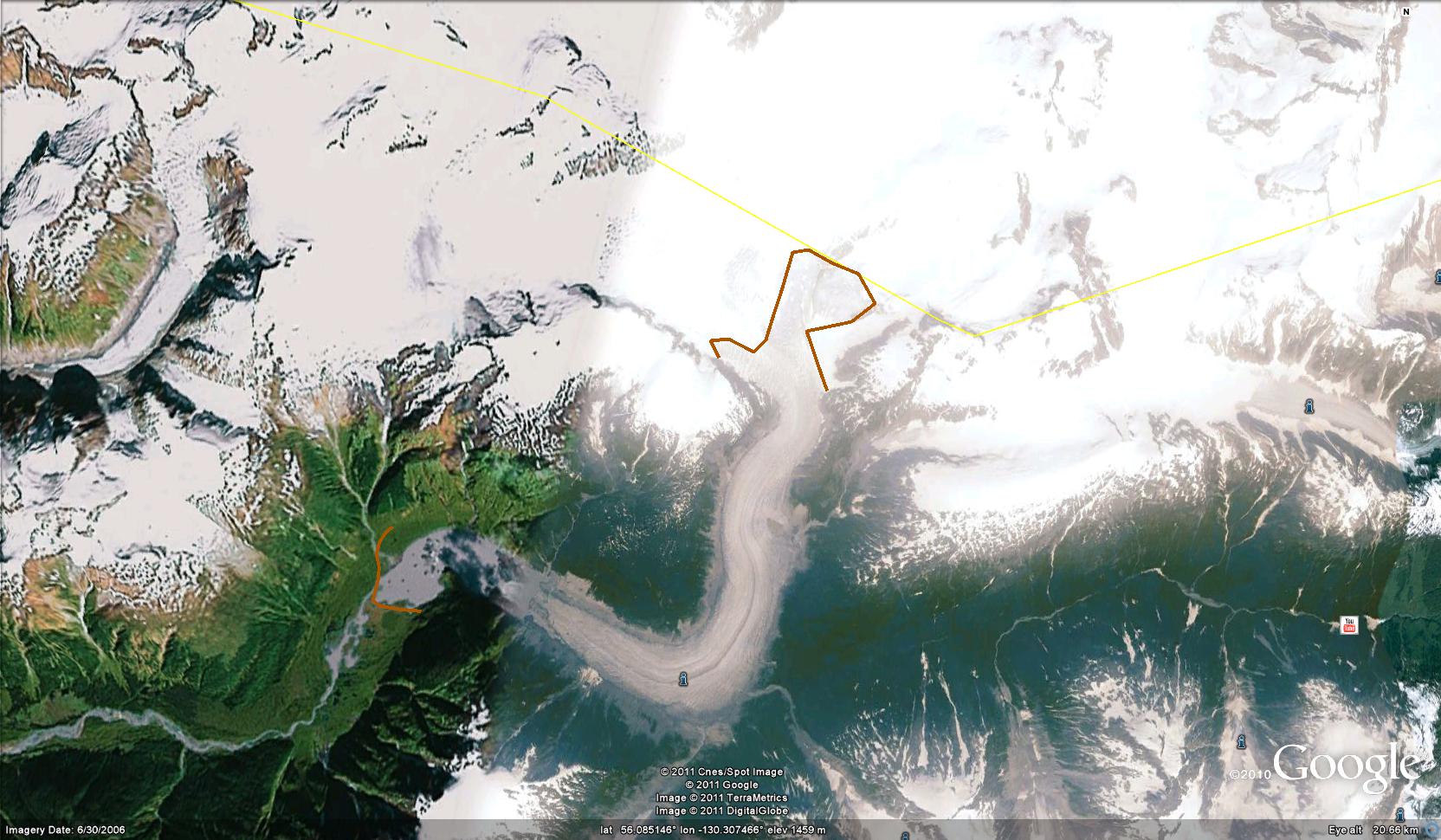
Chickamin Glacier in southeast Alaska has undergone a 3 kilometer retreat since 1955. The glacier drains south from an icefield near Portland Canal and straddling the border with British Columbia. The glacier ended on an outwash plain in 1955 at 250 meters. The Through Glacier at this time is a large tributary feeder joining Chickamin at the elbow where it turns west, (bottom image) Shortly thereafter a lake began to form, and by 1979 a Landsat image indicates a lake that is 1300 meters long. A this point the Through Glacier is just barely in contact with Chickamin Glacier. . By 2004 in an Ikonos image the glacier has retreated 1400 meters from the 1979 position, top image. This image is from the USGS and has been further annotated. In a 2009 Geoeye image the glacier has receded an additional 300 meters, 3000 meters since 1955. Just as impressive is the retreat of Through Glacier that now terminates 1500 meters from its former Junction with Chickamin Glacier. This separation and retreat has occurred during a period of higher snowlines in the region. The snowline of the glacier has averaged 1200 meters in recent years, 100 meters higher than before, and the summit of the glacier is at 2000 meters. The retreat and thinning of this glacier follow that of Sawyer Glacier, Gilkey Glacier and Lemon Creek Glacier. The current terminus region indicates considerable rifting in the lower 500 meters indicating this will be rapidly lost, note the red arrow. The blue arrow indicates a zone below which the glacier appears stagnant with no active crevasse features. The green arrow indicates the transition to a zone of active flow and crevassing. At meters kilometers above the terminus a basin has developed, orange arrow, this is filled periodically becoming a lake, which then drains beneath this glacier. This lake and basin will continue to expand.