A Tale of Two Glaciers Columbia and Easton Glacier 2021

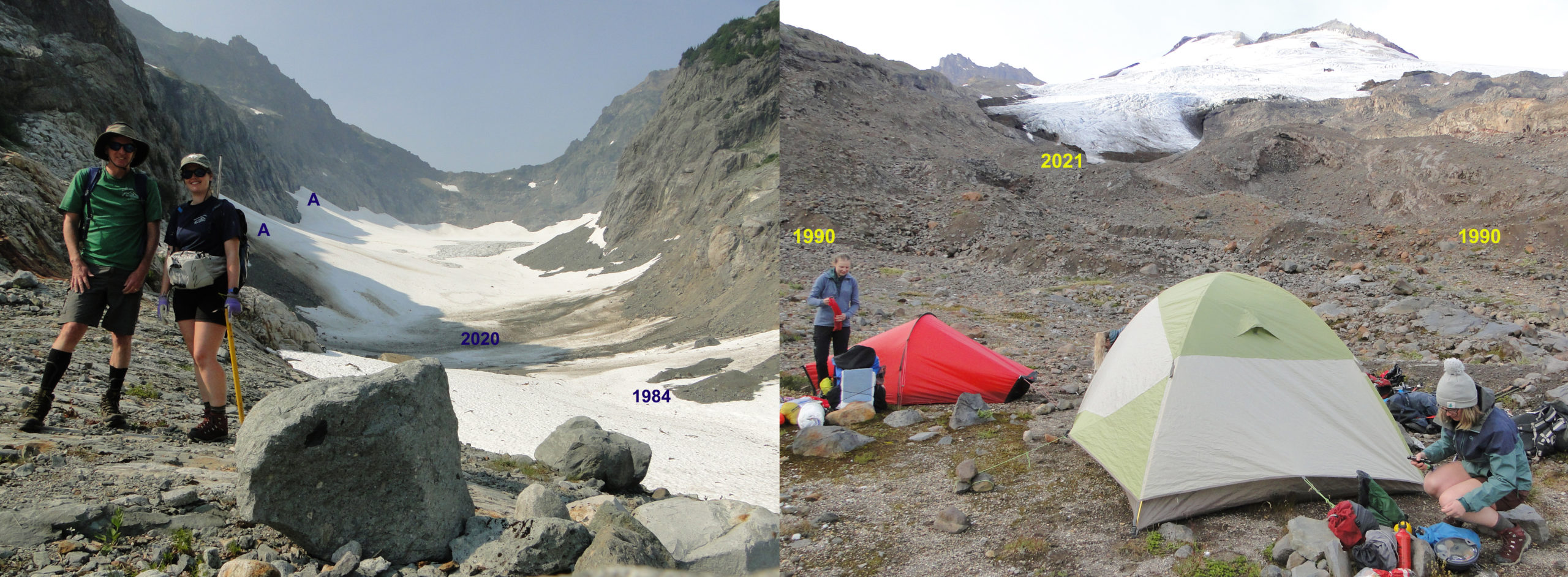
Terminus of Columbia Glacier on left with 1984 terminus location noted.  Observe the avalanche fans (A) and the relatively high snowcover on 8-2-2021.  At right is Easton Glacier on 8-11-2021 with the location of the 1990 terminus indicated, 440 m of retreat to the 2021 terminus position. The glacier has only 38% snowcover at this time, which is better illustrated below.

Columbia and Easton Glacier in the North Cascade Range of Washington are two of the reference glaciers for the World Glacier Monitoring Service.  We have monitored their mass balance in the field for 38 and 32 years consecutively. This year Ashley Parks, Sally Vaux, Jill Pelto  and I worked on all of the glaciers with Abby Hudak, Rose McAdoo and Ben Pelto joining us for either Easton or Columbia Glacier. In 2021 a combination of an above average winter snowfall and a record summer melt has led to a different story of mass balance for the two glaciers. At Mount Baker and Stevens Pass winter snowpack on May 1 was 116% and 115% of normal (NWAC, 2021). From June 1-Aug. 17 the mean average temperature is similar to 1958 and 2015, and well above every other year. With the maximum temperature exceeding 80 F on 17 days during this period at Stevens Pass ( 3950 ft, 1200 m), each of those days represents exceptional melt conditions.  Our observations indicate 11-14 cm of snowpack melt on glacier during exceptionally warm days like this. Just the melt from these 17 days would equate to half of the average summer melt for a North Cascade glacier (Pelto, 2018).  The earlier summer heat wave has led to exposure of greater higher albedo and faster melting glacier ice, which is why such a heat wave is more impactful than in late summer.

Columbia Glacier occupies a deep cirque above Blanca Lake ranging in altitude from 1400 meters to 1700 meters. Kyes, Monte Cristo and Columbia Peak surround the glacier with summits 700 meters above the glacier. The glacier is the beneficiary of heavy orographic lifting over the surrounding peaks, and heavy avalanching off the same peaks.  Standing on the glacier is a bit like being in the bottom of a bath tub, with avalanche slopes extending up both sides, predominantly on the west side. The last half of January 2021 was a dry period in the region, with an extensive crust forming on the snowpack. This was followed by 106 inches of dry snowfall from Feb. 4 to Feb. 20,and then 34 inches of wet snowfall and even rain through Feb. 24 This generated extreme avalanche danger and numerous climax avalanches in the Stevens Pass region.

NWAC’s avalanche forecast on 2/20 for Stevens Pass indicated that, “We haven’t seen rain above 3,500ft or so since mid-January, so one of the main concerns is that slabs 5-10′ feet thick may begin to come crashing down. The avalanche cycle(s) may last through the day Monday. In any case, very large storm slabs and wet loose avalanches are expected to continue to run from steep slopes through Monday as our once beautiful cold, dry snow becomes overloaded by wet, heavy rain and snow.”
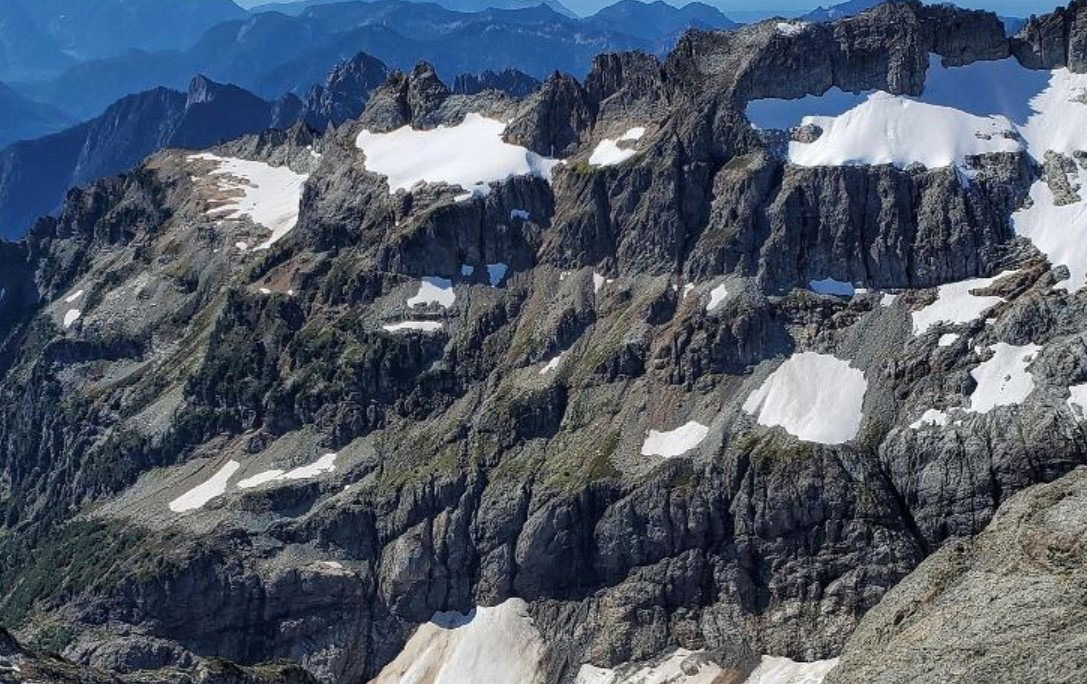
The avalanche slopes with many pockets above Columbia Glacier in Aug. 2020, one fan can be seen bottom center. These have to filled each winter season before slides occur, in 2020 avalanching was limited.

As we headed up onto Columbia Glacier on Aug. 1, 2021 we noted a significant number of large avalanches had descended near and onto the glacier. The glacier was 87% snowcovered, including the terminus area.  This is well above the recent early August average. As is the case every year we measure snow pack depth in a grid across the entire glacier.  Snow depth in the three biggest west side avalanche fans averaged 4.9 m, 25% above normal.  The three largest fans comprise an area of 0.14 km2, yielding a volume of 686, 000 m3 swe.  The melt season ends in another month, however, due to this substantial avalanching that will keep this section of the glacier covered in snow, Columbia Glacier will have a small-moderate negative mass balance.

Ashley Parks, Jill Pelto and Sally Vaux measuring snow depth in the Columbia Glacier avalanche fans.

The three primary avalanche fans each had a slope of 23 degrees.  Here we are spaced out at 50 m intervals mapping the size of the fan.

Easton Glacier on the south flank of Mount Baker does not recieve avalanche accumulation, and the regions above 2500 m, typically have significant wind  scouring, that leads to little increase in mass balance with elevation above this elevation on the upper glacier. There are both basins where snow is preferetially deposited by wind and convex regions where snowpack is scoured. In 2021 enroute to the glacier terminus we observed considerable stunted alpine vegetation, that emerged and then did not grow.  This was prevalent on rocky slopes that were exposed during the heat wave.  The example below is of Lupine with the growth from last year now brown and flat indicating the stunted size this year.

Stunted Lupine, each patch is typically 20-30 cm high and equally broad. Here the plants are 3-5 cm high.

On Aug. 11, 2021, the glacier had only 38% snowcover, with more than 50% of the area above 2500 m having lost all winter 2021 snowcover.  By summer’s end the glacier will certainly have the lowest percentage of snowcover of any year since we began monitoring in 1990. The bench at 2000 m typically has 2.75 m of snowpack on Aug. 10, and this year was 50% bare, with an average depth of 0.25 m.  The icefall above also lacked snowcover as well. There are a number of pockets/basins, where wind deposition increased snow depth and this snowpack will be retained.

The observations across the range illustrated that glaciers or areas of glaciers that do not have enhanced deposition from wind drifting or avalanching are either bare already or will be by the end of August.  The full extent of the loss on Columbia and Easton Glacier from this summer will be evident in a month. What is apparent is that the losses from Easton Glacier will be extraordinary. More frequent heat waves continue to plague alpine glaciers, these can even occur in winter such as on Mount Everest in January 2021 (Pelto et al. 2021)

View of the lack of snowcover in the icefall at 2000-2300 m on Easton Glacier.  The lack of snowcover above this point is also evident in the upper image.
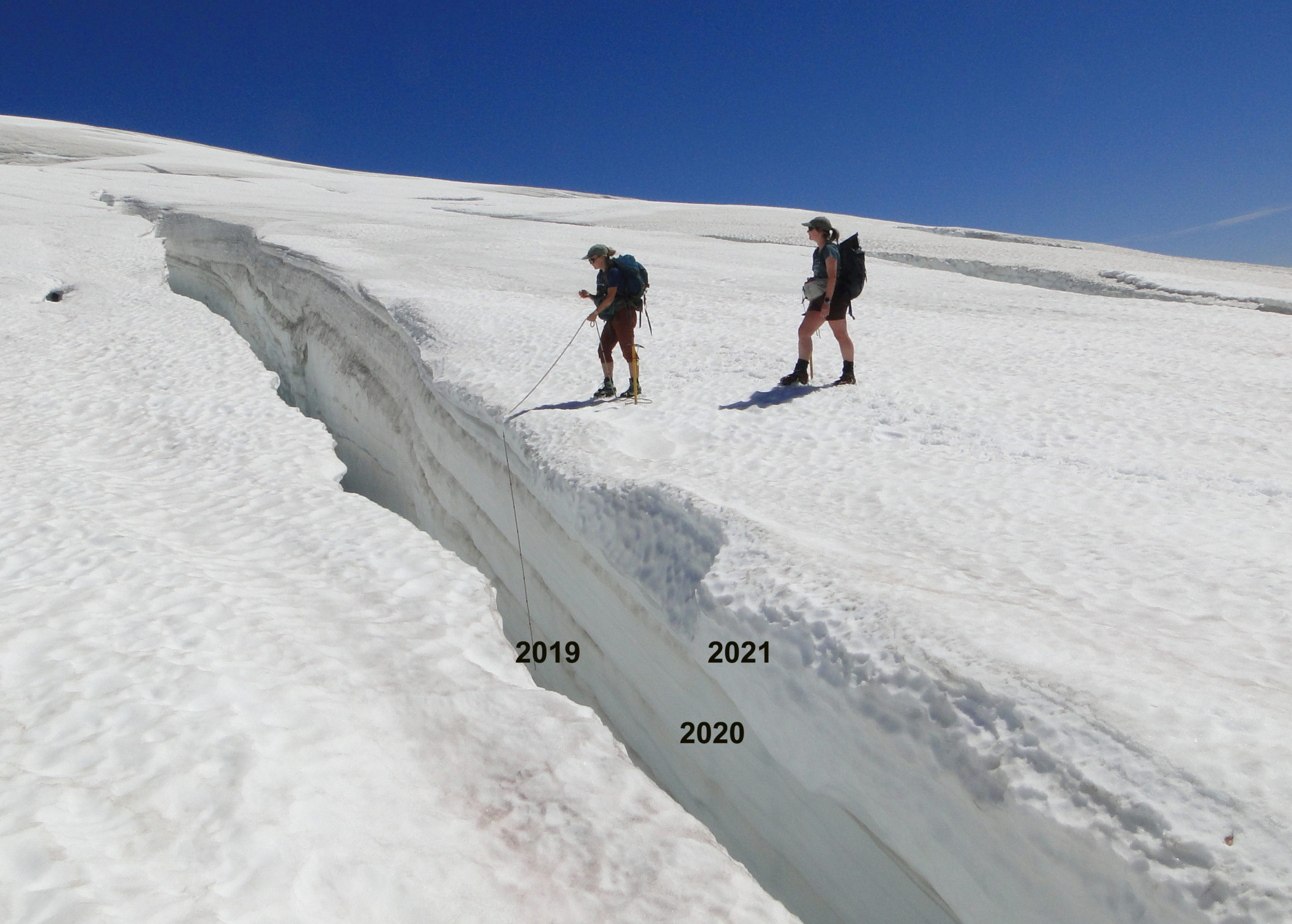
Rose McAdoo and Jill Pelto measuring the 2021 snowpack at 2350 m is alareay thinner  than the 2020 or 2019 retained snowpack and will be gone by the end of the month.
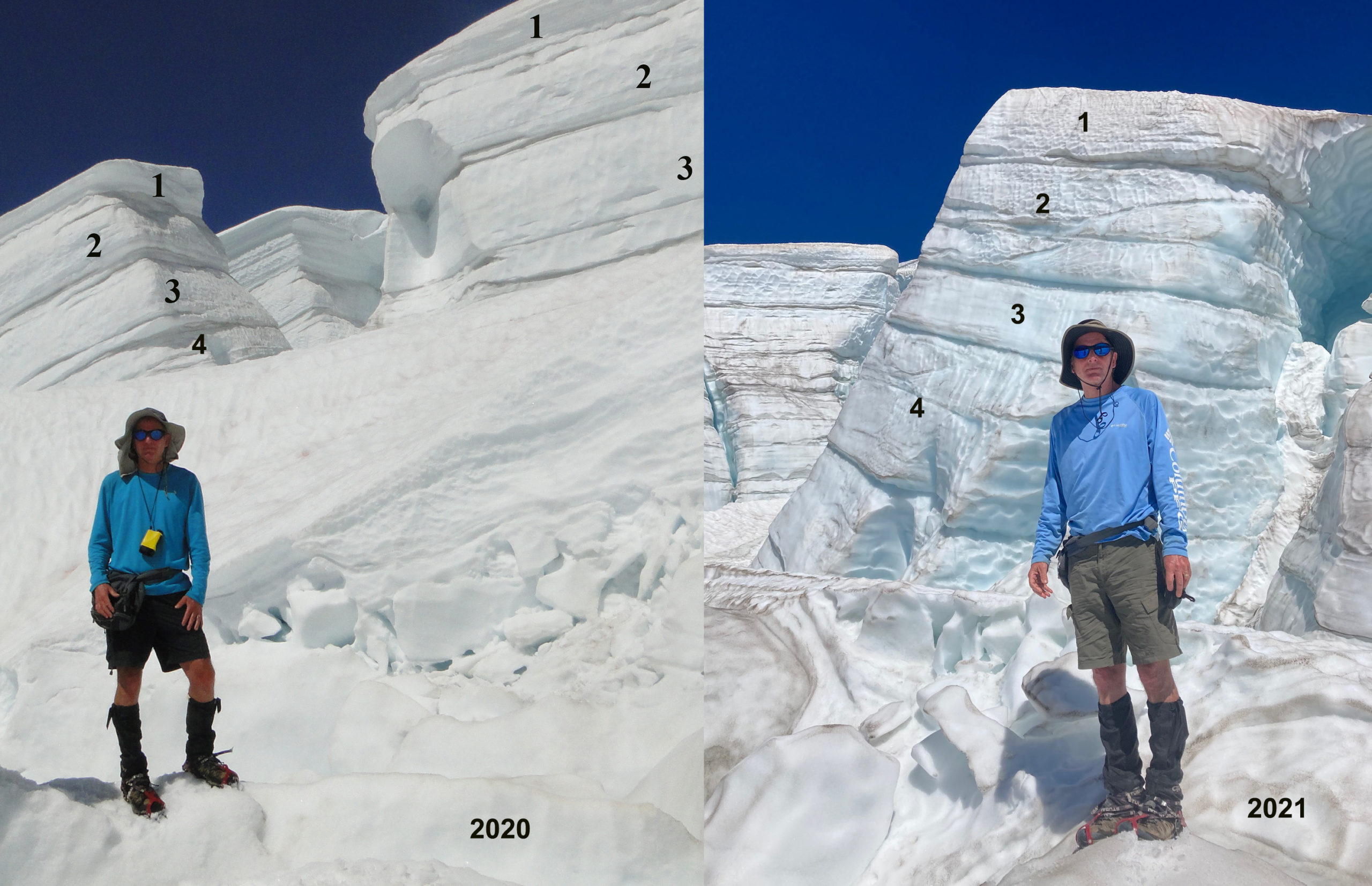
In 2021, I am in front of the same serac as in 2020, down slope. The average retained accumulation at this 2600 m location in the laterally extensive layers is 2-2.2 m.  This year there will no retained accumulation.
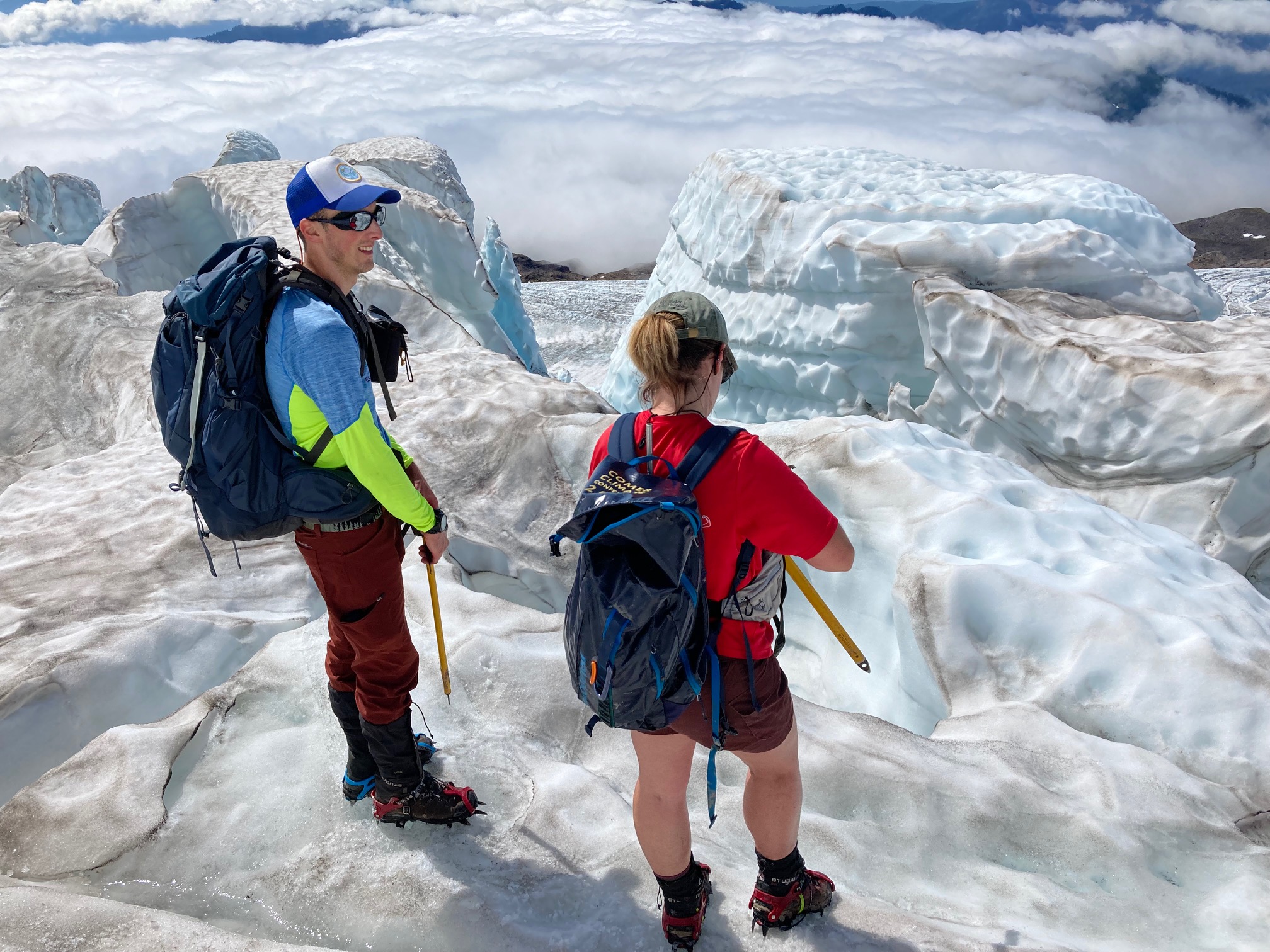
Ben and Jill Pelto amongst the seracs where snowpack should be extensive, but in 2021 they are standing on 2020 firn.
Canadian Columbia Basin Glacier Fall 2016 Field Season

Guest Post by Ben Pelto, PhD Candidate, UNBC Geography, pelto@unbc.ca

gmb

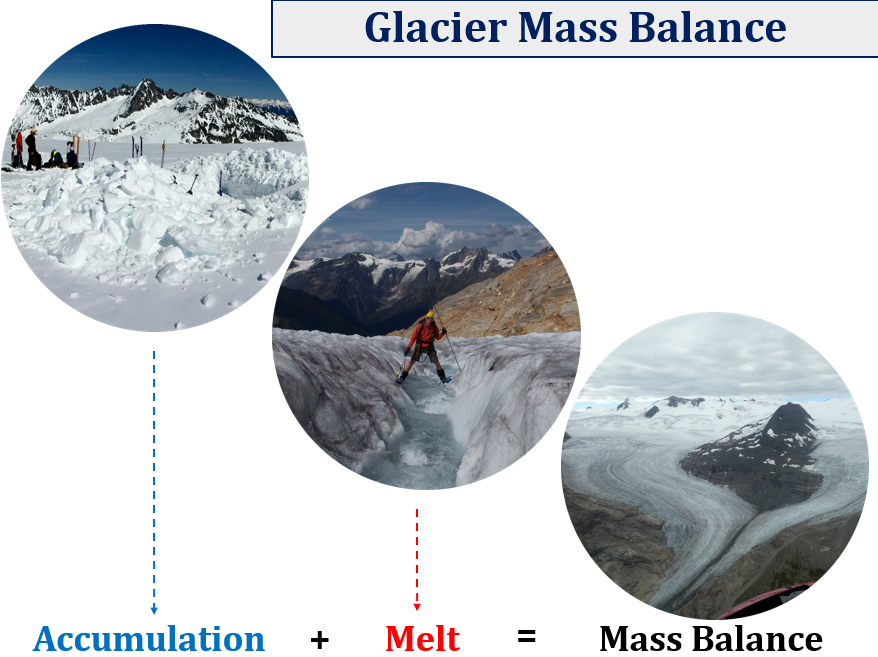
Figure 1. An illustration of the glacier mass balance sum. Mass balance is equal to the amount of snow accumulation and the amount of ice melt over time. Traditionally, this is reported as annual mass balance (how much mass a glacier gained or lost in a particular year) and is reported in meters water equivalent (mwe).

The Columbia Basin Glacier Project is studying the mass balance of several glaciers in western Canada to assess their ‘health’ over time (Figure 1) using field-based measurements and remote sensing. This work is funded by the Columbia Basin Trust and BC Hydro. During the fall season of 2016, we visited our four study glaciers in the Columbia Mountains (Figure 2). These form a transect from south to north: the Kokanee Glacier (in the Selkirk Range), Conrad Glacier (Purcell Range), Nordic Glacier (Selkirk Range), and Zillmer Glacier (Premier Range). We also visited Castle Creek Glacier and the Illecillewaet Glacier with Parks Canada. This post is an overview of the field season and some preliminary results for 2016.

 If you are interested in our main research objectives and methods, you can see the abstract from my recent talk at the American Geophysical Union conference and a video of an accompanying press conference (my piece starts at 18 minutes) with Gerard Roe (University of Washington) and Summer Rupper (University of Utah) titled: Attributing mountain glacier retreat to climate change. More information can be found in the November 29th episode of the Kootenay Co-op radio program Climate of Change (start at 34 minutes).

  areamap
Figure 2. Map of the Columbia River Basin in Canada. Our six study glaciers are marked by red stars. Other glaciers are in light blue (from the Randolph Glacier Inventory) and major rivers and lakes are in dark blue.

Our research consists of both field work and remote sensing. The fieldwork involves manually measuring the amount of snow that accumulates and ice that melts on each glacier at the start (spring) and end (fall) of each melt season (Figure 3). This gives us a mass balance measurement for individual glaciers but is very labor intensive (even if the views are great!). The remote sensing portion of the project is conducted using aerial laser altimetry (Figure 4). To conduct the laser altimetry we mount a Light Detection and Ranging (LiDAR) unit to the bottom of a fixed-wing aircraft and fly surveys of the glaciers twice each year. This creates two 3-Dimensional models of each glacier, one for the spring and one for the fall. When we subtract the spring model from the fall model, we are left with the thickness change of the glacier, and can thus derive mass change. We are still developing this method as a means of measuring more glaciers each year than could be achieved in the field.

 p1030807

Figure 3. To measure ablation (ice melt) we use ablation stakes drilled into the glacier in fall so that the top is flush with the ice surface. The following year, we visit the stakes to measure how much ablation has occurred during the summer, and then drill them in again to record the next year’s melt. In fall 2015, the top of this stake in the terminus of Nordic Glacier was flush with the ice surface, so it has lost nearly 3 meters of ice thickness (photo by Micah May). kokan

Figure 4. Kokanee Glacier elevation change map showing the difference in glacier elevation between September 2015 and September 2016. The difference can be used to calculate glacier mass loss. The glacier (black outline) flows from the bottom of the page to the top, so the terminus of the glacier lost the most mass whereas the middle reaches are net neutral and the upper reaches gained mass. Non-ice areas (e.g. rock) are white because there was no elevation change. The blue and red patches outside the glacier are changes in seasonal snow patches and fresh snow deposited in depressions after a small storm at the time of the 2016 survey.

The year of 2015 was a record for glacier melt across western North America. By contrast, 2016 resulted in slightly negative mass balance for our study glaciers. This means that on average the glaciers we studied lost far less mass in 2016 than in 2015 (and 2014, see Figure 5).

 
conrad

Figure 5. The Conrad Glacier terminus in 2014 (on the left) and 2016 (on the right). Between 2014 and 2016, the terminus of this glacier retreated by 75 m (yellow arrows) and the glacier also thinned markedly. The visibility of the rock band in the center of the image shows this thinning of the ice (red arrows). Also note the orbital crevasses (green arrow), which formed due to the collapse of ice caves along the margin. These ice caves formed in 2014 and 2015 as the surrounding exposed rock warmed (via solar heating) and melted the ice margins from below, and subsequently collapsed in 2016.

Spring arrived around four weeks earlier than normal this year, as we noted in our spring report, with the melt season commencing near the start of April instead of the start of May. At the beginning of April, the 2015-2016 winter had resulted in average snowpack in the northern half of the Columbia Basin and above-average snowpack in the southern half. However, early hot temperatures during April then led to early melt instead of a slow increase in snow throughout the rest of the spring. By mid-April, the snowpack across the entire basin had dropped to under 50% of the normal amount. One caveat here is that province-wide snow monitoring includes many measurements at around 2000 m, but very few above this elevation. Most glaciers in the Columbia Basin lie above 2000 m elevation, so our understanding of the snowpack affecting these glaciers is limited. While there are no long term records for higher elevations in the basin, our data, and discussions with local ski guides and lodge operators, suggests that the snowpack was probably around average during winter 2015-2016 until April.

Our measurements indicate that overall, the 2015-2016 winter resulted in a snowpack that was only 7% lower than the 2014-2015 winter. Why, then, was 2015 a year of substantial mass loss in the Columbia Basin but 2016 only a slightly negative year? The answer is that temperature difference has a far greater impact in this region than the amount of snow accumulation. In our region, at the elevation where glaciers are located (generally above 2000 m), the variability in snowfall year to year is far smaller than the variability in annual temperatures. Temperatures have risen over the Canadian portion of the Columbia River Basin by 1.5°C over the past century, more than double the global rate according to the Columbia Basin Trust. Due to rising temperatures, above-average snowpack is needed just to break even in a typical year. Thus, in order to have a positive mass balance year, you need above average snowfall and below average temperatures.

The summer of 2016 featured average to slightly above average temperatures (Figure 6), with a cooler-than-average July. This is in contrast to the last two years, which both featured well-above-average temperatures through the melt season. Precipitation was also about average over the basin during the summer months (Figure 7). The basin began with a roughly average alpine winter snowpack, experienced an early and hot spring, slightly warmer-than-average summer temperatures, and average precipitation. The combination of these factors led to a slightly negative mass balance overall for our glaciers in 2016: those in the north lost around 0.5 mwe and those in the south stayed around neutral or even slightly gained mass.

 2016jja_temp

Figure 6. Summer (June/July/August) mean daily maximum temperature anomaly for British Columbia in 2016. The red ellipse highlights the Columbia Basin, where temperatures were average to slightly above average (data from the Pacific Climate Impacts Consortium).

The 2016 trend was likely due, in part, to the prevailing position of the jet stream in the 2015-2016 winter. The northerly position of the jet stream, and persistent ridge over the Pacific Northwest, led to warmer winter temperatures over the southern part of the Columbia Basin but also more moisture and concentrated storm tracks (calcification: while accumulation variability resulting from winter weather patterns may have played a role in the north-south trend, the magnitude of mass change (small loss) was controlled by melt season temperatures). My favorite location to observe the jet stream in winter is from the California Region Weather Server at San Francisco State University. There have been many discussions of the jet stream behavior and its influence on winter weather in this region (here’s a simple overview from NOAA). The north-south trend was observed in 2015 as well, but in reverse, with the glaciers in the south experiencing greater mass loss.

2016jja_ppt

Figure 7. Summer (June/July/August) precipitation anomaly for BC. Red ellipse highlights the Columbia Basin. Columbia Basin precipitation was net average to slightly below average for summer 2016 (Pacific Climate Impacts Consortium).

Well-above-average snowfall and well-below-average spring, summer and fall temperatures would be needed for any of the Columbia Basin glaciers to gain substantial mass. This has happened just twice over the past 20 years, as recorded by the North Cascades Glacier Climate Program in the North Cascades of Washington, just southwest of the Columbia Basin. During the winter of 1999, Mt. Baker set the record for most snowfall ever recorded in the US at 1140 inches (or 2900 cm, yes…29 meters!), leading to average glacier mass gain of over 1 meter water equivalent (mwe). The winter of 2011 also featured above average snowpack, and in combination with a cool and cloudy summer, led to below-average melt and a positive mass gain of over 1 mwe. Unfortunately, closer to the Columbia Basin, the Peyto, Place and Helm Glaciers of British Columbia, have never reported a mass gain of 1 mwe since Geologic Survey of Canada records began for those glaciers in the 1960s and 1970s.

The take home points: 

  • In 2016, glaciers in the Columbia Basin experienced a slightly negative mass balance year. There was slight mass gain in the south (less than +0.25 mwe) and moderate mass loss in the north (around -0.5 mwe).
  • At present, an average year still results in moderate glacier mass loss in the Columbia Basin. Either above-average snowpack or below-average temperatures are needed during the melt season for a neutral mass change. A combination of both is required for the glaciers to gain mass.

 If you want to see what our fieldwork looks like in practice, see my video from the spring field season.


Columbia Glacier Past, Present and Future

For the last 27 years the first week of August has found me on the Columbia Glacier in the North Cascades of Washington. Annual visit pictures up to 2008 can be seen at bottom of post.

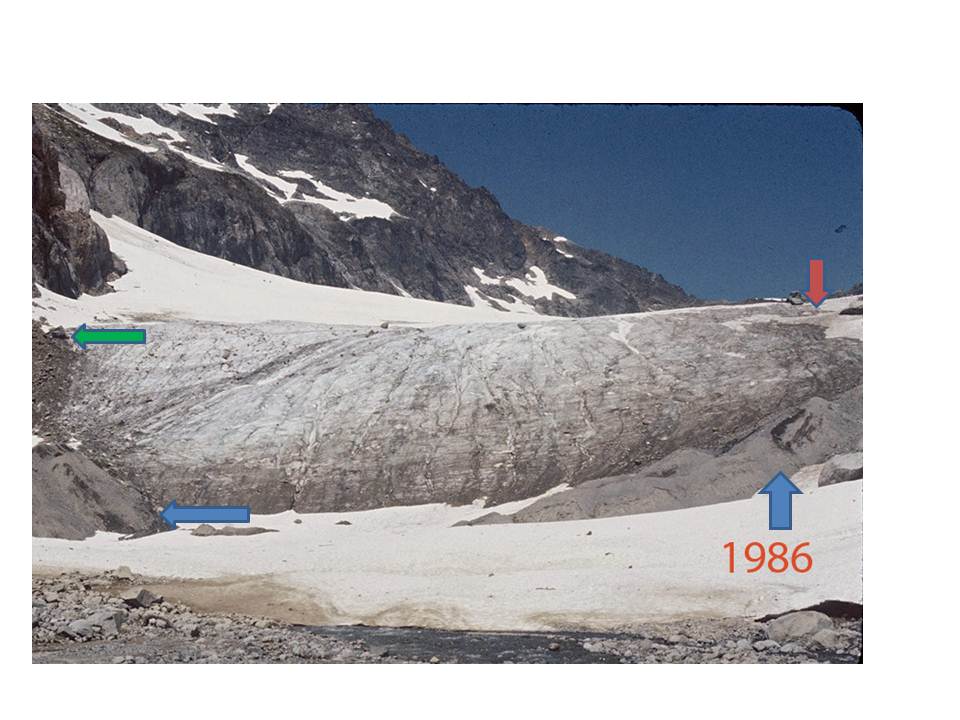
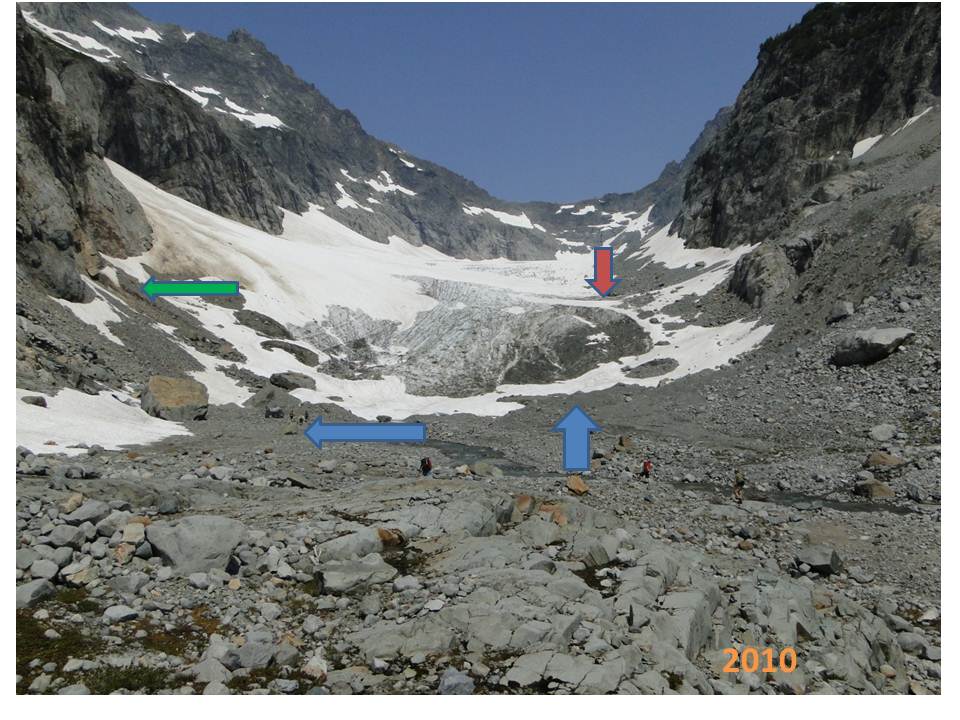
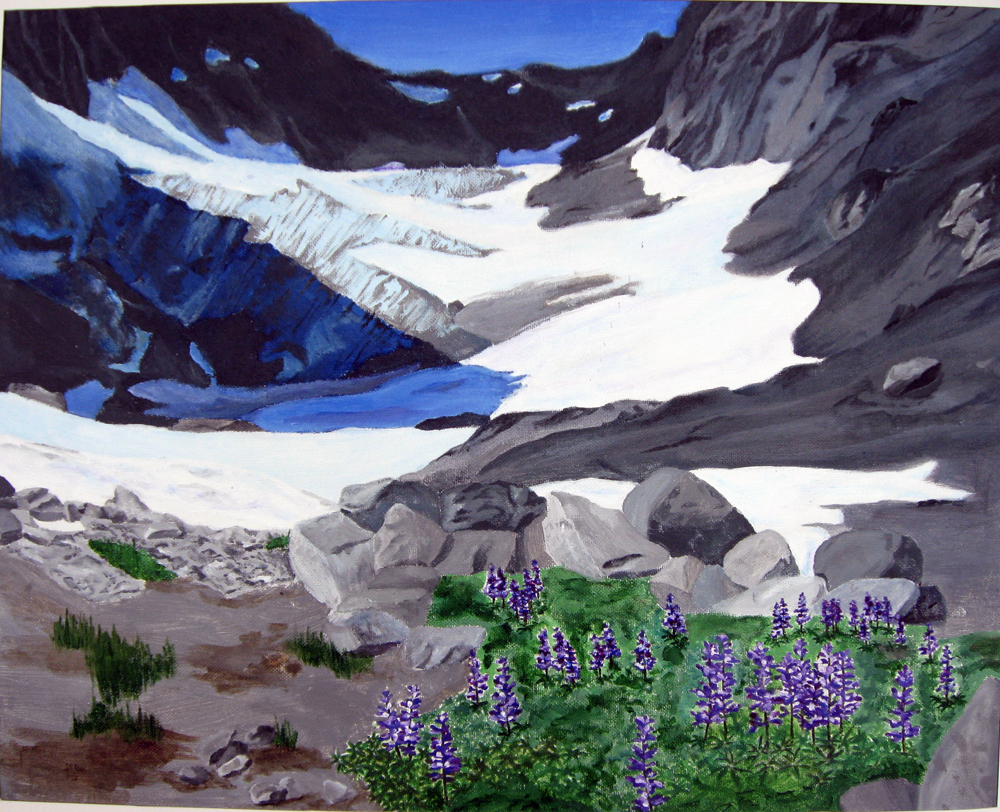
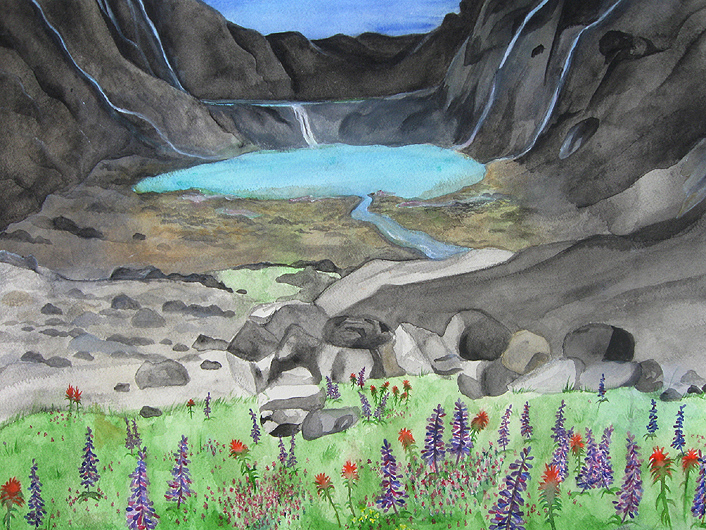
This is the lowest elevation large glacier in the North Cascades. Columbia Glacier occupies a deep cirque above Blanca Lake and ranging in altitude from 1400 meters to 1700 meters. Kyes, Monte Cristo and Columbia Peak surround the glacier with summits 700 meters above the glacier. The glacier is the beneficiary of heavy orographic lifting over the surrounding peaks, and heavy avalanching off the same peaks. Over the last twenty seven years the annual mass balance measurements indicate the glacier has lost 14 meters of thickness. Given the average thickness of the glacier of close to 75 meters in 1984 this represents a 20% loss in glacier volume. During the same period the glacier has retreated 135 meters, 8% of its length. Most of the loss of volume of this glacier has been through thinning not retreat. The glacier remains thick, but cannot survive current climate, which has left the glacier without any snowpack by the end of the summer in five of the last 10 years. This lack of persistence is the sign of a glacier than cannot survive. We can look at the past of the Milk Lake Glacier near Glacier Peak in 1988, 30 miles northeast of Columbia Glacier, and the present of Milk Lake without the glacier. The green arrow points to the forming lake filled with by both icebergs and the still evident glacier. The upper margin of the glacier is indicated by the red arrow. The lake in 2009 still is a nice jade green from glacier erosion. This lake will slowly become more azure in color as no new glacier sediment is added. In the same respect we can look at the past and present of Columbia Glacier comparing a 1986 and 2010 photograph. The blue arrows indicate moraines that the glacier was in contact with in 1986, and now are 100 meters from the glacier. The green arrow indicates the glacier active ice margin in 1986 and again that same location in 2007 now well off the glacier. The red arrow indicates the same location in terms of GPS measurements, this had been in the midst of the glacier near the top of the first main slope in 1986. In 2007 this location is at the edge of the glacier in a swale.. To look to the future Jill Pelto, (see marvelous destiny blog) my daughter painted the glacier as it was in 2009 (top) and then what the area would like without the glacier in the future, at least 50 years in the future (middle), and Jill at the sketching location (bottom), turned 180 degrees to view Blanca Lake. The lake is colored by the glacier flour from Columbia Glacier to the gorgeous shade of jade. Clearly the area will still be beautiful and we will gain two new alpine lakes with the loss of the glacier. After making over 200 measurements in 2010 we completed a mass balance map of the glacier. This summer we will be back again for the 28th annual checkup.