North Cascade Glacier 2022 Initial Observations-39th Field Season

field team 1

2022 North Cascade Glacier Climate Project Field Team

Science Director: Mauri S. Pelto, mspelto@nichols.edu
Art Director: Jill Pelto, pelto.jill@gmail.com

For the 39th consecutive summer we were in the field to measure and communicate the impact of climate change on North Cascade glaciers. We completed detailed measurements on 10 glaciers, three of which are part of the World Glacier Monitoring Service reference glacier network (42 glaciers globally), which have 30+ consecutive years of mass balance observations. NCGCP was founded in 1983 to identify and communicate the response of North Cascade glaciers to regional climate change. We are a fieldwork-based project with a focus on measuring changes in mass balance, glacier runoff, and terminus behavior. The project has an interdisciplinary scope — collaborating with a range of natural scientists, artists, journalists, and conservationists.

This winter snowpack remained below average until a late season surge from April into May.  Snowpack was 90% of the mean (1977-2021) on April 1% and 110% of the mean on May 10.  The month of May and June had below normal temperatures leading to an above average glacier snow cover as June ended. July and August were exceptionally warm at Heather Meadows  (4200 feet) average July and August maximum temperature is 19.2 C, this year 20 days reached or exceeded 5 C above this temperature in July and August 2022. At Stevens Pass (4000 feet) average July and August maximum temperature is 21.4 C, this year 24 days reached or exceeded 5 C above the temperature in July and August 2022. The average July-August temperature at the Stevens Pass and Lyman Lake sites was the highest since records began in 1990.

The result is that glacier snowcover rapidly melted during the July-August period, which is resulting in significant mass losses for North Cascade glaciers that continue to thin, retreat and lose volume. The climate stress is evident on the glaciers, but also in the alpine vegetation and alpine aquatic ecosystems.

Field team backpacking around Blanca Lake at our first field site.

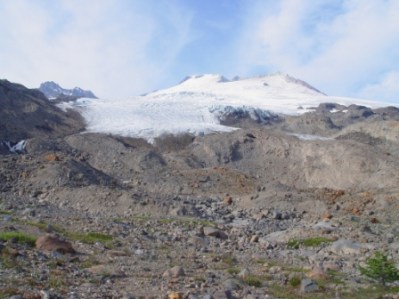
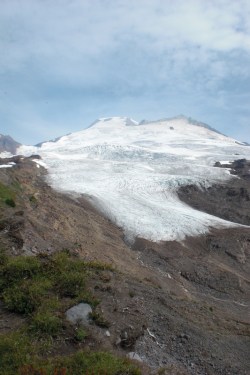
Columbia Glacier with the 1984 terminus position, note the glacier profile now descends from west side (left) to east side (right) of the glacier. The glacier has retreated 270 m since 1984. Note steep tongue extending across entire cirque valley in 1988 lower image.
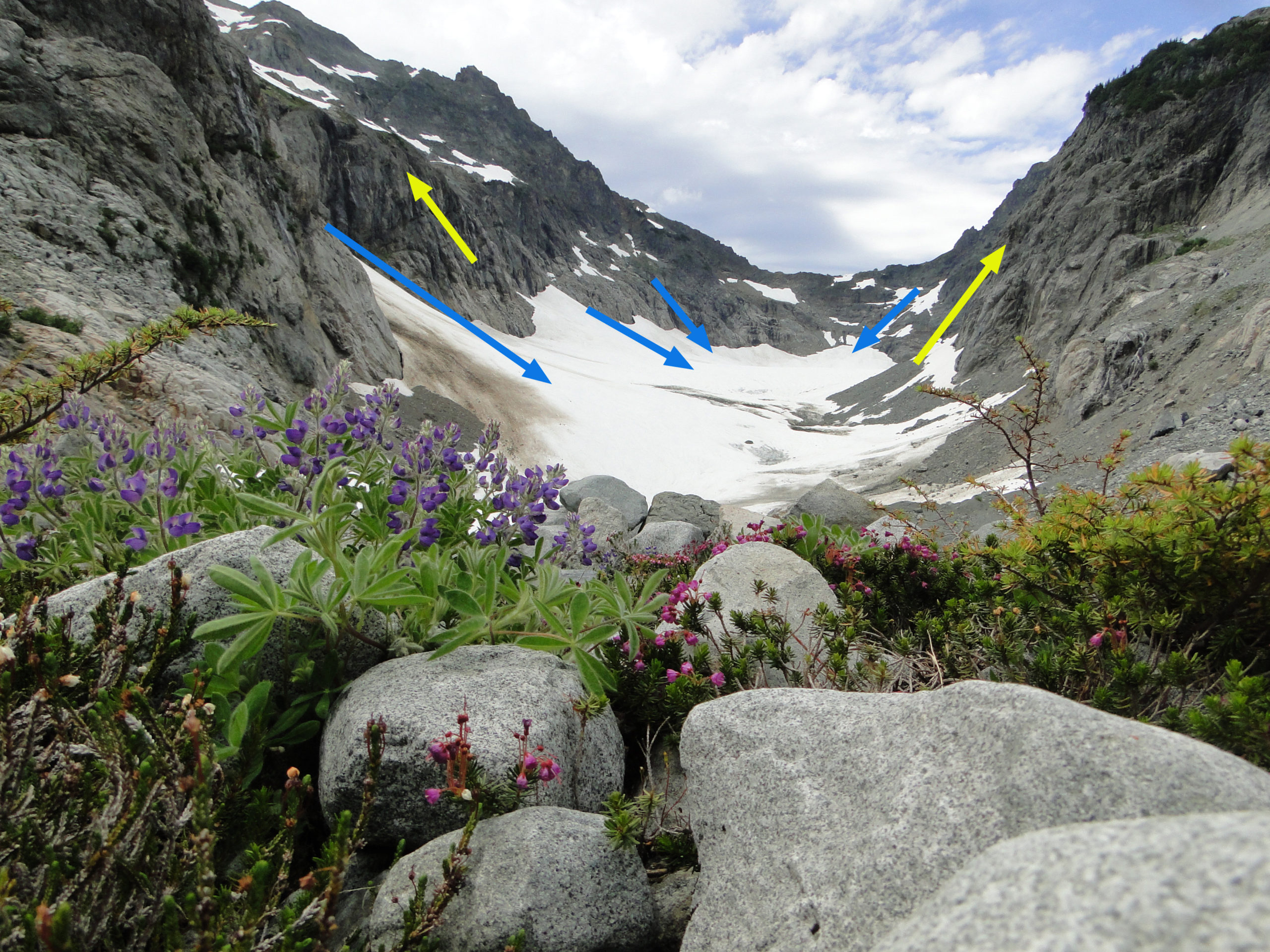
Columbia Glacier indicating the avalanche fans that now provide most of the accumulation to the glacier at the blue arrows. The yellow arrows indicate avalanche slopes that are no longer key feeders resulting in marginal thinning and recession. These locations or reduced avalanching have resulted from the source area slopes having lost their perennial snow and ice, which must be filled each winter before a slide can occur. Snowpack in the avalanche fans exceeds 3 m, while outside of the avalanche fans averaged 1.8 m on Aug. 1-2, 2022.
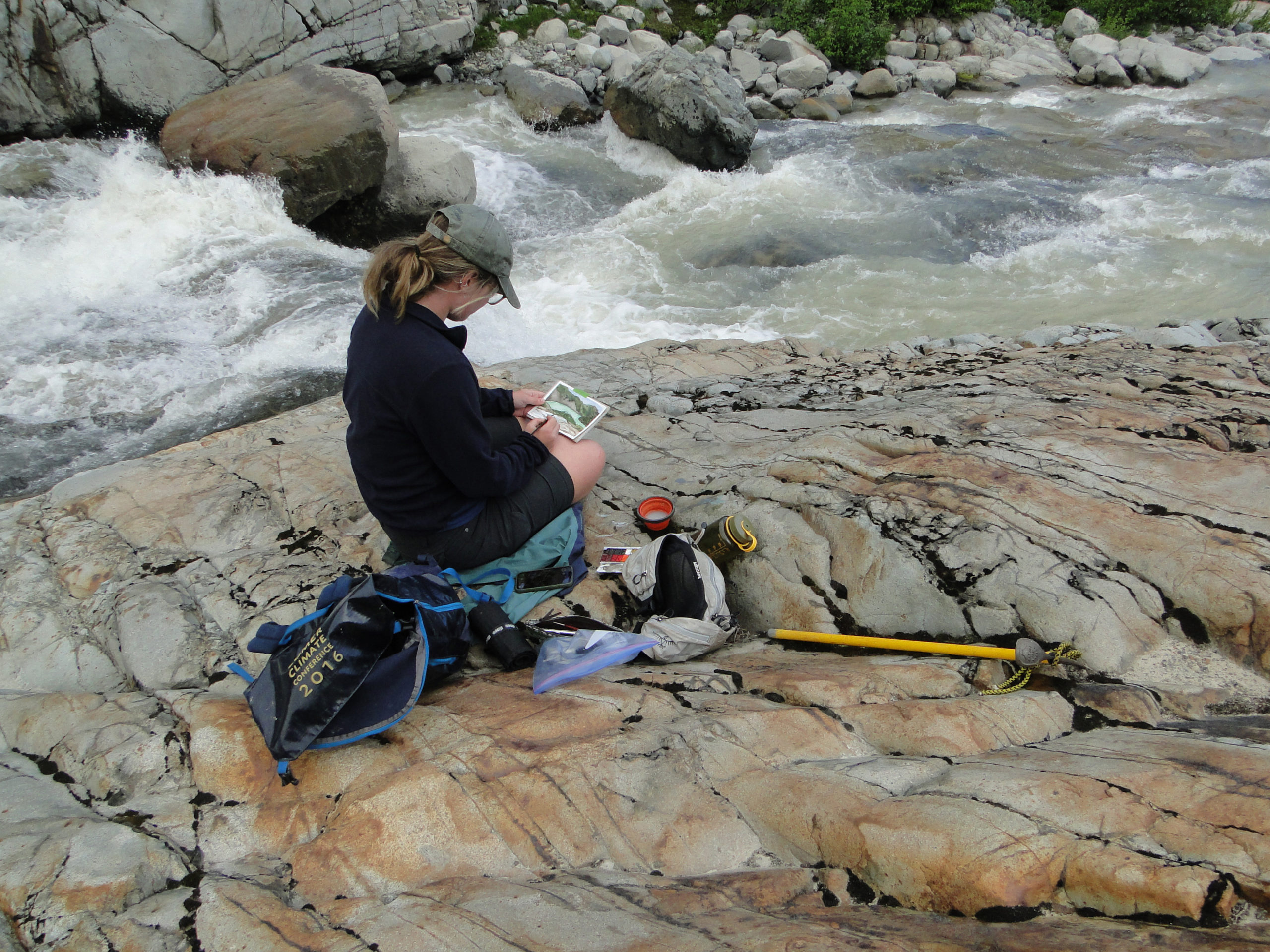
Jill Sketching Blanca Lake and Troublesome Creek draining from Columbia Glacier.

Braided stream issuing from the the rapidly retreating and thinning Sholes Glacier on the north flank of Mount Baker. Retreat since 2015 has been 90 m, with 225 m since 1984.

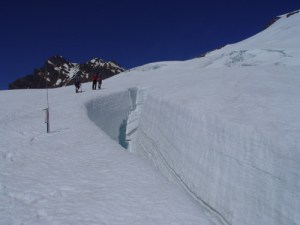
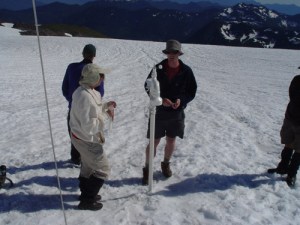
Snow depth measurements  in meters on Rainbow Glacier using crevasse stratigraphy, adjacent Park and Mazama Glacier drain the upper part of Mount Baker. Average depth at 2000 m was 5.25 m, 3.15 m water equivalent. The terminus of the glacier continues to retreat rapidly, but was buried by avalanche debris at the time of our survey in 2022.
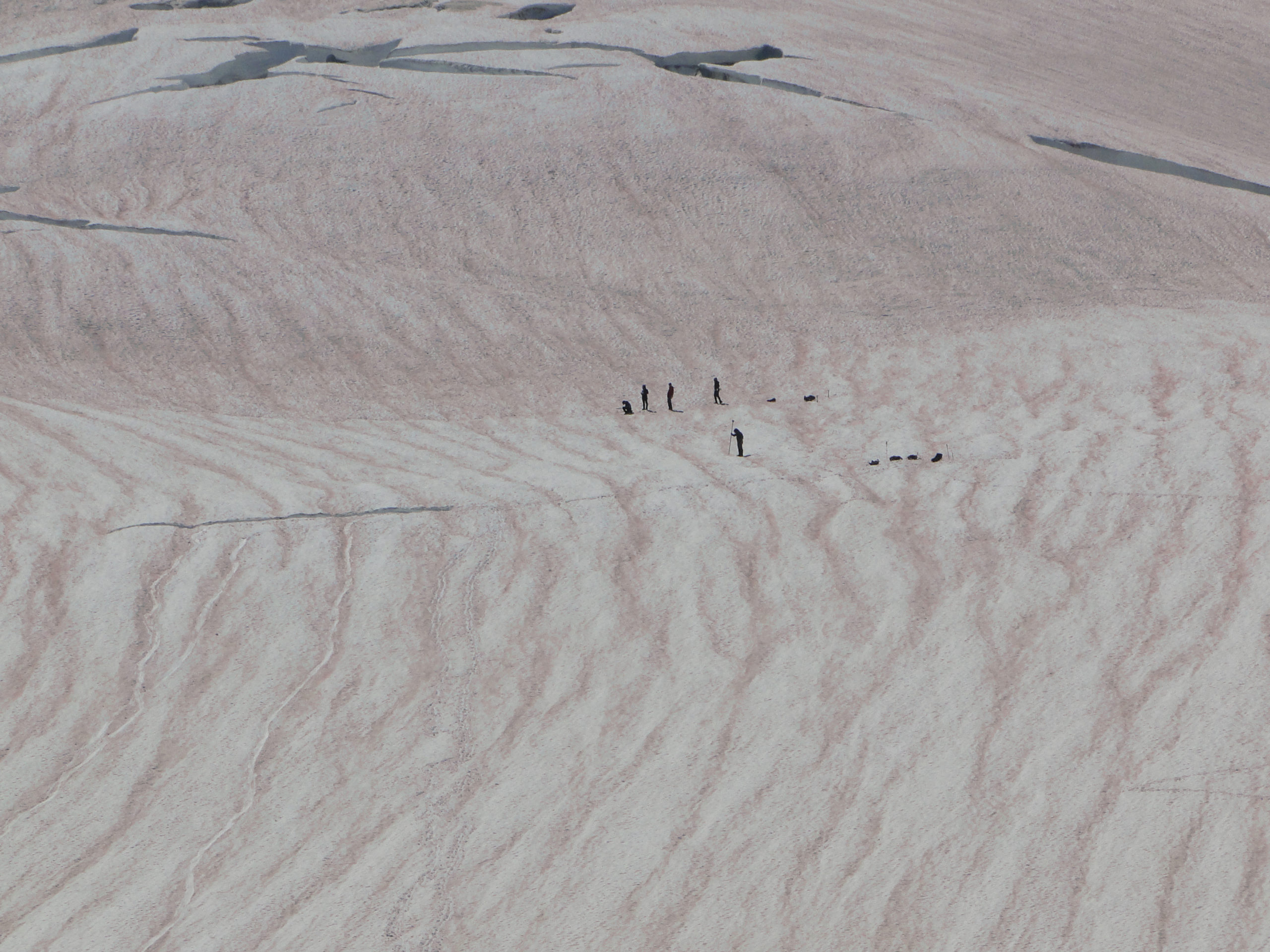
Alia Khan’s Western Washington University team assessing a red algae zone on Rainbow Glacier, we led them through the icefall to this location, where they sample impurities on the glacier surface and relate that to remote sensing products.

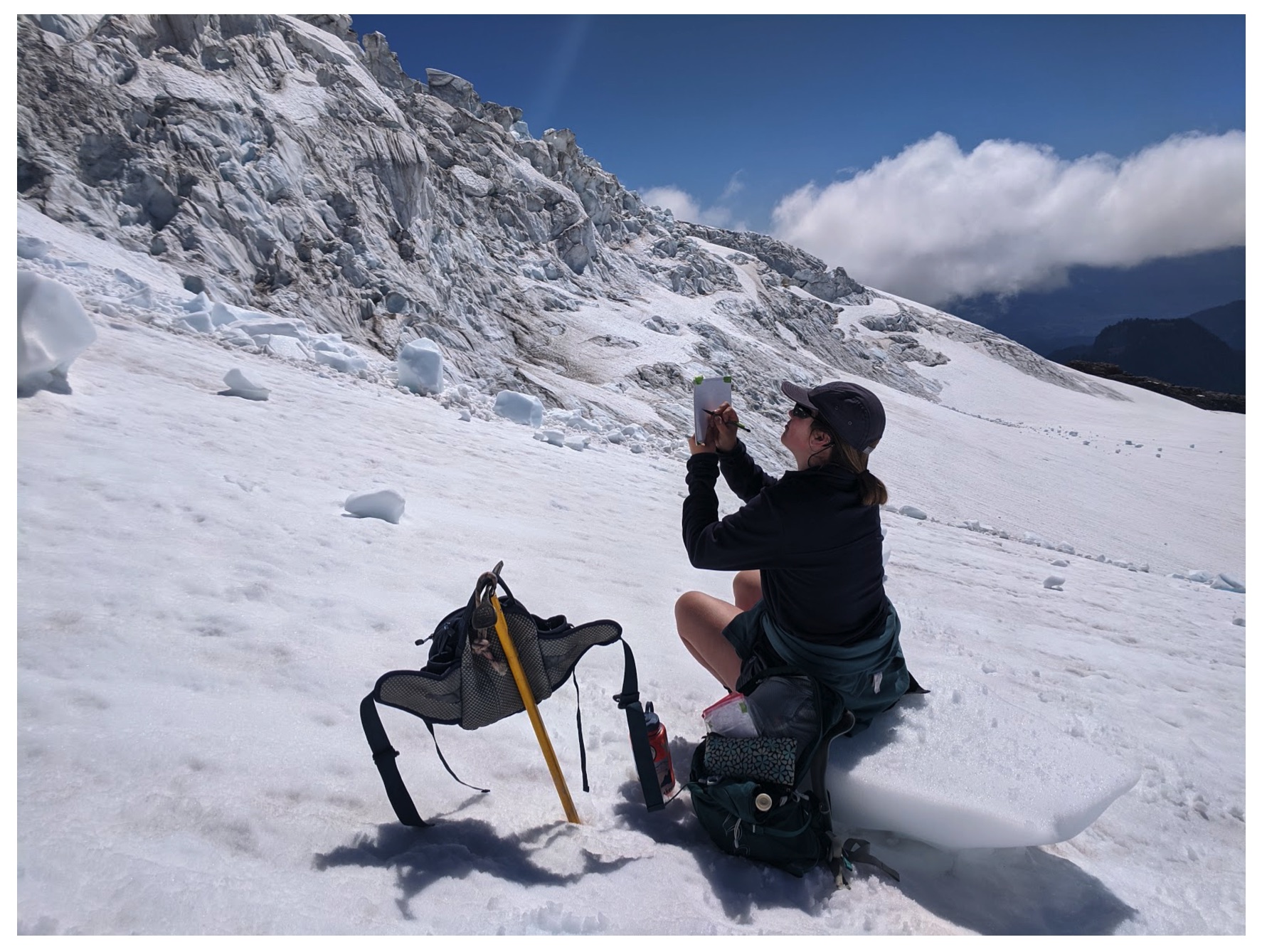
Jill’s sketch of Rainbow Glacier and Mount Baker from trail above Lake Ann.

Lower Curtis Glacier indicating recession since 1985. The glacier has thinned considerably in the lower section since the 2003 image below.

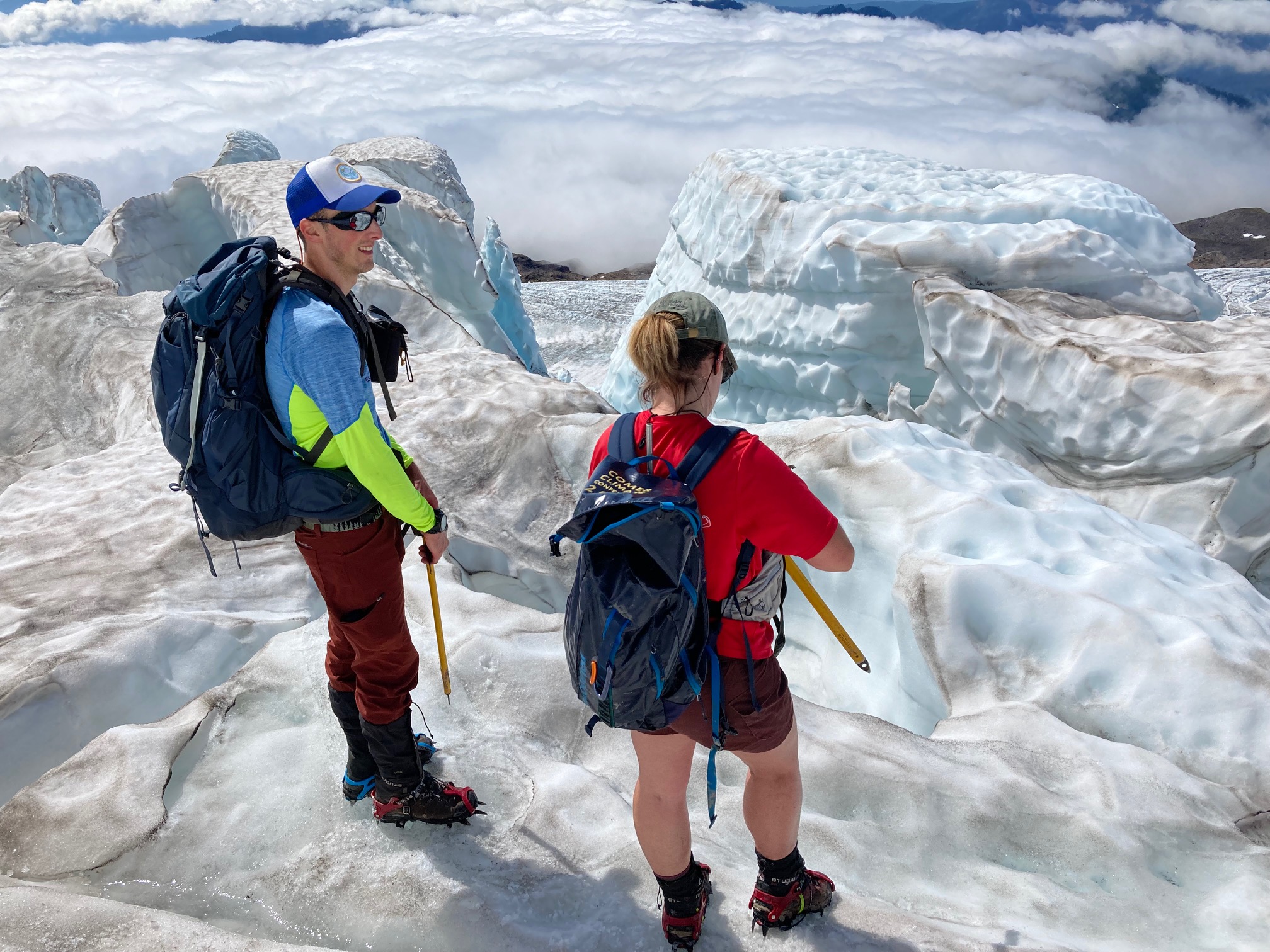
Navigating through the icefall region on Lower Curtis Glacier where we are mapping snow pack depth and crevasse depth. 
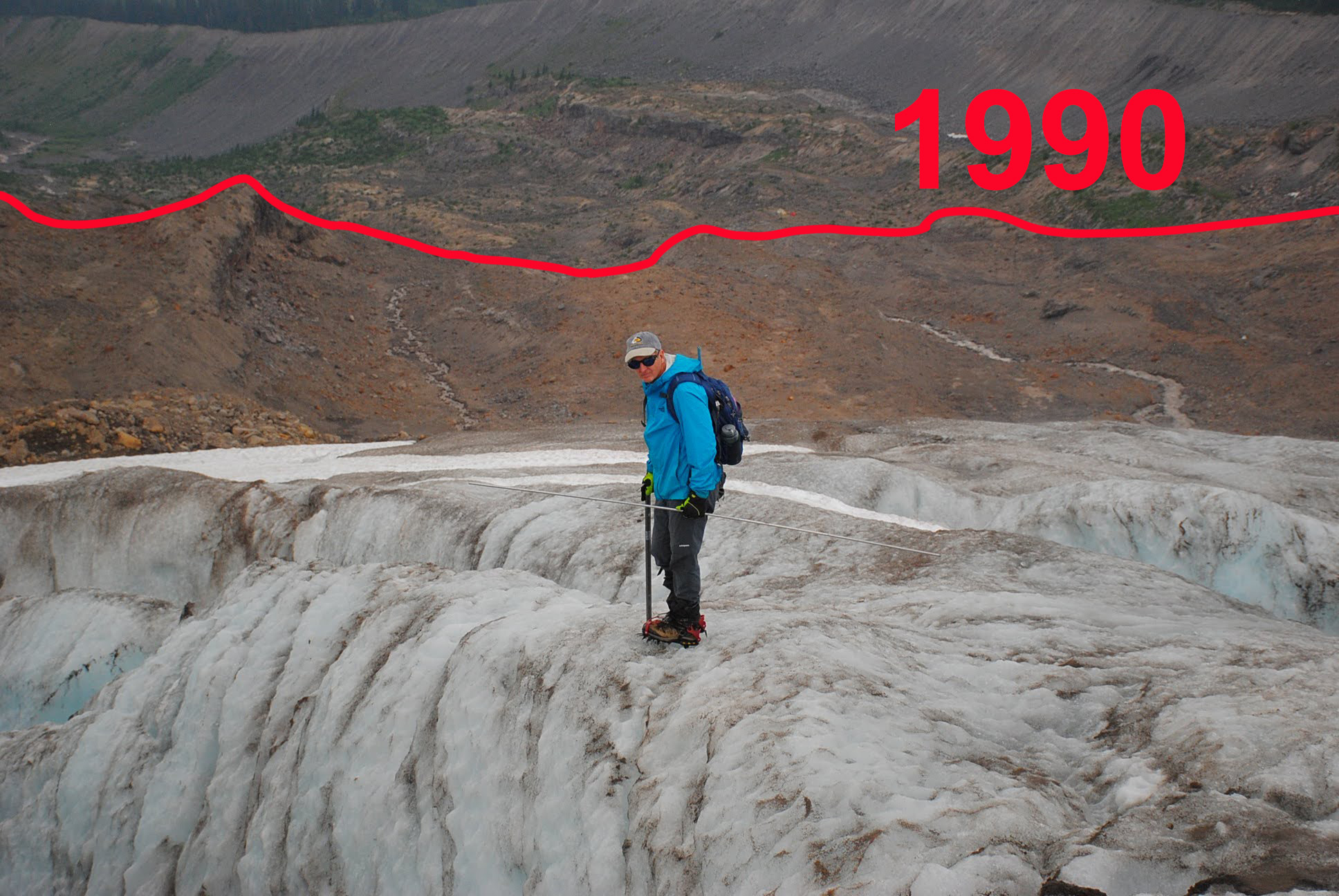
Deglaciated terrain since 1990 below Easton Glacier. We mapped this at 0.18 square kilometers in 2022.

We have observed crevasse depths for a decade and have seen both their number and depth decline in icefalls on Easton and Lower Curtis Glacier due to glacier thinning and reduced velocity. Deepest crevasses are at the top of the convex slope change, 25-30 m deep.

Claire Giordano painting Easton Glacier crevasse ‘blues’ at top of lowest icefall.

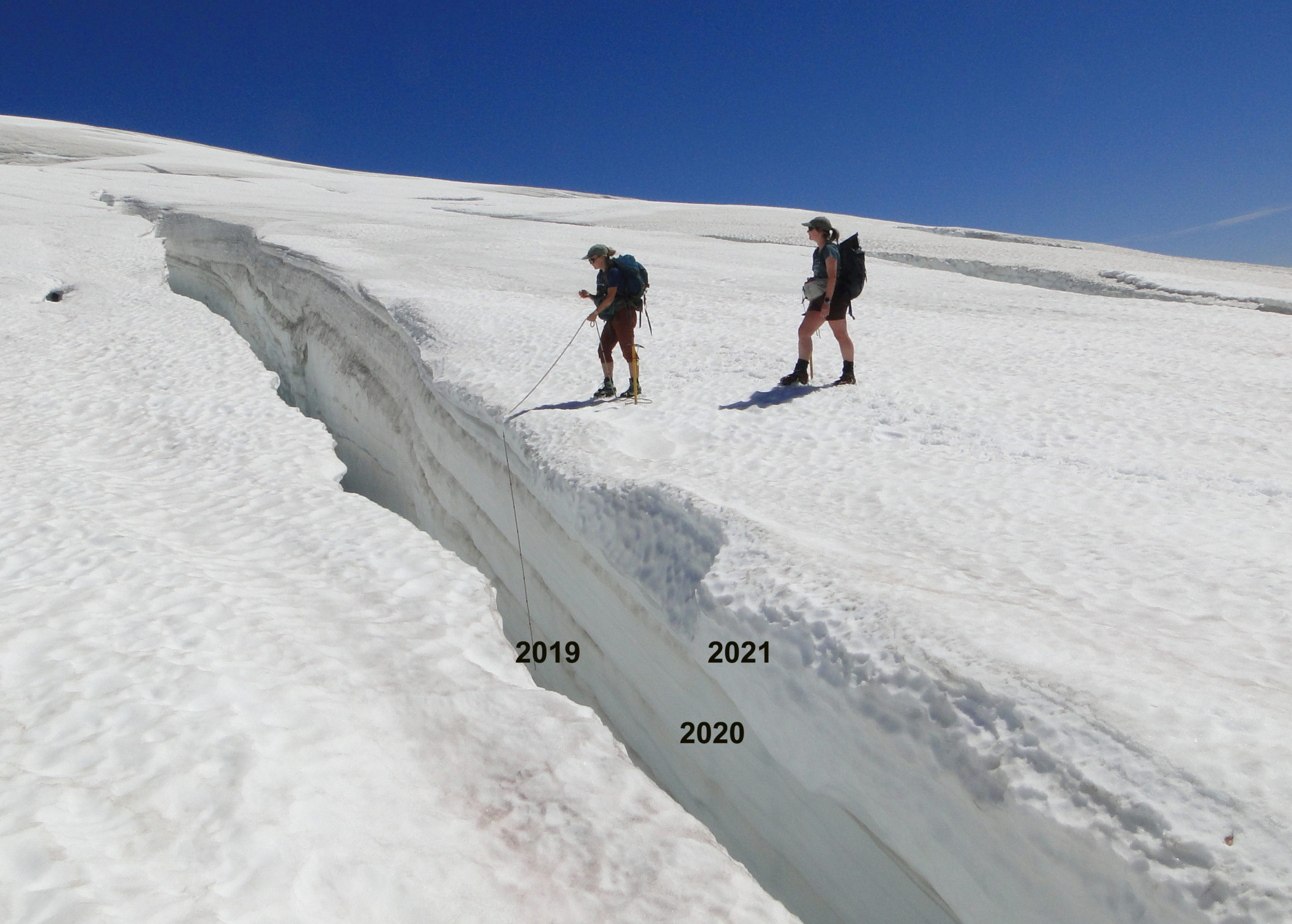
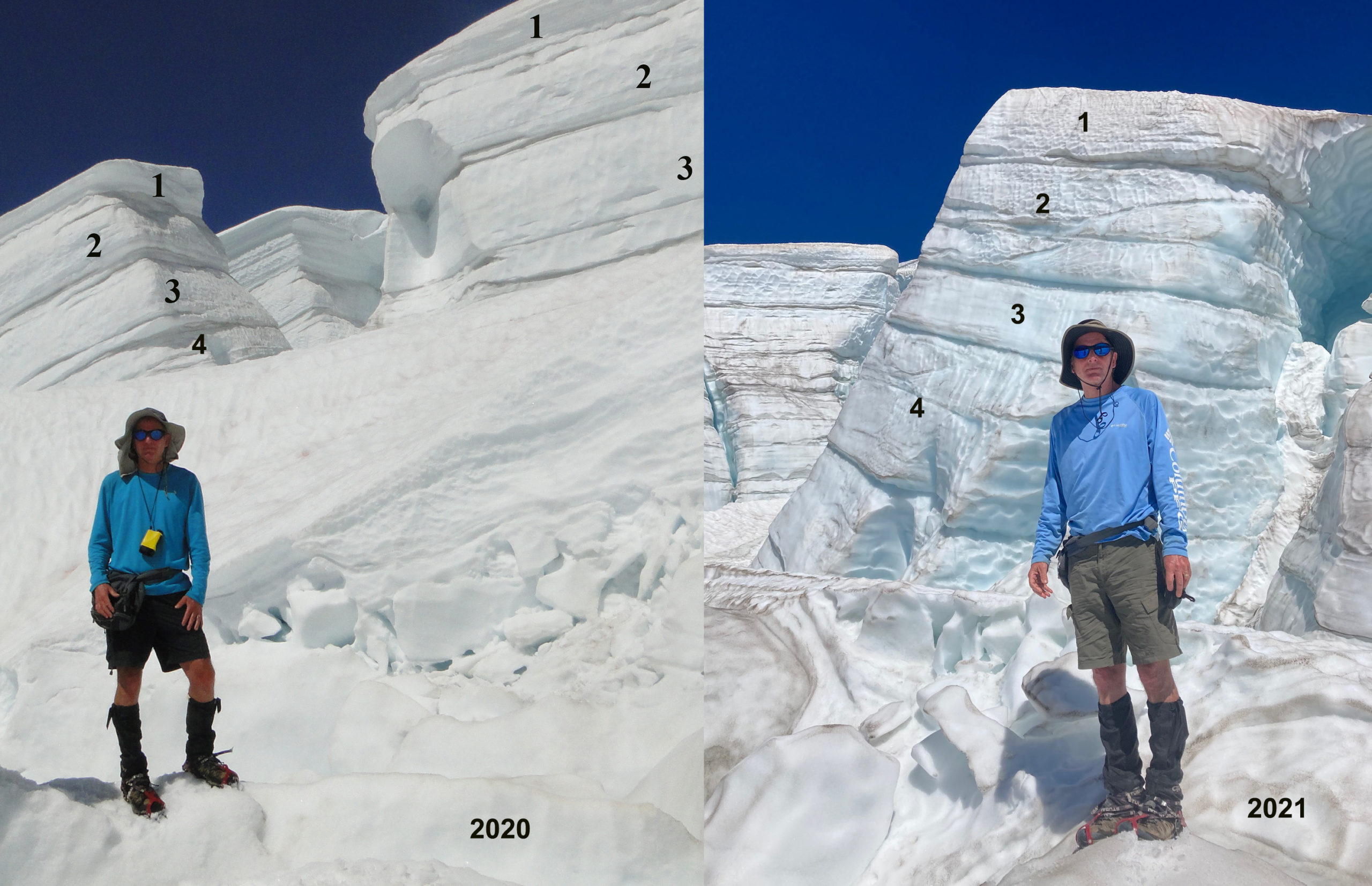
Ascending into Easton Icefall with five annual layers exposed on serac.
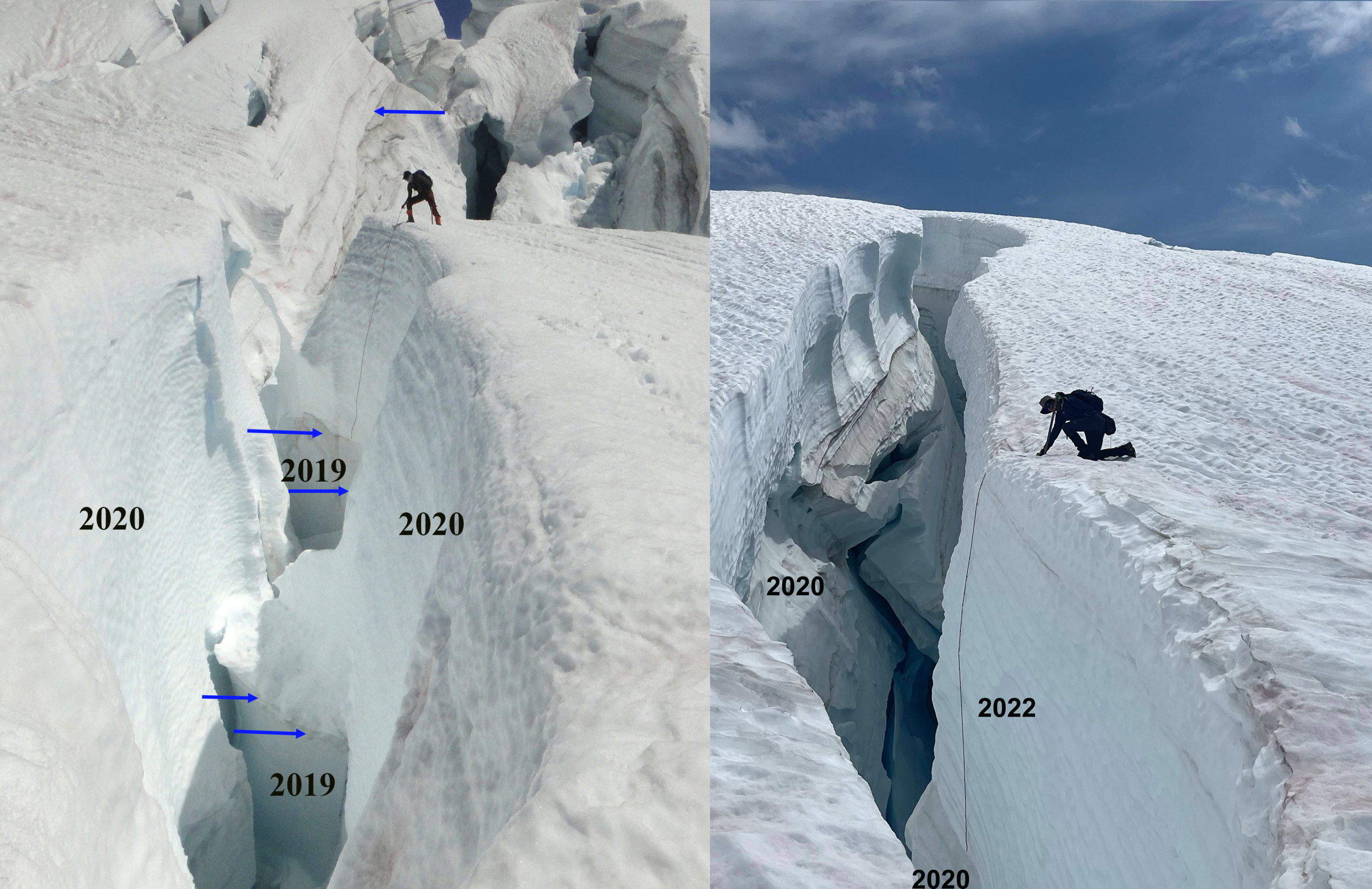
Snow depth assessment in specific crevasse at 2500 on Easton Glacier. No snow was retained here in 2021. Avergage depth in 2020 in this region 5.5 m, 4.75 m in 2022.
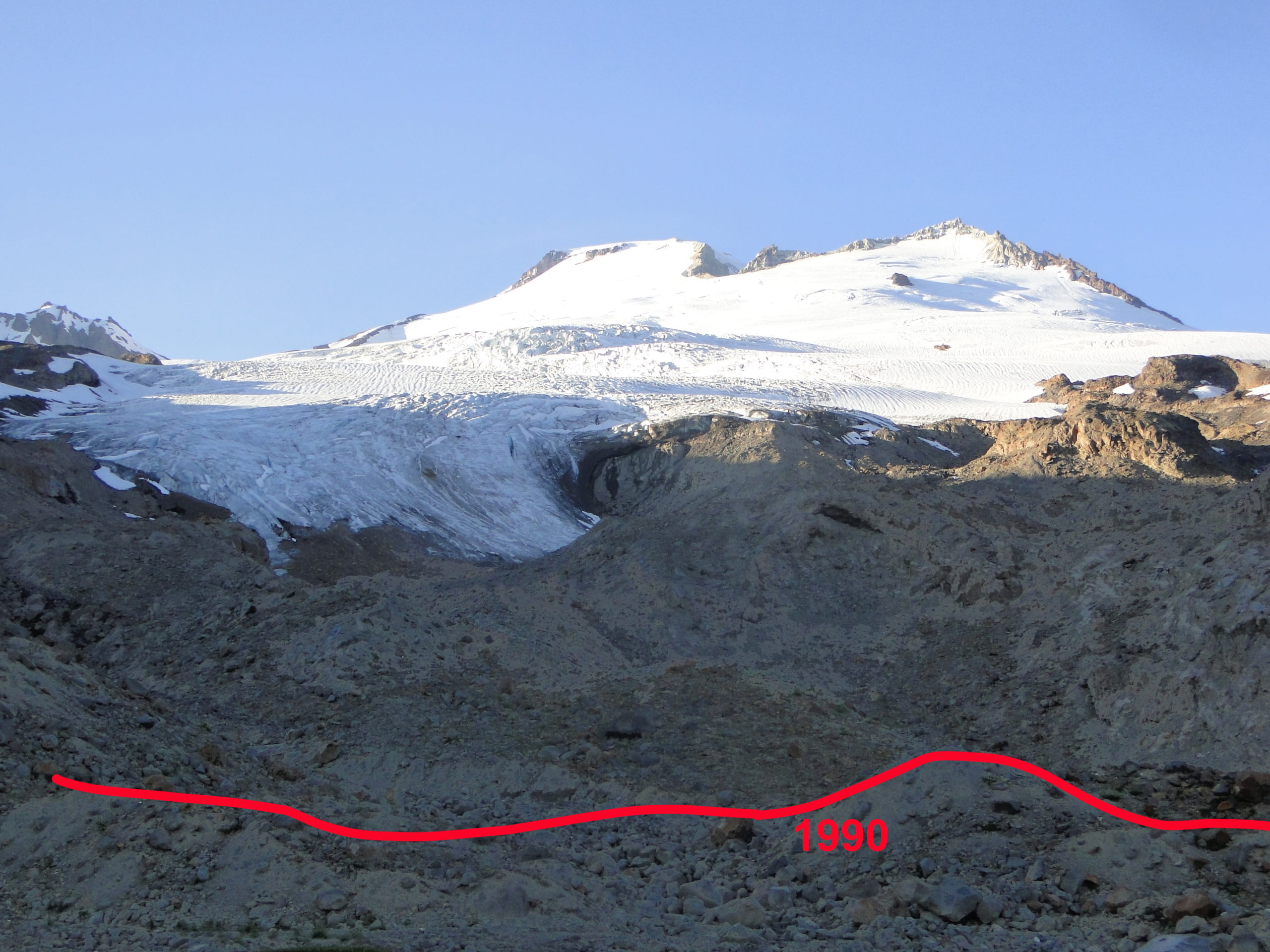
Easton Glacier has retreated 470 m from 1990-2022. Above is 2022 and below is 2003 image.

Ice Worm Glacier on Mount Daniel was fully snowcovered. We completed a grid of 72 snow depth measurements with a mean of 2.1 m in depth. The glacier continues to recede faster on its upper margin than at the terminus.

Descending onto Lynch Glacier, which had an accumulation area ratio of 83% in mid-August. Average snow depth 2.5 m.

Probing snow depth and surveying blue ice margin on Lynch Glacier.

Daniel Glacier was fully snowcovered in mid-August. Consistent snow depths of 1.8-2.5 m.

Jill’s field watercolor and colored pencil. This piece was done below the small Iceworm Glacier, on Mt. Daniel. It looks out towards the prominent Cathedral rock and Alpine Lakes Wilderness. Jill really enjoyed making this piece — to start she sketched the landscape, and then temporarily moved in front of the purple penstemon and the pale elmira flowers to capture them in the foreground. A while after she began painting, the wind dropped, and the mosquitoes arrived in force. Jill had to stop painting for the evening and went back to camp. Because Jill then finished at home, it was fun to add some more detail to this piece.

In the vicinity of Peggy’s Pond near our Mount Daniel base camp are a dozen shallow ponds, 10-20 cm are average that typically endure through the hatch of tadpoles in late August or early September. The primary inhabitants are frogs (Rana Cascadea) and their tadpoles. In 2022 despite a wet spring and early summer that had the ponds brimming with water, right above, tadpoles were observed, where typically there are several hundred, and the frog numbers were ~50% of usual. This followed the dried beds of these ponds in 2021, at left.  Maybe this is in part why mosquitoes were swarming here.
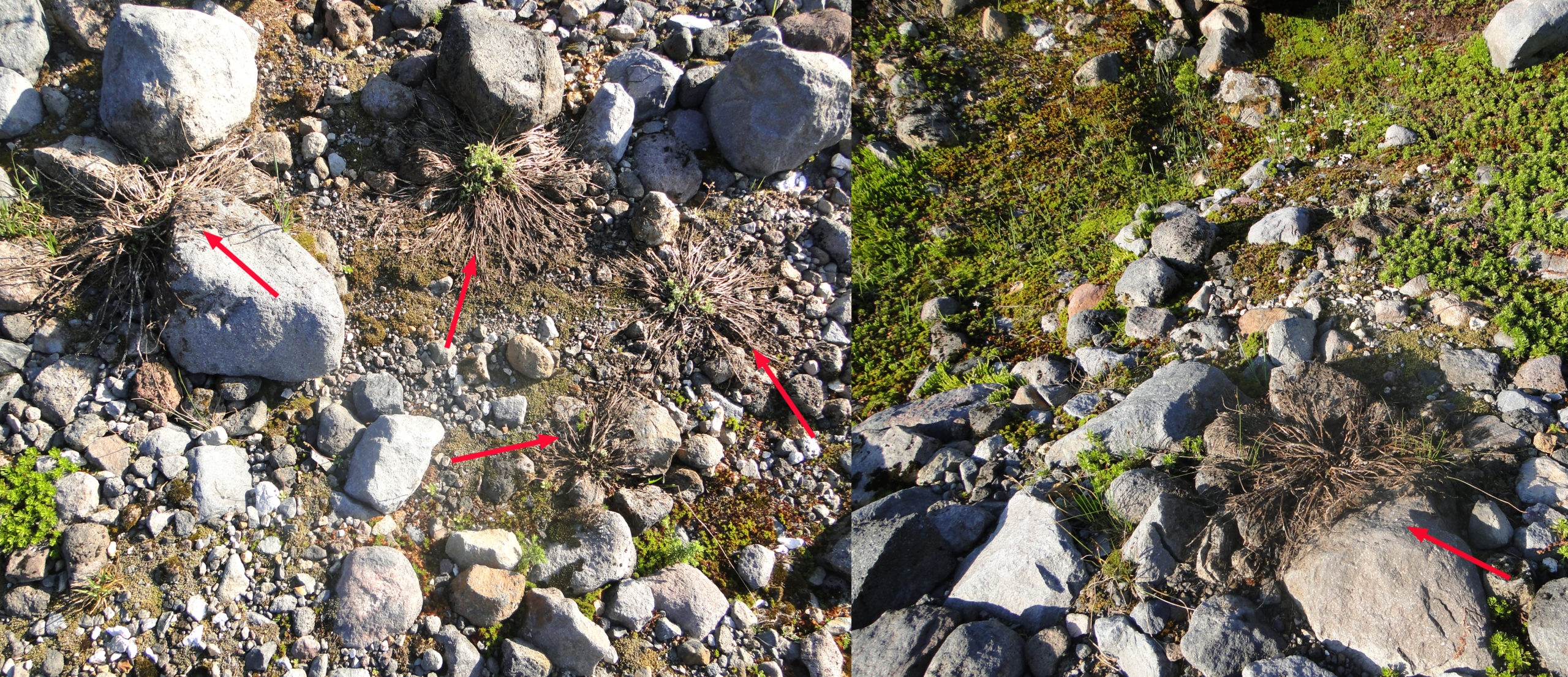
In 2021 below Easton Glacier we noted a number of alpine plants that had emerged just before or during the record June heat wave, had been dessicated/cooked by the heat in this are of relatively barren volcanic rock. Most notably lupine. This year in the same region we noted that ~30% of the lupine had failed to develop by August 2022, despite a cool wet spring. In contrast the evergreen alpine plants in the same area penstemon, saxifrage, pink and white heather, and partridge-foot all were fine.
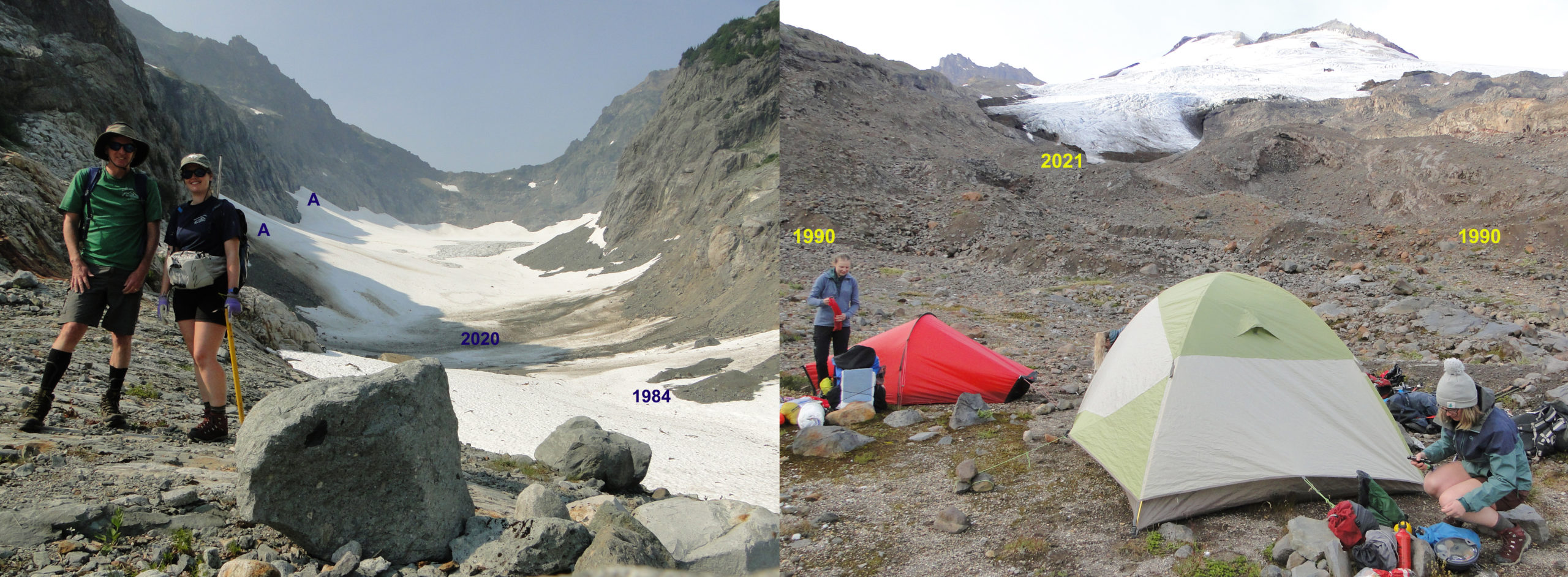
A Tale of Two Glaciers Columbia and Easton Glacier 2021

Terminus of Columbia Glacier on left with 1984 terminus location noted.  Observe the avalanche fans (A) and the relatively high snowcover on 8-2-2021.  At right is Easton Glacier on 8-11-2021 with the location of the 1990 terminus indicated, 440 m of retreat to the 2021 terminus position. The glacier has only 38% snowcover at this time, which is better illustrated below.

Columbia and Easton Glacier in the North Cascade Range of Washington are two of the reference glaciers for the World Glacier Monitoring Service.  We have monitored their mass balance in the field for 38 and 32 years consecutively. This year Ashley Parks, Sally Vaux, Jill Pelto  and I worked on all of the glaciers with Abby Hudak, Rose McAdoo and Ben Pelto joining us for either Easton or Columbia Glacier. In 2021 a combination of an above average winter snowfall and a record summer melt has led to a different story of mass balance for the two glaciers. At Mount Baker and Stevens Pass winter snowpack on May 1 was 116% and 115% of normal (NWAC, 2021). From June 1-Aug. 17 the mean average temperature is similar to 1958 and 2015, and well above every other year. With the maximum temperature exceeding 80 F on 17 days during this period at Stevens Pass ( 3950 ft, 1200 m), each of those days represents exceptional melt conditions.  Our observations indicate 11-14 cm of snowpack melt on glacier during exceptionally warm days like this. Just the melt from these 17 days would equate to half of the average summer melt for a North Cascade glacier (Pelto, 2018).  The earlier summer heat wave has led to exposure of greater higher albedo and faster melting glacier ice, which is why such a heat wave is more impactful than in late summer.

Columbia Glacier occupies a deep cirque above Blanca Lake ranging in altitude from 1400 meters to 1700 meters. Kyes, Monte Cristo and Columbia Peak surround the glacier with summits 700 meters above the glacier. The glacier is the beneficiary of heavy orographic lifting over the surrounding peaks, and heavy avalanching off the same peaks.  Standing on the glacier is a bit like being in the bottom of a bath tub, with avalanche slopes extending up both sides, predominantly on the west side. The last half of January 2021 was a dry period in the region, with an extensive crust forming on the snowpack. This was followed by 106 inches of dry snowfall from Feb. 4 to Feb. 20,and then 34 inches of wet snowfall and even rain through Feb. 24 This generated extreme avalanche danger and numerous climax avalanches in the Stevens Pass region.

NWAC’s avalanche forecast on 2/20 for Stevens Pass indicated that, “We haven’t seen rain above 3,500ft or so since mid-January, so one of the main concerns is that slabs 5-10′ feet thick may begin to come crashing down. The avalanche cycle(s) may last through the day Monday. In any case, very large storm slabs and wet loose avalanches are expected to continue to run from steep slopes through Monday as our once beautiful cold, dry snow becomes overloaded by wet, heavy rain and snow.”

The avalanche slopes with many pockets above Columbia Glacier in Aug. 2020, one fan can be seen bottom center. These have to filled each winter season before slides occur, in 2020 avalanching was limited.

As we headed up onto Columbia Glacier on Aug. 1, 2021 we noted a significant number of large avalanches had descended near and onto the glacier. The glacier was 87% snowcovered, including the terminus area.  This is well above the recent early August average. As is the case every year we measure snow pack depth in a grid across the entire glacier.  Snow depth in the three biggest west side avalanche fans averaged 4.9 m, 25% above normal.  The three largest fans comprise an area of 0.14 km2, yielding a volume of 686, 000 m3 swe.  The melt season ends in another month, however, due to this substantial avalanching that will keep this section of the glacier covered in snow, Columbia Glacier will have a small-moderate negative mass balance.

Ashley Parks, Jill Pelto and Sally Vaux measuring snow depth in the Columbia Glacier avalanche fans.

The three primary avalanche fans each had a slope of 23 degrees.  Here we are spaced out at 50 m intervals mapping the size of the fan.

Easton Glacier on the south flank of Mount Baker does not recieve avalanche accumulation, and the regions above 2500 m, typically have significant wind  scouring, that leads to little increase in mass balance with elevation above this elevation on the upper glacier. There are both basins where snow is preferetially deposited by wind and convex regions where snowpack is scoured. In 2021 enroute to the glacier terminus we observed considerable stunted alpine vegetation, that emerged and then did not grow.  This was prevalent on rocky slopes that were exposed during the heat wave.  The example below is of Lupine with the growth from last year now brown and flat indicating the stunted size this year.

Stunted Lupine, each patch is typically 20-30 cm high and equally broad. Here the plants are 3-5 cm high.

On Aug. 11, 2021, the glacier had only 38% snowcover, with more than 50% of the area above 2500 m having lost all winter 2021 snowcover.  By summer’s end the glacier will certainly have the lowest percentage of snowcover of any year since we began monitoring in 1990. The bench at 2000 m typically has 2.75 m of snowpack on Aug. 10, and this year was 50% bare, with an average depth of 0.25 m.  The icefall above also lacked snowcover as well. There are a number of pockets/basins, where wind deposition increased snow depth and this snowpack will be retained.

The observations across the range illustrated that glaciers or areas of glaciers that do not have enhanced deposition from wind drifting or avalanching are either bare already or will be by the end of August.  The full extent of the loss on Columbia and Easton Glacier from this summer will be evident in a month. What is apparent is that the losses from Easton Glacier will be extraordinary. More frequent heat waves continue to plague alpine glaciers, these can even occur in winter such as on Mount Everest in January 2021 (Pelto et al. 2021)

View of the lack of snowcover in the icefall at 2000-2300 m on Easton Glacier.  The lack of snowcover above this point is also evident in the upper image.

Rose McAdoo and Jill Pelto measuring the 2021 snowpack at 2350 m is alareay thinner  than the 2020 or 2019 retained snowpack and will be gone by the end of the month.

In 2021, I am in front of the same serac as in 2020, down slope. The average retained accumulation at this 2600 m location in the laterally extensive layers is 2-2.2 m.  This year there will no retained accumulation.

Ben and Jill Pelto amongst the seracs where snowpack should be extensive, but in 2021 they are standing on 2020 firn.

Art and Science on the Easton Glacier: Reflections from the NCGCP 2020 Field Season

The field team at Camp discussing science communication and gazing at the Easton Glacier. Photo by Jill Pelto

By: Cal Waichler, Jill Pelto, and Mariama Dryak. 

It is the evening of Aug. 9th, 2020 and six of us are camped near the terminus of Easton Glacier. The sun has dropped below the moraine ridge above camp and a chilly breeze has forced us to put on layers. We are enjoying dinner cooked on our camp stoves, discussing what we observed on the ice today.  The toll of climate change on Easton Glacier, on the southern flank of Mount Baker, is impossible to escape. We are here to both measure this change and communicate what it means.

Within our team of six, four of us are trained as scientists, and all of us highly value creative science communication. This passion can manifest as art (painting, printmaking, sketching), writing, podcasting, blogging or video-making. We all appreciate that exercising creativity with others can provide us with a unique context for communicating about glaciers and climate change. 

Cal creates at Columbia Glacier–sketching and taking notes to capture the power of our lunch spot that day. Photo by Mariama Dryak.
Jill paints the icefall. Photo by Mariama Dryak.                                                                                                                                                                                                                  .

The Easton Glacier is large and stretches up to 2950 m elevation. We are here to monitor its health for the 31st consecutive year: its snow coverage, snow depth, terminus retreat, change in surface profile, and its annual mass balance (snow gain vs. snow loss). Easton Glacier is one of the forty-two World Glacier Monitoring Service reference glaciers, meaning it has 30+ consecutive year of mass balance observations, qualifying it for this select group. To learn more about this glacier over time, check out https://glaciers.nichols.edu/easton/  and a previous Easton Glacier update.

While we are at Easton Glacier to measure annual changes, we also see this landscape in the realm of both art and science. From the artistic lens we may note the same things that we do during research: the debris covering the retreating terminus, the crevasses melting down and getting shallower. But we also notice the beauty of these structures, how the crevasse patterns splay out across a knob, and the parallel lines preserved on a serac – recording five years of accumulation like rings on a tree. Observation is a theme in both art and science. We train our eyes to notice things in different ways, to pay attention to certain details. We are able to document these changes in our field notebooks, but also in sketchbooks, journals, photos, and videos.

The records of beauty stored in our sketchbooks serve as a qualitative reminder of what this landscape looks and feels like. In the process of depicting the landscape at the end of a field day, we paint our joy and exhaustion onto the page. In the moment, this act uncovers more details and allows us to reflect. Weeks later when we are off the mountain, we reopen our water-logged, dirt-streaked pages and are taken back to that place where we were. Field sketches, poems and paintings help us capture the emotion of moving through and attempting to understand sublime spaces. They are a vital link between our memories and sharing the meaning of our experience with others. They are also a deliberate recording of time and place — a kind of data in their own right.

The experience of working in this environment is memorable to us — we get to observe a plethora of crevasses, dozens of meltstreams, and strikingly beautiful colors. We can feel a range of excited, inspired, and nervous emotions throughout the day. For us, this experience is giving us the emotional context to our research: being present we can understand that “why”. That reason why the work matters not just for scientific knowledge, or the local ecosystem, but also for humanity. The science results alone can share the data that underlies that, but they might not always connect with other people in a way that elicits that comprehension. Our creative communication through writing and art can elicit that deeper, emotional understanding of why it’s important to preserve and protect these places, and why we need to understand the amount of change that will occur to the climate and ecosystem. Our collection of art shares stories about Easton Glacier in ways that connect with the science, and also go beyond it. 

This summer we all felt especially fortunate to be in the North Cascades. Covid-19 has kept us all so isolated and often indoors. The chance to work on the glaciers and live at their feet for two weeks gave us back some of the breathing room we lacked in 2020 – a lucky opportunity indeed.

Cal’s Art – clairewaichler.com

Mariama’s website – Let’s Do Something Big

Jill’s Art – jillpelto.com


Easton Glacier, Mount Baker, WA Annual Retreat & Mass Loss 1990-2017

Mass balance, terminus and supra glacial stream assessment are illustrated in the video, Filmed by Mauri Pelto, Jill Pelto, Melanie Gajewski, with music from Scott Powers.

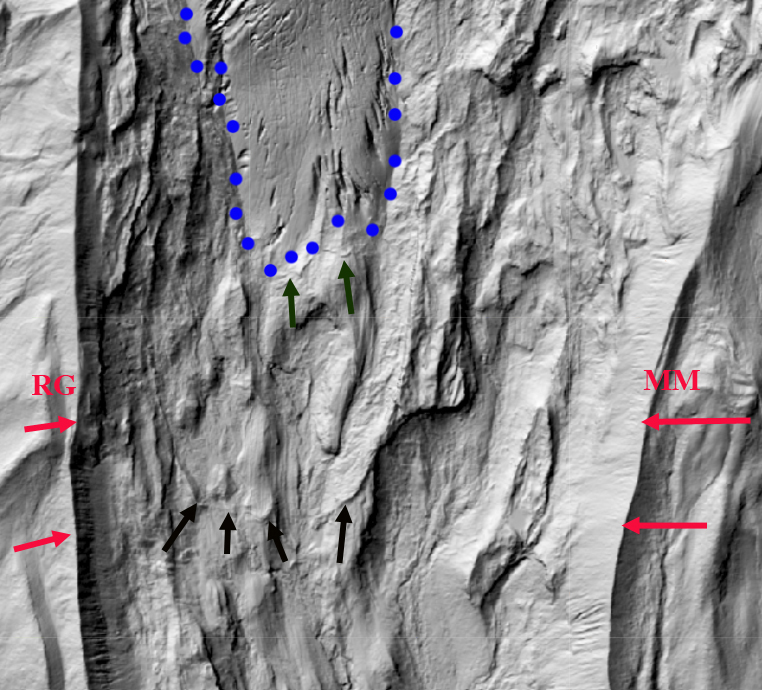
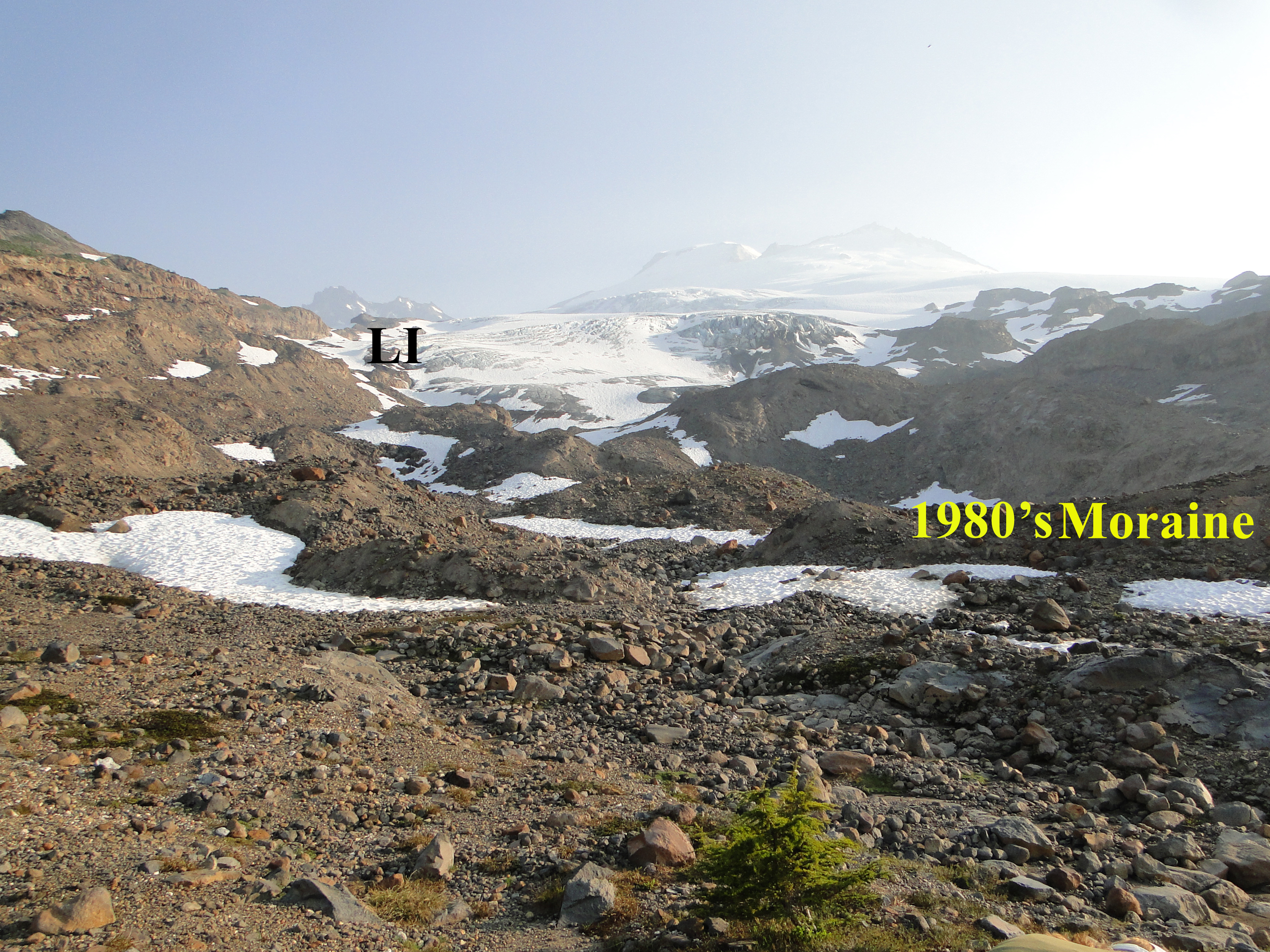
This is the story of  the annual monitoring of Easton Glacier, Washington.  We have been monitoring Easton Glacier on Mount Baker, a stratovolcano in the North Cascade Range, Washington since 1990.  Each year we survey the terminus position, measure its mass balance, assess crevasse depths and map surface elevation on a transect across the glacier.  In 1990 Easton Glacier was in contact with an advance moraine built from the late 1950’s- 1980’s.  The advance moraine is noted in the 2015  Washington DNR Lidar  image of the terminus area by black arrows. The green arrows indicate the recessional moraine from the winter of 2015. Red arrows indicate the Little Ice Age lateral moraines Railroad Grade (RG) to the west and Metcalfe Moraine (MM) to the east. From 1990-2017 the glacier has retreated 370 m, including 65 m in the last three years. The second Lidar image indicates the transect where the surface elevation is mapped, red line.  This is close to 2000 m in elevation, and in a good snow year retains snowpack and in most recent years has lost its snowpack (note paired image below). In 2015 the worst year, the snowpack had been lost by the end of July. Note the comparison of the 2017 transect snowpack and 2015 lack of snowpack.

Washington DNR Lidar image of Easton Glacier , black arrows indicate 1980’s advance moraine, green arrows 2015 winter moraine and red arrows the Little Ice Age lateral moraines. Blue dots indicate the glacier margin.


Washington DNR Lidar image of Easton Glacier. Blue dots indicate the glacier margin.  Red line the cross glacier profile.

A view along the cross glacier profile at 2000 m in early August of 2015, snowpack gone already and in 2017 with 2 m of snowpack remaining. 

More than 5000 measurements of snow depth and melt have been completed illustrating the glacier has lost 16.6 m of water equivalent thickness, over 18 m of thickness from 1990-2016.  For a glacier that averaged 70 m in thickness in 1990 this is ~25% of the volume of the glacier gone.  The glacier has not maintained sufficient snow cover at the end of the summer to have a positive mass balance, this is the accumulation area ratio.  The mass balance and terminus data is reported annually to the World Glacier Monitoring Service.  The area lost in the terminus region due to the retreat has been 0.22 km2.

The glacier has also slowed its movement as it has thinned, evidenced by a reduction in number of crevasses. In the lowest icefall Jill Pelto has surveyed the crevasse depths finding a mean depth 20 m and a maximum depth of 32 m. This glacier supplies runoff to Baker Lake and its associated hydropower projects.  Our annual measurements here and on Rainbow Glacier and Lower Curtis Glacier in the same watershed provide a direct assessment of the contribution of glaciers to Baker Lake.  The glacier is also adjacent to Deming Glacier, which supplies water to Bellingham, WA. The Deming is too difficult to access, and we use the Easton Glacier to understand timing and magnitude of glacier runoff from Deming Glacier.  Deming Glacier has retreated a greater distance during this period, 705 m, but has lost a similar area.

Annual terminus survey in 2015 terminus exposed to melting by early July.  In 2017 terminus being exposed first week in August. Taken from same location.

Crevasses measurement in lower icefall and on the cross profile.  In both cases crevasse depth is measured, on the profile 2017 winter snow depth remaining measured. 

Easton Terminus viewed from our benchmark location just beyond 1980’s margin. Tree in foreground is over 50 years old.


Conducting Long Term Annual Glacier Monitoring

2015 time lapse easton

Easton Glacier in 1990, 2003 and 2015 from same location. Below Painting by Jill Pelto of crevasse assessment using a camline.

camline

This is the story of how you develop and conduct a long term glacier monitoring program.  We have been monitoring the annual mass balance of Easton Glacier on Mount Baker, a stratovolcano in the North Cascade Range, Washington since 1990.  This is one of nine glaciers we are continuing to monitor, seven of which have a 32 year long record. The initial exploration done in the pre-internet days required visiting libraries to look at topographic maps and buying a guide book to trails for the area.  This was followed by actual letters, not much email then, to climbers who had explored the glacier in the past, for old photographs.  Armed with photographs and maps we then determined where to locate base camp and how to access the glacier.  The first year is always a test to make sure logistically you can reach enough of the glacier to actually complete the mass balance work with a sufficiently representative network of measurement sites.  The second test is if you can stand the access hike, campsite, and glacier navigation, to do this every year for decades; if the answer is no, move on.  That was the case on Boulder Glacier, also on Mount Baker:  poor trail conditions and savage bugs, were the primary issue. Next we return to the glacier at the same time each year, completing the same measurements each year averaging 210 measurements of snow depth or snow melt annually.  This occurs whether it is gorgeous and sunny, hot, cold, snowy, rainy, or recently on this glacier dealing with thunderstorms.  You wake up, have your oatmeal and coffee/cider/tea, and get to work.  Lunch on the snow features bagels, dried fruit, and trail mix. Happy hour features tang or hot chocolate depending on the weather.  It is then couscous, rice, pasta or quinoa for dinner, with some added dried vegetable or avocado.  The sun goes behind a mountain ridge and temperatures fall, and the tent is the haven until the sun returns.  Repeat this 130 times on this glacier and you have a 25 year record. During this period the glacier has lost 16.1 m of water equivalent thickness, almost 18 m of thickness.  For a glacier that averaged 70 m in thickness this is nearly 25% of the volume of the glacier gone.  The glacier has not maintained sufficient snow cover at the end of the summer to have a positive balance, this is the accumulation area ratio, note below.  The glacier has retreated 315 m from 1990-2015.  This data is reported annually to the World Glacier Monitoring Service.  The glacier has also slowed its movement as it has thinned, evidenced by a reduction in number of crevasses. During this time we have collaborated with researchers examining the ice worms, soil microbes/chemistry, and weather conditions on the ice. This glacier supplies runoff to Baker Lake and its associated hydropower projects.  Our annual measurements here and on Rainbow Glacier and Lower Curtis Glacier in the same watershed provide a direct assessment of the contribution of glaciers to Baker Lake.  The glacier is adjacent to Deming Glacier, which supplies water to Bellingham, WA. The Deming is too difficult to access, and we use the Easton Glacier to understand timing and magnitude of glacier runoff from Deming Glacier.

The glacier terminates at an elevation of 1650 m, but thinning and marginal retreat extends much higher.  A few areas of bedrock have begun to emerge from beneath the ice as high as 2200 m. The changes in ice thickness are minor above 2500 m, indicating this glacier can retreat to a new equilibrium point with current climate.

Mass balance, terminus and supra glacial stream assessment are illustrated in the video, Filmed by Mauri Pelto, Jill Pelto, Melanie Gajewski, with music from Scott Powers.

easton 2010
Mass balance Map in 2010 of Easton Glacier used in the field for reference in following years. 

easton aar

Accumulation Area Ratio/Mass balance relationship for Easton Glacier

Easton Glacier Assessment, Washington

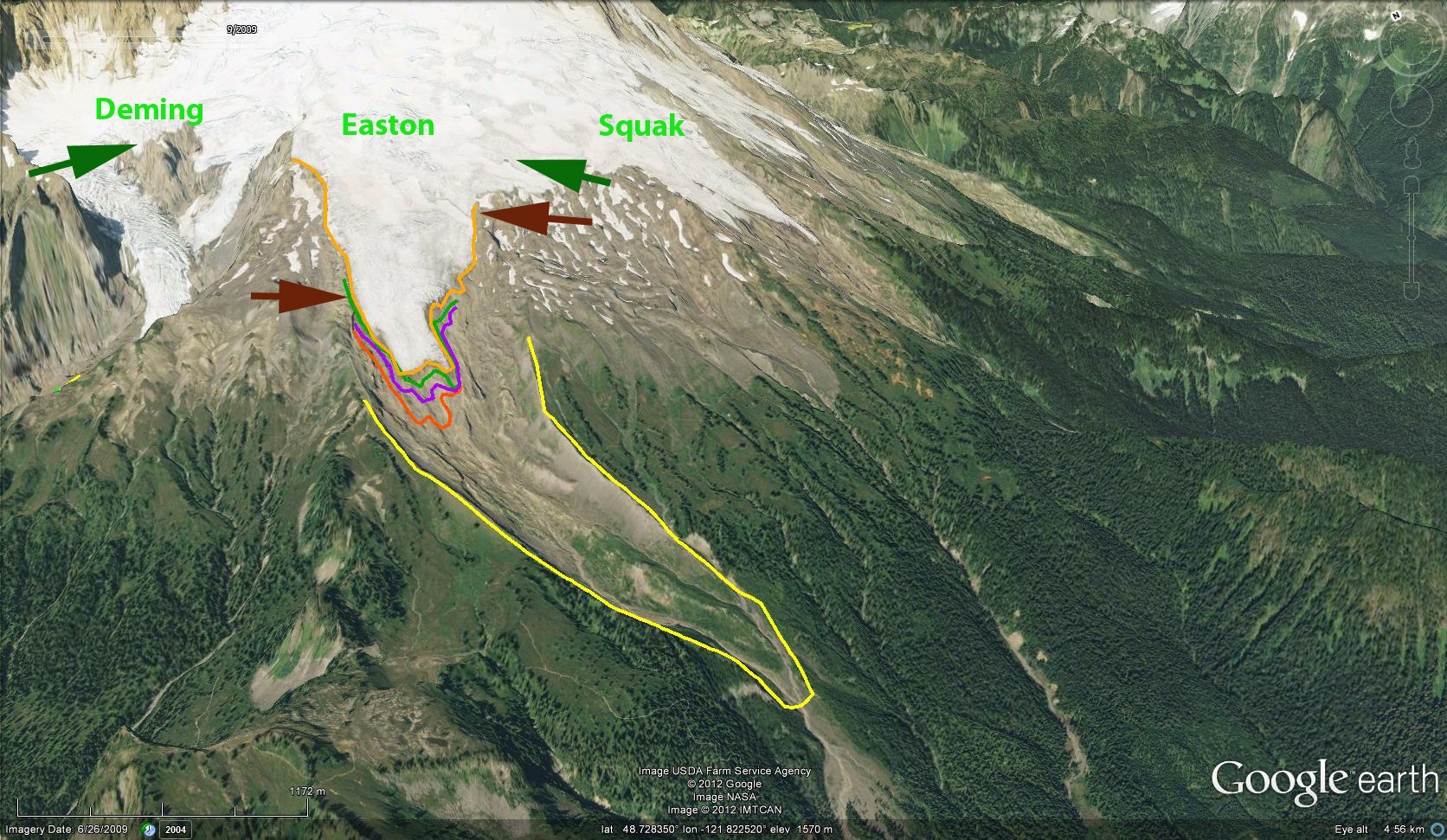
In August we will be making a detailed study of the Easton Glacier for the 23rd consecutive summer. Our main focus is measurement of snow depth and snow melt on the glacier. We will be mapping the terminus position and two profiles of the surface elevation across the glaciers at 1800 m and 1950 m. We will also examine two new bedrock knobs that have melted out in the midst of the glacier at 2050 m. The Easton Glacier is important as a water resource for the Baker lake and Baker River Hydropower system. This hydropower system is capable of producing 170 MW of power. The runoff from Easton Glacier would normally flow into the Baker River below Upper Baker Dam, however it is extracted from the normal stream and routed through a pipeline to enter Baker Lake and then produce power via Upper Baker Dam (second image), note yellow dots showing runoff pathway. The Easton Glacier retreated over 2 km from its Little Ice Age maximum to 1955. By 1965 the glacier was advancing, this advance ended in the early 1980’s and by 1987 retreat from the moraine was evident. Beginning in 1990 we have made an annual survey of the glacier terminus noting a retreat of 320 m from 1987-2010. The first image below is of Easton Glacier from 1912 the second from 2011 with the same locations highlighted. A prominent knob on the upper glacier has changed little, ocher arrow. The lower margin of the glacier on either side of the main Easton at the blue arrow and red arrow show substantial thinning and retreat. The purple arrow indicates the terminus change. The lower Easton Glacier has changed a great deal in the last 100 years, not the upper glacier. This is an indication of a glacier adjusting to climate change that is retaining an accumulation and can survive. The last image in the sequence indicates the Little Ice Age terminus yellow line, the 1993 terminus orange, 1998 terminus is purple, 2004 terminus is green and 2009 terminus is ochre.
In the above image the red arrows indicate the location of the two survey profiles we complete across the glacier. The green arrows indicate two locations of investigation for the summer, to the left is the top of the Deming Glacier Icefall that will visit and the right green arrow a new bedrock knob that emerged from beneath the glacier in 2009. A month from now we will be surveying the glacier covering the glacier top to bottom and side to side. We will be joned by Peter Sinclair who is going to use is videography skills to examine how we measure glacier change. The first image below is from Steph Abegg a superb climber and photographer who was with us in 2010 as part of Team Juicebox working on the Uncertain Ice documentary. The main goal of our research each year is assessing the glacier’s mass balance. This is the equivalent of its bank account, with snow accumulation being deposits and snow-ice melt being withdraws. We map the changes across the glacier and determine if the bank account grew or declined, 2011 map is below. Since 1990 the bank account has lost 10 meters of thickness of an average of 70 m total. Last year the glacier did gain over a meter. A key measure is the percent of the glacier in the accumulation zone (AAR), below 65% is a loss above a gain, bottom image. The 2012 winter was a La Nina which tends to lead to very good snowpack, the transition out of La Nina took place in late spring-early summer leading to greater melting than 2011, we will see in three weeks.

Mass Balance of the Easton Glacier 2009

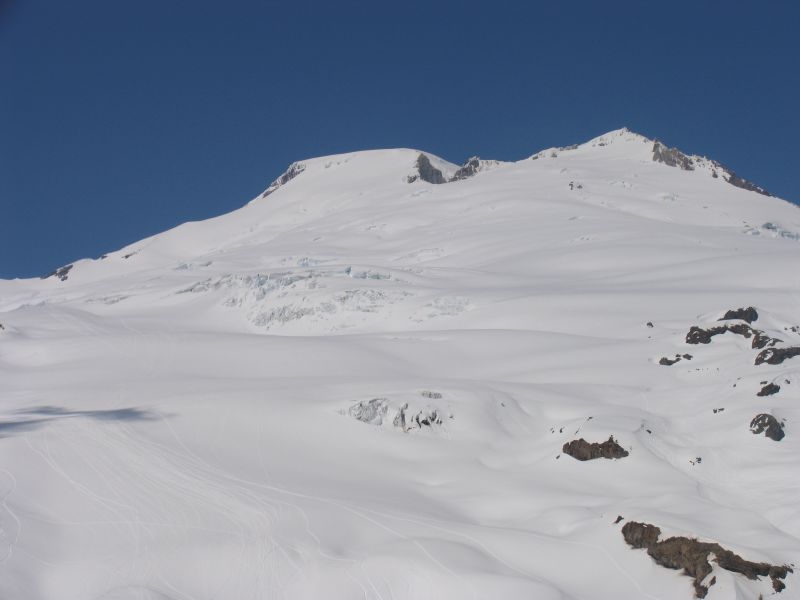
Immediately below is Easton Glacier on Mt. Baker in the North Cascades in late May 2009. The glacier is still completely snow covered. The bench where the small gray cloud shadows are at 6000 feet averages 20 feet of snow remaining.
easton 5-20-09 (1)Easton Glacier extends from the terminus at 5600 feet to the slopes near Sherman Crater at 9000 feet. Each summer since 1990 NCGCP has measured the mass balance of this glacier. View Youtube for a pictorial review of the full 2009 field season . The glacier has retreated 300 m since 1990. During this same period the glacier has lost a cumulative mean of 13 m of thickness. Given a thickness in 1990 between 60 and 75 m, this is about 20 % of the total glacier volume. The image below shows the terminus in 2009(green=2009, 2006=brown, red=2003, purple=1993 and yellow=1984). Measuring mass balance requires assessing snowpack depth and areal extent at the end of the summer melt season and the amount of melting in areas where blue ice or firn (snow more than a year old) is exposed. Below is measuring crevasse stratigraphy and below that emplacing a stake to measure ablation with weather instruments on it. f25f18

Mass Balance = residual snow accumulation – ice-firn melting.

The melt season began a bit late just when the May picture was taken Winter snowpack was between 75and 90% of normal in the area as of April 1. The melt season had been late to begin and snowpack by late May was near normal. Record heat was experienced at the end of May and the start of June, quickly causing snowpack to fall below normal.Each year we measure the snow depth via probing and crevasse stratigraphy at more than 200 locations. These depth measurements allow the completion of a map of snow distribution. This map is completed in early August and updated, based on a smaller number of observation in late September. The amount of melting is assessed from stakes emplaced in the glacier and the recession of the snowline in areas where snow pack depth has been assessed. below are images from early and then mid-August indicating the rise of the snowline. DSC02239easton8-16-09
A warm June and July caused exceptional snow pack melt and by early August when we began assessing snow pack depth retained, the snowcover had receded to the 6400 foot level, 300-400 feet higher than normal. Snowpack remained below normal all the way to the 8600 foot level. the snowpack since early July had been rising nearly 100 feet per week. By mid-August at right the snow line on the glacier averaged 6800 feet. By mid and Late September the snowline had risen to 7400 feet a rate of rise of 150 feet per week since mid-August. Below is an image from mid-September 2009. The amount of melting on the glacier in July was the highest we have measured totaling, 2.1 m. This led to the exposure of a couple of new bedrock knobs evident in the picture at right near the 2100 meters, black arrows. Overall the mass balance of the glacier in 2009 was a negative 2.06 m. This glacier averages 55-70 m in thickness and this mass balance loss represents a 3% volume loss in a single year for the glacier.