Lekhziri Glacier, Georgia Retreat Leads to Separation 1996-2022

Lekhrziri Glacier in 1996 and 2022 Landsat images illustrating the retreat and separation of the three tributaries central (Lc), eastern (Le) and western (Lw). Red arrow indicates 1996 terminus and yellow arrows the 2022 terminus locations

Lekhrziri Glacier has been the largest glacier in Georgia, and was until 2011 a compound glacier comprised of three tributaries joining a short distance from the terminus (Tielidze et al 2016).  Tielidze et al (2015) observed in 2011 that the central tributary separated from the east and west tributary that year at the headwaters of  the Mestiachala River Basin. From 2000-2020 Lekhziri Glacier experienced the largest retreat, of 1395 m, of 16 large Caucasus glaciers examined by (Tielidze et al 2022). Here we examine Landsat and Sentinel imagery from 1996-2022 to illustrate the changing nature of this glacier.

In 1996 the three tributaries joined at 2300 m and then flowed jointly south for 1 km to the terminus, red arrow on Landsat image. The August snowline is at 3300 m. By 2013 the central glacier has visibly separated by 500 m from the other tributaries. The primary terminus has had a retreat of ~500 m since 1996. The August snowline is at 3400 m in 2013. In 2022 additional retreat as separated the east and west tributaries, with an evident river emanating from each tributary, yellow arrows, feeding into the Mestiachala River. The central tributary terminates 800 m from the former junction. The retreat of the east tributary has been 1.3 km since 1996 and the west tributary 1.25 km since 1996. There is also a small lake that is evident, green arrow, in 2022 that will fill in with sediment.  The snowline at the end of August 2022 is at 3450 m. The persistent high snowlines due to warm melt season conditions has led to ongoing mass loss that will lead to continued declines in the Lekhziri Glacier system. This is one example of the widespread retreat of glaciers in the region chronicled by Levan Tielidze. The high snowlines of 2017 and 2022 have been noted for Gora Gvandra glaciers and Zeno Svaneti glaciers.

Lekhrziri Glacier in 2013 Landsat image illustrating the retreat and separation of the three tributaries central (Lc), eastern (Le) and western (Lw). Red arrow indicates 2013 terminus and purple dots the snowline.

Lekhrziri Glacier in 2022 Sentinel image illustrating the retreat and separation of the three tributaries central (Lc), eastern (Le) and western (Lw). Yellow arrows the 2022 terminus locations aand green arrows the small lake at headwaters of Mestiachala River Basin.

Zemo Svaneti Glaciers, Georgia Not Poised for Survival

Ladevali (L), Tsaigmili (T), Baki (B), and Cherinda Glacier (C) in Sentinel false color image from August 30, 2022. Illustrating that each has 10% or less of the glacier surface retaining snowcover.

Several glaciers at the headwaters of the Doira River in the Zemo Svaneti Planned National Park in the Georgian Caucasus have been stripped of snowpack during recent summers. A glacier without a zone a persistent snowcover throughout the year has no accumulation zone and cannot survive (Pelto, 2010). Here we examine Ladevali, Tsaigmili, Baki and Cherinda Glaciers during August of 2016, 2018, 2020 and 2022 using Sentinel imagery. Tielidze and Wheate (2018)  completed an inventory of Caucasus glaciers documenting the 1986 glacier surface area at 1482 square kilometers decreasing to 1193 square kilometers by 2014, a 20% decline in this 28 year period. Tielidze et al ( 2022) update this inventory identifying a 23% decline in area from 2000 to 2020, greater than 1% per year.

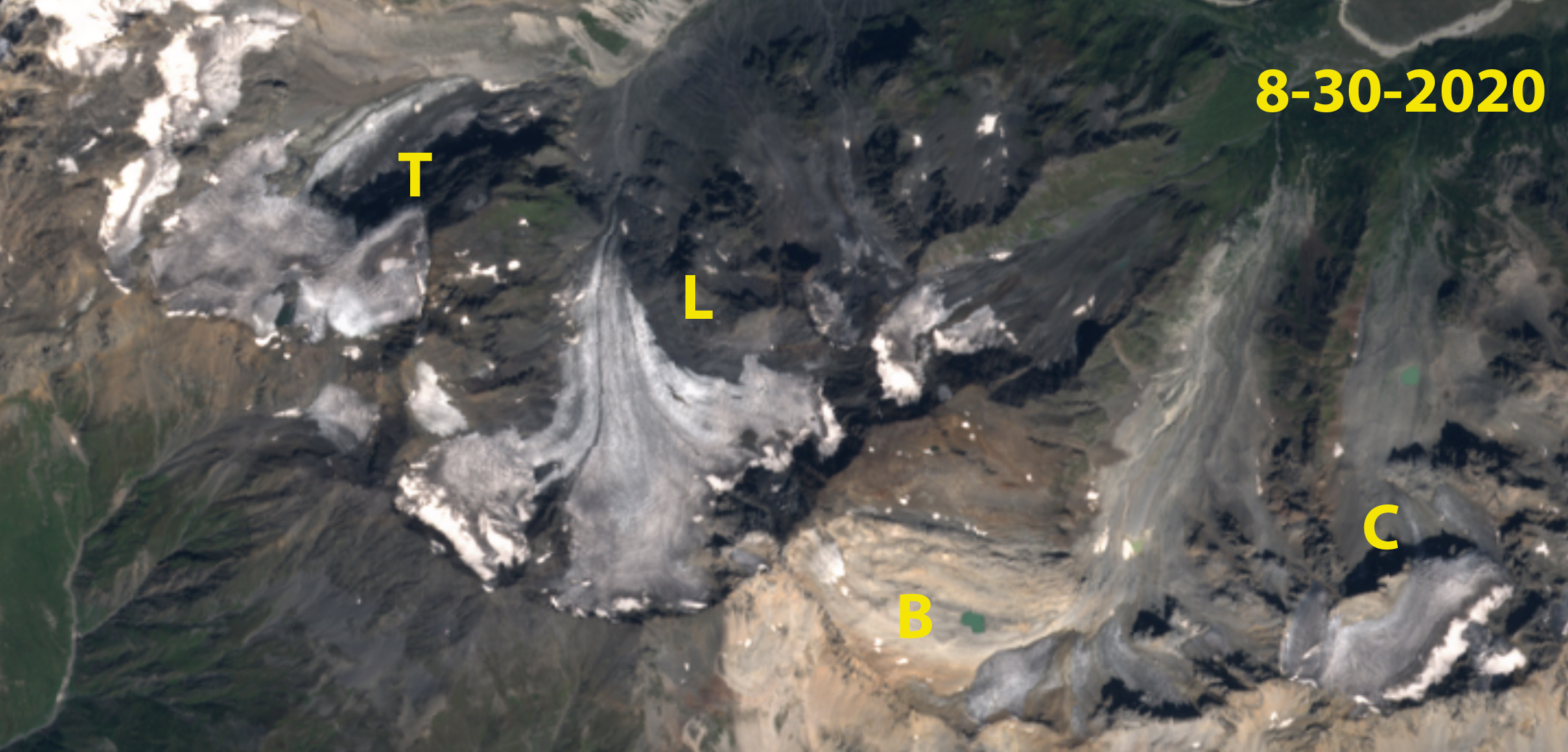
In 1998 ther Ladvali and Tsaigmili Glacier nearly join at the terminus. Baki Glacier spans the entire upper basin and no lake is evident near Point B. Cherinda Glacier descends a bedrock step to form a lower section. In mid-August of 2018 Baki Glacier has lost nearly all snowcover and a new lake has formed adjancent to Point B. Cherlinda Glacier has a fringe 15% along its upper margin and is no longer connected to lower relict ice below the bedrock step. Ladevali and Tsaigmili Glacier have snow cover above 3200 m covering 15-20% of the glacier and the termini are now separated by ~1 km.  At the end of August in 2020 Baki Glacier is snow free. Cherinda has a fringe on its upper maring covering less than 10% of the glacier. Ladevali and Tsaigmili Glacier have snow cover above 3300 m covering ~5% of the glacier. At the end of August 2022 Baki Glacier is again snow free, while Cherinda has a fringe on its upper margin covering 10% of the Glacier. Ladevali and Tsaigmili Glacier have snow cover above 3250 m covering ~10% of the glacier. In 2022 the glaciers also exhibit a lack of retained firn from any recent year, illustrating a consistent lack of retained accumulation.  This consistent minimal retained snowcover illustrates that the glaciers cannot survive current climate. A similar situation has been observed further east at Gora Gvandra. The mass balance in the region has continued to decline with a mean annual loss of ~-0.5 m/year from 2000-2019, (Tielidze et al 2022) with 2020-2022 likely even worse

Ladevali (L), Tsaigmili (T), Baki (B), and Cherinda Glacier (C) in Sentinel true color image from August 30, 2020. Illustrating that each has 10% or less of the glacier surface retaining snowcover.


Ladevali (L), Tsaigmili (T), Baki (B), and Cherinda Glacier (C) in Sentinel false color image from August 16, 2018. Illustrating that each has 20% or less of the glacier surface retaining snowcover with several weeks left in the melt season.

Ladevali (L), Tsaigmili (T), Baki (B), and Cherinda Glacier (C) in Landsat image from mid-August 1998. Ladvali and Tsaigmili nearly join in 1998. Baki Glacier expands across the entire basin and Cherlinda descends below a bedrock step.


Suatisi Glacier Retreat, Mount Kazbek, Georgia

Suatisi compare

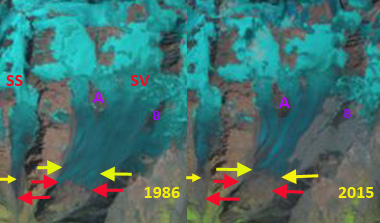
Comparison of Suatisi Vost (SV) and Suatisi Sredny (SS) in 1986 and 2015 Landsat images.  The red arrow is the 1986 terminus and the yellow arrows the 2015 terminus.  Point A and B are to areas of expanding bedrock amidst the glacier. 

Suatisi Vost and Suatisi Sredny Glacier are two glaciers on the south flank of Mount Kazbek in northern Georgia.  The region is prone to landslides and debris flows. On September 20, 2002 a collapse of a hanging glacier from the slope of Mt Dzhimarai-Khokh onto the Kolka glacier triggered an avalanche of ice and debris that went over the Maili Glacier terminus then slid over 15 miles (NASA Earth Observatory, 2002). It buried small villages in the Russian Republic of North Ossetia, killing dozens of people. The glacier runoff from Suatisi Glacier supplies the Terek River, which has a hydropower project under construction.  The Dariali Hydroplant will have an installed capacity of 108 MW and is a run of river type plant near Stepantsminda, Georgia. This plant has suffered from two landslides in 2014 (Glacier Hub, 2014) that jeopardize its completion.

Shagadenova et al (2014) examined glaciers in the Caucasus mountains and found that from 1999/2001 and 2010/2012 total glacier area decreased by 4.7%. They also noted that recession rates of valley glacier termini increased between 1987– 2000 and 2001–2010, with the latter period featuring retreats averaging over 10 m/year.  A positive trend in summer temperatures forced glacier recession (Shagadenova et al 2014). Here we examine changes in Suatisi Glacier from 1986 to 2015 with Landsat imagery.

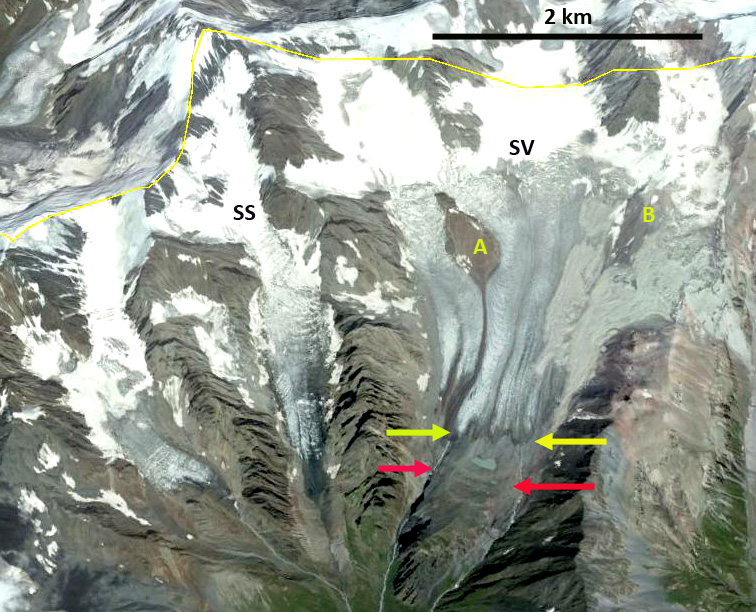
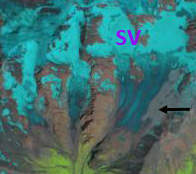
In 1986 Suatisi Vost western side terminates at the top of deep canyon, red arrow.  The eastern side of the terminus is on a flatter till plain.  The area around Point B is all glacier ice.  Suastisi Sredny terminates near the end of the valley it occupies in 1986.  In the 2001 image a large debris flow/landslide has covered the eastern margin of Suatisi Vost surrounding the area of Point B, black arrow in 2001 image below.  By 2010 the Google Earth image indicates significant retreat of Suatisi Vost and the debris flow below point B is a light gray color. The bedrock at Point B has expanded.   By 2015 Suatisi Vost terminus has retreated 350 m since 1986, what is just as evident is the loss in width of the terminus in the 1986-2015 side by side comparison. Suatisi Sredny has retreated 450 m.  The snowline is at an elevation of 3750-3800 m in 1986, 2010 and 2015. With the terminus at 3250 m and the highest elevation at 3950-4000 m, this is too high to sustain the glacier at its current size and retreat will continue. The debris cover has reached the terminus on the east side of the glacier by 2015. The changes are the same across the border in Russia, for example Lednik Midagrabin.

suatisi ge

2010 Google Earth image of Suatisi Vost and Suatisi Sredny.  

suatisi 2001

2001 Landsat image indicating the landslide covering surface of Suatisi Vost.

suatisi j2015

2015 Landsat image indicates Landslide deposit evolution, with movement downglacier and retreat, it is now close to the ice front on the east side of the margin.