La Perouse Glacier, Alaska Lake Formation Retreat Acceleration

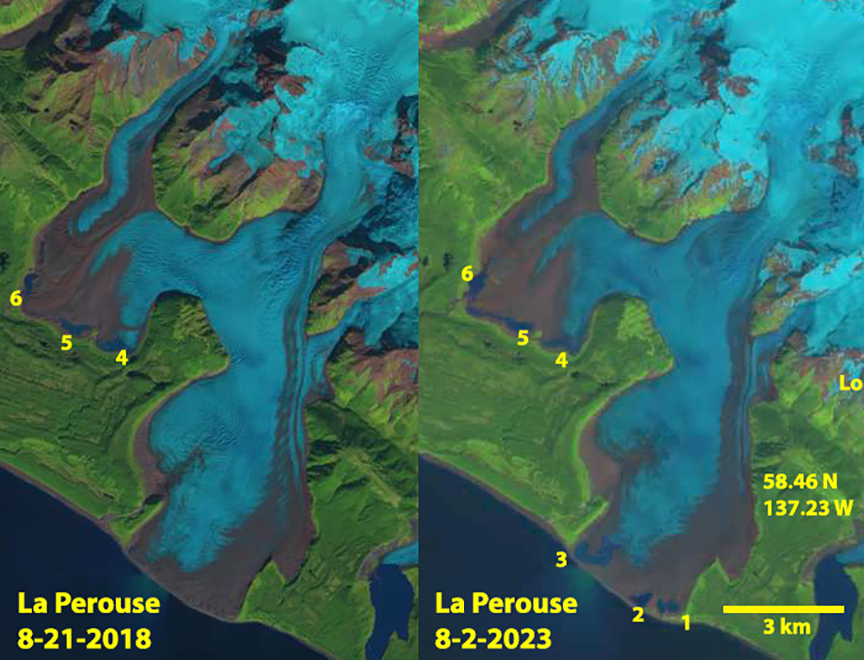
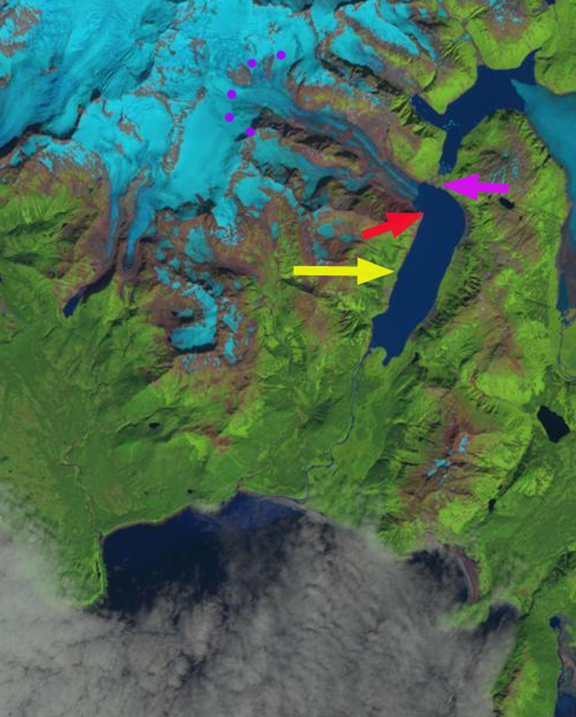
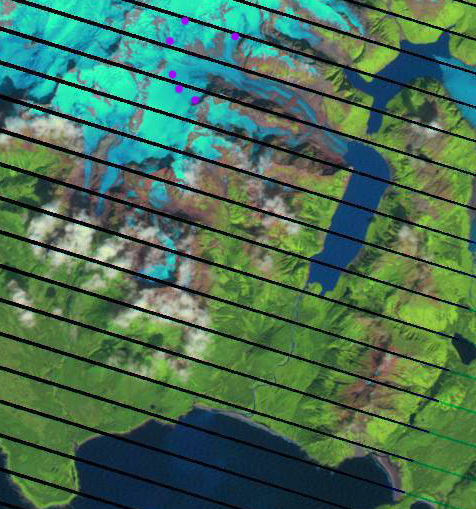
La Perouse Glacier in 2018 and 2023 Landsat images indicating the six developing proglacial lakes (1-6). The lakes in 2023 have a combined area of 1.3 km2. Debris cover has expanded notably at Points D.

La Perouse Glacier flows from the Fairweather Range to the Pacific Coast. The glacier advanced to the coast in the mid-late 19th century and has remained tidewater on the coast since (Gaglioti et al 2019). I first saw this glacier in 1982 and its terminus stretched 3.5 km along the coast, a second terminus ended inland and was 3.2 km wide. Both of the terminus are piedmont fed by a significant accumulation area above 2300 m, that flows through a spectacular icefall from 1100 to 1800 m. This high accumulation zone helps make the glacier more resilent to warming temperature (Pelto, 1987). Berthier et al (2010) noted a ~0.5 m/loss average loss for glaciers in this region from 1962-2006, which has generated this retreat. The glacier because of its size and large piedmont lobe is slow to respond to climate change, 20 km2 coastal lobe and 10 km2 inland lobe.

La Perouse Glacier coastal terminus area indicating the three developing proglacial lakes, yellow arrows. False color Sentinal images.

Up to 2018 the coastal terminus was thinning, but had not experienced significant recession or proglacial lake development. There was significant marginal recession by 2018 exposing a forest overrun by the glacier in the 1860’s (Gaglioti et al 2019). In 2018 the inland terminus had developed 3 proglacial lakes wiyth a combined area of 0.4 km2. By 2023 the inland terminus lakes spread across 90% of the width of the terminus, with a combined area of 0.7 km2. In 2023 the main terminus had developed three proglacial lakes each, #1 at 0.12 km2, #2 at 0.16km2 and #3 at 0.36 km2. Lake #3 has numerous bergs indicating the ability to rapidly expand by calving, due to having a greater water depth. In just five years the debris covered area has expanded notably. This combination of expanding glacial lakes and debris cover is an indication of ongoing rapid decline. The changes here are simialr to that at nearby Brady Glacier and progressing on the same trend as Fingers Glacier. Look for further lake development in 2024 particularly in the coastal lobe.

Brady Glacier, Alaska Nunatak Expansion and High Snowline 2018

Emergence of Nunataks at Point A, B and C at 850 m on Brady Glacier from 1986 and 2018 Landsat Images.  Transient snowline on 9/21/2018 indicated by purple dots.

Brady Glacier,  is a large Alaskan tidewater glacier, in the Glacier Bay region that is beginning a period of substantial retreat Pelto et al (2013). Pelto et al (2013) noted that the end of season observed transient snowline averaged 725 m from 2003-2011, well above the 600 m that represents the equilibrium snowline elevation, for the glacier to sustain its current size. In 2015, 2016 and 2018 the snowline has been at 900-1000 m.  This is leading to thinning across of what was much of the accumulation zone.  Here we examine Landsat images from 1986 to 2018 to identify signs of this thinning.

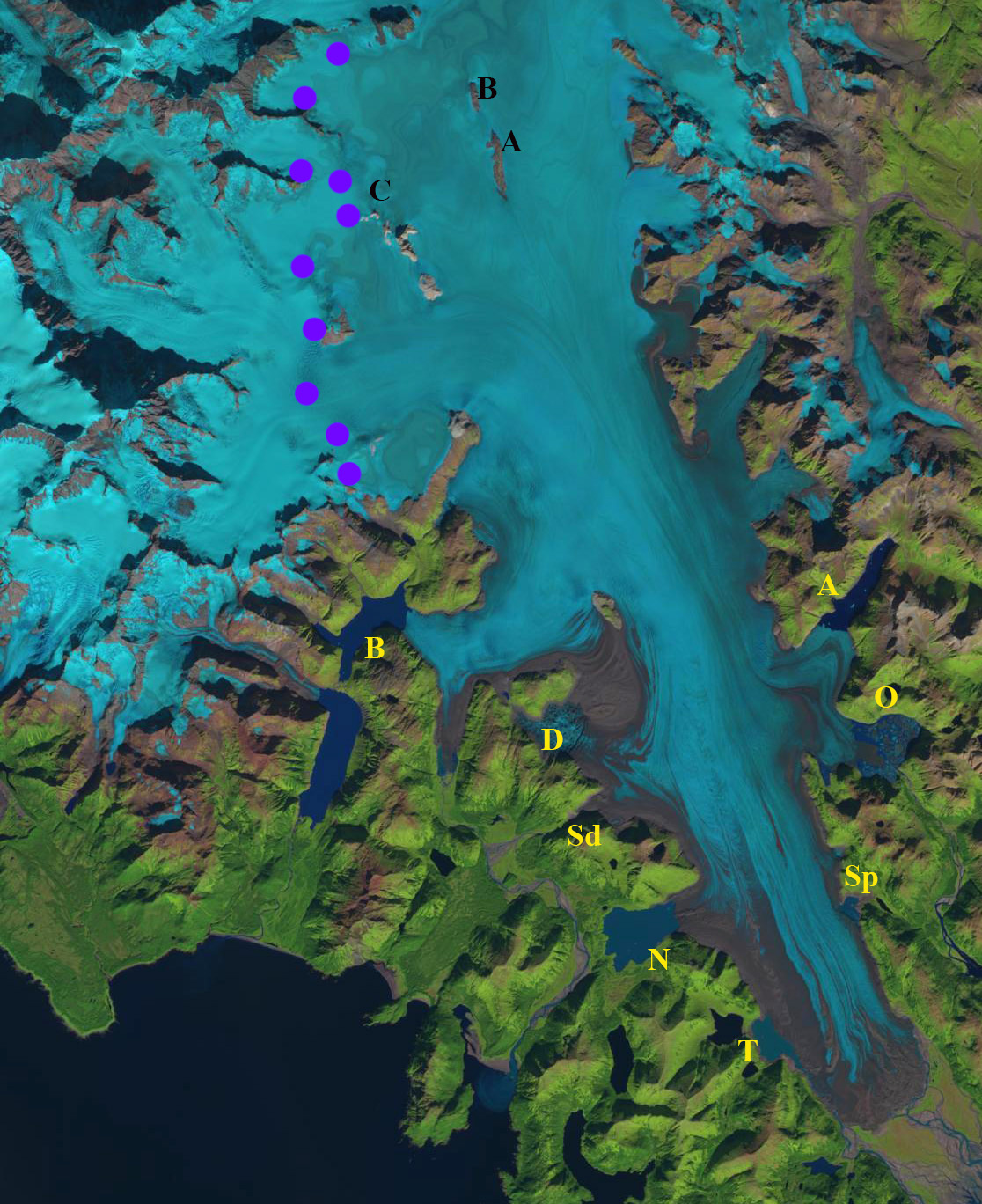
In 1986 Point A and B have insignificant rock exposure, while C has a limited single rock nunatak.  By 2000, below there is bedrock exposed west of Point A and B, with two small nunataks near C.  By 2015 there is a 2 km long bedrock ridge at Point A and a ~1 km long bedrock ridge at Point B.  The snowline in 2015 is just above Point B and C at 900 m.  In 2016 on Oct. 1 2016 after the end of the typical melt season the snowline is at 900 m. In 2018 the snowline on Sept. 21 is at 1000 m.  At Point A the bedrock Ridge is now 2300 m long and up to 300 m wide.  At Point A the ridge is 1100 m long.  At Point C a third nunatak has emerged and the series of nunataks will soon merge into a single ridge.

The persistent high snowlines indicate the consistent accumulation zone is now above 900 m, below this point thinning will continue.  The mean elevation of the glacier is at 720 m and thinning is significant below 1000 m from 1995-2011(Johnson et al 2013).  That far less than 50% of the glacier is retaining snowpack and widespread thinning will drive further retreat of the distributary glacier termini in expanding lakes noted by Pelto et al (2013) and a the 2016 blog post.   Brady Glacier abuts the adjacent Lampugh Glacier that has and will be impacted by a large landslide.

Trick Lakes: In 1986 North and South Trick Lake are proglacial lakes in contact with the glacier. By 2016 the two lakes are no longer in contact with the glacier, water levels have fallen and a third lake East Trick Lake has formed. The more recently developed East Trick Lake is the current proglacial Trick Lake, a large glacier river exits this lake and parallels the glacier to the main Brady Glacier terminus, going beneath the glacier for only several hundred meters.

North Deception Lake had a limited area in 1986 with no location more than 500 m long. By 2016 retreat has expanded the lake to a length over 2 km. The width of the glacier margin at North Deception Lake will not change in the short term, but the valley widens 2 km back from the current calving front, thus the lake may grow considerably in the future.

South Dixon Lake This new lake does not have an official name. It did not exist in 1986, 2004, 2007 or 2010. It is nearly circular today and 400 m in diameter.

Dixon Lake: It is likely that retreat toward the main valley of the Brady Glacier will lead to increased water depths at Dixon Lake, observations of depth of this lake do not exist. Retreat from 1986 to 2016 has been 600 m.

Bearhole LakeBearhole Lake is expanding up valley with glacier retreat, and there are no significant changes in the width of the valley that would suggest a significant increase in calving width could occur in the near future. Currently the lake is 75 m deep at the calving front and there has been a 1400 m retreat since 1986 Capps et. al. (2013).

Spur Lake:It is likely that retreat toward the main valley of the Brady Glacier will lead to increased water depths at Spur Lake. the depth has fallen as the surface level fell from 1986-2016 as the margin retreated 600 m, leaving a trimline evident in the 2016 imagery.

Oscar Lake has experienced rapid growth with the collapse of the terminus tongue. Depth measurements indicate much of the calving front which has increased by an order of magnitude since 1986 is over 100 m. The tongue as seen in 2014 Google Earth image will continue to collapse and water depth should increase as well. The central narrow tongue has retreated less than 200 m since 1986, but the majority of the glacier front has retreated more than 1 km since 1986.

Abyss Lake: Continued retreat will lead to calving width expansion> The retreat from 1986 to 2016 has been 400 m. The water depth has been above 150 m at the calving front for sometime and should remain high.

Emergence of Nunataks at Point A, B and C at 850 m on Brady Glacier from 2000 and 2015 Landsat Images.  Transient snowline on 9/21/2018 indicated by purple dots.
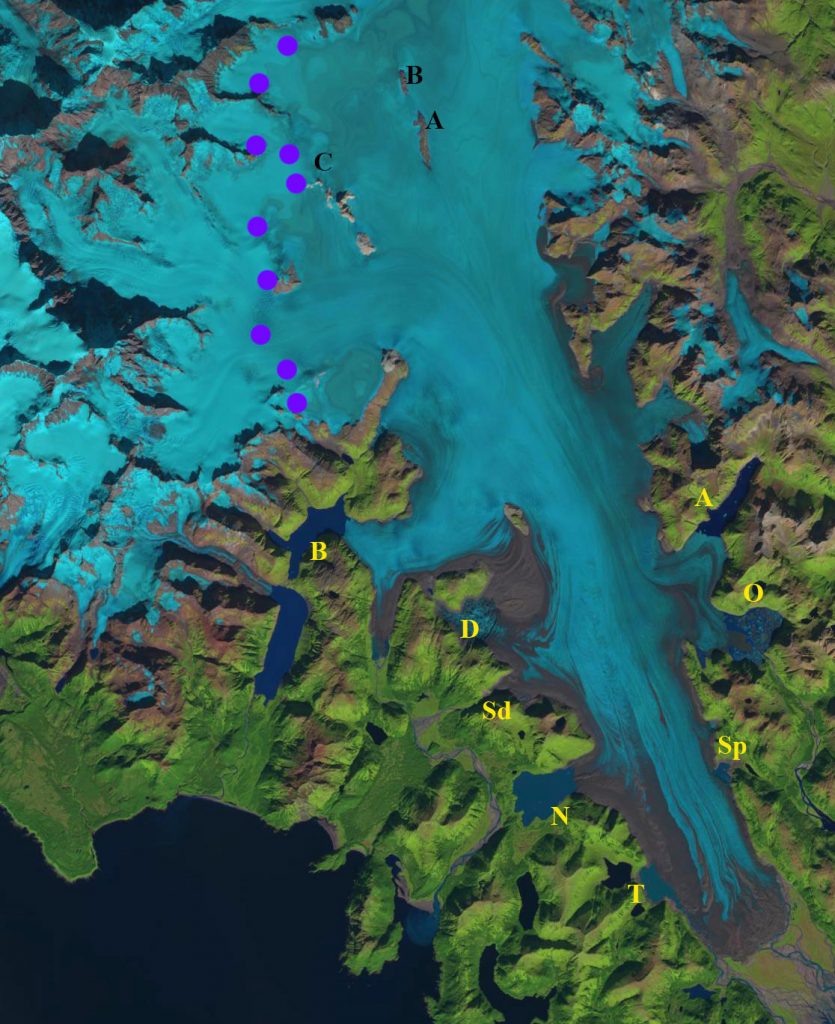
Landsat image of Brady Glacier on 9/21/2018 indicating the snowline (purple dots)  and the emerging nunataks at Point A-C. Lakes noted are: A=Abyss, B=Bearhole, D=Dixon, N=North Deception, O=Oscar, Sd=South Dixon, Sp=Spur, T=Trick.

Landsat image of Brady Glacier on 10/1/2016 indicating the snowline (purple dots)  and the emerging nunataks at Point A-C.

McBride Glacier Increased Retreat and Harbor Seals, Glacier Bay, Alaska

mcbride compare

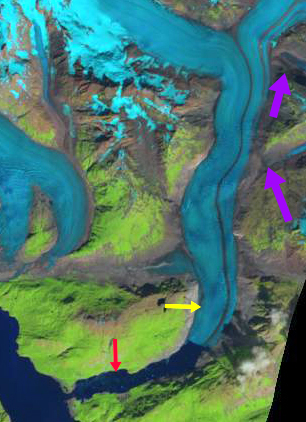
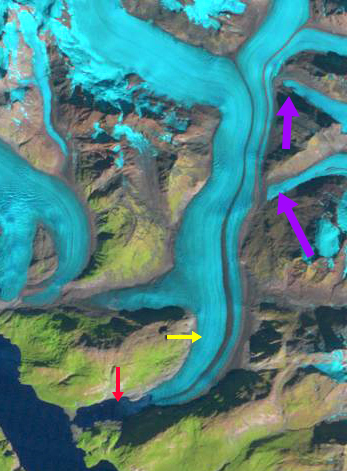
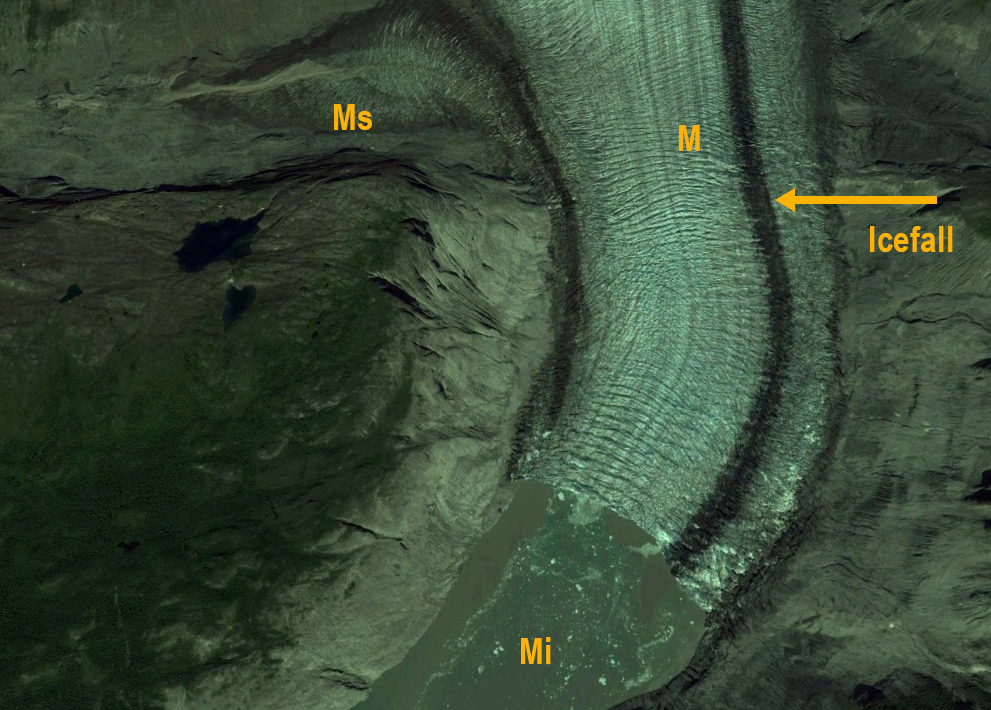
McBride Glacier (M), its secondary terminus (Ms), MCbride Inelt (MI) and Riggs Glacier (R) in Landsat image comparison from 1985 and 2015.  The red arrows indicate the 1985 terminus location and the yellow arrows the 2015 terminus location.  Main terminus 4.4 km retreat, secondary terminus 2.7 km retreat.

McBride Glacier was part of the Muir Glacier complex in Glacier Bay, Alaska, until the 1960’s when it separated from Muir and adjacent Riggs Glacier.  Riggs Glacier and Muir Glacier are no longer calving tidewater glaciers, while McBride has continues to terminate in a tidewater inlet.  Riggs Glacier’s retreat from the sea was complete by 2009.The continued rapid retreat of McBride Glacier is enhanced by calving. Calving generates icebergs, the number of icebergs has had a direct relationship with number of harbor seals. The number of harbor seals observed has declined substantially in Glacier Bay since 1993 (Glacier Bay NPS).  In particular the population has declined in front of Muir Glacier which no longer calves, while a smaller population has remained in front of McBride Glacier (Womble et al, 2010).  Here we examine Landsat imagery from 1985 to 2015 to quantify the retreat and estimate how long until this glacier too will no longer calve.

Inn 1985 the main glacier terminated 1.3 km from Muir Inlet, with a narrow connecting stream to Muir Inlet.  The secondary terminus extended west down a separate valley, 3.75 km from the main glacier nearly reached the Riggs Glacier. The snowline was at 900 m.  By 1996 the main terminus had retreated 1.1 km, and the connection with Muir Inlet had expanded to 200 m.  The secondary terminus had narrowed but still nearly reached Riggs Glacier. There are two tributaries from the east at purple arrows connected to main glacier. By 2013 the glacier has retreated an additional 2.0 km and reached a northward turn in the inlet, The secondary terminus had mostly disappeared extending only 1.25 km from the main glacier.  The eastern tributaries, purple arrows, had both retreated and detached from main glacier. By 2015 the glacier had retreated 4.4 km since 1985 including 1.3 km since 2013.  The glacier now terminates at the head of a 6 km long inlet. The glacier is still actively calving, which is good for the harbor seals.  However, a small icefall 0.8-1.1 km from the current terminus indicates a possible location for the end of the tidewater portion of this valley, note orange arrow in Google Earth image below. The retreat of the secondary terminus has been 2.7 km during this same period, without any calving. In 2013 and 2015 the snow line was above 1000 m, which as on nearby Brady Glacier is well above the equilibrium average which will continue to drive retreat Pelto et al, 2013).  In 2016 southeast Alaska has had its hottest spring, which will continue this chapter.

Counting harbor seals is a task completed by the Glacier Bay NPS, they follow two populations the larger in John Hopkins Inlet off of Glacier Bay and the other in Glacier Bay proper.  Both have declined by over 80% since 1992.  In 2009 there were 200 harbor seals in McBride inlet Glacier Bay NPS.  Glaciers are part of the local ecosystem where they exist, glacier changes do result in broader ecosystem changes, in this case harbor seals is one monitored example.  The NPS prepares annual reports on glacier change in the region and notes widespread thinning in the region since 1995 and a 15% decline in glacier area in the last half century Loso et al (2014). The team of N.Loso, A.Arendt, C Larsen, N.Murphy and J.Rich have produced annual reports in recent years with valuable detail on changes of glaciers across Alaskan National Parks.

mcbride Glacier 2013

1996 Landsat image indicating terminus positions from 1985, read arrow and 2015 yellow arrow.  The purple arrow indicates tributaries attached to main glacier.

mcbride Glacier 1996

2013 Landsat image indicating terminus positions from 1985, read arrow and 2015 yellow arrow.  The purple arrow indicates tributaries detached from main glacier.

mcbride ge

2014 Google Earth image indicating the icefall in relation to 2014 terminus.  The icefall has increased calving and a 100 m increase in elevation.  This is certainly a location where the valley bottom rises, and may be the end of the tidewater reach of the inlet.

Fingers Glacier, Alaska loses a finger to melting

finger compare
Landsat comparison of terminus area of Fingers Glacier 1986 and 2015

Fingers Glacier flows from the southern end of the Fairweather Range to the coastal plain, where is expands into a segmented piedmont lobe. The southernmost finger is heavily debris covered. In the Mount Fairweather B-4 quadrangle USGS map based on 1951 aerial photographs the glacier has four prominent fingers each eroding its own basin.  Here we examine Landsat imagery to illustrate the changes in this glacier from 1951 to 2015.  From 1950-1980  glacier’s just to the north In Lituya Bay were advancing. The La Perouse Glacier its immediate neighbor to the north was stable. Palma Glacier directly to the southeast has retreated throughout the 1950-2015 period.  Larsen et al (2015) identify that from 1994-2013 this region of Alaska is a significant source of glacier volume loss and hence contributor to sea level rise.  The loss of 75 gigatons per year from glaciers in southern Alaska was determined in this study to be largely from surface melt not from calving losses.  The mass balance of both Taku and Lemon Creek Glacier of the Juneau Icefield have had a notable decline in mean mass balance from 1986-2015 versus the 1951-28985 period (Pelto et al, 2013).  The nearby Brady Glacier also experience a higher snowline (Pelto et al, 2013b) which led to volume losses quantified by Larsen et al (2015).
fingers map

USGS map based on 1951 images

By 1986 the glacier still had four fingers with retreat from the 1951 position yellow arrow to the 1986 position red arrows.  Retreat was 900 m for the first finger, 400 m for the second finger, 300 meters for the third and 400 meters for the fourth southernmost finger.   A new lake had developed at the second finger, well lake expansion occurred at the first and third finger.  By 1999 a lake is beginning to form at the fourth finger.  In 2015 the first finger has retreated 600 meters in 30 years.  The second finger has disappeared after a 700 m retreat from 1986-2015..  The third finger has lost half of its length to the expanding lake, a retreat of 600 m in 30 years.  The fourth finger which is the most debris covered, leading to slower thinning, has retreated 600 meters since 1986, with a lake at the terminus that is continuing to expand.

fingers 1986

1986 Landsat Image

fingers 1999

1999 Landsat Image

fingers 2015

2015 Landsat Image
fingers glacier

Google Earth Image indicating flowlines.

Palma Glacier, Alaska Retreat Opens Lake Passage

Palma Compare
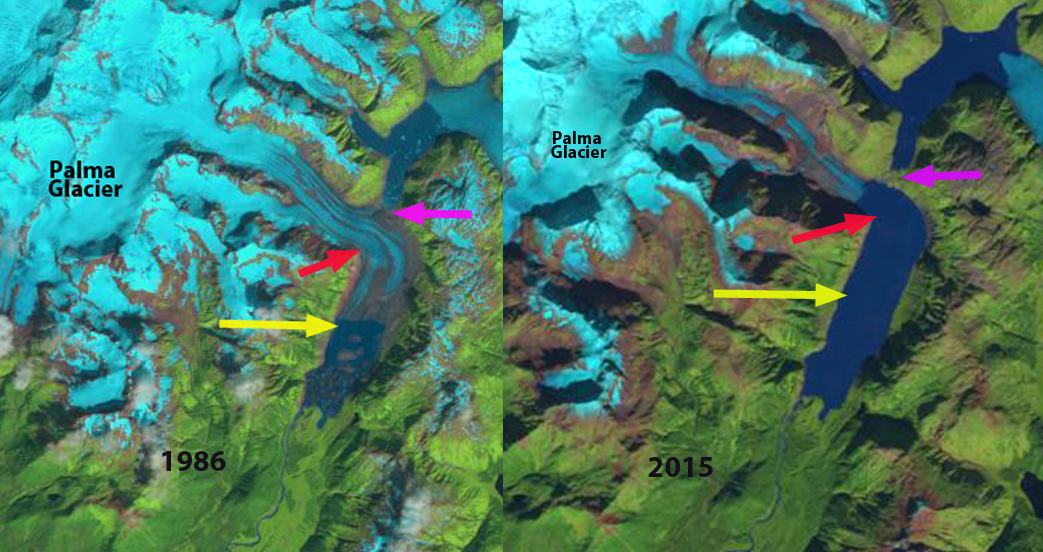
An August 1986 and September 2015 Landsat Image of Palma Glacier, 1986 terminus yellow arrow.
Palma Glacier is an unnamed glacier just west of Brady Glacier and Glacier Bay that is the principal glacier draining into Palma Bay.  Here we examined the changes in this glacier from 1986 to 2015 with Landsat Imagery.  The glacier has terminated in a lake at the head of a river draining into Palma Bay at least since the 1950 USGS map was prepared.The neighboring Brady Glacier advanced for much of the 20th century,  its tributary lobes began to retreat after 1970.  The main Brady Glacier terminus did not begin to retreat until 2009 and is poised to begin a rapid retreat as lake development at the terminus continues due to ongoing thinning (Pelto et al, 2013)..

palma glacier ge

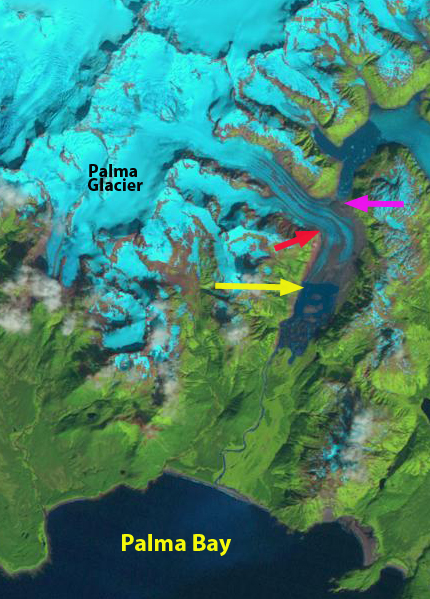
Google Earth image of the Palma Bay and Palma Glacier region

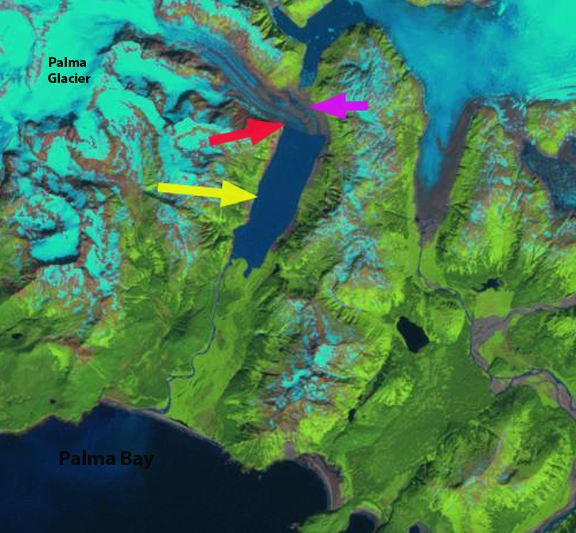
In 1986 Palma glacier flowed south out of the mountains before turning sharply west for 2 km before terminating in a lake at the yellow arrow. The lake had considerable debris covered ice bergs that had recently calved. By 1999 the glacier had retreated to the westward turn, red arrow, but did extend to the south side of the lake.  By 2014 the glacier had retreated from the westward turn, red arrow, and the strip of land between the two lakes at the purple arrow has been exposed and vegetated. it is now possible to paddle up one lake and portage to the next. The snowline purple dots is at 1000 m.  In 2015 this September image at top is after an early season snowfall, the last image below is an August image indicating the snowline is again at 1000 m with several weeks left in the melt season.  The glacier has retreated 2100 meters from 1986 to 2015 and still terminates in the lake. The retreat has slowed since 1999 after the lake narrowed at the westward turn. Retreat will continue as a snowline at 1000 m is to high to sustain even the current size of Palma Glacier.

palma Glacier1986
1986 Landsat image

palma glacier1999
1999 Landsat Image
palma glacier 2014
2014 Landsat Image
Palma snowline Aug 2015
2015 Landsat Image