Grand Pacific Glacier Losing its Grand and Pacific Connection

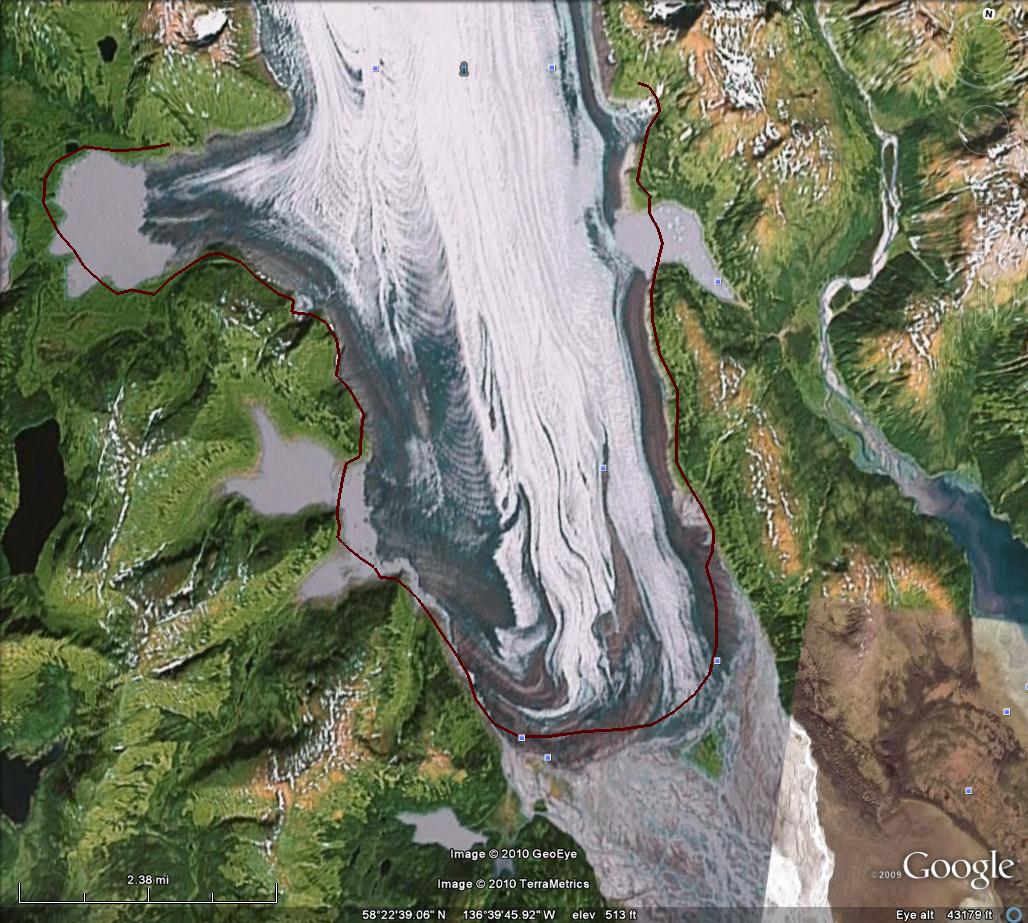
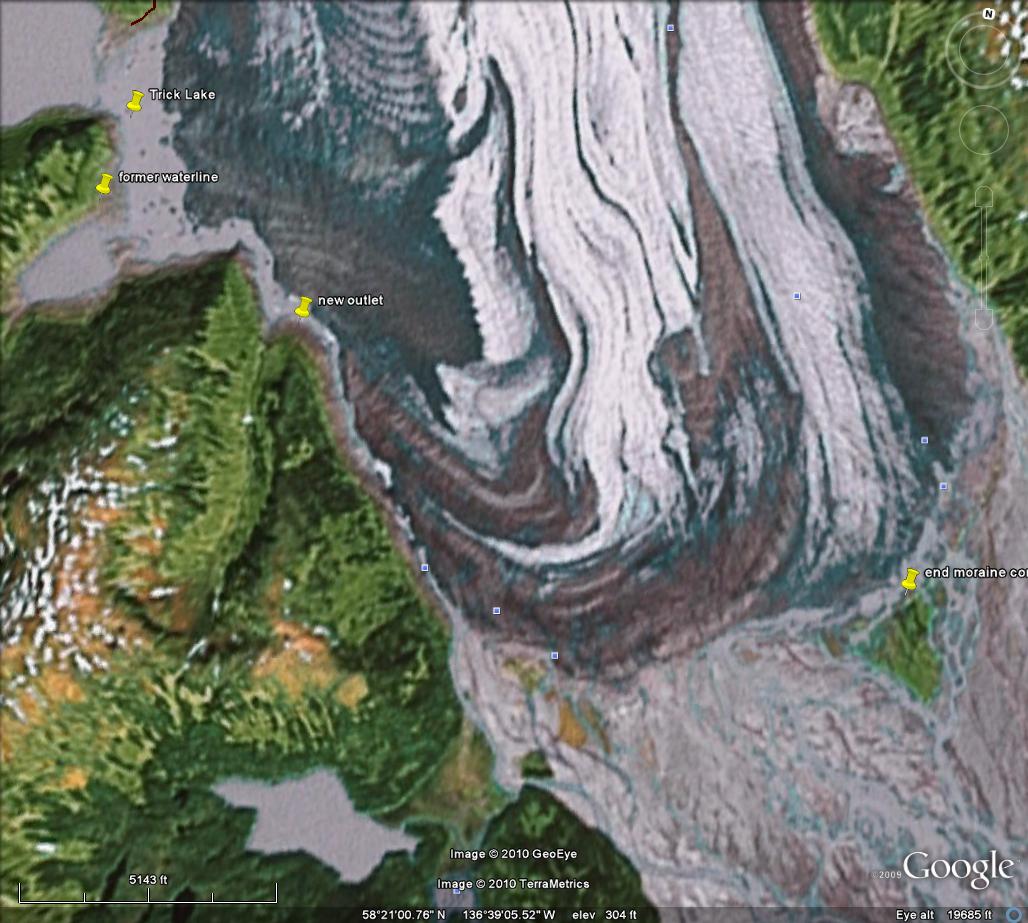
Grand Pacific Glacier in 1984 and 1999 Landsat images. Red arrow indicates the front of the clean ice flow of the Grand Pacific that also marks its lateral boundary with Ferris Glacier.  B and C indicate locations where tributary tongues have been retreating from the main glacier. M is the Margerie Glacier.
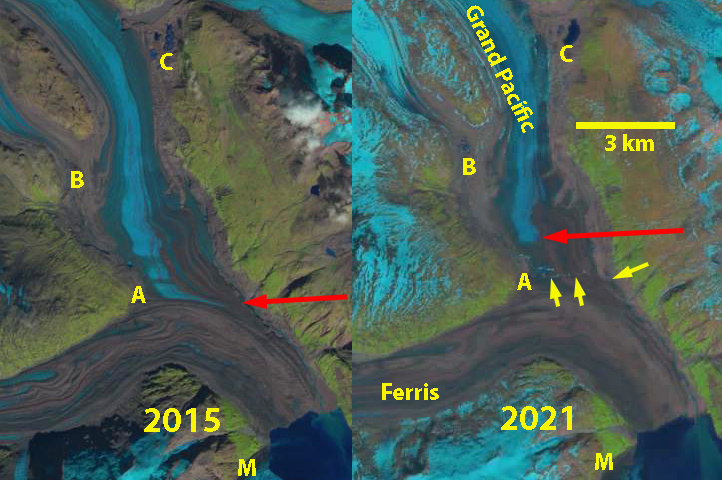
Grand Pacific Glacier in 2015 and 2021 Landsat images. Red arrow indicates the front of the clean ice flow of the Grand Pacific that also marks its lateral boundary with Ferris Glacier and the front of its active ice. Yellow arrow indicates outlet stream that is now beginning to separate the glaciers. B and C indicate locations where tributary tongues have been retreating from the main glacier. M is the Margerie Glacier.

The Grand Pacific joins with Ferris Glacier before ending at the head of Tarr Inlet in a ~1.9 km wide glacier front and 20-50 m high ice front. William Field observed the glacier advancing steadily from the 1930’s-1968 at 35 m/year , extending ~.0.5 km across the US/Canada boundary.  This advance continued behind its protective shoaling moraine/outwash plain until it was 1.5-1.6 km across the national boundary and just meeting the Margerie Glacier. A slow recession of 200 m has occurred since, with the current terminus having a width of 1.8 km, most in shallow water or terminating on a tidal flat. The Grand Pacific Glacier has been thinning for more than 50 years, which is leading to the recession, though not nearly as significant at for Melbern Glacier which it shares a divide with. Clague and Evans (1993) noted a 7 km retreat of Melbern Glacier from 1970-1987, and a 5.25 km retreat from 1986-2013 (Pelto, 2011-2017). The mass loss of the Grand Pacific Glacier system is part of the 75 Gt annual loss of Alaskan glaciers that make this region the largest alpine glacier contributor to sea level rise  from 1984-2013 (Larsen et al 2015).

William Field reported that Grand Pacific Glacier comprised 80% of the joint glacier front with Ferris Glacier in 1941, declining to 40% in 1964.  In 1984 Landsat imagery illustrates that the Grand Pacific is still supplying ice to the glacier front but only comprises 25% of the ice front. In 1999 this has diminished to 20% of the ice front, that is now entirely on an outwash plain above the tidal level.  Tributary C has disconnected from Grand Pacific Glacier between 1984 and 1999, and tributary B has retreated substantially from the Grand Pacific. By 2015 the junction of the Ferris and Grand Pacific Glacier indicates all flow of the latter is diverted east along the Ferris margin and does not reach the ice front. There is a band of clean glacier ice that reaches the junction in 2015 and in the 2016 Sentinel image, but no longer reaches the eastern margin. In 2016 the glacier outlet stream along the west side of the Grand Pacific goes under the glacier to the east margin near the junction. By 2018 the surface exposed section of the stream extends ~700 m across the Grand Pacific Glacier before going beneath the glacier along the Ferris/Grand Pacific margin. In 2021 the glacier outlet stream cuts halfway across the glacier before going beneath and emerges prior to reaching the east margin, note yellow arrows below on the Sentinel image . The clean ice area no longer reaches the junction with the Ferris Glacier in 2021. The rapid expansion of the surficial outlet stream that is physically separating the two glacier will continue to cut across the entire width of the Grand Pacific Glacier. This glacier no longer has a connection to the Pacific Ocean, and no longer presents a grand front. The retreat is limited in distance compared to Grand Plateau or Fingers Glacier, but the separation is dramatic.
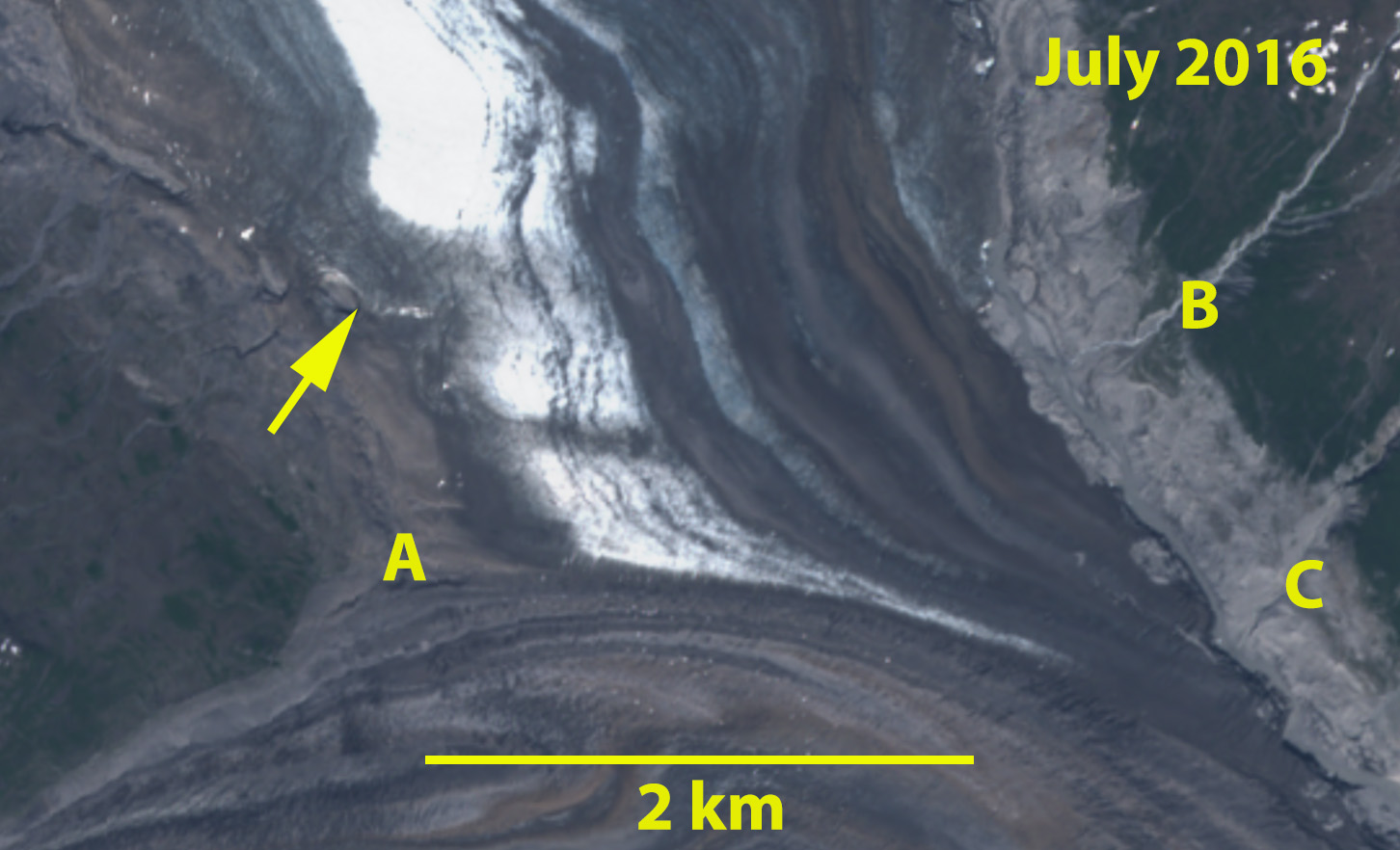
Sentinel 2 image of Grand Pacific Glacier in July 2016, yellow arrow indicates glacier outlet stream beginning to transect glacier. 
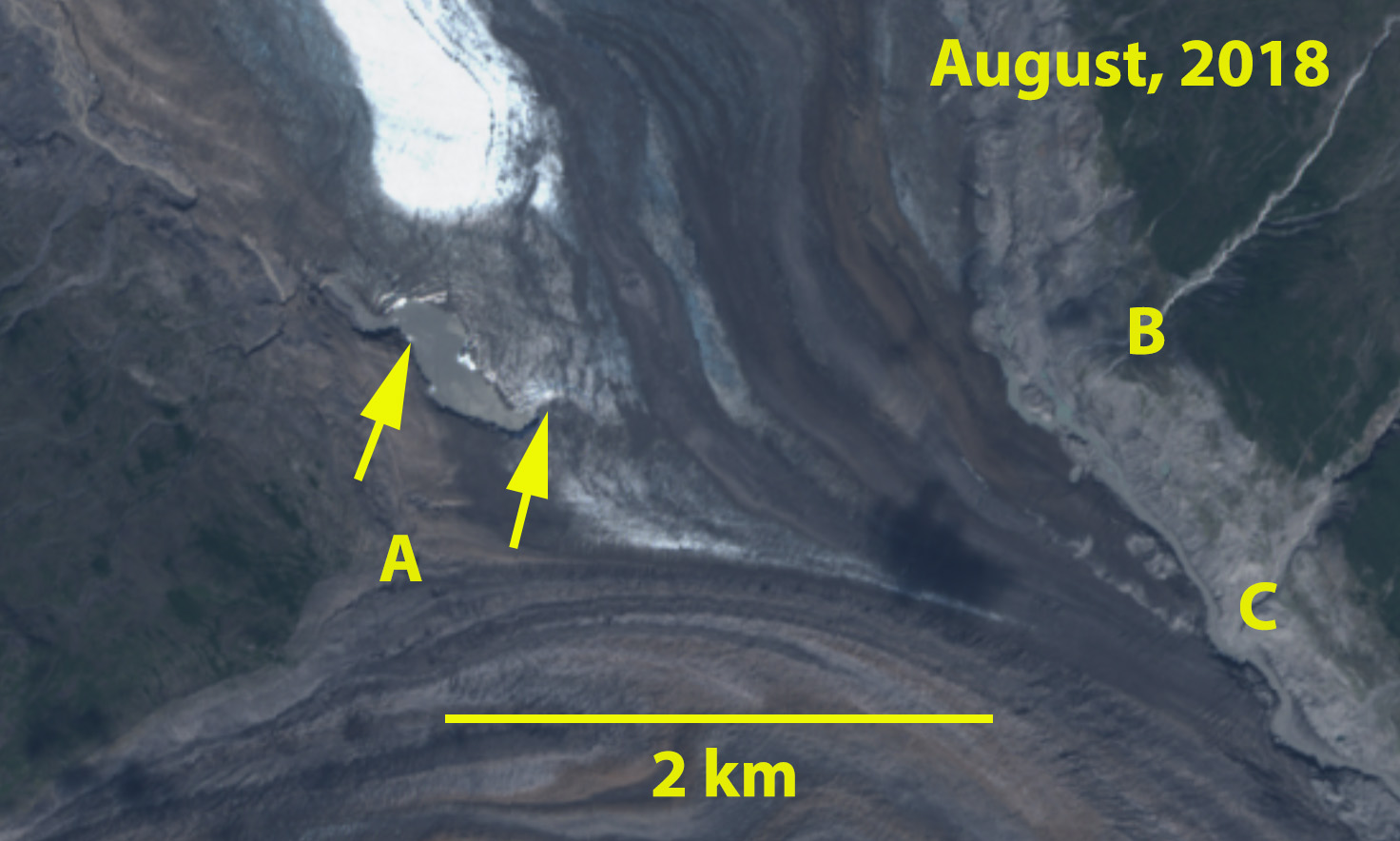
Sentinel 2 image of Grand Pacific Glacier in August 2018, yellow arrow indicates glacier outlet stream expanding across glacier. 

Sentinel 2 image of Grand Pacific Glacier in July 2016, yellow arrow indicates glacier outlet stream nearly transecting the entire width of the Grand Pacific Glacier front/margin with Ferris Glacier.


Geikie Glacier, Alaska Lofty No More


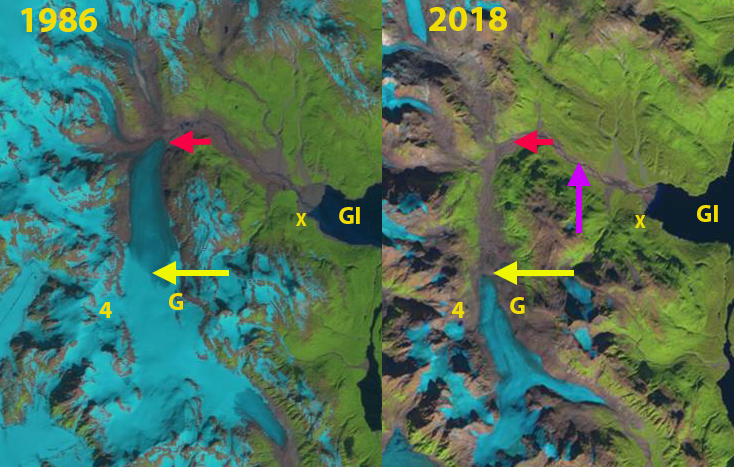
Geikie Glacier (G) in 1986 and 2018 Landsat images. Pink arrow is the 1954 terminus, red arrow the 1986 terminus and yellow arrow the 2018 terminus location. GI is Geikie Inlet which the glacier withdrew from 110 years ago.

Geikie Glacier is on the west side of Glacier Bay, Alaska. John Muir in October 1879 observed Geikie Glacier in Geikie Inlet, which had separated from Muir Glacier within the last 20 years.  He wrote in John Muir Travels in Alaska, “Its lofty blue cliffs, looming through the dragged skirts of the clouds, gave a tremendous impression of savage power, while the roar of the newborn icebergs thickened and emphasized the general roar of the storm.” By 1892 when surveyed by  H.F. Reid it had retreated to within several kilometers of the head of the inlet.  It retreated from tidewater in ~1910 (Field, 1966), with the full inlet being 15 km in length. I had the opportunity to visit the glacier in 1982 arriving by float pane at the X at the head of the inlet. There was no glacier even in sight, where a century before was buried beneath thick glacier ice.  It took us four hours to reach the terminus through what was a mixed outwash plain with developing shrubs. Today that same journey would be much more difficult as the shrubs, trees and undergrowth have thickened. William O. Field with the American Geographical Society visited Geikie Glacier in 1935, 1941, 1950 and 1958, noting limited retreat from tidewater up to 1935. though considerable frontal thinning was evident. Here we examine the changes using Landsat images from 1986, 2018 and 2019 combined with the 1961 USGS Mount Fairweather C-2 topographic map based on 1948 and 1955 photographs.

By ~1950 the glacier had retreated 2.1 km from tidewater, a rate of 50 m/year. The retreat had been interrupted by a small advance around 1920 (Field, 1966). In 1950 the glacier is fed by four tributary glaciers, with three feeding in, as the glacier makes an eastward turn. By 1986 the terminus had retreated 4.3 km from tidewater, no longer rounding the eastward bend, the retreat rate since ~1950 had been ~60 m/year.  Tributaries 1-3 had separated from the glacier.

In 2014 and 2015 the glacier lost all of its snowcover (see below). In 2018 the glacier had retreated 4.1 km since 1986 and 8.3 km from the inlet.  The rate had increased to ~125 m/year. Tributary 4 had separated from the glacier. The glacier shares a divide at ~600 m with a south flowing glacier and the head of the glacier is at ~1000 m.  In 2014, 2015, 2018 and 2019 the entire glacier lost all of its snowcover, indicating a glacier that cannot survive, as a consistent accumulation zone is essential (Pelto, 2010). The demise of Geikie Glacier is less complete than that of nearby Burroughs Glacier, but with current climate no less certain.  The glacier was ~14.5 km long when I journeyed there in 1982 and in 2018/19 is just 6.1 km long, a loss of 58% of its length in 36 years.

In 2018 and 2019 the snowlines were the highest of any year since at least 1946 on nearby Taku Glacier (Pelto, 2019) and on Brady Glacier. The rising snow lines on Brady Glacier had been observed in recent years by Pelto et al (2013). which has led to the start of a retreat.  The lack of retained accumulation has also been noted at Lemon Creek Glacier and similar to Brady Glacier, Taku Glacier has now began a retreat ( McNeil et al, 2020).

Geikie Glacier (G) in 1961 USGS map and 2019 Landsat image. Red arrow the 1986 terminus and yellow arrow the 2018 terminus location. GI is Geikie Inlet which the glacier withdrew from 110 years ago.


US Navy aerial photograph of Geikie Glacier terminus in 1948, tributaries 1-3 labeled. Digital Globe Image of the glacier in 2014, Point A in both is head of eastward turn. 


Brady Glacier, Alaska begins a substantial retreat

Brady Glacier is a large glacier at the south end of the Glacier Bay region, Alaska. When first seen by George Vancouver it was a calving tidewater glacier in 1794 filling Taylor Bay with ice. Brady Glacier ceased calving and advanced approximately 8 km during the 19th century (Klotz, 1899). As Bengston (1962) notes, the advance is likely another example of an advance following a change from tidal to non-tidal status rather than that of a more positive mass balance. Bengston (1962) further notes that the massive outwash plain at the terminus is primarily responsible for Brady glacier maintaining itself well other glaciers in the Glacier Bay region retreat. The ELA on this glacier is 800 m, the line above which snow persists even at the end of the average summer, this is one of the lowest in Alaska. The main terminus was still advancing in the 1960’s and 1970’s and has managed a 250-300 meter advance since the USGS map of the 1950’s. The main terminus is not advancing any longer and has begun to retreat, the retreat to date is less than 200 meters. The image below is the 1950’s map of the glacier. Brady Glacier is a complex glacier with many subsidiary termini. Echelmeyer, Arendt, Larsen and Harrison from the University of Alaska noted a thinning rate in the mid 1900’s of about 1 meter per year on the Brady Glacier complex. A comparison of 1950’s USGS maps and 2004-2006 satellite imagery indicate all six main subsidiary termini are retreating. The retreat ranges from 200 m in Abyss Lake, 200 m in Trick Lake to 1200 meters in North Deception Lake. The image below is the 2006 satellite image. Compare to the map, Deception has increased in size several fold. North Trick and South Trick Lake are now joined, Trick Lake. Of further interest is the stream draining Trick Lake that sneaks down the west margin of the glacier. This has enabled the water level in the glacier dammed Trick Lake to decline. Note the brown grey “Bath Ring” so to speak above the lake level. The outlet has also been marked in the image below. Pelto (1987) noted that the percentage of the glacier in the accumulation zone was right at the threshold for equilibrium. Subsequent warming of the climate in southeast Alaska and reduced glacier mass balance in the region has initiated this retreat.These termini are all closer to the equilibrium and would respond first to changes in mass balance due to recent warming and consequent measured thinning. This entire line of reasoning must be explored. The glacier is thinning substantially and would appear to be poised for a substantial retreat of the main termini, not just the subsidiary termini.
References not linked:
Bengston, K. recent behavior of Brady Glacier, Glacier Bay National Monument, Alaska. IAHS, 58, 59-77.
Klotz O. 1899: Notes on glaciers of southeast Alaska and adjoining territories. Journal of Geography, 14, 523-534.
Pelto, M. 1987. Mass balance of southeast Alaska and northwest British Columbia glaciers from 1976 to 1984: Methods and Results”. Annals of Glaciology 9: 189–193.