New Zealand Glacier Retreat will Impact Hydropower

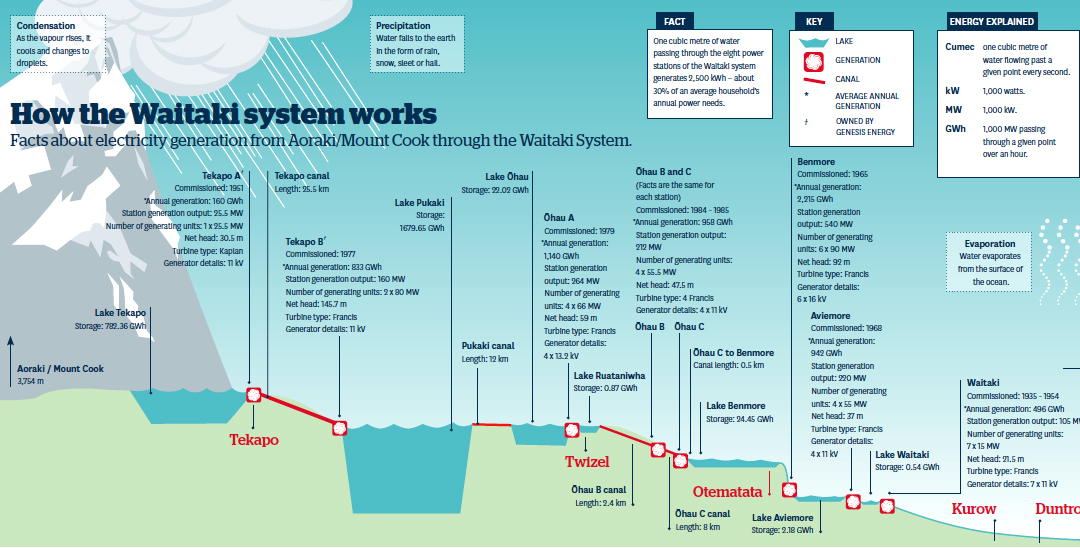
Map of the Waitaki Hydropower system, from Meridian and images of the system taken by Jill Pelto January 2017.  

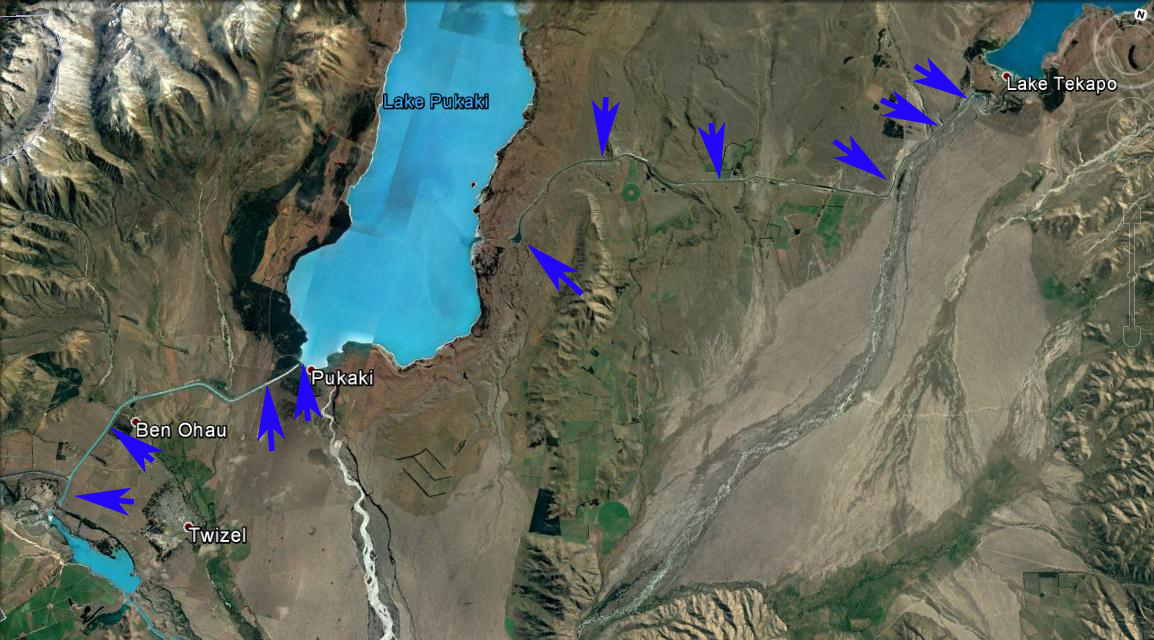
Hooker Glacier, Mueller, Murchison and Tasman Glacier drain into Lake Pukaki, where water level has been raised 9 m for hydropower purposes. Classen Glacier, Grey Glacier and Godley Glacier drain into Lake Tekapo. Lake Tekapo and Lake Pukaki are both utilized for hydropower. Water from Lake Tekapo is sent through a canal to Lake Pukaki. Water from Lake Pukaki is sent through a canal into the Lake Ohau watershed and then through six hydropower plants of the Waitaki hydro scheme: Ohau A, B and C. Benmore, Aviemore and Waitaki with a combined output of 1340 MW.  Meridian owns and operates all six hydro stations located from Lake Pūkaki to Waitaki. Below the Benore Dam is pictured,.  Interestingly salmon have been introduced into the Waitaki River system for fishing near its mouth. Benmore Lake itself is an internationally renowned trout fishing spot, providing habitat for both brown trout and rainbow trout. The reduction of glacier area in the region due to retreat will reduce summer runoff into Lake Pukaki and this hydropower system, which will reduce summer flow in the Waitaki River.

Mueller Glacier has had a 1500 m retreat from 1990-2015, which will continue in the future as the lower 2 km section of the glacier is stagnant. Hooker Glacier retreated 1200 m from 1990 to 2015 and the lake expanded to 2300 m, with the retreat enhanced by calving. Tasman Glacier retreated 4.5 km from 1990 to 2015 primarily through calving into the expanding proglacial lake.  Murchison Glacier has retreated 2700 m From 1990 to 2015. The rapid retreat will continue as 2010, 2013 and 2015 imagery indicate other proglacial lakes have now developed 3.5 km above the actual terminus. Classen Glacier  has retreated 1000 m from 1990 to 2015 leading to expansion of the lake it ends in (Pelto, 2016).  Godley Glacier has retreated 1300 m from 1990-2015 with an equal amount of lake expansion (Pelto, 2016). The expansion of debris cover is striking from 1990 to 2015 this indicates reduced flow from the accumulation zone.  Grey Glacier has a heavily debris covered terminus that prevents accurate assessment of retreat. Overall these 7 glaciers make up the majority of the volume and area loss of New Zealand glaciers, which has been dominated by 12 large glaciers (Salinger and Willsman, 2008).  The changes of 12 different glaciers have been examined in detail and are compile at the New Zealand Glacier Index. The loss of summer glacier runoff from each square kilometer of lower elevation glacier area that has disappeared is at least 50,000 cubic meters per day (Pelto, 2016).  Given the 12 square kilometer loss in the terminus zone of just these seven glaciers, you have a 600,000 cubic meter per day loss in runoff that would be heading into the Pukaki-Takapo-Waitaki Hydro system. The retreat is driven by mass losses as indicated by the rising snowline observed by NIWA.

nzhydro

Map of the glaciers feeding Lake Pukaki and Lake Tekapo. M=Mueller, H=Hooker, T=Tasman, Mu=Murchison, Gr=Grey, Go=Godley and C=Classen. From Pelto (2016)
tekapo-canals

Canals connecting Lake Pukaki and Lake Tekapo
Waitaki Hydropower network

New Zealand Glacier Change Index

 nzlake compare2

Terminus of Tasman, Mueller and Hooker Glacier terminus in Mount Cook 1972 map, no lake present.
Progalcial lakes forming in front of Tasman, Mueller and Hooker Glacier in 1990 above and 2015 Landsat images below. 
Red arrows are the 1990 terminus and yellow arrows the 2015 terminus locations.


Overview

The Southern Alps of New Zealand are host to over 3000 glaciers that owe their existence to high amounts of precipitation ranging from 3 to 10 m (Chinn, 1999). The list below examines the changes of 12 glaciers examined in a separate post. The NIWA glacier monitoring program has noted that volume of ice in New Zealand’s Southern Alps has decreased by 36% with the loss of 19.0 km3 of glacier ice, from 53.3 km3 in 1978 to 34.3 km3 in 2014 (New Zealand Govt., 2015). Volume loss in New Zealand glaciers is dominated by 12 large glaciers (Salinger and Willsman, 2008). More than 90% of this loss is from 12 of the largest glaciers in response to rising temperatures over the 20th century (Chinn, 1999).  In the 1972 map of the region there is no lake at the terminus of the Tasman Glacier, Mueller Glacier or Hooker Glacier; each are substantial in size by 2015. Each lake continues to expand and as glacier retreat continues .From 1977-2015 NIWA has conducted an annual snowline survey, in six of the last nine years the snowline has been significantly above average and three years approximately at the average (Willisman et al., 2015).  This has driven the widespread glacier retreat underway. In each case the retreat of the largest glaciers has been enhanced by the formation and expansion of lakes, in this newly developing lake district. Dykes et al., (2011) identify the role of glacier lakes in accelerating the retreat of Tasman Glacier.  The retreat of these glaciers has until recently been slowed by debris cover and the long low slope ablation zone segments  (Chinn, 1999).  Glaciers that lack debris cover and have a steeper slope have a more rapid response time, such as Fox Glacier and Franz Josef Glacier (Purdie et al., 2014).  These two glaciers have been in the news of late due to rapid retreat causing glacier tours of the lower reaches of the glacier unsafe.  NIWA reported that February of 2016 was the second warmest month of any month in New Zealand, which will drive snowlines higher and enhance glacier melt this year.

Many New Zealand glaciers are important for hydropower: Lake Tekapo and Lake Pukaki are both utilized for hydropower. Hooker Glacier, Mueller, Murchison and Tasman Glacier drain into Lake Pukaki, where water level has been raised 9 m for hydropower purposes. Water from Lake Pukaki is sent through a canal into the Lake Ohau watershed and then through six hydropower plants of the Waitaki hydro scheme: Ohau A, B and C. Benmore, Aviemore and Waitaki with a combined output of 1340 MW.  Meridian owns and operates all six hydro stations located from Lake Pūkaki to Waitaki. The reduction of glacier area in the region will reduce summer runoff into Lake Pukaki and this hydropower system.
gunn glacier 2006
Gunn Glacier in, 2006 above and 2012 below,Google Earth image.  Red arrows the 2006 terminus position yellow arrows 2012 terminus location. The glacier lost 25% of its area in six years. 

gunn glacier 2012
Individual Glacier Posts

Murchison Glacier   Tasman Glacier   Balfour Glacier

Mueller Glacier   Hooker Glacier   Salisbury Snowfield

Lyell Glacier     Douglas Neve    Gunn Glacier

Upper Volta Glacier  Donne Glacier

donne compare

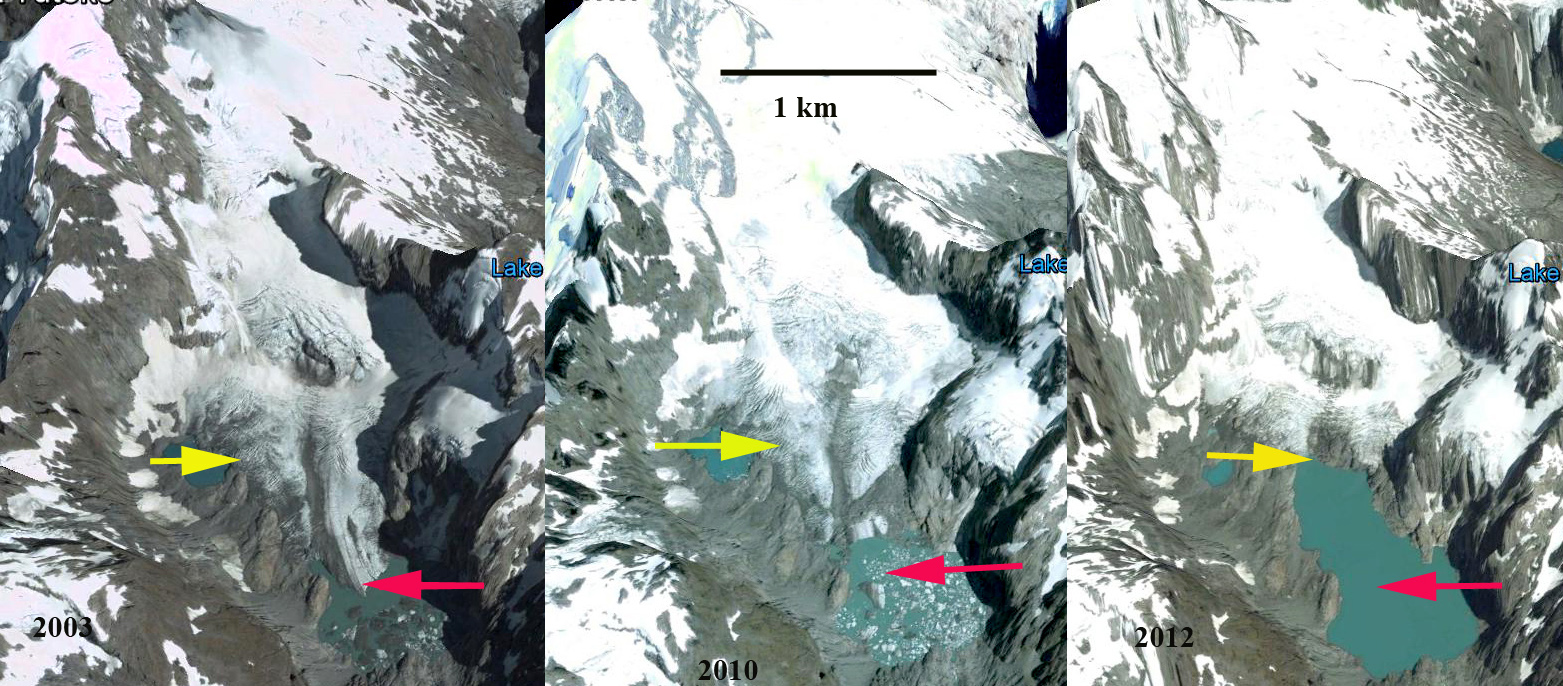
Donne Glacier from 2003-2012 in Google Earth images.  Red arrow is the 2003 terminus and yellow arrow the 2012 terminus. A seven hundred meter retreat in a decade.