Bailang Glacier and Angge Glacier Retreat, China 1995-2015

bailang compare

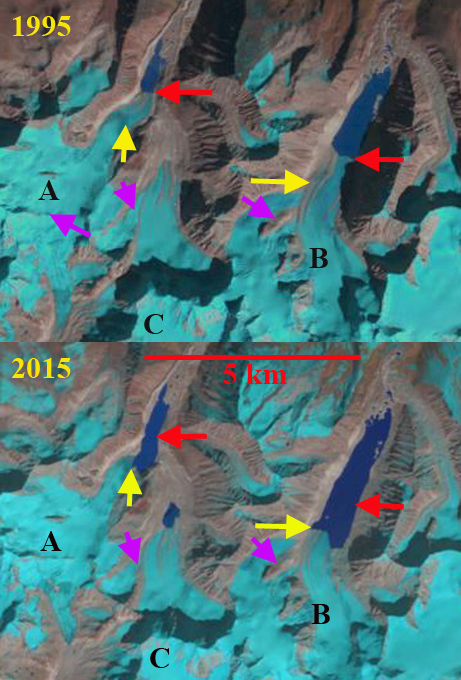
Comparison of 1995 and 2015 Landsat image illustrating 1995 (red arrows) and 2015 terminus locations (yellow arrows) of Bailang Glacier (B) and Angge Glacier (A).  Purple arrows indicate areas upglacier of expanding bedrock due to glacier thinning. Head of Chubda Glacier (C), Bhutan indicated. 

Bailang Glacier and Angge Glacier, China are adjacent to the Chubda Glacier, Bhutan.  Despite being in a different nation on a different side of the Himalaya, the behavior is the same. These are both summer accumulation type glaciers that end in proglacial lakes.  Both lakes are impounded by broad moraines that show no sign of instability for a potential glacier lake outburst flood. The number of glacier lakes in the adjacent Pumqu Basin to the west has increased from 199 to 254 since the 1970’s with less than 10% deemed dangerous  (Che et al, 2014) Here we compare Landsat images from 1995 and 2015 to identify their response to climate change.   The second Chinese Glacier inventory (Wei et al. 2014) indicated a 21% loss in glacier area in this region from 1970 to 2009.

Bailang Glacier in 1995 terminated in a proglacial lake that was 2.1 km long at an elevation of ~5170 m, red arrow. Angge Glacier terminated in a lake that was 1 km long at an elevation of ~5020 m.  By 2001 both glaciers had experienced minor retreat of less than 250 m.  By 2014 both lakes had expanded considerably due to retreat, no significant change in water level had occurred. By 2015 Bailang Glacier had retreated  800-900 m and the lake was now 3 km long.  A key tributary on the west side near the yellow arrow had also detached. There is no significant slope change in the lower 1 km of the glacier indicating retreat should continue enhanced by melting in and calving in the proglacial lake.  For Angge Glacier retreat from 1995 to 2015 was 700 to 800 m, with the glacier retreating to a westward bend in the lake basin.  The glacier has an icefall just above the current terminus suggesting the lake basin will soon end, which should slow retreat. The pattern of retreat and lake expansion is quite common as is evidence by Gelhaipuco, Thong Wuk and Longbashaba Glacier.

bailang glacier 2001

2001 Landsat image illustrating 1995 (red arrows) and 2015 terminus locations (yellow arrows) of Bailang Glacier (B) and Angge Glacier (A).  Head of Chubda Glacier (C), Bhutan indicated. 

bailang glacier 2014

2014 Landsat image illustrating 1995 (red arrows) and 2015 terminus locations (yellow arrows) of Bailang Glacier (B) and Angge Glacier (A).  Head of Chubda Glacier (C), Bhutan indicated. 


Retreat of Lake No Lake Glacier Junction, Juneau Icefield, British Columbia

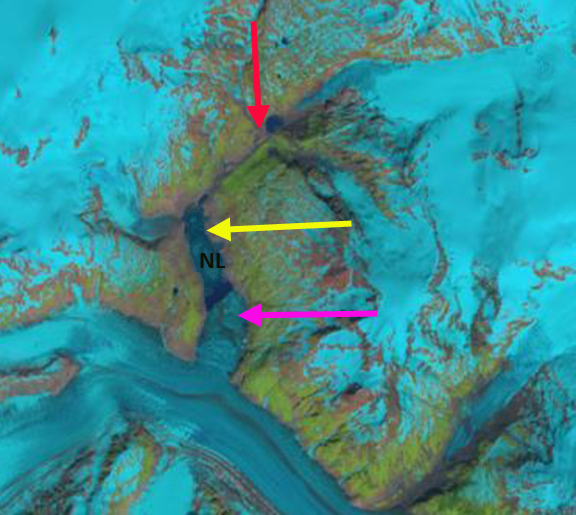
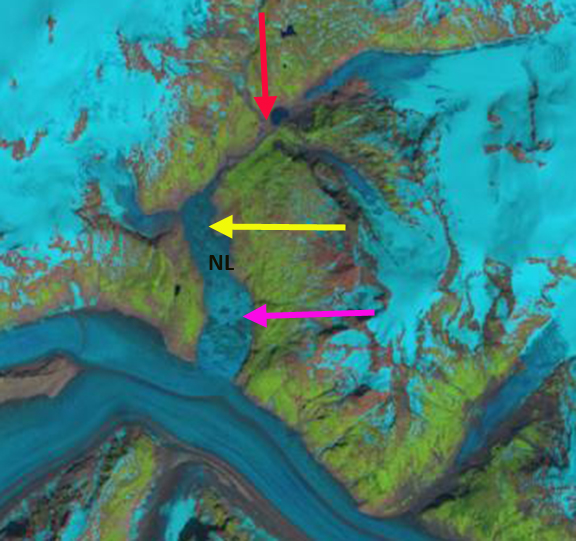
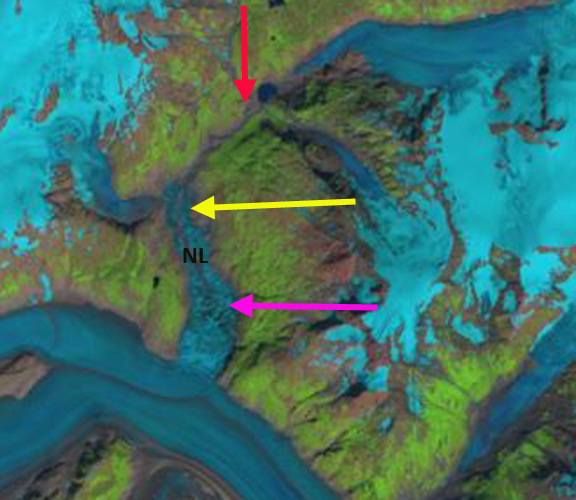
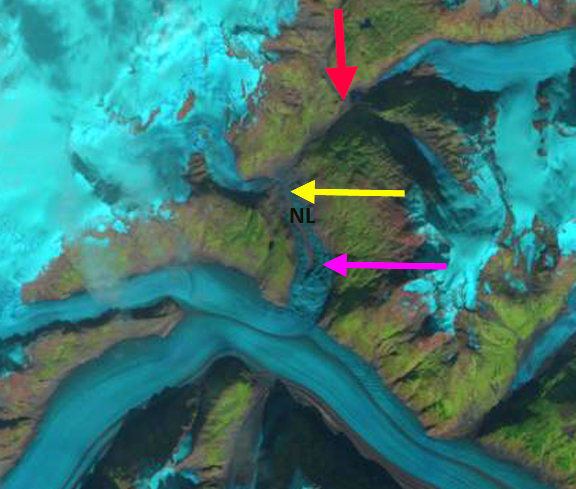
Lake No Lake is a glacier dammed lake that periodically drains under the retreating Tulsequah Glacier. Canadian topographic maps indicate that three glaciers coalesced to fill this valley: Tulsequah, No Lake East and No Lake West. By 1984 when I had a chance to see this lake had formed while working on Tulsequah Glacier. Here we examine the retreat of the three glaciers that has led first to lake formation and now to a reduction in lake size from 1984-2013. nolake map In 1984 the lake extended to the terminus of No Lake East Glacier at the red arrow, after that glacier separated from the other two. Most of the valley below this point is filled with the Tulsequah and No Lake West Glacier that are still connected. The retreat of No Lake East is 1.75 km and now filled by a lake. A series of five Landsat 8 images from 2013 indicates the progression of this lake during a summer. On June 14, 2013 the No Lake East Glacier and Tulsequah Glacier are now separated with a valley 2.5 km long in between. This segment of the valley is filled by the lake, but the lake does not extend upvalley from West to East No Lake Glacier. By June 21 the lake has extended another 400 m upvalley to the northeast as the lake fills. By June 30th the lake has expanded to a length of 3 km and an average width of 600 m. By August 1st the lake has largely drained, though there are many icebergs still on the lake bottom and there is certainly some water remaining. By September 28th the lake is completely drained. The retreat of No Lake East Glacier from the 1984 terminus location at the red arrow is 450 m. The retreat of No Lake West Glacier from the yellow arrow is 400m. The 30 year retreat of the arm of the Tulsequah Glacier from the yellow to the pink arrow is 1800 m. As the damming arm of Tulsequah Glacier continues to thin this glacier will continue to decline in both depth and area. A 2010 Google Earth image is used to indicate the lake margin as indicated by stranded icebergs after drainage. Geertsema and Clague (2012) observed that this lake grew rapidly and began having glacier outburst floods during the 1970’s, but is now declining in size.nolake 1984
1984 Landat image

nolake 6142013
6-14-2013 Landsat image

nolake6212014
6-21-2013 Landsat image

nolkae6302014
6-30-2013 Landsat image

nolake 812014
8-1-2013 Landsat image

nolake 9282013
9-28-2013 Landsat image

lake no lake 2010
Google Earth image, yellow dots lake outline