Global Glacier Change Bulletin 3 (WGMS) Reports Increasing Mass Balance Losses

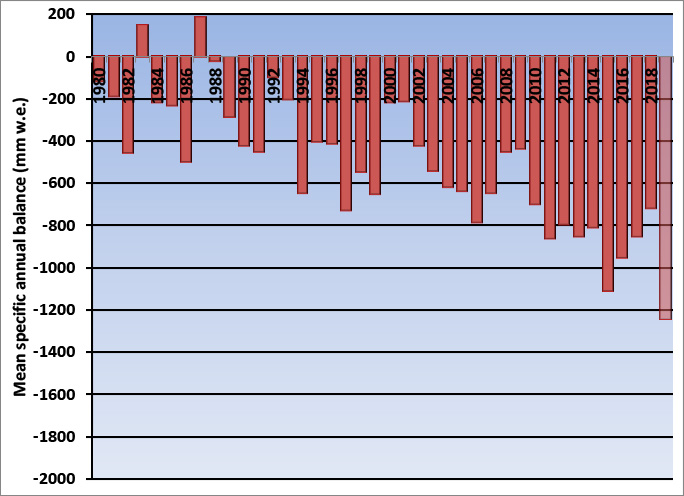
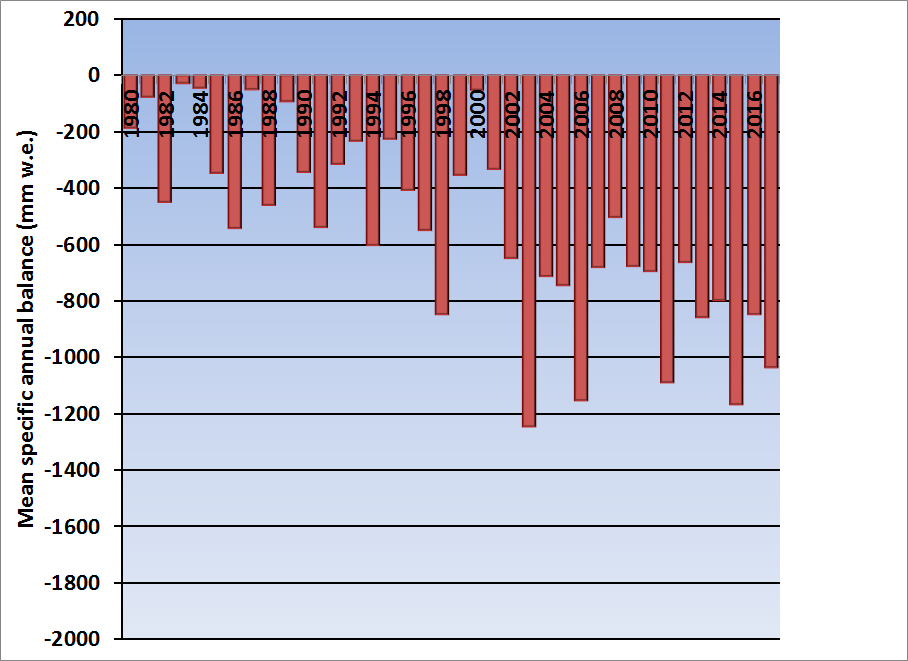
Figure 1. Regionalized mean annual mass balance of WGMS reference glaciers 1980-2018, with 2019 being a mean of reference glaciers.

Glaciers have been studied as sensitive indicators of climate for more than a century and are now experiencing a historically unprecedented decline (Zemp et al, 2015).  Glacier fluctuations in terminus position, mass balance and area are recognized as one of the most reliable indicators of climate change. This led to glacier mass balance being recognized during the International Geophysical Year (IGY) in 1957 as a key focus area for developing long term data sets and the need to establish an international data repository.

Today this data reporting system is managed by the World Glacier Monitoring Service (WGMS). WGMS annually collects standardized observations on changes in mass, volume, area and length of glaciers with time, and additionally collecting statistical information on the distribution of glaciers from inventories.  WGMS just published their third Global Glacier Change Bulletin, a comprehensive data report covering the 2015/2016 and 2016/2017 hydrologic years. I review some of that information here with updated reference glacier mass balance data from WGMS for 2018 and 2019.

The data set compiled by the World Glacier Monitoring Service has 45,840 measurements on 2540 glaciers (WGMS, 2020). Annual mass balance measurements are the most accurate indicator of short-term glacier response to climate change.  WGMS, (2020) data set has 7300 annual balance values reported from 460 glaciers, with 41 reference glaciers having 30+ year consecutive ongoing records. Annual mass balance is the change in mass of a glacier during a year resulting from the difference between net accumulation and net ablation.

The key data set is the annual balance record from the reference glacier network, these glacier have extensive continuous field monitoring programs with at least a 30 year record.  For example on Columbia Glacier, Washington I have been in the field 36 consecutive summers, over 120 days taking 4600 measurements with 63 assistants. Figure 1 above illustrates glacier mass balance for the set of global reference glaciers for the time-period 1980-2019. Global values are calculated using a single value (averaged) for each of 19 mountain regions in order to avoid a bias to well observed regions.

In the hydrological year 2016/17, observed glaciers experienced an ice loss of -550 mm, and 2017/18 of -720 mm. For 2018/19 hydrologic year a regionally averaged value will not be available until December 2020, the overall mean of all reference glaciers of -1241 mm, compared to -1183 mm in 2017/2018. This will make 2019 the 32nd consecutive year with a global alpine mass balance loss and the tenth consecutive year with a mean global mass balance below -700 mm. The simple mean mass balance of WGMS records has a slight negative bias compared to geodetic approaches, but this bias has been effectively eliminated with the regionalized approach now used by WGMS, see Figure 2 (WGMS, 2020).

Figure 2. Glaciological mass balance of all glacier, reference glaciers (mean), regional mean of reference glaciers and regionalized mean geodetic mass balances for the 1930-2017 period.  Pay particular note to the 1960-2017 period where the data records are better.  Observe the similarity in cumulative mass balance losses regardless of approach.

The decadal averaged annual mass balance was -172 mm in the 1980’s, -460 mm in the 1990’s, 500 mm for 2000’s and – 889 mm for 2010-2019.  The increasing rate of glacier mass loss, with eight out of the ten most negative mass balance years recorded after 2010, during a period of retreat indicates alpine glaciers are not approaching equilibrium and retreat will continue to be the dominant terminus response (Pelto, 2019; WGMS, 2020).  The accumulation area ratio is an indication of the expansion of the ablation areas globally, despite retreat accumulation areas are shrinking.  The decline in accumulation area extent, hence AAR has been rapid, the data in 2017/2018 yields a mean of 13%, whereas the average needed to be in balance is 56%. The low AAR in 2019 is illustrated at two reference glaciers Lemon Creek, Alaska and Alfotbreen, Norway below.

Years

Ba

AAR

1980-1989

-172

47

1990-1999

-460

44

2000-2009

-525

35

2010-2019

-889

28

Table 1 Glaciologic annual balance for each decade from the WGMS reference glacier mean of the 19 regions. The AAR is a simple mean of the reference glaciers.

Landsat images of Lemon Creek Glacier, Alaska and Alfotbreen, Norway in 2019. White dots indicate the glacier boundary on Alfotbreen, purple dots the snowline. Lemon Creek AAR=0%  Alfotbreen AAR=~15%

Detailed information is reported for 20 glaciers distributed around the globe that includes annual mass balance maps as illustrated from Columbia Glacier. The relationship between elevatation and annual balance is the balance gradient seen below for Mocho Glacier, Chile. This glacier is in the lake district of Chile at 39.90° S and 72.00° W and did not have significant accumulation in 2016 or 2017.  The  AAR-annual balance relationship and the ELA-annual balance relationship and annual balance record are reported, as exemplied by Silvretta Glacier, Switzerland, where negative balances occurred in 2016 and 2017.

The result of the rising snowline is mass losses, which drives glacier retreat. This also leads to decreased average albedo and surface lowering, which in turn cause pronounced positive feedbacks for radiative and sensible heat fluxes. This rapid decline in mountain glaciers chronicled by WGMS is expected to accelerate.  Huss et al (2017) describe a cascade of effects that are occuring, impacting ecosytems, communites and our economy.
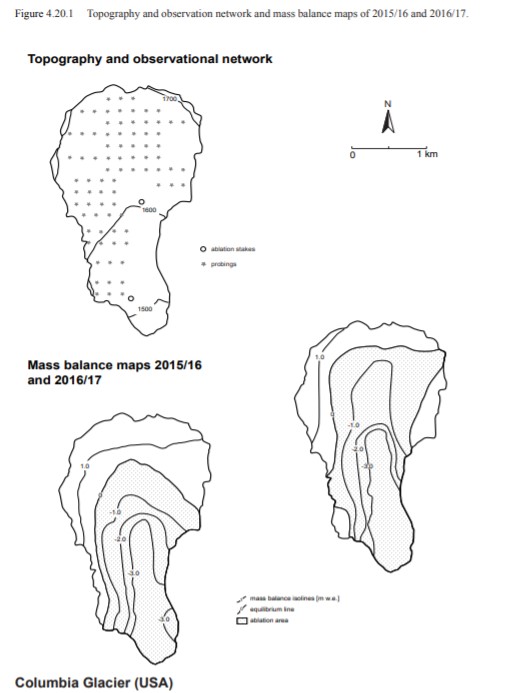
Annual mass balance maps and measurement network on Columbia Glacier.
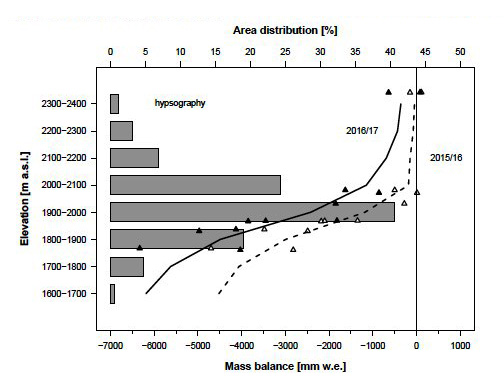
Annual balance gradient for Mocho Glacier, Chile.
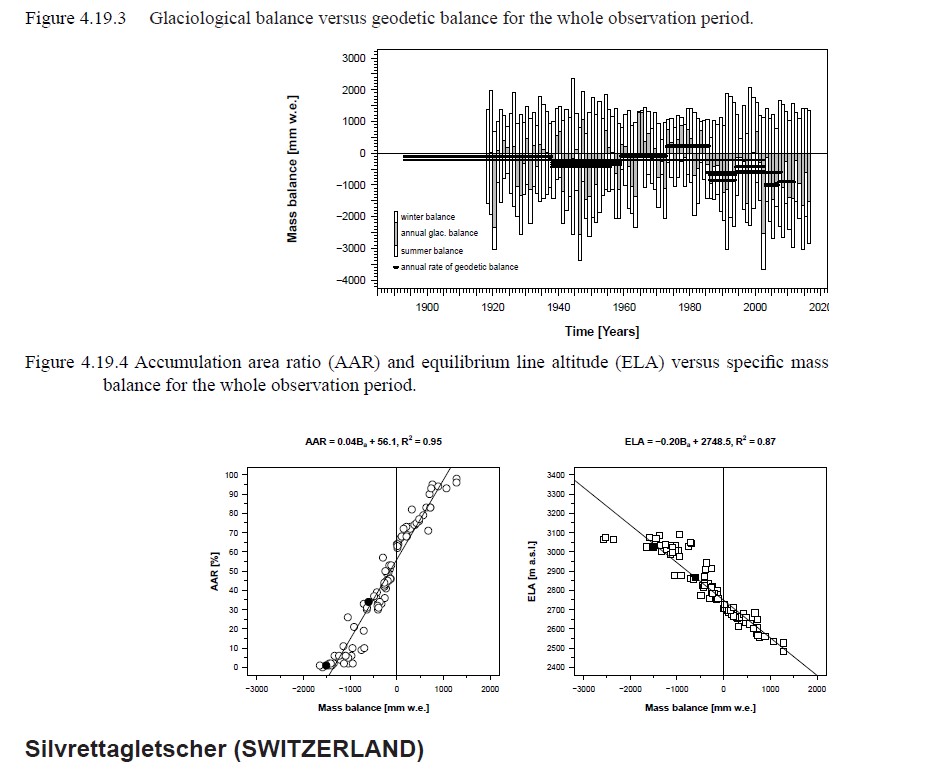
Annual balance record and annual balance relationship to both AAR and ELA on Silvertta Glacier.
Alpine Glacier-BAMS State of the Climate 2017

Global alpine glacier annual mass balance record of reference glaciers submitted to the World Glacier Monitoring Service, with 2017 continuing the trend of significant negative mass balance. 

The Bulletin of the American Meteorological Society: State of the Climate 2017 has been published.  Since 2008 I have written the chapter on alpine glaciers.

The World Glacier Monitoring Service (WGMS)record of mass balance and terminus behavior (WGMS 2017) provides a global index for alpine glacier behavior. Glacier mass balance is the difference between accumulation and ablation, reported here in mm of water equivalence. Mean annual glacier mass balance in 2016 was −847 mm for the 37 long-term reference glaciers and −761 mm for all 140 monitored glaciers. Of the reporting reference glaciers, only one had a positive mass balance. Preliminary data reported to the WGMS in 2017 from Austria, Canada, China, France, Italy, Kazakhstan, Norway, Russia, Switzerland, and United States indicate that 2017 will be the 38th consecutive year of negative annual balances with a mean loss of −1036 mm for 29 reporting reference glaciers, with three glacier reporting a positive mass balance (http://wgms.ch/latest-glacier-mass-balance-data/).

The ongoing global glacier retreat is currently affecting human society by raising sea levels, changing seasonal stream runoff, and increasing geohazards (Huss et al. 2017a). Huss and Hock (2018) indicate that approximately half of 56 glaciated watersheds globally have already passed peak glacier runoff. Rounce et al. (2017) identify the widespread expansion of glacier lakes due to retreat in Nepal from 2000 to 2015, which pose a glacier lake outburst flood hazard. Glacier retreat is a reflection of strongly negative mass balances over the last 30 years (Zemp et al. 2015). Marzeion et al. (2014) indicate that most of the recent mass loss, 1991–2010, is due to anthropogenic forcing.

The cumulative mass balance loss from 1980–2016 is −19.9 m, the equivalent of cutting a 22-m thick slice off the top of the average glacier .  The trend is remarkably consistent from region to region (WGMS 2017). WGMS mass balance based on 41 reference glaciers with a minimum of 30 years of record is not appreciably different from that of all glaciers at −19.1 m. The decadal mean annual mass balance was −228 mm in the 1980s, −443 mm in the 1990s, −676 mm for 2000s, and –896 mm for 2010–17 (WGMS 2017). The declining mass balance trend during a period of retreat indicates alpine glaciers are not approaching equilibrium and retreat will continue to be the dominant terminus response.

Exceptional glacier melt was noted across the European Alps, leading to high snowlines and contributing to large negative mass balance of glaciers on this continent (Swiss Academy of Sciences 2017). In the European Alps, annual mass balance has been reported for nine reference glaciers from Austria, France, Italy, and Switzerland. All had negative annual balances: exceeding −1000 m with a mean of −1664 mm. This continues the pattern of substantial negative balances in the Alps that continue to lead to terminus retreat. In 2016, in Switzerland 94 glaciers were observed: 82 retreated, 7 were stable, and 5 advanced (Huss et al. 2017b). In 2016, Austria observed 90 glaciers: 87 retreated, 2 were stable, and 1 advanced; the average retreat rate was 14 m (Fischer 2017).

In Norway and Svalbard, terminus fluctuation data from 36 glaciers with ongoing assessment, indicates that in 2016 32 retreated, 3 advanced, and 1 was stable. The average terminus change was −12.5 m (Kjøllmoen, 2017). Mass balance surveys with completed results are available for nine glaciers; seven of the nine had negative mass balances with an average loss of −80 mm w.e.

In western North America data have been submitted from eight reference glaciers in Alaska and Washington in the United States, and British Columbia in Canada. Seven of the eight glaciers reported negative mass balances with a mean loss of −1020 mm. Winter and spring 2017 had above-average snowfall, while ablation conditions were above average. In Alaska mass losses from 2002 to 2014 have been −52 ± 4 gigatons yr−1, as large as any alpine region in the world (Wahr et al. 2016).

In the high mountains of central Asia four glaciers reported data from China, Kazakhstan, and Nepal. All four were negative, with a mean of −674 mm. This is a continuation of regional mass losses, such as reported by King et al. (2017) who found for 2000–15 the mean annual mass balance of 32 glaciers in the Mount Everest region was −520 ± 220mm.


Landsat image from 8/19/2017 illustrating the snowline on Mont Blanc glaciers with one month left in the melt season (M=Mer de Glace, A=Argentière, S=Saleina, L=Le Tour, T=Trient)


Glaciers in BAMS State of Climate 2015

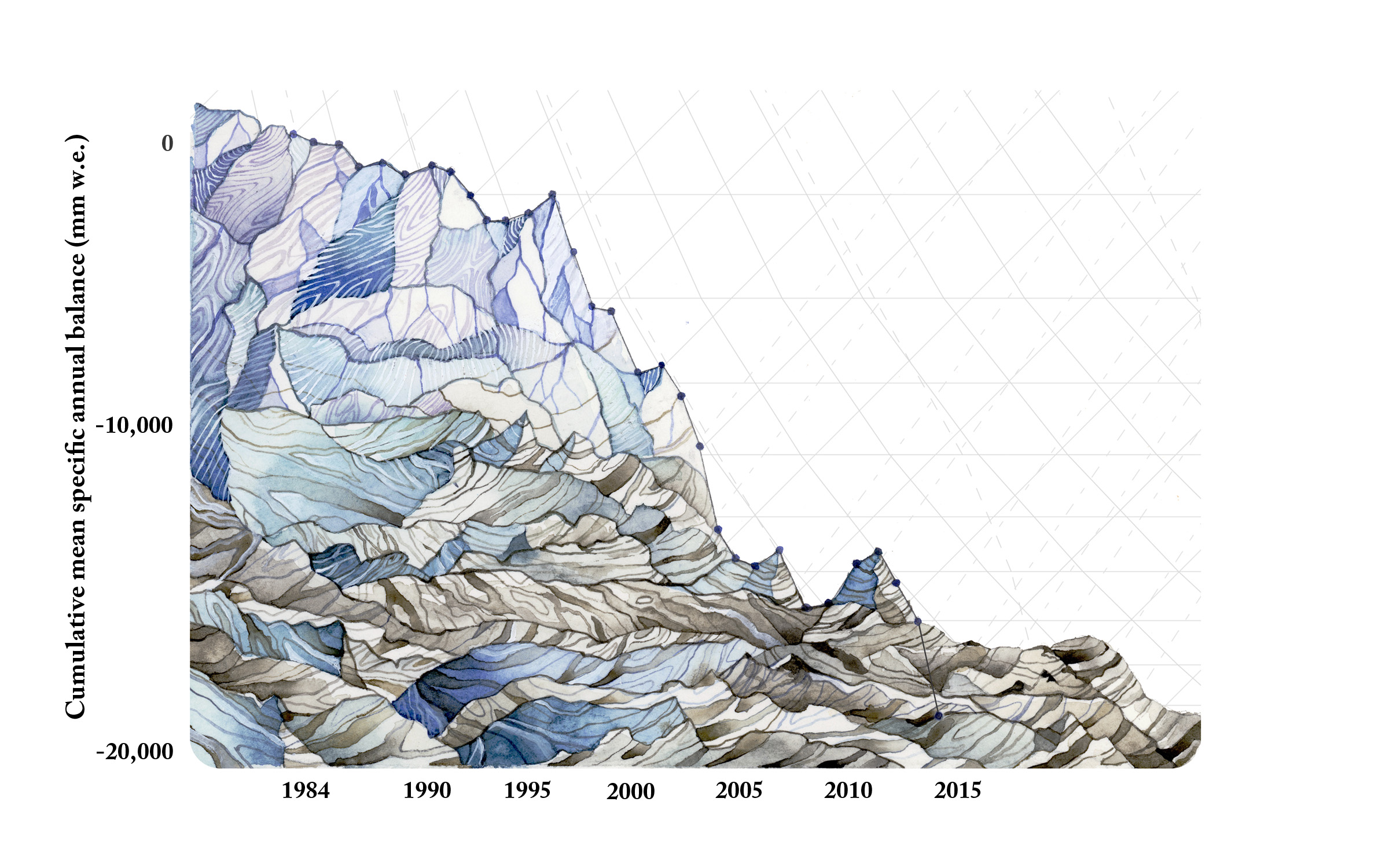
Decrease in Glacier Mass Balance uses measurements from 1980-2014 of the average mass balance for a group of North Cascade, WA glaciers. Mass balance is the annual budget for the glaciers: total snow accumulation minus total snow ablation. Not only are mass balances consistently negative, they are also continually decreasing. Glaciers have been one of the key and most iconic examples of the impact of global warming.  

BAMS State of Climate 2015 asked me about featuring some of the glacier images for the cover, and I countered with a suggestion to utilize one of a series of paintings by Jill Pelto that illustrate the impact of climate change magnifying the impact of the data.  Below are sections of this years report that focus on glaciers.

Glaciers and ice caps (outside Greenland)

M. Sharp, G. Wolken, L.M Andreassen, A. Arendt, D. Burgess, J.G. Cogley, L. Copland, J. Kohler, S. O’Neel, M. Pelto, L.Thompson, and B. Wouters

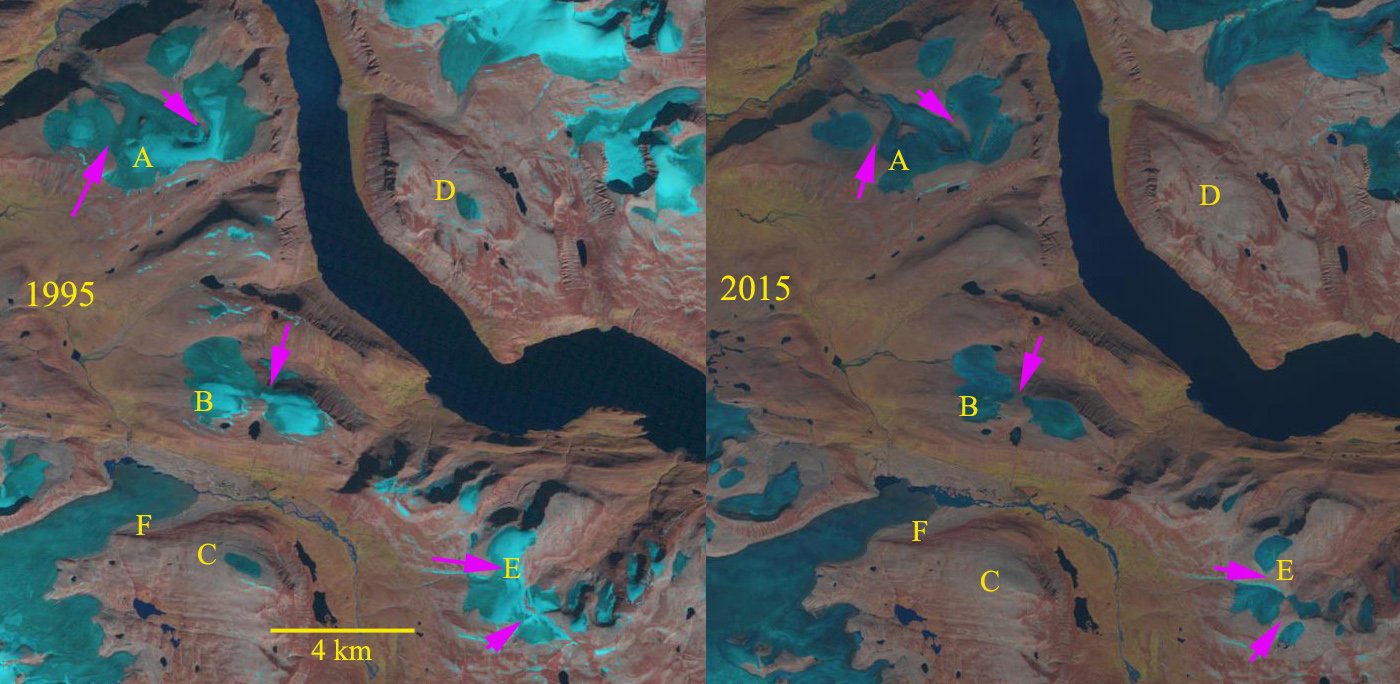
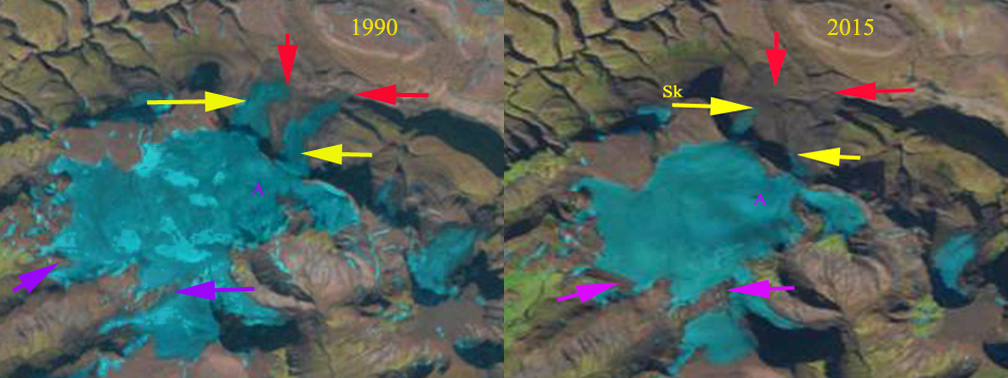
Among the seven glaciers for which 2014-2015 annual mass balance have been reported, the mass balances of glaciers in Alaska and Svalbard (three each) were negative, while the balance for Engabreen Glacier in Norway was positive. The pattern of negative balances in Alaska and Svalbard is also captured in time series of regional total stored water estimates, derived using GRACE satellite gravimetry, which are a proxy for regional total mass balance (ΔM) for the heavily glacierized regions of the Arctic (Figure 3). Measurements of ΔM in 2014-2015 for all the glaciers and ice caps in Arctic Canada and the Russian Arctic also show a negative mass balance year. The GRACE-derived time series clearly show a continuation of negative trends in ΔM for all measured regions in the Arctic. These measurements of mass balance and ΔM are consistent with anomalously warm (up to +1.5ºC) summer air temperatures over Alaska, Arctic Canada, the Russian Arctic, and Svalbard in 2015, and anomalously cool temperatures in northern Scandinavia, particularly in early summer (up to -2ºC). The warmer temperatures led to higher snowlines in the aforementioned regions as seen in images below.

clephane bay compare

Baffin Island Ice Cap near Clephane Bay indicate limited snowpack in 2015

frostisen compare

Frostisen Ice Cap, Svalbard with limited 2015 snowpack.

Alpine Glaciers

M.Pelto

Preliminary data for 2015 from 16 nations with more than one reporting glacier from Argentina, Austria, Canada, Chile, Italy, Kyrgyzstan, Norway, Switzerland, and United States indicate that 2015 will be the 32nd consecutive year of negative annual balances with a mean loss of -1169 mm for 33 reporting reference glaciers and -1481 mm for all 59 reporting glaciers. The number of reporting reference glaciers is 90% of the total whereas only 50% of all glaciers that will report have submitted data thusfar. The 2015 mass balance will likely be comparable to 2003, the most negative year at -1268 mm for reference glaciers and -1198 mm for all glaciers.

The cumulative mass balance loss from 1980-2015 is 18.8 m, the equivalent of cutting a 20.5 m thick slice off the top of the average glacier (Figure 1).  The trend is remarkably consistent from region to region (WGMS, 2015).  The decadal mean annual mass balance was -261 mm in the 1980’s, -386 mm in the 1990’s, 727 mm for 2000’s and -818 mm from 2010-2015.  The declining mass balance trend during a period of retreat indicates alpine glaciers are not approaching equilibrium and retreat will continue to be the dominant terminus response (Zemp et al., 2015). The recent rapid retreat and prolonged negative balances has led to many glaciers disappearing and others fragmenting (Pelto, 2010; Carturan et al, 2015).

columbia compare

In South America seven glaciers in Columbia, Argentina and Chile reported mass balance. All seven glaciers had losses greater than 1200 mm, with a mean of -2200 mm.  These Andes glaciers span 58 degrees of latitude.

In the European Alps, mass balance has been reported for 14 glaciers from Austria, France, Italy and Switzerland.  All 14 had negative balances exceeding 1000 mm, with a mean of -1865 mm. This is an exceptionally negative mass balance rivaling 2003 when average losses exceeded -2000 mm.

In Norway mass balance was reported for six glaciers in 2015, all six were positive with a mean of 780 mm.  This is the only region that had a positive balance for the year. In Svalbard six glaciers reported mass balances, with all six having a negative mass balance averaging -675 mm.

In Alberta, British Columbia, Washington and Alaska mass balance data from 17 glaciers was reported with a mean loss of -2590 mm, with all 17 being negative. This is the most negative mass balance for the region during the period of record.  From Alaska south through British Columbia to Washington the accumulation season temperature was exceptional with the mean for November-April being the highest observed.

In the high mountains of central Asia six glaciers from Russia, Kazakhstan, and Kyrgyzstan reported data, all were negative with a mean of -660 mm.

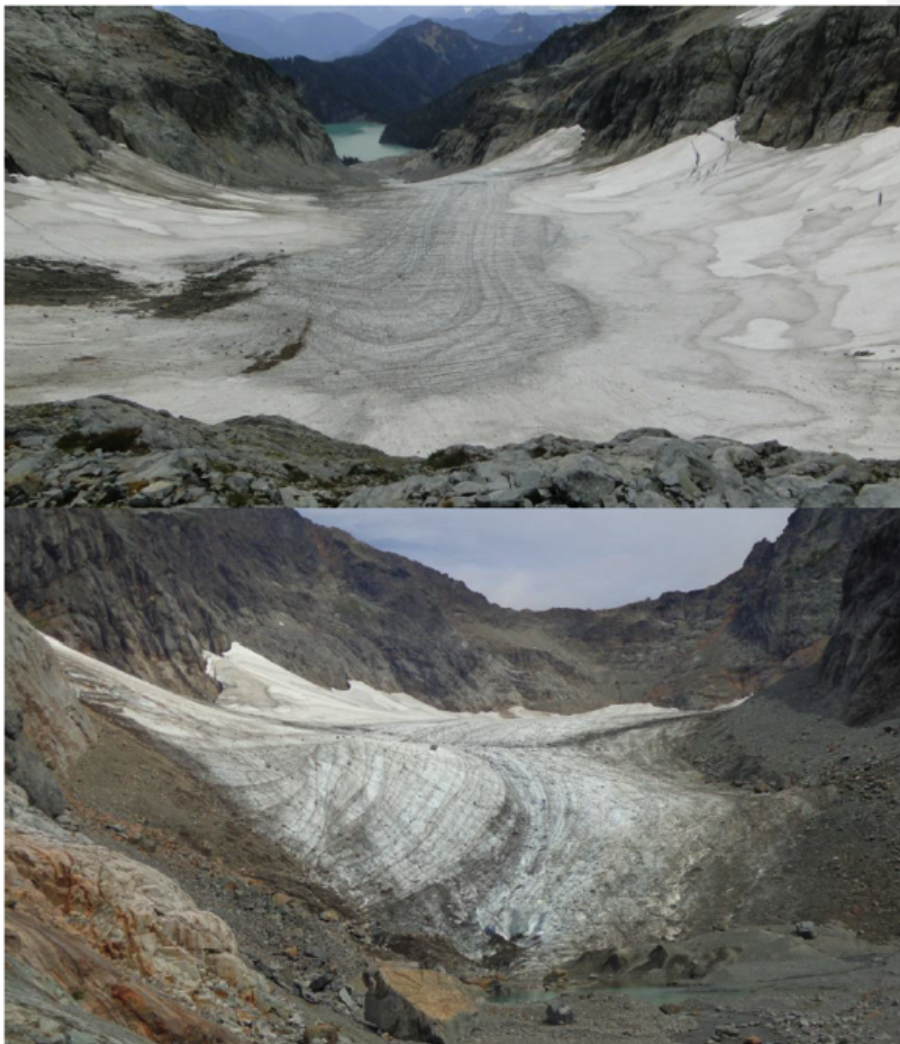
Columbia Glacier having lost nearly all of its snowcover by early August had its most negative mass balance of any years since measurements began in 1984