
 Comparison of the Cummins Glacier from 1986 to 2015. Purple arrows indicate upglacier thinning and disconnection. Red arrow indicates 1986 terminus position. Note the lack of snowcover in 2015.
The Cummins Glacier is part of the Clemenceau Icefield Group in the Rocky Mountains of British Columbia. The Cummins Glacier via the Cummins River feeds the 430 square kilometer Kinbasket Lake, on the Columbia River. The lake is impounded by the 5,946 MW Mica Dam operated by BCHydro. Jiskoot et al (2009) examined the behavior of Clemenceau Icefield and the neighboring Chaba Icefield. They found that from the mid 1980’s to 2001 the Clemenceau Icefield glaciers had lost 42 square kilometers, or 14% of their area. Tennant and Menounos (2012) examined changes of the Rocky Mountain glaciers and found between 1919 and 2006 that glacier cover decreased by 590 square kilometers, 17 of 523 glaciers disappeared and 124 glaciers fragmented into multiple ice masses. Here we examine the Landsat images from 1986-2015 to illustrate that Cummins is one of those fragmenting glaciers.

Cummins Glacier on the western side of the Clemenceau Icefield shares a connection with Tusk Glacier.
In 1986 Cummins Glacier had a joint terminus with the main southeast flowing branch and the west flowing branch terminating at the red arrow. The glacier also had a substantial connection, purple arrow, with Tusk Glacier that flows east terminating northeast of Tusk Peak. There are other connections with other high elevation accumulation areas, purple arrows. In 2013 and 2014 Cummins Glacier had less than 20% retained snowcover by the end of the melt season. Typically 50-65% of a glacier must be snowcovered at the end of the summer season to be in equilibrium. In 2015 conditions were even worse with no retained snowcover, in fact there is only minor patches of retained firn from previous years. The lack of a persistent accumulation zone indicates a glacier that cannot survive the climate conditions (Pelto, 2010). By 2015 a proglacial lake had formed at the terminus that is 500 m long, representing the retreat during the thirty year period. The west flowing portion of the Cummins has detached from the larger branch. The connection to Tusk Glacier is nearly severed, and in terms of flow is effectively ended. Retreat of the margin higher on the glacier is also evident at each purple arrow. Tusk Glacier is no longer connected to Duplicate Glacier, and has retreated to the north side of Tusk Peak. The dominant change in Cummins Glacier has been thinning, it should now be poised for a more rapid retreat.
The result for Kinbasket Lake of the loss of the collective large area is a reduction in summer glacier melt and summer glacier runoff. The annual runoff which will be dominated by annual precipitation would not change just because of the glacier loss as noted in cases like the Skykomish Basin (Pelto, 2011) and on Bridge River (Stahl et al 2008).
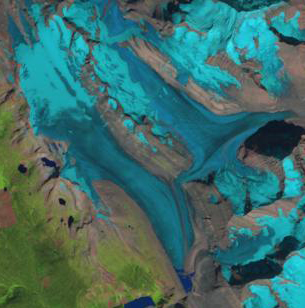
2013 Landsat image indicating 20% retained snowcover with a month left in the melt season.
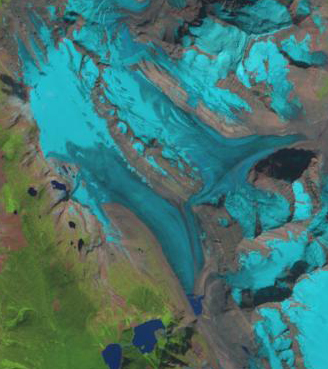
Landsat image 2014 about 25% retained snowcover with three week left in the melt season.

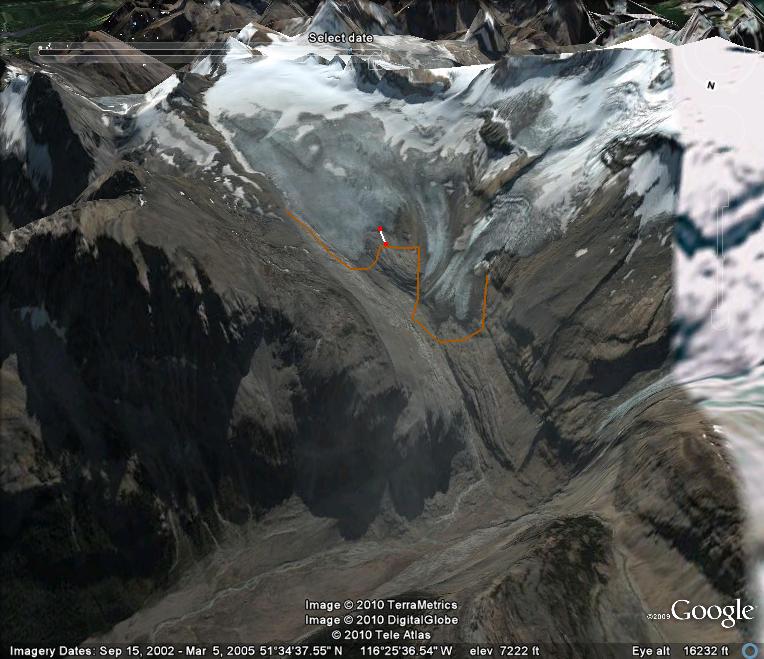
Google Earth Image of Cummins Glacier location to Kinbasket Lake.




 From a Glaciers Perspective