Freemanbreen, Svalbard Retreat Leads to Island Formation

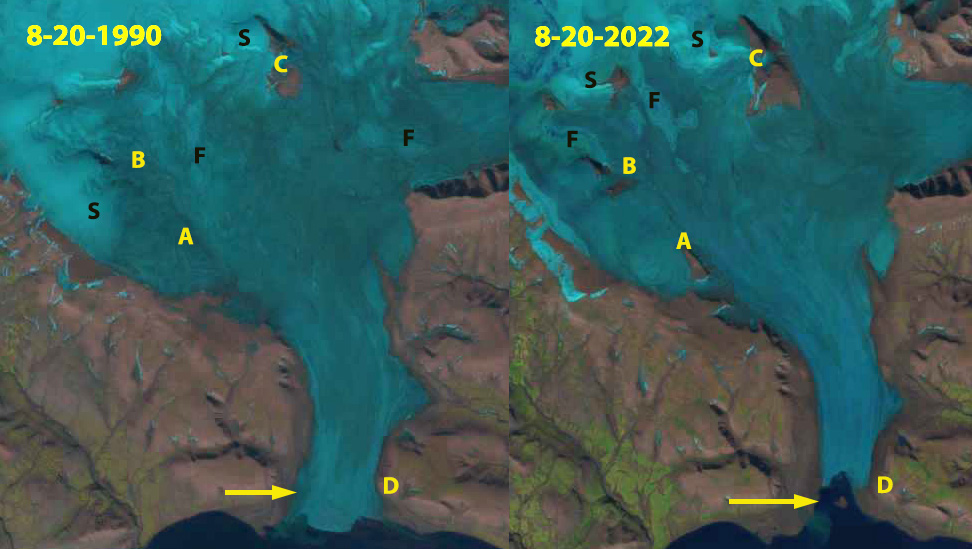
Freemanbreen in 1990 and 2022 Landsat images.  Both are years with limited retained snowcover (S) and some area of retained firn (F). The glacier has retreated from a new island that had formed at Point D. At Point A-C glacier melt and resultant thinning has exposed and expanded bedrock areas.

Freemanbreen is the primary southern outlet glacier of the icecap that dominates Barentsøya, Svlabard. Here we examine Landsat imagery from 1990-2022 to illustrate the the impact of climate change on this glacier. Dowdeswell and Bamber (1995) report that Freemanbreen last surged in 1956 and has retreated since, and that most of its bed is above sea level. Morris et al (2020) note a thinning rate of -0.6 m/year for the area from 2011-2017 that is driven by atmospheric temperature and sea surface temperature warming.

In 1990 Freemanbreen experienced a year of extensive melt with limited retained snowpack (S), there is some retained firn which does retain some percolating meltwater from the snowpack. The glacier extended beyond its fjord ending in a convex tidewater front in Freeman Sound. By 2010 the glacier had retreated into the fjord and was pinned on an island in the center of the fjord. By 2013 the glacier had pulled back from the island and the terminus has since developed a concave terminus front. In 2022 the glacier has retreated 800 m from the island  (Arrow-Point D) and 1.8 km from its 1990 position. The tidewater front has been reduced from 2.8 km to 1.3 km. The reduction in calving has not offset the increase in glacier melt resulting in continued retreat. The surface melt has led to surface thinning and the expansion or exposure of bedrock areas amidst Freemanbreen at Point A-C. In 2022 the glacier experienced another summer of extensive melt, likely the most extensive melt in the region in at least the last 50 years (Climato-Liege University).  This left the glacier largely bare of snowpack, with less than 5% snowcover in the area above 500 m near Point C and limited retained firnpack from previous years note NW of Point B. The ice cap summit is in the 600 m range. This loss is similar but not as complete as obseved on the ice caps of Edgeøya.

Left image aerial photograph from TopoSvalbard, at right Sentinel 2 image from 2022. Island indicated by arrow.

Freemanbreen surface conditions in Sentinel image from 8-19-2022, snow cover (S), Firn Cover (F.)
Glacier Retreat Generating New Islands List

Climate change has been driving the recession of glaciers and ice sheets, which in turn has been changing our maps.  One notable category of physical geographic features indicative of the change due to the retreat is the formation of new islands.  Below is a list of new islands that this blog has identified and reported.  This is not a comprehensive list of all islands that have been formed.  

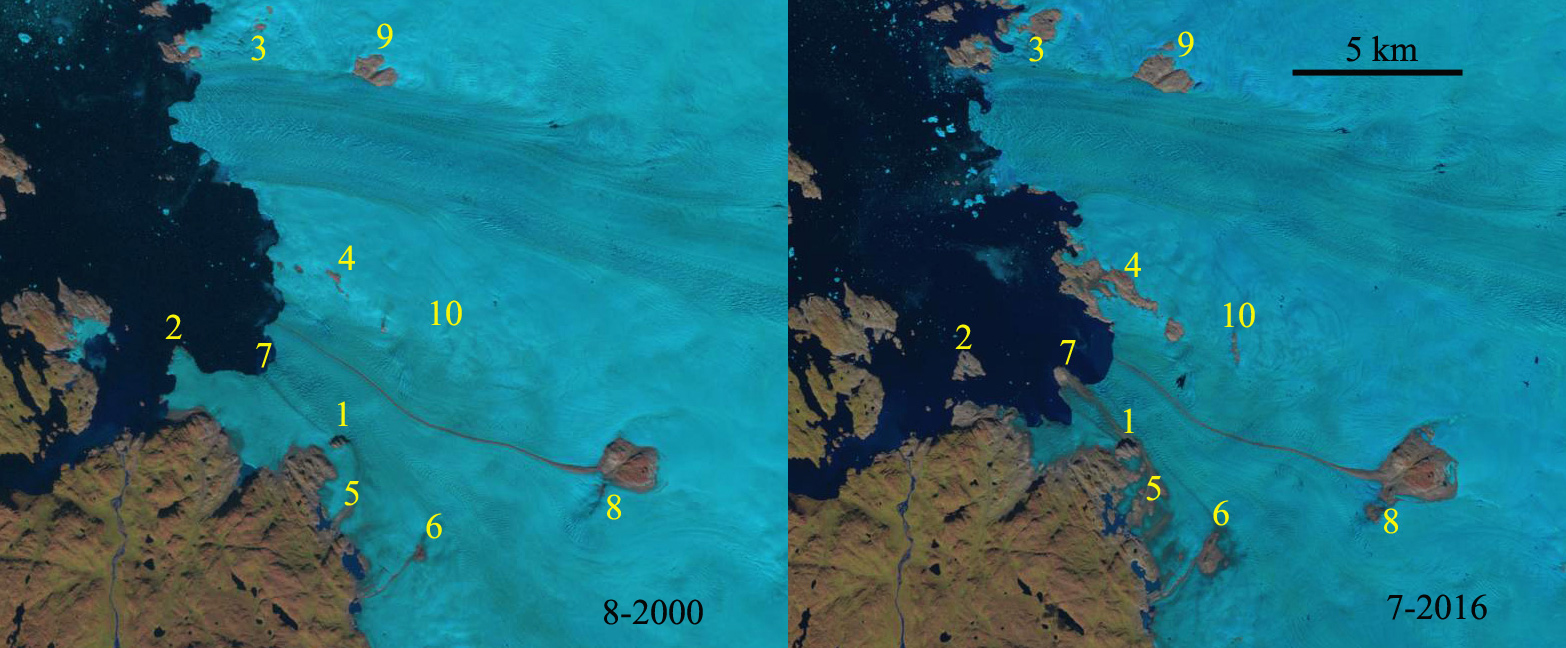
Upernavik Glacier, Greenland in Landsat images from August 2000 and August 2016.  Each Point is at the same location in both image, and the changes are noted in the discussion below.  The same locations are also identified in the July 2001 and Aug. 2016 image below. 

Kong OscarGreenland: Island A forms with B and C on the verge.

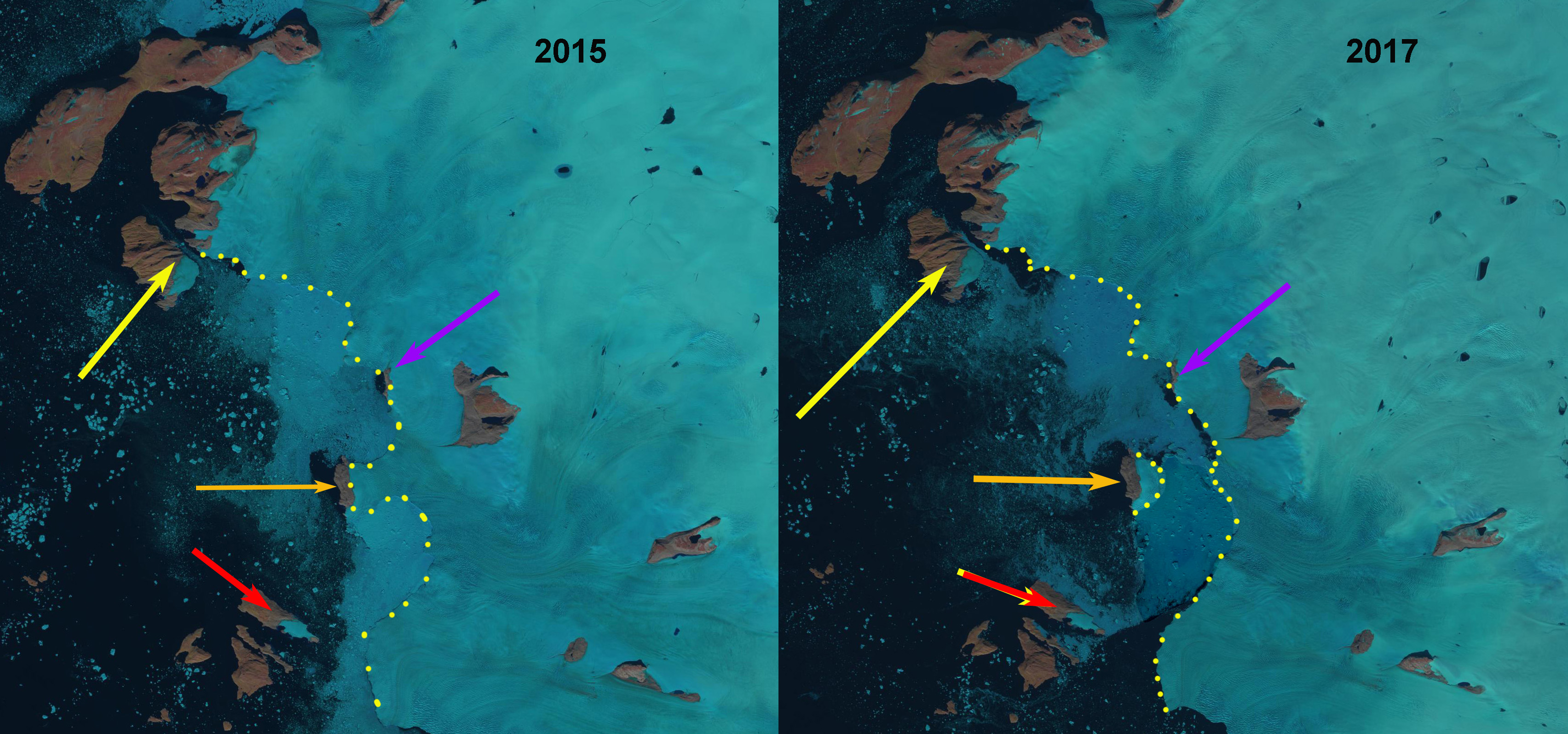
Steenstrup Glacier, Greenland front in 2015 and 2017 illustrating location with respect to the new islands at: Red Head-red arrow, Tugtuligssup Sarqardlerssuua at yellow arrow , and the 2017 new island at orange arrow.  Yellow dots indicate icefront and purple arrow another future island to be released from the glacier.  

corontation-compare-copy

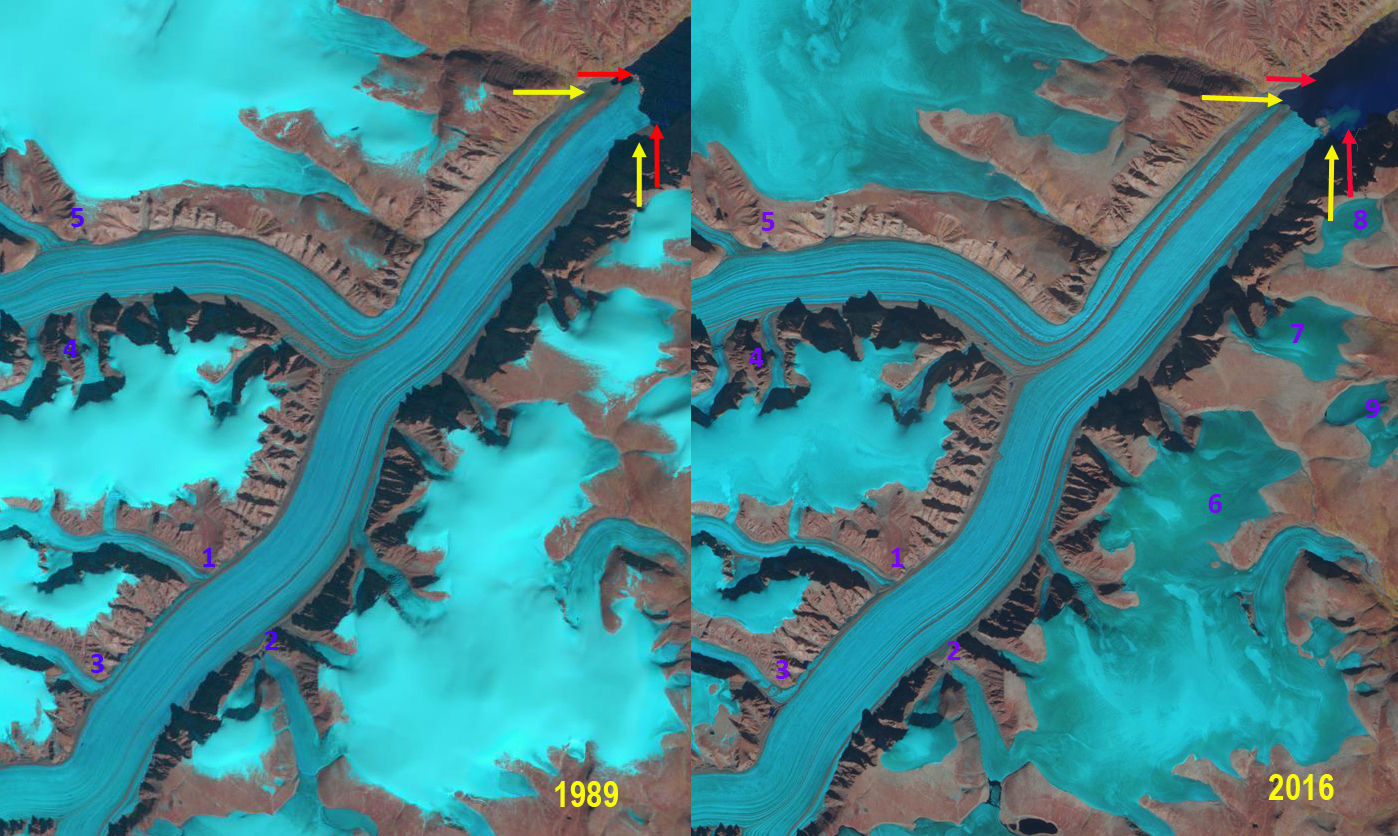
Coronation Glacier, Canada: A Landsat image from 1989 and a Sentinel 2 image from 2016 illustrate the retreat of Coronation Glacier.  Red arrows indicate the 1989 terminus and yellow arrows the 2016 terminus location.  Purple numbers 1-5 indicate locations of tributary retreat or thinning. Purple numbers 6-9 are icecaps that did not retain snowcover in 2016. 

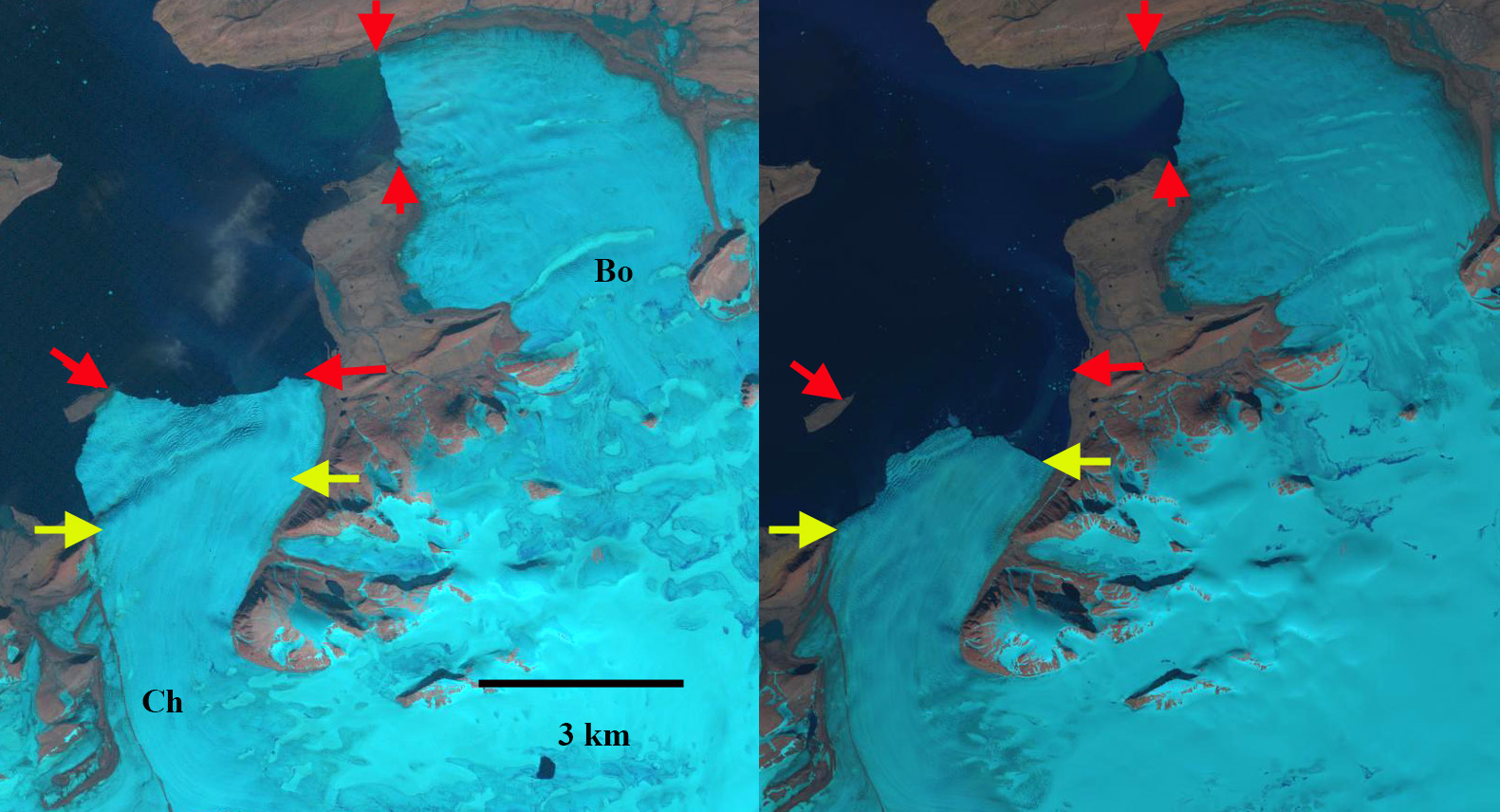
Chernysheva Glacier and Borozova, Novaya Zemlya comparison in 1990 and 2015 Landsat images. Red arrows indicates 1990 terminus and yellow arrow 2015 terminus position. Island has formed at the 1990 terminus position of Chernysheva.

Tasija and Krayniy GlacierNovaya Zemlya: Tasija Glacier (T) and Krayniy Glacier (Ky) compared in 1990 and 2015 Landsat images.  Red arrows indicate 1990 terminus positions, yellow arrows 2015 terminus positions and purple arrows upglacier thinning. A new island formed upper right red arrow.

Nizkiy Glacier, Novaya ZemlyaNizky Glacier (N) and Glasnova Glacier (G) compared in 1990 and 2015 Landsat images.  Red arrows indicate 1990 terminus positions, yellow arrows 2015 terminus positions and purple arrows upglacier thinning.  An island has formed at the second red arrow from the bottom.

Krivosheina GlacierNovaya Zemlya:  Krivosheina Glacier compared in 1990 and 2015 Landsat images.  Red arrows indicate 1990 terminus positions, yellow arrows 2015 terminus positions and purple arrows upglacier thinning.  Point A indicates a new island that has formed.

Vilkitskogo GlacierNovaya ZemlyaVilkitskogo South Glacier (Vs) and Vilkitskogo North Glacier (Vn) compared in 1990 and 2015 Landsat images.  Red arrows indicate 1990 terminus positions, yellow arrows 2015 terminus positions and purple arrows upglacier thinning.


Vasilievebreen, Svalbard: retreat from 1990-2017 has led to the creation of one island at the pink arrow, while the island at the orange arrow has eroded and an island at the white arrow is on the verge of being released by the glacier.  

Samarinbreen, Svalbard: Landsat imagery from 1990-2014 illustrates that the retreat of the glacier has been 2.1 km including the formation of an island.