

Stave Glacier area in 1992 and 2019 Landsat images illustrating the loss of glacier area. Red arrows indicate 1992 terminus location, yellow arrow 2019 terminus location, Point 1-3 are proglacial lake that are evolving, P=Piluk Glacier and S=Stave Glacier.
Stave River drains into Stave Lake and has a 40 km length above the lake. The basin has a glaciated area of 32 km2. The basin above Stave Lake has two Run of River Hydropower plants (RORH) . The 17.5 MW RORH project on the Northwest Stave River was built by Innergex Resources and was opened in 2013. The facility is 18 km upstream of Stave Lake and has 1.9 km long diversion reach. The 33 MW RORH project on the Upper Stave River was built by Innergex Resources and was opened in 2011. Stave River has a substantial fall run of Coho and Chum. A decline in the salmon runs beginning in 2000 led to development of a Lower Stave river water use plan to reduce blockage at the Ruskin Dam hydropower site, which is not an RORH. This has not led to a recovery of salmon, in fact the 2008-2012 population numbers are lower than prior [Ladell and Putt, 2015]. Stave River has a peak flow in June and mean July-September runoff is 37.4 m3s-1.
RORH lack significant reservoirs by definition and as a result cannot alter the discharge of a river or store water, including glacier runoff. RORH divert a portion of a rivers discharge through the power system, reducing discharge for the diversion reach of the power system, before returning the water to the river. Mountainous nations with substantial hydropower potential and glaciers are expanding their use of RORH [Orlove, 2009]. The growth of RORH has been due to the lower cost of development and reduced environmental impact, which result from the absence of a large storage reservoir.
Peak streamflow in the alpine regions of the Pacific Northwest occur during the spring snow melt season. Glacier runoff peaks in the mid to late summer during the height of the ablation season, coincident with minimum streamflow of late summer and early fall. The loss of glacier area from these watersheds thus reduces streamflow primarily during late summer minimum flow periods. This has been observed in several Pacific Northwest basins where a decline of more than 20% in glacier area has led to a decrease in glacier runoff [Stahl and Moore, 2006; Pelto, 2011]. In such basins RORH will have a reduced seasonal production capacity.
Stave Glacier, the largest glacier in the watershed, declined from 11.38 km2 in 1988 to 9.45 km2 in 2005 [Koch et al 2009] and 8.6 km2 in 2019. The terminus retreated 1900 m during the 1992-2019 period. Piluk Glacier terminated in a proglacial lake in 1992. By 1998 it had retreated from this lake and by 2015 a new proglacial lake was forming at Point 2. The glacier retreated 800 m from 1992 to 2019, and the area was reduced from 3.5 km2 to 2.0 km2 . The glacier lost all of its snowcover in 2015, and more than 90%in 2016 and 2019, indicating it cannot survive current climate. Point 1 indicates where a glacier terminates in a proglacial lake in 1992 at what is more of a pass than a valley. This is still the case in 1998, but in 2015 the lake is no longer proglacial and only 20% of the 1992 glacier remains. Point 3 in 1992 is a glacier filled basin that is narrowly attached to an adjacent glacier. In 1998 the glacier still fills the basin but is no longer attached to the adjacent glacier. By 2015 the basin is mainly a proglacial lake. In 2019 only a small section of glacier remains at the southwest edge of the lake. There are two other glaciers between Stave Glacier and Piluk Glacier that are unnamed where red arrows indicate the 1992 terminus location. The northern flowing of these glaciers has retreated 850 m, while the south flowing glacier retreated 400 m. In both cases this represents more than 30% of the total glacier length.
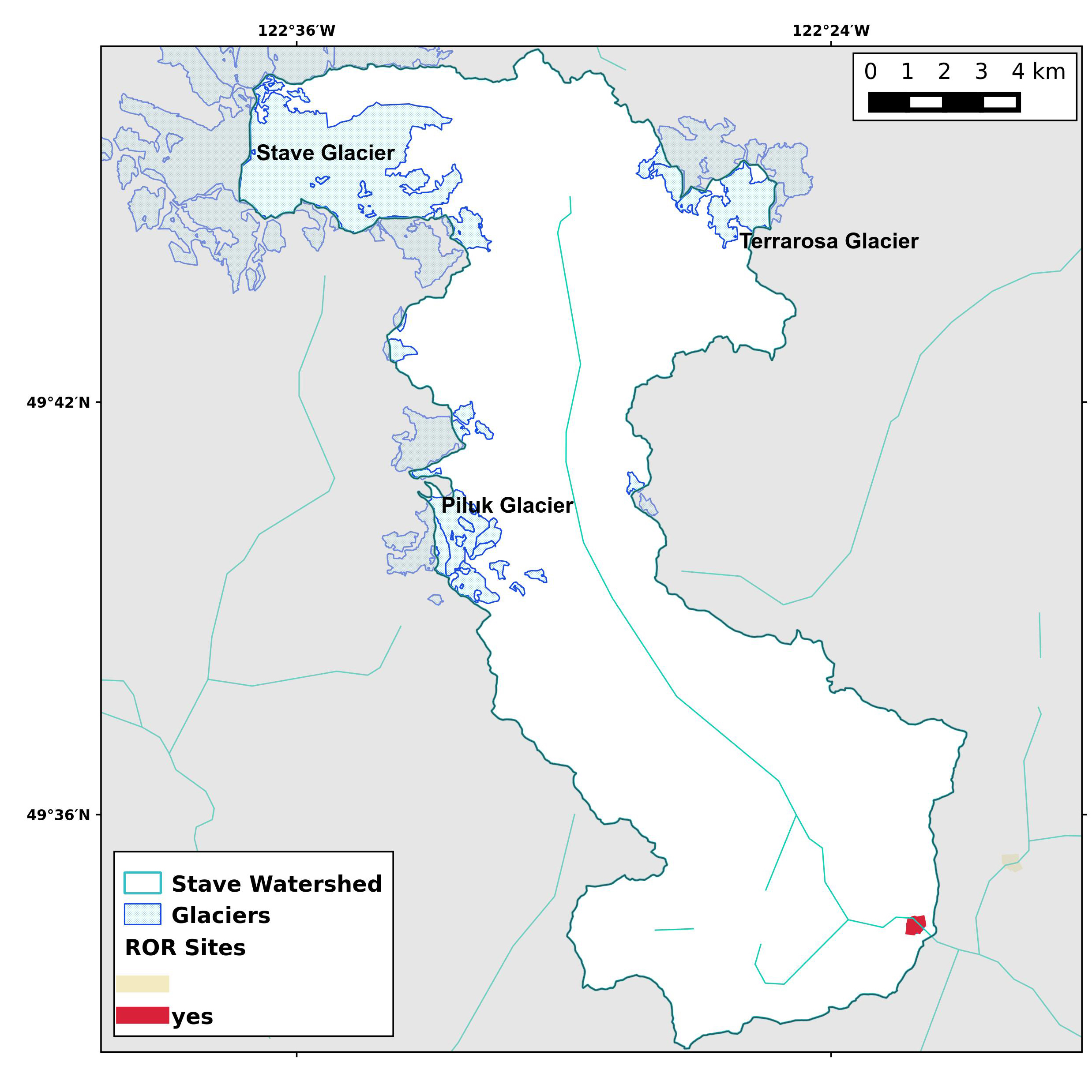
Stave River Basin, British Columbia indicating hydropower plants and glaciers in the basin (Map created by Ben Pelto)
Future Glacier Runoff and Hydropower Implications
Recent glacier runoff is determined from a mean observed regional summer balance of -2.9 m w.e. Summer glacier runoff is 98.6 million m3, yielding a mean summer discharge of 7.5 m3s-1, which is 20 to 24% of total stream discharge.The rate of glacier area loss was 0.53%/year from 1985-2005 [Bolch et al 2010]. A continuation of this trend up to 2050 would yield a 24% area decline, with glacierized area in the basin of approximately 26 km2 in 2050. Since 2005 the area loss has accelerated to ~1% /year. This would lead to an area of 22.4 km2. A greater decline is likely however, as modeled warming of 2.2 ˚C by 2050 would lead to higher ablation rates [Clarke et al 2015]. Using the temperature index model and applying the increased temperature yields a mean summer balance of -3.5 m w.e., yielding 78.4 million m3. This is equivalent to mean summer discharge of 5.9 m3s-1, a 20% decline from present glacier runoff. in 2050. The reduced glacier runoff will add to the earlier snowmelt runoff in the region through 2050 leading to significantly reduced late summer discharge and hydropower potential in the Stave River basin. Peak glacier runoff has passed and an ongoing decline will occur as is the case at many basins in the region including the Nooksack Basin in Washington (Pelto, 2015).
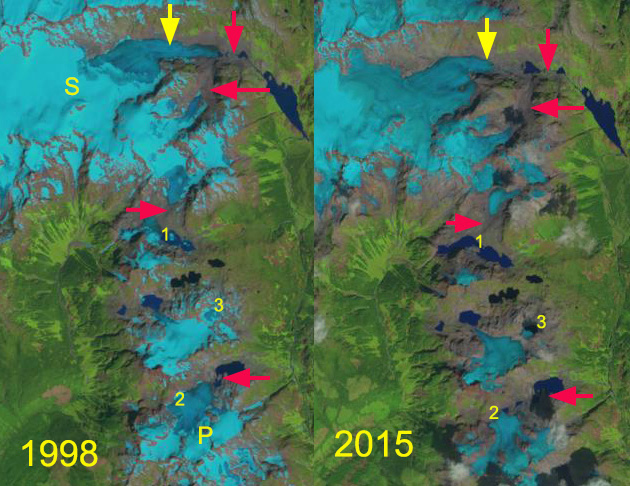
Stave Glacier area in 1998 and 2015 Landsat images illustrating the loss of glacier area. Red arrows indicate 1992 terminus location, yellow arrow 2019 terminus location, Point 1-3 are proglacial lake that are evolving, P=Piluk Glacier and S=Stave Glacier.

 From a Glaciers Perspective