Tungnafellsjökull, Iceland Recession and Thinning 1999-2020

Tungnafellsjökull Ice Cap in 1999 and 2020 Landsat images indicating  terminus changes at three northern outlets, red arrows, and at four locations of bedrock exposure.

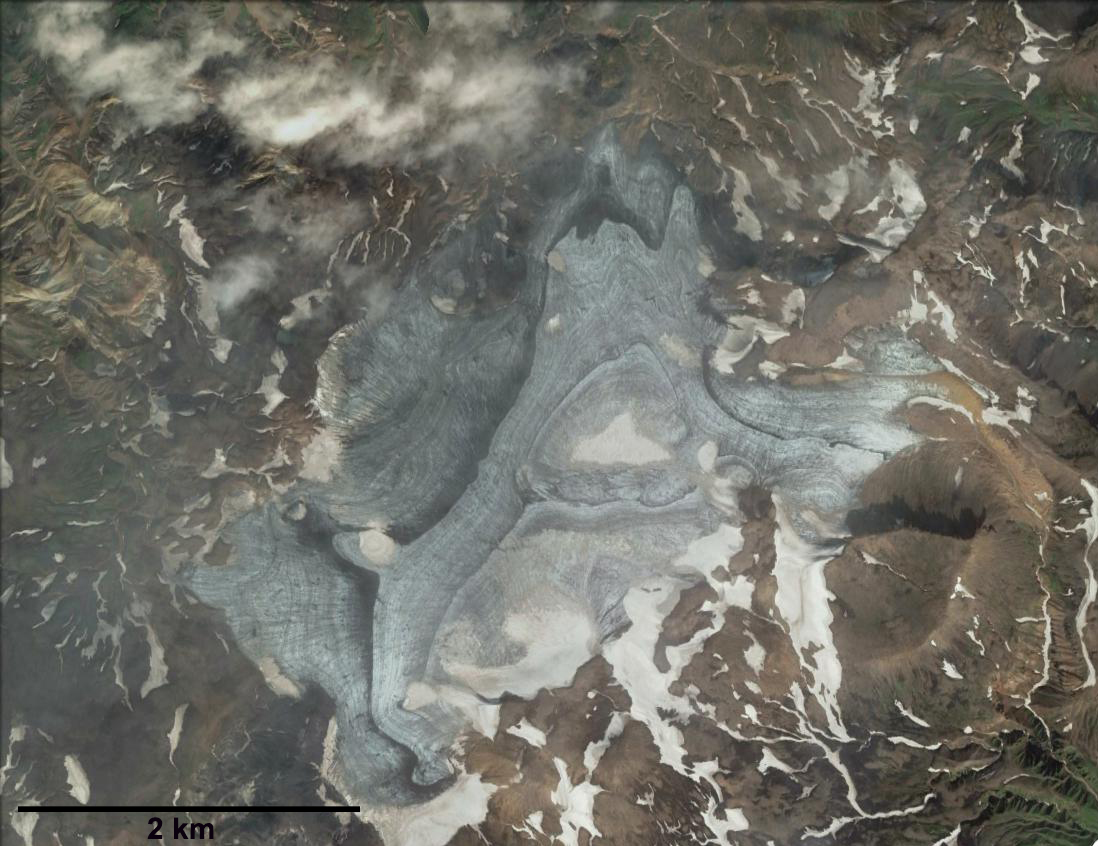
Tungnafellsjökull Ice Cap is a ~32km2 ice cap located between Vatnajökull and Hofsjökull.  Gunnlaugsson (2016) reported on the mass balance changes of the Tungnafellsjökull Ice Cap and found it had lost 20 of its volume and 16% of its area from 1960-2013.  The ice cap was essentially in balance from 1960-1986 and had a slight mass balance loss from 1986-1995.  Almost all of the loss has been since 1995. Belart et al (2020) report on losses from 14 smaller glacier in Iceland including Tungnafellsjökull and found signficant increase in mass loss from a near equilibrium 0.07 m/year from 1960-1994 to -1.20 m/year from 1995-2010. Here we examine the impact of the 25 years of sustained mass loss on Tungnafellsjökull using Landsat images.

In 1999 the transient snow line in August is at ~1200 m.  Point A,B and D indicate bedrock knobs amidst the ice cap and Point C a bedrock ridge that the ice cap flows over near Point C.  The three northern outlets terminate at the red arrows. From east to west they are Nordur Tungnafellsjökull, Innri Hagajökull and Fremri Hagajökull. In 2000 the transient snowline in August is again at ~1200 m. In 2014 the snowline was above 1500 m laving the ice cap without any retained snowpack from the previous winter.  The area of exposed firn encompasses 40% of the ice cap indicating the size of the accumulation zone in the several years prior to 2014. By 2016 the ice cap no longer flows over the ridge near Point C.  The transient snowline is at ~1400 m. In 2020 the transient snowline is at ~1350 m.  The bedrock knob at Point B is no longer surrounded by the ice cap. The bedrock at Point A and D have expanded.  The retreat from 1999-2020 is most significant at the three northern outlet glaciers, where Gunnlaugsson (2016)  indicated thinning was greatest. The retreat has been 200 m at Nordur Tungnafellsjökull,  600 m at Innri Hagajökull and  500 m at Fremri Hagajökull.

With an accumulation area covering approximately 40% of the ice cap, mass balance losses will continue and the ice cap will continue to retreat.  Retreat has been the consistent response of more than 90% of  Iceland glaciers since 2000 (Iceland Glaciological Society), such as at Norðurjökull.

Tungnafellsjökull Ice Cap in 2000 and 2016 Landsat images indicating  terminus changes at three northern outlets, red arrows, and at four locations of bedrock exposure.

Landsat image in August 2014 indicating the lack of retained snowcover.  The glacier surface is bare ice blue-gray and exposed firn indicated by the zone inside of the yellow dots.

Torfajökull, Iceland Accumulation Zone Demise Drives Recession

Torfajökull in 1994, adn 2014 Landsat images.  Note the lack of retained snowpack in 2014 and emerging bedrock areas within icecap, purple arrows.

Torfajökull is a small ice cap north of  Myrsdaljökull in Iceland.  The glacier’s lowest elevation is 750 m and the highest elevation is 1150 m.  This low of an elevation range in a climate driving higher snowlines places this type of ice cap at great risk for losing its accumulation zone and its ability to survive.   The Iceland Glaciological Society spearheads an annual terminus monitoring program led by Oddur Sigurðsson. In 2013 the report indicates all seven glaciers in the region near Torfajokull were in retreat.  In this post we look at the loss of the accumulation zone in 2014 and the longer term change in size noted by the Iceland Glaciological Society. This is not a good area for acquiring a suntan as the lack of clear imagery indicates for 2015 or 2016. 

In 2006 the Iceland Glaciological Society began monitoring the terminus of this glacier, the measurement is completed at the northeastern terminus.  From 2006-2014 the glacier has retreated 150 m.  The monitored terminus the location where areas of bedrock have begun to emerge from beneath the thinning ice cap, purple arrows. The bedrock areas exposed within the ice cap were not evident in 1994 images or the 2000 glacier outline. The loss of glacier area from 1946-2000 in the Iceland Glaciological Society map indicates area loss around the entire margin of the icecap including the highest elevations, located on the southern margin.  Recession at the head of a glacier suggests a glacier that lacks a persistent accumulation zone.

The change from 2000 to 2014 has been more pronounced on the eastern lobes that extend away from the main glacier.  The loss in ice cap area from 2000-2014 is ~10%.  In 2014 the glacier had 12% retained snowcover on August 12th, note Landsat image above and Google Earth below, by Sept.2014 there was no retained snowpack.  There is some retained firn the lightest blue, but even this is limited indicating that the snowpack from the previous few winters had not survived over most of the glacier either.

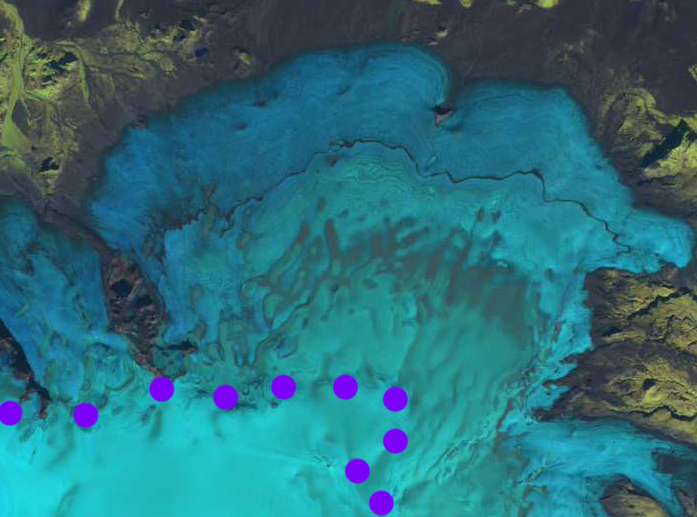
This is a recipe for glacier loss. The snowline on Aug. 12, 2014 shown below on Myrsdaljökull was at 1225 m, well above the top elevation of Torfajökull.  This glacier lacks the higher accumulation zone of some smaller Icelandic ice caps such as Eiriksjökull.


Iceland Glaciological Society map of glacier boundaries in 1890, 1946 and 2000, with the 2014 boundary added from the Landsat images above.  

Landsat image of Myrdalsjokull on 8/12/2014 with snowline at purple dots., 1225 m.

Hagafellsjokull, Iceland Reflects Langjokull Thinning & Retreat

hagafellsjokull-compare

Landsat comparison of the terminus of Hagafellsjökull from 2000 and 2016.  The red arrows are the 2000 terminus, the yellow arrows the 2016 terminus.  Purple arrows indicate upglacier thinning. 

Langjökull is the second largest iceap in Icalnd with an area of over 900 square kilometers. The mass balance of the icecap has been reported since 1997 and his lost over 1 m per year during this period (WGMS, 2016).  Pope et al (2010) noted that the icecap has lost an area of 3.4 ± 2.5 km2 yr-1 over the decade from 1997-2007.  Pope et al (2010) noted that the loss of ice volume confirms previously published predictions that Langjökull will likely disappear within the next 200 years if current trends continue. A key outlet of  Langjökull is  Hagafellsjökull which terminates in Hagvatn. Hagafellsjökull ended a sustained post Little Ice Age retreat in 1970.  The ensuing advance of approximately 1 km ended by 2000.  Here we examine Landsat imagery from 2000-2016 to identify recent changes in this outlet glacier.

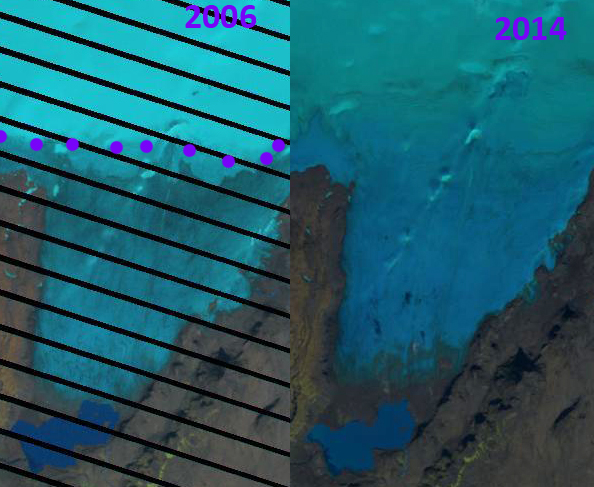
In 2000 the glacier terminated on an island in Hagavatn, red arrow.  The east margin of the glacier featured several locations where secondary termini overflowed a low ridge on the east side of the glacier.  By 2006 the glacier had retreated 500-600 m from the island.  By 2016 the terminus had retreated across its entire width by 800-850 m, 50 m/year, yellow arrows.  A closeup view from the Iceland online map application illustrates the 2014 terminus red dots. The end of the glacier has a low slope, low velocity and is debris covered.  The western side has terminated on land during this entire period and has approximately the same retreat rate as the eastern half that still ends in the expanding lake. There is little evidence of iceberg release into the lake, which helps explain the similar retreat rate. The low slope and upglacier thinning noted at the purple arrows indicate the retreat will continue.  In 2014 the transient snowline reached near the head of the glacier at over 1100 m.  In 2000, 2006 and 2016 the snowline with several weeks left in melt season ranged from 859-950 m. The retreat is similar to that of Norðurjökull another outlet of the Langjökull and Porisjokull.

langjokull-south-outlet-ge-2010

Google Earth view of the terminus of Hagafellsjökull in 2014. Red arrow is the 2000 terminus position and yellow arrow the 2014 position.

 hagafellsjokull-ismap

Online Iceland Map Viewer indicating the terminus of Hagafellsjökull in 2014, red dots.

hagafellsjokull-tsl

2006 and 2014 Landsat images of Hagafellsjökull indicating the transient snowline off the image in 2014 and at 850 m in 2006.