Reru Glacier, Kashmir Retreat and Lake Expansion

Reru Glacier in 1998 and 2018 Landsat images.  The red arrow indicates the 1998 terminus location, the pink arrow a recent landslide, Point 1 and 2 are tributaries that are losing connection with the main glacier and purple dots are the snowline.

Reru Glacier, Kashmir is at the headwaters of the Reru River, which drains into the Doda River and then the Zanskar River.  Murtaza et al (2017) noted a 17% loss in glacier area and a 80-300 m rise in the ELA of Kashimir glaciers form 1980-2013. This is similar to the rate of loss from 1962-2001 of 18% reported by Rai et al (2013) The Kolahoi Glacier has experienced an accelerated retreat in the last decade (Rashid et al, 2017)Babu Govindha Raj (2010) identified  the glacier retreating at an average rate of 12 m per year from 1975-2005,  with lake area expanding from 0.17  to 0.42 square kilometers.  Here we examine Landsat images from 1998-2018 to document changes of Reru Glacier.

In 1998 the glacier terminates in a 1 km long lake. The snowline is at 500 m, and tributaries at Point 1 and 2 flow into the main glacier. In 2002 the snowline is at 5300 m, the tributaries still join the main glacier and no landslide is evident at the pink arrow.  By 2014 the glacier terminates in the proglacial lake that has expanded to 1.6 km in length and tributary 1 has detached from the main glacier.  The snowline is at 5100 m.  In 2018 the glacier has retreated from the proglacial lake which is 1.7 km long.  The glacier has retreated 600-700 m since 1998.  A landslide is now evident at the pink arrow. Potentially from the period of intense flooding in 2015. Tributary #2 has a narrow but existing connection to the main glacier. The snowline in 2018 is particularly high at 5700 m. This is reflective of the high freezing levels in this area in 2018.  The retreat is significant, but not rapid.  This is similar to both Kolahoi Glacier and Durung Drung Glacier.

Reru Glacier in 2002 and 20184 Landsat images.  The red arrow indicates the 1998 terminus location, the pink arrow a recent landslide, Point 1 and 2 are tributaries that are losing connection with the main glacier and purple dots are the snowline.
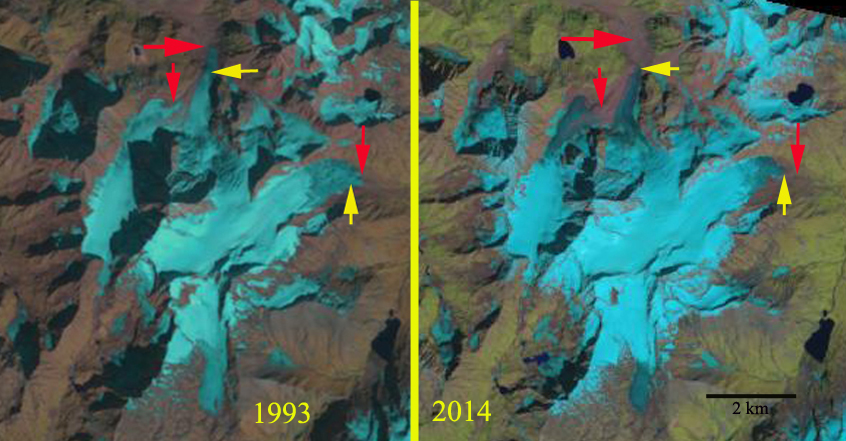
Goddess of Light (Kolahoi) Glacier Showing Mortality, Kashmir Retreat 1993-2015

kolahoi compare

Kolahoi Glacier comparison in Landsat images from 1993 to 2014.  Kolahoi Glacier is the northern glacier, East Kolahoi Glacier the other noted glacier.  Red arrows indicate 1993 terminus locations, and yellow arrows the 2014 terminus locations. 

The Kolahoi Glacier in Kashmir is known as the—”goddess of light”—Gwash Brani  (NatGeo, 2010). The glacier descends the north side of the mountain with two tongues of the glacier merging above the terminus in 1993. The glacier drains into the Liddar River and then the Jhelum River system.  The Jhelum River has several large operating hydropower stations and several more under construction including the Karot Hydropower Project a 720 MW run of river project.  Jeelani et al (2012) observed that the Liddar Watershed derives 60% of its runoff from snowmelt and just 2% from glacier ice melt.  They further report that the Liddar watershed has 17 glaciers covering an area of 40 km2 in 2008. The climatic warming in the region has led to mass wasting of Kolshoi Glacier and retreat.  From 1970 to 1990 there was a cooling trend of about −0.02°C per year followed by the time period from 1991 to 2010 with the highest increasing trend of 0.07°C per year (Jeelani et al 2012) .  Tayal (2011) observed the detachment of the two glacier branches and a loss of 2-3.5 m of ice thickness due to ablation in the lower reach of the glacier.

jhelum_river_basin

Hydropower Projects in Jhelum Basin.

From 1993 to 2001 there is limited retreat of Kolahoi Glacier and East Kolahoi Glacier, though both glacier fronts become narrower.  By 2006 Kolahoi Glacier has retreated to near the base of a steeper slope.  The glacier remains heavily crevassed in the region above the icefall within 1 km of the terminus, Point A. By 2014 the glacier has retreated to the top of the steeper slope between two bedrock knobs at 3650 m, total retreat from 1993 to 2014 is 700 m.  Crevassing above the slope, at Point A, that used to be an icefall has become limited since 2006 and before.  The reduction in velocity indicates retreat will continue. The western tributary of the Kolahoi has developed a separate termini from the main glacier after 2001, single vertical red arrow.. The East Kolahoi Glacier has retreated 300 m.  The lower 300 m of Kolahoi Glacier is thin and relatively uncrevassed.  This indicates the retreat will continue.  This region has its highest precipitation from January through April and highest runoff in June and July.  Hence, the glacier is not a summer accumulation type like glaciers to the east in the Himalaya. The retreat is similar to that of Samudra Tupa Glacier and Durung Drung Glacier.

kolahoi ge 2014

Google Earth image from 2014 of Mount Kolahoi and its main glaciers flow directions indicated.

kolahoi 2001

2001 Landsat image of Kolahoi Glacier

koahoi 2015

2015 Landsat image of Kolahoi Glacier

kolahoi terminus compare

Google Earth image of the terminus area outlined in blue of Kolahoi Glacier in 2006 and 2014. 

kolahoi-fig-0006

Image of the terminus of Kolahoi Glacier in 2010 from Jellani et al (2012)