Lower Curtis Glacier Annual Terminus Response to Climate Change

Side view of Lower Curtis Glacier in 2013, 2015 and 2017, illustrating the reduced slope and height of glacier front in just four years.

Terminus observations have been reported to the WGMS from 2500 glaciers with 46,500 specific observations since the late 19th century, which you can explore with the glacier viewer application. Here we examine what it looks like to report from a glacier each year.  I have visited this glacier 34 consecutive years, each time camping in a tent near the glacier, a fun spot indeed when the weather cooperates. The Lower Curtis Glacier is an avalanche fed cirque glacier on Mount Shuksan in the North Cascades of Washington. It is a south facing and low elevation glacier for the range. This is an unusual combination that is supported by the heavy accumulation via avalanching from the upper slopes of Mount Shuksan. The glacier displays a magnificent set of annual layers in its terminus tongue. The terminus tongue is a spectacular wall of seracs that quickly rises 55 m above the bedrock. There are typically 50 layers visible indicating that this most of the ice in the glacier is 50 years of less in age.

Lower Curtis Glacier Front in 2007 and 2017 taken from same location.  Both retreat and thinning of the front in the decade is evident. 

From 1908 to 1950 the glacier retreated from the valley bottom into the cirque. The glacier advanced from 1950-1985 down slope and has retreated since.  Each year we survey the terminus location, measure the mass balance and survey the glacier surface elevation on a cross profile. Here we report on the annual terminus survey from 2007-2017.  The frontal change reported to the World Glacier Monitoring Service has been 2007=-13 m, 2008=-17 m, 2009=-20 m, 2010=-7 m, 2011=-5 m, 2012=-6 m, 2013=-5 m, 2014=-12 m, 2015=16 m, 2016=-16 m and 2017=12 m. This is a total of 129 m of retreat in 11 years, nearly 12 m per year. A longitudinal profile up the middle of the glacier indicates that it thinned 30 meters from 1908-1984 and 22 m from 1985-2016. Because of its heavy accumulation via avalanching the glacier moves rapidly and is quite crevassed at the terminus with large high seracs at the glacier front. In 2007 the height of the terminus seracs was 45 m, by 2014 the seracs were 37 m high and in 2017 had shrunk to 26 m high and not as steep.  The imposing tongue has certainly diminished. The glacier retreat fits the pattern in the region, with all Mount Baker a glaciers retreating (Pelto, 2015).
Ampere-Lapparent Glacier Retreat, Kerguelen Island

ampere compare

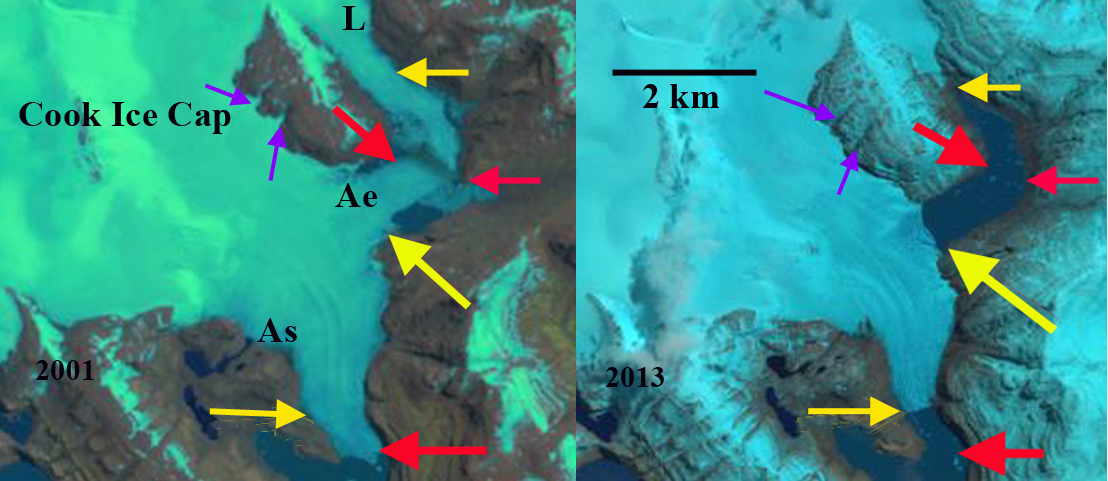
Comparison of Ampere Glacier (A) and Lapparent  Glacier (L) southern outlet glaciers of the Cook Ice Cap in 2001 and 2013 Landsat images; red arrow indicates 2001  terminus locations, yellow arrows 2013 terminus locations and purple arrow upstream thinning.

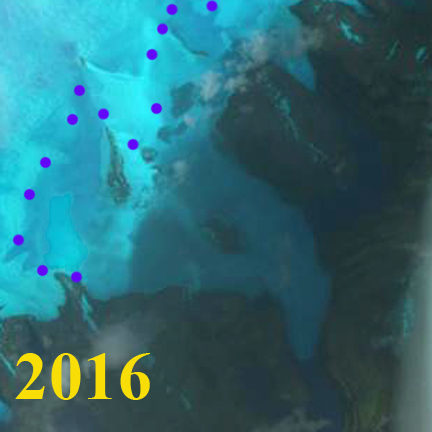
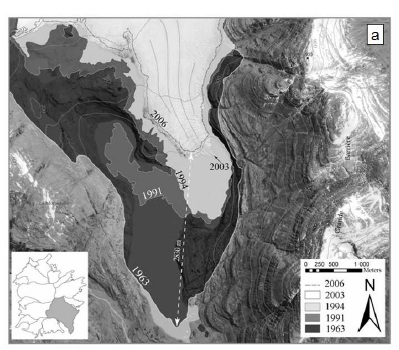
Kerguelen Island sits alone at the edge of the furious fifties in the southern Indian Ocean. The island features numerous glaciers, the largest being the Cook Ice Cap at 400 square kilometers. A comparison of aerial images from 1963 and 2001 by Berthier et al (2009) indicated the ice cap had lost 21 % of its area in the 38 year period.  Ampere Glacier is the most prominent outlet glacier of the Cook Ice Cap.  Berthier et al (2009) noted a retreat from 1963 and 2006 of 2800 meters of the main glacier termini in Ampere Lake (As). The lake did not exist in 1963. A second focus of their work was on the Lapparent Nunatak due north of the main terminus and close to the Ampere Glaciers east terminus (Ae). The nunatak expanded from 1963-2001, in the middle image below from Berthier et al (2009), but it was still surrounded by ice.  This is dominated by cloudy weather, with not a single good Landsat image of the glacier since 2013, the January 2016 indicates the snowline, purple dots is similar to 2001.

Kerguelen-Island-topo-Map

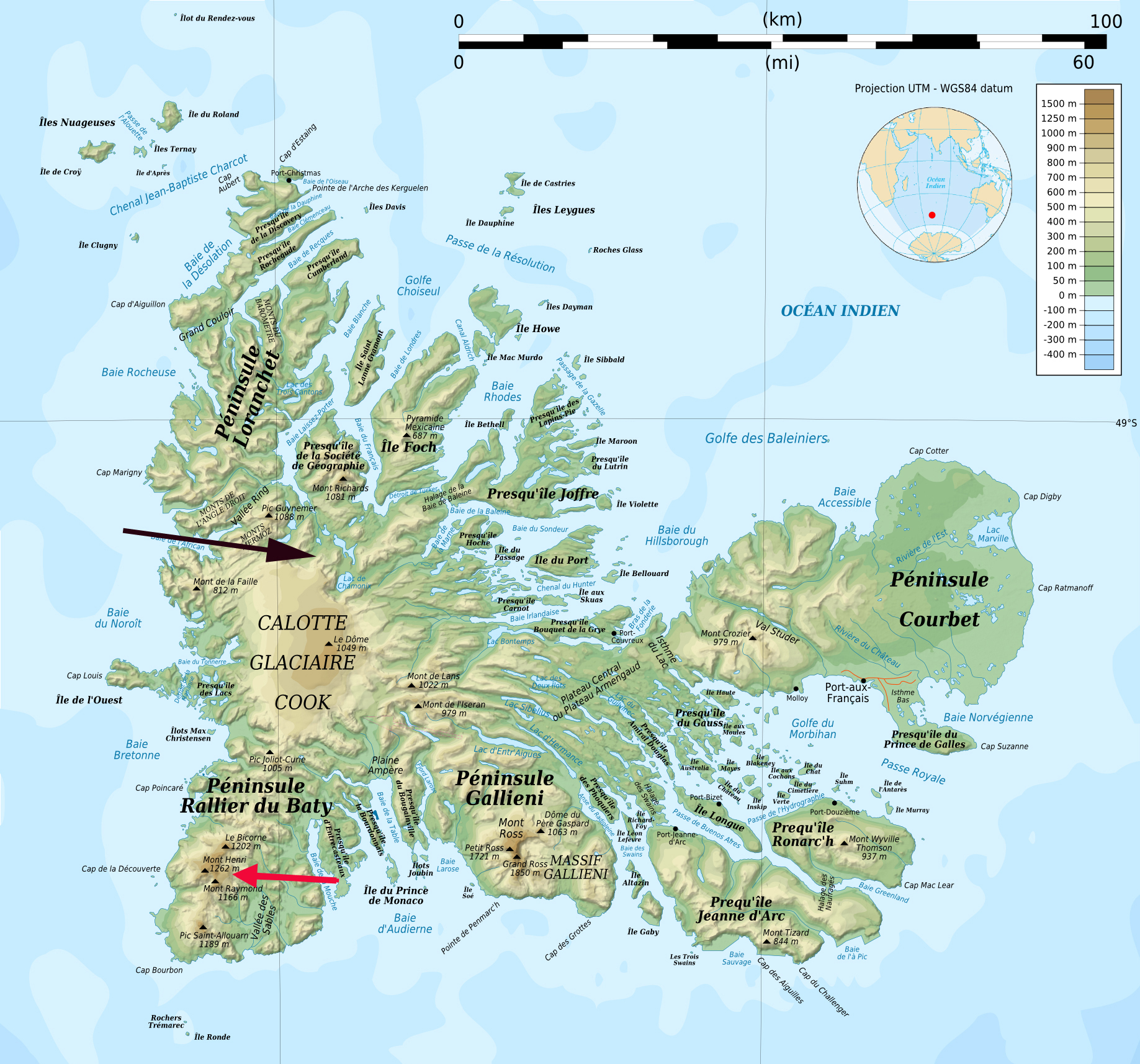
Map of Kerguelen Island

The main terminus has retreated 800 meters from 2001-2013. Here the terminus has pulled back from the tip of the peninsula on the west side of the terminus and is currently at a narrow point.  The eastern terminus has retreated to its junction with the main Ampere Glacier a distance of 1400 m.  Berthier et al (2009) had noted thinning around the Lapperent Nunatak of 150 to 250 m, purple arrows indicate this location of thinning.  Above the current main terminus the valley widens again to the junction with the location of the eastern terminus.  It seems likely the main glacier will retreat north until there is a single terminus north of the southern end of Lapparent Nunatak. Lapparent Glacier was formerly joined with the Ampere Glacier’s eastern outlet.  The comparison of  Landsat imagery from 2001 and 2013 indicate widespread thinning and deglaciation of this glacier.  In 2001 Lapparent Glacier merges with the east terminus of Ampere Glacier at the red arrows with a medial moraine evident.  By 2013 the eastern arm has narrowed from 1100 m to 500 meters and retreated 2100 m in 12 years. The result is less ice flow over a bedrock step just above the terminus. This continued thinning since 2001 will lead to further retreat of the glacier. There is no calving and the rate of retreat will decline. A 2009 Landsat image 2009 and 2013 Google Earth image indicate icebergs stranded in the lake by Lapparent Glacier and the eastern outlet indicating glacier lake drainage lowering the level.

ampere-hd

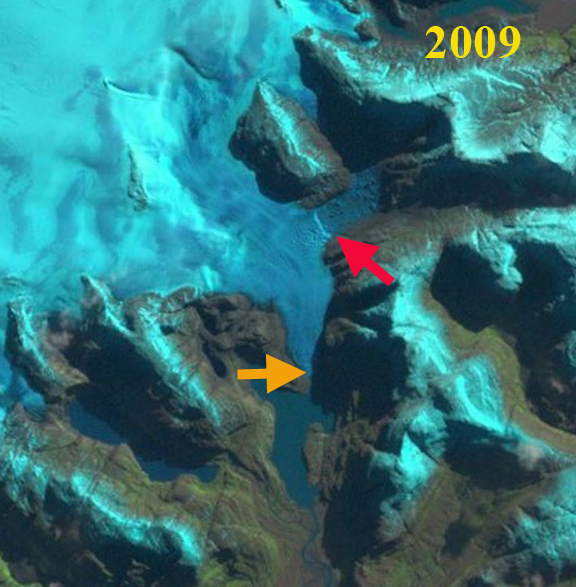
2009 Landsat image icebergs evident in lake in the upper right.

ampere ge

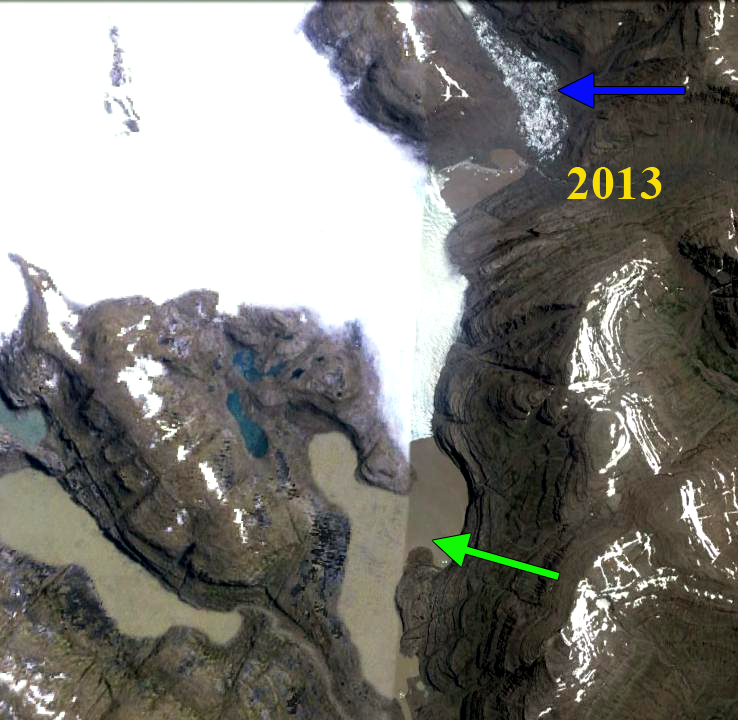
2013 Google Earth, icebergs at blue arrow.  Highly turbid water in proglacial lakes indicates a recent high flow event.

amperre 2016

2016 Landsat image

Ampere Glacier Retreat Kerguelen Island

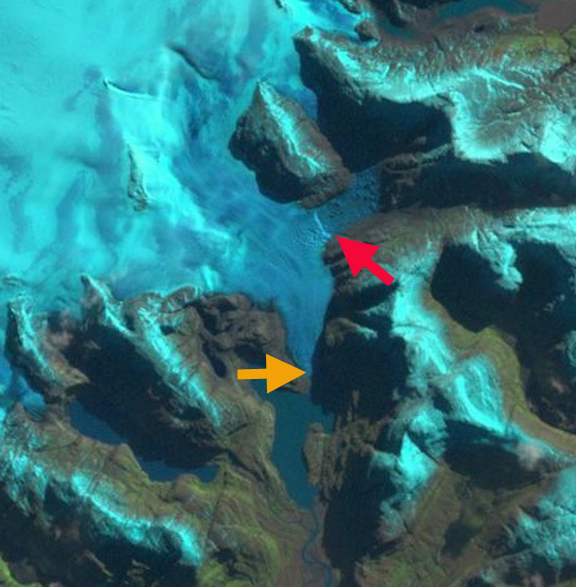
Kerguelen Island sits alone at the edge of the furious fifties in the southern Indian Ocean. he island features numerous glaciers, the largest being the Cook Ice Cap at 400 square kilometers. A comparison of aerial images from 1963 and 2001 by Berthier et al (2009) indicated the ice cap had lost 21 % of its area in the 38 year period.Kerguelen-Island-topo-Map T In this paper they focused particular attention on the Ampere Glacier draining the southeast side of the ice cap. Berthier et al (2009) noted a retreat from 1963 and 2006 of 2800 meters of the main glacier termini in Ampere Lake. The lake did not exist in 1963. The map below is from the paper indicating the terminus position. A second focus of their work was on the Lapparent Nunatak due north of the main terminus and close to the east terminus. A nunatak is a ridge or mountain surrounded by a glacier, really an island in a sea of ice. The nunatak expanded from 1963-2001, in the middle image below from Berthier et al (2009), but it was still surrounded by ice. The bottom image is from Google Earth in 2003. Given our current climate I wondered what might have changed in the last few years. Landsat images from 2001, 2009, 2011 and 2013 indicate the retreat of the main terminus at the orange arrow and the secondary terminus at the red arrow. The east terminus has retreated 1500 meters since 2003 leading to the expansion of a new substantial lake. The main terminus has retreated additionally 800 meters from 2001-2013. Here the terminus has pulled back from the tip of the peninsula on the west side of the terminus, which the orange arrow crosses in each image. This glacier is experiencing the same climatic warming that has led to the retreat of other glaciers in this circum-Antarctic latitude belt, Arago Glacier further south on Kerguelen, nearby Aggasiz Glacier Stephenson Glacier on Heard Island and Neumayer Glacier on South Georgia. In this ever changing world, it is melting that is changing our maps.ampere glacier 2001
2001 Landsat image
ampere-hd
2009 Landsat image

ampere 2011
2011 Landsat image

ampere 2013
2013 Landsat image.