

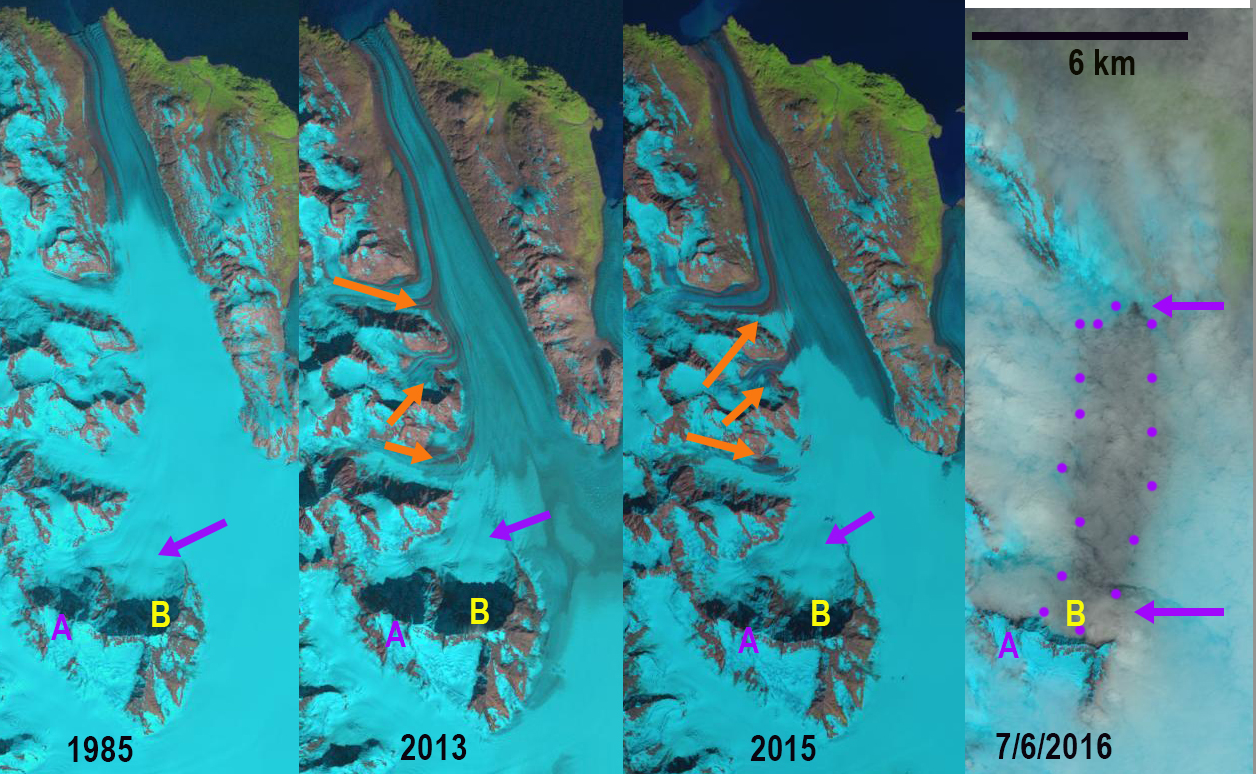
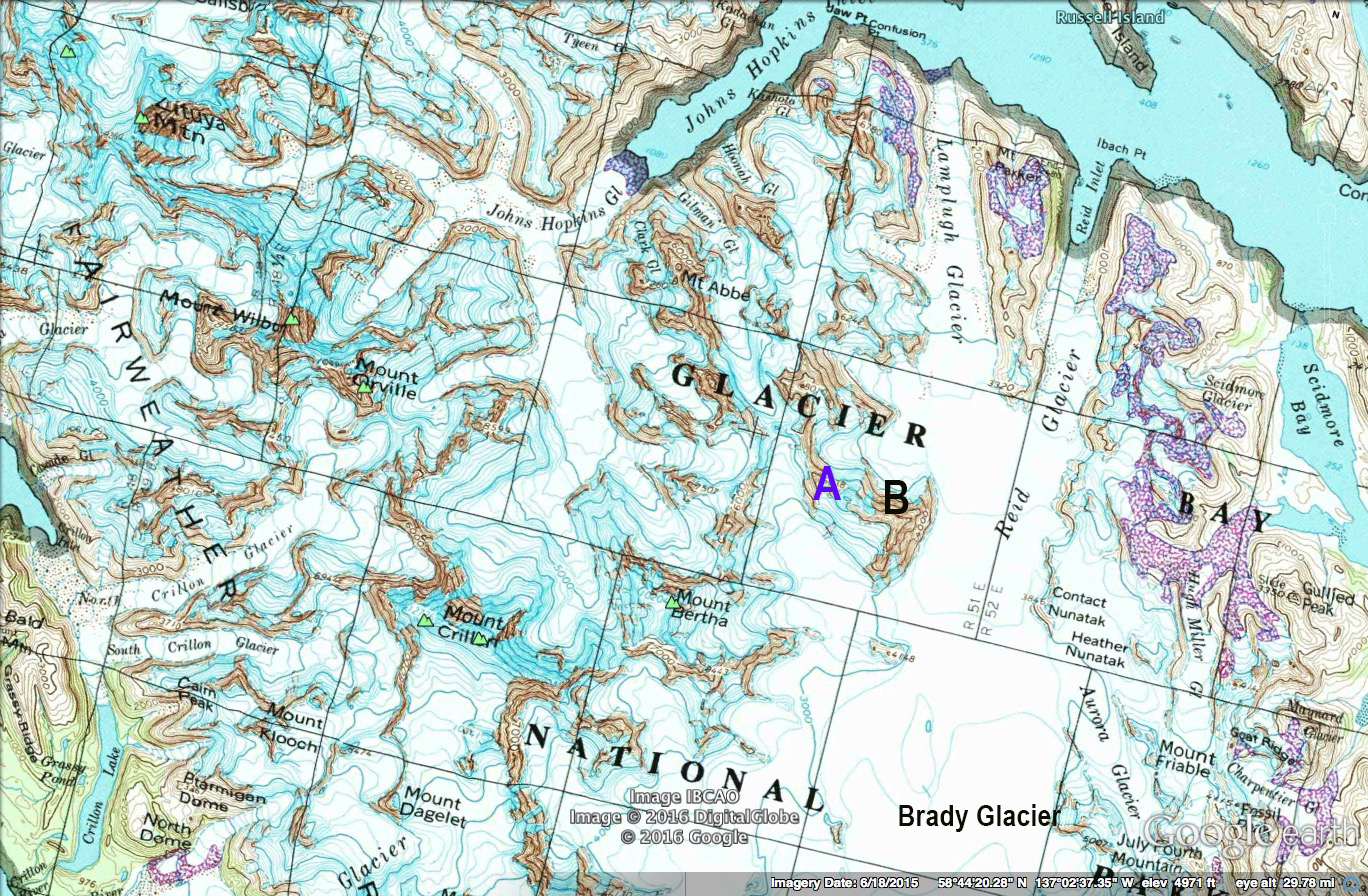
Lamplugh Glacier, Alaska in 2015 (before) and 2016 (after) landslide in Landsat images. The Landslide covered 17 km2 of the glacier, yellow dots. B=Brady, L=Lamplugh, R=Reid Glacier.
Ice whether as permafrost, in a glacier, filling cracks or coating surfaces literally helps stabilize materials on mountain slopes. Climbers who ascend glaciated peaks have long practiced early starts to avoid the heat of the day. The goal to avoid falling, rock, ice and snow all made more prevalent by the rising temperatures of the day, which leads to thawing/weakening the ice and snow binding materials together and to the mountain. Working on steep alpine glaciers each summer for 40 years, we do not go below a steep convex icefall or terminus after the sun is on it. These approaches are a risk accommodation to short term diurnal changes. This combination of hazards has been playing itself out on the small scale altering the climbing routes from Mont Blanc to Mount Kenya and Mount Rainier generating more frequent large-scale avalanches/landslides/glacier collapses in glaciated mountain ranges. On Mont Blanc massif Maurey et al (2019) found that 93 of 95 climbing routes had been affected by climate change, 26 greatly and 3 no longer existed.
Long term climate change also leads to preconditioning that increases opportunities for thawing/melting and weakening of the bonds between mountains and the rocks, snow and ice perched on and within their slopes. Atmosphere and ocean warming over the past century are driving rapid glacier thinning and retreat of the majority of alpine glaciers destabilizing hillslopes and increasing the frequency of landslides from unconsolidated, unstable sediments often perched on slopes. Jacquemart et al (2020) conclude that as “meltwater production increases with rising temperatures, the possible increase in frequency of glacier detachments has direct implications for risk management in glaciated regions.”
The long term preconditioning has led to a number of large avalanches/landslides/glacier collapses from 2015-2021. Each has a unique story, but each is connected to warming.
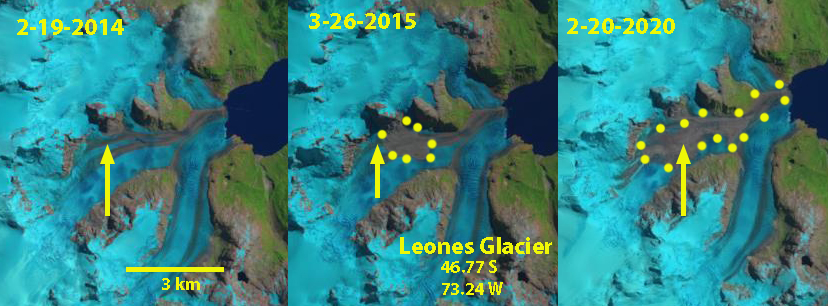
Leones Glacier, Chile sequence of Landsat images illustrating the landslide and its evolution.
Flat Creek, AK
Flat Creek, Alaska is in the Wrangell Saint Elias National park. Jacquemart and Loso (2018) detailed a series of events from 2013-2016 generating debris flows. They identified in satellite images, that large parts of the glacier that occupied the head of Flat Creek disappeared during the August 2013 and August 2015 events. In 2013 shows that the front third of the glacier tongue went missing and in 2015, the ice in the central trough of the glacier disappeared altogether. The combined events transported 24.4–31.3 × 10⁶ m3 of ice and lithic material from Flat Creek Glacier (Jacquemart et al 2020), who concluded this event was triggered by unusably high meltwater input. In 2016 the event was smaller, but the resulting debris flow/slushalanche was caught on video .
Taan Fjord, AK
Taan Fjord is a newly developed fjord in Icy Bay, Alaska resulting from glacial retreat in recent decades that has exposed unstable slopes and allowed deep water to extend beneath some of those slope. The Tyndall Glacier had retreated 17 km from 1961 to 2015, stranding lose deposits of glacial sediments on the slopes (Williams and Koppes, 2020). Slope failure at the terminus of Tyndall Glacier on 17 October 2015 sent 180 million tons of rock, 60 × 106 m3 into Taan Fiord, (Dufresne et al 2017) . The resulting tsunami reached elevations as high as 193 m.
Lamplugh Glacier, AK
Lamplugh Glacier terminates in Glacier Bay, Alaska. In 2016 Southeast Alaska had its warmest spring ever. On June 28, 2016 a landslide triggered by the collapse of a rock face occurred. After accelerating downslope the debris hit the ice on the glacier and kept sliding bulldozing snow and ice as it went. Seismic analysis, indicated a landslide of about 120 million metric tons (Morford, 2016). The Landslide covers an area of 17 km2 and is 7.5 km long on the Lamplugh Glacier (Pelto, 2016)
Eliot Creek, BC
Rapid glacier retreat set the stage for a slope failure to occur in Eliot Creek, a steep mountain valley in the Coast Range of British Columbia on November 28, 2020, about 18 million m3 of rock descended 1000 m down the steep slop, then across the toe of a glacier before entering a 0.6 km2 glacier lake displacing water that produced a >100-m high run-up (Geertsema et al 2022). A water saturated debris flow overtopped the lake outlet and scoured a 10-km long channel before depositing a 2 km2 fan below the lake outlet. Floodwater and associated debris entered the fjord where it produced a 60+km long sediment plume and altered turbidity, water temperature, and water chemistry for weeks. The outburst flood destroyed forest and salmon spawning habitat throughout the valley (Geertsema et al 2022).
Joffre Peak, BC
Two catastrophic landslides occurred in quick succession on May 13 and 16, 2019 from the north face of Joffre Peak in the Southern Coast Mountains, British Columbia. Beginning at 2560 m and 2690 m elevation as rock avalanches each rapidly transformed into debris flows along Cerise Creek. The toe of the main debris flow deposit travelled 4 km from the origin, with debris flood materials reaching 5.9 km downstream. Photogrammetry indicates the source volume of each event is 2–3 Mm3, with combined volume of ~5 Mm3 (Freile et al 2020). The slope was pre-conditioned by progressive glacier retreat and permafrost degradation, with precursor rockfall activity noted at least ~6 months previous. The 13 May landslide followed a rapid snowmelt, with debuttressing from the first slide triggering the 16 May event (Freile et al 2020).
Chamoli, India
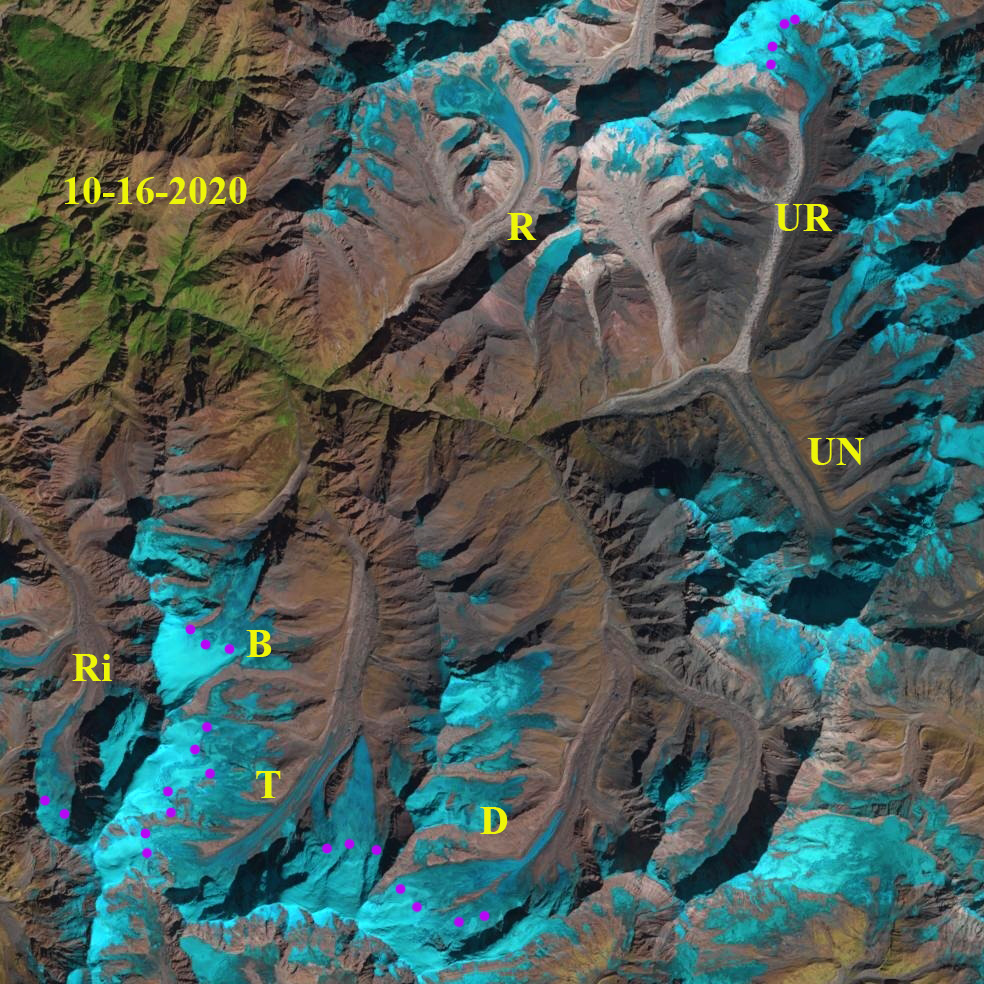
Nanda Devi region glaciers in 10-16-2020 image indicating the snowline at between 5800 and 6000 m on all the glaciers in the upper Rishi Ganga: Bethartoli (B), Dakshini (D), Ramani (R), Rinti (Ri), Trisul (T), Uttar Nanda Devi (UN), Uttar Rishi (UR).
On 7 February 2021, a catastrophic mass flow descended from the steep north face of Ronti Peak and then descended the Rishiganga, and Dhauliganga valleys in Chamoli, Uttarakhand, India, causing widespread devastation and severely damaging two hydropower projects (Shugar et al 2021). This event occurred after a post-monsoon season featuring high snowlines on adjacent glaciers and the warmest January in the last six decades in Uttarakhand, India. and warmth across the region (Pelto et al, 2021; Matthews et al, 2021). By mid October the snowline on the glaciers had risen to ~5800-6000 m on glaciers in the region which is above the landslide initiation location, see above. More than 200 people were killed or are missing. The~27 × 106 cubic meters of rock and glacier ice collapsed and rapidly transformed into an extraordinarily large and rapidly moving debris flow that scoured the valley walls up to 220 meters above the valley floor (Shugar et al 2021).
Aru Glacier, Tibet
A 3 km long glacier collapsed in an ice avalanche on July 17, 2016, killing nine herders living in their summer pasture at Aru Village, Xizang Autonomous Region, China (Tian et al 2016). The Aru Glacier, ranged in elevation from 5250 to 6150 m. The collapsed ice flowed/slid downslope within 4–5 min over the narrow terminus tongue and swept across the gently-sloping alluvial fan, reaching Aruco Lake. The average depth of the deposits was estimated to be 7.5 m indicating a total volume of fallen ice of at least 70 million m3, or equivalent to an average glacier thickness loss of ~21 m (Tian et al 2016). Both glaciers had a mass balance gain in years prior to the collapse.
Air temperature at the nearest state-run meteorological station had increased by ~1.5°C over the past five decades. The total precipitation in the area prior to the accident had been the highest in the 2010–16 period exceeding the average value by 88% (Tian et al 2016).The event occurred in the midst of the summer monsoon during a period of wet weather. The warm wet weather likely pre-conditioned the event. There is no evidence of a previous event at this site.(Jacquemart et al 2020) concluded this event was triggered by unusably high meltwater input.
Leones Glacier, Chile

Leones Glacier in March 2015, Jill Pelto Photograph
Leones Glacier is a lake terminating outlet glacier on the east side of the Northern Patagonia Icefield. In late 2014 or early 2015 a landslide spread onto the Leones Glacier from an adjacent mountain slope. My daughter Jill took this image out a plane window returning from field work in the Falkland Islands, illustrating the landslide. Landsat images from 2014 (before) and 2015 (after) indicate the 1.5 km2 size of the landslide debris cover on the glacier. By 2020 the landslide had migrated downglacier, but there is also debris cover further upglacier suggesting an additional smaller landslide, from a bedrock ridge in an icefall area. The glacier had been thinning 1 m/year and had a high snowline averaging above 1300 m in 2013, 2014 and 2015, which would further debuttress the mountain slope (Glasser et al 2016: Pelto, 2017).
Amalia Glacier, Chile
Amalia Glacier is a rapidly thinning outlet glacier of the Southern Patagonia Icefield. A 2019 landslide from the northeast slopes of Reclus Volcano with a volume of 262 ± 77 × 106 m3 disrupted 3.5 km2 of Amalia Glacier’s surface (Van Wyck de Vries et al 2022). Retreat had debuttressed the ice marginal mountain side that failed. The glacier briefly accelerated and then decelerated after the landslide.
Santa Lucia, Chile
On December 16, 2017 a rock landslide was triggered that transitioned into a debris flow incorporating much of a glacier before destroying most of Santa Lucia killing 18 people (Duhart et al 2019). The landslide occurred following an intense rainfall event with 122 mm of rain in 24 hours and a two week period of high temperatures. The flow had a volume of 7.2 million m3 with a flow velocity of 72 km/hour.

 From a Glaciers Perspective