Norðurjökull Retreats from Hvítárvatn, Langjökull, Iceland

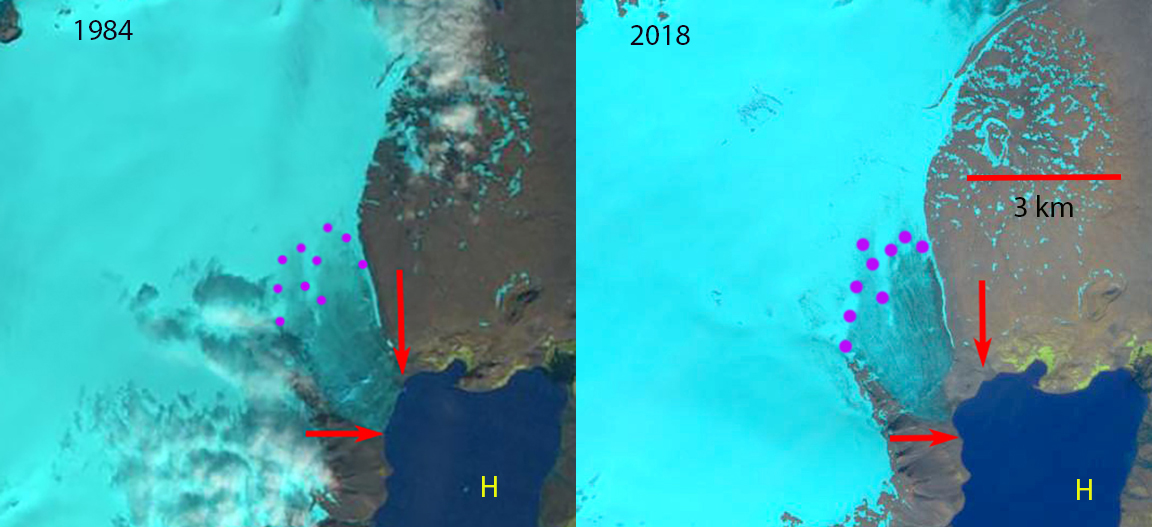
Norðurjökull in 1984 Landsat image and 2018 Sentinel image.  Red arrows indicate the margins of the glacier in 1984.  Purple dots indicate the snowline.

Langjökull is the second largest icecap in Iceland with an area of 920 square kilometers (Jóhannesson (2009). One of the main outlet glaciers of Langjökull is the Norðurjökull which has terminated in Hvítárvatn. Hvítárvatn is a large lake that recieves 70% of its inflow from Langjökull (Flowers et al, 2007). The lake has a maximum depth of 84 m and a surface area of 30 square kilometers.

The mass balance of Langjökull has been reported to the since 1997.  The mass balance has been negative in 20 of the 21 years of reported data, with a loss of 18 m of water equivalent since 1997 (VAT). This is 8-10% of the volume of the ice cap (Guðmundsson et al, 2008).  Pope et al (2010) observed that Langjökull has lost an area of 3.42.5 square kilometers/year over the decade.

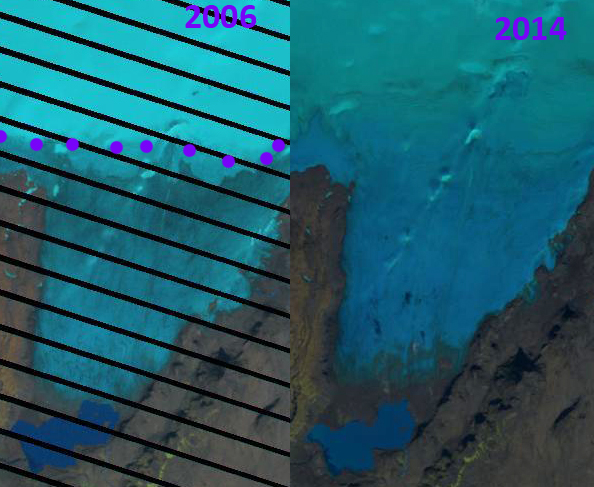
Here we examine the changes in Norðurjökull from remote sensing imagery from 1984, 1994, 2006, 2014 and 2018.  In 1984 the glacier terminated in Hvítárvatn along a width of 1100 m and the snowline is at 800 m.  In 1994 the width of the terminus front in the lake has increased by 100 m indicating a small advance. By 2006 the width of the glacier front in Hvítárvatn has been reduced to 600 m and the snowline is at 1000 m.  By 2014 this connection with the lake is just 300 m.  In the two Sentinel images from 2018 the terminus no longer reaches the shore of Hvítárvatn. Iceberg calving will no longer be a consideration at this outlet glacier.  The snowline on 8/11/2018 is at 800 m rising to ~950 m by 8/25/2018. The retreat of this glacier is like that of other Langjökull outlets Hagafellsjokull and nearby Porisjokull. The retreat has been less significant than the thinning, Pope et al (2016) illustrated this for the 1994-2007 period.


Norðurjökull in 1994 Landsat image and 2018 Sentinel image.  Red arrows indicate the margins of the glacier in 1984.  Purple dots indicate the snowline.
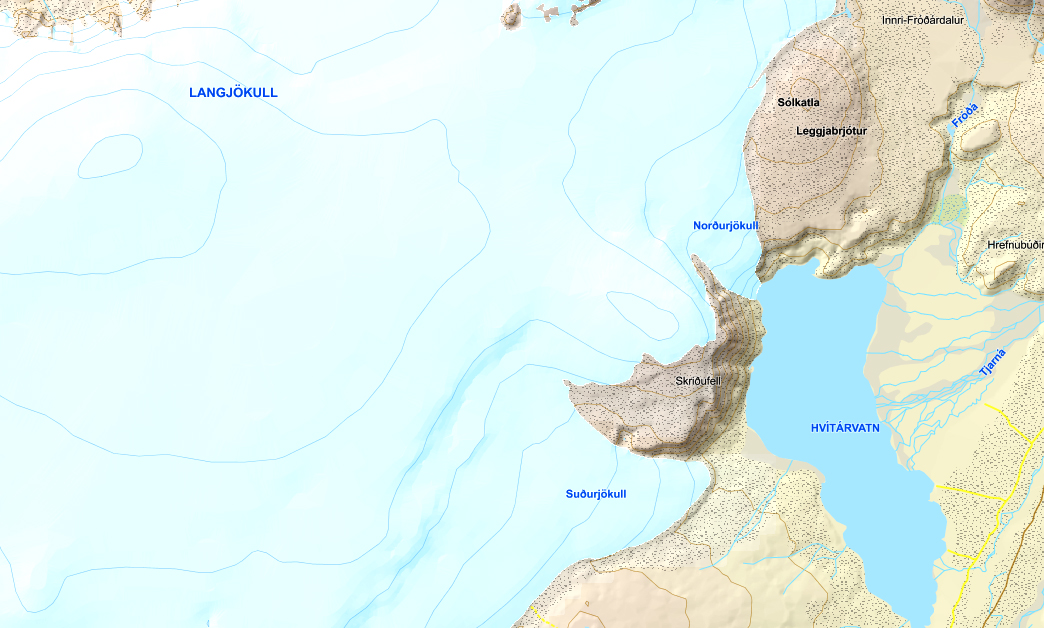
Langjökull map showing terminus.

Aug. 1, 2019 Landsat image indicating the snowline reached the crest of the icecap at Norðurjökull in 2019.

Norðurjökull in 2006 Landsat image and 2014 Digital Globe image. Glacier still in contact with the lake.

Hagafellsjokull, Iceland Reflects Langjokull Thinning & Retreat

hagafellsjokull-compare

Landsat comparison of the terminus of Hagafellsjökull from 2000 and 2016.  The red arrows are the 2000 terminus, the yellow arrows the 2016 terminus.  Purple arrows indicate upglacier thinning. 

Langjökull is the second largest iceap in Icalnd with an area of over 900 square kilometers. The mass balance of the icecap has been reported since 1997 and his lost over 1 m per year during this period (WGMS, 2016).  Pope et al (2010) noted that the icecap has lost an area of 3.4 ± 2.5 km2 yr-1 over the decade from 1997-2007.  Pope et al (2010) noted that the loss of ice volume confirms previously published predictions that Langjökull will likely disappear within the next 200 years if current trends continue. A key outlet of  Langjökull is  Hagafellsjökull which terminates in Hagvatn. Hagafellsjökull ended a sustained post Little Ice Age retreat in 1970.  The ensuing advance of approximately 1 km ended by 2000.  Here we examine Landsat imagery from 2000-2016 to identify recent changes in this outlet glacier.

In 2000 the glacier terminated on an island in Hagavatn, red arrow.  The east margin of the glacier featured several locations where secondary termini overflowed a low ridge on the east side of the glacier.  By 2006 the glacier had retreated 500-600 m from the island.  By 2016 the terminus had retreated across its entire width by 800-850 m, 50 m/year, yellow arrows.  A closeup view from the Iceland online map application illustrates the 2014 terminus red dots. The end of the glacier has a low slope, low velocity and is debris covered.  The western side has terminated on land during this entire period and has approximately the same retreat rate as the eastern half that still ends in the expanding lake. There is little evidence of iceberg release into the lake, which helps explain the similar retreat rate. The low slope and upglacier thinning noted at the purple arrows indicate the retreat will continue.  In 2014 the transient snowline reached near the head of the glacier at over 1100 m.  In 2000, 2006 and 2016 the snowline with several weeks left in melt season ranged from 859-950 m. The retreat is similar to that of Norðurjökull another outlet of the Langjökull and Porisjokull.

langjokull-south-outlet-ge-2010

Google Earth view of the terminus of Hagafellsjökull in 2014. Red arrow is the 2000 terminus position and yellow arrow the 2014 position.

 hagafellsjokull-ismap

Online Iceland Map Viewer indicating the terminus of Hagafellsjökull in 2014, red dots.

hagafellsjokull-tsl

2006 and 2014 Landsat images of Hagafellsjökull indicating the transient snowline off the image in 2014 and at 850 m in 2006.