Sonderarm Glaciers Retreat, Southern Greenland

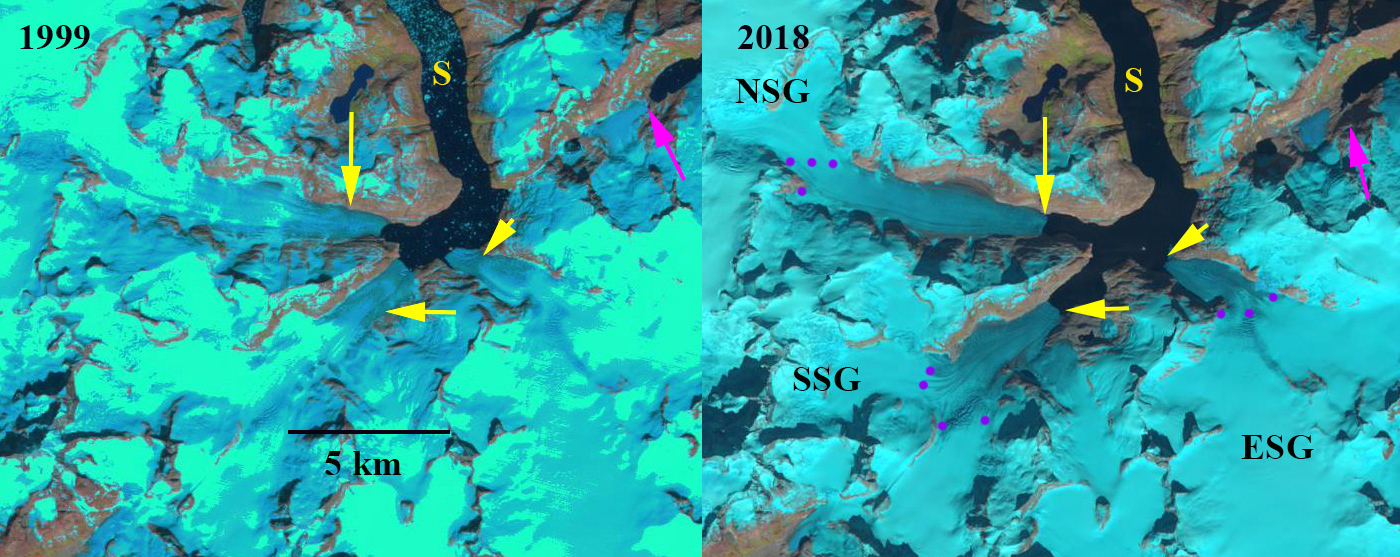
Three glaciers at the head of Sonderarm fjord in 1999 and 2018 Landsat images.  Yellow arrows indicate terminus location in 2018 of each glacier, pink arrow indicates a separate valley glacier that has diminished.

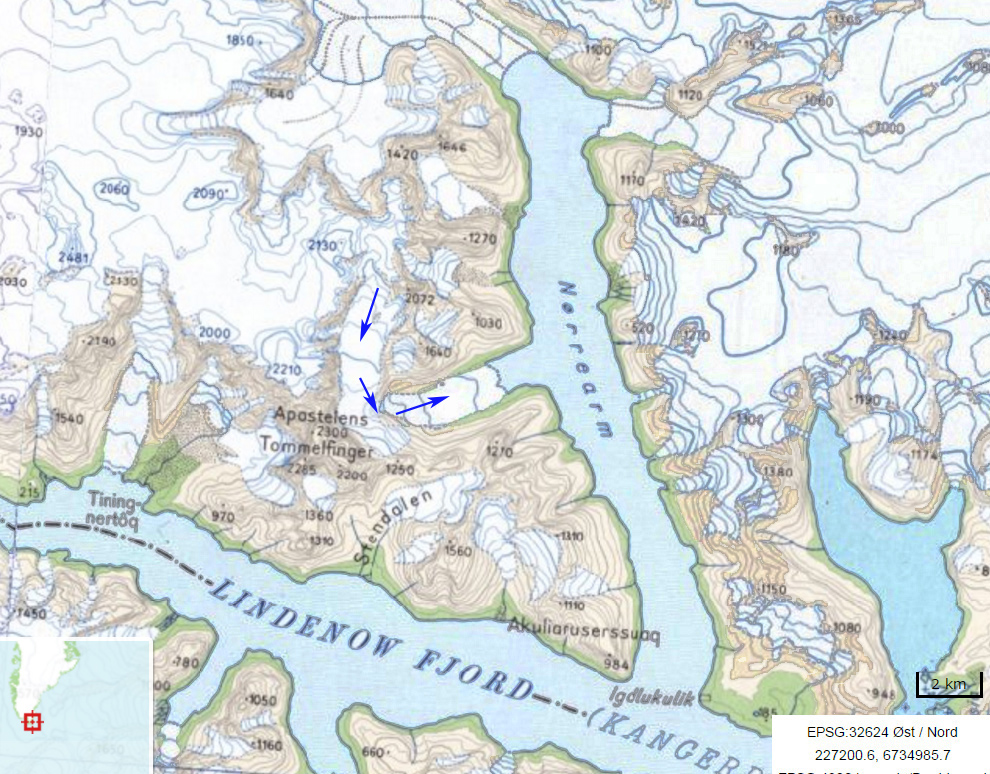
Sonderarm is a fjord that extends south from Lindenow Fjord in southern Greenland. The glacier is a short distance east of Kangersuneq Qingordleq, where recent retreat has led to glacier separation and a just south of Norrearm where glacier retreat has led to fjord extension.

In 1999 the Eastern Sonderarm Glacier (ESG) extended beyond its inlet into Sonderarm.  The Southern Sonderarm Glacier (SSG) extended to the end of its arm of the fjord.  The Northern Sonderarm Glacier (NSG) terminated 600 m from the end of its arm of the fjord.  At the pink arrow the separate valley glacier was just in contact with tidewater.  By 2002 there was significant narrowing of the terminus front of ESG and the separate valley glacier no longer reaches tidewater.  There is considerable calving in Sonderarm, with NSG appearing to be the most active. In  2017, the snowline is relatively high at 700-800 m in early August, there is limited calving evident in Sonderarm.  By 2018 the retreat of NSG is 1100 m since 1999, of SSG 1300 m and of ESG 400 m with a significant reduction in the width of the calving front. The snowline in 2018 is again above 700 m in early August.  There are no evident icebergs in Sonderarm.  The separate valley glacier now terminates 300 m from tidewater.  The reduction in calving accompanying retreat indicates that it is surface melt as indicated by higher snowlines that is driving retreat of the Sonderarm glaciers.  NSG begins at 1200 m with only a limited area above 1000 m, while ESG and SSG begin at 1000 m.

Greenland tidewater outlet glaciers in this region have experienced substantial retreat since 1990 (Weidick et al 2012).  Murray et al (2015) examined 199 tidewater glaciers in Greenland and noted significant retreat of 188 of them.
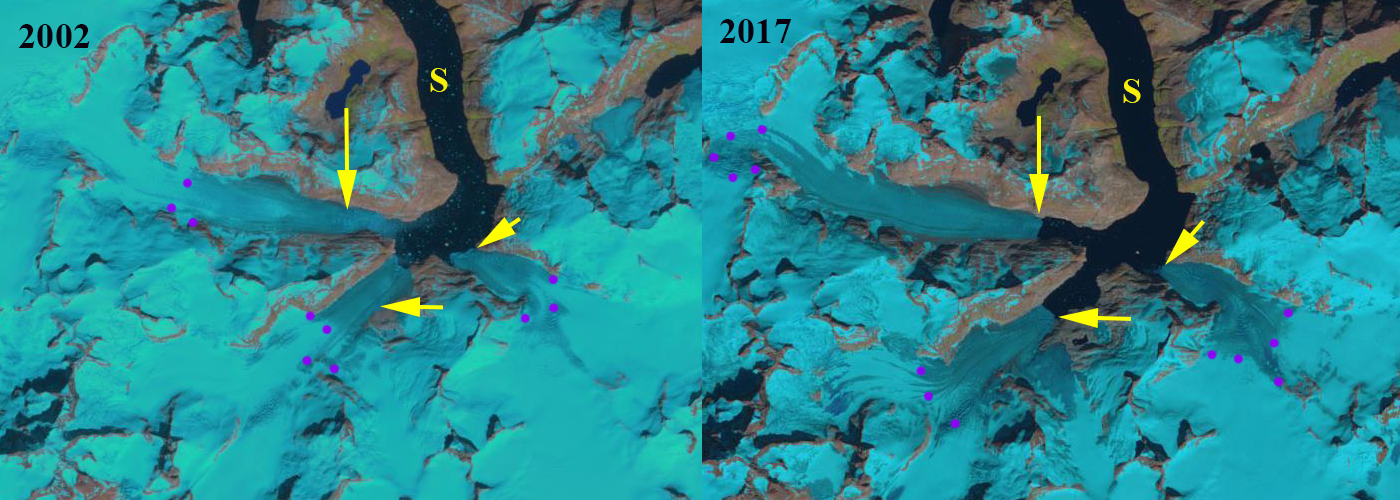
Three glaciers a the head of Sonderarm fjord in 2002 and 2017 Landsat images.  Yellow arrows indicate terminus location in 2018 of each glacier and purple dots the snowline.
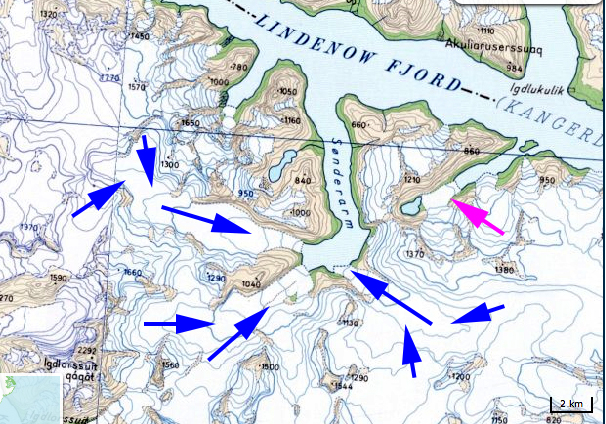
Sonderarm region map with glacier flow of the three Sonderarm glaciers in blue.  Pink arrow indicates valley glacier that has diminished and formerly reached tidewater.

Norrearm Fjord Glacier Retreat, Greenland

norrearm-compare

Apostelens Glacier in Norrearm Fjord Landsat comparison from 1999 to 2016. Red arrows are the 1999 terminus location, yellow arrows the 2016 terminus location and purple arrows indicate an expanding bedrock ridge.

“Apostelens” Glacier drains east from a peak of the same name into an arm of Norrearm Fjord, which in turn is part of Lindenow Fjord in southern Greenland. The glacier is a short distance north of Kangersuneq Qingordleq, where recent retreat has led to glacier separation. The glacier is soon to lose its tidewater connection as has occurred at Tasermiut Fjord to the west.  This will result in a decline in iceberg production as well.

Here we examine Landsat imagery from 1999-2016 to identify glacier change.  In 1999 the Apostelens arm of Norrearm Fjord is largely filled by the glacier which extends to within 2.5 km of Norrearm Fjord, red arrow.  The tongue contains numerous ogives formed each year due to seasonal velocity changes through an icefall.  This is evident in the Google Earth image from 2004, where 24 ogives are evident on the low slope glacier tongue, in 1999 the number is over 30. By 2013 the glacier has retreated nearly 2 km from the 1999 terminus position, red arrow. In 2012 Google Earth imagery indicates increased crevassing near the front and the loss of most ogives.  New ogive formation is also hard to distinguish.  By 2016 the glacier has retreated 2.6 km and is nearing the headward limit of the fjord arm.  The collapse of the fjord tongue and its associated ogives indicates the loss of 30 years worth of volume flux that emerged from the icefall that generated the ogives.

Greenland tidewater outlet glaciers in this region have experienced substantial retreat since 1990, Weidick et al (2012) and Howat and Eddy (2011).  Murray et al (2015) examined 199 tidewater glaciers in Greenland and noted significant retreat of 188 of them.  Apostelens Glacier was not one of these, and soon will not be a tidewater glacier to be included in the list.

norrearm-ge

Apostelens Glacier in Norrearm Fjord Google Earth comparison from 2004 and 2012. Red arrows are the 2004 terminus location, and yellow arrows the 2012 terminus location.  Note ogives in 2004 and loss of them in 2012. 

norrearm-map

Map of the Norrearm Fjord region and Apostelens Glacier, with blue arrows indicating flow.