Neumayer Glacier 8.8 km retreat 1999-2020 Fjord Expansion

Neumayer Glacier (N) in 1999 and 2020 Landsat images. Red arrow is 1999 terminus position, pink arrow 2016 terminus location and yellow arrow March 2020 terminus location. K=Konig and T=Three Brothers Tributary, L=glacial lake.

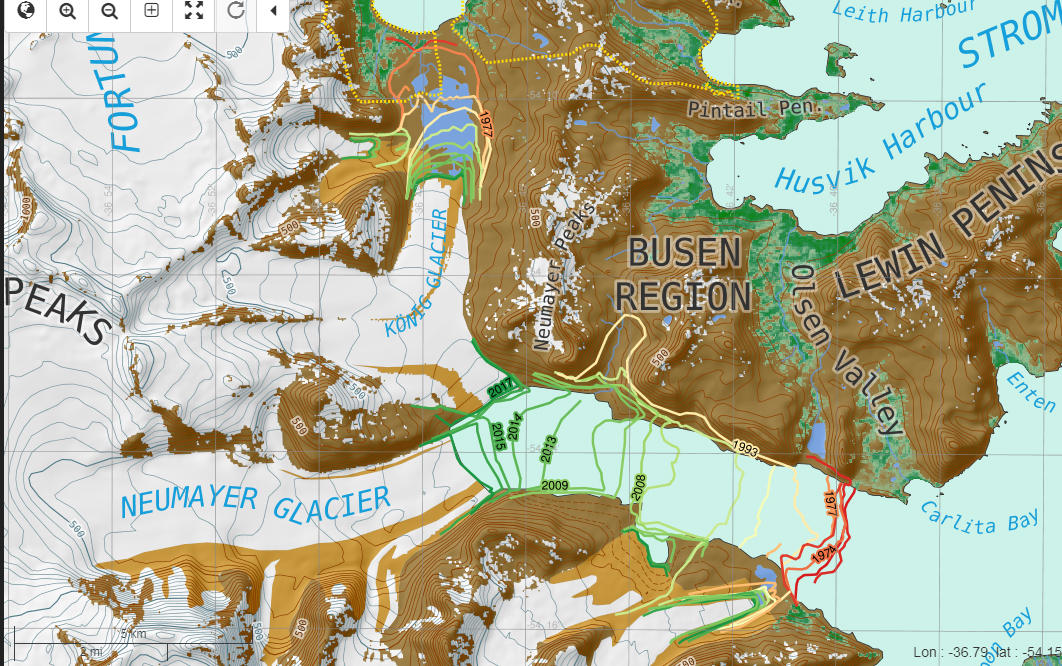
Neumayer Glacier, South Georgia  is a calving glacier that has been retreating rapidly since 1993 that was dynamically connected to the Konig Glacier along its southern margin just where the glacier turns northeast  The glacier ends in a fjord that until recently was too short to be given a name, that empties into Cumberland Bay.  Gordon et al., (2008) observed that larger tidewater and sea-calving valley and outlet glaciers generally remained in relatively advanced positions until the 1980’s.  After 1980 most glaciers receded; some of these retreats have been dramatic (NASA, 2017).  The BAS has a mapping function that provides glacier front positions since early in the 20th century (Cook et al 2010). For Neumayer Glacier the 1938 position is 3.5 km down fjord from the 2006 position. There was essentially no retreat up to 1974 and limited retreat up to 1993. Here we examine 1999-2020 Landsat imagery to identify glacier change.

In 1999 and 2002 the glacier extends passed the junction with Konig Glacier terminating in 2 km wide calving front. By 2002 the glacier had retreated 0.5 km, by 2006 1.8 km, by 2011 3.0 km and by 2016 5.3 km.  A glacier dammed lake (L) along the north shore of the fjord no longer exists in 2016 and one tributary from the south is no longer connected. The glacier appears to have retreated into a deeper section of the fjord then where it ended from 1970-2002. The glacier is on the verge of separation into two main tributaries, Konig and Neumayer. In 2016 the calving front is 1.6 km long for Neumayer.  Konig Glacier has a 1.3 km long tidewater front, but has limited calving. In 2018 I reported that the glaciers had separated (Pelto, 2018), with Neumayer Glacier still being in rapid retreat and Konig Glacier changing little. A tributary (T) from the south that parallels the Three Brothers Range, is still connected to Neumayer Glacier. In January 2020 the glacier remains connected to tributary (T). By early March 2020 the glacier has further retreated separating from tributary (T).  The total retreat from 1999-2020 is 8.8 km, a retreat rate of over ~420 m/year. In the BAS map it is evident that there is a smaller slope change 2 km from the current terminus and a large slope change 5 km from the current terminus.  The former may represent the end of the fjord or at least a significant shallower.  The latter slope change is certainly the end of the low slope valley reach of the glacier, whether that be a shallow fjord or not. This is one of the most dramatic South Georgia glacier retreats along with Ross and Hindle Glacier (Pelto, 2017). Cook et al (2010) noted the average retreat of glaciers in this area of South Georgia of 60 m/year for the

Neumayer Glacier (N) in 2002 and 1-2020Landsat images.Red arrow is 2002 terminus position, pink arrow 2016 terminus location and yellow arrow March 2020 terminus location. K=Konig and T=Three Brothers Tributary.

Neumayer Glacier (N) in 2016 and 2018 Landsat images. Red arrow is 2002 terminus position, pink arrow 2016 terminus location and yellow arrow March 2020 terminus location. K=Konig and T=Three Brothers Tributary.

Neumayer Glacier (N)  in South Georgia GIS Map from the BAS showing terminus change. 
Konig Glacier, South Georgia Separates from Neumayer Glacier in 2017

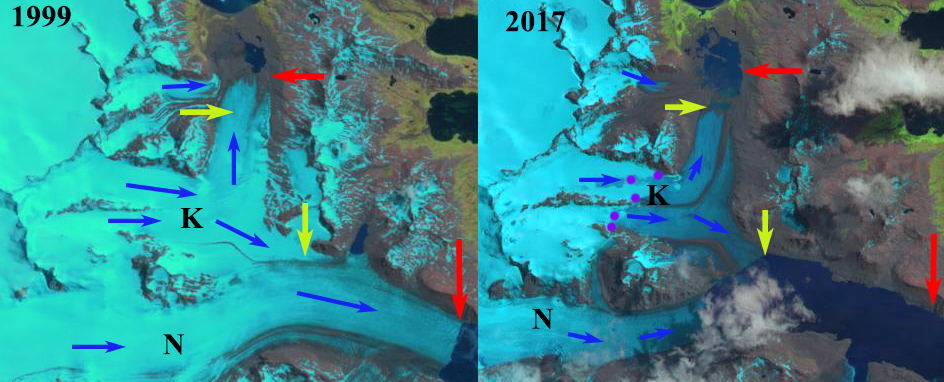
Konig Glacier (K) terminus retreat compared in 1999 and 2017 Landsat images.  The red arrow indicate the 1999 terminus location, yellow arrows 2017 terminus location and blue arrows the surface movement. The southern terminus formerly connected with Neumayer Glacier (N) is now separate.

Konig Glacier is a land terminating glacier just north of the Neumayer Glacier, on the northwest coast of South Georgia.  The glacier has a split terminus, a northern terminus ending on an outwash plain near Fortuna Bay and a southern terminus that has merged with Neumayer Glacier. In 1977 the glacier extended to within 300 m of Fortuna Bay and no proglacial lake existed (BAS map).  Neumayer Glacier is a calving glacier that has retreated 5600 m from 1999 to 2016 and is dynamically connected to the Konig Glacier along its southern margin just where the glacier turns northeast. Gordon et al., (2008) observed that larger tidewater and sea-calving valley and outlet glaciers generally remained in relatively advanced positions until the 1980’s.  After 1980 most glaciers receded; some of these retreats have been dramatic and a number of small mountain glaciers will soon disappear.  Here we examine 1999-2017 Landsat imagery to identify glacier change.

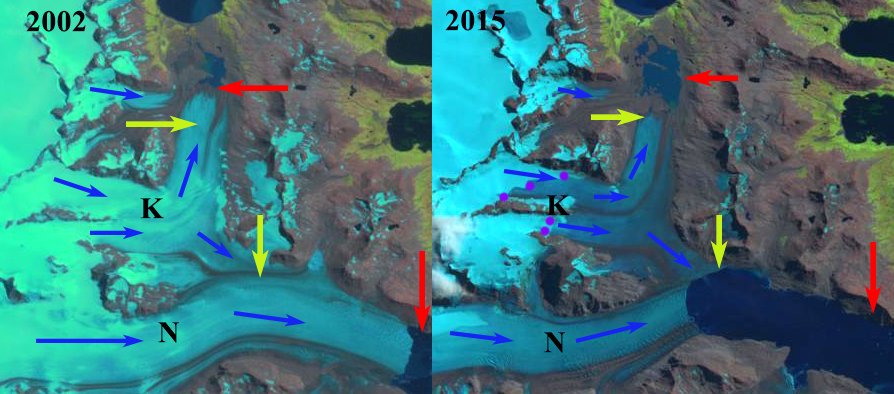
In 1999 the southern terminus merged with Neumayer Glacier and extended several kilometers down the fjord.  The northern terminus ended in a proglacial lake adjacent to a tributary joining from the west.  By 2002 glacier retreat had expanded the lake at the northern terminus while limited retreat had changed little at the southern terminus.  In 2006 the northern terminus is at the southern margin of the proglacial lake.  By 2015 the northern terminus had separated from the western tributary and the terminus had retreated from the proglacial lake.  The proglacial lake had expanded in width possibly due to ice cored moraine metling.  The snowline, purple dots, in 2015 is at 550 m.  By 2017 the southern terminus of Konig Glacier has separated from the rapidly retreating main trunk of Neumayer Glacier.  The northern terminus has retreated 1100 m since 1999 and a new upper proglacial lake is forming at the terminus. The western tributary no longer approaches Konig Glacier. The medial moraine running down both the southern and northern arm have expanded in prominence suggesting enhanced ablation.  The snowline in December 2017 is at 450 m with several months of the melt season to go.  The retreat of Konig Glacier is like that of land terminating Purvis Glacier. While glacier separation has also been since at Ross and Hindle Glacier.

Map of terminus positions of Konig and Neumayer Glacier, South Georgia from the British Antarctic Survey online map site.

Konig Glacier (K) terminus retreat compared in 2002 and 2015 Landsat images.  The red arrow indicate the 1999 terminus location, yellow arrows 2017 terminus location and blue arrows the surface movement. The southern terminus is still connected with Neumayer Glacier (N).

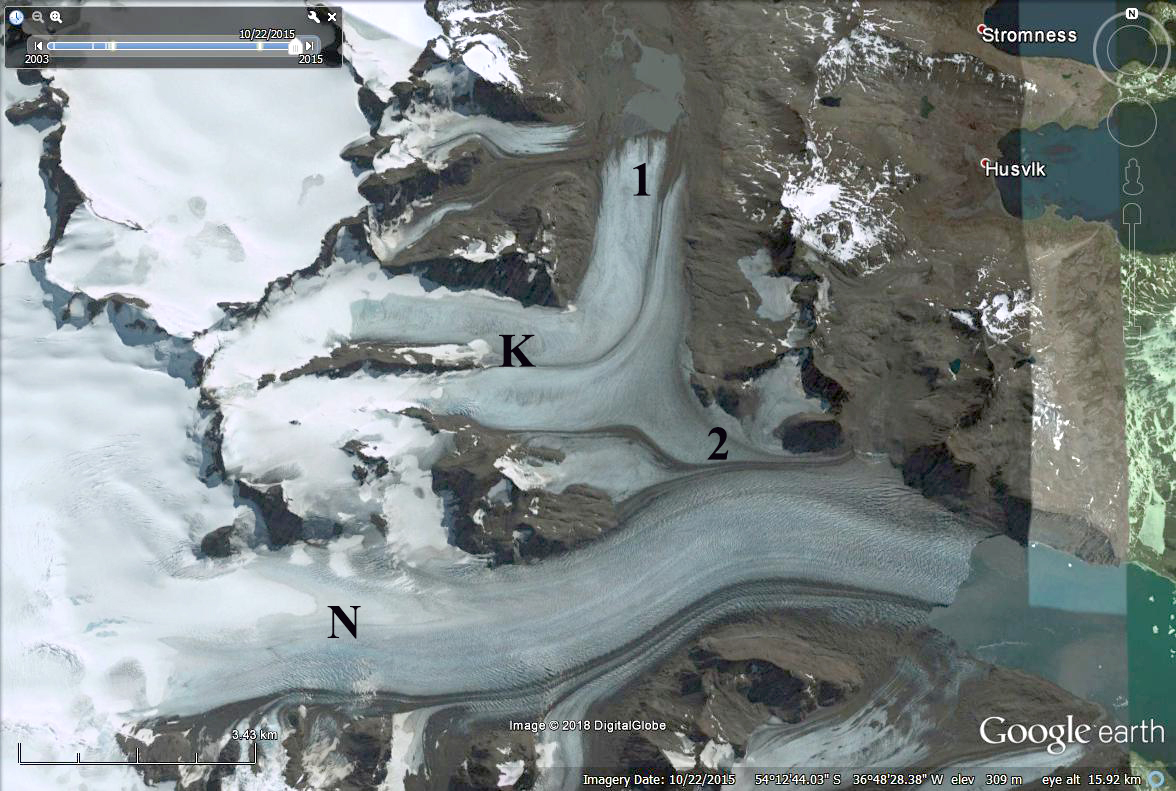
Konig Glacier in 2006 Google Earth image indicating northern terminus (2) and southern terminus (1).


Neumayer Glacier, South Georgia, 5.6 km retreat 1999-2016


neumayer 2016

Comparison of Neumayer Glacier in 1999 and 2016 Landsat images; red arrow indicates 1999 terminus locations, yellow arrows 2016 terminus locations. Purple arrows indicate upglacier thinning.

South Georgia sits amidst the circum Antarctic westerlies and its maritime climate leads to numerous glaciers. This region is famous for the endless march of storms parading around Antarctica . The island is south of the Antarctic Convergence, preventing any truly warm season from persisting. The cool glaciers covering a majority of the island and quite low equilibrium line altitudes. Neumayer Glacier is one of the largest tidewater glaciers on South Georgia. Sugden, Clapperton and Pelto (1989) noted the ELA of Neumayer Glacier at 550 m.

The BAS has a mapping function that provides glacier front positions since early in the 20th century. For Neumayer Glacier the 1938 position is 3.5 km down fjord from the 2006 position. There was essentially no retreat up to 1974 and limited retreat up to 1993. Gordon et al., (2008) observed that larger tidewater and sea-calving valley and outlet glaciers generally remained in relatively advanced positions until the 1980s. After 1980 most glaciers receded; some of these retreats have been dramatic.

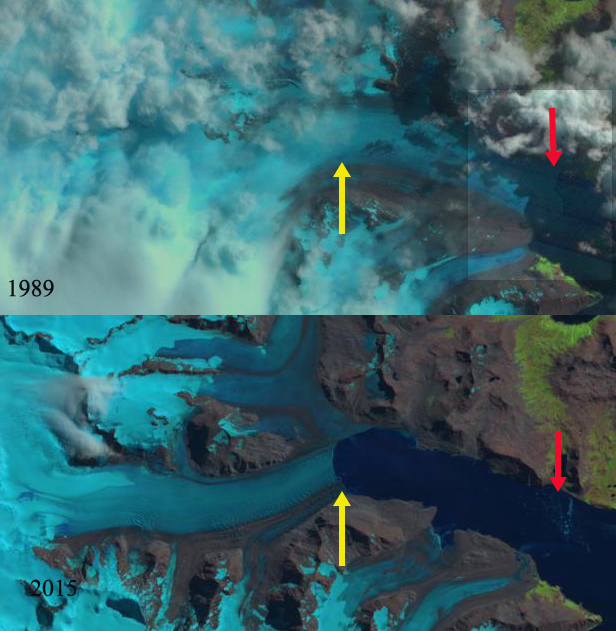
Landsat Images from 1999 to 2016 indicates retreat of 5600 m from the red to the yellow arrow, this is 350 m/year. A glacier dammed lake along the north shore of the fjord no longer exists in 2016. The glacier appears to have retreated into a deeper section of the fjord then where it ended from 1970-2002. The glacier is on the verge of separation into two main tributaries. This will enhance calving from the glacier, and promote additional mass loss and retreat. This retreat will impact Konig Glacier to the north, which is connected to the Neumayer Glacier. Below the comparison of terminus location from 1989 to 2015 indicates a retreat of 6700 m.  NASA Earth has piggy backed on this assessment, with excellent recent imagery. Calving rate increases with water depth.  Calving rate increases with water depth and the degree of glacier flotation. Flotation depends on water depth, ice thickness and the number of pinning points. Pelto and Warren (1991) provided an expanded version of the water depth/calving relationship first quantified by Brown and others (1982). In the you would have never guessed it category, is the glacier retreat has been an aid to the rat population, as the glacier tongues used to corner populations.

BAS Glacier front map

neumayer compare

Comparison of Neumayer Glacier in 1989 and 2015 Landsat images; red arrow indicates 1989 terminus locations, yellow arrows 2015 terminus locations.


Konig Glacier Retreat, South Georgia Island

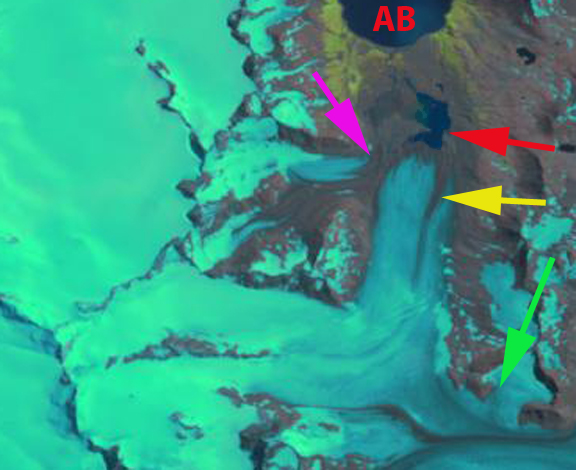
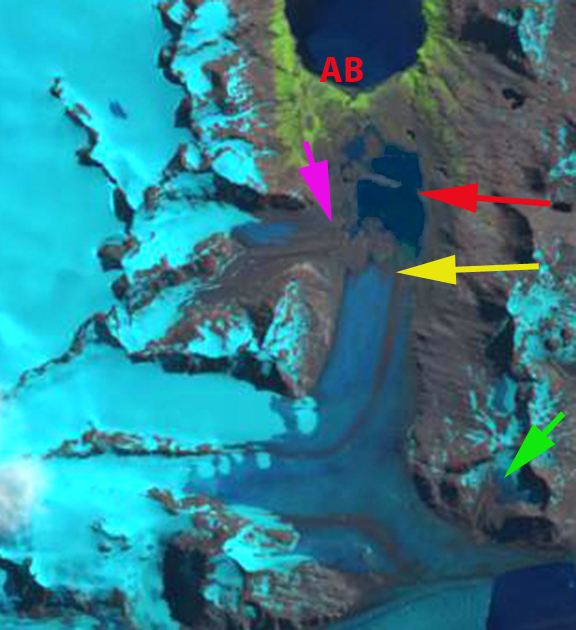
Konig Glacier is a land terminating glacier just north of the Neumayer Glacier, ending on an outwash plain in the Antarctic Bay (AB) on the northwest coast of South Georgia. In 1977 the glacier extended to within 300 m of Antarcic Bay and no proglacial lake existed (BAS map). Neumayer Glacier is a calving glacier that has retreated 4800 m from 1999 to 2014 and is dynamically connected to the Konig Glacier along its southern margin just where the glacier turns northeast. Gordon et al., (2008) observed that larger tidewater and sea-calving valley and outlet glaciers generally remained in relatively advanced positions until the 1980s. After 1980 most glaciers receded; some of these retreats have been dramatic and a number of small mountain glaciers will soon disappear. konig glacier ge Here we examine changes in Konig Glacier from 1999 to 2014 using Landsat imagery. In 1999 the glacier ended in a proglacial lake at the red arrow, where a terminal moraine developed across the lake. A tributary glacier from the west joins the Konig Glacier near the terminus in 1999, pink arrow. At the green arrow is a small cirque-valley glacier that joins the Neumayer Glacier near the boundary with Konig Glacier. In 2003 there has been limited retreat of the main terminus since 1999 and of the west tributary at the pink arrow, the British Antarctic Survey mapping shows that the two glacier had separated by 2003. The side cirque glacier at the green arrow is still connected. By 2005 a closeup of the terminus in Google earth indicates the low slope, lack of crevasses and developing outwash plain at the terminus. The terminal moraine in the middle of the lake marking the 1993 terminus position is also evident (BAS). The retreat from this moraine by 2005 is 500m. In 2014 the glacier has retreated from to the yellow arrow, this is an 800 m retreat in 15 years from the 1999 red arrow terminus. The proglacial lake is now 1500 m across and the terminus is 2300 m from Antarctic Bay. The west gtributary at the pink arrow is fully separated. The side cirque glacier at the green arrow no longer is connected to the Konig-Neumayer Glacier. This indicates considerable thinning of the junction of these two glaciers which will result in further retreat of Konig Glacier.
konig glacier 1999
1999 Landsat image
konig glacier 2003
2003 Landsat image

konig terminus
Google earth image 2005

konig glacier 2014
2014 Landsat image

Neumayer Glacier, South Georgia Retreat

South Georgia sits amidst the furious if not screaming fifties latitude belt, the circum Antarctic westerlies. This region is famous for the endless march of storms parading around Antarctica. The island is south of the Antarctic Convergence, preventing any truly warm season from persisting. The cool maritime climate leads to numerous glaciers covering a majority of the island and quite low equilibrium line altitudes. Sugden, Clapperton and Pelto (1989-sorry no good link to this paper, one of the first I worked on), 1989 noted the ELA of Neumayer Glacier at 550 m. The tidewater glaciers of South Georgia in general maintained fairly advanced positions unitl 1980. Gordon et al., (2008) observed that larger tidewater and sea-calving valley and outlet glaciers generally remained in relatively advanced positions until the 1980s. After 1980 most glaciers receded; some of these retreats have been dramatic and a number of small mountain glaciers will soon disappear. Neumayer Glacier is one of the large tidewater glaciers on South Georgia. Maps from the British Antarctic Survey (BAS) and satellite imagery are used here to assess the changes in this glacier terminus position. A view of the entire glacier in 2006 from Google Earth, from beyond its calving terminus, indicates indicates the glacier remains vigorous with extensive crevassing at the calving front and extensive snowcover above the ELA. The BAS has a mapping function that provides glacier front positions since early in the 20th century. For Neumayer Glacier the 1938 position is 3.5 km down fjord from the 2006 position. There was essentially no retreat up to 1974 and limited retreat up to 1993. . In 2004 and 2009 NASA provided two images of Neumayer Glacier indicating retreat from 2004 when the glacier extended to the down fjord edge of a tributary glacier from the south. By 2009 the glacier has retreated upglacier of this now former tributary, this retreat is 1300 m. Landsat Image from 1999 to 2014 indicates retreat of 4800 m from the red to the green arrow , this is 320 m/year. The glacier appears to have retreated into a deeper section of the fjord then where it ended from 1970-2002. This will enhance calving from the glacier, and promote additional mass loss and retreat. This retreat will impact Konig Glacier which is connected to the Neumayer Glacier. Calving rate increases with water depth and the degree of glacier. Pelto and Warren (1991) provided an expanded version of the relationship first quantified by Brown and others (1982). In the you would have never guessed it category, is the glacier retreat has been an aid to the rat population, as the glacier tongues used to corner populations.neumayer 1999

newmayer 2014