Mount Everest Region Glaciers December 2019 Limited Accumulation Area

Mount Everest region snowline identified on Dec. 11, 2019 Landsat image (yellow dots).  Green dots indicate the terminus and pink arrows flow direction of specific glaciers: T=Trakarding, DN=Drogpa Nagtsang, M=Melung, BK=Bhote Koshi, S=Shalong, Y=Yanong, G=Gyabarg, YN=Yanong North, GY=Gyachung, J=Jiuda, R=Rongbuk, ER=East Rongbuk, I=Imja, L=Lhotse, M=Marala, K=Khumbu, N=Ngozumpa.

The winter monsoon for the Himalaya is a dry cold period with limited new snow accumulation.  The Landsat image of Dec. 11, 2019 highlights the snowline at 5500-6200 m on glaciers around Mount Everest.  This high of an elevation indicates the accumulation area of the glaciers is too small to sustain the current ablation areas. This is explored in detail below. King et al (2019) found during the 2000-2015 period Himalaya mass balance losses of debris-covered and clean-ice glaciers to be substantially the same, with mass balance loss for lake-terminating glaciers being significantly higher. The overall mean was −0.39  m/year.  Maurer et al (2019) found a doubling of the average rate of loss across the Himalaya during 2000–2016 relative to the 1975–2000 interval. King et al (2017) observed the mass balance of 32 glaciers in the Mount Everest area from 2000-2015 finding a mean mass balance of all glaciers was −0.52 m/year, increasing to -0.7 m/year for lake terminating glaciers. Brun et al (2017) identify a mean balance of -0.33 m/year for 2000-2016 in Eastern Nepal, similar to King et al (2019) and not the highest loss rate in the region. Dehecq et al (2018) examined velocity changes across High Mountain Asia from the 2000-2017 period identifying a widespread slow down in the region.  The key take away is warming temperatures lead to mass balance losses, which leads to a velocity slow down, and both will generate ongoing retreat.

For an alpine glacier to be in equilibrium requires at least 50% of its area to be in the accumulation zone, this is the accumulation area ratio (AAR).  On Dec. 11, 2019 the snowline indicates where the accumulation zone begins.  The elevation ranges from 5500 m on Melung Glacier to 6200 m East Rongbuk Jiuda and Gyabarg Glacier.  The area above the snowline, AAR, is less than 30% of the total glacier on: Trakarding, Drogpa Nagtsang, Melung, Bhote Koshi, Shalong, Yanong, Gyabarg,  Jiuda, Rongbuk, East Rongbuk, Imja, Lhotse, Marala Glacier.  Gyachung and North Yanong Glacier have an AAR between 30 and 40%. Khumbu and Ngozumpa Glacier have a high mean elevation and an AAR of close to 50%.

In 2015 and again in 2018 high winter snowlines indicated the same process in the Mount Everest region. See below the rise from Nov. 2017 to Feb. 2018 to similar elevation as seen in Dec. 2019. The high snowlines indicate an accumulation area that is too small to maintain these glaciers, which drives continued retreat, such as reported at Drogpa Nagtsang and Yanong Glaciers.

Dec. 11, 2019 snowline:

6200 m =East Rongbuk, Jiuda, and Gyabarg

6100 m = Gyachung,

5900 m= Rongbuk, Imja, Lhotse

5800 m=Trakarding, Melung, Yanong North

5700 m= Ngozumpa, Drogpa N., Yanong, Shalong, Bhute Khosi

5600 m= Marala, Khumbu

5500 m= Melung
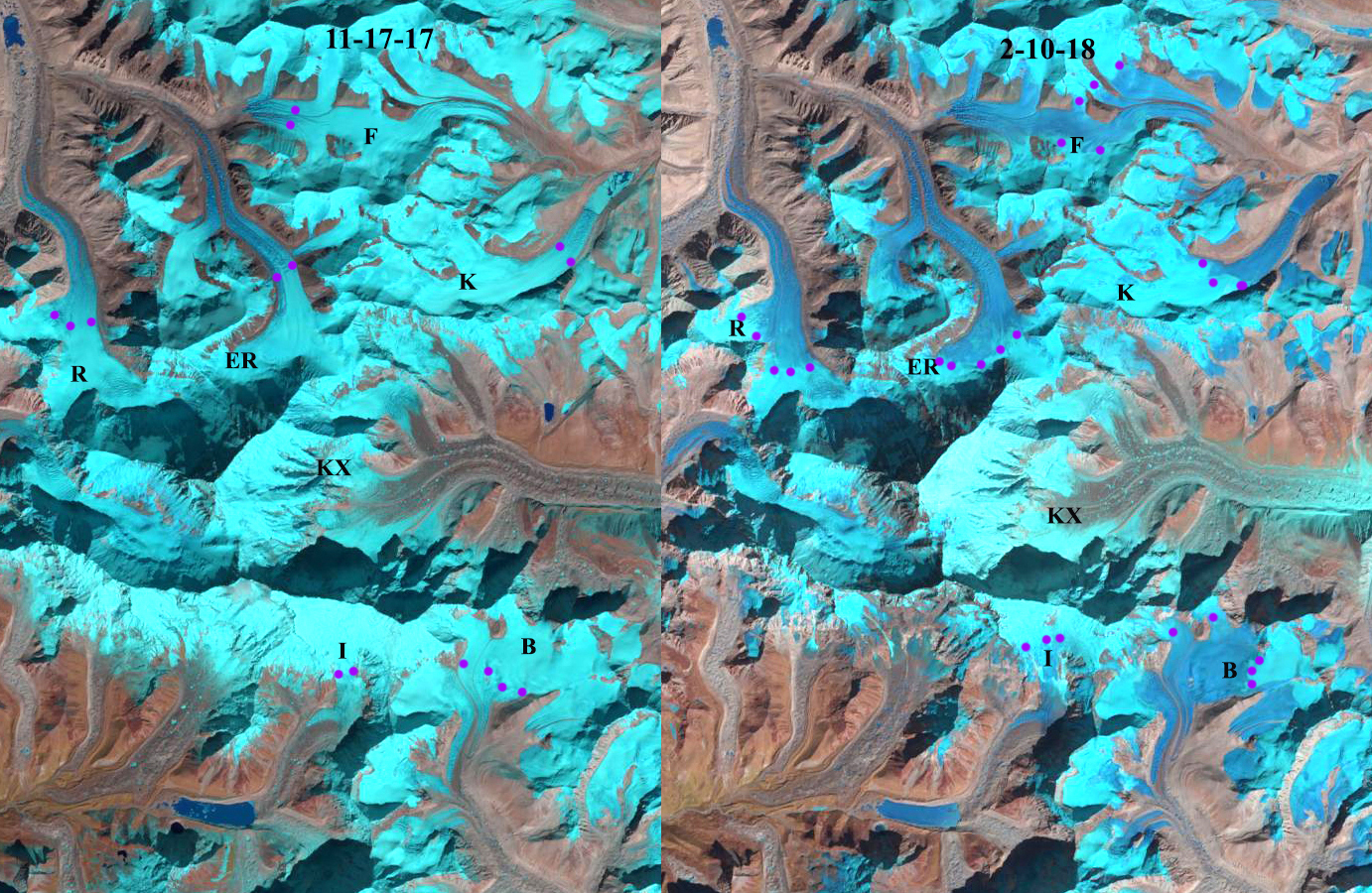
Landsat images from Nov. 17 2017 and Feb. 10 2018 indicate a rise in the snowline, purple dots, on glaciers east of Mount Everest, indicating ablation even in winter from the terminus to the snowline. Rongbuk Glacier=R, East Rongbuk Glacier=ER Far East Rongbuk Glacier=F, Kada Glacier=K,  Barun Glacier=B,  Imja Glacier=I and Kangshung Glacier=KX.

Where is the snow at Nup La, 5850 m, West Rongbuk Glacier?

nup la 1516

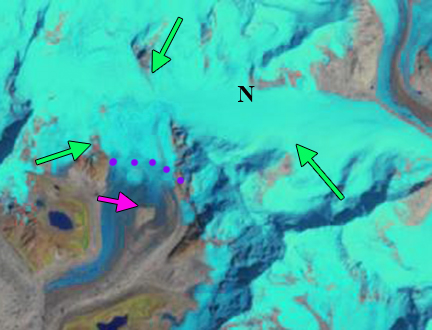
Landsat image from January 4, 2016 indicating the actual Nup La (N).  Purples dots is the snowline. Green arrows are expanding bedrock exposures and pink arrow a specific rock know amidst the glacier.

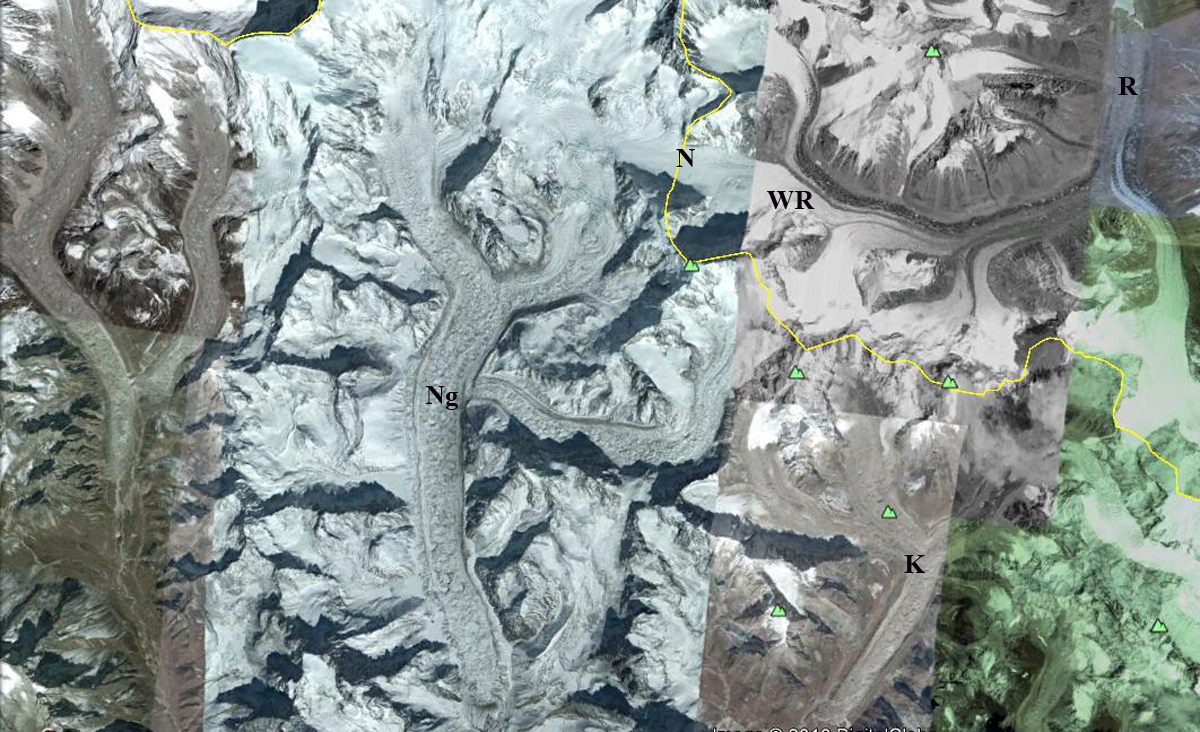
Nup La at 5850 m is on the Nepal-China border and is the divide between the West Rongbuk Glacier and the Ngozumpa Glacier.  The pass should be part of the accumulation zone of both glaciers.  In recent years including currently this has not been the case, this past Christmas was not a white one at the pass.  Our attention is often focused on the more easily viewed terminus of a glacier, and both of these glaciers are retreating. The changes higher on the glacier can have more far reaching implications. Bolch et al (2011) observed strong thinning in the accumulation zone on nearby Khumbu Glacier, though less than the ablation zone . This can only happen with reduced retained snowpack particularly in winter.  This has occurred with increasing air temperatures since the 1980’s. Mean annual air temperatures have increased by 0.62 °C per decade over the last 49 years; the greatest warming trend is observed in winter, the smallest in summer (Yang et al., 2011). The glaciers in the area are summer accumulation type glaciers with 70% of the annual precipitation occurring during the summer monsoon. There is little precipitation early in the winter season (November-January). The limited snowpack with warmer winter temperatures have led to high snowlines during the first few months of the winter season in recent years. Here we examine Landsat images from 1992 to 2016 to observe changes in the snowline during the early winter period.

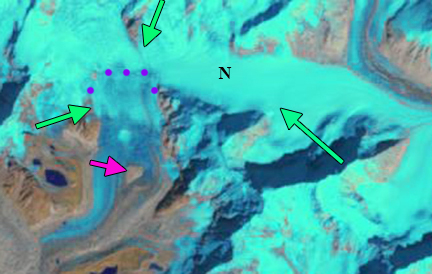
In January of 2016 the snowline is at 6100 m, which is well above Nup La and the divide between West Rongbuk and Ngozumpa Glacier.  The green arrows indicate three areas of expanding bedrock exposure occurring over the last 15 years.  This indicates thinning in this region of 5700-6000 m, which should typically be the accumulation zone.  In December 2015 three works prior to the 2016 image the situation is the same.  In November 2014 the snowline is lower at 5750 m.  In 1992 the snowline is at 5600 m, and the bedrock areas at the green arrows are reduced from above.  In November 2000 the snowline is at 5450 m and in November 2001 it is at 5600 m.  In all images prior to 2012 the snowline does not reach the region around Nup La above 5700 m during the early winter period.  In recent years the snowline has remained high, above 5700 m, significantly into the winter season almost every year, and in 2015/16 remains high three months into the winter season. This is an indication of an extended period after the summer monsoon, in which not only is snow not accumulating, but ablation can occur mostly via sublimation at elevations of Nup La. The thinning resulting has caused the expansion of bedrock areas at the green arrows and at the pink arrow.

nup la region
Google Earth image of the region indicating Nup La (N), Wests Rongbuk Glacier (WR), Rongbuk Glacier (R), Ngozumpa Glacier (Ng) and Khumbu Glacier on Mount Everest (K)

nup la dec2015
December 2015 Landsat image indicating the actual Npu La (N).  Purples dots is the snowline. Green arrows are expanding bedrock exposures and pink arrow a specific rock know amidst the glacier.

nup la 11202014
November 2014 Landsat image indicating the actual Npu La (N).  Purples dots is the snowline. Green arrows are expanding bedrock exposures and pink arrow a specific rock know amidst the glacier.

nup la oct92
October 1992 Landsat image indicating the actual Npu La (N).  Purples dots is the snowline. Green arrows are expanding bedrock exposures and pink arrow a specific rock know amidst the glacier.

nup la oct2001
November 2000 Landsat image indicating the actual Npu La (N).  Purples dots is the snowline. Green arrows are expanding bedrock exposures and pink arrow a specific rock know amidst the glacier.

nup la 10152000
November 2001 Landsat image indicating the actual Npu La (N).  Purples dots is the snowline. Green arrows are expanding bedrock exposures and pink arrow a specific rock know amidst the glacier.

nup la 2014
Google Earth image indicating flow paths at Nup La.


Ngozumpa Glacier Retreat Tongue Disintegration, Nepal

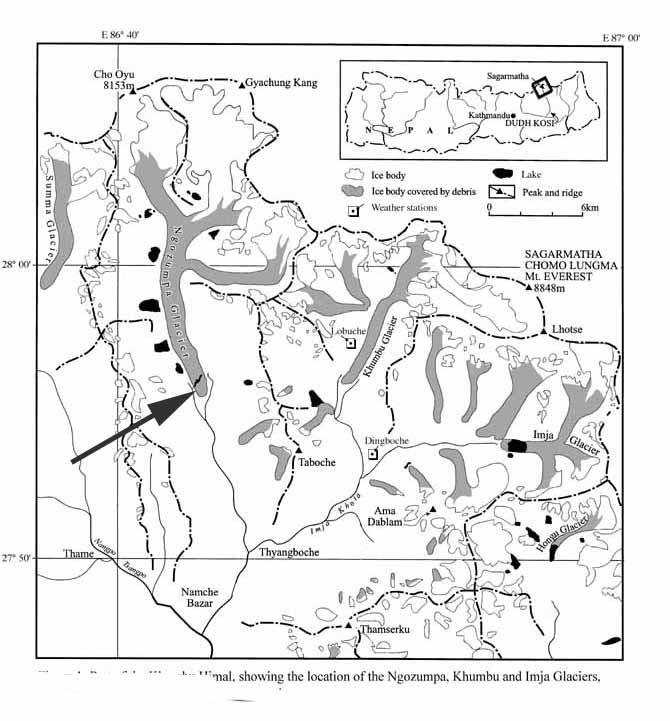
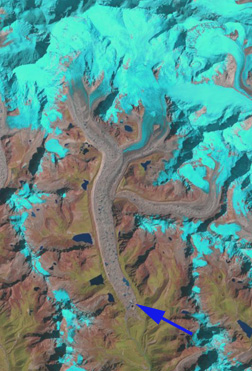
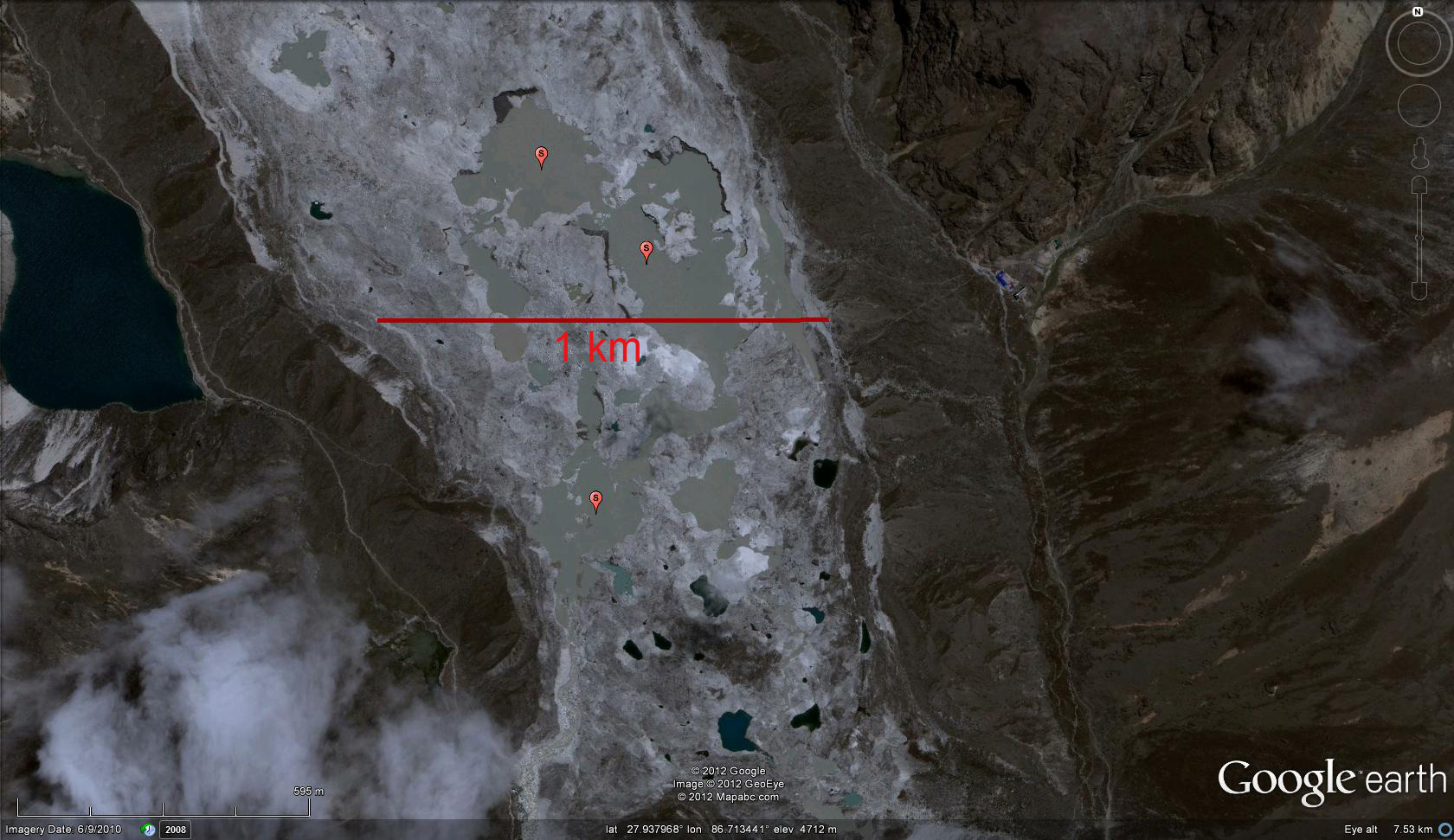
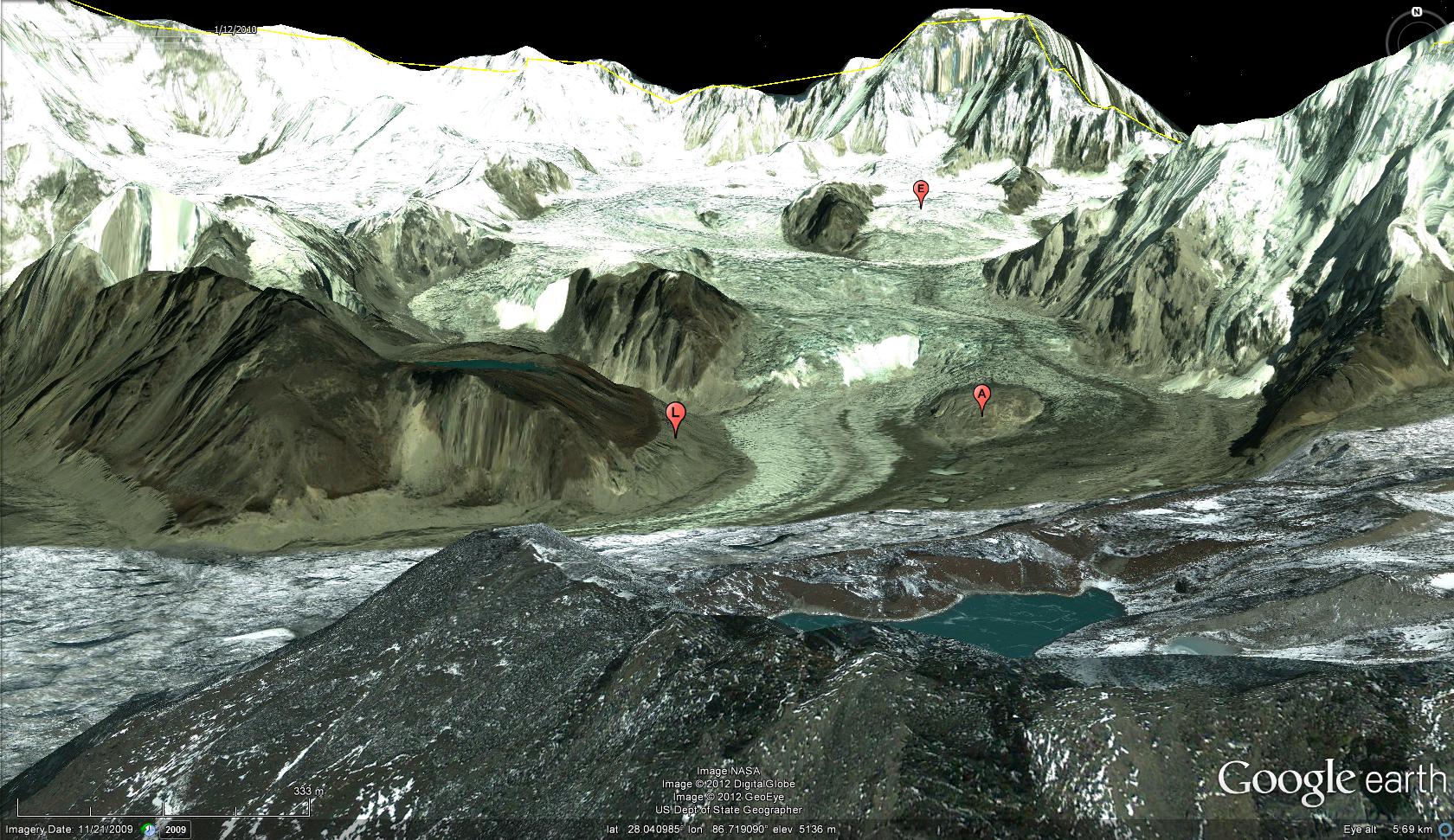
Ngozumpa Glacier (also Ngozumba) is a large debris covered valley glacier draining south from Cho Oyu and Gyanchung Kang one valley west of the Khumbu valley. The lower kilometers of this glacier is heavily debris covered, similar to the Khumbu Glacier and Imja Glacier. Above image from Doug Benn. From the terminus at 4700 meters to 4900 meters a distance of 8 kilomters the glacier is increasingly riddled with supraglacial lakes (lakes on top of glacier) as this section downwastes. Velocity in this reach is less than 5 meters/year, essentially stagnant. The snowline of the glacier has been at nearly 6000 meters in recent years. On the following image the snowline (blue dots), accumulation areas (A) and terminus blue arrow are indicated. It is evident that more than 50% of this glacier is debris covered. An examination of Landsat imagery from 1992, 2000 and 2009 indicates the expansion of these lakes near the terminus. These lakes (S) in the 2010 (Goggle Earth imagery) are beginning to coalesce and look to be creating a proglacial lake (lake at front of glacier) at the terminus of the glacier. Benn et al (2001) examining the supraglacial lakes hypothesized that the glacier was close to forming a moraine dammed proglacial lake. This is a scenario very similar to what has developed on Menlung Glacier, which is just over the pass into Tibet from the Ngozumpa. Further upglacier the surface of the glacier is riven with more lakes amidst the debris covered relatively stagnant ice. Further upglacier the thinning is evident in the expansion of a bedrock knob in the midst of the glacier (A), the decrease in surface elevation compared to the lateral moraine-trimline (L) and the quite high equilibirum line for 2009 (E). Strong thinning in the accumulation zone, though less than the ablation zone, of Khumbu Glacier was found by Bolch et al(2011)