
Colonial Glacier is on the southwest side of Colonial Peak in the Skagit River Watershed, North Cascades of Washington. The North Cascade Glacier Climate Project has made six visits to this glacier over the last 25 years. Meltwater from this glacier enters Diablo Lake above Diablo Dam and then flows through Gorge Lake and Gorge Dam. These two Seattle City Light hydropower projects yield 360 MW of power. As this glacier shrinks the amount of runoff it provides during the summer for hydropower is reduced. In 1979 the glacier was clearly thinning, having a concave shape in the lower cirque, but still filled its cirque, there is no evidence of a lake in this image from Austin Post (USGS). The glacier had retreated 80 meters since 1955. In 1985 my first visit to the glacier there was no lake at the terminus. In 1991 the lake had begun to form, second image, but was less than 30 m across. The upper glacier was a smooth expanse of snow. 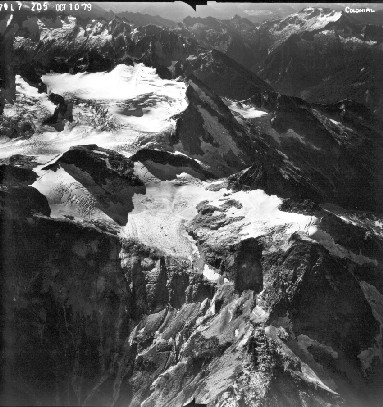
 By 1996 the lake was evident, and was 75 meters long. In 2001 the lake had expanded to a length of 125 meters. By 2006 the lake was 215 m in length, and had some thin icebergs broken off from the glacier front. Runoff to the Skagit River is impacted directly by the climate change and the resultant retreat of the glaciers. Three notable changes in North Cascade streamflow have occurred.
1) Alpine runoff throughout the North Cascades is increasing in the winter (Nov.-Mar.), as more frequent rain on snow events enhance melting and reduce snow storage Streamflow has risen 18% in Newhalem Creek and 19% in Thunder Creek despite only a slight decrease, 1% in winter precipitation at Diablo Dam, within 5 km of both basins. These basins are on either side of Colonial Glacier.
2)Spring runoff (April-June) has increased in both basins by 5-10% due to earlier alpine snowpack melting.
3)Summer runoff has decreased markedly, 27%, in the non-glacier Newhalem basin with the earlier melt of reduced winter snowpack. In Thunder basin runoff has in contrast increased negligibly, 4%. The difference is accounted for in part by enhanced glacier melting. The observed net loss of -0.52 meters per year in glacier mass spread over the melt season is equivalent to 2.45 cubic meters per second in Thunder Basin, 10% of the mean summer streamflow. This trend of enhanced summer streamflow by reduction in glacier volume will not continue as the extent of glaciers continues to decline.
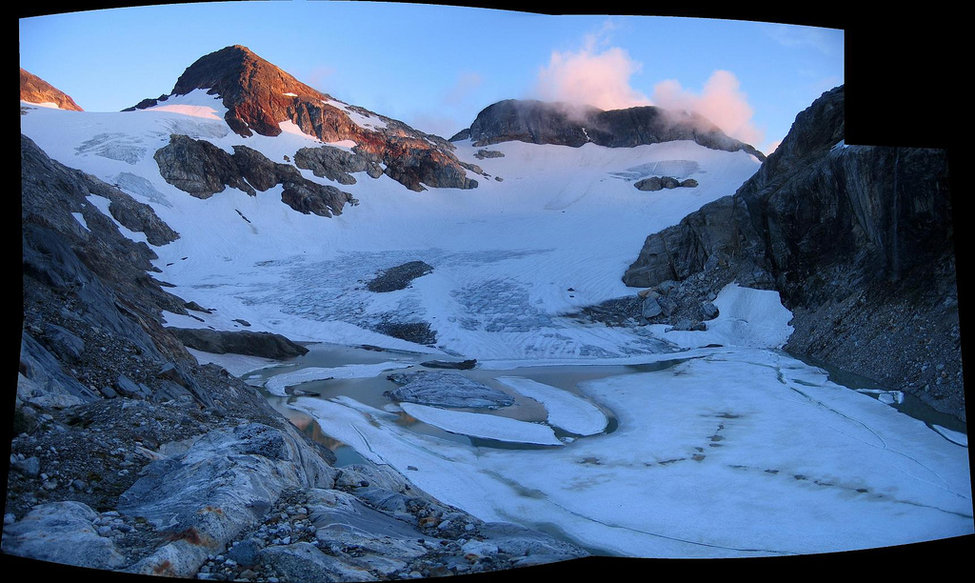
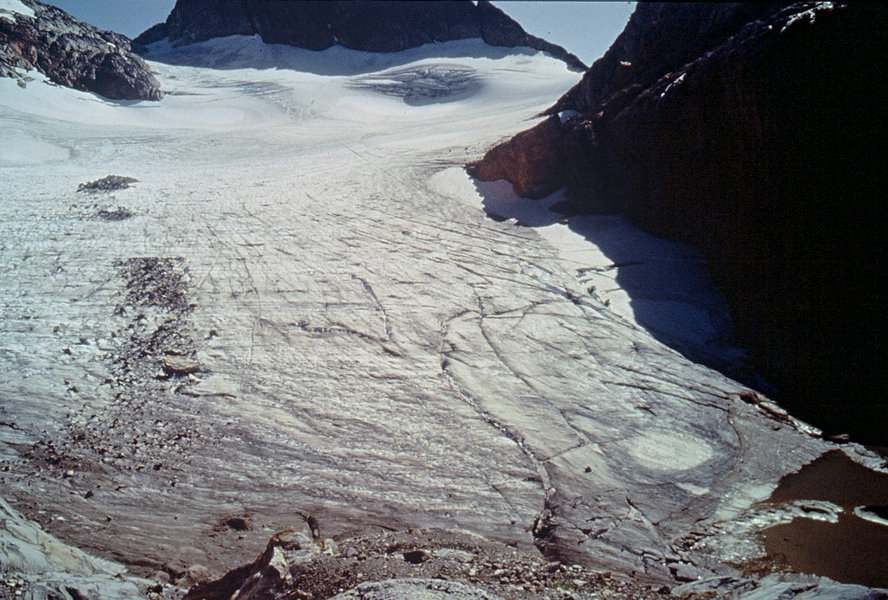 The lower portion of Colonial Glacier is not moving. GPS readings on both rockpiles on the lower glacier indicated no movement from 1996-2006. In the picture above the lake is still small in 1996, lower right corner and the lower rock pile distant from the terminus. The first two images below are from 2006, the lower rock pile is near the terminus and the last image is 2007 the lake has expanded back to the lower rockpile. Additional rock outcrops have appeared in the midst of the upper glacier that were not present in 1991, indicating this glacier does not have a persistent accumulation zone and will not survive current climate.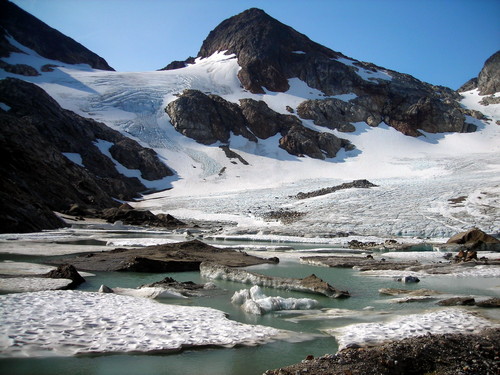



 From a Glaciers Perspective