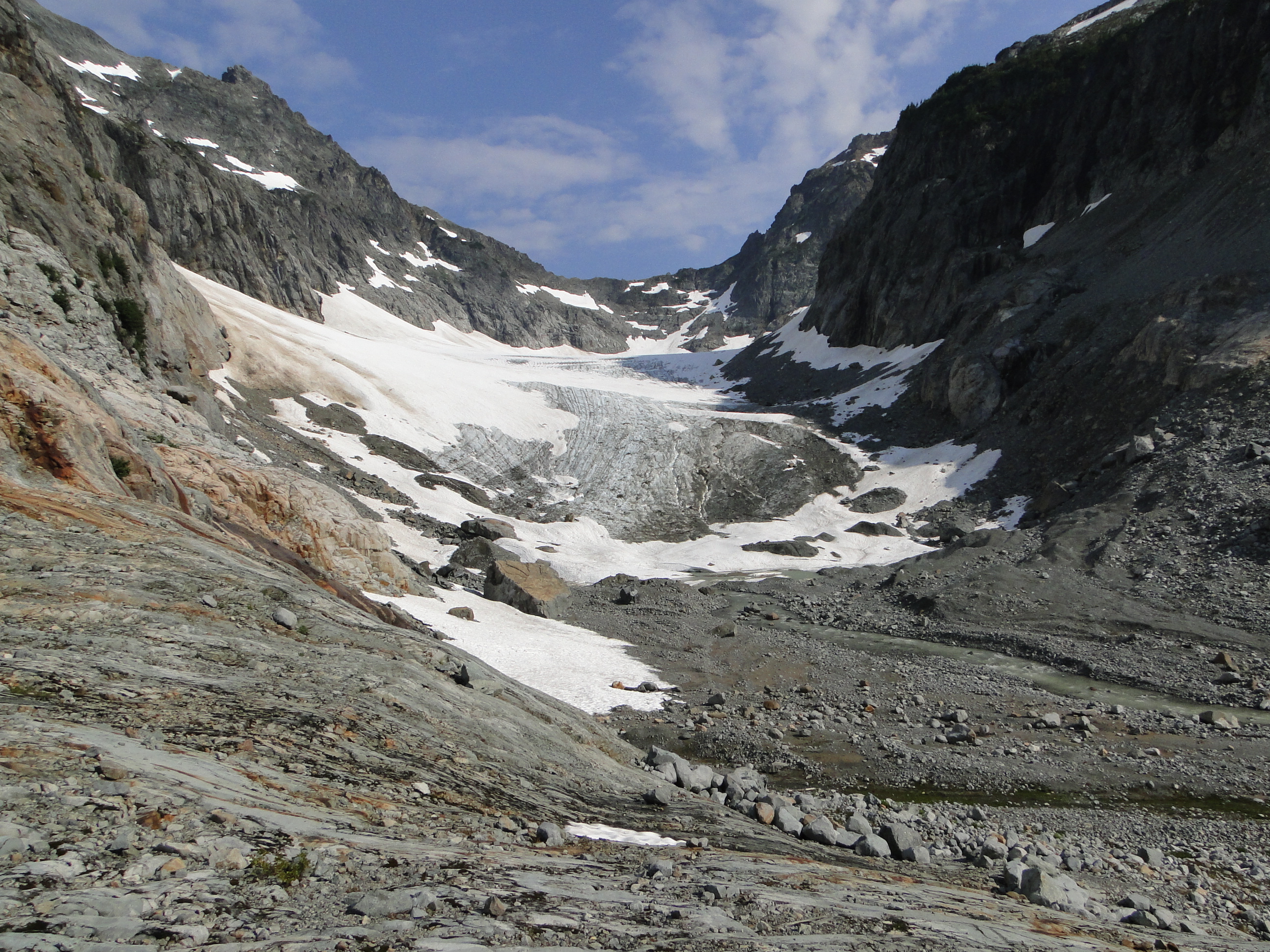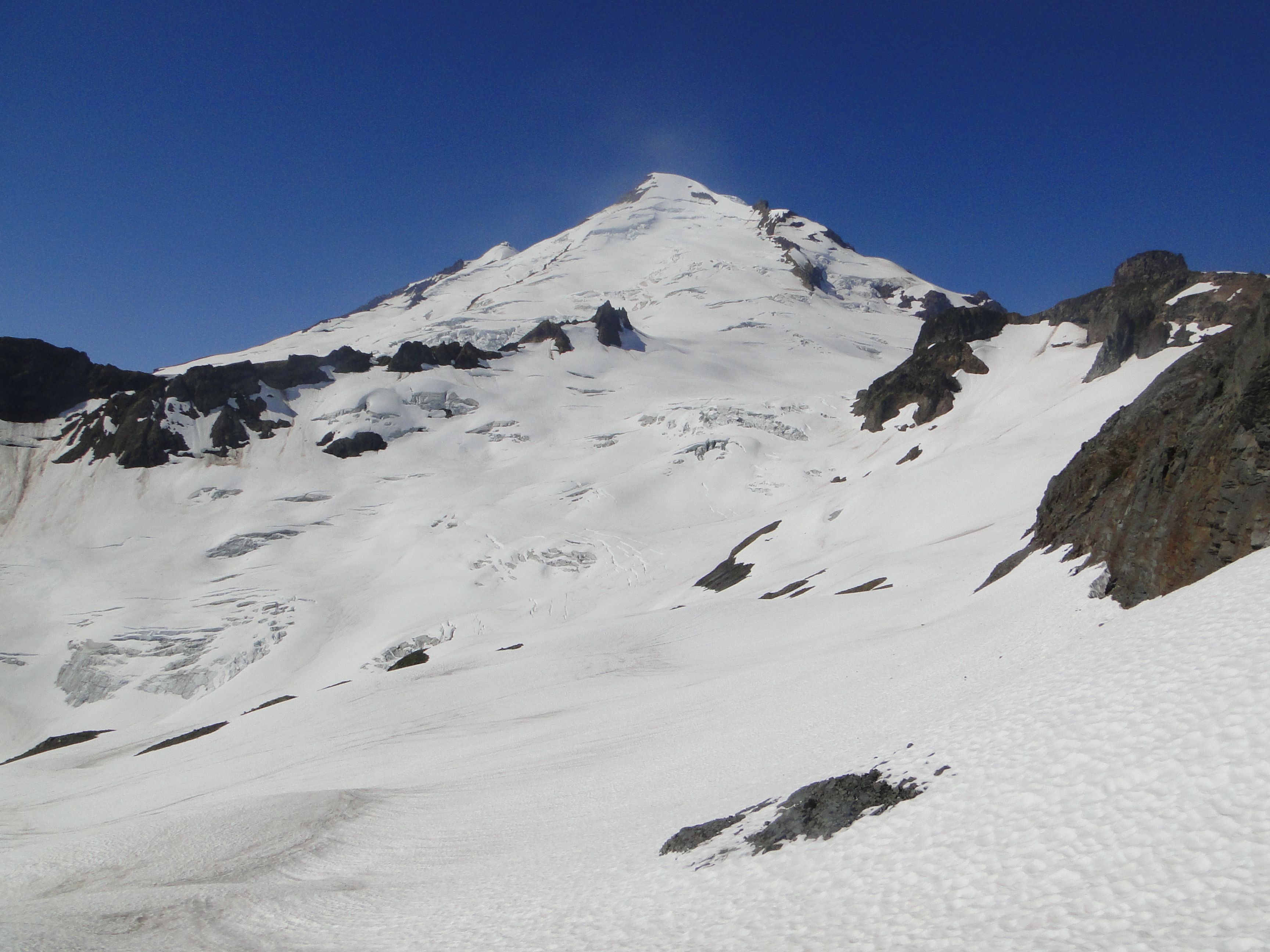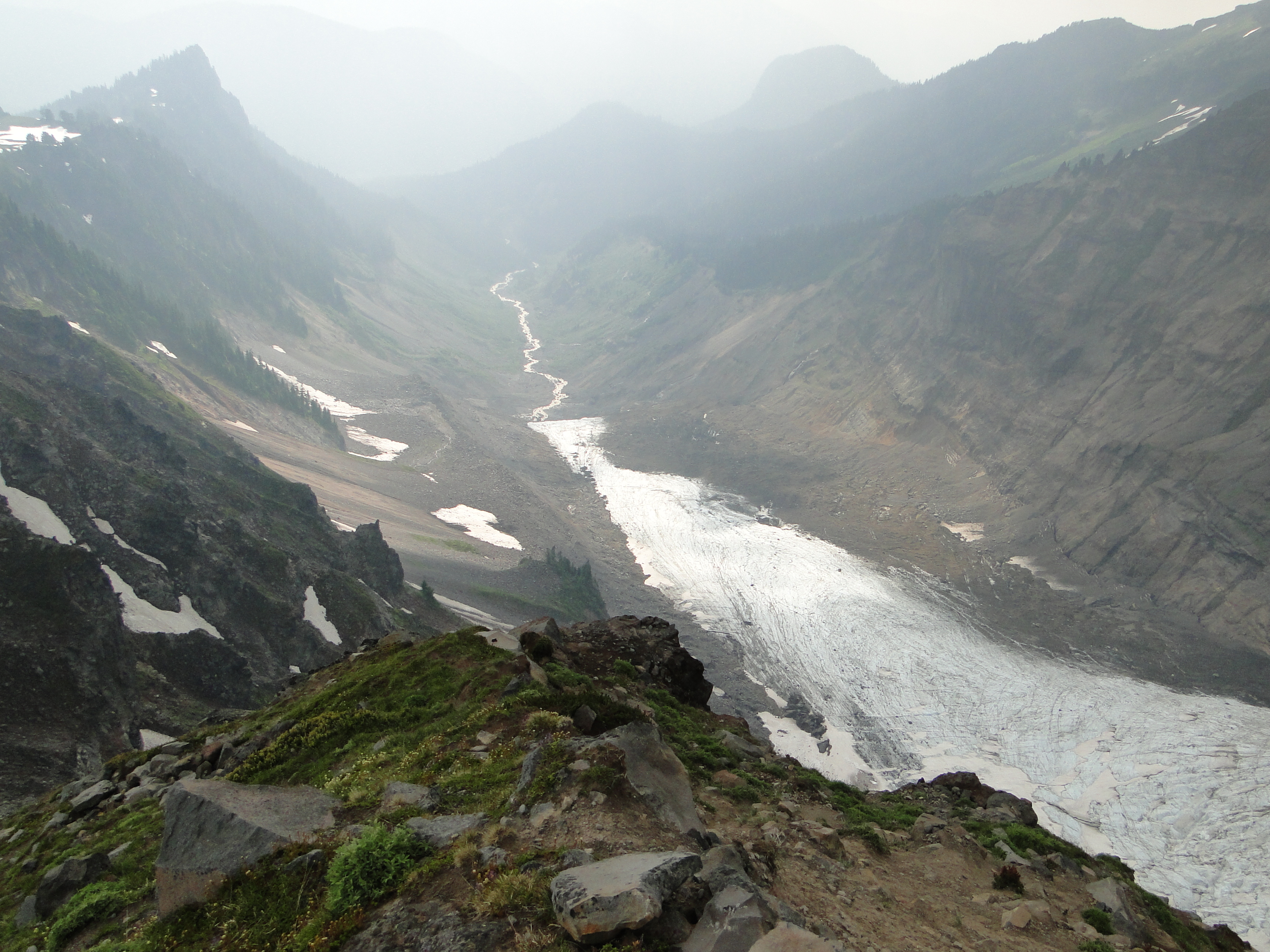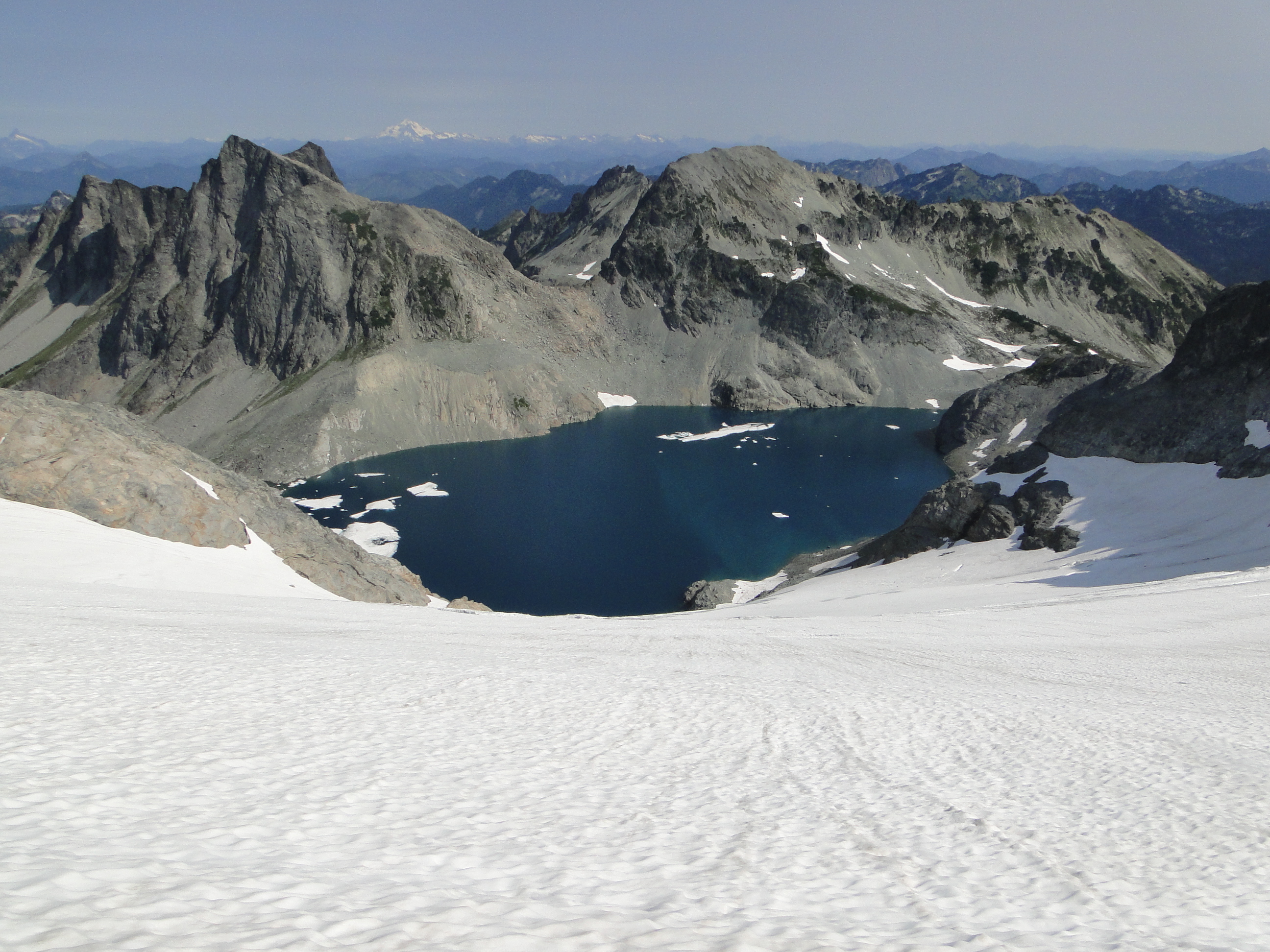
2024 North Cascade Glacier Climate Project Results-41st year

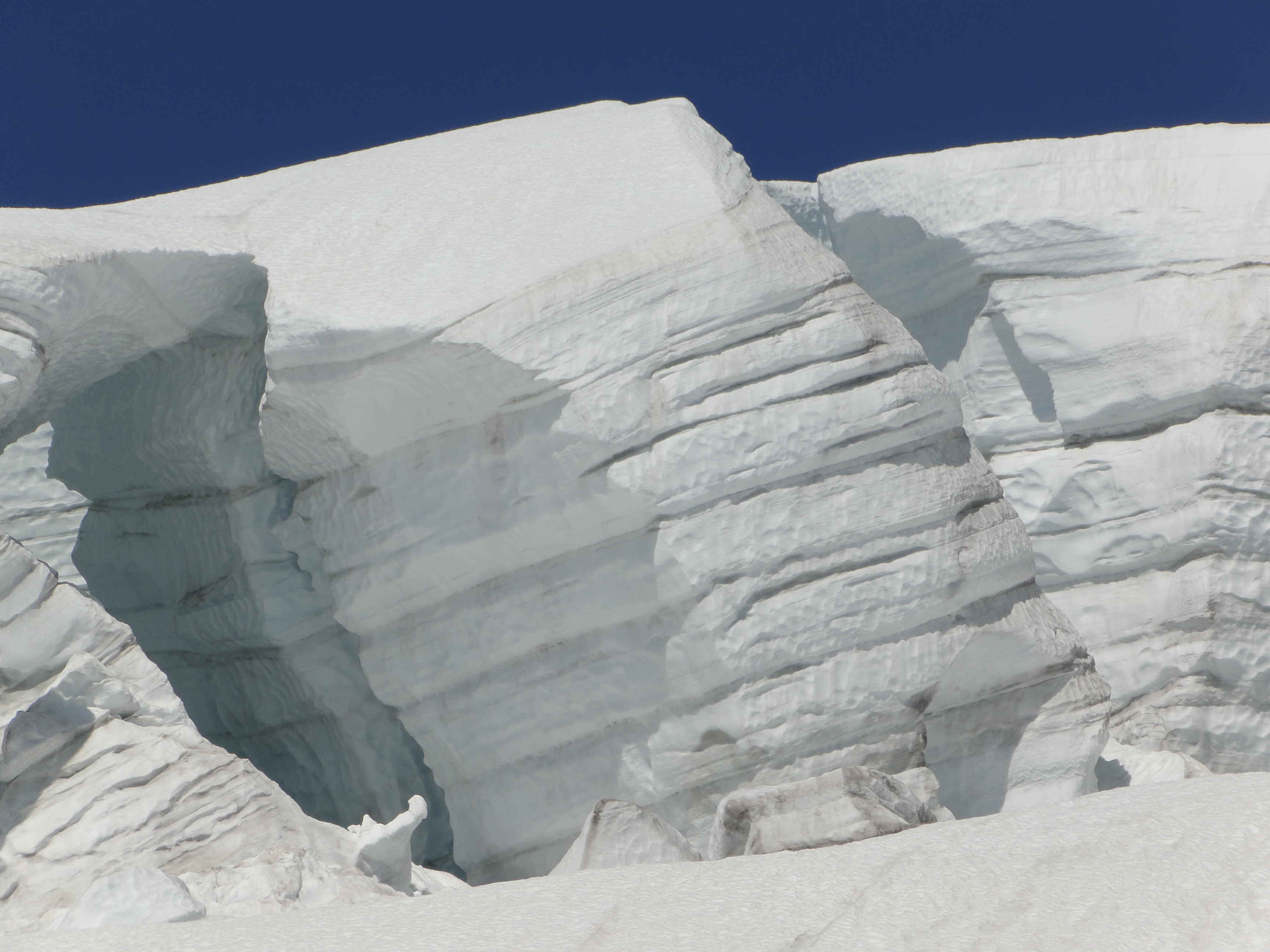
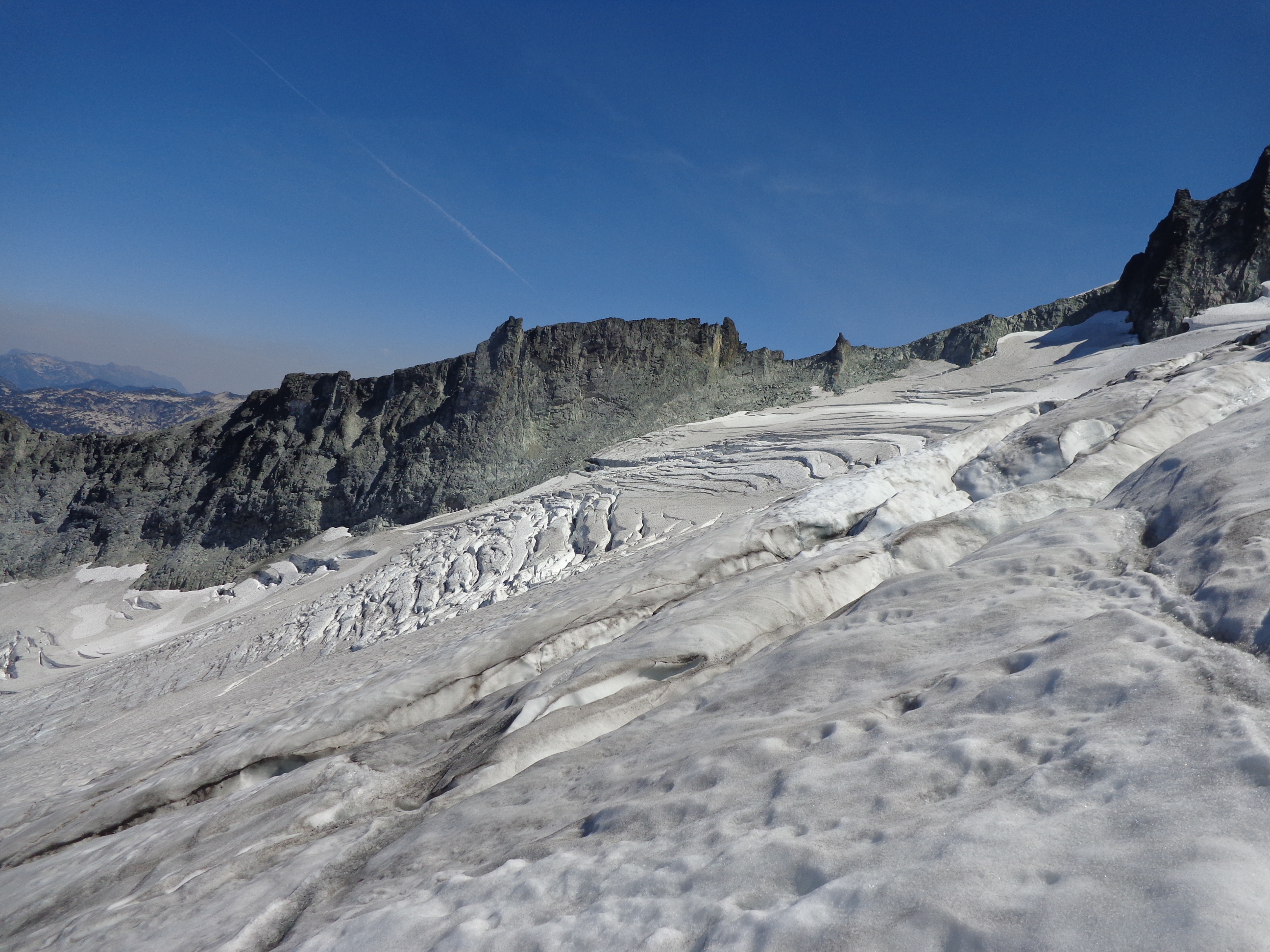
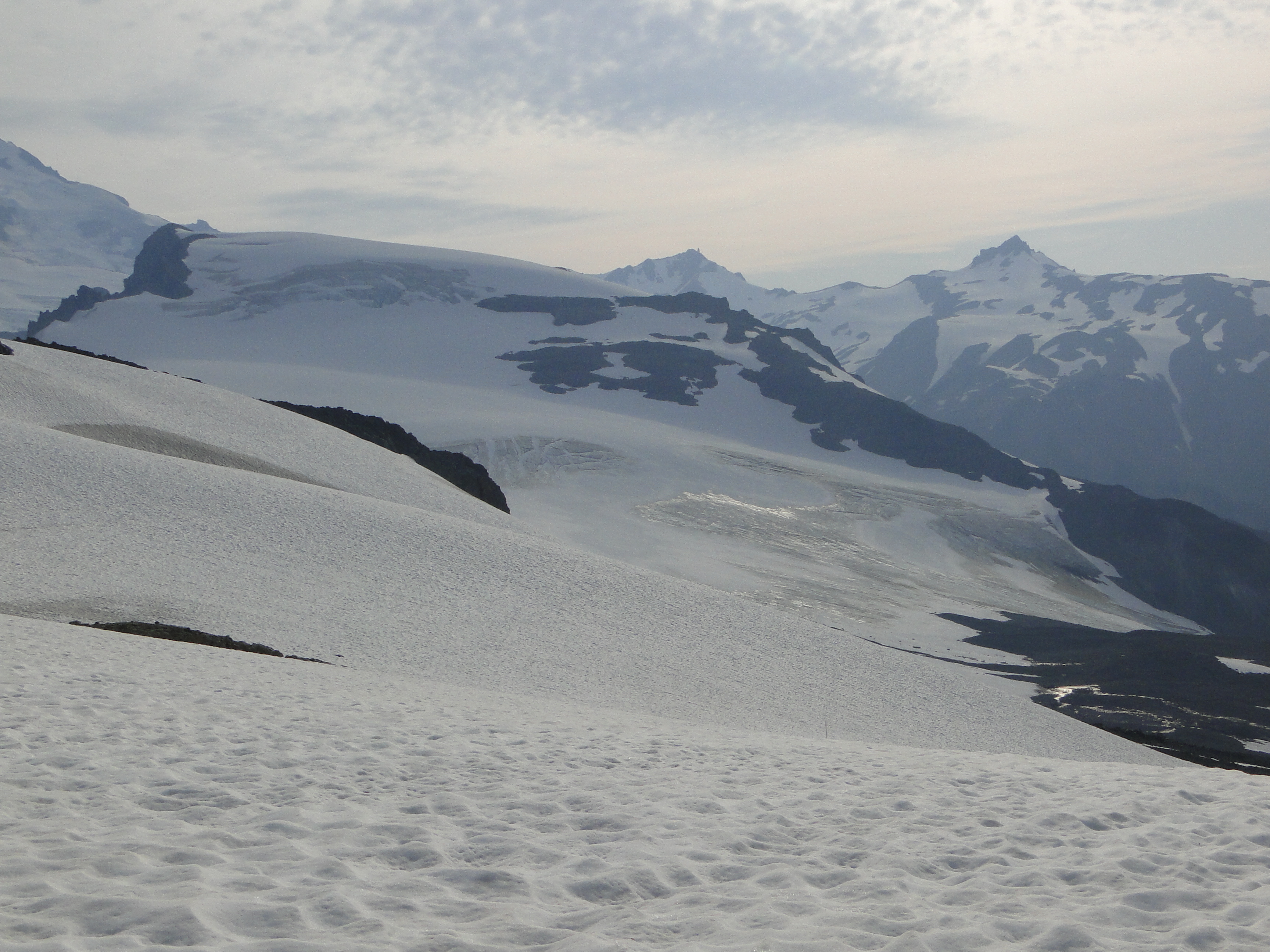
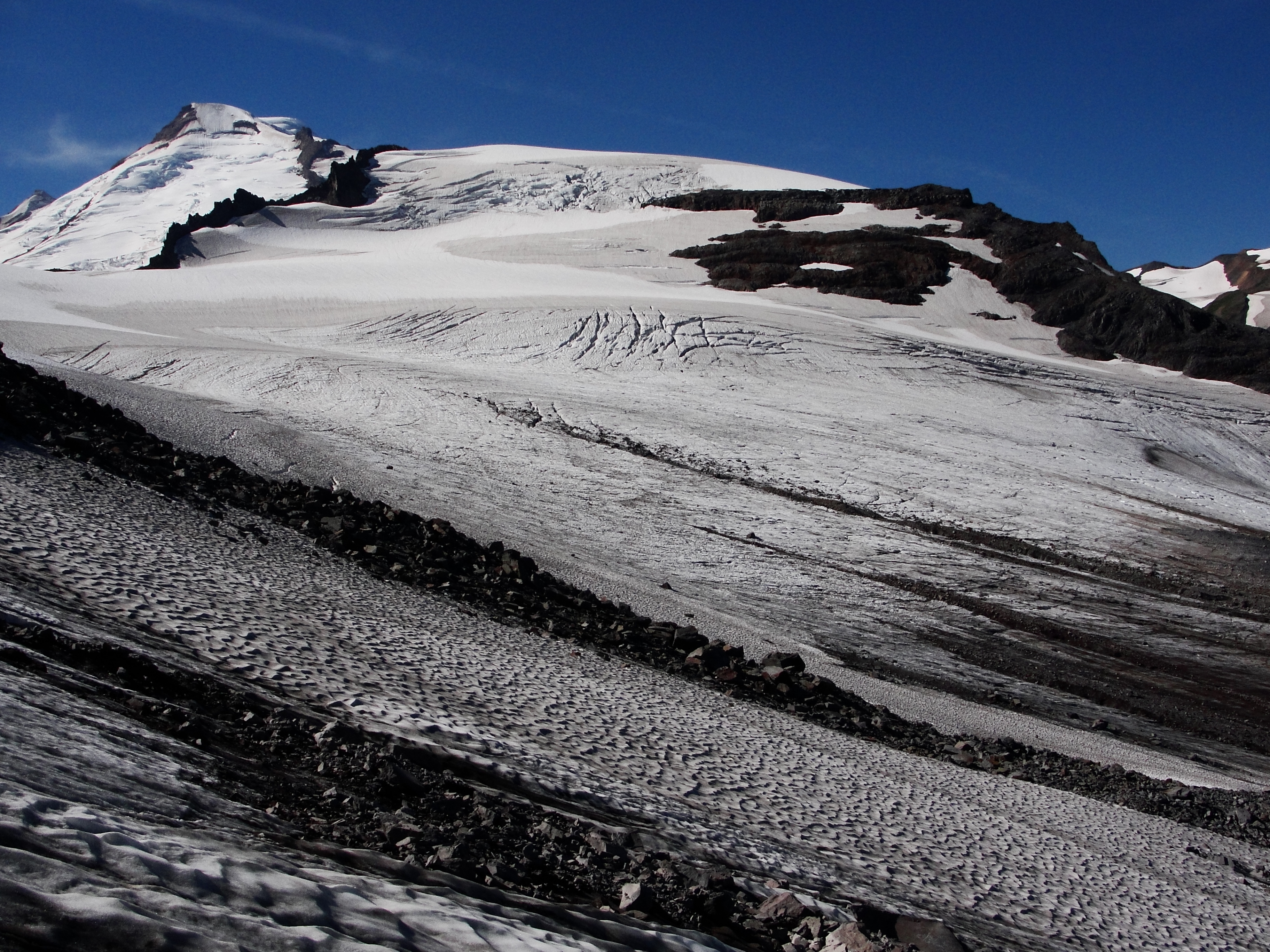
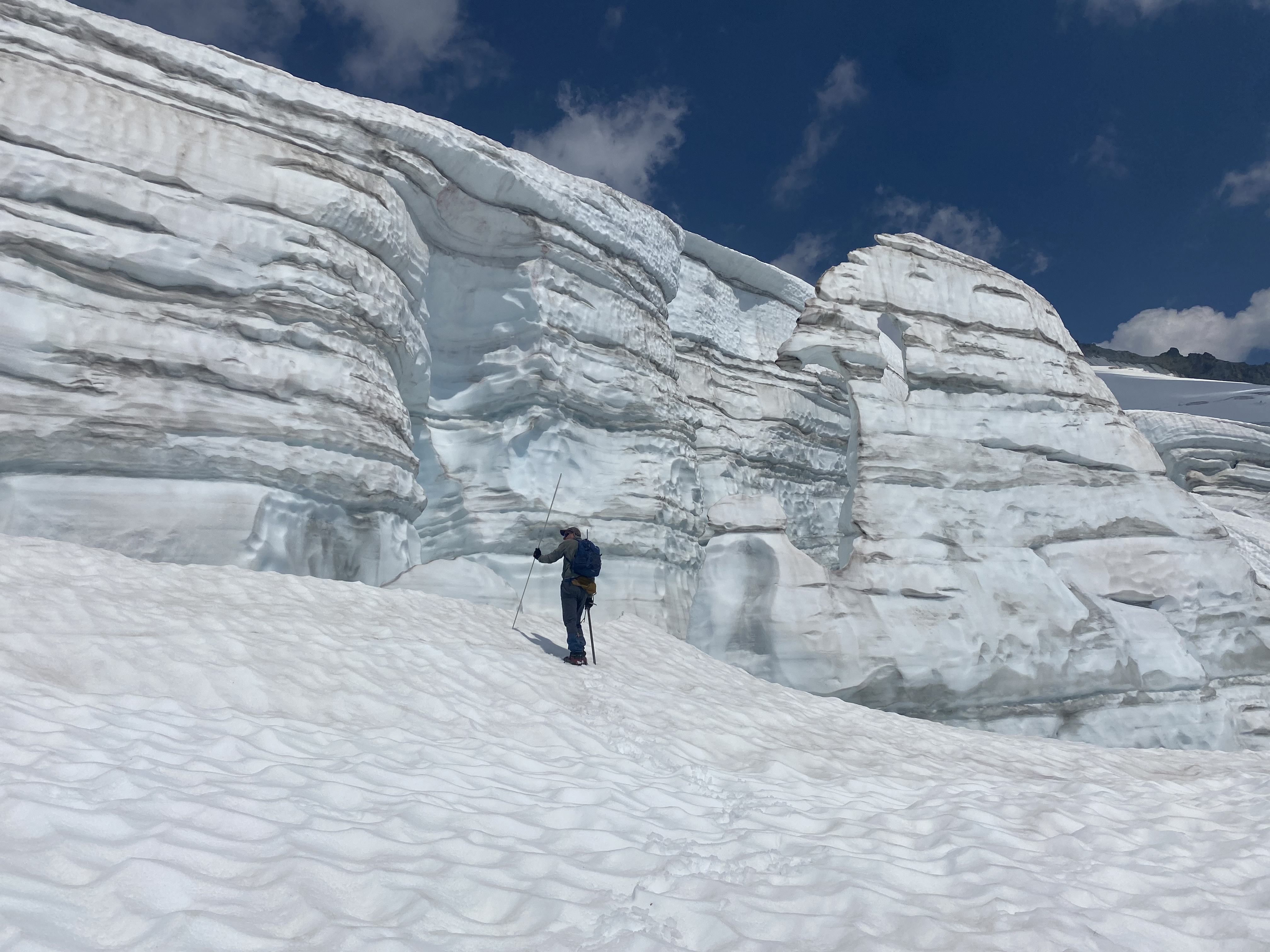
Serac on Easton Glacier at 2400 m indicating retained snowpack from previous years.

Climate Conditions Summary

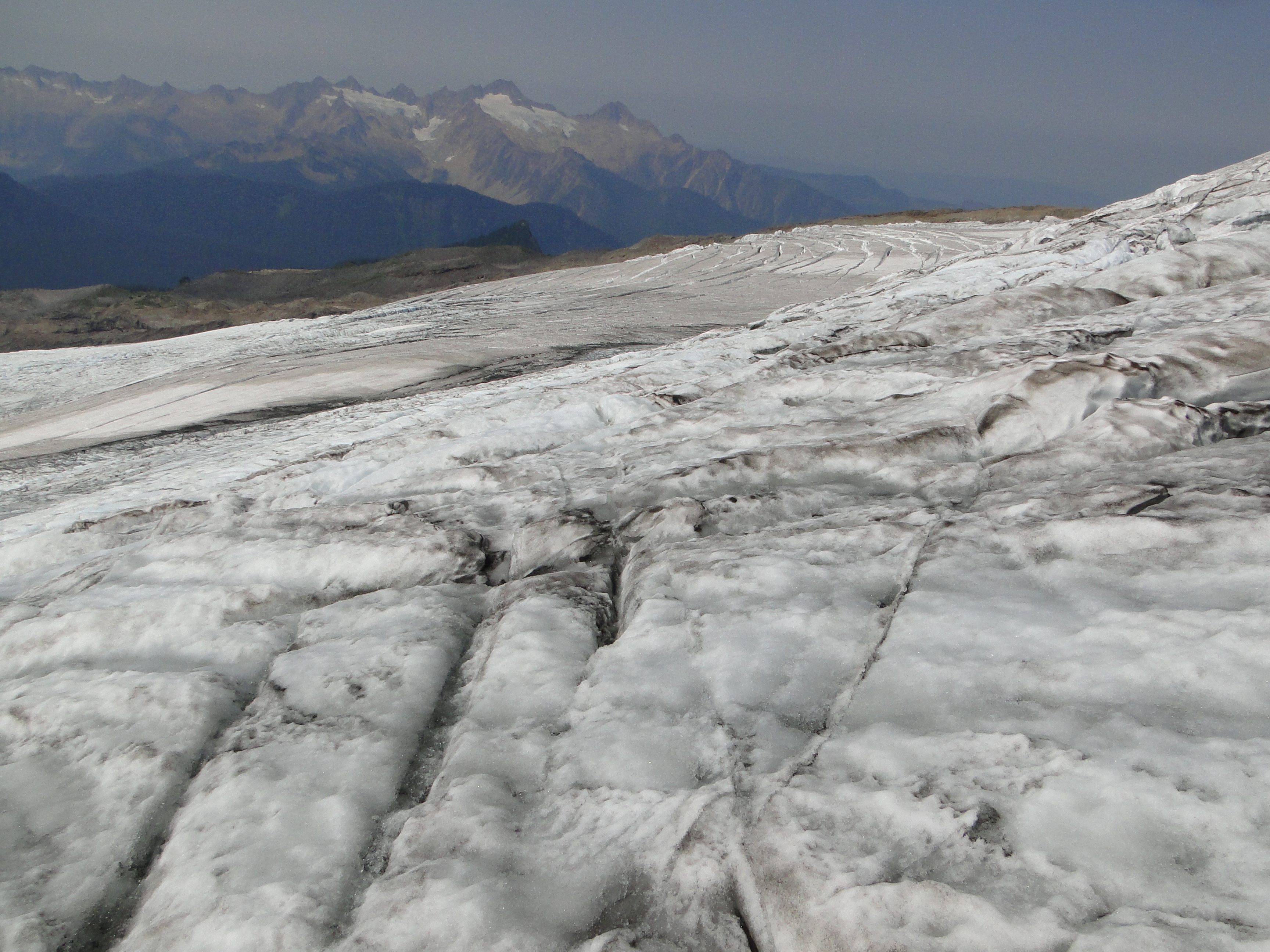
The winter season of 2023/24 yielded a low snowpack across the North Cascades. Snowpack at six longer Snotel stations was 0.63 m w.e on April 1, vs. a 1984-2024 average of 1.02 m. This was the third lowest snowpack of this period, with 2005 and 2015 being lower. The melt season in May and June was cool, helping extend the low snowpack at elevations above 1500 m. July rivaled 2015 for the warmest of the last 50 years, quickly melting back the snowpack by the start of August. The end of the melt season was fairly typical with several new snowfalls and periods of heat. The main melt season for the glaciers is June-September and this year the average temperature was 18.3 C, which is 1.3 C above the long term mean. This was the fourth year in a row above 18 C and thus the fourth consecutive year of large glacier mass balance losses. The cumulative impact is glacier recession, thinning, loss of a number of glacier and overall steeper/dirtier ice. We conducted detailed field work on eight glaciers.
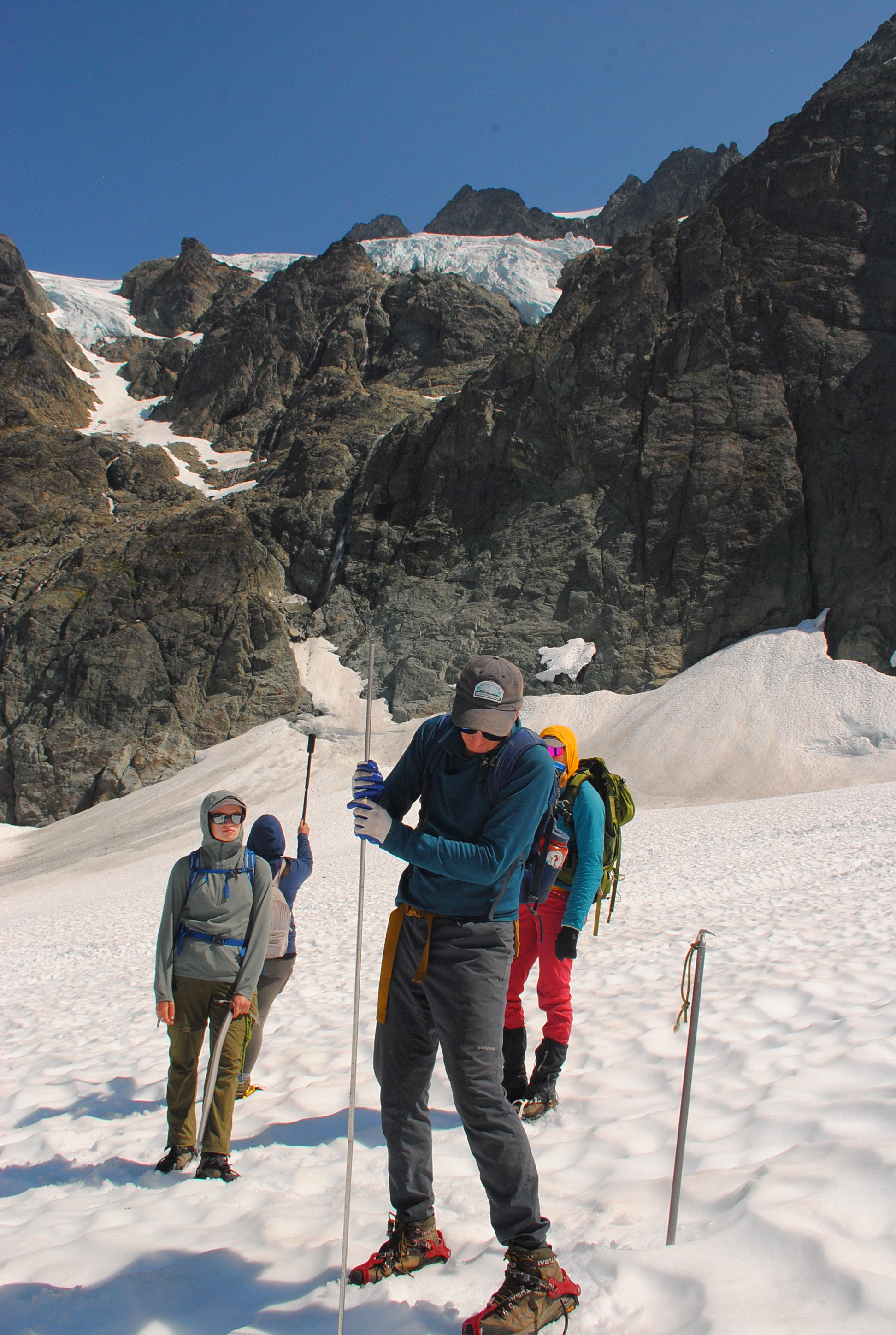
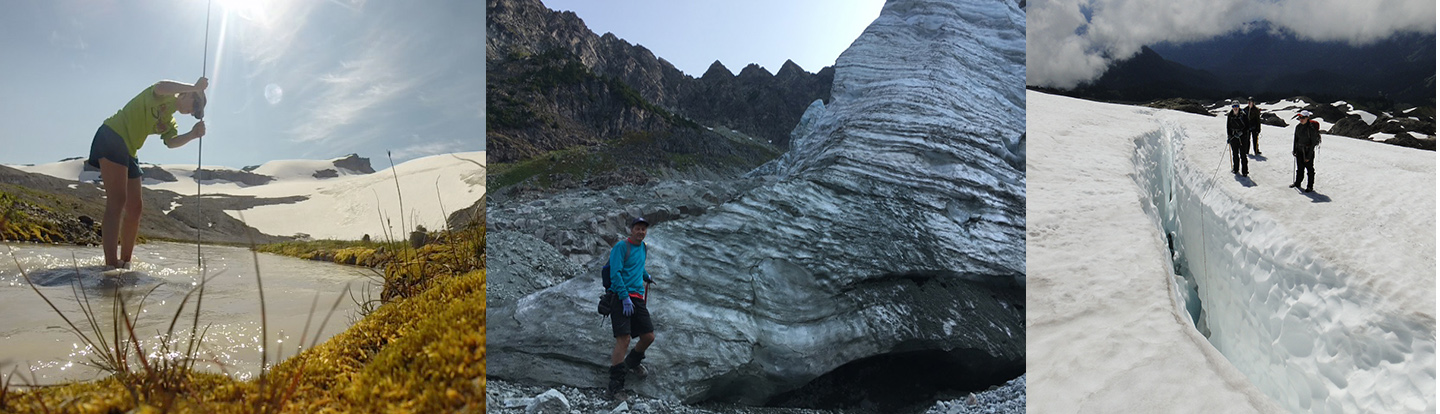
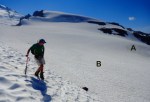
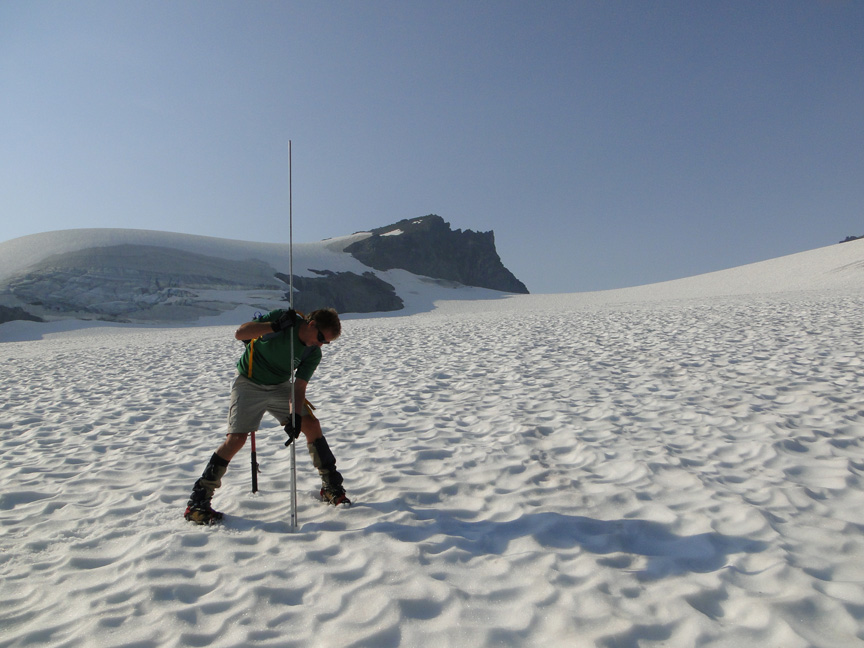
Probing snow pack depth on Lower Curtis Glacier. The 12 foot segmented steel probe cannot penetrate the icy surface from the previous summer.

Glacier Mass Balance

Annual mass balance is the difference between the mass of snow and ice accumulation on the glacier and the ablation of snow and ice on the glacier during a year. The data is reported in the average change across the glacier in water equivalent thickness. In 2024 we again utilized probing snow depth with a 12 foot long segmented steel probe (520 measurements), annual layer thickness measurement in vertically walled crevasses (140 measurements), and mapping snow line position in the field. To assess ablation we used snow line migration in satellite imagery and ablation stakes drilled into the glacier. The mass balance at the snowline is 0 m w.e., and as it transects areas of known snow depth that identifies ablation rate.

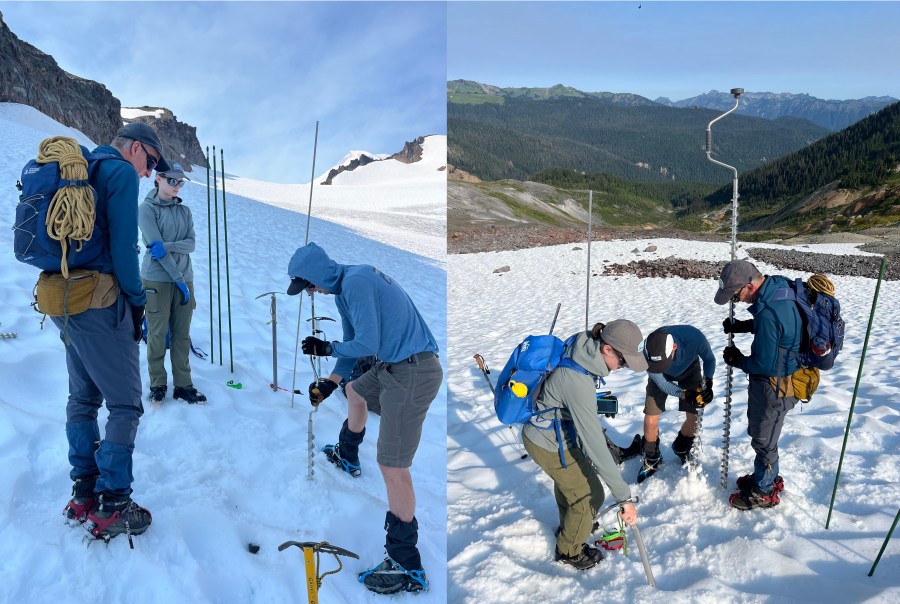
Ben Pelto deploying his ice augur to emplace ablaiton stakes on Sholes Glacier, Katie Hovind and Mauri Pelto assisting.
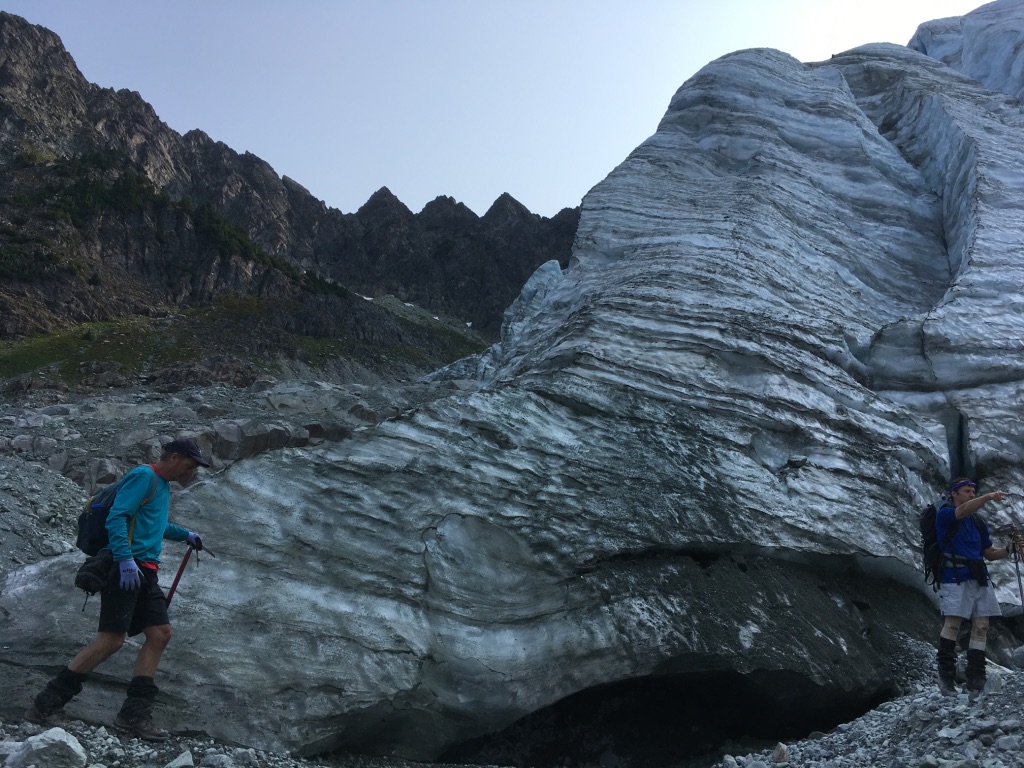
Jill and Mauri Pelto in front of Columbia Glacier that has retreated forming a new lake. Avalanche accumulation on west side only snowcover retained by end of summer.

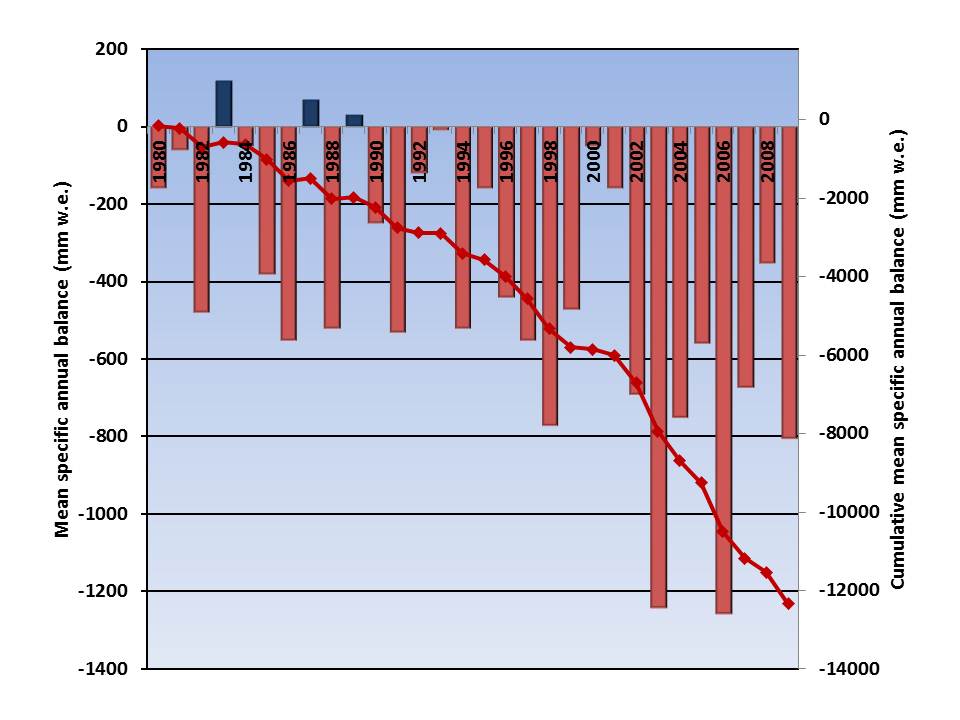
All eight glaciers had a negative balance exceeding 1.3 m w.e., with an average of -2.09 m w.e., this is equivalent to at ~2.25 m of glacier thinning. The loss during the last four years is unprecedented with 8 m of average thickness lost from 2021-2024. This is greater than the entire decade of loss for 184-1993, 1994-2003 or 2004-2013. The acceleration of loss continues even as the glaciers lose their highest melting terminus regions. This is an indication that none of the glaciers are approaching equilibrium. The cumulative mean mass balance loss has been -28.89 m w.e., ~33 m in thickness. This represents the loss of ~40% of volume of the glaciers we have observed, 1% loss per year overall but over 2% per year in the last decade.
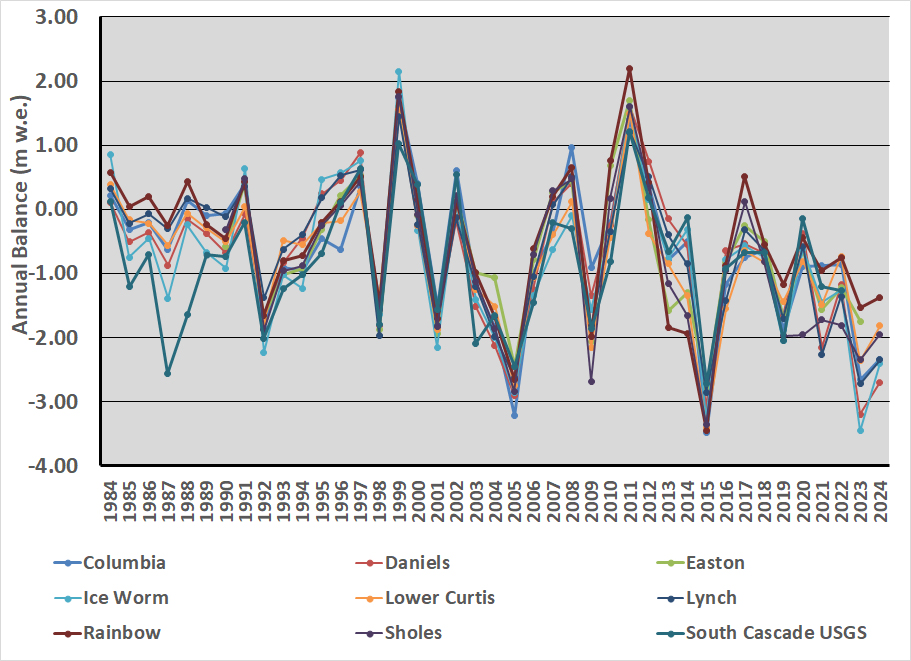
Annual mass balance time series for the eight glaciers we monitor and the USGS monitored South Cascade Glacier. In 2024 Columbia=-2.34, Daniels=-2.70, Easton=-1.74, Ice Worm=-2.40, Lower Curtis=-1.82, Lynch=-2.35, Rainbow=-1.38, Sholes=-2.35.

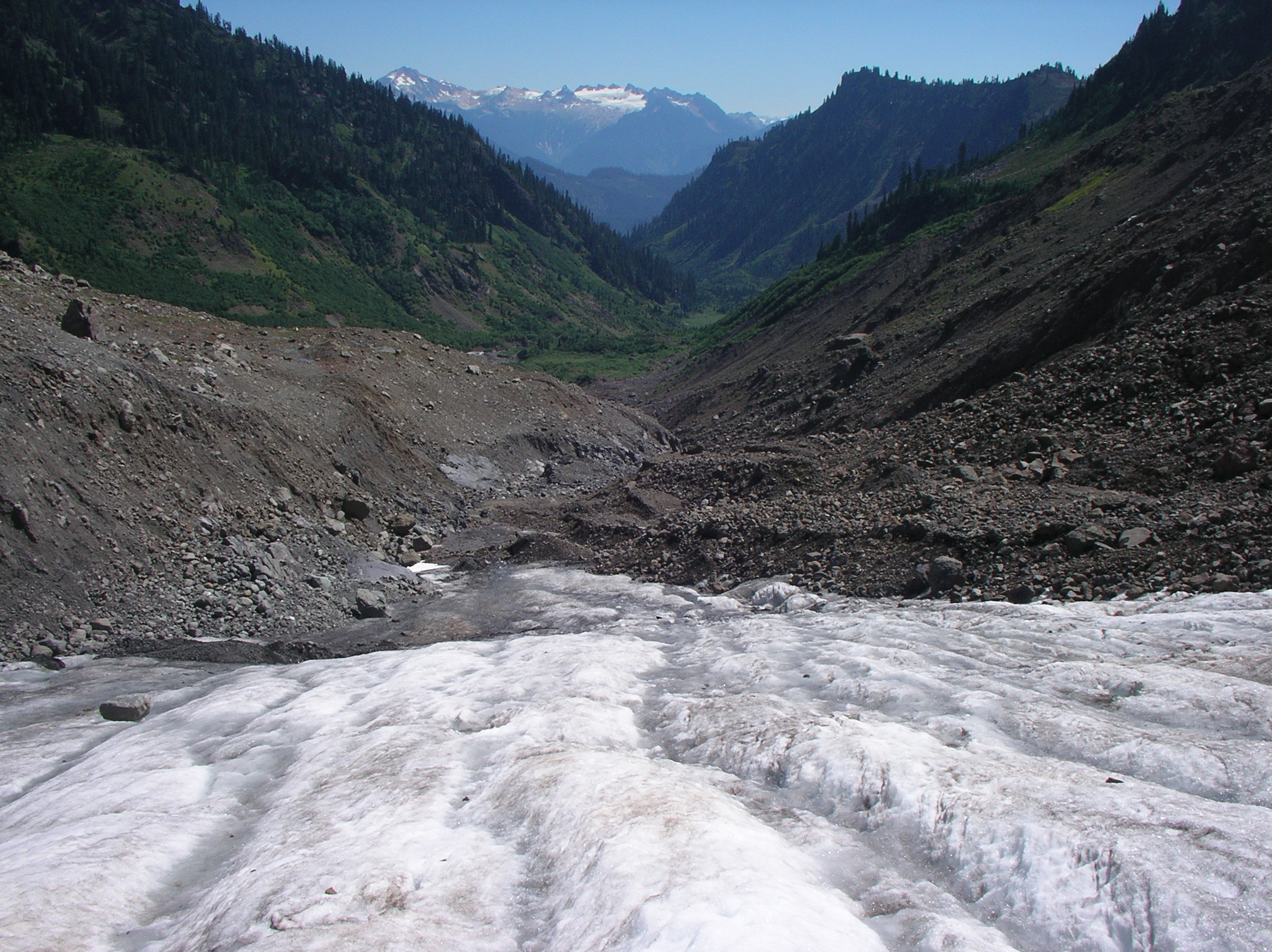
The deglaciated area exposed by the retreat over the last four decades is substantial and is most visible below Easton Glacier. The retreat of 620 m since 1990, has included a retreat of over 100 m in the last two years. The thinning of this glacier along with neighboring Squak and Deming have led to emergence of bedrock areas high on the glacier as well.

Deglaciated area below Easton Glacier from the 1990 advance moraine to 2024.
Bedrock areas that are emerging and expanding above 2100 m on the upper portions of Deming-Easton and Squak Glacier. Only one of these (upper right) existed before 2010.

Glacier Crevasses

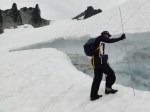
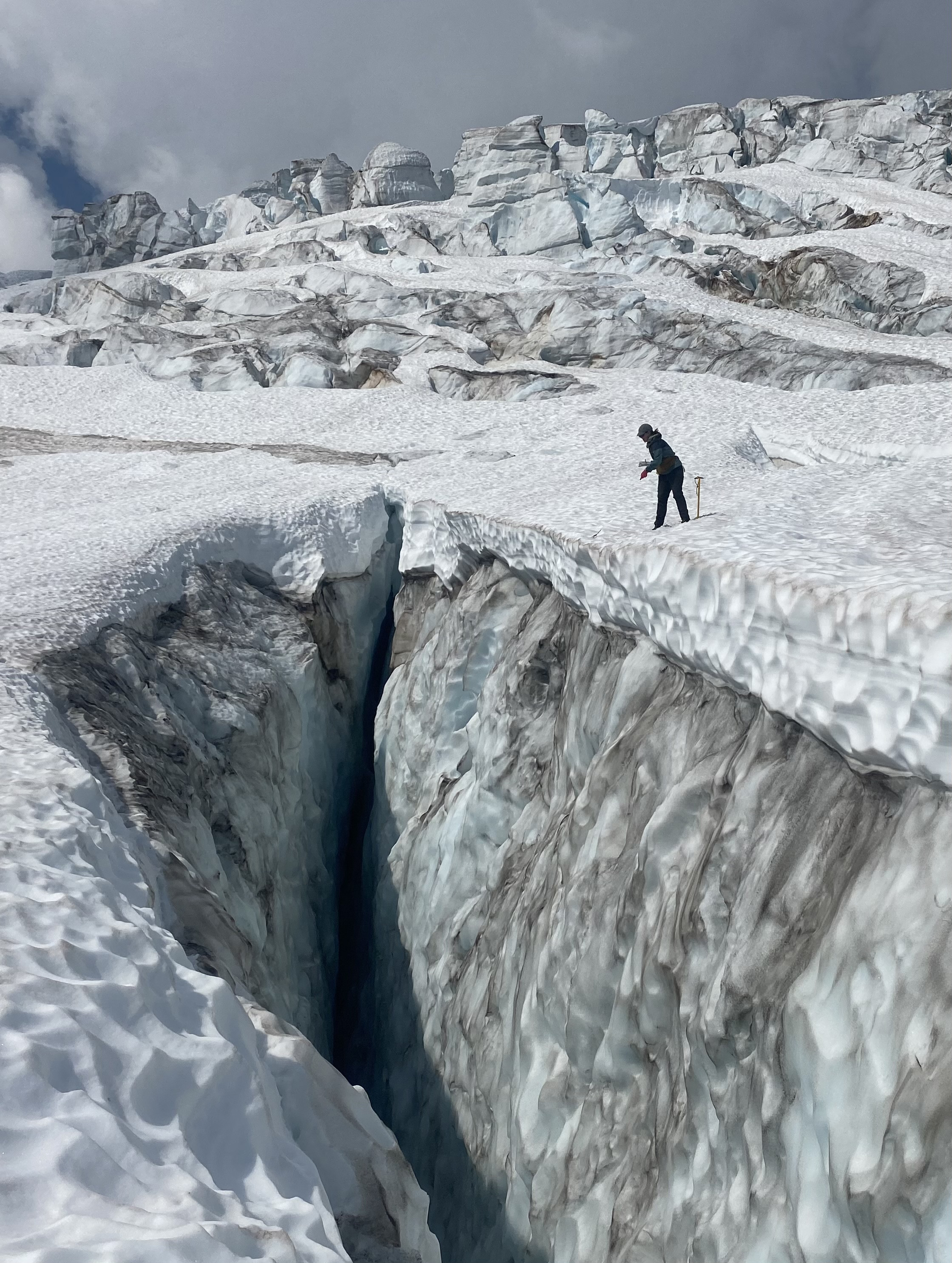
We have been assessing the depth and distribution of crevasses on several glaciers annually since 2013. We have noted a decline in the number of crevasses in specific icefall regions, such as on Lower Curtis, Rainbow and Easton Glacier. The depth also decline rapidly with glacial thinning during the last decade. In the main icefall on Easton Glacier in 2024 at 2300 m were the deepest crevasses we found at ~30 m. Below is Jill Pelto measuring crevasse depth using a camline.
Glaciers Lost

There are 31 active glaciers across the North Cascades that we observed since the 1980s that have now disappeared. The list below indicates the year they were lost, the area of the glaciers in the GLIMS inventory for initial area (1958-1984), 2015 area, and the area of the former glacier in 2022/24. This is not a complete list of glaciers lost in the North Cascade Range. The rate of loss is clearly accelerating.

When a glacier’s volume becomes too limited to generate motion, a combination of thickness below ~15-25 m, and area less than 0.02-0.05 km2, it is no longer a glacier.

North Cascade glaciers that we observed as glaciers in the 1980s that are now gone. The first two areas reported come from GLIMS.org inventories, and the last area and year of loss come from our observations.

Glacier Runoff

We directly measured runoff below Sholes Glacier and in the basin of former Ice Worm Glacier. In each continued glacier recession is reduing glacier runoff. The increased rate of melt is, exceeded by the reduced area available for melting. The result is declining summer streamflow and increased late summer stream temperatures.
NORTH CASCADE GLACIER CLIMATE PROJECT 2022-39th Annual Field Program

Mount Baker camp for Rainbow and Sholes Glacier (Illustration by Megan Pelto)

Science Director: Mauri S. Pelto, mspelto@nichols.edu
Art Director: Jill Pelto, pelto.jill@gmail.com

2022 Field Season: For the 39th consecutive summer we are heading into the field to measure and communicate the impact of climate change on North Cascade glaciers. We will complete detailed measurements on 10 glaciers, three of which are part of the World Glacier Monitoring Service reference glacier network (42 glaciers globally), which have 30+ consecutive years of mass balance observations.

Who we are? NCGCP was founded in 1983 to identify and communicate the response of North Cascade glaciers to regional climate change. We are a fieldwork-based project with a focus on measuring changes in mass balance, glacier runoff, and terminus behavior. The project has an interdisciplinary scope — collaborating with a range of natural scientists, artists, journalists, and conservationists. The goal of this is to best document and share our research with a broad audience. We aim to bring stories of these places and their changes to as many people as we can, making our research feel personal to more than just our team. The North Cascades glaciers are important for the ecosystem, as a water resource to Washington, and as a place of recreation for so many. By monitoring them every year, we continue to provide critical data on glacier response to climate change and informed stories of their health that reveal the impacts of our warming world.

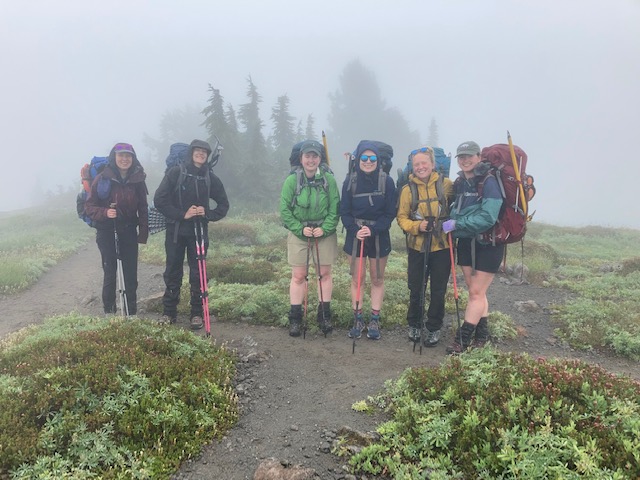
2021 Field Team for Rainbow Glacier

Why study glaciers in the North Cascades? Glaciers are one of the world’s best climate monitors and are a critical water resource to many populated glaciated regions. This is particularly true in the North Cascades where 700 glaciers yield 200 billion gallons of summer runoff and glaciers have lost 30 % of their area in the last century.  This has reduced glacier runoff in late summer in the region as the reduction in glacier area has exceeded the increase in melt rate. During heat waves this role is even more profound with the glacier fed North Fork Nooksack River discharge rising ~24% due to greater melt, while adjacent unglaciated South Fork Nooksack River discharge declines by ~20% (Pelto et al., 2022). The increased discharge limits the rise in river temperature during heat waves to 0.7 C in the North Fork, with the South Fork increasing by 2 C. This increases stress on the salmon in the South Fork (Pelto et al., 2022).

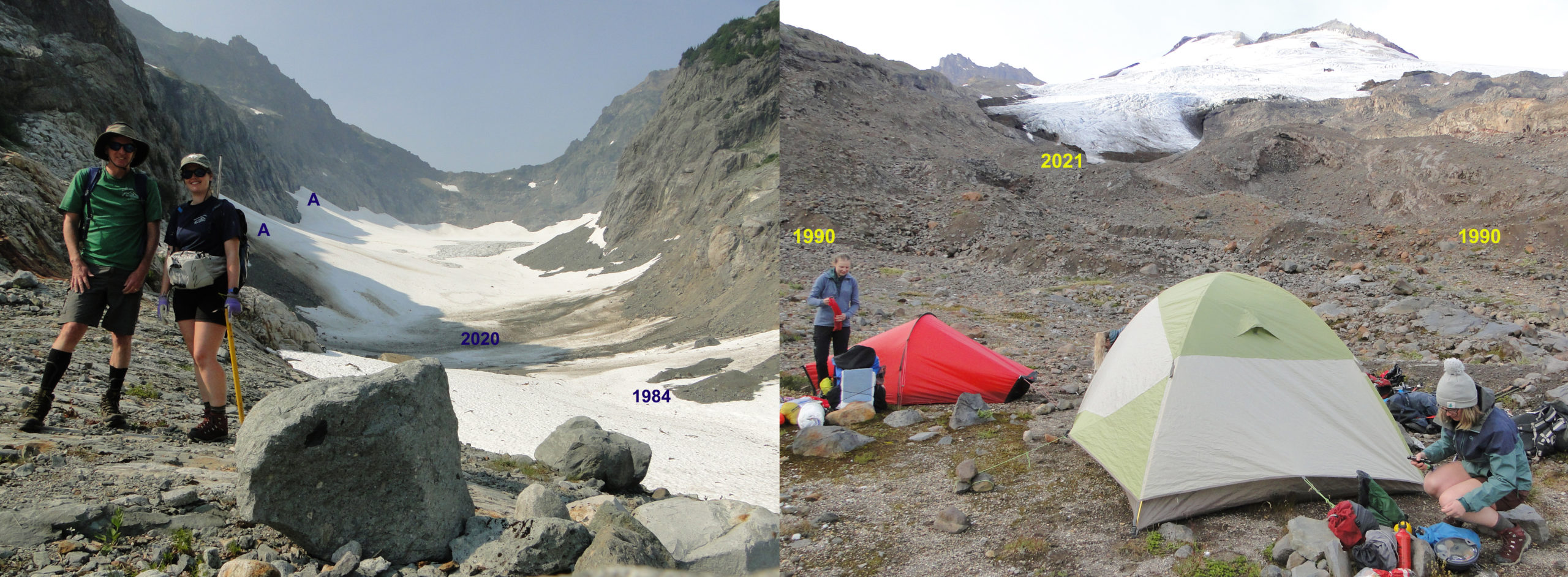
Terminus Change at Columbia and Easton Glacier.

This field season follows the 2021 season that featured a historic heat wave at the end of June and a period of extended warm weather that lasted until Mid-August. The heat led to a greater exposure of bare ice on glaciers earlier in the summer, particularly at higher elevations.  For ice surfaces with a higher albedo and greater density the observed melt rates are 7-9 cm per day water equivalent during warm weather events vs 4-6 for snow surfaces. This led to substantial mass losses on North Cascade glaciers, -2 m.

This summer we will have an opportunity to assess the long-term ramifications of the 2021 summer and measure the response of glaciers to the weather of 2022. This winter snowpack remained below average until a late season surge from April into May. The month of May and June had below normal temperatures leading to an above average snowpack. A hot July has melted into this snowpack and we will observe how much remains on the glaciers.

Field Team 2021:

Jill Pelto is an artist and scientist from New England who grew up loving winter sports and trips to the mountains. She incorporates scientific research and data into paintings and prints to communicate environmental changes. Her multi-disciplinary work weaves visual narratives that reveal the reality of human impacts on this planet. She completed both her B.A. degrees in Studio Art and Earth and Climate Science and her M.S. focused on studying the stability of the Antarctic Ice Sheet at the University of Maine, spending two field seasons at a remote camp in the southern Transantarctic Mountains. Jill will be joining the project for her 14th field season. She is excited about continuing to document the change in North Cascade glaciers that she has witnessed each of the last ten years — through science and art.

Mauri Pelto has directed the project since its founding in 1984, spending more than 700 nights camped out adjacent to these glaciers. He is the United States representative to the World Glacier Monitoring Service, author of the AGU blog “From a Glacier’s Perspective”, and associate editor for three science journals.  He is on the Science Advisory Board for NASA’s Earth Observatory. His primary position is Associate Provost at Nichols College, where he has been a professor since 1989.

Echo Allen is a rising Junior at UC Berkeley studying Architecture and Sustainable Design. Her studies deal with urban ecology and environmental justice in relationship to physical design. Echo finds inspiration for her studies in the backcountry as a NOLS backpacking student, avid rock climber, and kayak guide. Echo is currently working with the City of Richmond and SHAC (Sustainable Housing at Cal) to design and construct an affordable and scalable model of a solar-powered off-grid capable tiny house that will be used as affordable housing in Richmond CA. She hopes to help people understand the impact of climate change and implement possible mitigation strategies through her work in outdoor education and architecture.

Ellie Hall (she/her) is a recent graduate from the University of Colorado – Boulder with a BA in Environmental Studies, a minor in Geology, and a certificate in Arctic Studies. She is interested in researching and documenting the nuanced impacts of climate change on cold regions, and especially learning more about the relationship between decreasing snowpacks and increasing wildfires. She has spent the past two summers researching these areas, interning with INSTAAR’s Arctic Rivers Project and NASA’s ABoVE Campaign. She is excited to get into the field this summer to see the theoretical knowledge she’s learned be put into practice to collect valuable data. Ella’s other interests include backcountry skiing, mountain and gravel biking, rock climbing, and water sports.
Jenna Travers (she/they) is about to start her final year as a marine biology major at the University of Oregon. Her research focuses on the impacts of glacier retreat on salmon, how communities are affected by glacier loss and salmon declines, and how climate issues are communicated to the public. They are currently working as a writer with GlacierHub and a salmon identification contractor with the Wild Salmon Center, and they have also worked as a legislative intern for the Oregon State Legislature, a Water Justice intern with a local nonprofit. In her free time, Jenna enjoys hiking, skiing, rock climbing, and playing games with her roommates.
Field Partners 2022

Alia Khan’s research team including grad students Sally Vaux and Shannon Healy focus on environmental chemistry in the cryosphere, including black carbon and snow algae to document global change of glacier and snow melt in mountainous and polar regions. Western Washington University Cryosphere Studies and Aquatic Biochemistry Lab.
Claire Giordano is an environmental artist, writer, and educator creatively telling the stories of science, climate change, and the modern experience of nature. From creating rain-dappled sketches in an old growth forest to filming a watercolor class beside a glacier, careful observation of nature inspires her goal is to connect people and place through art.  In 2021 she founded the Adventure Art Academy – a series of virtual watercolor classes filmed outside – to invite others into the joy of painting outside.

Jaclyn Baer is an artist and photographer in the PNW. She is new to the climate change artist role, but excited to learn and share. She loves painting with gouache in her studio and watercolor out in the field. Besides painting, she spends her free time hiking and backpacking with her husband Ryan.

Nooksack Indian Tribe, for the 11th consecutive year, we will be conducting field work aimed at providing field validation and streamflow calibration data below Sholes Glacier for the ongoing work of the tribe.

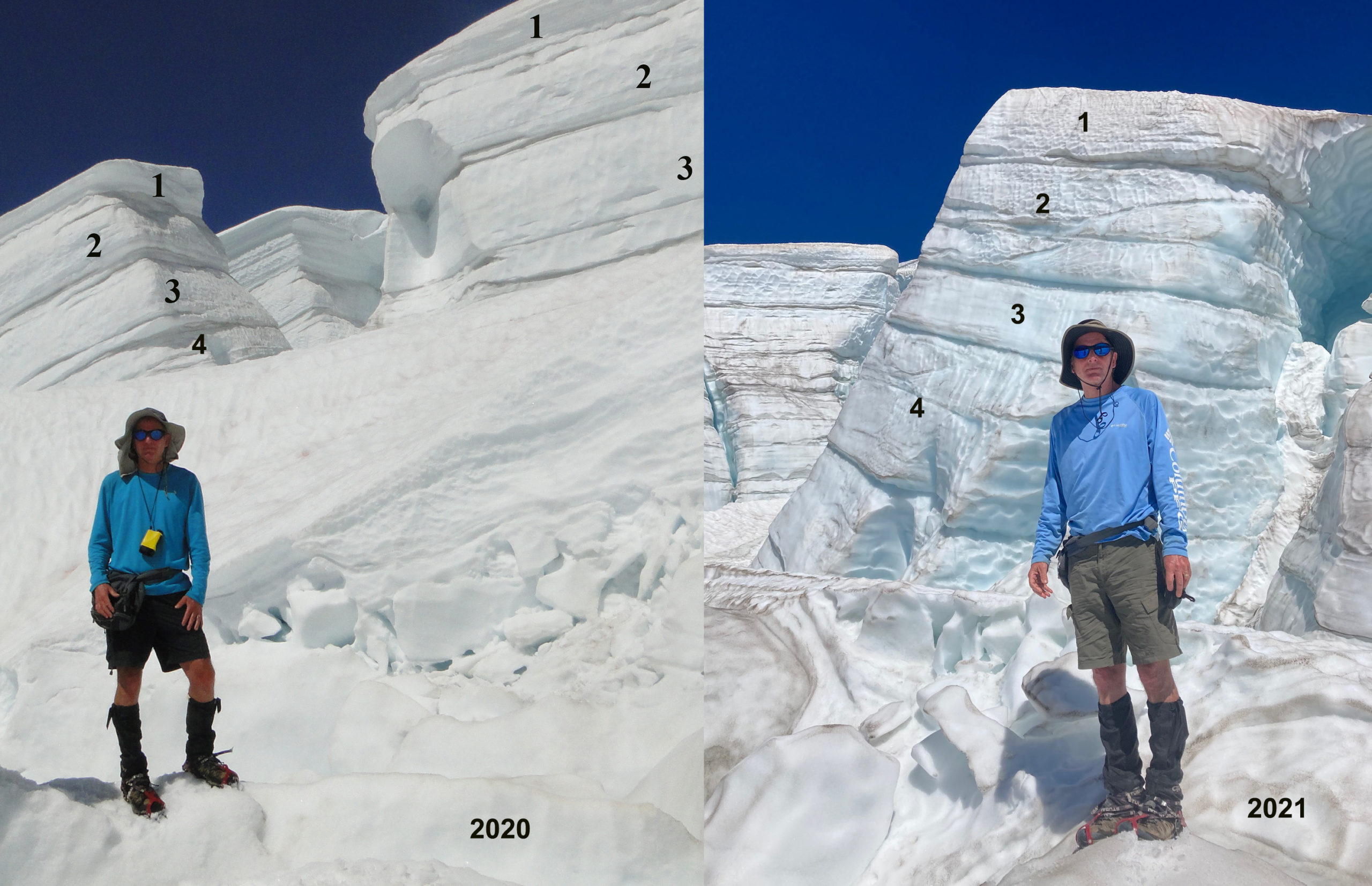
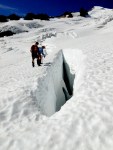
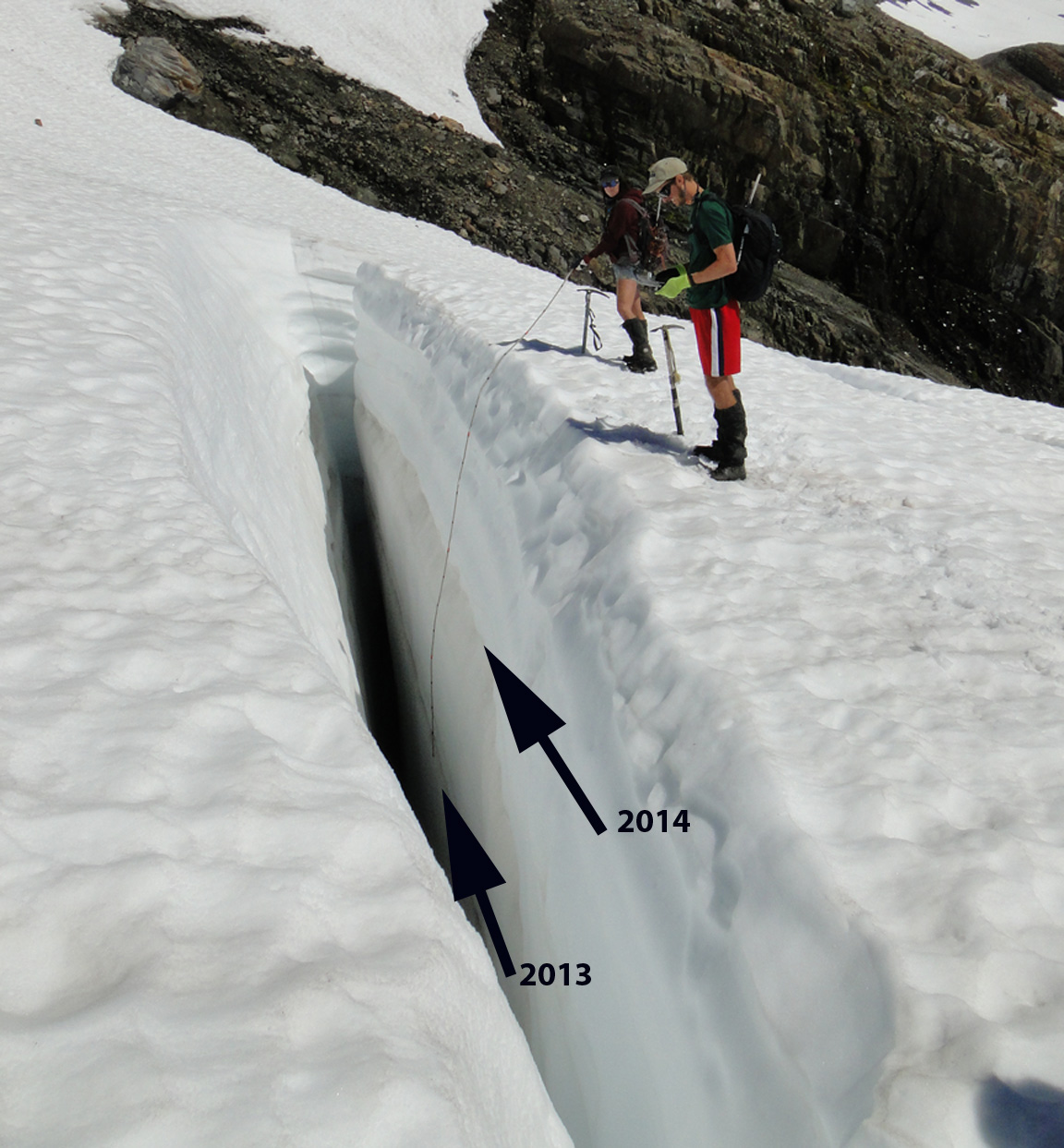
Crevasse Stratigraphy on Easton Glacier

 2022 Field Schedule

Jul 31:  Hike in Columbia Glacier
Aug. 1:  Columbia Glacier
Aug. 2:  Columbia Glacier
Aug. 3:  Hike Out Columbia, Hike in Ptarmigan Ridge
Aug. 4:  Sholes Glacier
Aug. 5:  Rainbow Glaciern
Aug. 6:  Rainbow Glacier
Aug.7:   Hike out, Hike in Lower Curtis Glacier
Aug. 8:  Lower Curtis Glacier
Aug. 9:  Hike out, Hike in Easton Glacier
Aug. 10: Easton Glacier
Aug. 11: Easton Glacier
Aug. 12: Hike out Easton/Hike in Daniel
Aug. 13: Ice Worm Glacier Survey
Aug. 14: Daniel and Lynch Glacier Survey
Aug. 15: Ice Worm ablation, Hike out
Aug. 16: Field season concludes


NORTH CASCADE GLACIER CLIMATE PROJECT 2020-37th Annual Field Program

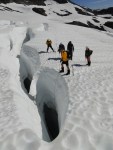
Field season images from 2019 indicating crevasse stratigraphy, annotated by Clara Deck.

Director: Mauri S. Pelto, mspelto@nichols.edu-Nichols College

Field Artist & Scientist: Jill Pelto, pelto.jill@gmail.com

Who we are? NCGCP was founded in 1983 to identify the response of North Cascade glaciers to regional climate change, particularly changes in mass balance, glacier runoff and terminus behavior.   NCGCP is a field project that has a broader interdisciplinary scope and examines more glaciers than any other program in North America.  It does so cost effectively relying on no permanent camps, helicopter support or salaries for the director. The field season includes no days off and each day is spent completing measurements on glaciers.  The focus is on glacier mapping, mass balance measurement, terminus observations and glacier runoff monitoring.  This program monitors two of the World Glacier Monitoring Service’s reference glaciers. There are ~45 such glaciers in the world with 30 years of continuous measurements. We complete mass balance and terminus observations on Columbia, Daniels, Easton, Ice Worm, Lower Curtis, Lynch, Rainbow and Sholes Glacier with runoff measurements below Sholes and Ice Worm.

Why study glaciers in the North Cascades? Glaciers are one of the world’s best climate monitors and are a critical water resource to many populated glaciated regions. This is particularly true in the North Cascades where 700 glaciers yield 200 billion gallons of summer runoff and glaciers have lost 30 % of their area in the last century.

Field Team 2020:

Jill Pelto is an artist and scientist from New England who grew up loving winter sports and trips to the mountains. She incorporates scientific research and data into paintings and prints to communicate environmental changes. Her multi-disciplinary work weaves visual narratives that reveal the reality of human impacts on this planet, as earlier in July was illustrated on the cover of TIME. She completed both her B.A. degrees in Studio Art and Earth and Climate Sciences and her M.S. focused on studying the stability of the Antarctic Ice Sheet at the University of Maine, spending two field seasons at a remote camp in the southern Transantarctic Mountains. Jill will be joining the project for her 12th field season. She is excited about continuing to document the change in North Cascade glaciers that she has witnessed each of the last ten years — through science and art.

Mauri Pelto has directed the project since its founding in 1984, spending more than 700 nights camped out adjacent to these glaciers. He is the United States representative to the World Glacier Monitoring Service, author of the AGU blog “From a Glacier’s Perspective”, and on the Science Advisory Board for NASA’s Earth Observatory.  His primary job is Dean of Academic Affairs at Nichols College, where he has been a professor since 1989.

Cal Waichler is an environmental science major at Colby College in Maine and is from Winthrop, WA. She looks to bridge the gap between science and the public by creating impactful, accurate climate art and storytelling. This summer’s research goal is to generate building blocks to contextualize her work within two fields: glacier science and climate communication.

Mariama Dryak (she/her) is an earth scientist, science communicator/writer and an advocate for action on creating solutions to the global climate crisis. Mariama is the creator and editor of an environmental advocacy blog Let’s Do Something BIG. and the ‘we persist.’ podcast, which shares the stories of underrepresented people in the earth, ocean and environmental sciences. Mariama received her Master’s from the University of Maine in 2019 in Earth and Climate Science, during which she drew connections between inferred ocean conditions and glacier change along the Antarctic Peninsula. Mariama can most often be found chatting science, going on adventures or getting muddy whilst doing something outdoors.

Columbia Glacier terminus with the 2018 field team.

 Field Partners 2020

Victoria Jarvis and Michelle Tanz are Wilderness Stewardship Fellows who will be gathering information about the Henry M Jackson Wilderness including the glacier. They are looking to understand the Columbia Glacier and our research within the scope of the 5 qualities of wilderness character (untrammeled, undeveloped, natural, solitude and primitive rec, other). They will then be able to incorporate our long-term monitoring efforts into their wilderness character narrative– a synthesized agency document providing insight about the wilderness.

Alia Khan, Western Washington University Cryosphere Studies and Aquatic Biochemistry Lab:

The research team including grad students Molly Peek and Shannon Healy focus on environmental chemistry in the cryosphere, including black carbon and snow algae to document global change of glacier and snow melt in mountainous and polar regions.

Tom Hammond, North Cascade Conservation Council,Will be joining us for the 17th year leveraging his experience with our for understanding the ongoing impact of climate change and our stewardship on the region.

Nooksack Indian Tribe, for the 9th consecutive year we will be conducting field work aimed at providing field validation and streamflow calibration data below Sholes Glacier for the ongoing work of the tribe.

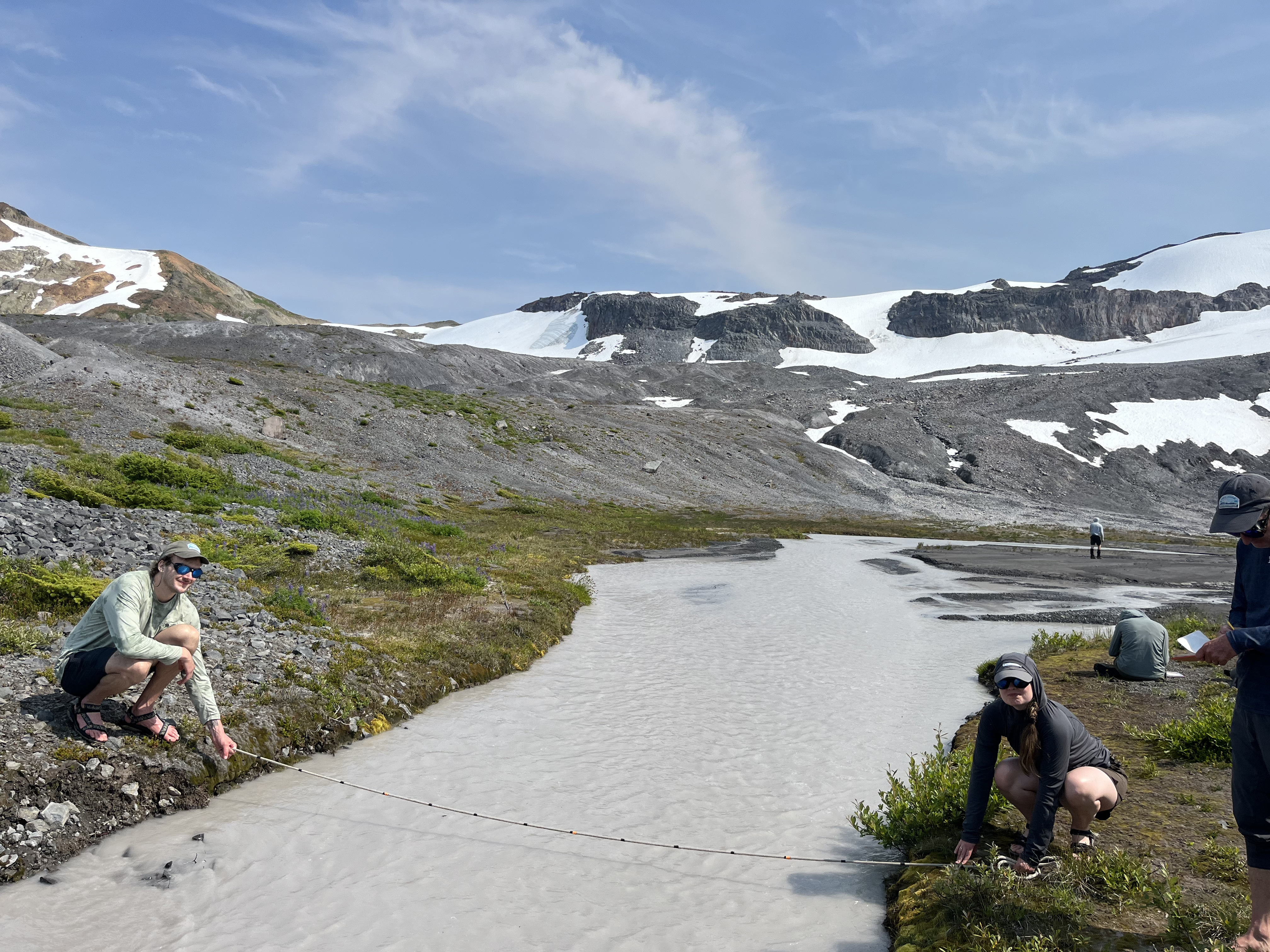
Measuring flow below Sholes Glacier

36th Annual North Cascade Glacier Climate Project Field Season Begins

Fieldwork includes terminus surveys, glacier runoff measurement and mass balance measurements

Field Season Begins August 1

Who we are? The North Cascade Glacier Climate Project (NCGCP) was founded in 1983 to identify the response of North Cascade glaciers to regional climate change, particularly changes in mass balance, glacier runoff and terminus behavior.   This was prompted by the  National Academy of Sciences listing this as a high priority and a personal appeal from Stephen Schneider. NCGCP is a field project that has a broader interdisciplinary scope and is the most extensive glacier mass balance field program in the United States.  Two of the 41 reference glaciers in the world are in our network, and as of next year that will become three glaciers.  We do this research cost effectively relying on no permanent camps, helicopter support or salary for the director. The field season includes no days off and each day is spent completing measurements on glaciers.  The focus is on glacier mapping, mass balance measurement, terminus observations and glacier runoff monitoring.  Each year we utilize several field assistants to complete the annual glacier surveys, with 2019 being the 36th field season.  Our goal in choosing assistants is not to pick the most experienced, but the individuals who are capable and can benefit the most.  We are a self-contained unit. Recently Hakai Magazine described our process well.

Why study glaciers in the North Cascades? Glaciers are one of the world’s best climate monitors and are a critical water resource to many populated glaciated regions. This is particularly true in the North Cascades where 700 glaciers yield 200 billion gallons of summer runoff and glaciers have lost 30 % of their area since 1980. These glaciers have lost 25-30% of their volume during the course of our study, three of our primary study glaciers have disappeared. We also monitor ice worms and mountain goats since we are in the same locations at the same time each year.

2019 Outlook: For North Cascade glaciers the accumulation season provides that layer of snow, that must then last through the melt season.  A thin layer sets the glaciers up for a mass balance loss, much like a bear with a limited fat layer would lose more mass than ideal during hibernation. The 2019 winter season in the North Cascade Range, Washington has been unusual.  On April 1 the retained snow water equivalent in snowpack across the range at the six long SNOTEL sites is 0.72 m, which is ~70% of average.  This is the fifth lowest since 1984.  The unusual part is that freezing levels were well above normal in January, in the 95% percentile at 1532 m, then were the lowest level, 372 m of any February since the freezing level record began in 1948.  March returned to above normal freezing levels.  As is typical periods of cold weather in the regions are associated with reduced snowfall in the mountains and more snowfall at low elevations.  In the Seattle metropolitan area February was the snowiest month in 50 years, 0.51 m of snow fell, but in the North Cascades snowfall in the month was well below average. From Feb. 1 to April 1, snowpack SWE at Lyman Lake, the SNOTEL site closest to a North Cascade glacier, usually increases from 0.99 m to 1.47 m, this year SWE increased from 0.83 m to 1.01 m during this period. The melt season from May-Mid-July has also been warmer than average.  This combination will lead to significant glacier mass loss in 2019, in one month we will report back on our measurements that will indicate just how negative.

2019 Field Team:

Clara Deck: is an earth scientist from Chicago with a passion for science communication, education, and outreach. She completed a B.A. in geology at the College of Wooster in Wooster, Ohio, where she began a journey in climatological research which led to a love for the cryosphere. In the summer of 2018, Clara contributed to glacial field work in the eastern Alaska Range, and was fascinated by the dynamic day-to-day changes in glacial features she was tasked with measuring. At the University of Maine, she is wrapping up her M.S. focused on numerical modeling of Antarctic ice shelf instabilities, but Clara’s favorite part of her college career has been sharing science with students as a teaching assistant. During her first visit to the North Cascades, she is excited to learn about ongoing glacial change and to explore accessible ways to share the findings with public audiences.

Abby Hudak is a native Floridian that has always had a deep calling to the mountains and frozen landscapes. Her passions revolve around understanding our changing climate and natural world which led her to attain a B.S. in Biological Sciences from the University of Central Florida. After starting her M.S. in Biological Sciences at Washington State University, she immediately indulged in snow sports and mountaineering in the Cascade Range. The beauty and vulnerability of these landscapes have driven her to expand her research interests to understanding aspects of the changing cryosphere. She is eager to intertwine her love for the Cascade Range and her desire to pursue scientific questions pertaining to climate impacts on alpine glaciers by working with the North Cascade Glacier Climate Project this summer.

Ann Hill, ever since she was a young child growing up in Minneapolis, Ann has been fascinated by ice and snow, however it wasn’t until her Sophomore year studying Geosciences at Skidmore College that she realized she could study ice as a career path. Consequently, during her junior year she traveled to Svalbard to gain hands-on experience studying and exploring glaciers. Determined to learn more, Ann spent a summer with the Juneau Icefield Research Program, which exposed her to glaciers that looked and behaved differently. In the fall, Ann will begin her M.S. in Earth and Climate Sciences at the University of Maine. Ann is thrilled to study the North Cascade glaciers to understand how their movement and characteristics compare to those she previously observed in Svalbard and Alaska.

Jill Pelto is an artist and scientist from New England who grew up loving winter sports and trips to the mountains. She incorporates scientific research and data into paintings and prints to communicate environmental changes. Her multi-disciplinary work weaves visual narratives that reveal the reality of human impacts on this planet. She completed both her B.A. degrees in Studio Art and Earth and Climate Sciences and her M.S. focused on studying the stability of the Antarctic Ice Sheet at the University of Maine. She spent two field seasons at a remote camp in the southern Transantarctic Mountains to map glacial deposits and collect samples from them for dating. Jill will be joining the project for her 11th field season. She is excited about continuing to document the change in North Cascade glaciers that she has witnessed each of the last ten years — through science and art.

Mauri Pelto has directed the project since its founding in 1984, spending more than 700 nights camped out adjacent to these glaciers. He is the United States representative to the World Glacier Monitoring Service, author of the AGU blog “From a Glacier’s Perspective”, and associate editor for three science journals.  His primary job is Dean of Academic Affairs at Nichols College, where he has been a professor since 1989.

Schedule

Aug. 1:  Arrive Hike into Easton Glacier

Aug. 2:  Easton Glacier survey

Aug. 3:  Easton Glacier survey

Aug. 4:  Hike out  Hike in Lower Curtis Glacier

Aug. 5:  Lower Curtis Glacier Survey

Aug. 6:  Hike out Lower Curtis Glacier Hike in Ptarmigan Ridge

Aug. 7:  Sholes Glacier

Aug. 8:  Rainbow Glacier

Aug. 9:  Hike out- Coleman Glacier survey

Aug. 10:  Hike in Columbia Glacier

Aug. 11:  Columbia Glacier survey

Aug. 12:  Columbia Glacier survey

Aug. 13:  Hike out Columbia Hike in Mount Daniels

Aug. 14:  Ice Worm Glacier survey

Aug. 15:  Lynch and Daniels Glacier survey

Aug. 16:  Hike out

35th Annual Field Season Monitoring North Cascade Glaciers Preliminary Assessment


We monitor the response of North Cascade glacier to climate change and the consequent impacts for water resources and the ecosystem, as illustrated here by Megan Pelto and Jill Pelto.

For the 35th consecutive year I headed to the North Cascade Range, Washington to monitor the response of glaciers to climate change. During the course of this study we  observed several of the glaciers we monitor disappear.  Two of the glaciers we monitor are now part of the 42 glaciers comprising the World Glacier Monitoring Service reference glacier network, where annual mass balance has been assessed for more than 30 years consecutively.

The 2018 winter season featured relatively normal snowpack despite a winter of wide temperature fluctuations, Feb freezing levels 400 m below the mean and December 500 m above the mean. Summer melt conditions featured a high freezing levels in May, normal freezing levels in June and high levels in July (NA Freezing Level tracker). The summer melt season through Aug. 20th has been exceptionally warm and dry, which has also helped foster forest fires. The melt rate during the August field season was 35% above normal.

We assessed the mass balance of eight glaciers.  All eight will have significant negative mass balances in 2018. Retreat was measured on six of the glaciers where the terminus was exposed, all had retreated since 2017.

Sholes Glacier Runoff Monitoring Location in early August 2018

This year the field team consisted of:

Mariama Dryak, UMaine graduate student quantifying iceberg melt rates and meltwater fluxes around the Antarctic Peninsula using satellite imagery.  She is the US national committee representative for the Association of Polar Early Career Scientists, co-chair of USAPECS and helps coordinate the USAPECS blog. Mariama is also the creator and editor of an environmental advocacy blog Let’s Do Something BIG., which highlights the need for effective science communication and the need for greater diversity in the earth sciences.

Erin McConnell, UMaine graduate student, who is studying ice core stable isotope records from the Eclipse Icefield, St. Elias Range, Yukon.She has written about the equal importance of communicating science and the science itself..

Jill Pelto, UMaine graduate student studying paleoclimate records recording past ice sheet changes in the Transantarctic Mountains and an artist, joining the field team for the 10th year. Her work has taken her to Antarctica, New Zealand and Falkland Islands and has been widely featured by Earth Issue,  The Smithsonian, and Edge Effects.

Mauri Pelto, Nichols College academic dean, World Glacier Monitoring Service Representative and director of the North Cascade Glacier Climate Project .  I am heading into the North Cascades for the 35th year. The results will from this year will be promptly published with the AGU From a Glaciers Perspective Blog and the North Cascade web site.  A video encapsulation of the field year will also be developed as in past years. Putting the long term record in perspective was the 2018 Water publication on the long term mass balance record.

Observing snowpack thickness retained in August on Rainbow Glacier

Mapping terminus of Lower Curtis Glacier

Terminus of Columbia Glacier with evident forest fire smoke haze.

Easton Glacier Icefall at 2500 m, indicating a typical 2.25 m thick accumulation layer.

Looking Inside a Glacier

Here we provide a visual look inside a glacier in the North Cascades of Washington.  Glaciers are not all the same, but the key internal ingredients in summer typically are in varied ratios: ice, meltwater, sediment and biologic material.  In this case there are torrents of water pouring through the interior of the glacier, generated at the surface the day we are filming.  We do measure the discharge and velocity of these streams.  Once they drain englacially they are much slower as there are numerous plunge pools.  There are also plenty of water filled crevasses. Some of the streams have considerable sediment in them, usually large clasts given the high velocity and low bed friction.  In this case there are also a great many ice worms clinging to the walls of a water filled crevasse, and the walls of the stream channels.  All of this water than merges by the terminus into an outlet stream.  This again we measure.  On the glacier we are measuring melt and at the end of the glacier runoff provides an independent measure of this melt as well. The water then heads downstream supplying many types of fish enroute to the ocean.

The last three years have led to considerable mass loss of glaciers in the area.  This means less snowcover at the surface, which leaves less room for the ice worms to live and forces them into the meltwater regions.  This also leads to more supraglacial stream channels, which develop and deepen.  In many cases the streams deepen to the point that they become englacial. The increased ice area also should stress glacier ice worms as they live on algae, which resides largely in snow, which is less extensive and persistent in recent summers.

Disastrous Year for North Cascade Glacier Mass Balance (Snow/Ice Economy)


Mass loss of North Cascade glaciers visualized.

A disastrous year is unfolding in 2015 for North Cascade glaciers, if normal melt conditions continue the range will lose 5-7% of its entire glacier volume in one year! For the 32nd consecutive year we were in the North Cascade Range, of Washington to observe the mass balance of glaciers across the entire mountain range. The melt season is not over, but already the mass loss is greater than any other year, with six weeks of melting left. An alpine glacier’s income is the snow that accumulates, and to be have an equilibrium balance sheet for a year, alpine glaciers typically need 50-65% snowcovered surfaces at the end of the melt season.  Below the accumulation zone, net assets are lost via ablation.

In 2015 of the 9 glaciers we examined in detail, 6 had less than 2% retained snowcover, which will be gone by the end of August.  Two more had no 2015 snowpack greater than 1.7 m in depth, which will also melt away before summer ends.  Average ablation during the August field season was 7 cm per day of snow, and 7.5 cm of ice. Only one glacier will have any retained snowcover at the end of the summer, we will be checking just how much in late September. This is the equivalent of a business having no net income for a year, but continuing to have to pay all of its bills. Of course that comes on top of more than 27 years of consecutive mass balance loss for the entire “industry” of global alpine glaciers.  The business model of alpine glaciers is not working and until the climate they run their “businesses” in changes, alpine glaciers have an unsustainable business model. Below this is illustrated glacier by glacier from this summer.  A following post will look at the glacier runoff aspect of this years field season.  The Seattle Times also featured our summer research.JillPeltoGMB_720_494_s_c1_c_c

Jill Pelto Painting of mass balance time series loss from 1984 to 2014. 

In a recent paper published in the Journal of Glaciology spearheaded by the WGMS group  (M. Zemp,  H. Frey, I.Gartner-Roer, S.Nussbaumer, M.Hoelzle, F.Paul, W.Haeberli and F.Denzinger), that I was co-author on, we examined the WGMS dataset on glacier front variations (~42 000 observations since 1600), along with glaciological and geodetic observations (~5200 since 1850).  The data set illustrated that “rates of early 21st-century mass loss are without precedent on a global scale, at least for the time period observed and probably also for recorded history.The rate of melting has been accelerating, and in the decade from 2001 to 2010, glaciers lost on average 75 centimetres of their thickness each year”, this is compared to the loss in the 1980’s and 1990’s 25 cm and 40 cm respectively each year (Pelto, 2015).  A comparison of the global and North Cascade Glacier mass balance records since 1980 indicate the cumulative loss, at bottom.

DSC08917

Columbia Glacier terminus August 3, 2015 with new expanding lake.

DSC00199

Upper portion of Columbia Glacier on Aug. 5, 2015 note lack of snowcover and all previous firn layers (firn is snow that survived a melt season but is not yet glacier ice).

DSC00503

Foss Glacier lacking snowcover and losing area fast this summer, this glacier will lose more than 15% of its volume in 2015.

DSC00435

Measuring firn from 2011-2014 retained in a crevasse on Easton Glacier, 2015 snowpack lacking.

DSC00429

The typical end of summer snowline elevation on Easton Glacier, bare ice and firn in 2015.

DSC09197

Rainbow Glacier amidst the normal accumulation zone, where there should be 3-4 m of snowpack, none left.

DSC09602

Lynch Glacier view across the typical end of summer snow line region on Aug. 17th 2015.

DSC00413

Terminus of Lower Curtis Glacier with many annual layers exposed to rapid melt, 31 m of retreat from spring to August 11th, 2015.

DSC00448

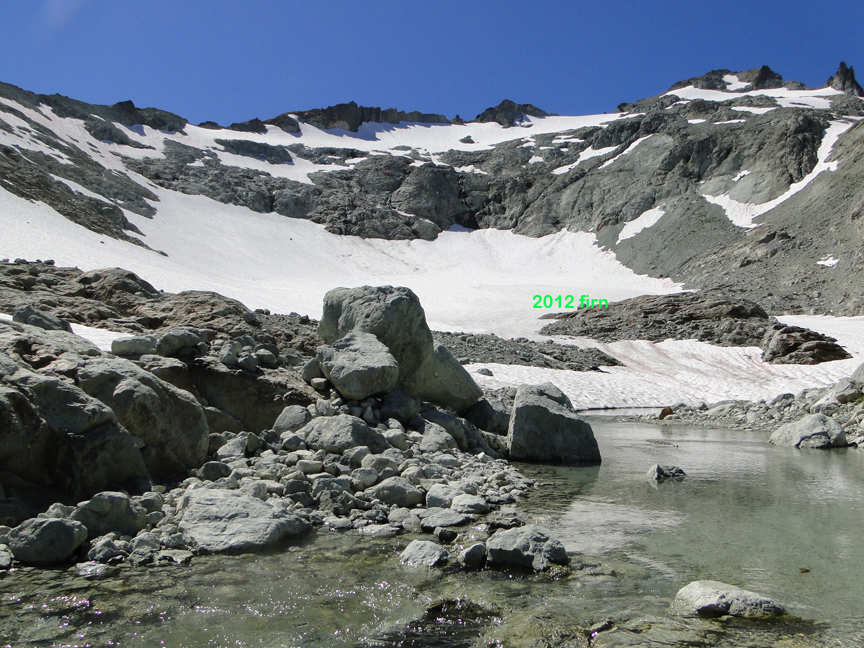
ice worm firn

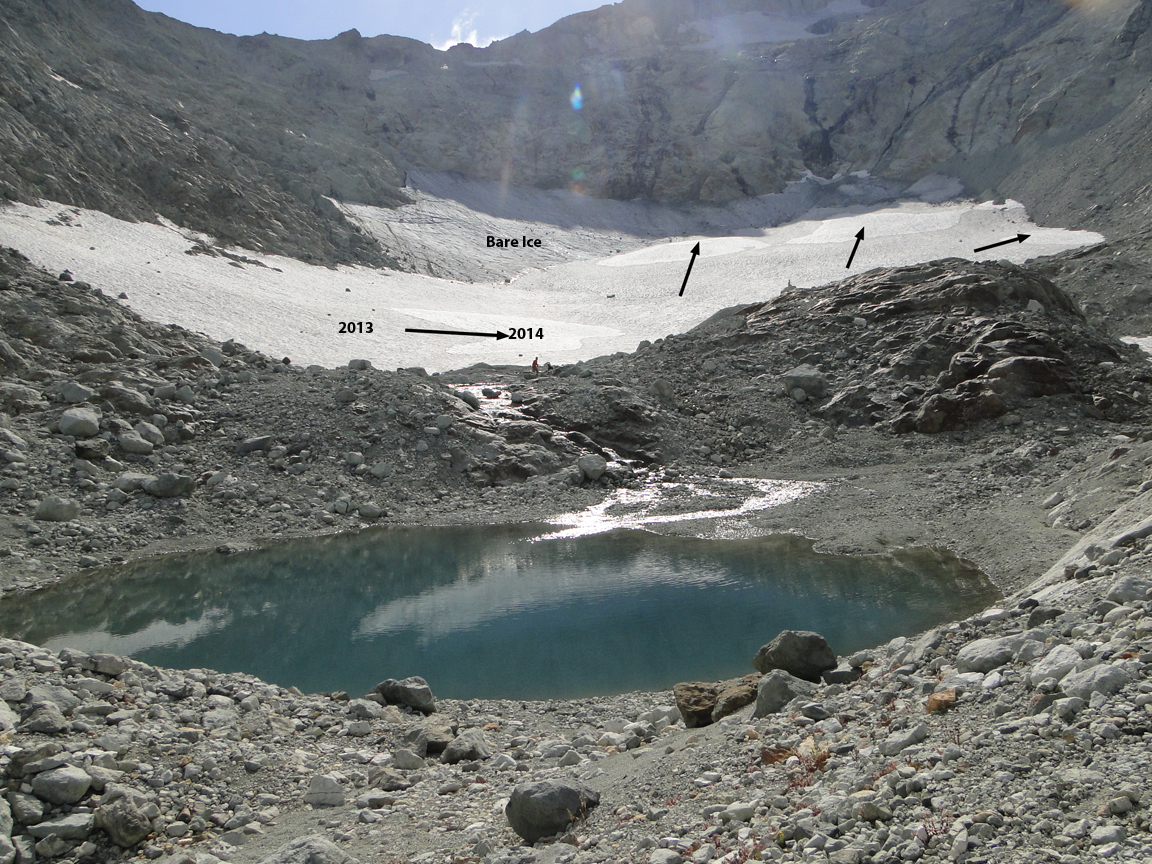
Only firn from 2013 and 2014 and bare ice at surface of Ice Worm Glacier.

ba2014


Comparison of cumulative glacier mass balance in the North Cascades and Globally (WGMS)

DSC00348

Primary field team for the from left, Mauri Pelto (Nichols College), Jill Pelto (UMaine), Tyler Sullivan (UMaine), Ben Pelto (UNBC) and Erica Nied (U-Colorado) summer with contributions from Justin Wright, Tom Hammond, Oliver Grah and Jezra Beaulieu not pictured

Embarking on the 32nd Annual North Cascade Glacier Climate Project


sholes compare
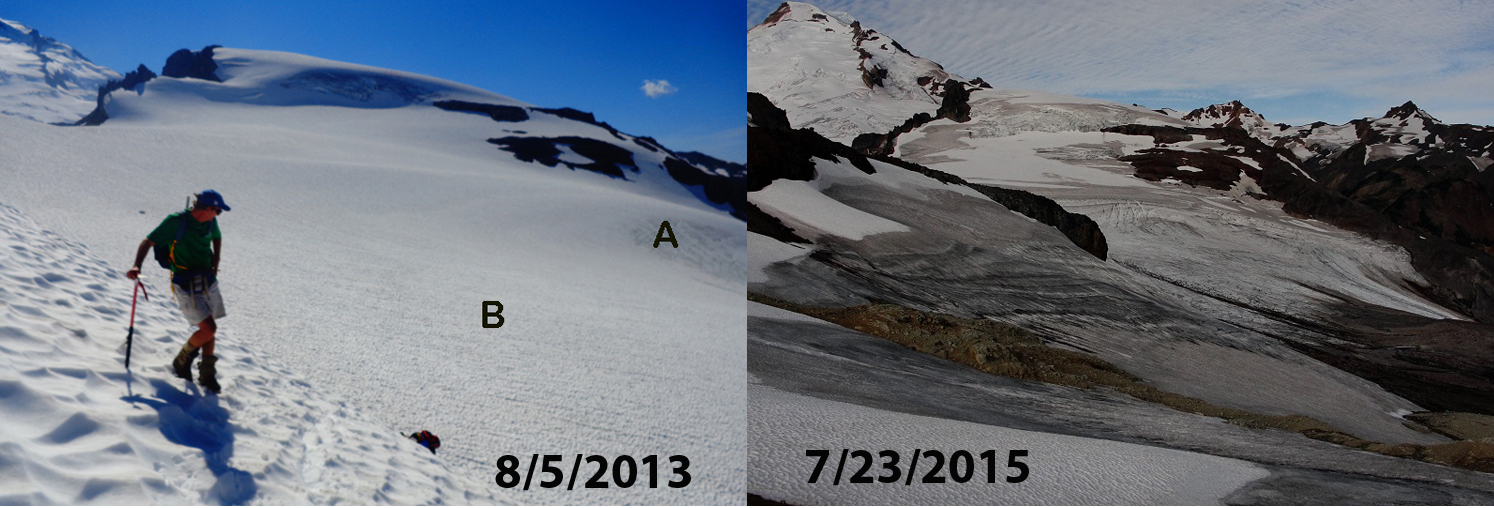
Sholes Glacier snowcover Aug. 5, 2013 (Jill Pelto) and Sholes Glacier July 23, 2015 (Oliver Grah)

For the 32nd straight summer we will be investigating North Cascade glaciers and their response to climate change over the next three weeks (that means no new posts until Aug. 20).  In 1984 the program was initiated to study the impacts of climate change across an entire mountain range, instead of on just one glacier.  This had been a high priority of the National Academy of Science, I felt I could address.  The glaciers in the North Cascades provide water resources for irrigation, hydropower, salmon and municipal supply.  During our 32 years we have seen the loss of 25% of the entire glacier volume of the range.  Unfortunately 2015 is almost certainly going to be the worst year during this period.  We will likely lose over 5% of the volume of these glaciers in one year.  The problem has been high freezing elevations in the winter, note the difference from other years below.  Because of the drought conditions glaciers are even more crucial to runoff, note the daily spike in flow due to glacier melt in the Nooksack River in July, black arrows.  Blue arrow indicates rain storm.

winter 2015nooksack

Freezing levels on Mount Baker during winter 2015 versus previous winters.  Nooksack River discharge from the USGS in July.

This has been followed by the warmest June and now July the region has seen. This has led to record low streamflow from either rain, groundwater or snowpack from non-glacier areas.  The result is that in glacier fed basins glacier runoff which is above normal because of the warm temperatures is even more important.  We are measuring flow below glaciers and melting on glaciers to quantify the percent of total flow contributed by glaciers.  In 2014 in the North Fork Nooksack River glaciers contributed more than 40% of total stream discharge in the river on 21 days, all in August and September. We again with the Nooksack Indian Tribe will be examining the issue, particularly at Sholes Glacier. We will also be measuring the mass balance, terminus change and mapping ten glaciers we visit every year, including Columbia Glacier seen below.

columiba compare

Terminus of Columbia Glacier and accumulation zone looking bare in 2005, the lowest snowpack year of the last 32 until this year

The glaciers are all in Wilderness areas which means no motorized vehicles or equipment, we have to hike everything in.  This has provided the opportunity to spend over 600 nights in a tent examining the glaciers, hiking/skiing over 3000 miles across the glaciers, and eating oatmeal each morning for breakfast.  It has also provided the opportunity to train and work with more than 60 different scientists.  This year the field team consists of Erica Nied from the University of Colorado, Tyler Sullivan from the University of Maine, Jill Pelto from the University of Maine for the seventh year and myself for the 32nd year.  We will be joined at times by Justin Wright, Oregon State, Tom Hammond, University of Washington, Ben Pelto University of Northern British Columbia, Oliver Grah and Jezra Beaulieu of the Nooksack Indian Tribe. Below are three videos from last year that illustrate: 1: Visual report on initial 2015 findings 2: How and why we measure mass balance.3. The Nooksack Indian Tribe perspective on threats of glacier runoff and our measurements of it.


Sholes Glacier, Washington: Measuring Annual Glacier Mass Balance

Annual mass balance is the difference between ice and snow added to the glacier via accumulation and snow and ice lost via ablation and in some cases calving. Alpine glacier mass balance is the most accurate indicator of glacier response to climate and along with the worldwide retreat of alpine glaciers is one of the clearest signals of ongoing climate change (WGMS,2010). For 25 consecutive years we (North Cascade Glacier Climate Project) have measured the mass balance of Sholes Glacier. On Sholes Glacier in 2014 we completed 162 measurements of snowpack depth using probing and crevasse stratigraphy, mainly probing on this relatively crevasse free glacier.  We mapped the extent of snowcover on several occasions, and using the retreat of the snowline and stakes emplaced in the glacier observed the rate of ablation (melting). We also measured runoff from the glacier in a partnership with the Nooksack Indian Tribe, which provided an independent measure of ablation. The final mass balance in 2014 was -1.65 m of water equivalent, the same as a 1.8 meter thick slice of the glacier lost in one year. In 2014 we arrived at Sholes Glacier to find it already had 15% blue ice exposed, on August 7th. This had expanded to 25% by August 12th. This rapidly expanded to 50% by August 23rd, note Landsat comparison below. The snow free area expanded to 60% by the end of August and then close to 80% loss by the end of the summer. Glaciers in this area need 60% snowcover at the end of the melt season to balance their frozen checkbook. This percentage is the accumulation area ratio. This mass balance data is then reported to the World Glacier Monitoring Service, along with about 110 other glaciers around the world.  Unfortunately the WGMS record indicates that Global alpine glacier mass balance was negative in 2014 for the 31st consecutive year.  The video below explains how we measure mass balance each year with footage from the 2014 field season.  Of course a key aspect is hiking to the glacier and camping in a tent each year.

The Sholes Glacier thickness has not been measured, but there is a good relationship between area and thickness, that suggests the glacier would average between 40 and 60 m in thickness. The 15 m of water equivalent lost from 1990-2014 is equal to nearly 17 m of ice thickness, which would be at least 35% of the glaciers volume lost during our period of measurement.

DSC07194 sholes 915og

Sholes Glacier on August 7, 2014 and Sept. 15 2014, the glacier had lost 80% of its snowcover at this point an indicator of poor mass balance 2014.

sholes landsat 2014
Landsat 8 images of Sholes Glacier in 2014, with red line indicating snow line.

sholes probing snowpack rainbow stratigraphy

Measuring Accumulation on a glacier using Probing and crevasse stratigraphy.

DSC02001
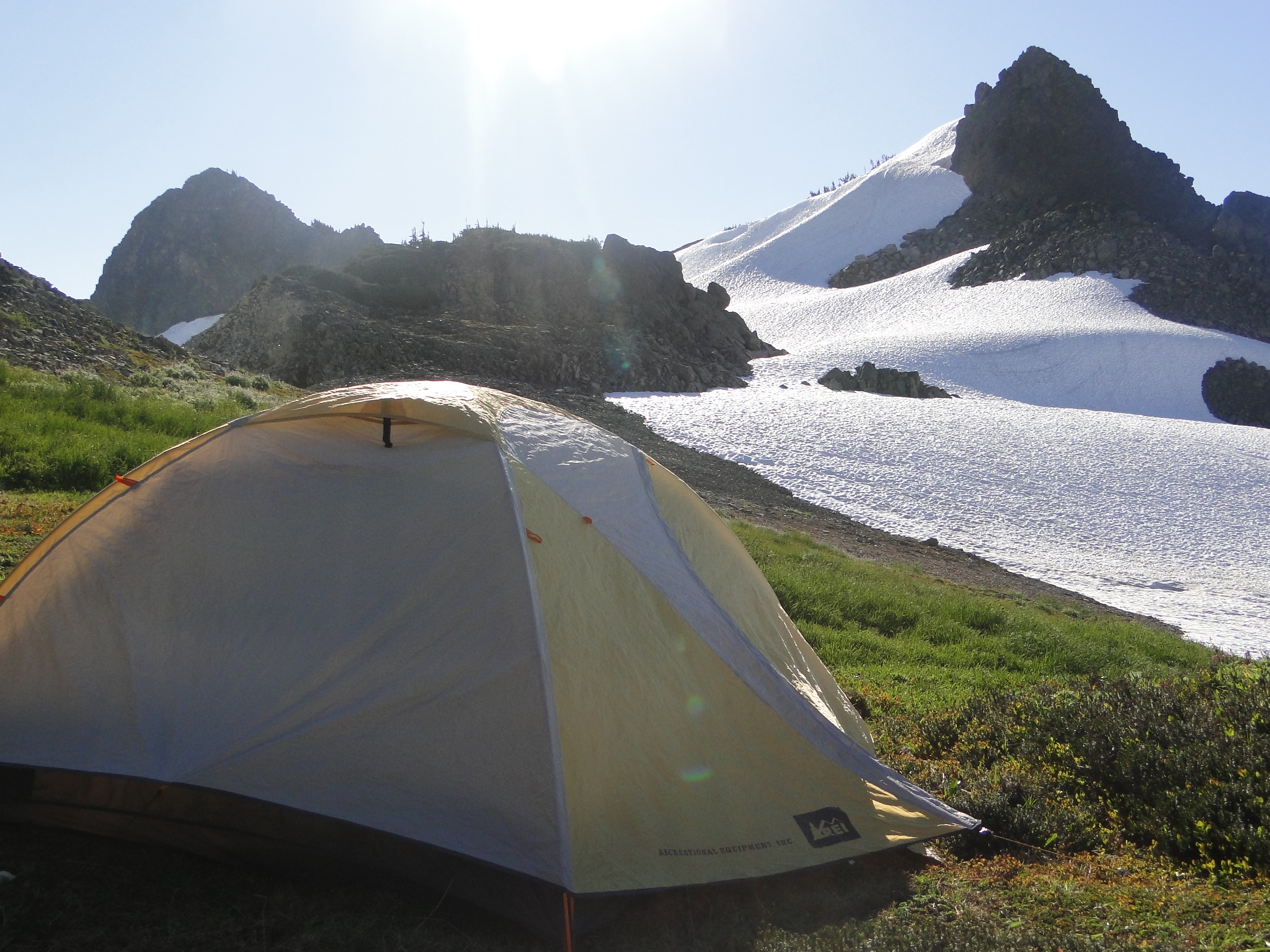
Base Camp where we have spent more than 100 nights in a tent in the last three decades.

North Cascade Glacier Climate Project 2013 Field Report

The 2013 winter season provided close to average snowpack in the North Cascades as indicated by the average SWE at SNOtel stations in the range. The summer melt season has proved to be long, warm and dry. The May-August mean temperature at the station closest to a glacier, Lyman Lake, has been tied for the 2nd warmest in the last 25 years with 2009 and only 2004 warmer. The summer has lacked record periods of warmth and has featured sustained warm temperatures and higher than average humidity, reducing the number of nights when the glacier surface has frozen. The average minimum temperatures at Lyman Lake are the highest in the last 25 years for July and August. The humidity was the strikingly high during our field season, note diagram from a Cliff Mass article on the topic. The net result will be significant negative glacier mass balances in the North Cascades. There is one month left in the melt season most glaciers are close to an equilibrium balance already.

The field team included Stewart Willis and Matt Holland, Western Washington University, Jill Pelto, U of Maine, Ben Pelto, UMass,-Amherst, Jezra Beaulieu and Oliver Grah, Nooksack Indian Tribe research scientists And Tom Hammond, North Cascade Conservation Council. Alan Kearney, Photographer worked with us for the first week capturing time lapse imagery of our work.

After a month of perfect summer weather we arrived to a foggy and wet conditions on the Columbia Glacier. The Columbia Glacier terminus was exposed and has retreated 85 m since 1990. The glacier had a substantial area of blue beginning 200 m above the terminus and extending along the western side of the basin for 400 m. The area of blue ice on August 1 was 50,000 square meters, by Aug. 21 the area had expanded to 200,000 square meters, the shift of the 2013 winter snowline during this period indicates a melt of m during the three weeks.


The Lower Curtis Glacier terminus was exposed early in the summer resulting in a continued retreat of 20 m since 2011, the area of thick seraced terminus lost since 1990 has been 60,000 square meters. The lateral retreat and terminus retreat since 1990 are both in the 125-150 meter range depending on location.
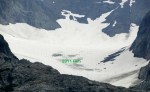
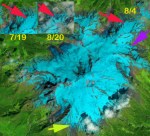
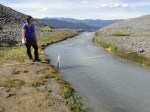
We spent a week observing ablation and resulting glacier runoff on Sholes Glacier. With Oliver Grah and Jezra Beaulieu who work for the water resources section of the Nooksack Indian Tribe we emplaced a stream gage right below Sholes Glacier and one on Bagley Creek which is snowmelt dominated. With the water level gages in we all began work on a rating curve for the Sholes Glacier site directly measuring discharge on 14 occasions, kayak socks helped reduce the impact of cold water. Average ablation during the week was 8.25 cm/day of snowpack or 5 cm of water, discharge measurements identified a mean of 5.2 cm/day of from the glacier during this period. The agreement between ablation and discharge was a nice result. Discharge became notably more turbid after 1 pm, peaking in turbidity around 5 pm. Of equal interest was the change in snowcovered area. On July 19th a Landsat image indicated 100% snowcover for Sholes Glacier. On Aug. 4th our surface measurements indicates a blue ice area of 12,500 square meters, which is also evident in a Landsat image from that day. By Aug. 20th a satellite image indicates that the blue ice area had expanded to an area of square meters. This coincided with the area where snowdepth was observed to be less than 1.2 m on Aug.4. This represents a volume loss of 592,000 cubic meters of water in 16 days.
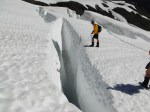
We measured the mass balance on Rainbow and Sholes Glacier during this period. The snowpack was poor on both, especially above 1900 meters on Rainbow Glacier. Typical depths are over 5-6 m, this year 3.75-4.5 m. The poor snow depths were also noted on the Easton Glacier above 2000 m in crevasse stratigraphy measurements. Each crevasse is approached probing to ensure it is safe and then assessed to make sure the crevasse is vertically walled, this enables a safe but also accurate measure. In some cases layers from mulitple years can be assessed. IN the Lynch Glacier crevasse the 2013 layer will be lost to melt before end of the summer. Easton Glacier had a terminus that was fully exposed by the start of August. The terminus slope has thinned markedly in the last three years as retreat has continued. The retreat of Easton Glacier has averaged 10 m/year from 2009-2013. This year the retreat will exceed that with two months of exposure. The Deming Glacier retreat has been exceptional over the last 12 months with at least 30 m of retreat. The snowline on Easton Glacier was at 1850 m on Aug. 10th. By the end of August the snowline had risen to 1980 m, where snow depths had been 1.5 m three weeks previous. The mass balance of Sholes, Rainbow and Easton Glacier will all be close to – 1 meters water equivalent, that is losing a slice of glacier 1.1-1.2 m thick. Mount Daniels had the best snowpack of any location in the North Cascades. On the small and dying Ice Worm Glacier ablation and runoff were assessed simultaneously. The expansion of the area where 2013 has all melted expanded rapidly from 8/13 to 8/21. The glaciers lower section had is often avalanche buried, this year the snowpack was gone on much of the lower section. However, snowpack averaged 1.7 m across the entire glacier on August 14th. With daily ablation of 7-8 cm/day this will be gone by early September. This will lead to a substantial negative mass balance this year. Lynch and Daniels Glacier both had limited exposed blue ice and firn, and snowpack values that were slightly above average. Both glaciers will have small negative mass balances this year. On Lynch Glacier a large crevasse at exposed the retained snowpack of the last three years, from 2010-2012 5 m of firn remains. ice worm 2013

ice worm 821upelto team
Ben in his 9th year, Jill her 5th year and Mauri 30th year of glacier work in the North Cascades

28th Field Season of the North Cascade Glacier Climate Project 8-1 to 8-20

During the interval of 8-1 to 8-20 there will be no blog updates, we will be in the field for the entire period. This is the 28th consecutive year we will monitoring the terminus behavior and mass balance of these glaciers identifying how they respond to climate change. In these 28 years all the glaciers have retreated significantly they have lost 20% of their volume and two of the glaciers we monitored every year have disappeared.
If you are in need of glacier observations, please take a look back at the index of 100+ posts to date
Or look at the video footage below from the 2010 field season and the 2009 field season

North Cascades Glacier Documentary Promo 2010 from Cory Kelley on Vimeo.


2009 field season video

We begin the field season on Columbia Glacier near Monte Cristo, WA.
We will then head north to the Lower Curtis Glacier on Mount Shuksan. A traverse west will takes us to Sholes and Rainbow Glacier on the ne side of Mount Baker.

We will then drive around Mount Baker and examine the Easton, Deming, Squak, Talum and Boulder Glaciers on the south and east side of Mount Baker.

We then head to Cache Col Glacier near Cascade Pass and finally south to Mount Daniels for Ice Worm, Daniels and Lynch Glacierto finish the field season. It was a historically cool and wet spring and the glaciers still have a thick blanket of snowcover. How thick is what we will be measuring one glacier at a time.

Rainbow Glacier Mass Balance

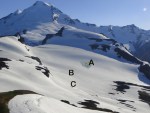
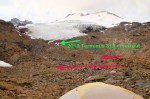
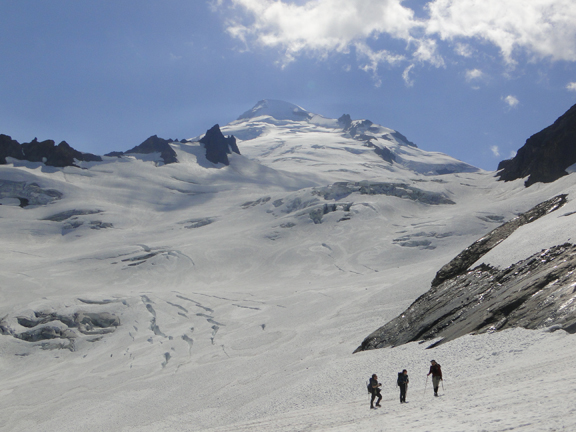
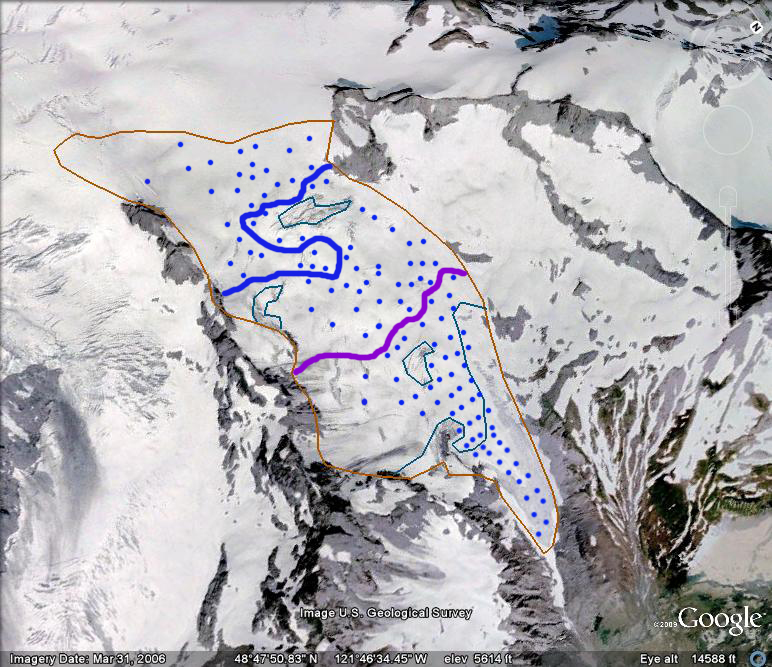
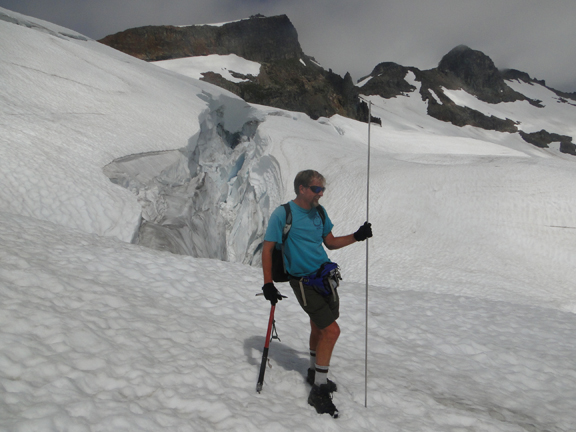
In 2010 at the end of a four day period of cool rainy weather we hiked into to our base camp on Ptarmigan Ridge to measure the mass balance of the Rainbow Glacier on Mount Baker in the North Cascades of Washington for the 27th consecutive year. Below is a view of Rainbow Glacier as we approach it. This is a valley glacier that begins on the slopes of Mount Baker at 2200 m and descends to a terminus that is often avalanche covered at 1350 m. The year proved to be the most variable in terms of glacier mass balance of any of our 27 years. Assessing the mass balance requires melting the extent and depth of snowpack on the glacier. We had a chance to measure the snow depth in 121 locations using crevasse stratigraphy and probing. The below image has all of the measurement locations, blue dots, and the rough contours of mass balance marking the snowline in green-blue, the 1 meter of snowpack water equivalent (swe) in purple and the 2 m of swe in blue. Glacier margin is in orange-brown.. The initial field assessment of mass balance for the Rainbow Glacier in 2010 was +0.81 m. At this time the significant melt season is at an end, new snow is projected for tomorrow 9/23. The average over the previous 26 years has been -0.40 m/year. Of the ten glaciers we monitor there was a split with six having negative balances and four positive, the variation is unusual. The probe is a half inch diameter steel rod that is easily driven through the snowpack until the hard icy layer marking last years summer surface is reached. This can either be bare glacier ice or the firn from the previous year. In either case it cannot be penetrated. The second means is to lower a tape measure down the wall of a vertically sided crevasse. This provides a two dimensional measure and view of snow depth versus the point measurement of probing. By late summer the density of the snowpack is uniform in the North Cascades. We survey the blue ice regions using a GPS to map the boundaries. Melting is assessed by observing the progressive ablation of snow and ice. On Rainbow Glacier snowpack was normal below 1800 m, where probing is dominantly used. The snowline was at 1450 m in early August and had risen to 1600 m by late September. Above 1600 m the snowpack increased very rapidly this year from 1.5 m at 1800 m to 5.5 m at 2100 m. This reflects the unusually warm winter that led to a dearth of snow below 1800 m by winters end. Above this elevation several winter events that were rain below were snow. Than melting was well below normal in the summer of 2010. Again spring snow storms retarded melt above 1800 m, while those were rain events below this elevation.
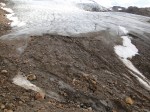
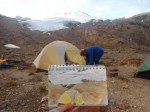
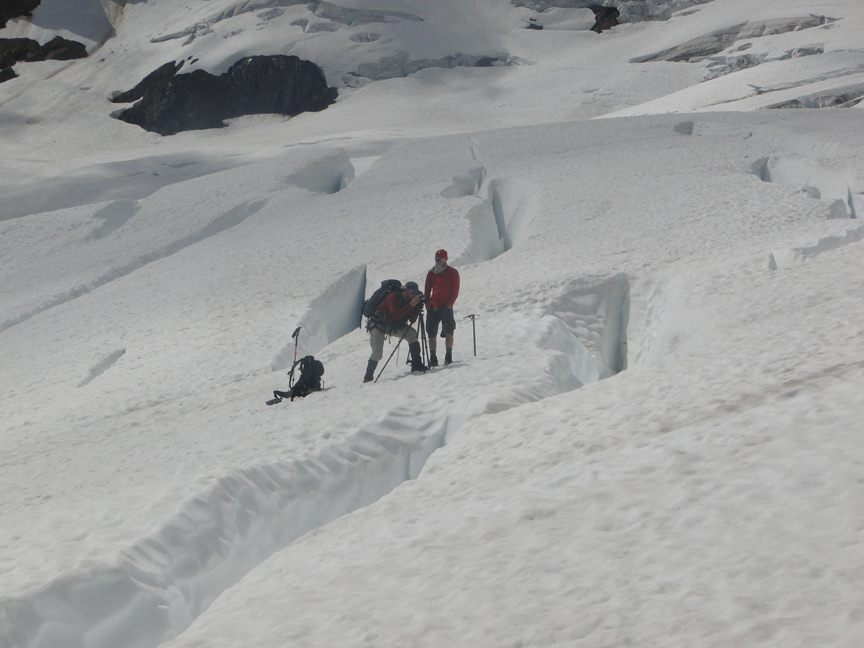
Crevasse stratigraphy was the dominant tool of measuring snowpack on the Rainbow up to is divide with Mazama Glacier. Navigating these crevasses takes considerable care using the snow probe as a crevasse probe. . The area of bare glacier ice is riven by some large streams, which are also the focus of annual observation. T The terminus this summer was buried in snow from an avalanche, as was the case last year. In 2007 the terminus was fully exposed and we could measure the retreat at 450 m in the last 25 years. This glacier’s mass balance history follows that of the other northwestern North American glaciers which also is right in line with global mass balance. All data is from the WGMS. One of the best parts of this location is the gorgeous campsite we use for a base camp. It is above the glacier so we have to hike uphill at the end of the day. . his area is noted for its mountain goats as well which we count annually. We will complete a final analysis in the next month and report this data to the World Glacier Monitoring Service.