Porcupine Glacier Major Iceberg Turns 3 Years Old, What Next?

Porcupine Glacier in Landsat images from 2016 and 2018 and 2019 Sentinel Image.  Iceberg A and Ice tongue B are indicated on each. The haziness in 2019 is forest fire smoke. The yellow arrows mark the 2019 terminus location.

Porcupine Glacier is a 20 km long outlet glacier of an icefield in the Hoodoo Mountains of Northern British Columbia that terminates in an expanding proglacial lake. During 2016 the glacier had a 1.2 km2 iceberg break off, the iceberg is still present. This is an unusually large iceberg to calve off in a proglacial lake, the largest I have ever seen in British Columbia or Alaska. NASA  generated better imagery to illustrate this observation. Here we examine the  change in terminus position and iceberg deterioration from 2016-2019  using Landsat images from 2015, 2016, 2018 and 2019.

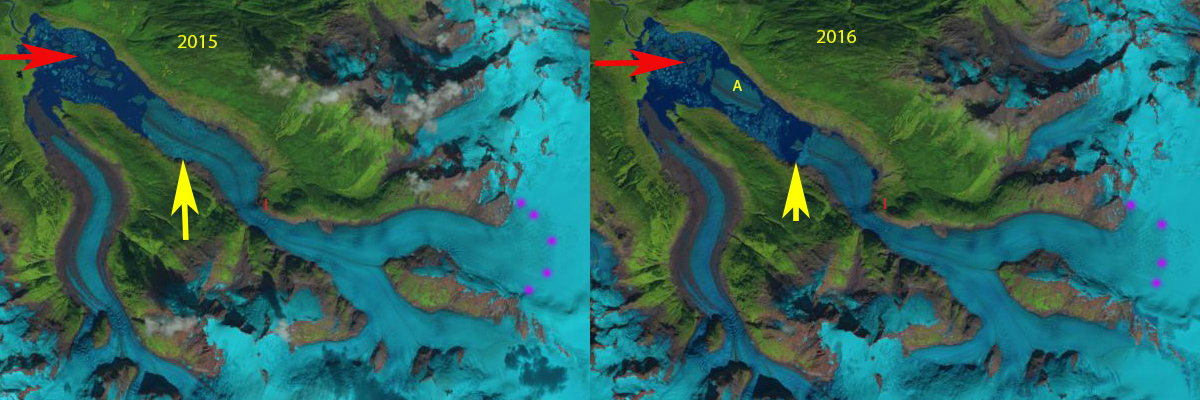
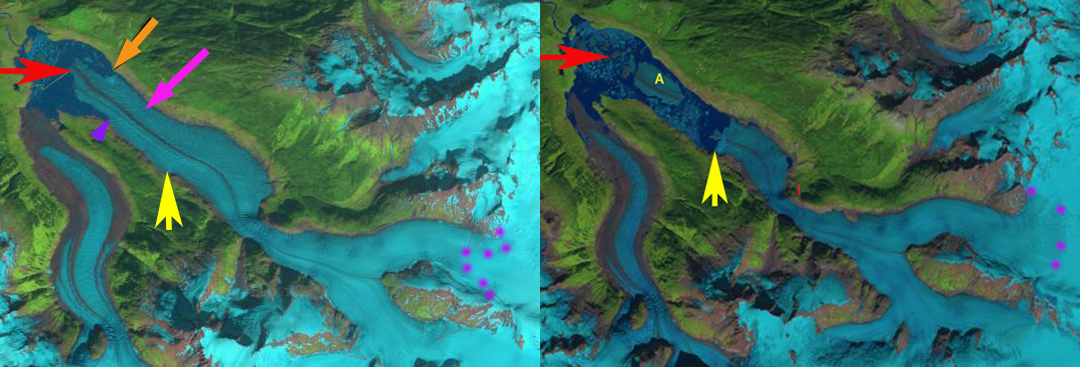
In 1988 a tongue of the glacier in the center of the lake reached to within 1.5 km of the far shore of the lake, red arrow (see below). The yellow arrow indicates the 2016 terminus position.  In 2015 the glacier had retreated 3.1 km from the 1988 location.  In 2015 there are two tongues of the glacier vulnerable to calving at Point A and B.  In 2016 Iceberg A has calved generating an immediate retreat of 1.7 km. In June of 2017 the iceberg size has been reduced 10-15%, with little change in position.  The iceberg is plugging smaller icebergs from moving down the lake. In August 2018 the iceberg because of its size has still drifted little and at 0.6 km2 has lost half of its area in the two years.  This has enabled smaller icebergs to move past the iceberg down the lake. In July of 2019 the iceberg has diminished further to 0.45 km2, but is enmeshed in a melange of other icebergs as well.  The glacier has continued to retreat from 2016 to 2019 as expected, ~500 m.  The glacier tongue at Point B has narrowed considerably from 2015 to 2019 and is poised to separate.  The narrowness and potentially shallower depth of this inlet may make it difficult for a single iceberg to emerge from the collapse of this glacier tongue that will occur in the next couple of years, I will be watching this summer. The snowline is already approaching a typical end of summer elevation in this image is from July 1, 2019.

In Antarctica it is not unusual to see an iceberg endure for many years.  In the northern hemisphere whether in a lake or in the ocean it is rare to see an iceberg last for three years as has occurred at Porcupine.  This is not due to slow melt, but simply due to the size and thickness of the iceberg, and the fact that this is a wave quiet environment. The retreat here mirrors that of other glacier to the south Klinaklini Glacier and Bridge Glacier  in BC and the north Excelsior Glacier and Yakutat Glacier in Alaska.

Porcupine Glacier in Landsat images from 1988, 2015 and 2017 .  Iceberg A and Ice tongue B are indicated in the latter two.  The yellow arrows mark the 2019 terminus location. The red arrow in 1988 marks its terminus location. The orange and purple arrows in 1988 indicate the margin where the terminus meets the lake shore.
 

Porcupine Glacier, BC 1.2km2 Calving Event Marks Rapid Retreat

porcupine iceberg comparison

Landsat images from Sept. 2015 and Sept. 2016.  Red arrow is the 1988 terminus and the yellow arrow the 2016 terminus.  I marks an icefall location and point A marks the large iceberg. 

Porcupine Glacier is a 20 km long outlet glacier of an icefield in the Hoodoo Mountains of Northern British Columbia that terminates in an expanding proglacial lake. During 2016 the glacier had a 1.2 square kilometer iceberg break off, leading to a retreat of 1.7 km in one year. This is an unusually large iceberg to calve off in a proglacial lake, the largest I have ever seen in British Columbia or Alaska. NASA has generated better imagery to illustrate my observations. Bolch et al (2010) noted a reduction of 0.3% per year in glacier area in the Northern Coast Mountains of British Columbia from 1985 to 2005. Scheifer et al (2007) noted an annual thinning rate of 0.8 meters/year from 1985-1999. Here we examine the rapid  retreat of Porcupine Glacier and the expansion of the lake it ends in from 1988-2016 using Landsat images from 1988, 1999, 2011, 2015 and 2016. Below is a Google Earth view of the glacier with arrows indicating the flow paths of the Porcupine Glacier. The second images is a map of the region from 1980 indicates a small marginal lake at the terminus.porcupine long term compare

Landsat images from 1988 and 2016 comparing terminus locations and snowline. Red arrow is the 1985 terminus and the yellow arrow the 2016 terminus.  I marks an icefall location and point A marks the large iceberg. Purple dots indicate the snowline.

In 1988 a tongue of the glacier in the center of the lake reached to within 1.5 km of the far shore of the lake, red arrow. The yellow arrow indicates the 2016 terminus position.  By 1999 there was only a narrow tongue reaching into the wider proglacial lake formed by the juncture of two tributaries. In 2011 this tongue had collapsed. In 2015 the glacier had retreated 3.1 km from the 1988 location.  In the next 12 months Porcupine Glacier calved a 1.2 square kilometer iceberg and retreated 1.7 km, detailed view of iceberg below. The base of the icefall indicates the likely limit of this lake basin. At that point the retreat rate will decline.The number of icebergs in the lake at the terminus indicates the retreat is mainly due to calving icebergs. Glacier thinning of the glacier tongue has led to enhanced calving. The retreat of this glacier is similar to a number of other glaciers in the area Great Glacier, Chickamin GlacierSouth Sawyer Glacier and Bromley Glacier. The retreat is driven by an increase in snowline/equilibrium line elevations which in 2016 is at 1700 m, similar to that on South Sawyer Glacier in 2016.porcupine 82716

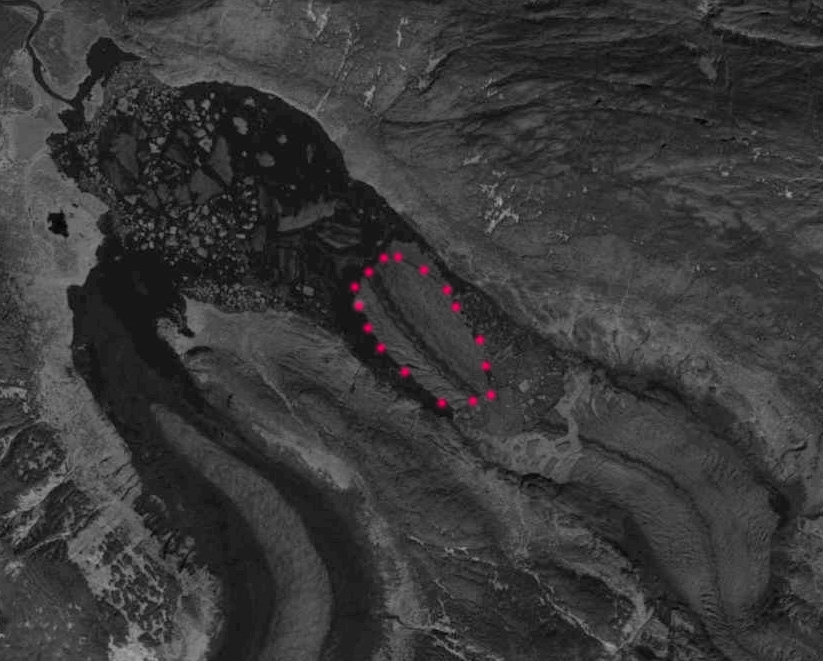
August 27, 2016 Sentinel 2 image of iceberg red dots calved from front of Porcupine Glacier. 

porcupine glacier-map

Canadian Toporama map of Porcupine Glacier terminus area in 1980.

porucpine glacierge

Google Earth view indicating flow of Porcupine glacier.

porcupine glacier 1999

1999 Landsat image above and 2011 Landsat image below indicating expansion of the lake.  Red arrows indicate the snowline.  Purple, orange and yellow arrows indicate the same location in each image.

porcupine glacier bc 2011