Rainbow Glacier Not Fading Away, Glacier National Park

Rainbow Glacier is the third largest of the 25 remaining glaciers in Glacier National Park occupying an east facing cirque between 2650 m and 2330 m. The glacier drains into Quartz Lake a key lake for bull trout in GNP, which are threatened by both invasive lake trout and climate change (Jones et al, 2013).  The National Park Serice and USGS have been established a glacier monitoring program that focuses on repeat photography, mass balance observations on Sperry Glacier and area change. GNP has lost the majority of the 150 glaciers that existed. The USGS reports that Rainbow Glacier had an area of 1.28 square kilometers in 1966 declining to 1.16 square kilometers in 2005, a 9.3% reduction. Has this slow rate of retreat continued? Here we examine Google Earth imagery from 1990-2013 and imagery taken by John Scurlock  compiled by Glaciers of the American West at Portland State University,

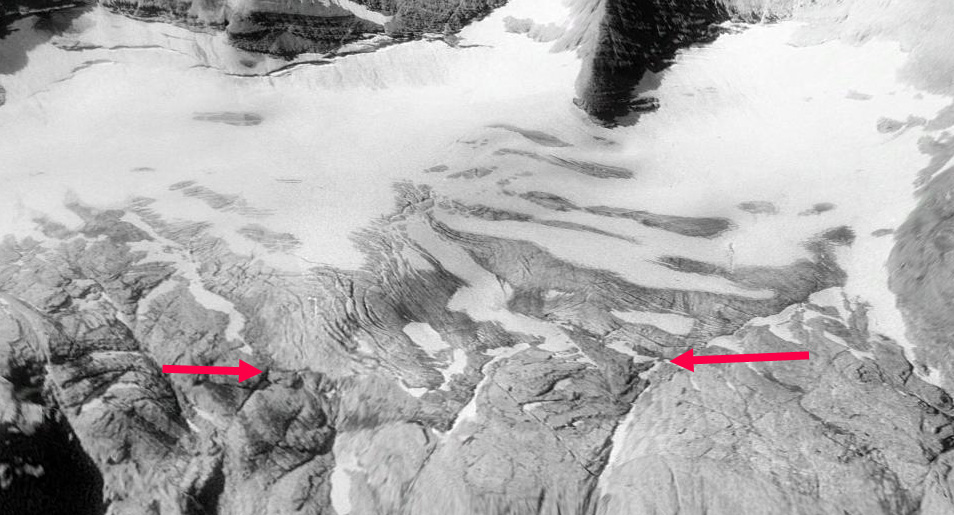
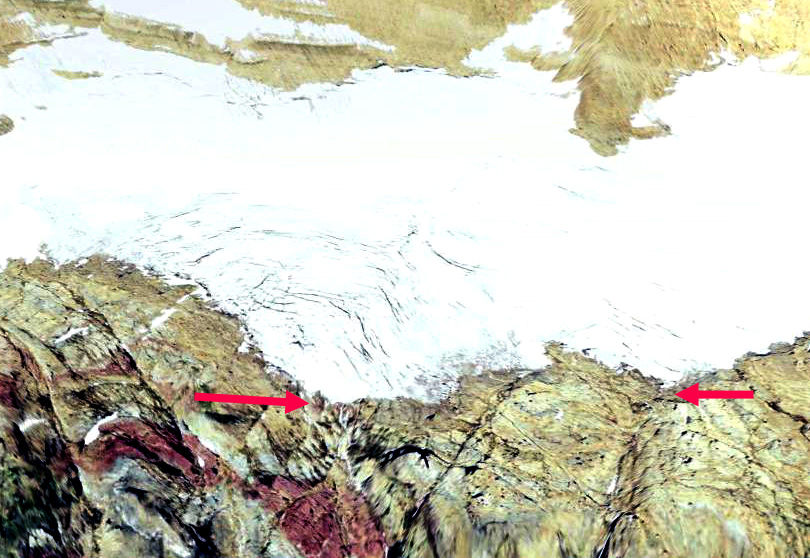
In the Google Earth images from 1990, 2003 and 2013 the margin of the glacier in 1990 is in red and from 2003 is in orange. The margin of the glacier from 1990 to 2003 indicates modest recession averaging 25-30 m along the glacier front.  This is part of the 9.3 % area loss noted by the USGS.  In 2013 there is too much snowcover to identify the glacier boundary, glacier ice is exposed providing a minimum extent at the green dots.  A comparison of 1990, 2005  and 2009 images, the latter from John Scurlock indicates the two primary terminus lobes.  From 1990 to 2005 the southern lobe retreated 45 m and the northern lobe 25-30 m. There is not a significant change in either lobe from 2005 to 2009. The 2003, 2005 and 2009 imagery does indicate a low percentage of retained snowcover.  This is the accumulation area ratio.  Persistent low values indicate a glacier that cannot survive.  In the case of Rainbow Glacier the accumulation area ratio is sufficient in most years to limit volume losses. In 2015 low snowpack exposed the terminus area,by late August the glacier still had 40% snowcover, indicating a negative mass balance, but not excessively negative.  Glacier area updated to 2015 using the Landsat image the area is now between 1.00 and 1.10 square kilometers an approximately 20% area loss in 50 years. It is evident that this is the only late summer area of snow-ice in the watershed and is particularly crucial to the water budget in late summer and early fall. The slow retreat of the glacier is good for the bull trout in the watershed, Rieman et al (2007) indicated the sensitivity of the trout to stream temperatures.  Glacier both increase flow and reduce stream temperature late in the summer. This is one glacier in the park that will not disappear by 2030 as has been often forecast.  It will join Harrison Glacier in this category, while other glaciers in GNP continue to disappear.
rainbow 1990 t

1990 Google Earth image with two main terminus lobes indicated by red arrows. 
rainbow 2005

2005 Google Earth image of Rainbow Glacier. 
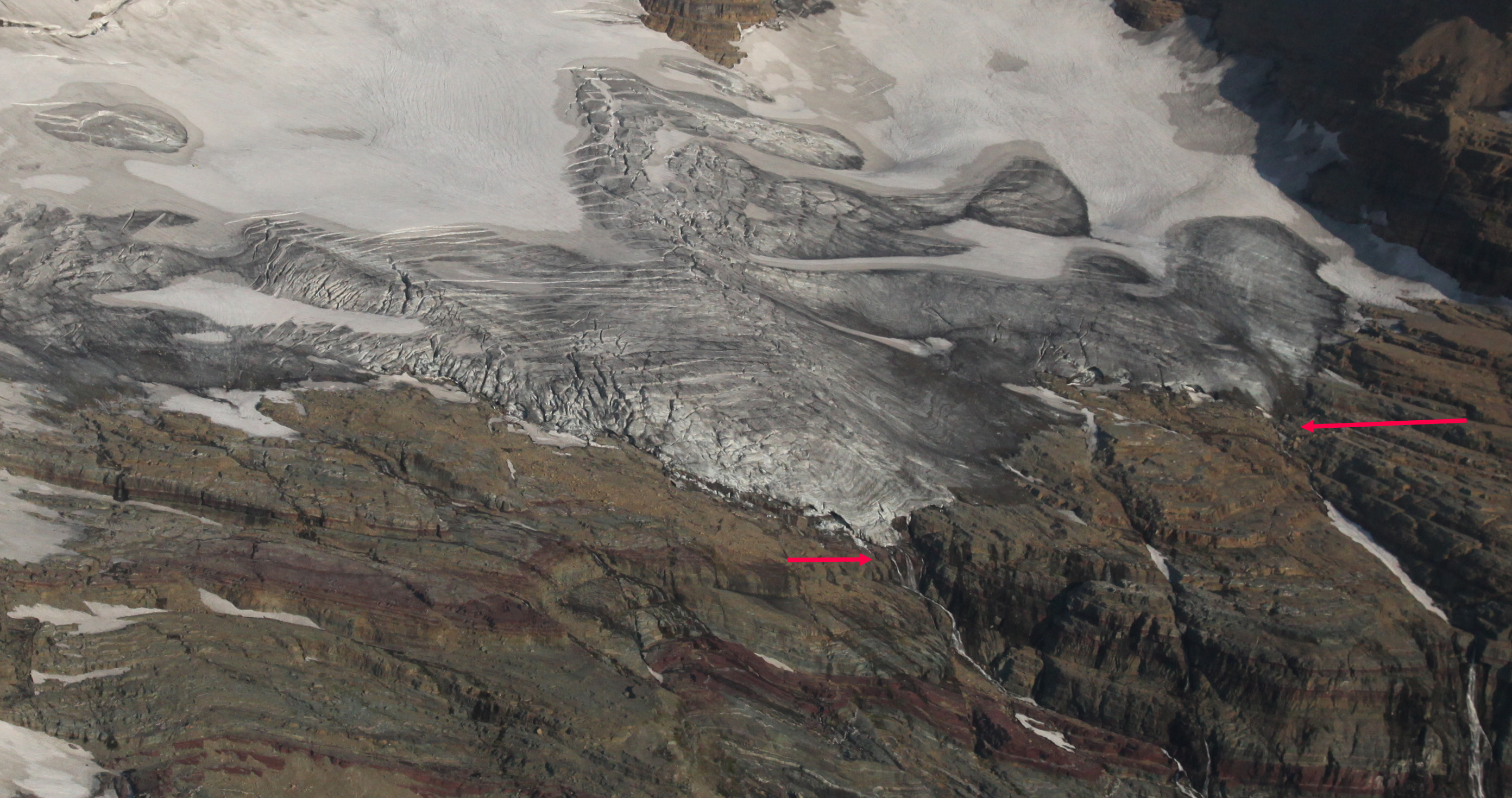
rainbow glacier 2009 scurlock

2009 John Scurlock image of Rainbow Glacier. 

Rainbow Glacier: Record Ablation in 2014 for 1984-2014 Period

From 1984-2014 we have monitored the mass balance of the Rainbow Glacier on Mount Baker, North Cascade Range, Washington. This entails detailed monitoring of snowpack depth in July and August, and subsequent ablation to the end of the melt season. On July 13th the glacier was completely snowcovered. By August 10th the snowline had risen to 1575 m, with 1.4 m of ablation since July 13th. We measured the snowdepth at 85 locations on the glacier, with only 6 measurements exceeding 3.5 m on Aug. 10th.

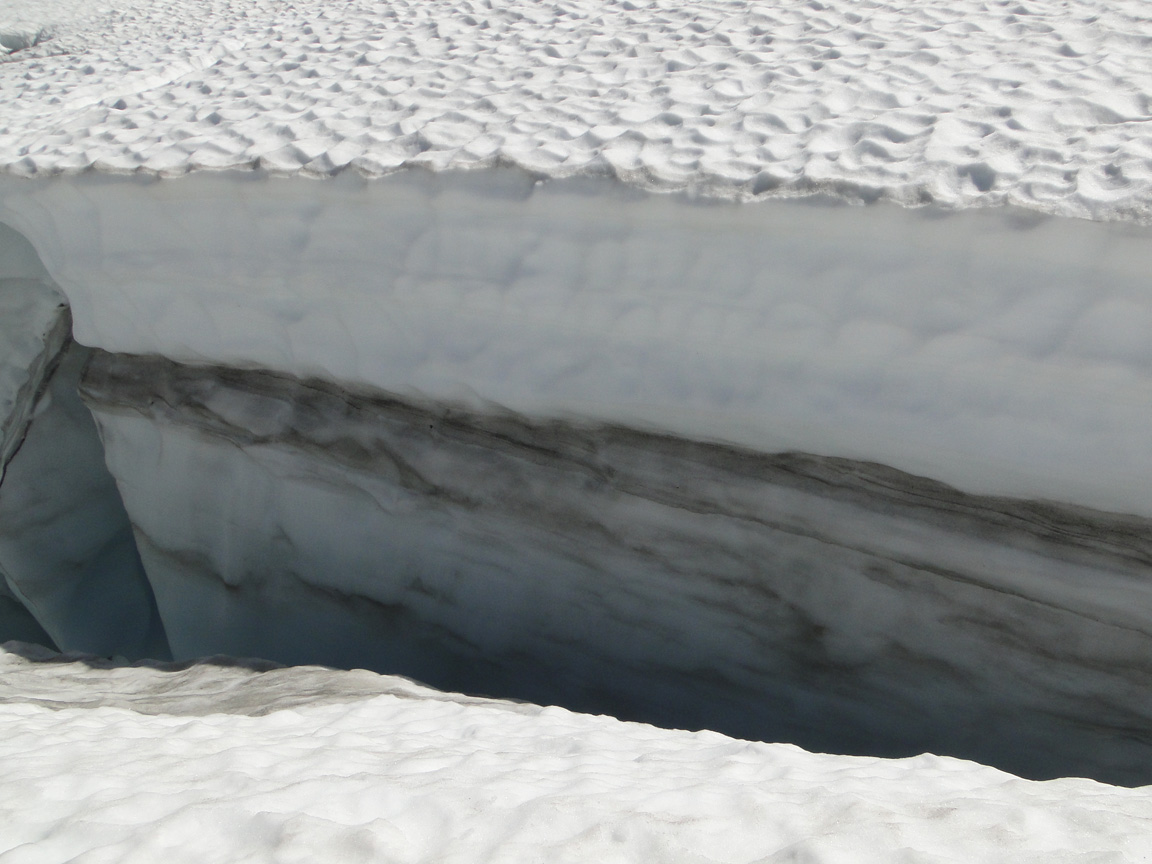
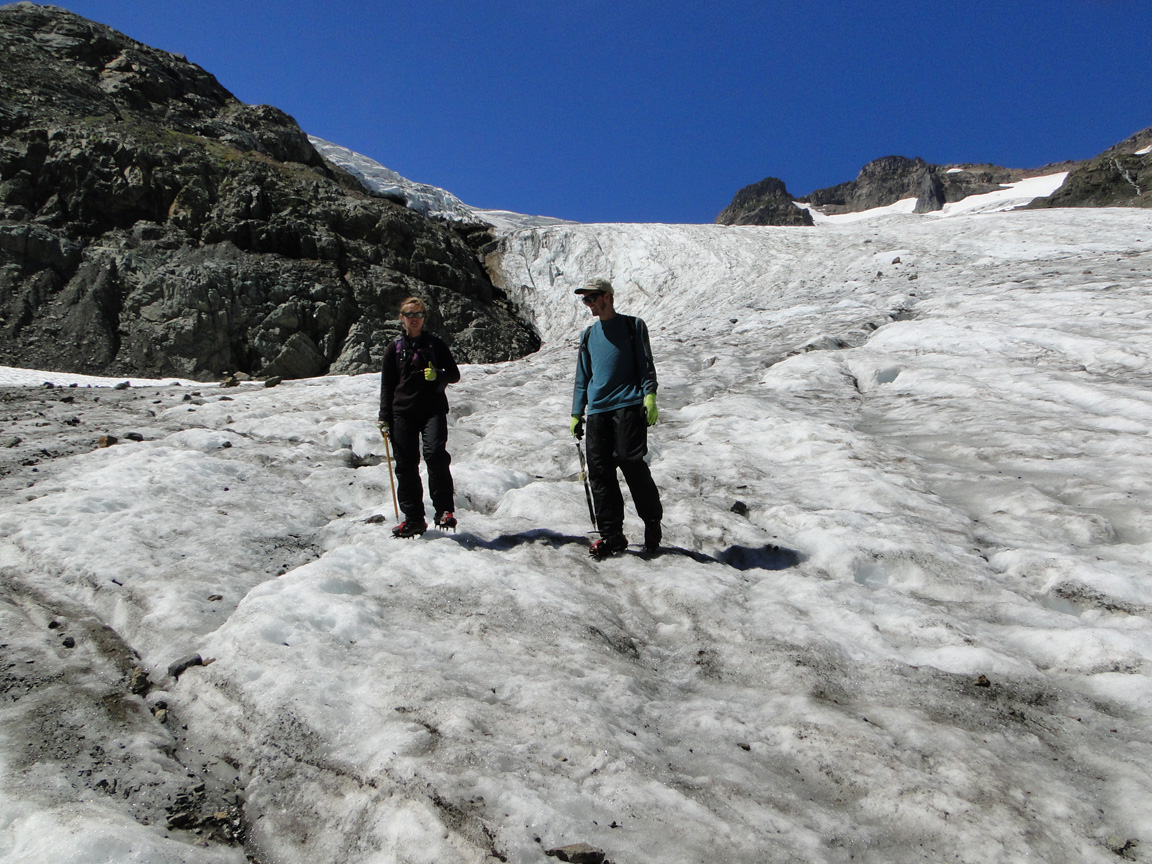
Ben Pelto and Ashley Edwards examining crevasse stratigraphy both the 2013 and 2014 layers evident.

Limited snowpack below the main icefall at 1750 m on Aug. 10.

Minimal 2014 snowpack in crevasses at 1650 m on Aug. 10th 1.25 m.
Limited snowpack below the main icefall at 1750 m on Aug. 10.
By September 27th the snowline had risen to 1975 m with a few pockets of snow retained where the snowdepth had exceeded 3.2 m on Aug. 10th. Snowdepth at the Sept. 27th snowline had been 3.0 to 3.2 m on Aug. 10th. This indicated ablation of approximately 3 m of snowpack, 1.8 m of water equivalent from Aug. 10th to Sept. 27th. Ablation from July 13th to Sept. 27th was 5.3 m of snowpack and 3.2 m w.e. This was 5-10% more ablation than any other year since 1984. A comparison of images from the ground on Aug. 10th indicates the snowpack on the glacier from 1550-1950 m, the blue arrows indicate locations where a patch of 2014 snow remained on Sept. 27th. The Sept. 27th image was taken by Tom Hammond from Rainbow Ridge the only location where the whole glacier can be viewed. The firn is simply old snow that survived a summer and could be from 2012 or 2013.
Aug. 10th accumulation zone view

Tom Hammond Image adusted to show firn, ice and retained snow. Sept. 27th

Winter snowpack was normal on Mount Baker, the record ablation then led to a large negative mass balance for the glacier of -1.8 m, but not a record loss. The ablation did lead to many significant surface streams on the glacier shown below, which drain into the glacier at moulins.

The terminus of glacier retreated rapidly from 1984 to 1998, but has slowed as it currently is in an avalanche runout zone. We visited the terminus in 1984 and all retreat is measured from that point when the glacier was in contact with an advance moraine from the 1955-1980 period of advance. A comparison of 1993 and 2006 Google Earth images indicates the retreat, red outline 2006 margin and black outline 1993. The 2014 image taken by Tom Hammond indicates that the terminus did get exposed in 2014 which will lead to additional retreat when we measure the terminus position next summer. Total retreat from 1984 to 2014 is 490 m.

1993 Google Earth view of terminus

2006 Google Earth view of terminus.
Picture of the terminus in 2014 indicating the 214 and 1984 position.  Taken by Tom Hammond from Rainbow Ridge.
Picture of the terminus in 2014 indicating the 214 and 1984 position. Taken by Tom Hammond from Rainbow Ridge.
Ablation zone on Aug. 10