Kiwa Glacier Retreat, British Columbia 1986-2015

compare kiwa

Kiwa Glacier retreat from 1986 to 2015 in Landsat images.  Red arrow is 1986 terminus and yellow arrow 2015 terminus location. Purple arrow indicates upglacier thinning where more bedrock is exposed.  Purple dots indicate the transient snowline

Kiwa Glacier is the longest glacier, at 9 km, in the Cariboo Mountains of  British Columbia.  The glacier drains northwest from Mount Sir Wilfred Laurier and is near the headwaters of the Fraser River, where it terminates in an expanding lake at 1465 m. Here we examine glacier change from 1986 to 2015. In 1986 the glacier terminated in the 700-800 m long proglacial lake.  The glacier has two significant icefalls above the terminus at 2300 m and 1800 m.   The lower icefall generating a series of ogives that are generated annually due to seasonal velocity fluctuations.  The ogives indicate the glacier velocity below this icefall.  There are 20 ogives in the span of approximately 1 km indicating a velocity of 50 m/year.  In 2015 the glacier still terminates in the proglacial lake that is now 1400-1500 m long indicating a retreat of 700 m in the thirty years from 1986-2015.  The lower 300 m of the glacier is nearly flat suggesting the lake will extend at least that far, note 2010 image from Reiner Thoni, Canadian Mountaineer.  This is also the extent that will be lost relatively quickly via iceberg calving and continued surface melt.  Above this point flow remains vigorous and retreat could diminish. Upglacier thinning has expanded bedrock areas even separating sections of the glacier, purple arrows. The transient snowline in mid-August in the Landsat images is at 2550 m. Driving through the area last week, the snowline is at 1000 m, quite high for mid-March.

Beedle et al (2015) note that glaciers in the Cariboo Mountains were close to equilibrium from 1952 to 1985 : 9 glaciers advanced, 12 receded, and 11 did not change. After 1985 they noted that all glacier retreated in the Cariboo Mountains. The response time of the glaciers to climate change is the main cause for the differing response of individual glaciers in the region as has been noted in other Pacific Northwest regions (Pelto and Hedlund, 2001 & Tennant et al, 2012).  Response times are faster for glaciers with steeper slopes, higher velocity/length ratios and a higher ratio of accumulation-ablation/ ice thickness.  The decline of glaciers, warm weather and reduced snowpack combined in 2015 to place a stress of Fraser River salmon due to lower discharge and higher temperature.  This could be an issue in 2016 as well.

adamant 2004 ge copy

Kiwa Glacier in 2004 Google Earth image

kiwa glacier rt

2010 Image from Reiner Thoni.  Well defined trimlines above the lake.  Note flat lower section of the glacier. 

Dismal Glacier, British Columbia Prospects Match Name

dismal
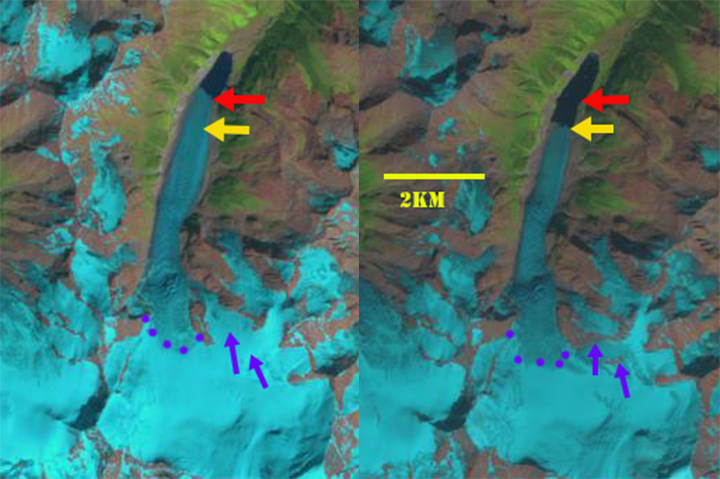
Landsat image comparison from 1988 and 2015, red arrow indicates 1988 terminus and yellow arrows 2015 terminus. Purple arrows indicate thinning upglacier.

Dismal Glacier flows north from Mount Durrand in the Selkirk Range of British Columbia.  It drains from 2500 m to 1950 m and its runoff flows into Downie Creek that is a tributary to the Columbia River and Revelstoke Lake.  This lake is impounded by the BCHydro Revelstoke Dam which is 2480 MW facility.  Here we examine Landsat images from 1988 and 2015 to identify changes in this glacier.  The glacier snowline in the mid-August image of 2015 is at 2400  m just above a substantial icefall.  The glacier has retreated 640 m from 1988 to 2015.  The eastern extension at 2200 to 2300 m of the glacier noted by a purple arrow, has lost considerable area, indicating thinning even well above the terminus  elevation. Note thinning of this section of the glacier by 2015 after it joins the main glacier, it is separated by a medial moraine. The terminus in the 2009 Google Earth image has a low slope and is uncrevassed.  This indicates the terminus reach is relatively inactive, but does not appear stagnant.   Tennant and Menounos (2012) examined changes of the Rocky Mountain glaciers just east of this region and found between 1919 and 2006 that glacier cover decreased by 590 square kilometers, 17 of 523 glaciers disappeared and 124 glaciers fragmented into multiple ice masses. This will happen at Dimsal Glacier as it has at Cummins Glacier.  Bolch et al (2010)  observed a 15% area loss from 1985-2005 in this region.  The snowline has been above the icefall at 2400+ m in 2013, 2014 and 2015, indicative of negative mass balance that will lead to continued retreat.  The glaciers name is not due to its future prospects, but its future prospects are indeed dismal.
dismal glacier ge
revelstoke-dam-powerhouse-columbia-river-place
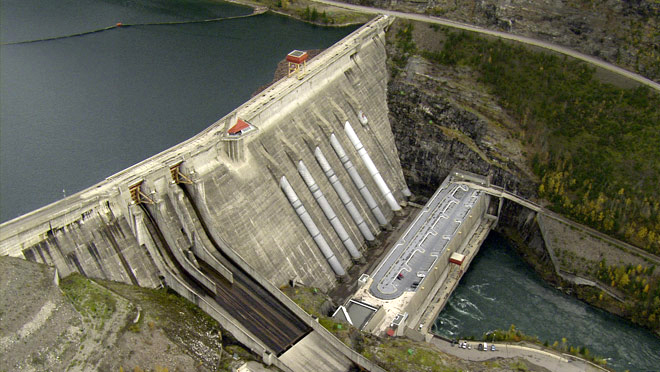
BCHydro image of Revelstoke Dam

dismal glacier
Google Earth image of Dismal Glacier terminus in 2009. Red arrow indicates 1988 terminus position, black arrows various recessional moraine features.

Haworth Glacier Retreat, Selkirk Mountains, British Columbia

Haworth Glacier in the northern Selkirk Mountains of British Columbia drains into Palmer Creek, which flows into Kinbasket Lake, and then the Columbia River. This glacier is often visited by climbers as the Canadian Alpine Club has a summer base camp near the terminus of the glacier. The glacier has a low slope and limited crevassing that makes it a good training ground for climbing. Menounos et al (2008) noted an advance of this glacier overrunning a stump that has since been exposed by retreat in the period from 3800 years before present, similar in timing to many glaciers in the region. The stump remained buried until recent exposure.
haworth map
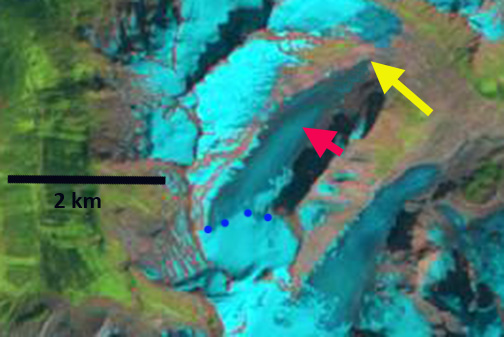
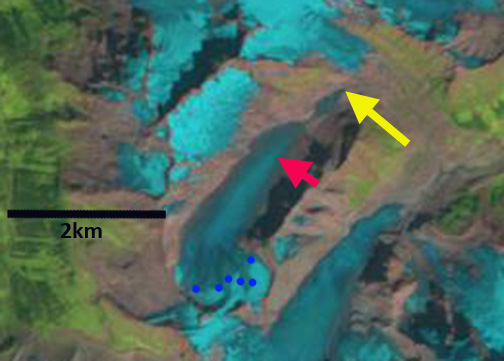
Here we examine a series of Landsat images from 1986-2013 to identify the retreat and forecast whether the glacier can survive even current climate conditions. In each image the blue dots mark the snowline, yellow arrow is the 1986 terminus and the red arrow the 2013 terminus. In 1986 the glacier ended near the far end of the basin where a lake has since developed, yellow arrow. Snowcovers 30% of the glacier in the late summer of 1986, 55-65% is necessary for glacier equilibrium. By 1994 the glacier had retreated exposing the new lake basin, the glacier was 25% snowcovered. By 1998 the glacier had retreated 550 m since 1986, the glacier was 15% snowcovered. In 2009 the glacier was 20% snowcovered. In 2013 the glacier terminates at the red arrow indicating a retreat of 1000 m since 1986, 37 m per year. The glacier is 10% snowcovered. The percent snowcover in each year is much less than the 55% minimum needed for a minimum balance, the images are also not precisely at the end of the melt season. If a glacier does not have a consistent and persistent snowcover at the end of the melt season it has no “income” and cannot survive (Pelto, 2010). This glacier has managed to retain a very small area of snowcover, but given the ongoing thinning and the lack of avalanche accumulation on this glacier, it is unlikely to be enough to save this glacier. Bolch et al (2010) noted a 10% area loss for British Columbia glaciers from 1985 to 2005, Haworth Glacier is above this average. Tennant and Menounos (2013) noted that the fastest rate of loss on Columbia Icefield glaciers from 1919-2009 was during the 2000-2009 period. The glacier is not retreating as fast as some of the glaciers that also calve into lakes such as Columbia Glacier, British Columbia. Nearby Apex Glacier has retreated at a similar rate. Jiskoot et al (2009) observed the terminus change of 176 glaciers in the Clemenceau Icefield and adjacent Chaba Icefield, and noted an average retreat of 21 meters per year from the 1980’s to 2001.
haworth galcier 1986
1986 Landsat image

haworth galcier 1994
1994 Landsat image

haworth glacier 1998
1998 Landsat image

haworth glacier 2009
2009 Landsat image

haworth glacier 2013
2013 Landsat image