Mount Baker Glacier’s Perspective on Climate Change 1984-2022-Disastrous!

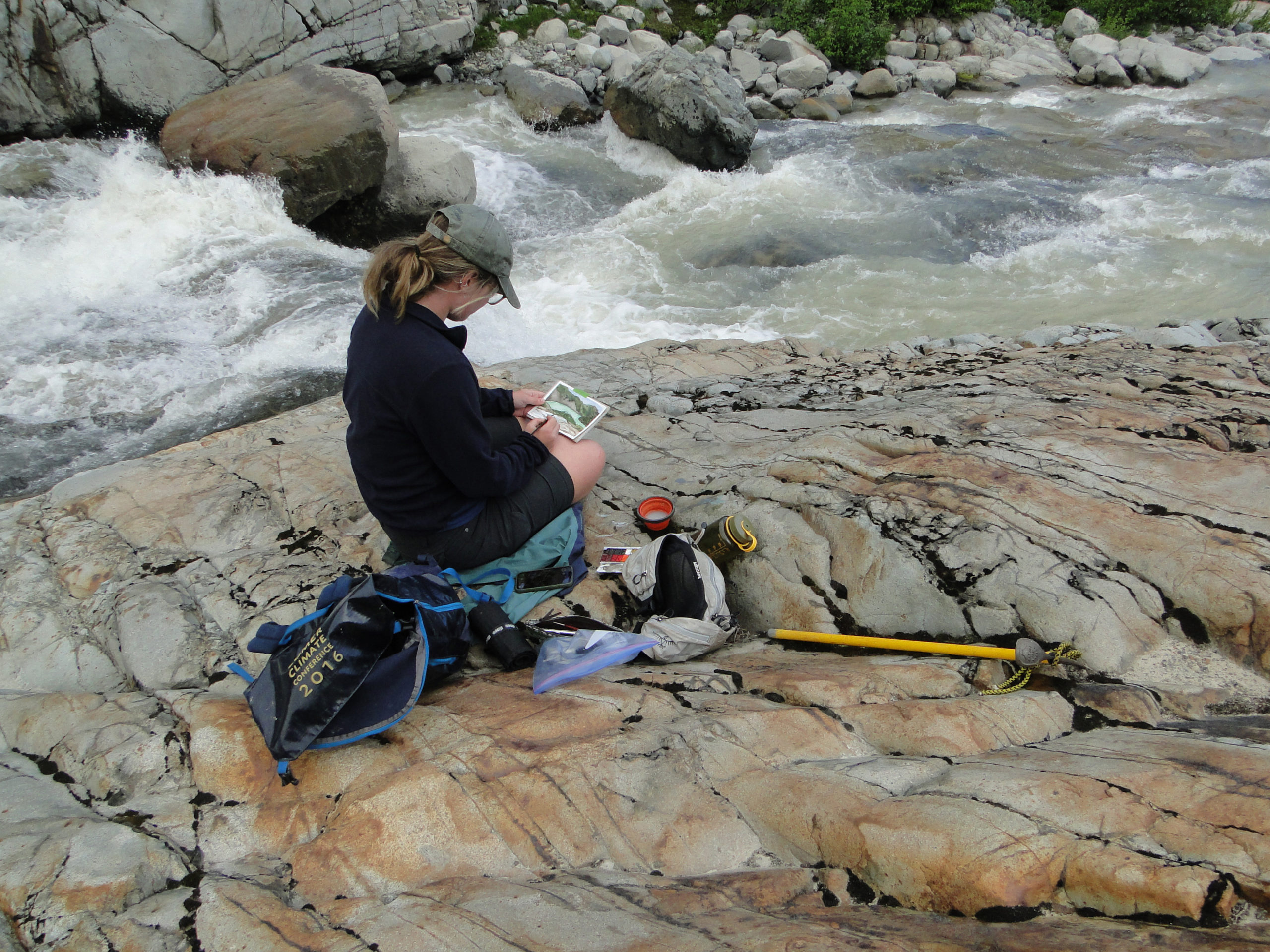
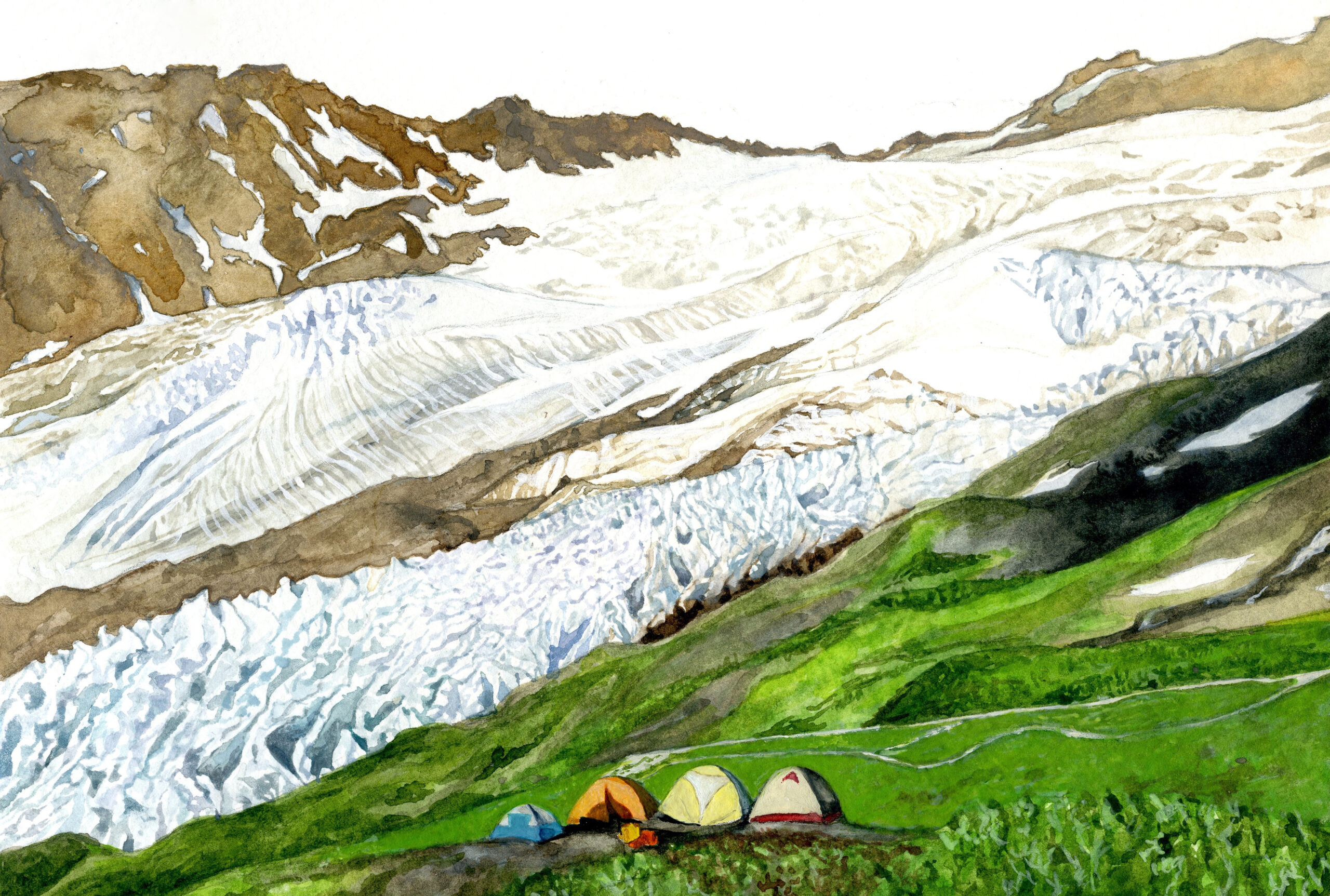
Camp above Coleman Glacier on Heliotrope Ridge, (Jill Pelto painting)

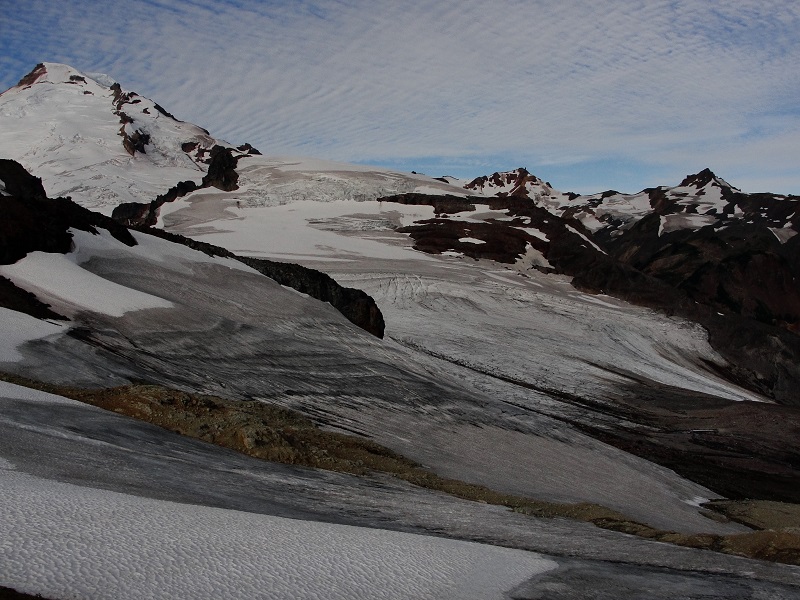
Mount Baker is the most glaciated peak and highest mountain in the North Cascade Range at 3286 m.  The Nooksack Indian Tribe refers to this strato volcano as Komo Kulshan, the great white (smoking) watcher. Mount Baker has 12 significant glaciers that covered 42 km2 in 1984 and ranged in elevation from 1320 m to 3250 m.  Kulshan watches over the Nooksack River Watershed, and its flanks are principal water sources for all three branches of this river and Baker River.  In 1984 we began an annual monitoring program of glacier mass balance, terminus position and glacier area on these glaciers. Over the last 40 years we have visited these glaciers every summer observing their response to climate change.
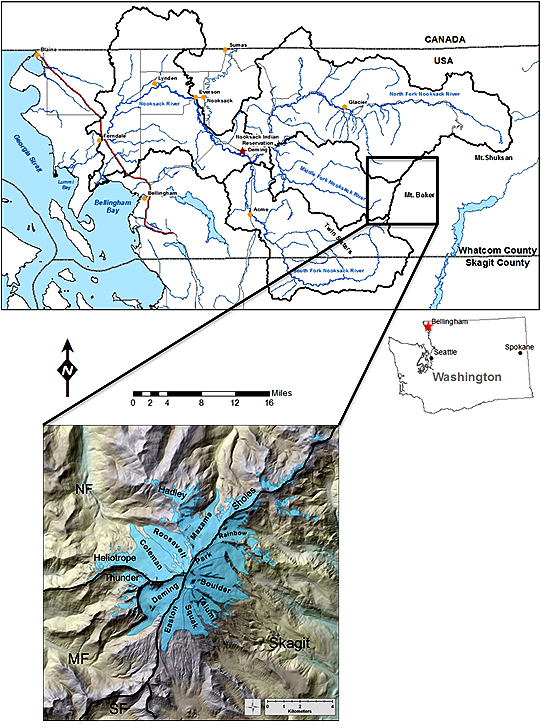
In 1984/85 we visited 11 of the 12 glaciers mapping their terminus position.  All but one had advanced between 1950 and 1975 emplacing an advance moraine.  In the 1980’s as each glacier retreated from this moraine we used these prominent moraines as a benchmarks, as their ice cores have melted and erosion has occurred they have become less prominent. The distance from the typically well preserved, fresh moraines  to the current glacier front has been measured in each case using a laser ranging device with an accuracy of +1m.   In 2009 Mount Baker glacier had declined to 38.5 km² Pelto and Brown (2012). The Randolph Glacier Inventory reported a glacier area of 37 km² in 2015.  In October 2022 an updated area was determined for Mount Baker glaciers at 33.5 km². This represents a decline of 20% in 38 years. Pelto and Brown (2012)  identified a mean annual mass balance loss of -0.52 m/year from 1990-2010 on Mount Baker glaciers. From 2013-2021 the mass loss had more than doubled to -1.30 m/year. Below we review each glacier circling the mountain counter-clockwise
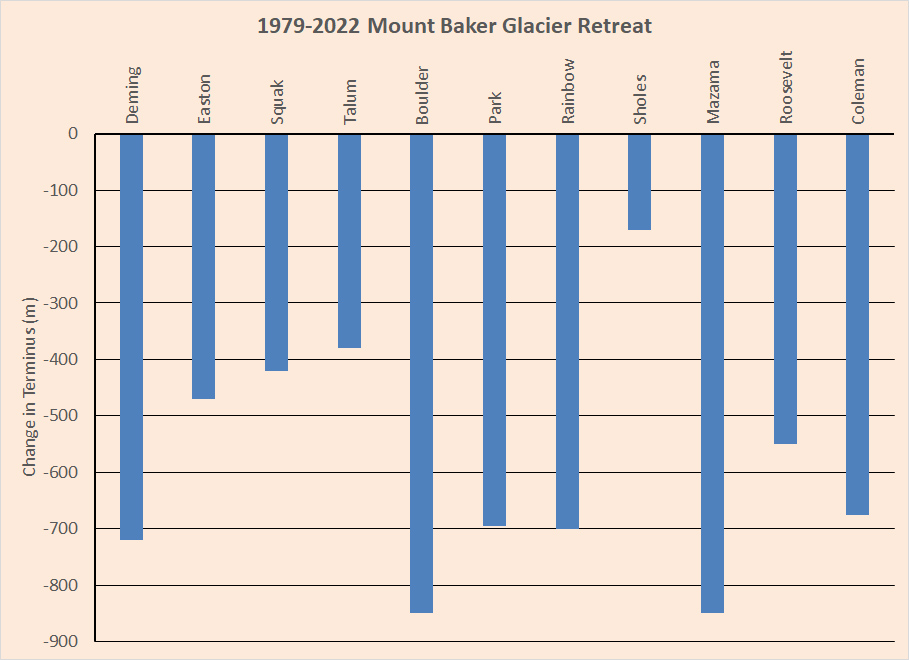
Measurement of glacier retreat from the advanced moraines ~1979 to 2022. We have measured terminus position of these glacier on 130 occassions from 1984-2022.
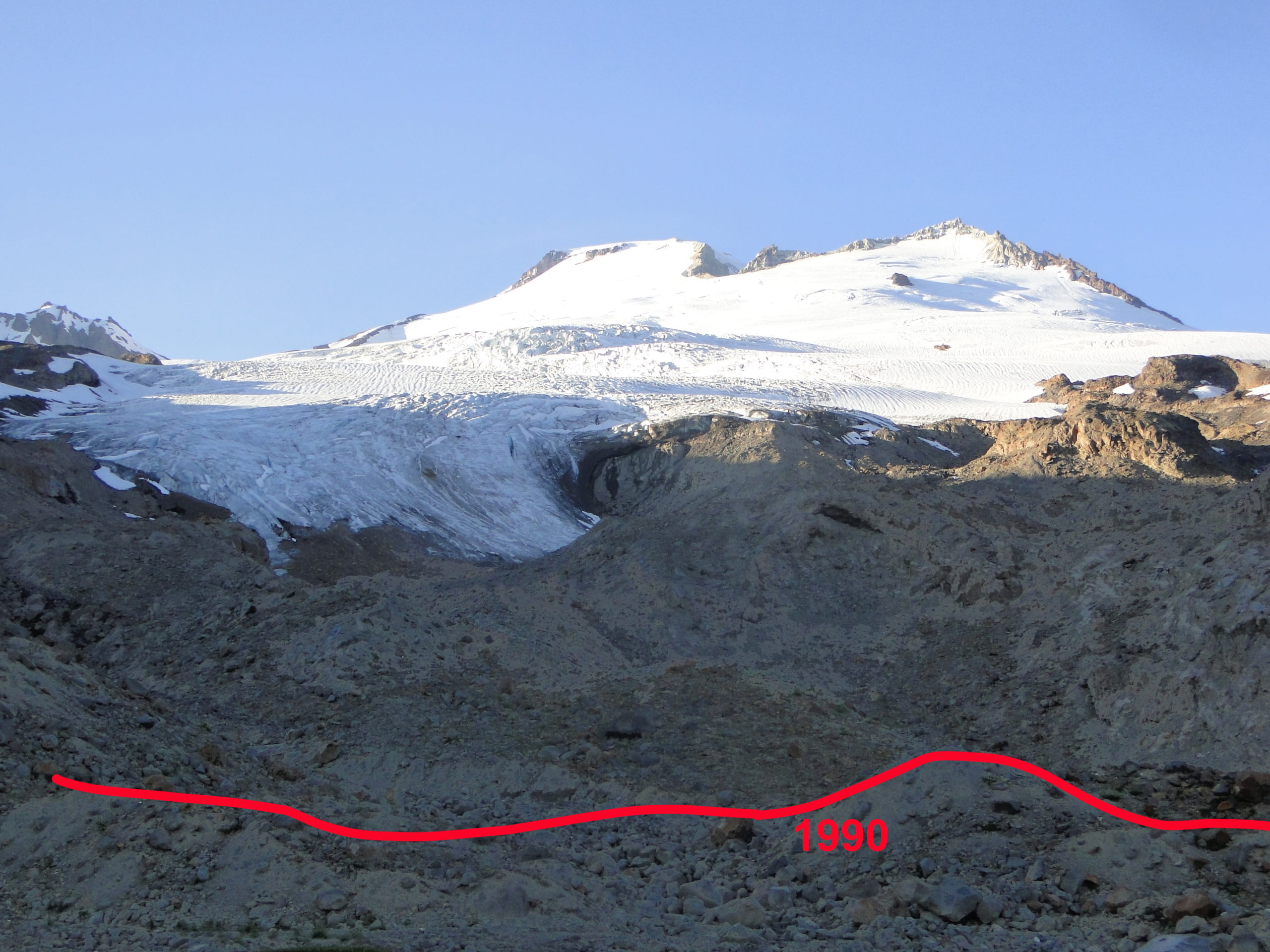
Easton Glacier from our survey camp  in (2022) above and 2003 (below) illustrating 470 m retreat from 1990-2022.

Change at terminus from August 2022 to August 2023. Image from same location though different orientation area the size of a hockey rink lost all of its ice here.
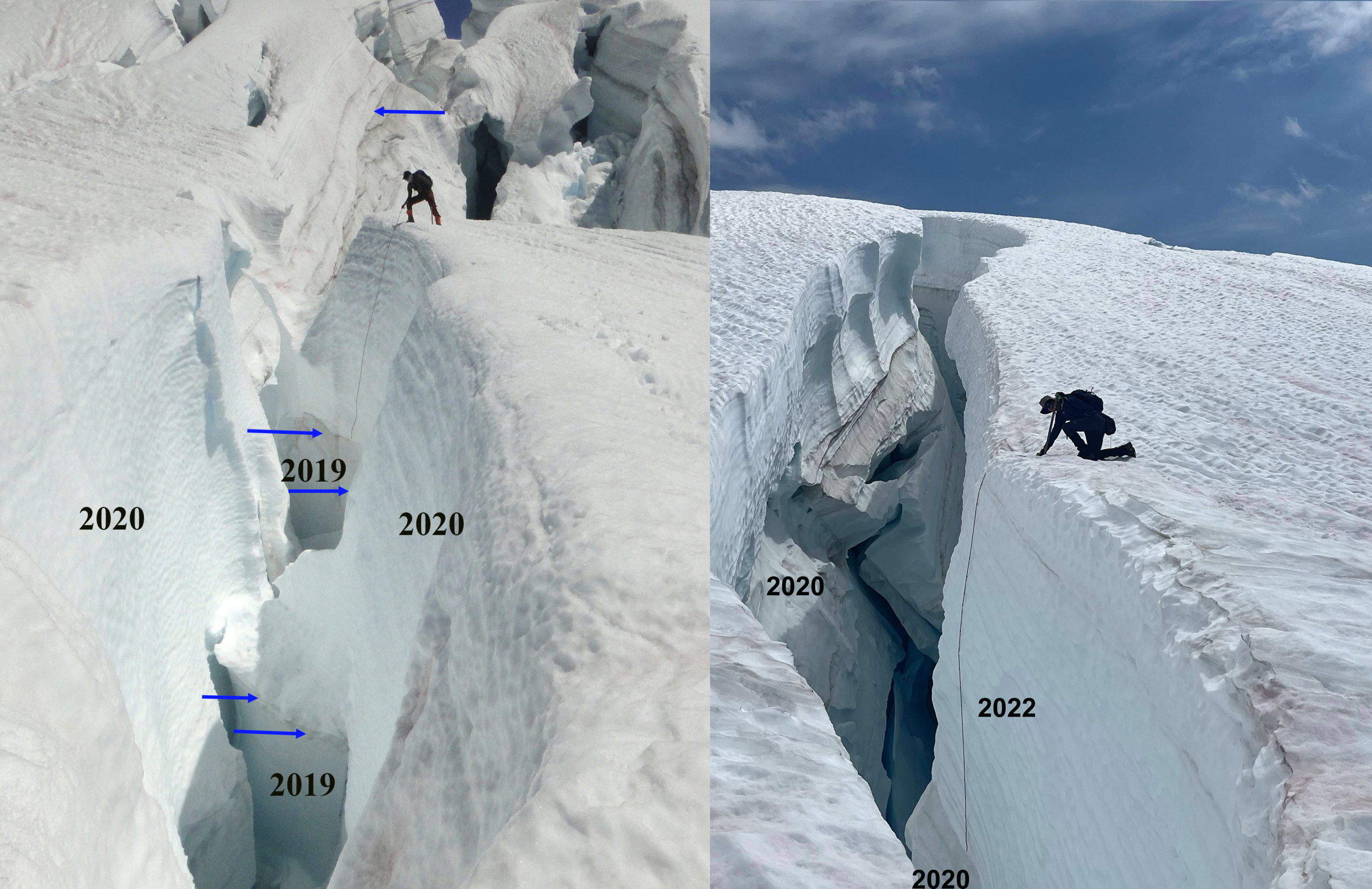
Crevasse measurement of annual snowpack at 2500 m on Easton Glacier comparison of 2019-2022.

Easton Glacier flows down the south side of the mountain and feeds the Baker Lake Hydropower project. We have monitored the mass balance and terminus change of this glacier every year from 1990-2022. This is a World Glacier Monitoring Service reference glacier. In recent years thinning has exposed a few bedrock knobs near 2200 m on the glacier. The glacier has lost 21 m w.e. since 1990 driving a 470 m retreat during this interval. The pace of loss and retreat has been faster since 2013. The typical snowpack retained at the end of the summer has declined from 2.6 to 1.2 m w.e. at 2300 m.

Deming Glacier icefall indicating velocity locations and change in terminus from 1979.

The Deming Glacier drains the southwest side of the summit of Mount Baker a stratovolcano in the North Cascades of Washington, with a massive icefall feeding the lower valley terminus reach of the glacier. The icefall begins at 2200 meters and descends to 1600 meters. The glacier feeds the Middle Fork Nooksack River which provides water supply to Bellingham, WA. Deming Glacier flows from the summit and is the headwaters of the Middle Fork Nooksack River. We observed the terminus of this glacier every year from a survey point and conduct snow depth measurements at 2200 m on the glacier. he NASA Measures ITS_LIVE application uses feature tracking to determine glacier velocity. An examination of velocity change from the top of the icefall to the bottom on Deming Glacier from 2015-2022 indicates deceleration at the three points within or below the icefall, but no change at the top of the icefall.  At the top of the icefall red X velocity has declined ~20%. In the middle of the icefall, green X, velocity has also declined ~20% since 2017. Near the base of the icefall, orange X, velocity has a chaotic signal lacking a clear trend.  Below the icefall at the blue X, velocity has declined by ~20-30%.  The resulting reduction in flux to the terminus will continue the rapid retreat.  Pelto and Brown (2012) measured a 360 m retreat of Deming Glacier from 1979-2009, ~20 m/year. From 1979-2021 the glacier has retreated 725 m, with the rate of retreat from 2009-2021 of ~30 m/year.

Coleman Glacier and Roosevelt Glacier terminus at their maximum size in 1979, photo from Austin Post. Each has receded above the first prominent icefall step indicated by extensive crevassing.

Coleman and Roosevelt Glacier in 2014

In 1984 Coleman Glacier had just completed its advance begun in 1948.  The Roosevelt Glacier on left almost merged with it and Coleman stretched across the Glacier Creek in the valley bottom leaving a prominent moraine that we surveyed retreat from.  The Coleman Glacier has retreated 200 m upslope from Glacier Creek by 1997. Retreat has accelerated with 675 m of retreat from the 1979 moraine to 2022. In 2019 we surveyed the same line across the glacier at 1800 m that we had examined in 1988 and found the glacier had thinned by 38 m in this area.


Coleman Glacier Terminus in 2022.
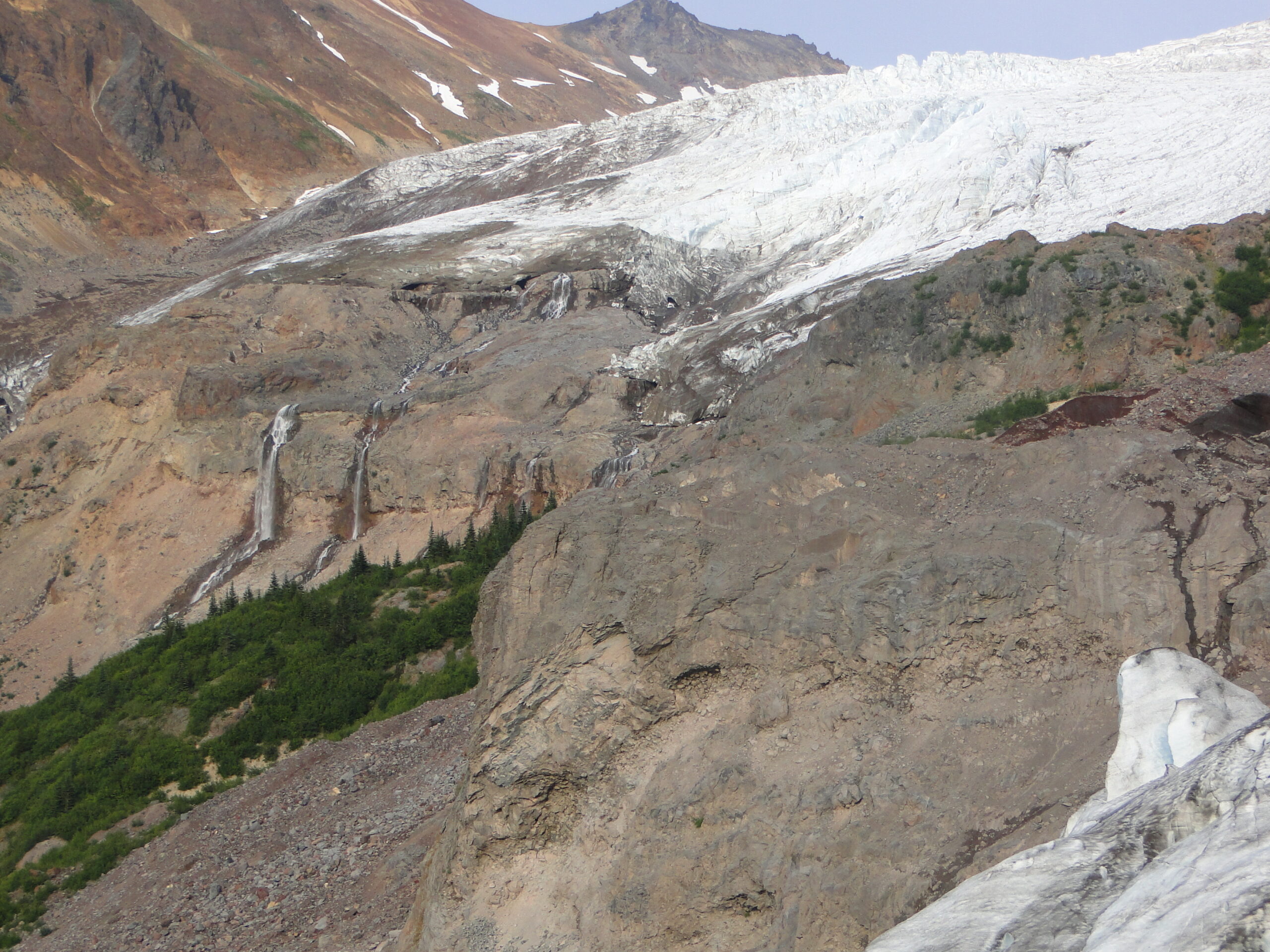
Roosevelt Glacier retreating to top of bedrock step in 2019.

Roosevelt Glacier is adjacent to Coleman Glaier on the northwest side of Mount Baker. It has followed the same pattern as the Coleman Glacier with less total retreat since 1979 of 550 m.  The glacier in 2022 has retreated above a large bedrock step and has a thin profile that will encourage ongoing rapid retreat.
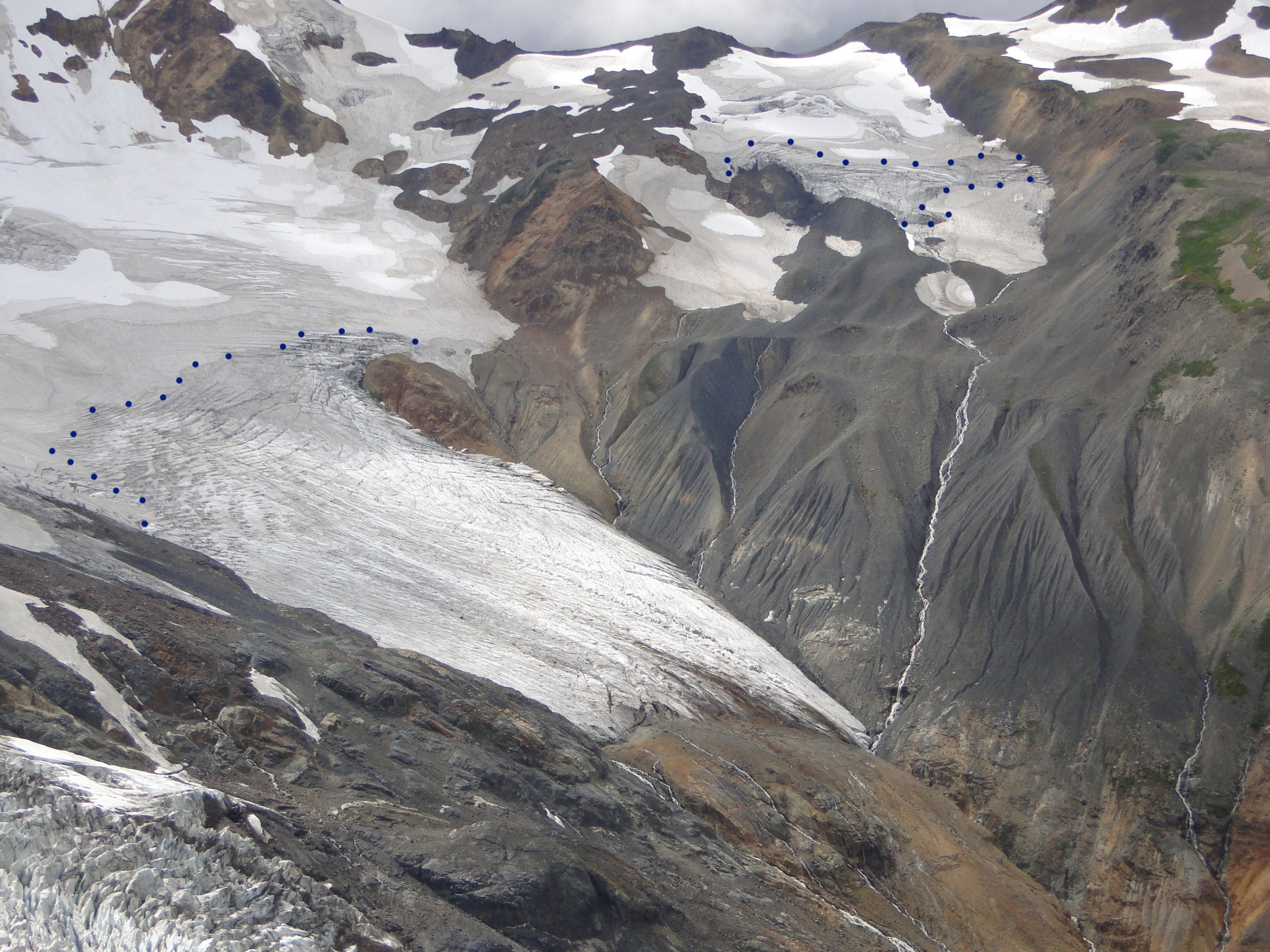
Mazama Glacier in 2015
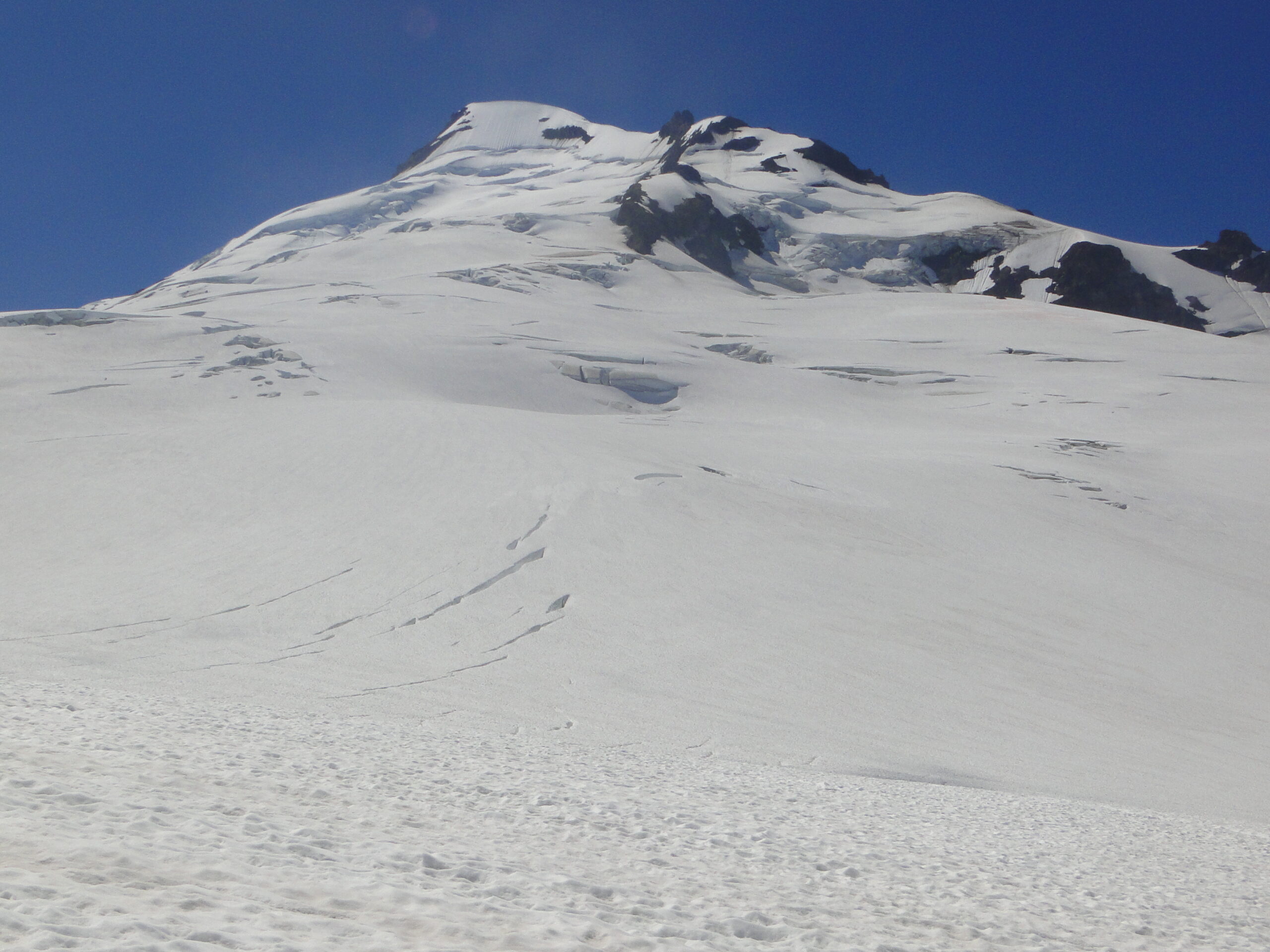
Looking up Mazama Glacier from near the saddle with Rainbow Glacier at 2000 m.

Mazama Glacier  flows from the summit down the north side of Mount Baker. The glacier terminates at the head of Wells Creek at 1470 meters. This is a glacier we visit briefly each summer since 1984, but is not a focus of detailed observations. The glacier had a low slope relatively stagnant tongue in 1988 that has led to a rapid retreat of 825 m by 2022. The glacier has a high snow algae region near the Dorr Steamfield.

Sholes Glacier terminus in 2015 with stream gaging location, we calibrated this stream discharge station for the Nooksack Indian Tribe.

Sholes Glacier terminus in 2022 with 1984 terminus location indicated.

Sholes Glacier is on a ridge extending northeast from Mount Baker. We have surveyed mass balance on this glacier each year since 1990. In 2012 in a joint project with the Nooksack Indian Tribe we began summer long monitoring of streamflow below this glacier that has identified the response of glacier melt to heat waves (Pelto et al 2022). The glacier has lost 24.6 m w.e. thickness since 1990 and retreated 170 m, most of that retreat since 2010. Our studies of streamflow indicate how during heat waves glaciers in this basin increase discharge by ~20% and limit water temperature increases (Pelto et al 2022).

Rainbow Glacier terminus in 2014 indicating the 2o14 and 1984 position. Taken by Tom Hammond from Rainbow Ridge.
Rainbow Glacier annual accumulaiton layer thickness in 2013.

Rainbow Glacier is a World Glacier Monitoring Service reference glacier that we have measured the mass balance of each year since 1984.The glacier begins at 2200 m at a saddle with Mazama and Park Glacier and drains the northeast flank of Mount Baker into the headwaters of Rainbow Ceeek and then Baker Lake. The glacier has lost 17.7 m w.e thickness which has driven a retreat of 700 m. The glacier was advancing during our first two years of observations. At the 2000 m saddle with Mazama Glacier the accumulation zone has persisted. The average retained snowpack has declined from 2.7 m to 1.5 m.

Park Glacier Cliffs in 2003

Park Glacier drains the northeast side of Mount Baker’s summit area, meltwater flowing into Baker Lake. Each year we work on the adjacent Rainbow Glacier and during the 1980’s and 1990’s the Park Glacier Cliffs provided a daily sequence of avalanches, the noise echoing across the valleys. By 2010 this occurrence was rare, as the cliffs receded and diminished in height. This accompanied the retreat of the main valley tongue that most of these avalanches had fallen onto.  By 2022 the glacier has receded 690 m from the advance moraine of the 1970’s
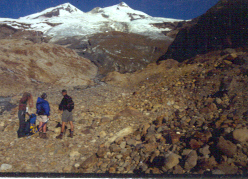
Boulder Glacier in 1993 from just below its 1970s advance moraine.

Boulder Glacier from our camp in 2003 illustrating retreat

Debris covered terminus of Boulder Glacier, due to subglacial debris exiting onto glacier surface

Boulder Glacier drains the east side of Mount Baker into Boulder Creek and then Baker Lake. The glacier was advancing rapidly in the 1950s. Our second visit in 1988 revealed a significant retreat underway.  The terminus area of the glacier is debris covered due to subglacial debris flows from the crater exiting onto the glacier surface. This glacier has retreated 850 m retreat from its advance moraine of the 1970’s.
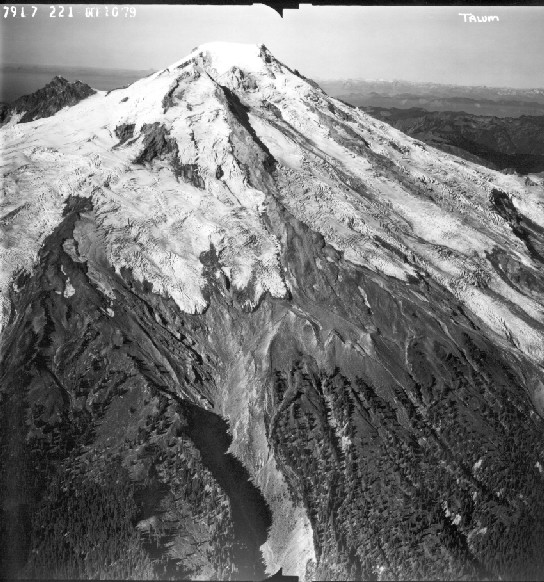
Talum Glacier in 1979 image from Austin Post

Talum Glacier has a wider bottom then top, as it is pinched between the Boulder and Squak Glacier on the east flank of Mount Baker. There are several terminus tongues, which tends to reduce the rate of retreat. Retreat from the advance moraines to 2022 has been 380 m.

Squak Glacier from survey camp in 1990

Squak Glacier from survey camp in 2009

Squak Glacier is adjacent to Easton Glacier on the southeast slope of Mount Baker. This glaciers retreat has been 420 m since 1984 when it was still in contact with its advance moraine. There are several bedrock areas emerging in what was the accumulation zone of the glacier, indicating a substantial expansion of the ablation zone. Thinning of the glacier from 1990-2009 is evident with expansion of ridge between Squak and Talum.

In 2023 we will again be on Mount Baker assessing the ongoing rapid response to climate warming generating glacier thinning and retreat.

 

North Cascade Glacier 2022 Initial Observations-39th Field Season

field team 1

2022 North Cascade Glacier Climate Project Field Team

Science Director: Mauri S. Pelto, mspelto@nichols.edu
Art Director: Jill Pelto, pelto.jill@gmail.com

For the 39th consecutive summer we were in the field to measure and communicate the impact of climate change on North Cascade glaciers. We completed detailed measurements on 10 glaciers, three of which are part of the World Glacier Monitoring Service reference glacier network (42 glaciers globally), which have 30+ consecutive years of mass balance observations. NCGCP was founded in 1983 to identify and communicate the response of North Cascade glaciers to regional climate change. We are a fieldwork-based project with a focus on measuring changes in mass balance, glacier runoff, and terminus behavior. The project has an interdisciplinary scope — collaborating with a range of natural scientists, artists, journalists, and conservationists.

This winter snowpack remained below average until a late season surge from April into May.  Snowpack was 90% of the mean (1977-2021) on April 1% and 110% of the mean on May 10.  The month of May and June had below normal temperatures leading to an above average glacier snow cover as June ended. July and August were exceptionally warm at Heather Meadows  (4200 feet) average July and August maximum temperature is 19.2 C, this year 20 days reached or exceeded 5 C above this temperature in July and August 2022. At Stevens Pass (4000 feet) average July and August maximum temperature is 21.4 C, this year 24 days reached or exceeded 5 C above the temperature in July and August 2022. The average July-August temperature at the Stevens Pass and Lyman Lake sites was the highest since records began in 1990.

The result is that glacier snowcover rapidly melted during the July-August period, which is resulting in significant mass losses for North Cascade glaciers that continue to thin, retreat and lose volume. The climate stress is evident on the glaciers, but also in the alpine vegetation and alpine aquatic ecosystems.

Field team backpacking around Blanca Lake at our first field site.

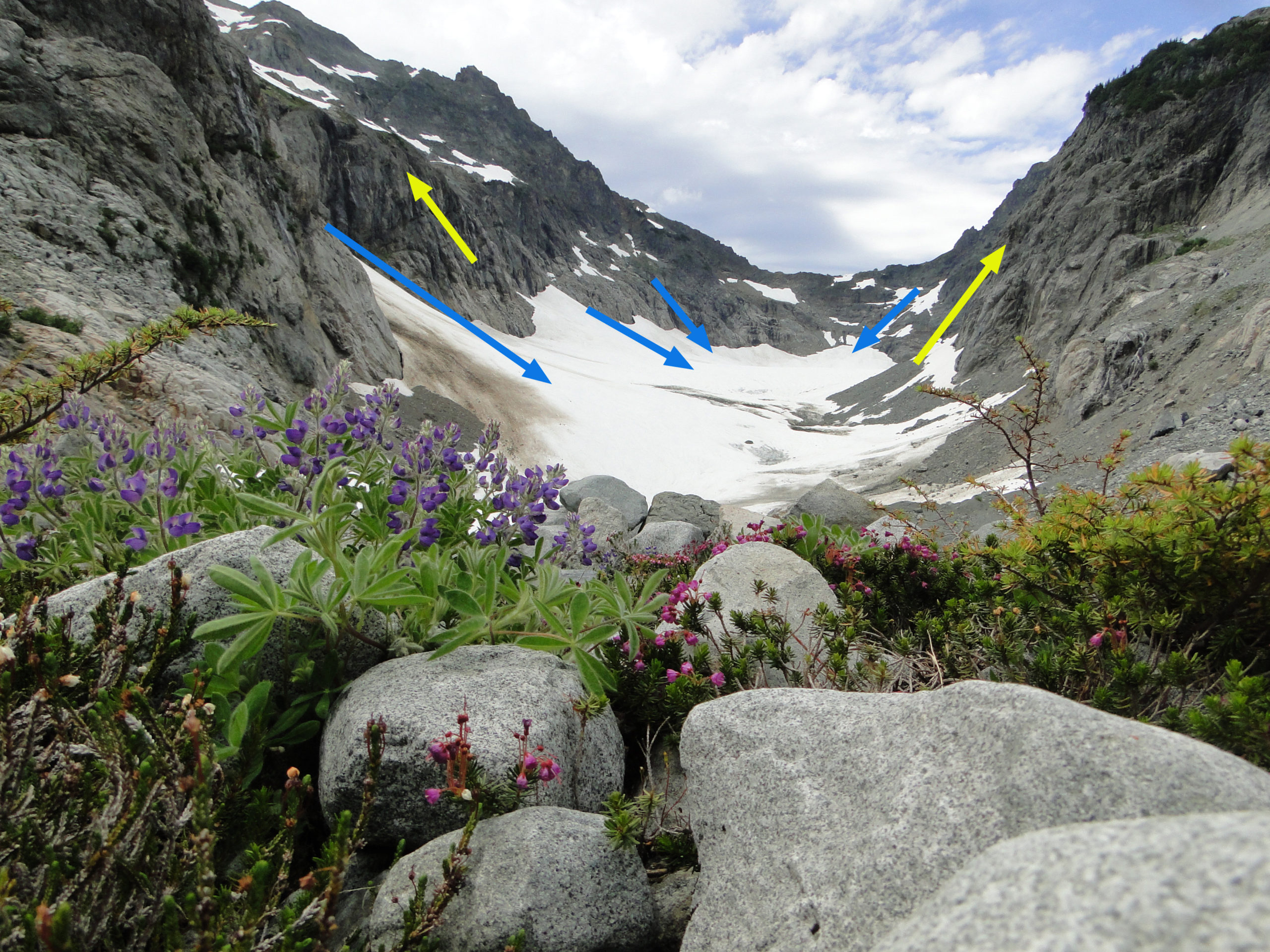
Columbia Glacier with the 1984 terminus position, note the glacier profile now descends from west side (left) to east side (right) of the glacier. The glacier has retreated 270 m since 1984. Note steep tongue extending across entire cirque valley in 1988 lower image.

Columbia Glacier indicating the avalanche fans that now provide most of the accumulation to the glacier at the blue arrows. The yellow arrows indicate avalanche slopes that are no longer key feeders resulting in marginal thinning and recession. These locations or reduced avalanching have resulted from the source area slopes having lost their perennial snow and ice, which must be filled each winter before a slide can occur. Snowpack in the avalanche fans exceeds 3 m, while outside of the avalanche fans averaged 1.8 m on Aug. 1-2, 2022.

Jill Sketching Blanca Lake and Troublesome Creek draining from Columbia Glacier.

Braided stream issuing from the the rapidly retreating and thinning Sholes Glacier on the north flank of Mount Baker. Retreat since 2015 has been 90 m, with 225 m since 1984.

Snow depth measurements  in meters on Rainbow Glacier using crevasse stratigraphy, adjacent Park and Mazama Glacier drain the upper part of Mount Baker. Average depth at 2000 m was 5.25 m, 3.15 m water equivalent. The terminus of the glacier continues to retreat rapidly, but was buried by avalanche debris at the time of our survey in 2022.

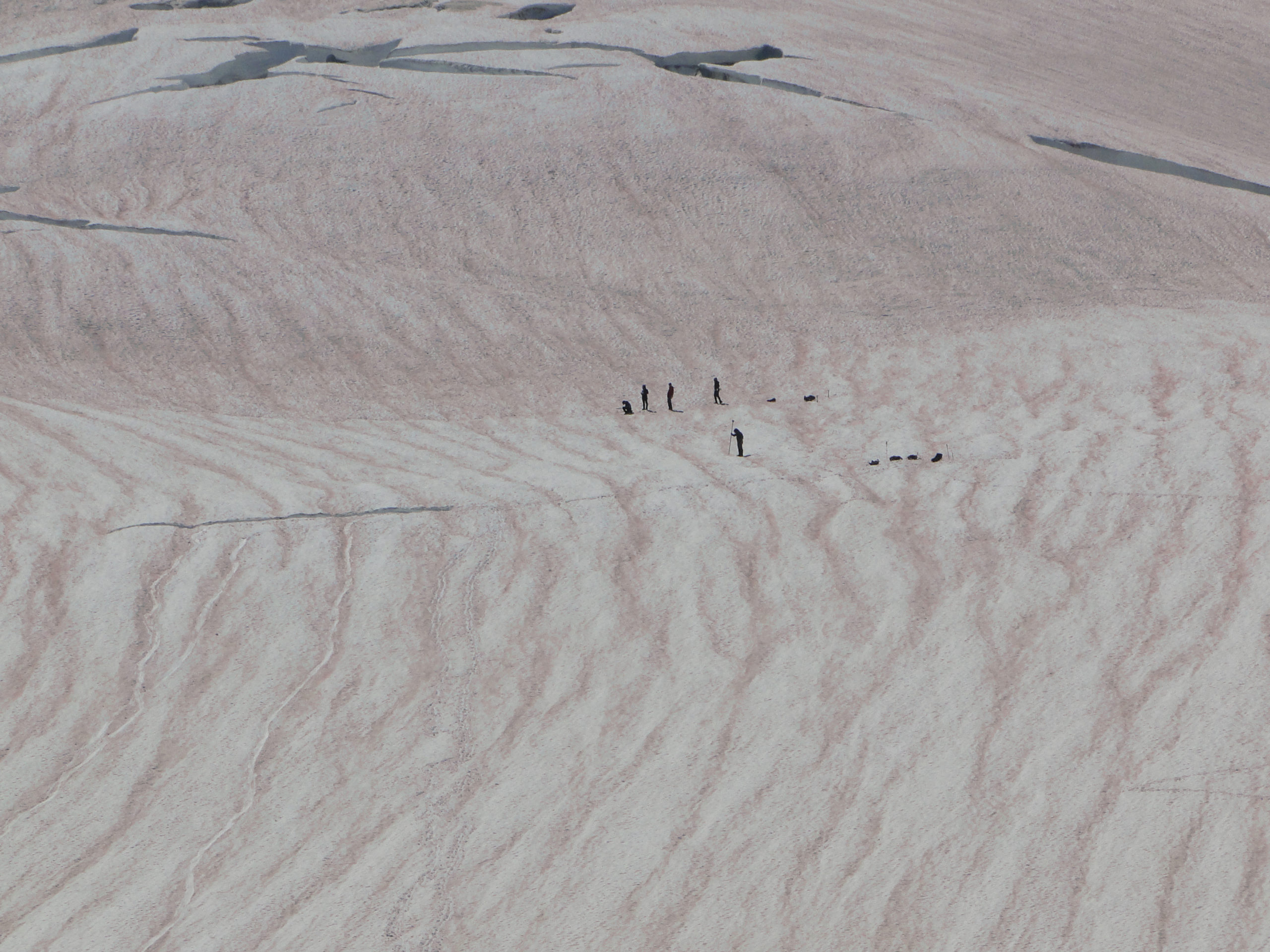
Alia Khan’s Western Washington University team assessing a red algae zone on Rainbow Glacier, we led them through the icefall to this location, where they sample impurities on the glacier surface and relate that to remote sensing products.

Jill’s sketch of Rainbow Glacier and Mount Baker from trail above Lake Ann.

Lower Curtis Glacier indicating recession since 1985. The glacier has thinned considerably in the lower section since the 2003 image below.

Navigating through the icefall region on Lower Curtis Glacier where we are mapping snow pack depth and crevasse depth. 

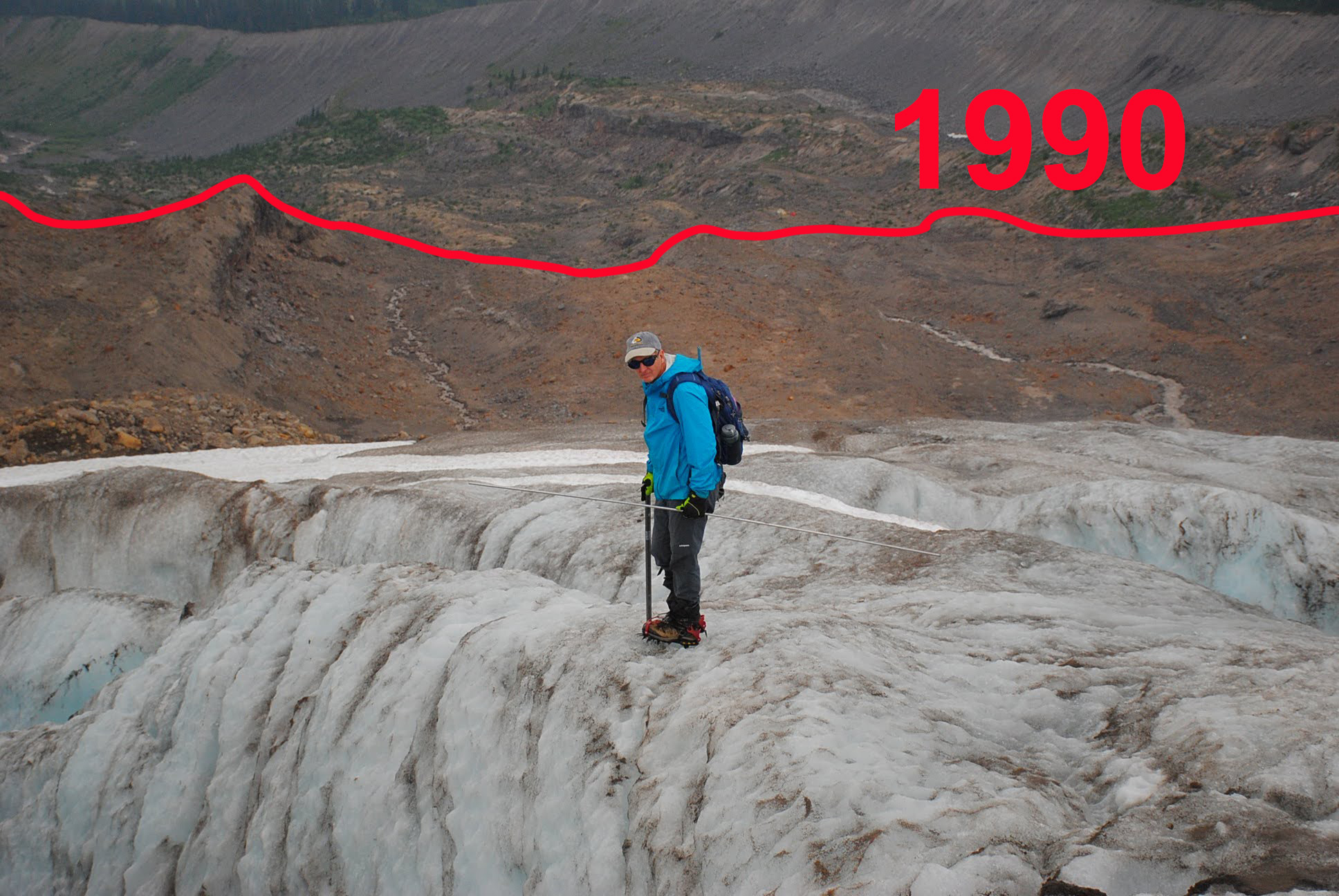
Deglaciated terrain since 1990 below Easton Glacier. We mapped this at 0.18 square kilometers in 2022.

We have observed crevasse depths for a decade and have seen both their number and depth decline in icefalls on Easton and Lower Curtis Glacier due to glacier thinning and reduced velocity. Deepest crevasses are at the top of the convex slope change, 25-30 m deep.

Claire Giordano painting Easton Glacier crevasse ‘blues’ at top of lowest icefall.

Ascending into Easton Icefall with five annual layers exposed on serac.

Snow depth assessment in specific crevasse at 2500 on Easton Glacier. No snow was retained here in 2021. Avergage depth in 2020 in this region 5.5 m, 4.75 m in 2022.

Easton Glacier has retreated 470 m from 1990-2022. Above is 2022 and below is 2003 image.

Ice Worm Glacier on Mount Daniel was fully snowcovered. We completed a grid of 72 snow depth measurements with a mean of 2.1 m in depth. The glacier continues to recede faster on its upper margin than at the terminus.

Descending onto Lynch Glacier, which had an accumulation area ratio of 83% in mid-August. Average snow depth 2.5 m.

Probing snow depth and surveying blue ice margin on Lynch Glacier.

Daniel Glacier was fully snowcovered in mid-August. Consistent snow depths of 1.8-2.5 m.

Jill’s field watercolor and colored pencil. This piece was done below the small Iceworm Glacier, on Mt. Daniel. It looks out towards the prominent Cathedral rock and Alpine Lakes Wilderness. Jill really enjoyed making this piece — to start she sketched the landscape, and then temporarily moved in front of the purple penstemon and the pale elmira flowers to capture them in the foreground. A while after she began painting, the wind dropped, and the mosquitoes arrived in force. Jill had to stop painting for the evening and went back to camp. Because Jill then finished at home, it was fun to add some more detail to this piece.

In the vicinity of Peggy’s Pond near our Mount Daniel base camp are a dozen shallow ponds, 10-20 cm are average that typically endure through the hatch of tadpoles in late August or early September. The primary inhabitants are frogs (Rana Cascadea) and their tadpoles. In 2022 despite a wet spring and early summer that had the ponds brimming with water, right above, tadpoles were observed, where typically there are several hundred, and the frog numbers were ~50% of usual. This followed the dried beds of these ponds in 2021, at left.  Maybe this is in part why mosquitoes were swarming here.

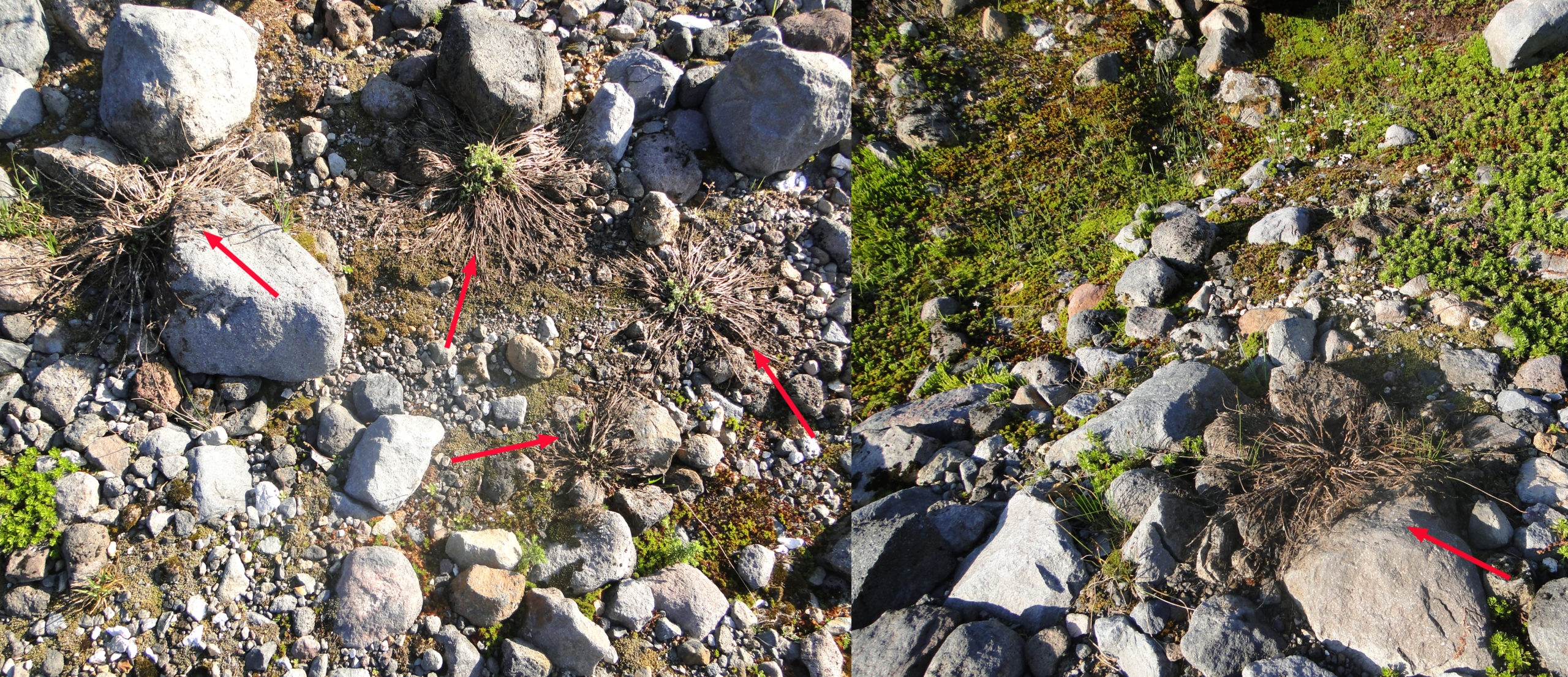
In 2021 below Easton Glacier we noted a number of alpine plants that had emerged just before or during the record June heat wave, had been dessicated/cooked by the heat in this are of relatively barren volcanic rock. Most notably lupine. This year in the same region we noted that ~30% of the lupine had failed to develop by August 2022, despite a cool wet spring. In contrast the evergreen alpine plants in the same area penstemon, saxifrage, pink and white heather, and partridge-foot all were fine.

Sholes Glacier, WA and a Cascade of Ologies

Watercolor painting of Sholes Glacier. The small figure is at the current terminus of the glacier, and the photo that inspired this painting was taken from where the glacier used to end about 35 years prior. By Jill Pelto

Sholes Glacier is on the northeast flank of Mount Baker, WA.  We have spent the last 32 years completing detailed measurments on this glacier that has revealed a story of glacier mass balance loss, thinning, retreat, declining area, and a cascade of other consequences impacting other “ologies” beyond the glacier.  If you are intrigued by many ologies, the Podcast by Allie Ward will be inspiring as it was to this title.

Sholes Glacier and stream gage station.  We have constructed a rating curve for this station, that the Nooksack Indian Tribe maintains (Grah and Beaulieu, 2013).

The climatology of the region has shifted, with one key change being more frequent and intense heat waves.  Glaciers and heat waves just are not compatible. Using daily maximum temperatures for the 1981-2021 period for Mount Baker from ERA5 temperature reanalysis, completed by Tom Matthews at Loughborough University, indicates that there have been 83 days where the maximum temperature exceeded 12°C, an average of 2 days/year.  In the last five years there have been 22 days exceeding 12°C,  over 4 days/year. There have been 16 days during 1981-2021 period when the maximum temperature exceeded 14°C, 75% (12) of these have been in the last five years.

Probing snow depth on Sholes Glacier in 2014, this is completed annually at a fixed network of over 100 locations.

In terms of glaciology the result of the climate shift is that the glacier has lost 25-30% of its volume from 1990-2021. The terminus has retreated 155 m while the area has decreased by 25%.  The changes have been most rapid in the last 8 years. The two years of largest mass loss were 2015 and 2021. We measure both melting (ablation) on the glacier and runoff from the glacier. This combination allows determination of the amount of glacier runoff. During 24 heat waves in the region from 2009-2021 mean daily ablation during the heat waves has ranged from 4.5-7.2 cm w.e./day (w.e.=water equivalent).  The highest rate of 7.2 cm was during the June 26-July 1, 2021 period.

Sholes Glacier in 2015 exhibiting the darkening of the surface that occurs in high melt years, increasing melt rates. How much black carbon and algae is part of this darkening is the research of Alia Khan (WWU).

For a glacier to be in equilibrium or have a positive mass balance the majority of the glacier must be in the accumulation zone, snow covered at the end of the summer, that is an accumulation are ratio (AAR) greater than 50%.  Pelto and Brown (2012) noted that for Mount Baker an AAR of 60% is required for a break even balance for the year.  From 2013-2021 the average accumulation area ratio has been 35%.  For Sholes Glacier if 50% of the glacier is exposed ice and firn in early August that increases mass loss.  The ice and firn for the same weather conditions have a 30-40% higher melt rate than the snowpack.  An early season heat wave strips the snow off earlier exposing the darker faster melting glacier surfaces for longer further increasing mass loss, note image above.

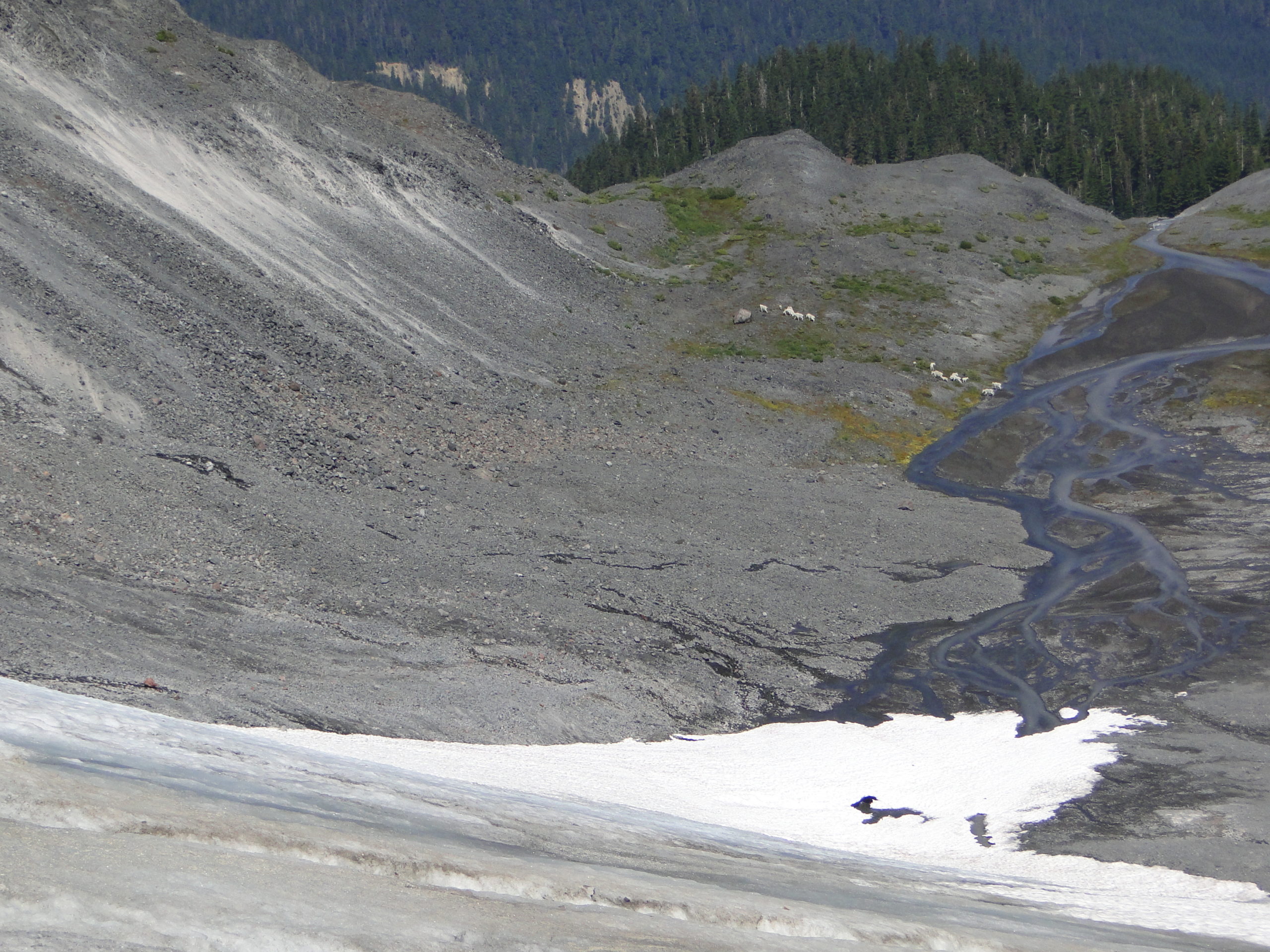
Sholes Glacier in 2021. The glacier has retreated 170 m from 1990-2021, the terminus in 1990 is approximately whre the goats are crossing the stream.

Hydrology downstream in Wells Creek and the North Fork Nooksack River is changing in part because of the changes in glacier runoff. Glacier runoff is a major source of streamflow during the summer low-flow season and mitigates both low flow and high water temperatures (Pelto, 2015). This is particularly true during summer heat wavesbut this ability has been diminishing in the region (Moore et al 2020)  For the last 37 summers we have been in the field monitoring North Cascade glaciers response to climate change including during heat waves (Pelto, 2018). In the last decade we have made synchronous observations of glacier ablation and stream discharge immediately below Sholes Glacier, Mount Baker (Pelto, 2015). This in conjunction with observed daily discharge and temperature data from the USGS stations on the ~6% glaciated North Fork Nooksack River (NFN) and the unglaciated South Fork Nooksack River (SFN), contrasts and quantifies the ameliorating role of glacier runoff on discharge and water temperature during 24 late summer heat wave events.

Measuring discharge below Sholes Glacier in 2016.

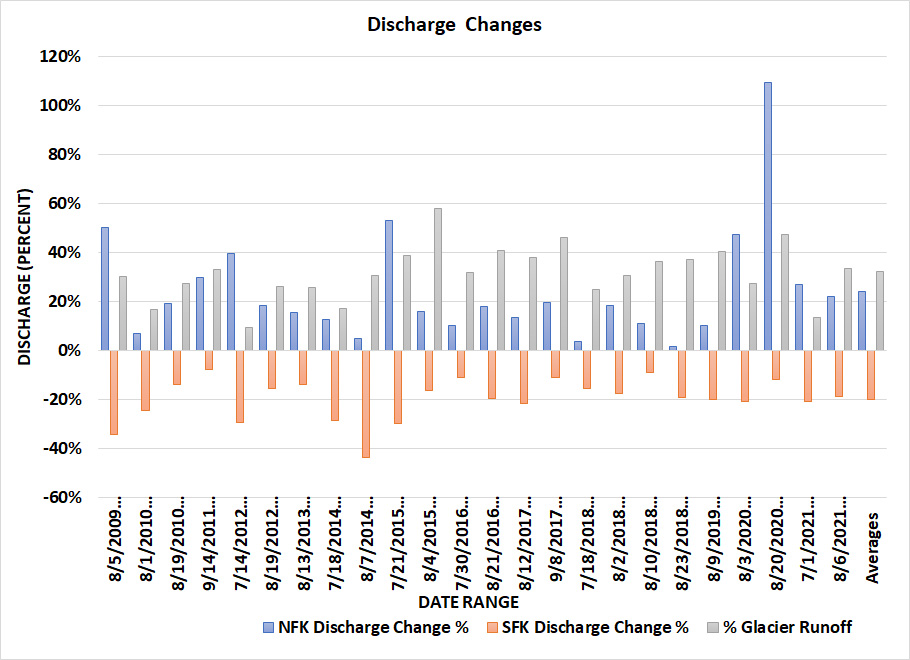
Sholes Glacier and ablation measurements on Sholes Glacier indicate daily ablation ranging from 5-6 cm/day, which for the NFN currently yields 9-11 cubic meters/second. This is 40-50% of the August mean discharge of 24 cubic meters/second, despite glaciers only covering 6% of the watershed. In the unglaciated SFN warm weather events generated a mean stream temperature change of +2°C, only 1 event in the NFN generated this rise and the mean was +0.7°C. Durng the June 2021 heatwave from June 21-29 maxium daily stream temperature in SFN warmed 3°C, vs 0.8°C for NFN.  This illustrates that a greater proportion of snowmelt, which NFN recieves, has limited the temperature rise.  Discharge rose at least 10% in 20 of the 24 events in the NFN with an average increase of 24%.  In the SFN all 24 events led to a decreased discharge with an average decrease of 20%. The primary response to these summer heat waes is increased discharge in the heavily glaciated NFN, and increased stream temperature in the unglaciated SFN.

Discharge change during heat waves in South Fork (decreases) and North Fork Nooksack River  (increases) above.  Below temperature change during heat waves in South Fork (significant rise) and North Fork Nooksack River (small rise).

Glacier runoff is a product of glacier area and melt rate.  Overall glacier runoff declines when area reductions exceed, ablation rate increases.  This has already occurred in the NFN and now glacier runoff is declining (Pelto, 2015). The measured ablation rate is applied to glaciers across the NFN watershed, providing daily glacier runoff discharge to the North Fork Nooksack River.  For the NFN glacier runoff production was equivalent to 34% of the total discharge during the 24 later summer heat wave events. As the glaciers continue to retreat the NFN will have a declining mitigation of heat waves for discharge and temperature and trend towards the the highly sensitive SFN where warm weather leads to declining streamflow and warming temperatures.

Nooksack Falls heavily glacier fed.

Aquatic ecology in glaciated watershed in turn is impacted. Glaciers are important in maintaining sufficient discharge and stream temperature that are critical for salmon in the North Fork Nooksack. Some cold-water trout and salmon species are already constrained by warm water temperatures and additional warming will result in net habitat loss (Isaak et al 2012). In the Fraser River and Thompson River, BC fish community thresholds were obsrved for mean weekly average temperatures of about 12°C and again above 19°C (Parkinson et al 2015). Below 12°C the community were characterized by bull trout and some cold water species, between 12°C and 19°C by salmonids and sculpins and above 19°C by minnows and some cold water salmonids (Parkinson et al 2015). These thresholds indicated small temperature changes can be expected to drive substantial changes in fish communities. During the 24 warm weather events noted in the North Fork only two events exceeded 12°C, while in the South Fork 15 of the events exceeded 19°C.  This suggest that both rivers are near a threshold that could alter the fish community.

In the North Fork Nooksack the number of returning chinook is divided into natural and hatchery spawned salmon. The Chum and Coho salmon data for the Nooksack River during the 1999-2013 interval indicate there are two salmon population peaks for each species. The early peak is in 2002 and the second peak occurs in 2010 (Washington Dept. Fish & Wildlife, 2020). Overall numbers have not sustained an increase and remain endangered.

Ice Worm counts as the sunsets, 110 worms per square meter.

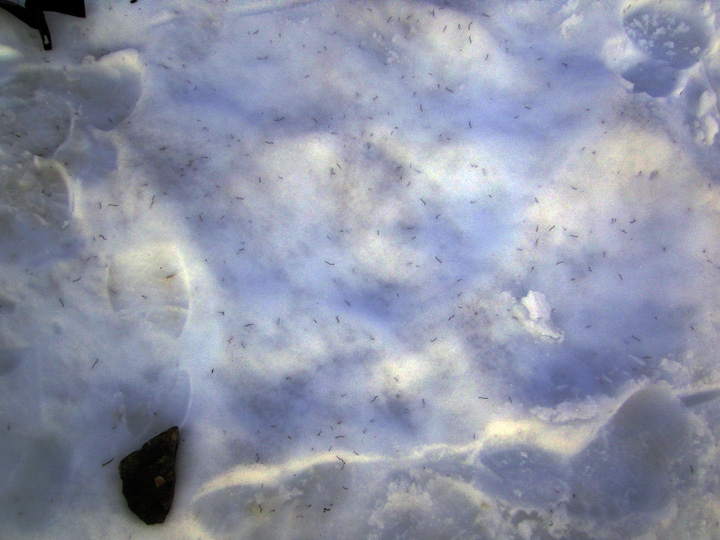
The climatology and glaciology has been difficult for ice wormology  On the glacier itself ice worm population density surveys conducted annually indicate the density of ice worms has decreased since 2000 and that even 10 m beyond the edge of the glacier on snowpack they do not exist.  This combined with the reduction in glacier area indicate population decline of ice worms.

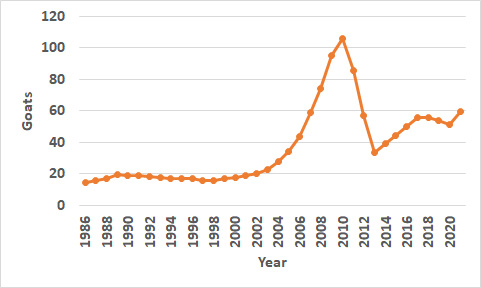
In 2009 we observed the largest goat herd 62 goats (13 kids), some of them seen here below Sholes Glacier.

The climatology has been more favorable in terms of Goatology.We have conducted annual mountain goat surveys in the Ptarmigan Ridge-Sholes Glacier region each years since 1984.  Populations stayed steady from 1984-2000, before rising dramatically through 2010. The difficult winters of 2011 and 2012 reduced the population, followed by a recovery up to 2021.

Three year running mean of mountain goat census conducted each summer while we are working on Ptarmigan Ridge, Sholes Glacier and Rainbow Glacier.