Mozigou Glacier Meltwater Pays High Hydropower Dividend

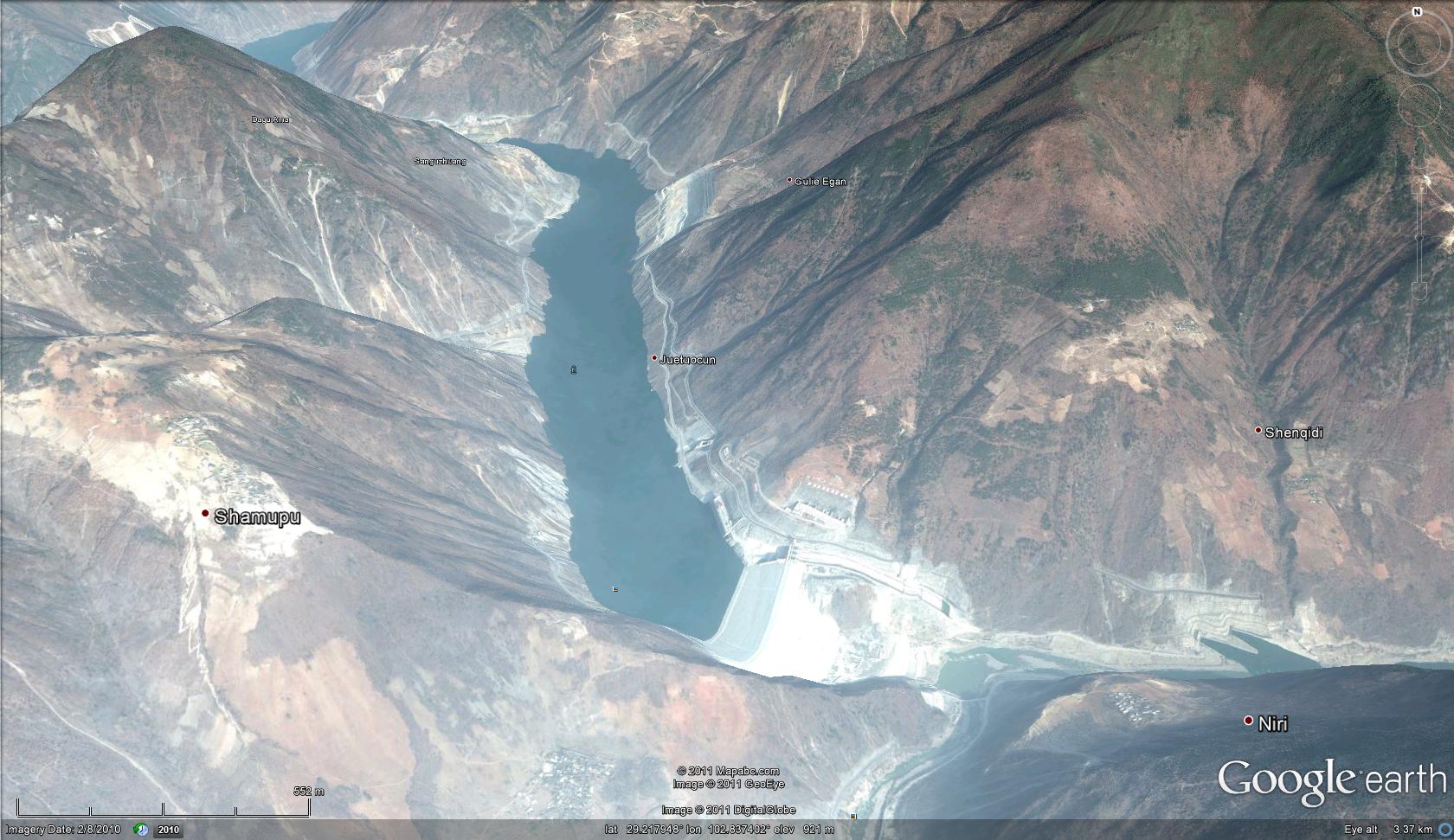
Mozigou Glacier is a valley glacier in the Gongga Mountains, Sichuan Province, China that drains into the Dadu River.  In the first 250 km after leaving the glacier this meltwater travels through seven hydropower projects that have a collective capacity of  over 9000 MW. Pan et al (2012) noted that the glaciers of the Gongga Shan have lost 11% of their area since 1966.  They further reported a 300 m retreat of Mozigou Glacier from 1994-2009. The glacier unlike its neighbor Hailuoguo Glacier does not have a debris covered terminus.  Liu et al (2010) report that the main change in the region affecting the glaciers is rising temperature.  The Gongga Shan glaciers are summer accumulation type with the majority of the accumulating snow occurring at the same time that ablation is at a peak lower on the glacier. They also report a steep precipitation gradient, which is key to glacier formation here. Here we examine Landsat imagery from 1994-2017 to indicate retreat of the glacier and Google Earth images of the hydropower projects to underscore the economic output of the runoff.

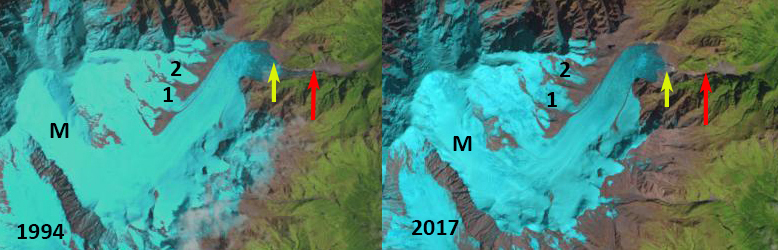
In 1994 the Mozigou Glacier had a thin terminus tongue extending downslope from the wide terminus area, red arrow.  The snowline is not far above the terminus. In 1995 the thin terminus tongue extending downvalley to the red arrow is still evident.  The snowline remains not far above the terminus.  By 2016 the thin 900 m long terminus tongue has melted away.  In 2017 the two lowest tributaries have been reduced in width. The  terminus is now on a lower sloped region and has extensive crevassing right to the terminus, see Google Earth image below. Both the reduced slope at the terminus and the rapid flow as indicated by the terminus suggest a glacier fed by high accumulation and one where retreat should diminish.

After a drop of water leaves the glacier it flows tinto the Dadu River where it pays dividends at the following: 35 km downstream is the Dagangshan Hydropower Station 2600 MW, 50 km downstream is the Longtoushi Hydorpower station is 700 MW, 115 km downstream is Pubugou Hydropower Station 3300 MW, 190 km downstream is  the Gongzui Hydropower Station 600 MW, 215 km downstream is the Tongjiezi Hydropower Station 700 MW,  225 km downstream is the  Shawan Hydropower station 480 MW and,  250 km downstream is the Angu Hydropower station 770 MW.

Hailuogou Glacier Retreat, China

The Hailuogou Glacier has retreated 1.8 km during the 20th century. This glacier drains southeast from Gongga Shan beginning at 7500 m and extending to a debris covered terminus at 3000 m. The first image is a map from Li et al (2010).The glacier has been the focus of an ongoing research program by the Laboratory of Cryospheric Sciences, Chinese Academy of Sciences, Lanzhou, China and Nagoya University, Japan. This glacier is a summer accumulation type glacier fed largely by the summer monsoon. The glacier feeds the Dadu River. which eventually joins the Yangtze River. The Dadu River has a series of hydropower plants that fed in part by the glaciers of Gongga Shan. The Pubugou Hydropower Station has a total generating capacity is 3,300 MW, Gongzui Hydropower Station 600 MW and Tongjiezi Hydropower Station 700 MW and the still under construction Dagangshan Hydropower Station 2600 MW. The main changes in the Hailuogou Glacier are the continued thinning of the ablation zone, not terminus retreat of the heavily debris covered terminus. The terminus is at 3000 meters (T), the debris cover dominates to 3400 m. The glacier continues with a low slope to the base of the icefall (I) at 3800 m. Through the icefall the elevation rises above the equilibrium line at 4900 meters (ELA). The thick debris cover insulates the underlying ice slowing the melting. Zhang et al(2010) indicate that thinning and retreat have both accelerated since 1989. The images from Google Earth below are from 2002. The glacier area has been reduced by 0.8 square kilometers over the last 44 years, but more importantly has thinned by 1.1 meters/year in the ablation zone (Pan et al, 2011). In the second image the red arrow indicates the start of the debris cover, and the blue arrow where the river emerges at the terminus. The beginning of the debris cover is noted (DC)(top image), the green arrow indicates where the glacier becomes stagnant and the debris cover is quite thick, the red arrow the terminus, where the glacial river emerges from below the glacier. In the closeup the blue arrows indicate the thick debris covered glacier area and red arrow the terminus where the river emerges. . The retreat rate was 13 meters/year from 1966-1989 and 27 m/year from 1998-2008. They also report a significant reduction in glacier velocity in the ablation zone. This is an indication of increasing stagnation of the terminus area, that will lead to continued downwasting and retreat. The glacier is responding to a temperature warming as noted at the Gongga Alpine Ecosystem Observation and Research Station of the Chinese Ecological Research Network, during 1966–2009, the mean annual temperature at the research station has been increasing by 0.15 to 0.21 C/decade. Two examples of the developing hydropower on the Dadu River fed by the glaciers of Gongga Shan are below with the Dagangshan Hydropower Station, 40 km downstream, top image and Pubugou Hydropower Station, 100 km downstream bottom image.