Belopolskijbreen Retreat Generates Terminus Split, Svalbard

BELOPOL COMPARE

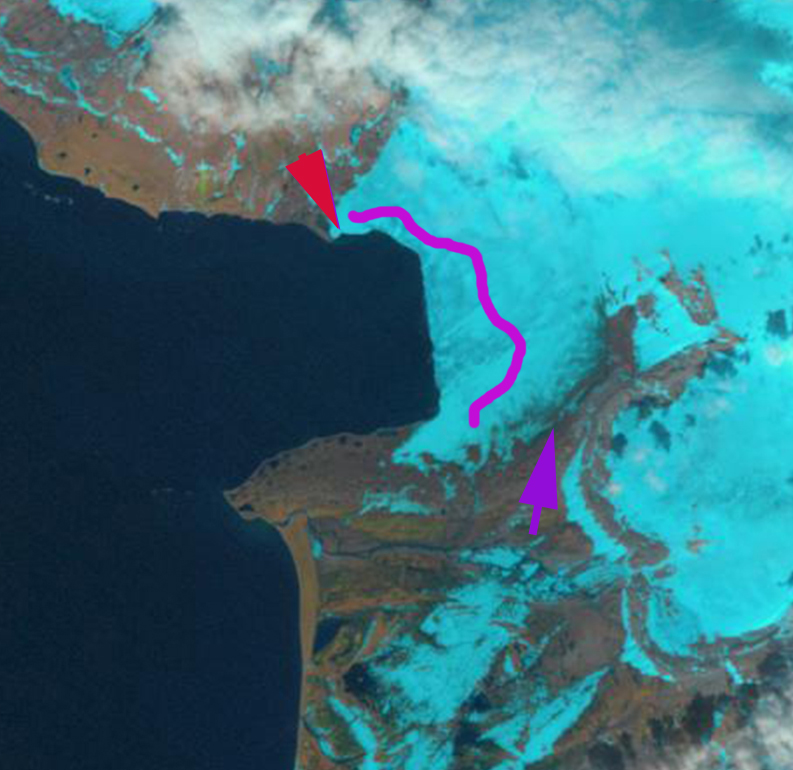
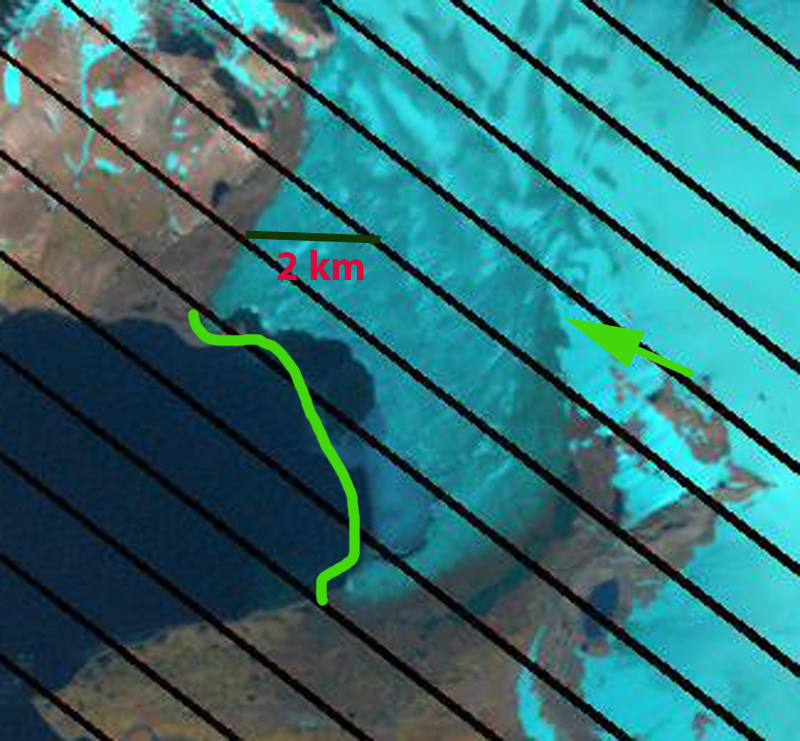
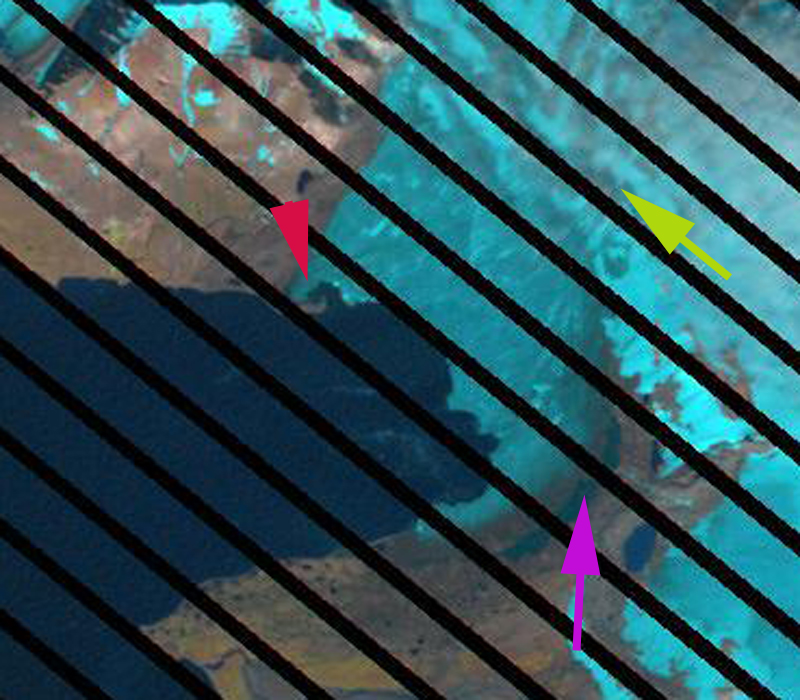
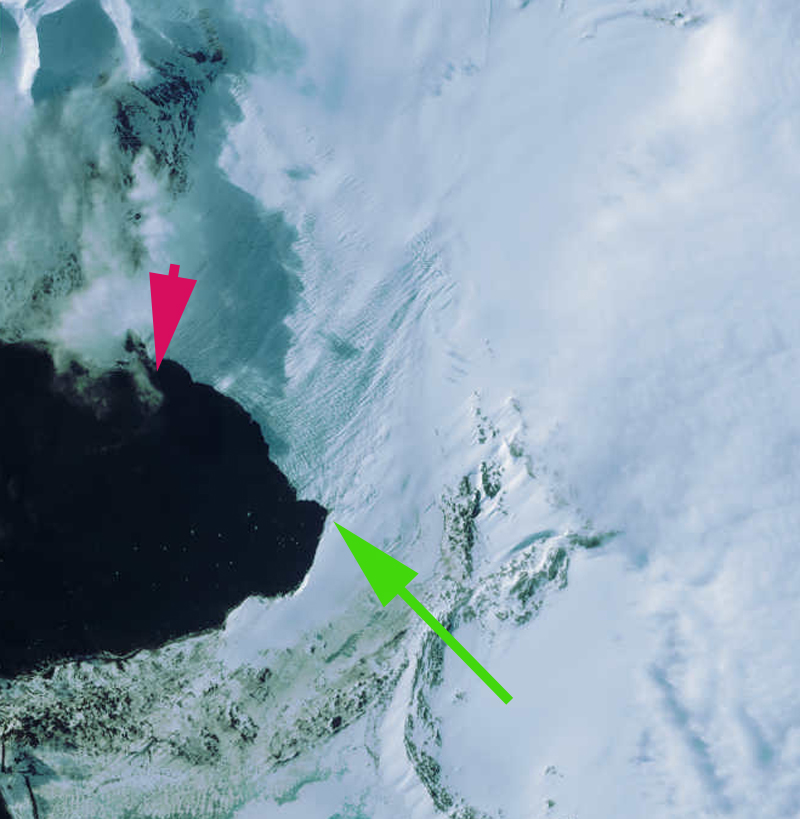
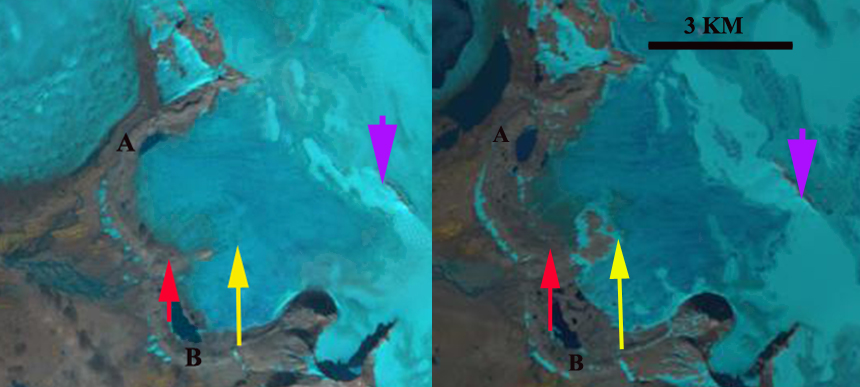
Belopolskijbreen comparison in 1990 and 2014 Landsat images.  Red arrow is the 1990 terminus location, yellow the 2014 extent of the a bedrock ridge separating the two lobes of the glacier, and purple arrow an area of thinning at the head of the glacier. 

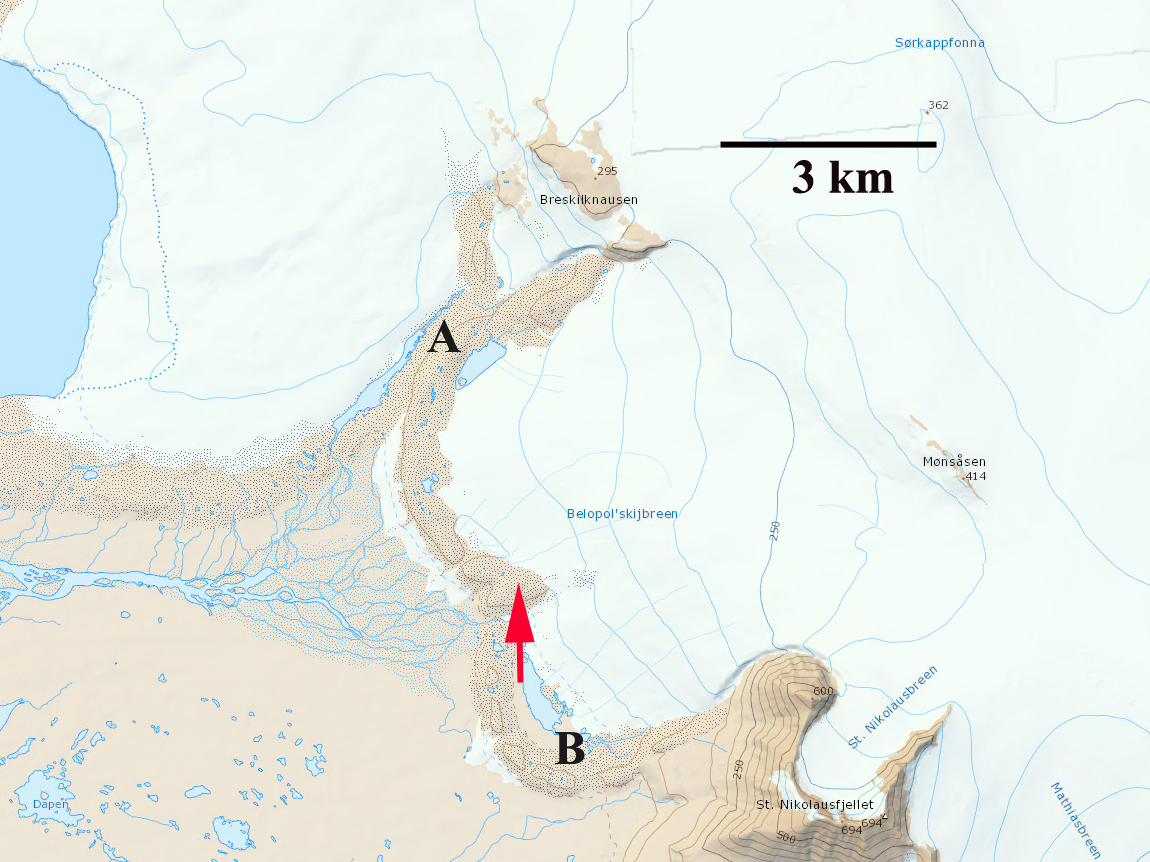
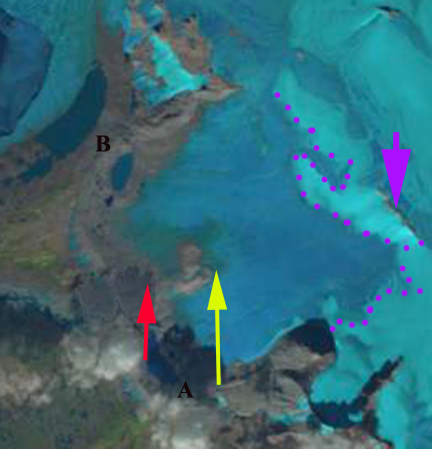
Most of the attention on Svalbard glaciers goes to the larger tidewater glaciers, which collectively having been losing volume rapidly.  Belopolskijbreen in Sorkappland near the southern tip of Svalbard a land based glacier that we examine here using Landsat images from 1990 to 2014.  The glacier is adjacent to Olsokbreen a rapidly retreating tidewater glacier. In 1990 and in the TopoSvalbard maps indicate the glacier terminating in proglacial lakes A and B. The snowline is restricted to the very top of the glacier.  With limited retained snowpack anywhere, the glacier will thin and retreat significantly.  In the middle of the glacier near the red arrow is a bedrock ridge that 700 m into the glacier.  By 2014 the bedrock ridge has extended to the yellow arrow, an additional 700 m.  The glacier has retreated 500 m from Lake A and 650 m from Lake B. The retreat of approximately 500 m across a 4 km wide glacier front plus the expansion of bedrock in the middle, represents more than 2 square kilometers of area lost.  This retreat will continues as the snowline has been limited to the very top of the glacier in 2013, 2014 and 2015. The 2013 Landsat image below indicates the snowline with purple dots.  The snowline is above 375 m with the top of the glacier at just over 400 m.  The glacier has 10% snowcover retained at a maximum, the minimum needed for equilibrium is 50%.

Nuth et al (2013) determined that the glacier area over the entire archipelago has decreased by an average of 80 km2 per year over the past 30 years, a 7% reduction. In the most recent period 1990-2007, terminus retreat was larger than in an earlier period from 1930-1990, while area shrinkage was smaller. Svalbard is host to 163 tidewater glaciers with a collective calving front of 860 km (Błaszczyk et al, 2009). Blaszczyk et al. (2013) reported the total area of the glacier cover lost in Hornsund Fjord area from 1899–2010 was approximately 172 square kilometers, which is just north of Sorkappland.
belopol

TopoSvalbard map of Belopolskijbreen, terminating at Lake A and B. Red arrow marks ridge separating glacier terminus into two lobes.
belopol 2013sn

2013 Landsat images.  Note the snowpack limited to the very top of the glacier, purple dots
Samarinbreen, Svalbard Rapid Retreat 1990-2014

samarinbreen compare
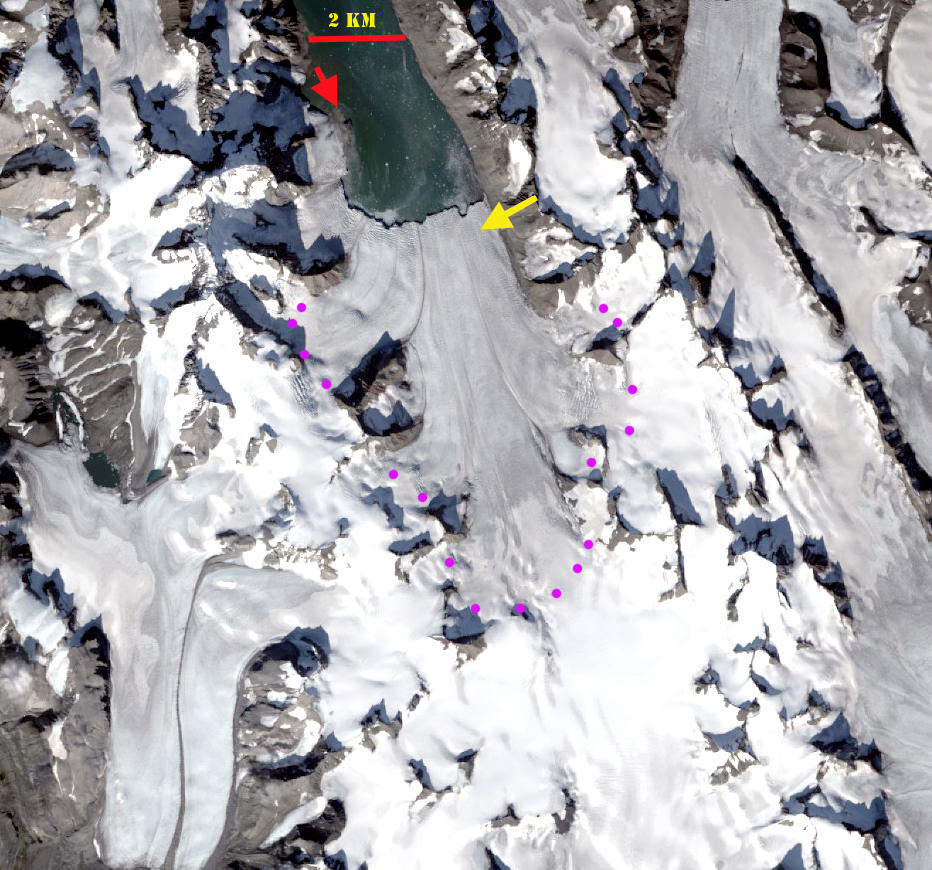
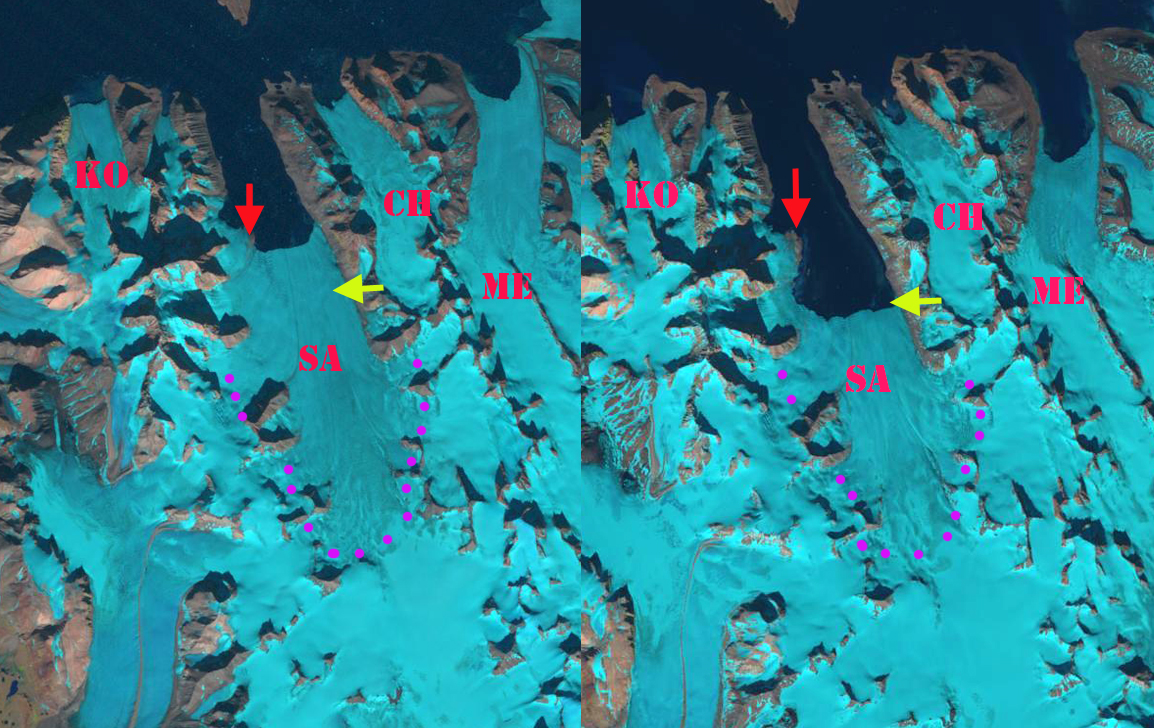
Samarinbreen (SA) 1990 left, and 2014 right, Landsat image comparison.  KO=Korberbreen, CH=Chomjakovbreen,
ME=Mendeleevbreen Red arrows indicate 1990 terminus position, yellow arrows 2014 terminus. and purple dots the snowline.

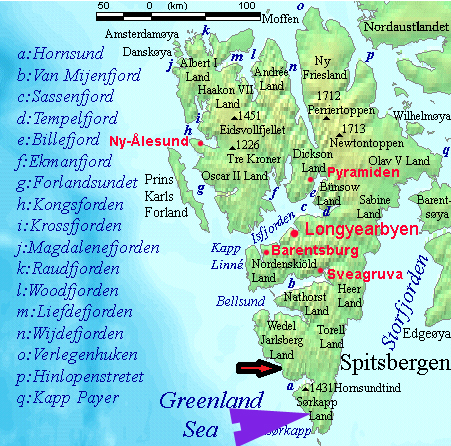
Samarinbreen terminated in a calving front in Samarinvagan, a bay on the southern side of Hornsund Fjord. Hornsund is a fjord that in 2015 almost cuts through the southern Island of Svalbard, due to the retreat of Hamberbergbreen and Hornbreen. The Institute of Geophysics Polish Academy have maintained a Polish Research Station in Hornsund since 1957. The 1984 map, from the University of Silesia, of the glaciers and geomorphology document the extent of the glaciers in 1983 in the region. Blaszczyk et al (2009) analysis identified 163 Svalbard glaciers that are tidewater with the total length calving ice−cliffs at 860 km for the 2001-2006 period. They observed that 14 glaciers had retreated from the ocean to the land over the last 3-4 decades. Nuth et al (2013) determined that the glacier area over the entire archipelago has decreased by an average of 80 km2/year over the past 30 years, a 7% reduction.In the most recent period 1990-2007, terminus retreat was larger than in an earlier period from 1930-1990, while area shrinkage was smaller. A more detailed examination by the same researchers, Blaszczyk, Jania and Kolondra (2013) reported the total area of the glacier cover lost in Hornsund Fjord area from 1899–2010 was approximately 172 km2. The average glacier area retreat increased from a mean of 1.6 square kilometers per year to 3 square kilometers per year since 2000. Samarinbreen begins near the height of land of Sorkappland sharing the divide with Olsokbreen at an elevation of below 400 m.
samarinbreen map
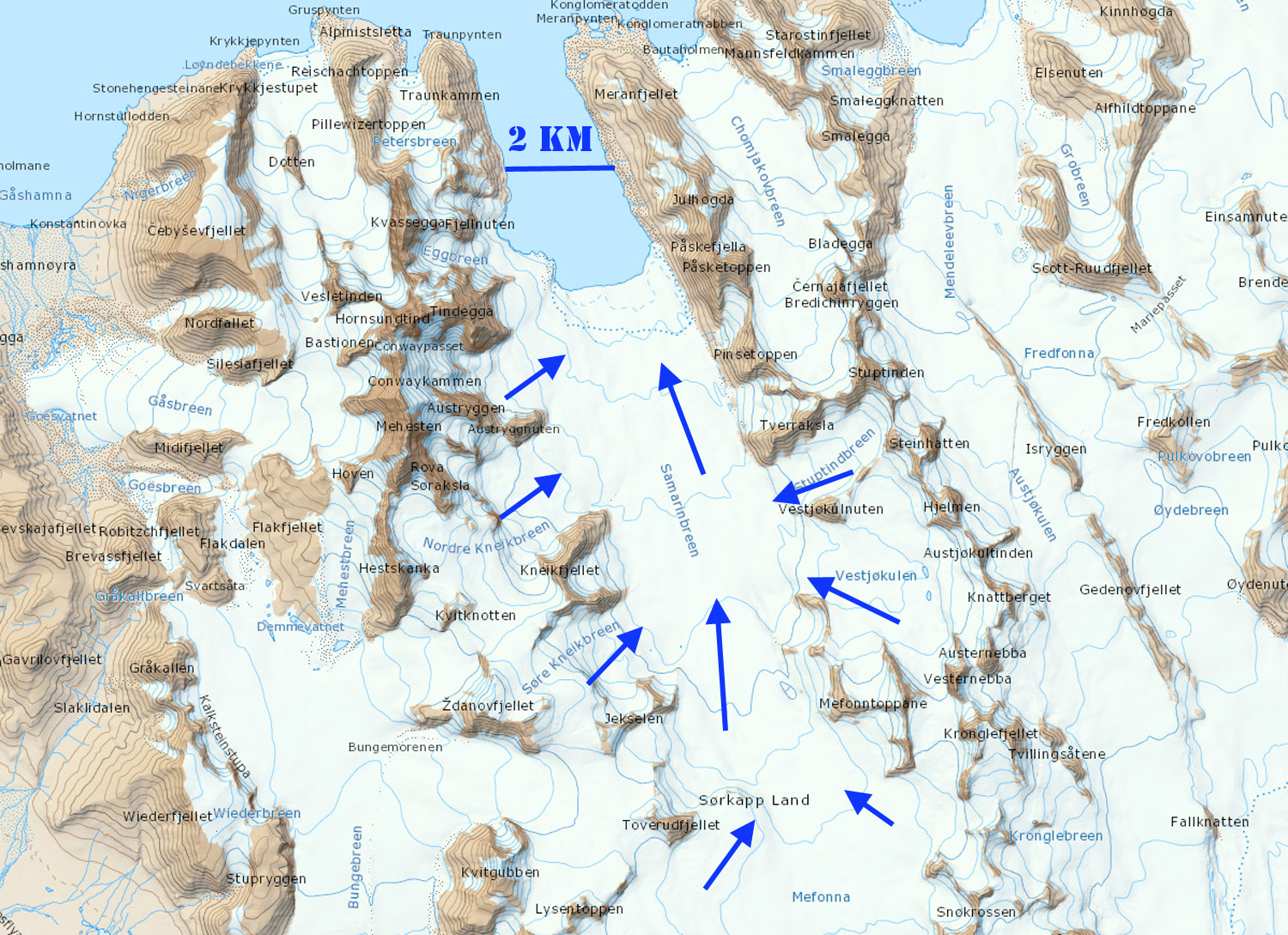
Map from Topo Svalbard
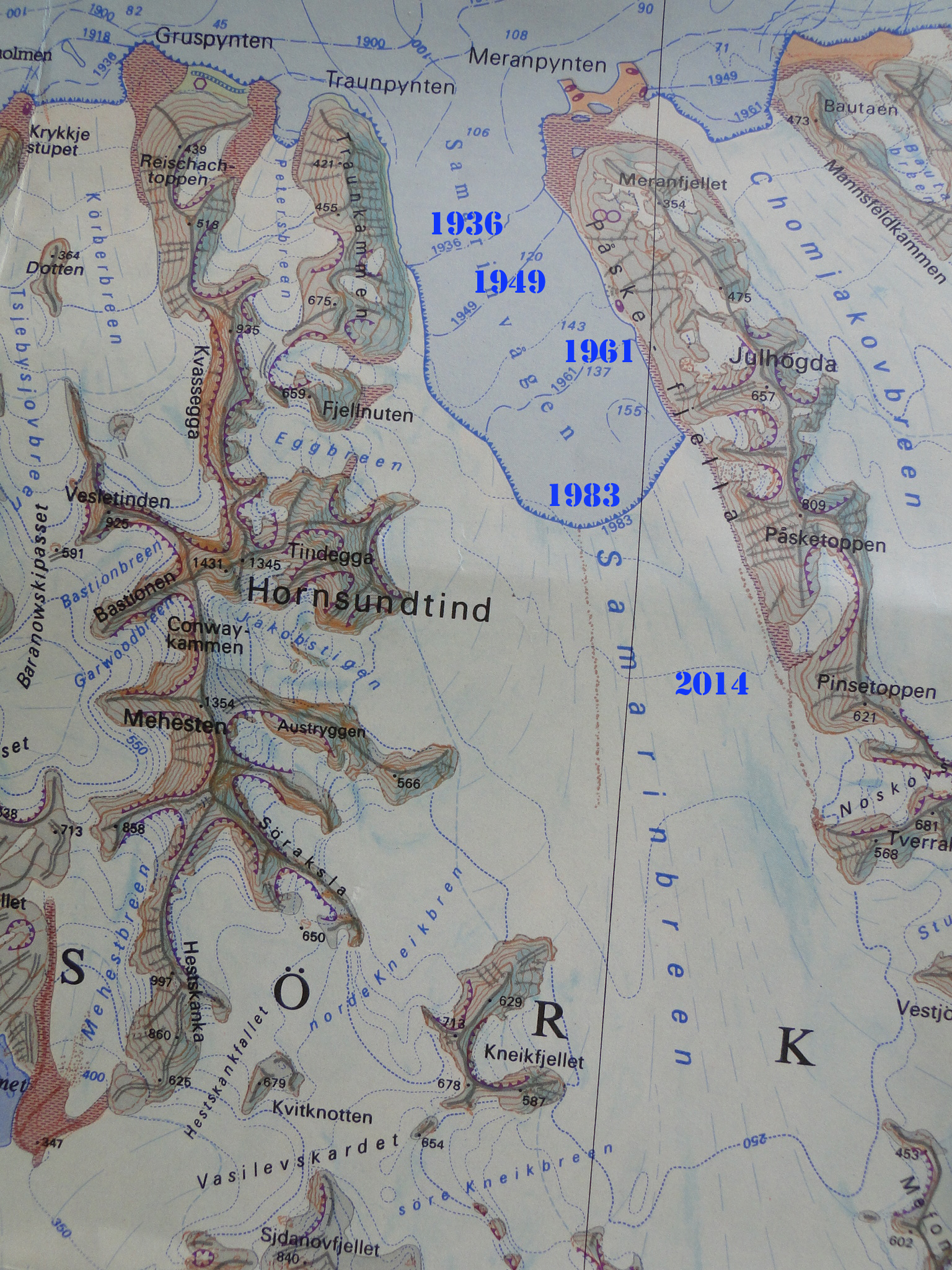
Samarinbreen retreat is documented by the map produced by the University of Silesia; 1936-1949 retreat equals 750 m, 1949-1961 retreat equals 1200 m, 1961-1983 retreat equals 1700 m. Landsat imagery from 1990-2014 illustrates that the retreat of the glacier has been 2.1 km. The 1990 terminus is indicated by the red arrow, and the 2014 terminus is the yellow arrow. The tidewater front shows limited icebergs from calving in all images I have reviewed, yet calving must be a key means of volume loss.   The snowline in 1990 is between 300 m in 1900. In 2014 the image is earlier in the melt season, but is at at 275 m.  The 2012 image of the terminus region illustrates the snowline again near 300 m. There is limited glacier area above 400 m, indicating the high snowfall and low melt rate of the region allowing a glacier to have such a low mean elevation. That the snowline is consistently so close in elevation to the highest section of the glacier indicates that mass loss will continue as will retreat.

samarinbreen silesia map

University of Silesia Map of Hornsund


saraminbreen image
Samrinbreen 2012 image from Topo Svalbard, red arrow indicates new island.

Olsokbreen Retreat, Svalbard

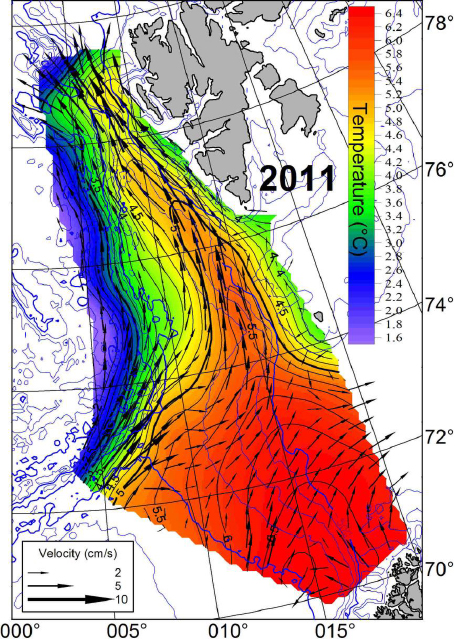
Svalbard is host to 163 tidewater glaciers with a collective calving front of 860 km (BŁASZCZYK et al, 2009). The southernmost of these glaciers on the west coast of Sørkappland is Olsokbreen, purple arrow. Olsokbreen has a 5 km calving front and its retreat was observed to have retreated 3.5 km from 1900-2008 (Zjaja et al, 2008). here we examine Landsat imagery from 2002 and 2010 and Geoeye from 2012 to illustrate a significant change in the ice front of Olsokbreen in the last ten years. The glacier has pulled back from a peninsula extending into the sound from the north side of the fjord that the glacier ended upon in 2002, red arrow. In the 2002 image the 2010 ice front is noted with a violet arrow as is an area of proglacial lakes that become more evident in 2010. In 2010 there are two images, indicating that relatively straight north-south calving front has become quite irregular during the 300-1100 meters of retreat along the ice front. The first image indicates the 2002 calving front (green line) and the snowline. The second image indicates the location of the proglacial lakes and the peninsula. The 2012 image is a Geoeye image and the main changes from 2010 is the extension of open water at the north side of the glacier between the terminus and the peninsula. This extends the calving front width and should increased calving. The southern edge has experienced more retreat since 2010 with the angular shaped calving embayment, green arrow. The Olsokbreen like the nearby Hambergbreen and Hornbreen is retreating and thinning.This glacier would seem to be particularly prone to impacts from warming water in the Barents Sea. In 2011 the ocean heat flux (Walczowski, 2011) passing Olsokbreen illustrates this. The sea ice off of Olsokbreen has also been exiting earlier as is evidenced in a recent image sequence from the Arctic Sea Ice Blog .