Baird Glacier, Alaska Terminus Tongue Breaks Off April 2024

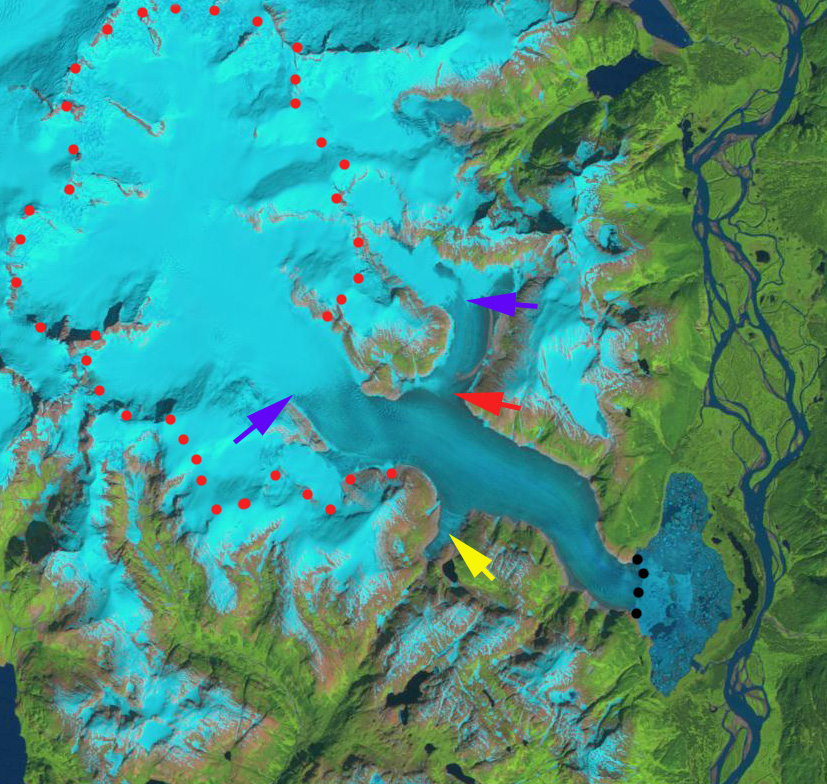
Baird Glacier terminus tongue gone in April 26, 2024 Landsat image. Red arrow indicates now joined 5 km2 proglacial lake. Yellow dots terminus of Baird and North Baird Glacier

Baird Glacier drains the west side of the Stikine Icefield in southeast Alaska. It is the only glacier of the Stikine Iceifield that did not retreat significantly from 1960-2010. Pelto et al (2013) predicted the onset of significant retreat of this glacier, which like Brady Glacier had been slow to begin retreat despite thinning that was evident when I visited the glacier in 1984. The proglacial lake that has emerged with retreat has an area of 3.25 km2 and the glacier retreat is 2800 m from 1990-2024. The North Baird Glacier separated from Baird Glacier in 2019, with a proglacial lake extending downvalley to the tongue of Baird Glacier that separated this lake from the Baird Glacier proglacial lake until April 2024.

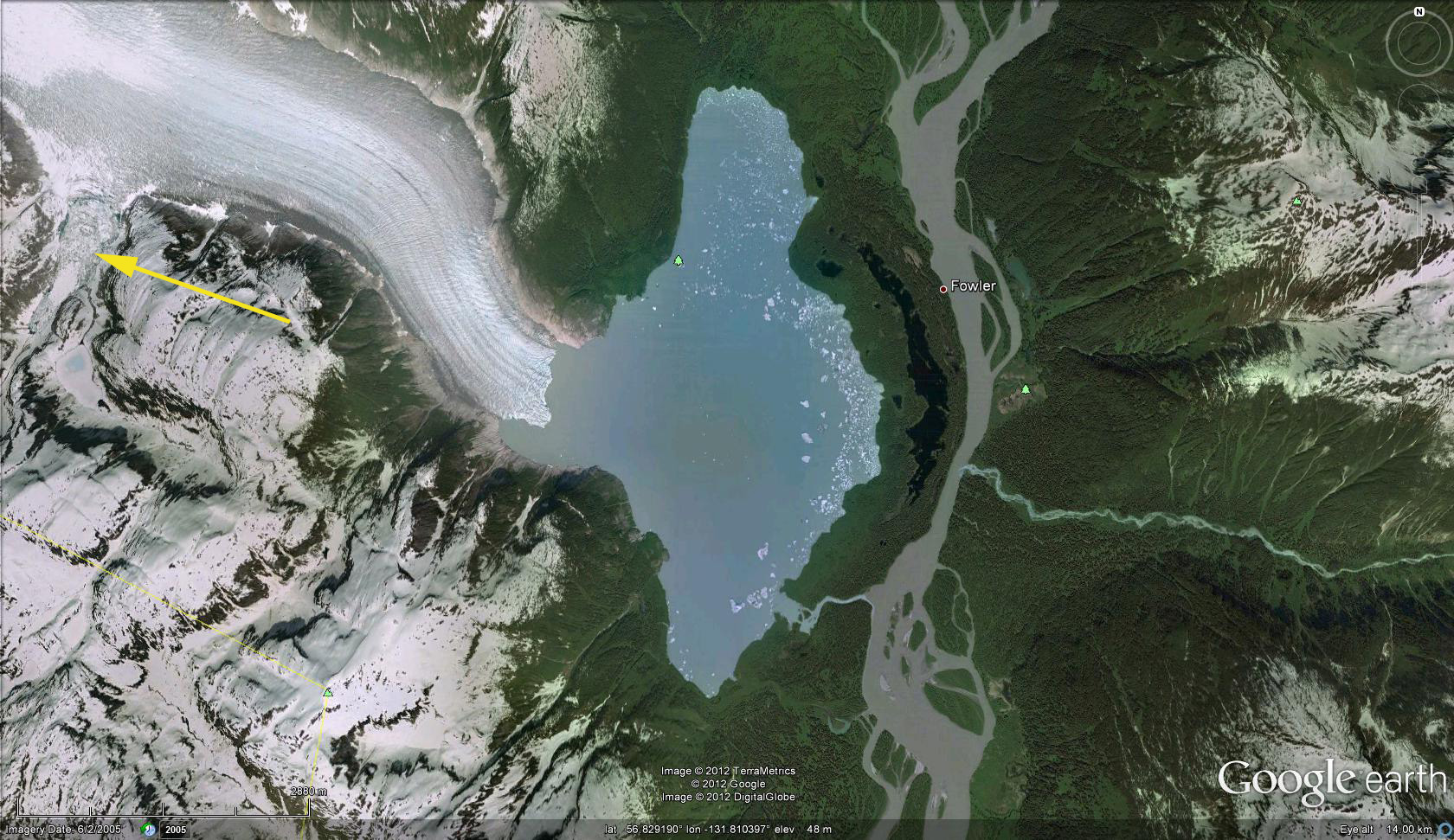
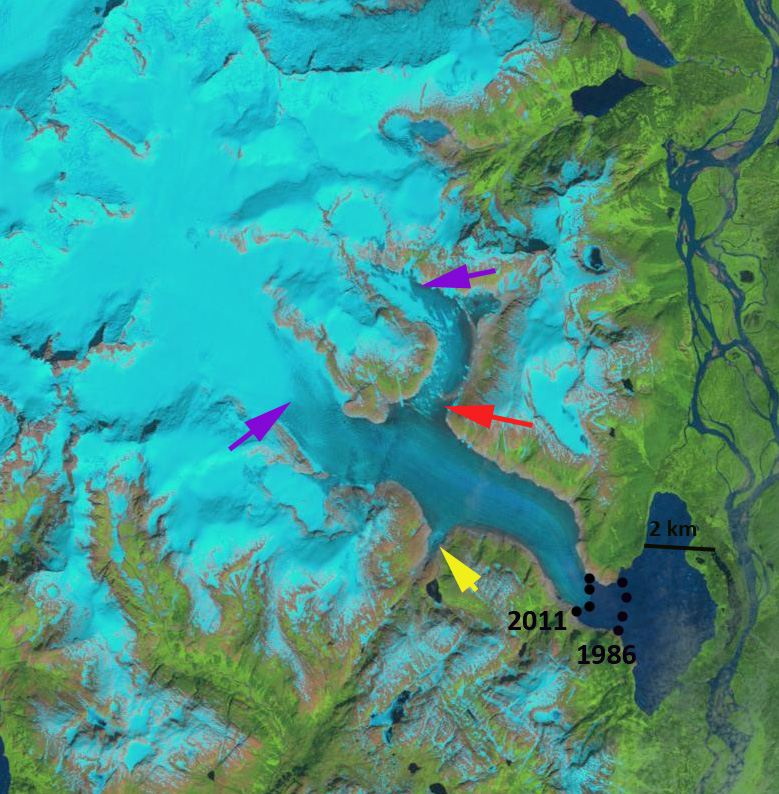
Baird Glacier in Landsat images from 1990 and 2023 illustrating retreat and proglacial lake expansion.
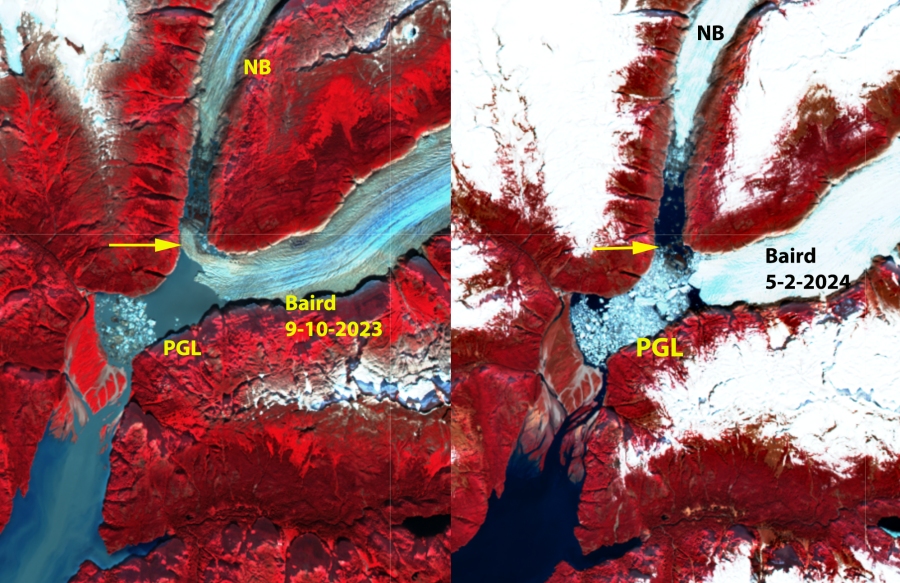
Baird Glacier in false color Sentinel images from September 10 2023 and May 2 2024. Proglacial lake (PGL) expanded from 3.2 to 5.1 km². Tongue extending upvalley toward North Baird Glacier (NB) broke up in late April, yellow arrow.

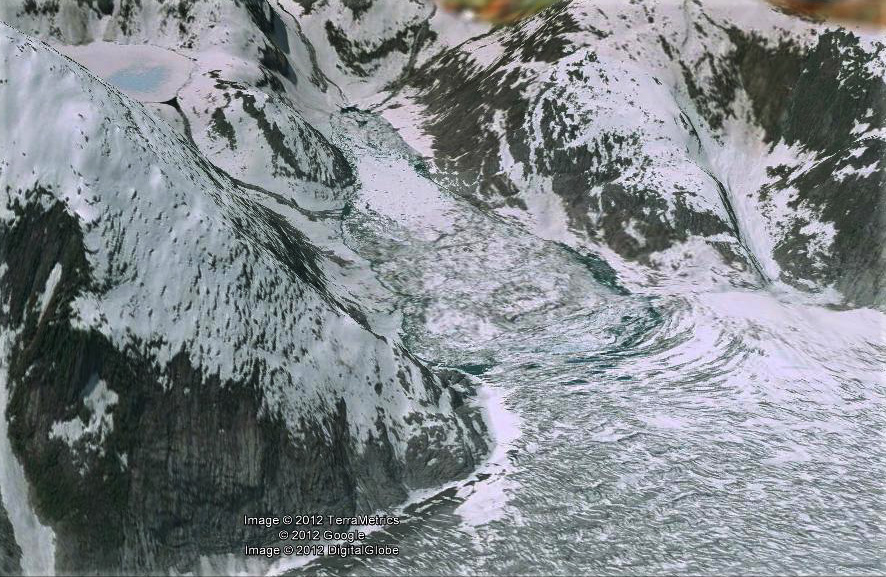
Baird Glacier in false color Sentinel images from July 2022 and July 2023. Proglacial lake (PGL) expanded from 3.00 to 3.25 km² width of tongue extending upvalley toward North Baird Glacier (NB) has declined from 700 m to 400 m.

In 1990 the Baird Glacier was sitting on an outwash plain, with no lake at the terminus. The North Baird Glacier was 1 km wide where it joined the Baird Glacier. By 2015 the glacier has retreated 750 m and the lake (PGL) has an area of ~1 km².  In 2022 the glacier has retreated leading to a lake expansion to 3.00 km². In July 2023 the tongue of ice extending across the front of the North Baird Glacier valley has thinned 40% since July 2022. The tongue remained throughout 2023 into April of 2024 before breaking up. This leaves the main terminus of the glacier more vulnerable to further rapid calving retreat. Baird Glacier is catching up to the rest of the Stikine Icefield that has experienced significant retreat, Dawes GlacierPatterson Glacier and Great Glacier. With Sawyer Glacier retreating from tidewater in 2023.

Dawes Glacier, Alaska Retreat Driven Separation

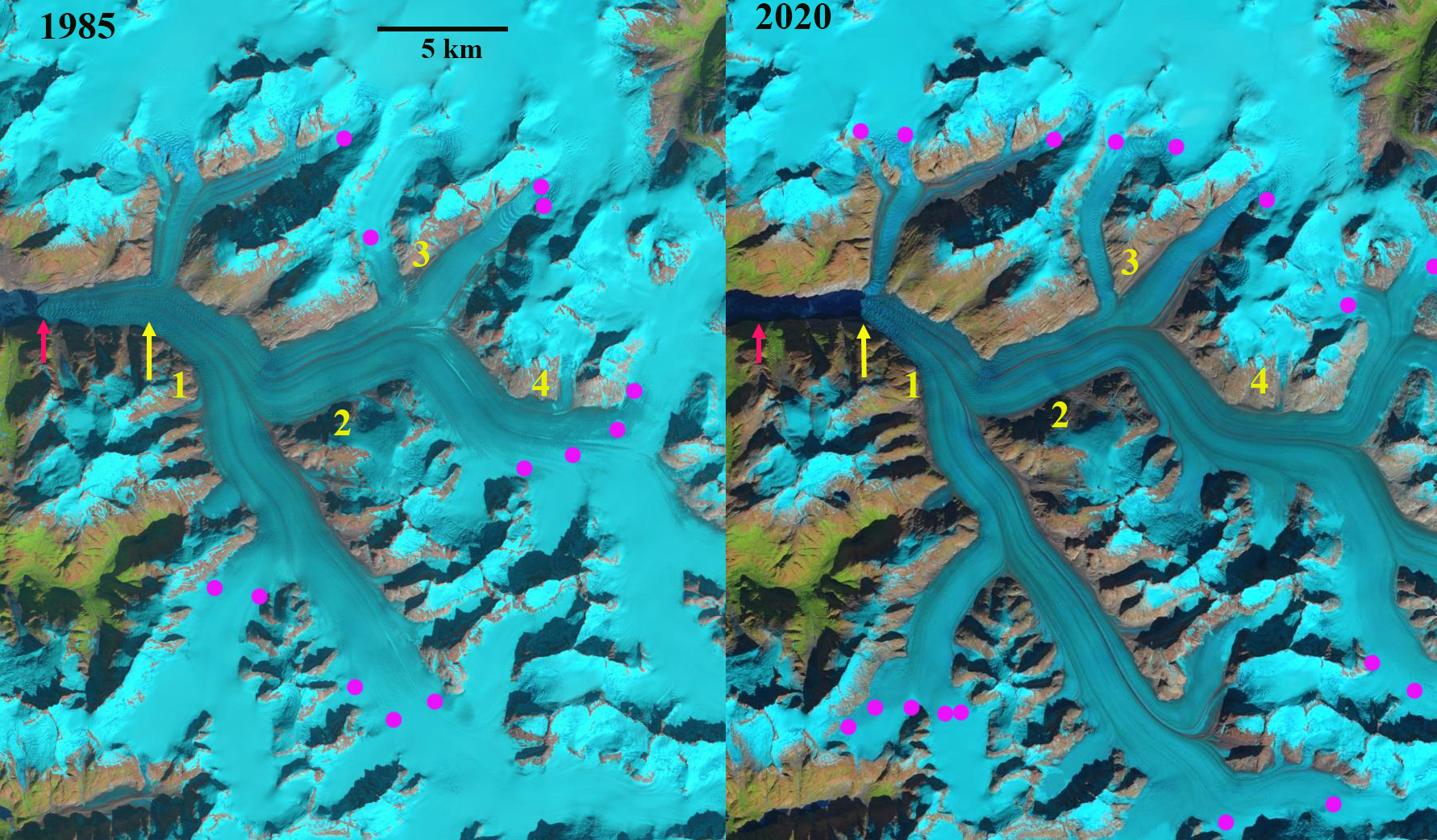
Dawes Glacier retreat in 1985 and 2020 Landsat images. Red arrow 1985 terminus, yellow arrow 2020 terminus. Point 1-3 are tributaries joining the main glacier. The glacier is about to separate into two calving termini.

Dawes Glacier terminates at the head of Endicott Arm in the Tracy Arm-Fords Terror Wilderness of southeast Alaska. Endicott Arm is a fjord that has been extending with glacier retreat, and is now  58 km long.  Dawes is a major outlet glacier of the rapidly thinning Stikine Icefield. Melkonian et al (2016) observed a rapid thinning of the Stikine Icefield of -0.57 m/year from 2000-2014.  Here we compare Landsat imagery to identify changes from 1985-2020. Endicott Arm is host to a population of harbor seals that prefer hauling out on icebergs during the day supplied by Dawes Glacier (Blundell and Pendleton, 2015)

In 1985 the glacier terminated at the red arrow in each image, the tributaries at points 1,2 and 4 connected with the main glacier. Point 3 is the junction point of two tribuataries. The northern arm is 1.3 km wide and the eastern arm is  2.5 km wide.  The snowline was at 1100 m.  In 1987 the snowline on the glacier was at 1150 m.  By 1999 the glacier had retreated 900 m since 1985 and the snowline was at  1300 m.  In 2019 the tributaries at Point 1, 2 and 4 have detached from the the main glacier. At Point 3 the northern arm has declined to 0.7 km wide and the eastern arm is  1.8 km wide.  In 2019 the snowline is at a record 1450-1500 m.This fragmentation of Dawes Glacier will continue, which leads to a reduced ice flux to the terminus reach. By 2020 Dawes Glacier has retreated 3.8 km since 1985, a rate of 105 m/year. The snowline is again exceptionally high at 1400-1450 m. Of equal importance the glacier terminus is separating into two individual calving termini, that could become fully separate this summer of 2021.

McNabb et al (2014) reported a thinning of 62 m/year from 1985-2013. The reduced inflow and up glacier thinning is ongoing and has driven the increased retreat rate despite a reduction in water depth at the cavling front. A key mechanism for retreat over the last century has been calving. The 2007 Hydrographic map of the area indicates water depth at the calving front still over 100 m, with a depth of 150 m 1 km down fjord of the terminus (see bottom image). The  depth more recently has declined to 60 m at the calving front in 2013 (Melkonian et al 2016), yet retreat has increased driven by enhanced melting. The glacier thinning is continuing, but the retreat rate will decline as the fjord head is approached.

At the glacier front the velocity was 13 m/day in 1985, increasing to 18 m/day by 1999 and declining to 5 m/day by 2014 (Melkonian et al 2016).

This reduction will reduce calving and iceberg production. As icebergs are reduced harbor seals will be disappointed as they prefer icebergs to haul out on. The Alaska Department of Fish and Game has been monitoring harbor seals in the fjord and noting that females travel to pup on the icebergs in the spring and also utilize them for mating.  ADFG attached satellite tags to harbor seals to monitor their movements beyond the breeding and puppin season finding  that that adult and sub-adult seals captured in Endicott Arm spent the late summer and fall months in Stephens Passage, Frederick Sound, and Chatham Strait. How will a reduction in icebergs affect this population overall?

The retreat leading to separation is also happening at other outlets of Stikine Icefield such as Baird Glacier and Sawyer Glacier.

Dawes Glacier retreat in 1985 and 2020 Landsat images. Red arrow 1985 terminus, yellow arrow 2020 terminus and purple dots the snowline. Point 1-4 are tributaries joining the main glacier.

Dawes Glacier retreat in 1985 and 2020 Landsat images. Red arrow 1985 terminus, yellow arrow 2020 terminus and purple dots the snowline. Point 1-4 are tributaries joining the main glacier.

Dawes Glacier in June 2021 Sentinel image. Indicating the impending separation of the terminus.

Hydrograh of Endioctt Arm from 2007.

Whiting River Headwater Glacier, British Columbia Separates into Four

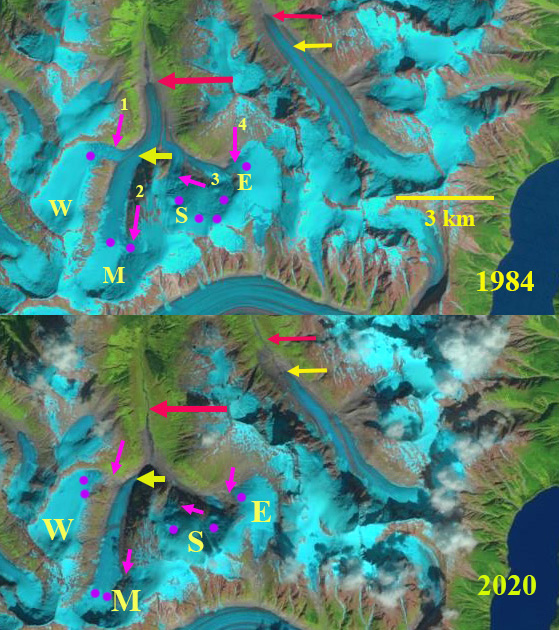
Whiting River headwaters glaciers in 1984 and 2020 Landsat images.  The red arrows indicate 1984 terminus positions, yellow arrow the 2020 terminus locations, pink arrows locations of glacier detachment and purple dots the snowline.

In Northwest British Columbia on the northeast side of the Stikine Icefield the Whiting Rver drains a series of glaciers, many unnamed.  Here we are focusing on a pair of glaciers just west of Whiting Lake the headwater of Whiting River, which is on the east margin of the Landsat images from 1984-2020. Glacier mass loss in the region has been extensive leading to substantial glacier recession. Melkonian et al (2016) dentified a mass loss for glaciers for Stikine Icefield of ~0.6 m year from 2000-2013 which is driving retreat.

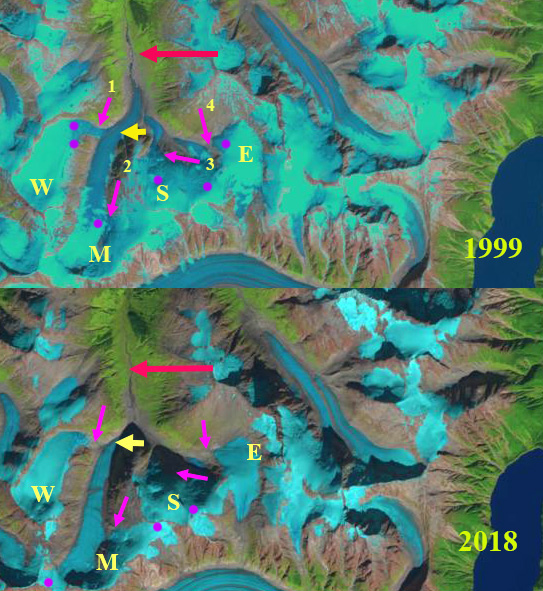
In 1984 the four branches of the westernmost glacier: west (W), main (M), south (S) and east (E) join together at ~900 m and the glacier flows downvalley to approximately 2 km to an elevation of 700 m.  The snowline is at 1250 m on the main branch. By 1999 the east branch has separated both from the south branch but also from the higher icefield at arrow #4. The snowline of the main branch is at 1300 m. By 2018 the west glacier has separated from the main branch at arrow #1, the south branch has also separated from the main branch near arrow #3. The four former tributaries are all separated.  The snowline in 2018 is the highest observed at 1550 m with a very limited accumulation area less than 10%, this year was a record high for the previous 70 years at nearby Taku Glacier. By 2020 the main branch has retreated 2300 m since 1984.  At arrow #2 there is a further detachment occurring from the east side accumulation are to the main branch. The eastern Whiting River Glacier has retreated 1250 m in this same period.

The retreat here is substantial in terms of the overall glacier length, and illustrates detachment as also noted for Farragut River, Alaska near the southwest corner of the Stikine Icefield. The retreat is less than that observed for the large outlet glaciers of Stikine Icefield such as South Sawyer, Dawes and Great Glacier. Whiting River is a remote and wild river that is host to six salmon species.


Whiting River headwaters glaciers in 1999 and 2018 Landsat images.  The red arrows indicate 1984 terminus positions, yellow arrow the 2020 terminus locations, pink arrows locations of glacier detachment and purple dots the snowline.

Glaciers Abandon Farragut River Valley, Alaska

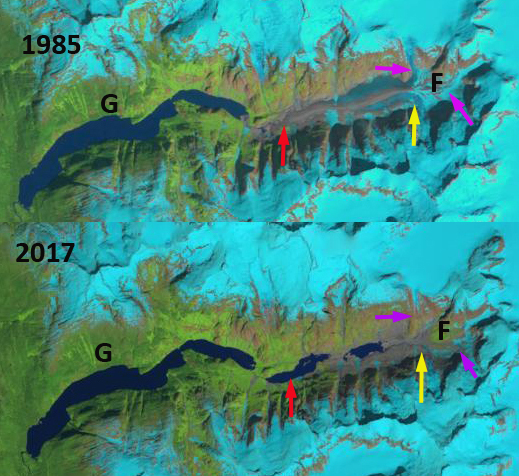
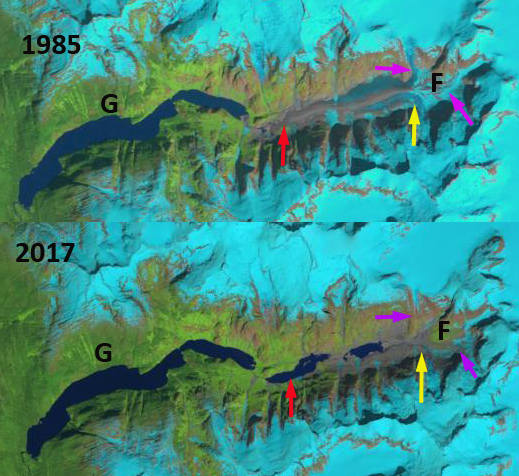
The Farragut Glacier  (F) in Landsat images in 1985 and 2017.  The red arrow indicates the 1985 terminus location, the yellow arrow the 2017 terminus location and the purple arrow, two tributaries in 1985 that now no longer connect to the former valley glacier. The glacier now terminates well short of Glory Lake (G) and two new lakes have formed. 

The Farragut River drains into Frederick Sound in Southeast Alaska.  The headwaters of this river in 1985 was a valley glacier, Farragut Glacier, fed by seven glaciers descending from peaks on the south wall of the valley or flowing down from the Stikine Icefield. The river is known for significant Pink and chinook salmon runs as well.  This valley is just to the north of Baird Glacier that has begun to retreat.

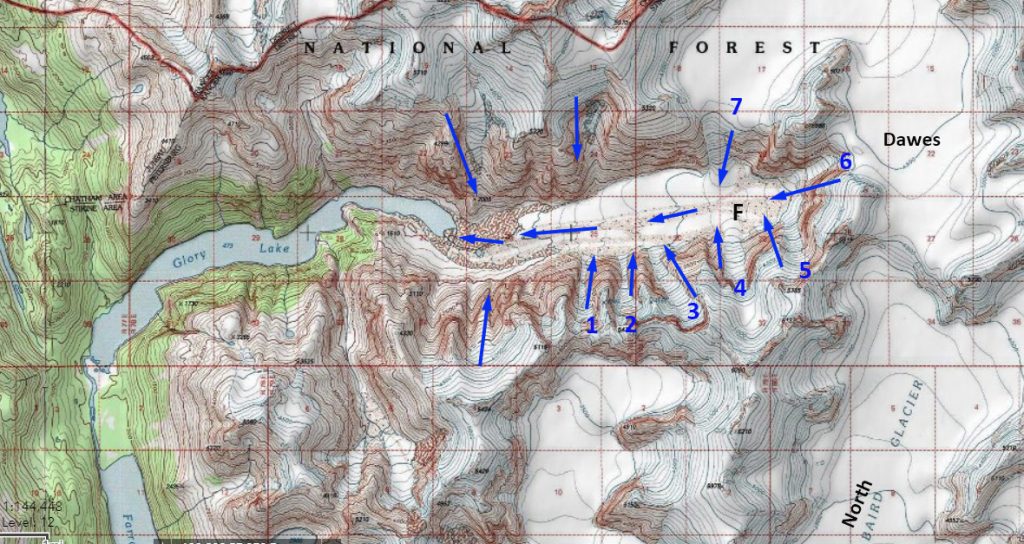
In the USGS map from 1975 there are seven glaciers that drain into the valley bottom contributing to the Farragut Glacier, see map below. The glacier at this time terminated in Glory Lake.  By 1985 the glacier had retreated 1.2 km from Glory Lake and was 7.2 km long. There was a medial moraine that had expanded in width and height indicating the glacier tongue was thinning rapidly. The overflow tributaries from Dawes and North Baird Glacier, purple arrows, still connected to the valley glacier.  By 1993 thinning and retreat had led to formation of a new lake.  The overflow tributaries from Dawes and North Baird Glacier no longer reach Farragut Glacier.  By 2016 vegetation there are two new lakes where the Farragut Glacier used to be.  New vegetation has developed where the tributary from Dawes and North Baird Glacier formerly joined the Farragut Glacier.  By 2017 there is only a single tributary that contributes to the Farragut Glacier, which occupies only a small segment of the valley floor.  The distance from this tributary to the terminus is 3.1 km.  The glacier has lost most of its length, six of its former glacier connections and two lakes have developed in 32 years of retreat and thinning.  The Farragut River valley has largely been abandoned by glaciers in the last three decades. The thinning and retreat is larger here than at Baird Glacier and Patterson Glacier

The Farragut Glacier  (F) in Landsat images in 1993 and 2016.  The red arrow indicates the 1985 terminus location, the yellow arrow the 2017 terminus location and the purple arrow, two tributaries in 1985 that now no longer connect to the former valley glacier.

USGS map indicating the seven glaciers that connect to make the Farragut Glacier in 1948.

Google Earth Image indicating the two lakes and the one tributary that reaches the Farragut River valley floor. 

Shakes Glacier Retreat-Tributary Separation, Alaska

Shakes Glacier drains the southern portion of the Stikine Icefield and terminates in Shakes Lake. It is between the more famous LeConte Glacier to the west and Great Glacier to the east. Larsen et al (2007) indicate recent thinning of 2-4 meters per year on the glaciers along the southern margin of the Stikine Icefield. Here we utilize 1985-2013 Landsat imagery to examine changes in this glacier. shakes overall

The USGS map of Shakes Glacier indicates the glacier turning the corner south along Shakes Lake. In each image the red arrow marks the 1986 terminus, the yellow arrow the 2013 terminus, the pink arrow a tributary from the east and the purple arrow a tributary from the west. shakes mapIn 1985 and 1986 the glacier has retreated onto the southeast trending arm of the lake ending at a deep gully on the west side of the lake, red arrow. The tributaries are still well connected to the glacier. By 1993 the glacier has retreated 300 m, the east tributary is still well connected, the west tributary at the purple arrow has considerably diminished. By 2003 the terminus has retreated 1.2 km from the 1985 position, the west tributary is just separating from the main glacier. The snowline is nearly at the top of the west tributary with a month left in the melt season. By 2011 a Google Earth image indicates the loss of connection with the west tributary and the disconnection on the east side which ends in a steep icefall slope. There is also a lake, green arrow just behind the terminus indicating impending rapid retreat will continue. The 2013 Landsat image the terminus has retreated 2.2 km from 1985, that is 78 meters/year. The lake is still evident behind the terminus. The continued significant retreat of Shakes Glacier matches that of other glaciers in the area Great Glacier, Baird Glacier, Patterson Glacier and Sawyer Glacier. shakes 1985
1985 Landsat image

shakes 1986
1986 Landsat image

shakes 1993
1993 Landsat image

shakes 2003
2003 Landsat image

shakes ge
2011 Google Earth image

shakes 2013
2013 Landsat image

Patterson Glacier Retreat, Southeast Alaska

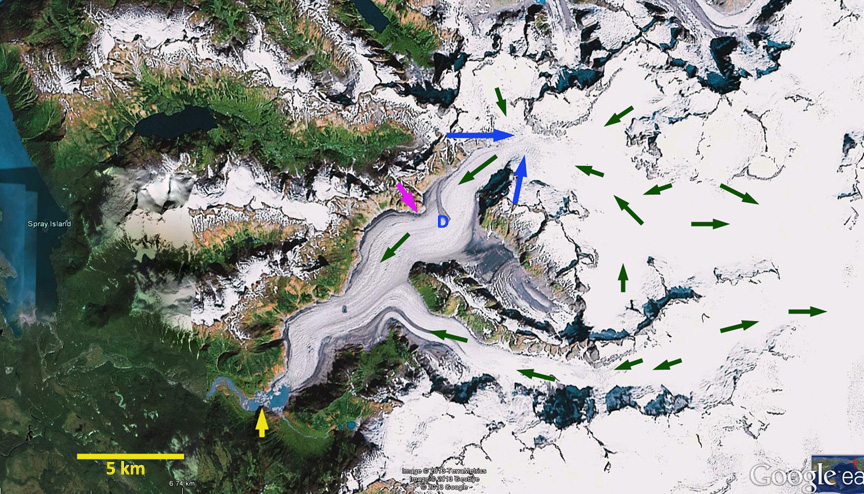
Patterson Glacier is a western outlet of the Stikine Icefield in southeast Alaska. The glacier does not reach tidewater it is 23 km long and has an area of about 100 km2. At the end of the 19th century, the terminus flowed both the east and the west, and was slowly advancing. William O. Field visited the glacier in 1941 and 1948 and found a 1.3 km retreat since the late 19th century. By 1979 the USGS noted a further 1 km of retreat. I saw the glacier enroute to the Juneau Icefield in 1984 and the lake at the terminus was still rather small. I talked to William O. Field right after that field season, he was convinced that all Stikine Icefield glaciers would be retreating more and we discussed Baird Glacier just to the north because it has not retreated yet, though it is showing signs now. In this post we examine the changes between 1985 and 2011 using Landsat imagery. Since 1984 frequent satellite imagery allows identification of the equilibrium line altitude (ELA), the snowline at the end of summer where accumulation equals ablation that year. The average ELA has been 1150 m, which given that the main accumulation zone ends at 1350 m is too high to maintain equilibrium. The green arrows indicate flow directions in the Google Earth image below. The yellow arrow the 1985 terminus, the red arrow the 2011 terminus, the blue arrows the snowline and the pink arrow a peninsula where a prominent debris band is located in 2011, that is also marked by the letter D. The debris band represents an avalanche that descended onto the glacier not too long before 1985. Glacier velocity is faster in the center and this fairly round debris will quickly become drawn down glacier faster in the center than at its edge, this had not notably occurred yet in 1985. patterson glacier ge A comparison of the 1985 Landsat image of Patterson Glacier and 2011 Landsat image indicate that the debris band (D) has shifted 3000 meters down glacier in 27 years, indicating approximately 110 meters per year velocity for the north side of the Patterson Glacier valley tongue. The terminus has retreated from the yellow to the red arrow a distance of 1200 meters, a rate of 45 m/year. The terminus lake is 2 km long in 2011. The 2011 terminus is quite narrow indicating the glacier maybe reaching the eastern end of this lake basin. A close up of the terminus area in Google Earth indicates the same features, orange arrows indicate the east and west flow at the terminus that was observed in the late 19th century. This glacier is responding very similarly to Speel Glacier, Great Glacierand Norris Glacier of the Juneau Icefield
patterson galcier 1985

patterson glacier 2011

patterson terminus

Great Glacier Retreat, Stikine Icefield, BC Canada

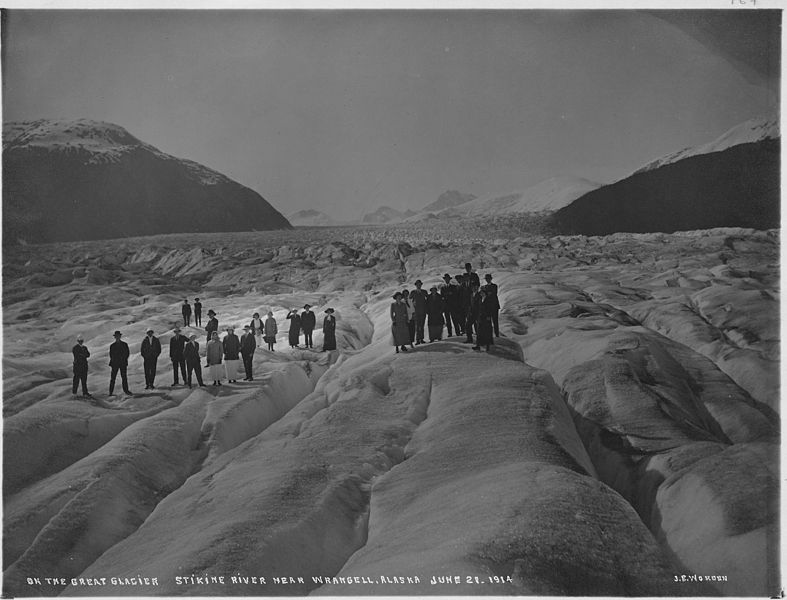
Great Glacier is the largest outlet glacier of the Stikine Icefield terminating in Canada. The name came from the large expanse of the glacier in the lowlands of the Stikine River during the late 19th and early 20th century, that has now become a large lake. The glacier filled what is now a large lake at the terminus of the glacier pushing the Stikine River to the east side of the valley. In 1914 the glacier was easy to ascend from the banks of the Stikine River, the picture below is from the National Railroad Archive. By 1965 the new lake had formed, but the glacier still reached the far side of the lake in several places as indicated by the 1965 Canadian Topographic Map, green arrows. A comparison of 1986 Landsat, 2005 Google Earth and 2011 Landsat imagery illustrates the retreat. The yellow arrow indicates a glacier dammed lake, the violet arrows the snowline and the red arrow the northeast tributary. By 1986 the new lake had largely developed, and the glacier was beginning to retreat into the mountain valley above the lake. Retreat from the moraines of the late 19th century was 3200 m. By 2011 the glacier had retreated further into valley, 900 m retreat from 1986-2011. Great Glacier is following the pattern of behavior of other Stikine Icefield glaciers such as Sawyer Glacier There is a glacier dammed lake that has to date changed little at the yellow arrow, this lake fills and drains under the glacier periodically, top image below. A view of the glacier from across the lake today indicates the distance to the now valley confined glacier, and the trimlines of the former ice surface, yellow arrows in middle image The Great Glacier has one major tributary on the northeast tributary that is very low in elevation with a top elevation of 800 m. Given the regional snowline of 1100-1200 meters (Pelto, 1987)this is too low to retain snowcover through the summer and will lead to progressive thinning. This branch of the glacier has and will thin faster than the rest of the glacier and is doomed given its limited top elevation. The proglacial lakes on its periphery will continue to grow as this downwastes, green arrow bottom image.