Baqupu Glacier, China Merging Supraglacial Lakes 1998-2020

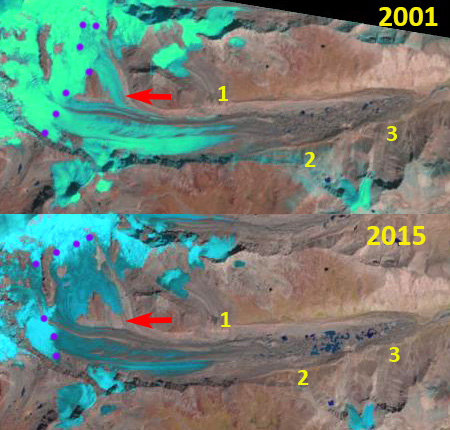
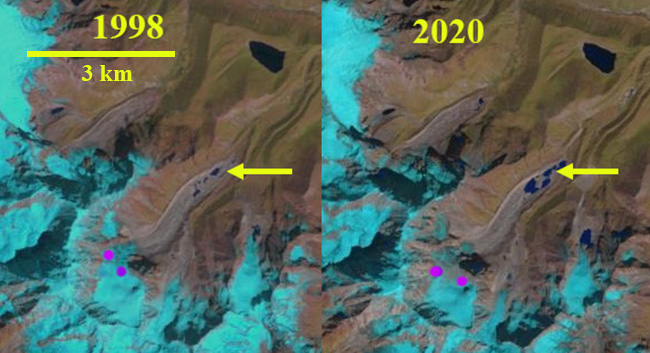
Baqupu Glacier in Landsat images from 1998 and 2020 indicating the expansion of supraglacial lakes in the terminus zone.  Purples dots indicate the snowline in October of each year.

Baqupu Glacier is in the Poiqu River watershed in southern Tibet, China.  The Poiqu River becomes the Bhote Koshi as it crosses into Nepal before joining the Sun Koshi River. The terminus of the glacier extending from 4500-4800 m is debris covered. An icefall extends from 4800-5300 m, above which the accumulation zone extends up to 5900 m. Shrestha et al (2010) examined the risk of a glacier lake outburst flood in the Sun Koshi basin from a Lumichimi Lake further north in the Poiqu Basin.  They identified the potential for damage to the  45 MW Bhote Koshi Hydropower Plant.  A  July 2016 GLOF in the basin did in fact severely damage the Bhote Koshi Hydropower Plant. In a 2020 ICIMOD report (Bajracharya et al 2020) inventory of glacial lakes and potentially dangerous ones in the Koshi, Gandaki and Karnali Basin’s was updated. In the Sun Koshi Basin they mapped 181 lakes with an area of over 0.02 km2 with four being potentially dangerous lakes. The developing Baqupu Lake is not listed as potentially dangerous.

In 1998 Baqupu Glacier features a 0.03 km2 network of small supraglacial ponds at its surface at ~4500 m.  The snowline is near the top of the icefall at 5200 m in October.  By 2000 some evident expansion of the ponds is evident.  The snowline in October is again near the top of the icefall at 5200 m.  By 2018 there are four substantial ponds that have nearly coalesced. In 2019 the ponds have coalesced into two lakes.  The snowline is just above the icefall at 5300 m.  In 2020 the supraglacial lake system has an area of 0.24 km2.  Average area of  glacial lakes in basin is 0.12 km2 (Bajracharya et al 2020). The snowline is above the icefall at ~5400 m.  The persistent equilibrium line above the icefall during this period is reducing the flux through the icefall to the debris covered tongue.  The tongue is increasingly stagnant and the thinning will lead to continued lake expansion into what will be a proglacial lake.  This expansion is similar to that on Rongbuk Glacier, while other nearby lakes have had expanding proglacial lakes, Drogpa Nagtsang Glacier and Yanong Glacier.

.Ya
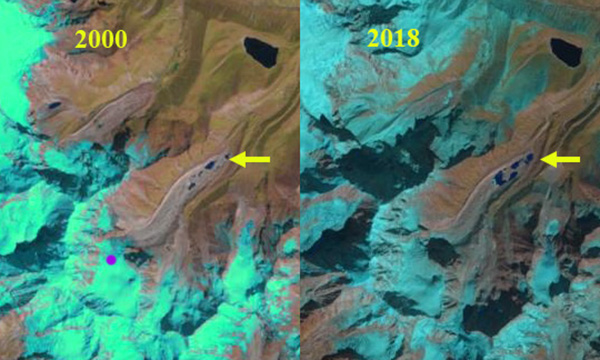
Baqupu Glacier in Landsat images from 2000 and 2018 indicating the expansion of supraglacial lakes in the terminus zone.  Purples dots indicate the snowline in October of each year.

Baqupu Glacier in Digital Globe image from 2019. A=Accumulation zone; D=Debris cover, I=Icefall, S=Supraglacial lake. 
Lapche Glacier, China Supraglacial Ponds Transitioning to Lake

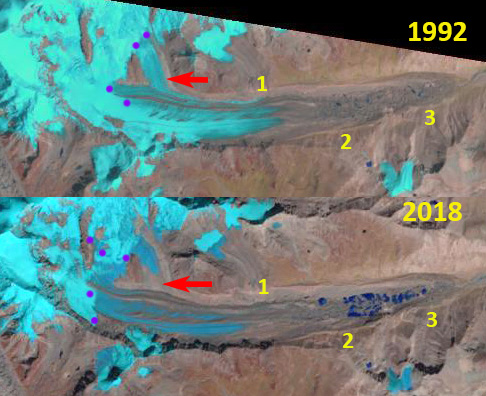
Lapche Glacier (Tibet 1), China in 1992 and 2018 Landsat images.  The expansion of supraglacial ponds is evident between Point 2 and 3. A tributary that detaches between 1992 and 2018 is indicated by red arrow.  The end of the clean ice and start of debris cover ice is just below Point 1 in 1992 and well above this Point in 2018. 

Lapche Glacier (Tibet 1), China flows east from Lapche Kang (Lobuche Kang) in the Bum Chu River Basin. King et al (2017) examined the mass balance of 32 glaciers in the Everest region for the 2000-2015 period including the Lapche, which they called Tibet 1, and found a mass loss of ~0.5 m/year, with the loss of lake terminating glaciers at ~-0.7 m/year.  King et al (2017) also observed that a number of these glaciers had nearly stagnant tongues with coalescing and expanding supraglacial ponds. Here we examine the expansion of the supraglacial ponds from 1992 to 2018 using Landsat images.

The lower four kilometers of Lapche Glacier in 1992 is relatively flat with the terminus at 5100 m and four kilometers upglacier at just 5200 m. In this stretch there are several small isolated supraglacial ponds between Point 2 and 3.  At Point 1 is the end of the clean ice section of the glacier, with debris cover obscuring the underlying ice below this point. There is a tributary joining the glacier at the red arrow. In 2001 the snowline is at 5600 m, and there are a few more supraglacial ponds, but with a total surface area under 0.1 square kilometers.  In 2015 the tributary at the red arrow has detached and the area covered by ponds has expanded and now cover ~0.5 square kilometers.  The snowline in 2015  is at 5650-5750 m. In 2018 the supraglacial ponds have largely coalesced, and have an area of ~1.0 square kilometers.  These lakes are on the verge of creating one larger lake as has happened on Rongbuk Glacier .  The debris covered portion of the glacier now begins above Point 1, 1 km upglacier of its 1992 location.  The snowline in 2018 is at 5650-5750 m.

King et al (2018) indicate a velocity of less than 10 m/year in the lower 5 km of the glacier, essentially stagnant.  Point 1 is just over 6 km above the 1992 terminus. The retreat here is difficult to discern, but with the proglacial lake development it will soon be identifiable and in line with that of other glaciers in the area Duiya and Yanong.   Zhang et al (2010) observed the loss of glacier area and lake expansion in the region from 1976-2006 driven by warming.

Lapche Glacier (Tibet 1), China in map view.  Point 1-3 same as in images, ice flow indicated by blue arrows, elevation contours labelled at 51oo and 5200 m. Debris cover beginning noted at DC.

Lapche Glacier (Tibet 1), China in 2001 and 2015 Landsat images.  The expansion of supraglacial ponds is evident between Point 2 and 3. A tributary that detaches between 2001 and 2015 is indicated by red arrow.