Arnesenbreen, Svalbard Retreat, Separation and Surge

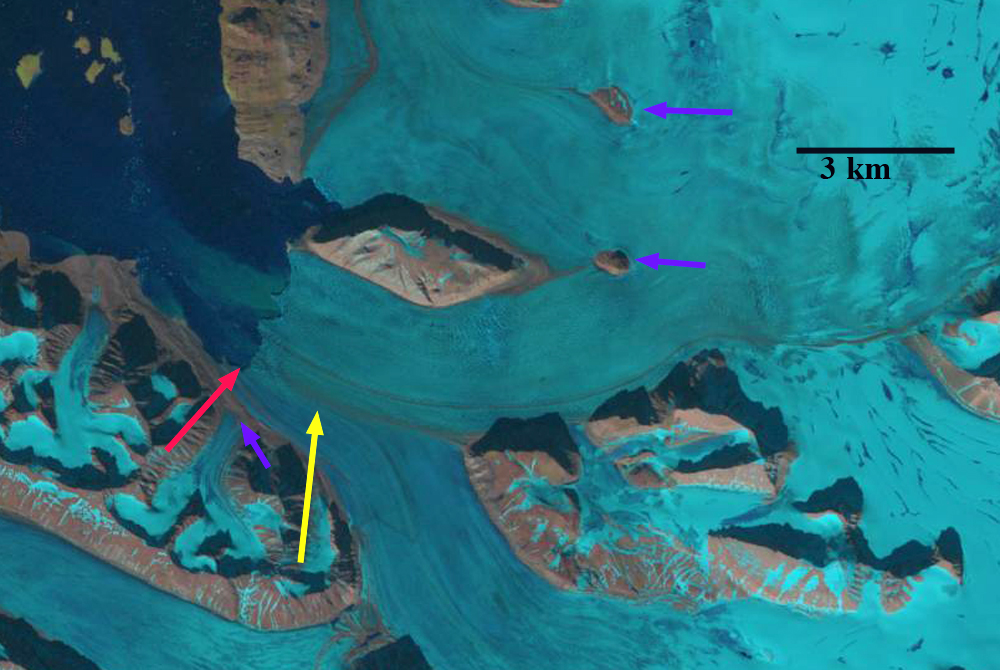
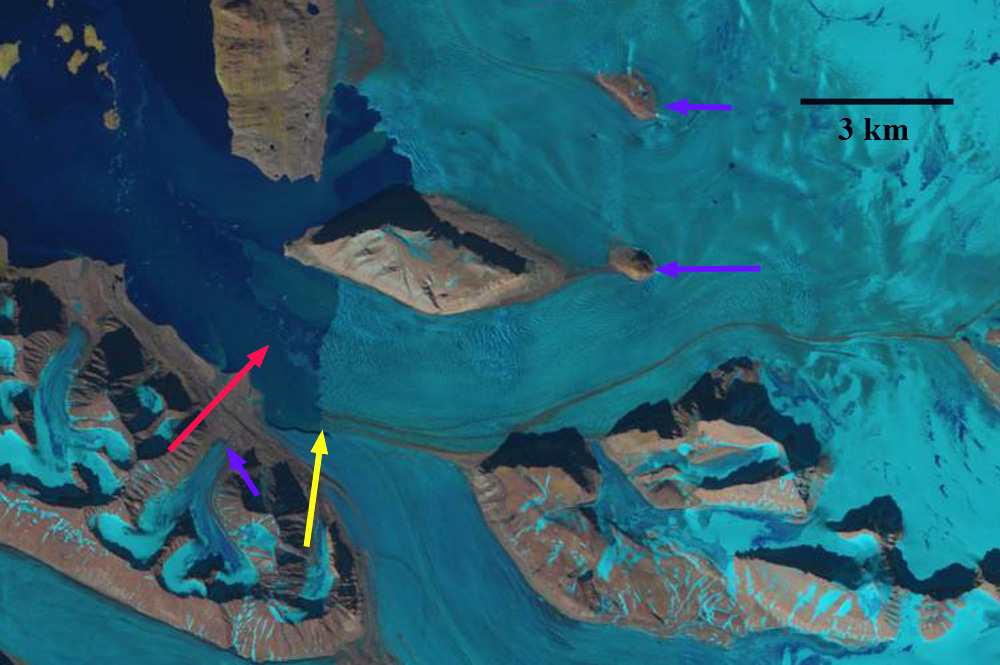
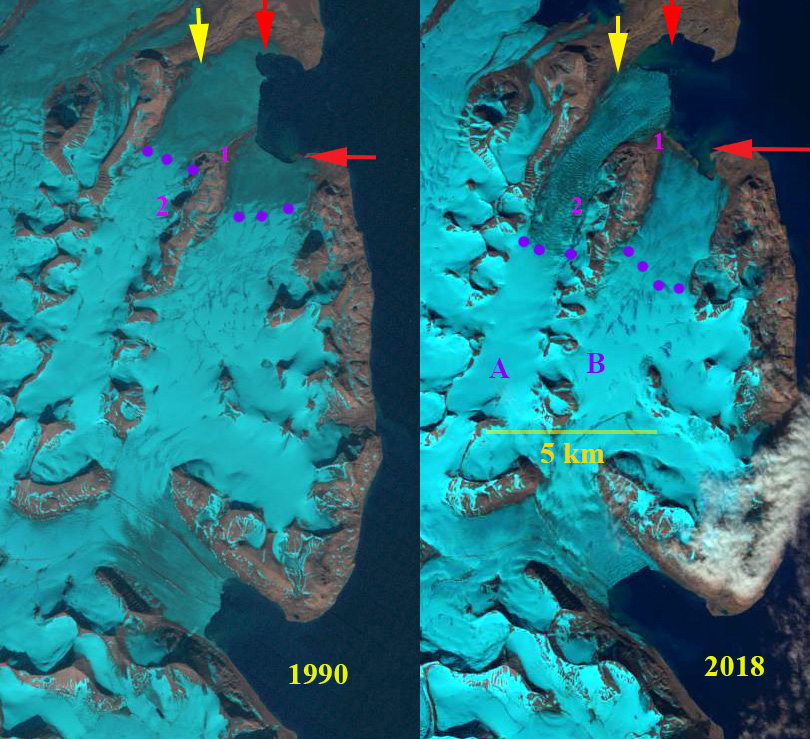
Arnesenbreen (A) and Bereznikovbreen (B) in 1990 and 2018 Landsat images.  Red arrow is 1990 terminus location, yellow arrow the 2018 terminus location and purple dots the transient snowline.

Arnesenbreen and Bereznikovbreen are glaciers in Svalbard on the east coast of Spitsbergen that in 1990 had a joint calving front near Kapp Murchison. Blaszczyk et al’s (2009) analysis identified 163 Svalbard glaciers that are tidewater with the total length calving ice−cliffs at 860 km for the 2001-2006 period. They observed that 14 glaciers had retreated from the ocean to the land over the last 30–40 year period. Some of these are surging glaciers, which are common in Svalbard.  Arnesenbreen was observed to surge in the 1930’s and in 2018 a surge was observed that was initiated from its terminus, which is a more unusual type of surge (Holmund, 2018).  Sevestre et al (2018) document mechanisms that help generate terminus initiated surges, include tidewater retreat from a pinning point and/or crevasses allowing meltwater rainwater to access the bed. The surge generated considerable crevassing that extended from the tidewater terminus to an elevation of 300 m, 5 km inland of the terminus. Here we examine the behavior of these glaciers using Landsat imagery from 1990-2018.

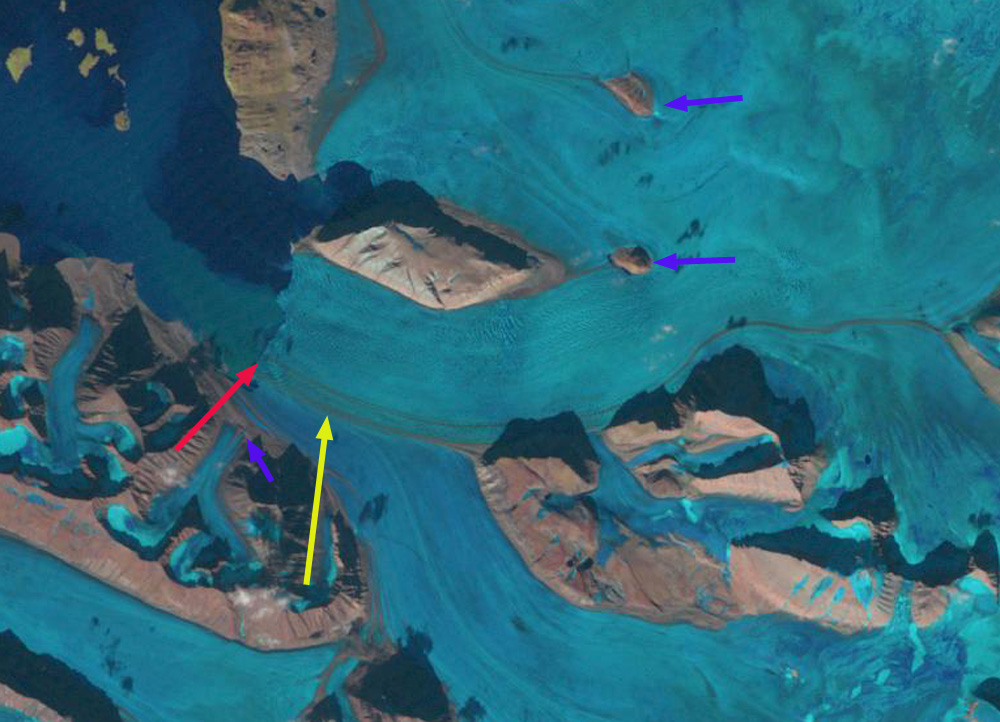
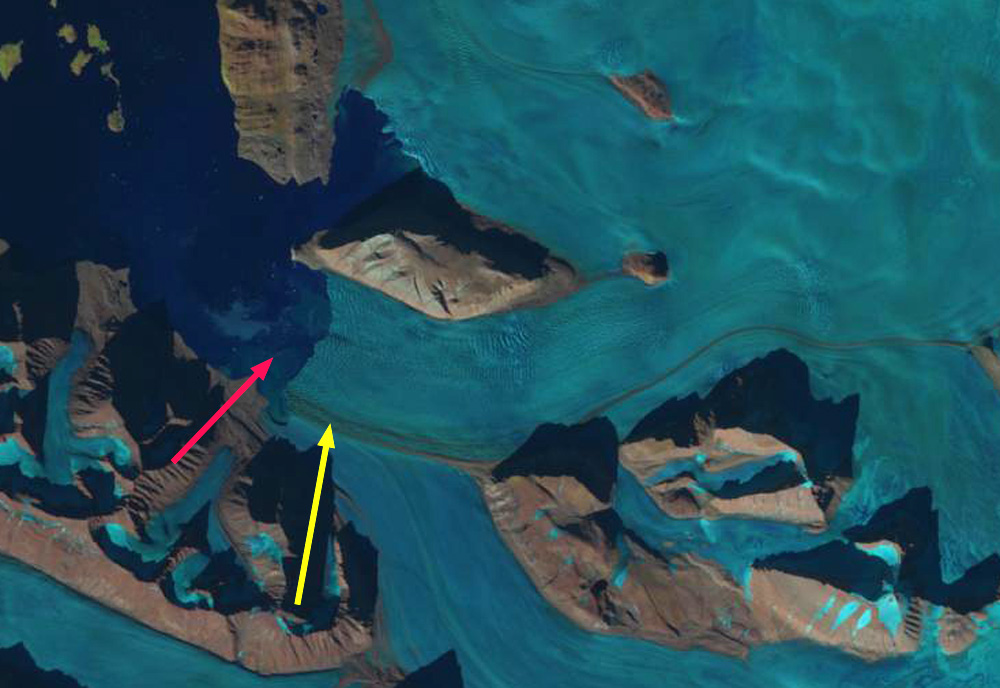
In 1990 Arnesenbreen-Bereznikovbreen had a shared 5 km long tidewater front. The transient snowline in this July image is at 200 m. The glacier terminus reach is not extensively crevassed.  In 2002 the two glaciers are separating at Point 1 each having retreated ~400-500 m, crevassing remains limited.  The transient snowline in 2002 is at 300 m. By 2014, Arsenenbreen has retreated 1400 m since 1990 and crevassing remains limited.  The transient snowline is at 300 m, though there is a saturated zone of snowpack above this line, that suggests extensive melt up to 500 m.  In 2018 the surge crevassing was most apparent in the April image of Holmund (2018).  On June 30 the extensive crevassing is still evident, particularly in the 200-250 m elevation band near Point 2, but is reduced from April in the terminus zone near Point 1.  By July 21 the image indicates much reduced calving in the terminus zone of the glacier.  Sevestre et al (2018) note a pattern of terminus initiated surge progression, “Upward migration of the surge coincided with stepwise expansion of the crevasse field.” This is exactly what is seen at Arnesenbreen, we are also seeing the surge terminating with calving reduction at the terminus first.  The short lived nature of the surge indicates the limited impact on the longer term retreat. The surge did not lead to a reconnection with Bereznikovbreen. Bereznikovbreen has retreated 700-800 m since 1990 and Arnesenbreen has retreated ~1500 m from 1990-2018.

The ongoing retreat here is like that of Svalbard glaciers in general including surging glaciers (Nuth et al 2013).  Strongbreen Glacier has separated from key tributaries. The ongoing retreat has prompted the question on other surging Svalbard glaciers, can the glaciers continue to surge? On Fridtjovbreen it appears a future significant surge is unlikely.  For Arnesenbreen the terminus reach below 150 m is where the glacier expands laterally and is an area of reduced slope.  This configuration remains and would allow further surges unless further retreat of more than ~1500 m occurs.
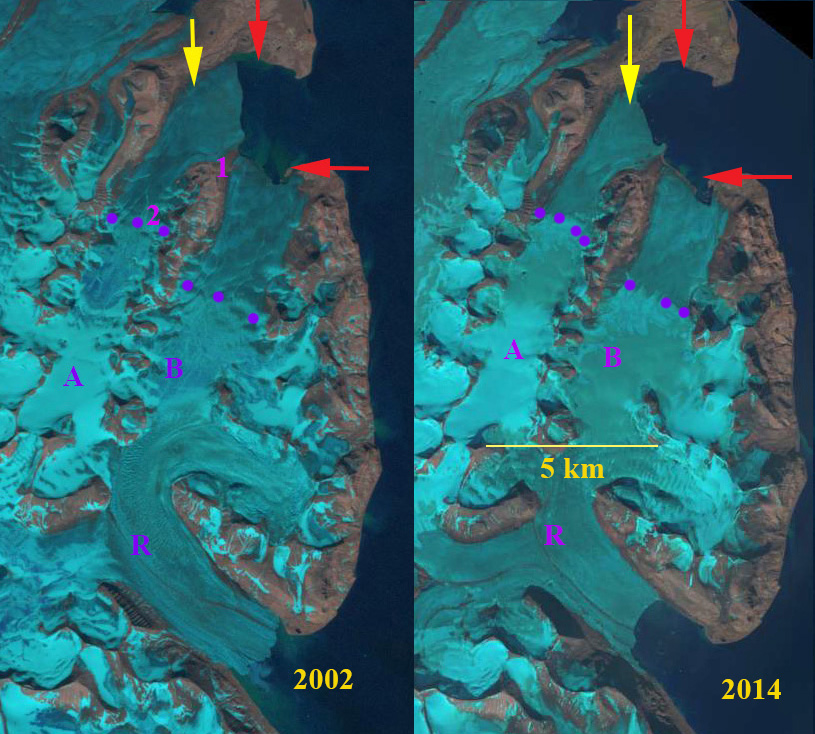
Arnesenbreen (A) and Bereznikovbreen (B) in 2002 and 2014 Landsat images.  Red arrow is 1990 terminus location, yellow arrow the 2018 terminus location and purple dots the transient snowline.
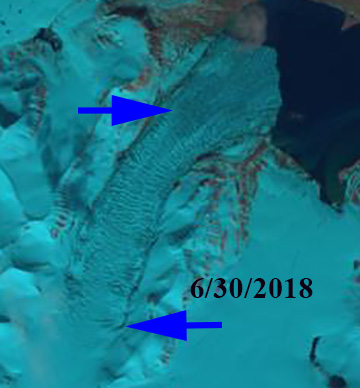
Arnesenbreen in Landsat image from6/3/2018 indicating zone of most extensive crevassing.
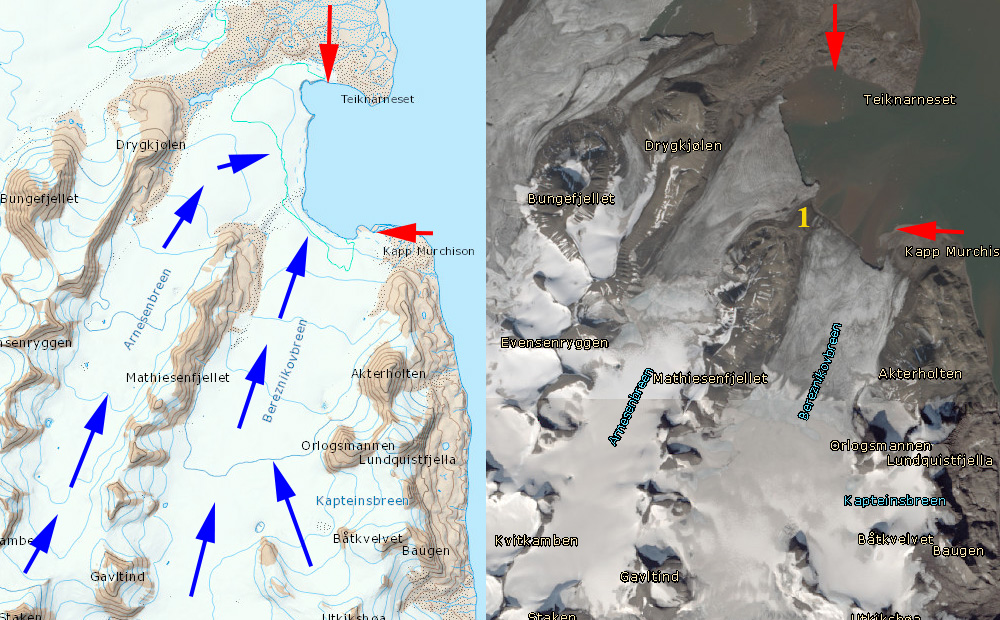
Arnesenbreen (A) and Bereznikovbreen (B) in Toposvalbard map and recent Landsat imagery from Toposvalbard.
Kronebreen and Kongsvegen, Svalbard Initiation of Glacier Separation 2015

kronebreen terminus2
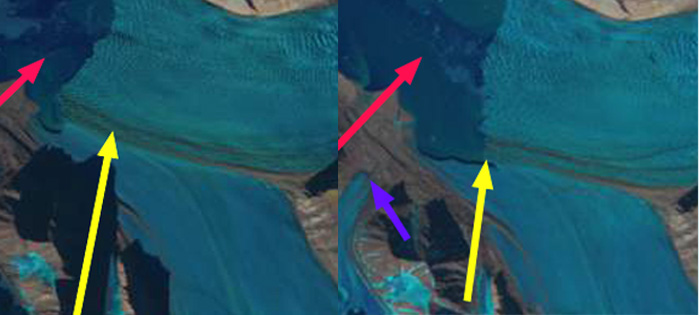
Kronebreen terminus in 2013 (left) and 2015 (right), note the configuration change and separation initiation of Kronebreen and Kongsvegen at yellow arrow.
Kronebreen is a large, (450 km2) tidewater glacier on the northwest coast of Svalbard terminating in a shared terminus with Kongsvegen at the head of Kongsfjorden.  Changes in 2015 indicate the shared terminus will not continue.  Luckman et al (2015) observed Kronebreen has a winter speed of 1.5–2 m/day, with summer peaks of 3–4 m/day associated with positive air temperatures and periods of high rainfall.  The terminus of the glacier was relatively stable from 1990 to 2001 with even a slight advance at the end of that period (Trusel et al, 2010).  The fjord lacks a significant sill at its mouth resulting in significant connectivity with water masses of the West Spitsbergen Shelf, including Atlantic Water  Trusel et al, 2010). This aspect during summer can aid in frontal ablation and terminus retreat as noted in Figure 2a from Luckman et al (2015). Shellenberger et al (2014) observed that the period of Kronebreen stability ended in 2007 and that the glacier retreated 850 m and lost 2.1 square kilometers from 2007-2013. Long term they observed that the ablation loss of the terminus reach increased from 0.14 Gt per year from 1960-1990, to 0.20 Gt per year from 1990-2007 and was 0.21 Gt per year in 2013. The University Centre in Svalbard has established a set of cameras for time lapse work at the terminus, which is fortuitous given the changes that have occurred recently. In 2015 returning in the spring University Centre in Svalbard researchers noted the thinning and stretching of the terminus reach: Doug Benn, Penelope How, Heidi Sevestre and Nick Hulton. Penelope How examines the deployment of the cameras in 2015. Here we examine Landsat images to provide a snapshot of the changes that the above researchers have examined in detail.konebreen map
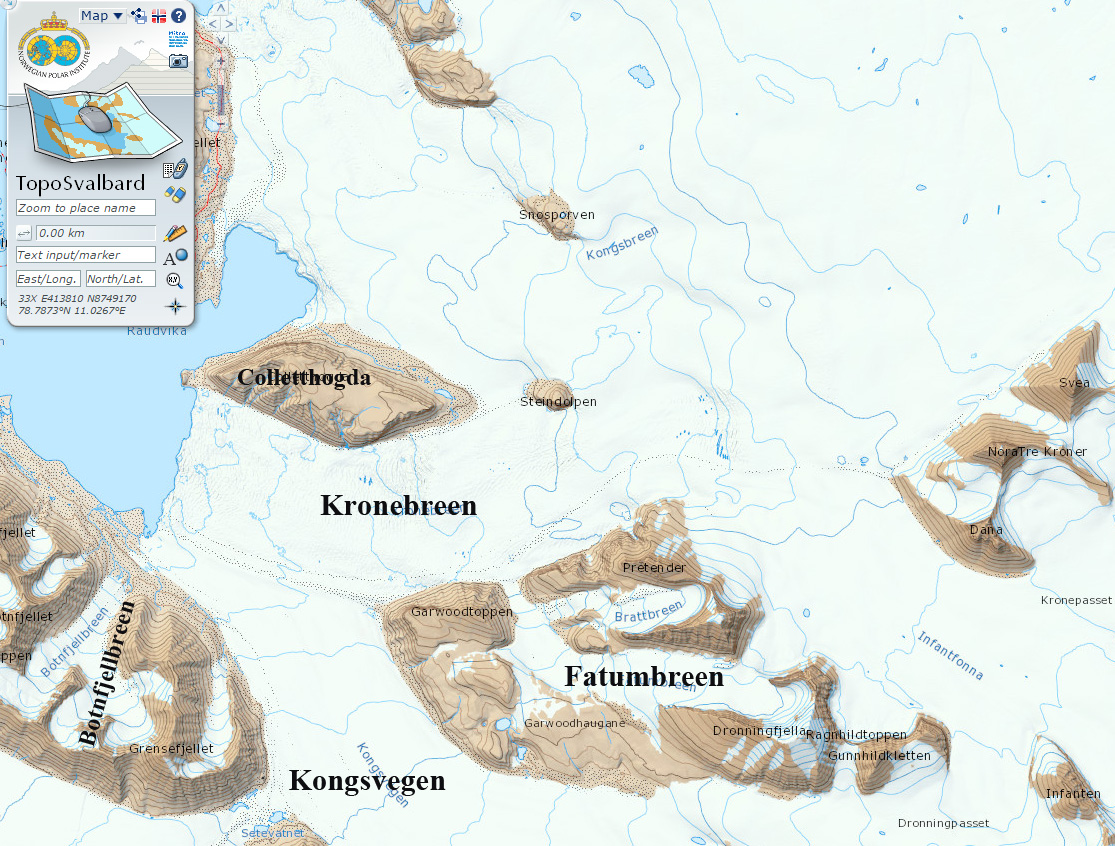
Map of Glacier front from TopoSvalbard.
In 1987 the joined front terminated near the western tip of Colletthogda, red arrow. The purple arrows indicate locations for comparison to 2015 of glacier thinning. By 1998 there has been a small retreat, that will be erased by a small advance the following years. I 2011 the front remains a single linear front, the greater level of crevassing of Kronebreen is evident as well as the shallower water on the southern margin of the fjord the Kongsvegen terminus. In 2013 a larger retreat has begun, the calving front is concave with more retreat on the southern, Kongsvegen side of the terminus. In 2015 substantial changes have occurred. The front of Kronebreen has retreated 1200 m on the northern margin since 1998 and 1500 m on the southern lateral moraine, this is 300-500 m since 2013. The most striking element is the right angle turn in the calving front at the lateral moraine with Kongsvegen. This is not a stable configuration. This represents the initiation of the separation of Kronebreen and Kongsvegen. The weakness along which the process is taking place is the lateral moraine. Kronebreen terminates in deeper water and can retreat more rapidly via calving. This retreat has been driven by enhanced ablation both at the surface and by the ocean. The higher velocity of Kronebreen is clear in the video of the glacier from the University Center of Svalbard. The process of separatiion is a trend in Svalbard note Samarinbreen.and Vasilievbreen.kronebreen 1987
1987 Landsat image

kronbreen 1998
1998 Landsat image
kronebreen terminus ge 2014
2011 Image from TopoSvalbard, note the differenence in level of calving between Kronebreen and Kongsvegen.

kronebreen 2013
2013 Landsat image

kronebreen 2015
2015 Landsat image