Otemma Glacier Retreat & Snowline Rise, Switzerland

Otemma Glacier is in the Upper Rhone River watershed and feeds Lac de Mauvoisin. Climate change is altering this glacier, with terminus change not being the main story it is the rising snowline and separation from tributaries. The lake fed by the glacier is impounded by Mauvoisin Dam one of the 10 largest concrete arch dams in the world. The reservoir can store 200 million cubic meters of water. The dam provides hydropower and protection against natural hazard. In 1818, an advance of the Gietro Glacier, now retreated high above the reservoir, generated ice avalanches which blocked the flow of the river. When the ice barrier was breached, 20 million cubic meters of flood water was released devastating the valley (Collins, 1991).There are several other large glaciers in the basin Gietro, Mont Durand and Brenay that provide runoff to power what is today a large hydropower project. The Mauvoisin Dam can produce 363 MW of power.

Otemma Glacier is one of the glaciers where the terminus is monitored annually by the Swiss Glacier Monitoring Network (SCNAT). Here we examine changes in this glacier from 1985 to 2014 including changes in the terminus, snowline elevation and tributary connection during this period using Landsat Imagery. SCNAT reports that the glacier retreated at a rate of 27 m/year from 1985-1999, to 40 m/year from 2000-2014.
otemma glacier gearth
Google Earth view of the glacier indicating glacier flow direction.

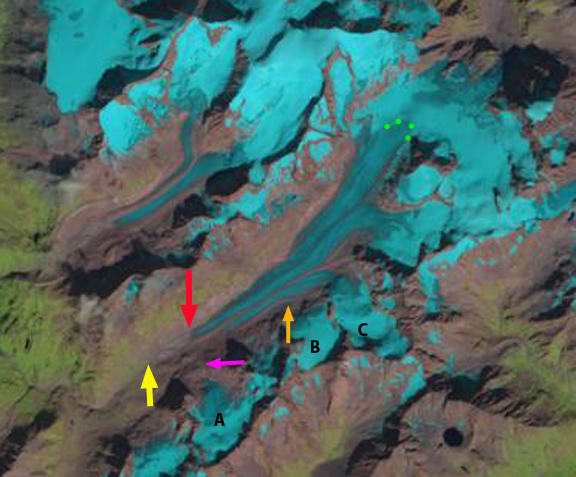
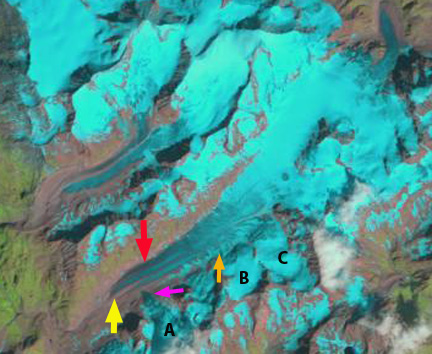
In 1985 the glacier terminates at the yellow arrow, with tributaries A,B & C all joining the main glacier. The snowline is at 2800 m, green dots. In 1988 the snowline extends to the divide with Bas Glacier d’Arolla at 3050 m. In 1999 the snowline also extends to the divide with Glacier d’Arolla. Tributary A no longer connects to the glacier, pink arrow, and the terminus has retreated 300 m.

By 2013 Tributary B is also detached from the main glacier (orange arrow). The terminus has retreated to the red arrow a distance of 1010 m over the thirty year period. The snowline in 2013 and 2014 almost reaches the divide with Bas Glacier d’Arolla with a few weeks left in the ablation season. The area of persistent snowcover is thus restricted to the region above 3050 m. This region is not large as the Bas Glacier d’Arolla captures most of the upper basin. That the snowline is consistently reaching the highest divide for this large glacier is noteworthy. The retreat of the large valley tongue of Otemma Glacier will remain rapid given the consistent high snowlines indicative of limited retained accumulation. Even with current climate not much of the Otemma Glacier can survive. The rising snowline is observed on most glaciers including nearby Rutor Glacier, Italy.
otemma 1985
1985 Landsat Image
otemma 1988
1988 Landsat Image
otemma 1999
1999 Landsat Image
otemma 2013
2013 Landsat Image
otemma 2014
2014 Landsat Image

Mittelaletsch Glacier Retreat, Switzerland

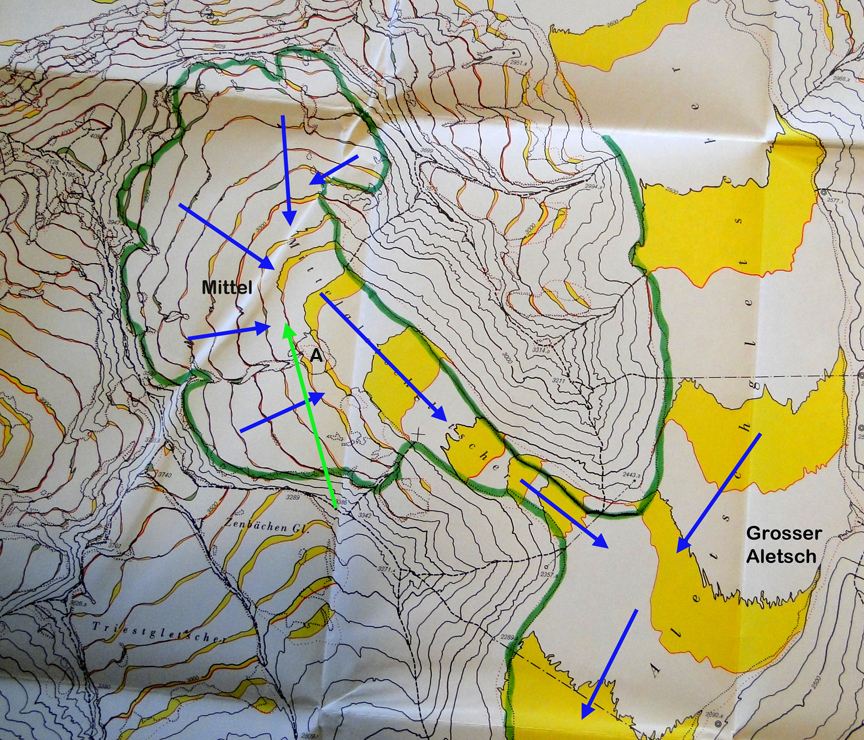
Mittelaletsch Glacier was a tributary to the Alps largest glacier Grosser Aletsch, until separation in 1990. The map of the glacier represents changes in the glacier from 1926 to 1957, indicating the connection of the two glaciers at that time. By 1970 Mittel had separated from Grosser, and experienced 420 m of retreat from 1970 to 2000 as noted by the Swiss Glacier Monitoring Network. mittel 1957
Map showing 1957 glacier extent with elevation changes from 1926 in yellow.

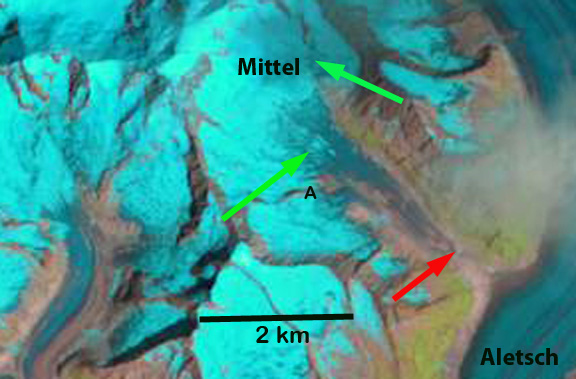
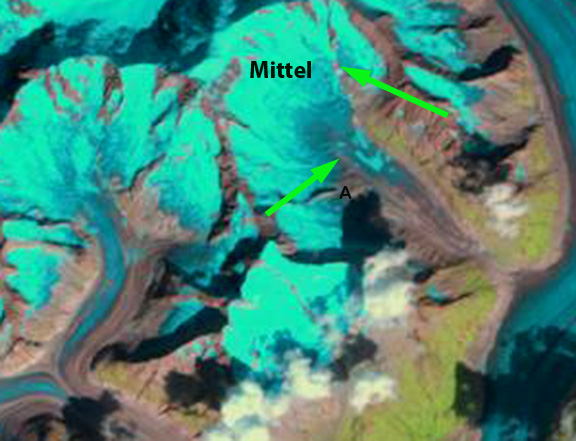
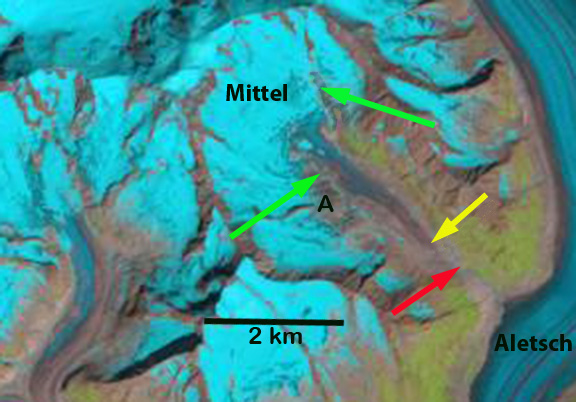
Here we examine changes in the glacier using Landsat imagery from 1990 to 2013. In each image an upper and lower green arrow point to the same location where expanding bedrock areas are separating the upper and lower portion of the glacier. Point A is at the lower end of a prominent rock rib. In 1990 the glacier ends at the red arrow separated from Grosser Aletsch by 600 m. At the lower green arrow the glacier is flowing across this slope contributing snow and ice to the lower glacier. In 1999 the area of exposed bedrock between the upper and lower glacier has expanded by at least 500 m at both green arrows. By 2007 Google Earth imagery indicates a continued expansion at the lower green arrow. The glacier terminates at the yellow arrow 1050 m from a connection to the Grosser Aletsch Glacier. The lower 1 kilometer of the glacier is stagnant as seen in the closeup view of the terminus, pink arrow indicates start of stagnant section. In 2013 the glacier has retreated 1400 m from the Grosser Aletsch Glacier, terminating at yellow arrow versus 1990 terminus red arrow. The margin of the Grosser Aletsch has contracted 150-200 m, hence the actual retreat since separation is 1200-1250 m. By 2013 at the lower green arrow the bedrock strip separating this section of the upper and lower glacier has expanded to a length of 1 km. This is equivalent to a company losing income from an important division, or a family losing one income stream. The lower glacier is recieving less snow and ice contribution and will continue to retreat, quickly loseing the stagnant area the comprises the lowest 700-100 m of the glacier. Jouvet et al (2011) reconstruct the behavior of the Aletsch Glacier system to various climate scenarios and find that any scenario leads to 2 km of retreat by 2040 for Grosser Aletsch and somewhat less for Mittelalestch. This glaciers behavior is similar to that of nearby Gauli and Oberaar. mittel 1990
1990 Landsat image

mittel 1999
1999 Landsat image

mittelaletsch ge
2007 Google Earth Image

mittelaletsch profile
2007 Google Earth image

mittel 2013
2013 Landsat image

Ried Glacier Rapid Glacier loss, Switzerland

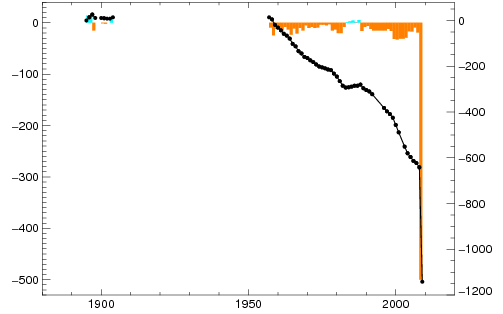
Ried Glacier is beneath the Durrenhorn in the Pennine Alps of Switzerland. The glacier was 6.3 km long in 1973. In 2010 the glacier is 5.1 km long. From the Swiss Glacier Monitoring Network annual measurements, Ried Glacier retreated 300 m from 1955-1990, 8 meters/year. From 1990-2008 retreated an additional 300 m, 30 m/year. Than in 2009 the glacier retreated 500 m. A comparison of a 2004 image taken by M. Funk and a Sept. 2008 image from D. Gara indicate why the change was so abrupt. The glacier had been retreating upvalley with a long gentle terminus tongue. This section of the glacier separated from the glacier in late 2008, with the terminus now ending on a steep rock slope. There is still stagnant ice in the valley below the end of the current glacier. It is heavily debris covered and no longer connected to the glacier system. This glaciers recent rapid retreat parallels that of Dosde Glacier, Italy and Triftgletshcer, Switzerland and Rotmoosferner, Austria. A look at the glacier system and the terminus in Google Earth imagery provides a broader view of the glacier behavior. The terminus in this image still extends downvalley with the low sloping tongue that is now separated. Current terminus marked with red-T.
In the imagery above the glacier is still connected to the terminus tongue. It is evident that the glacier has two primary icefalls at that time. The upper icefall is the location of the annual snowline, where accumulation tends to persist throughout the year. Below this point only seasonal snowfall is retained. The retreat history from the Swiss Glacier Monitoring Network is seen below.