Basodino Glacier, Switzerland Mass Balance Loss & Hydropower

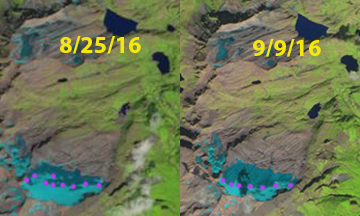
Basodino Glacier in August and September of 2016 illustrating the upward shift of the snowline in the 15 days between the Landsat (left) and Sentinel (right) image. purple dots mark snowline. 

Basodino Glacier is a small northeast facing slope glacier in the southern Swiss Alps.  The glacier is in the Ticino River watershed and supplies the Robiei Hydropower system. The glacier is in the same basin as Cavagnoli Glacier, which is fading away. The main branch presently covers an area of 1.8 km2 and extends from 2562 to 3186 m.  In 1973 the glacier had an area of 2.3 km2 .  Detailed mass balance investigations have been carried out since 1990.  During this period the glacier has lost more than 11 m w.e. thickness.  In seven years from 1980-2014 the glacier has had an AAR below 10 (Bauder, 2016).  This is indicative of minimal retained accumulation and not a consistent accumulation zone (Pelto, 2010) .  Huss (2012) noted that mean glacier mass balance in the European Alps was −0.31  m w.e./ year from 1900–2011, and −1 m w.e. /year over the last decade.  For Basodino Glacier the loss during this enite period averaged ~-0.2 m w.e./year (Huss, 2012).  The glacier advanced 95 m from 1967-1986 and has retreated 260 m since, front observations are completed and submitted by Claudio Vallegia of Ticino, Sezione Forestale (Swiss-ETHZ, 2016).

Water from glacier melt  is channelled to the Robiei-Zött reservoirs and hydro plants, generating enough electricity for a city. The Cavagnoli and Naret reservoirs at 2310 m feed the Robiei power station, situated 400 m below. The Robiei power station is also capable of pumping the water from the Robiei-Zött up to the higher Cavagnoli-Naret reservoirs.

Basodino Glacier in late August of 2016 had 5-60% of the glacier still in the accumulation zone. two weeks later on Sept. 9, 2016 the glacier had 35% of the glacier in the accumulation zone.  This is the accumulation area ratio, which needs to be above 55% for equilibrium.  For Basodino Galcier 2016 will be another year of mass balance loss and retreat.  The detailed monitoring will provide specific values for each reporting to the Swiss Glacier Monitoring Network system and the WGMS.

[ngg_images source=”galleries” container_ids=”48″ display_type=”photocrati-nextgen_basic_imagebrowser” ajax_pagination=”1″ template=”/nas/wp/www/sites/blogsorg/wp-content/plugins/nextgen-gallery/products/photocrati_nextgen/modules/ngglegacy/view/imagebrowser-caption.php” order_by=”sortorder” order_direction=”ASC” returns=”included” maximum_entity_count=”500″] 

Findelengletscher, Switzerland Retreat & Hydrology Insights from David Collins

findelen compare

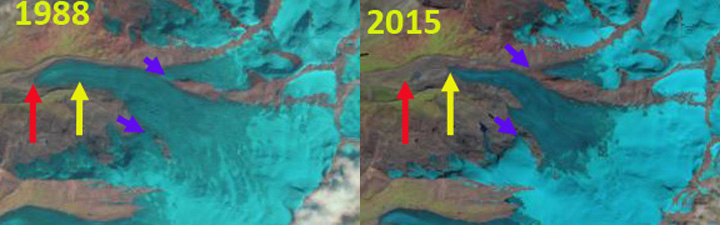
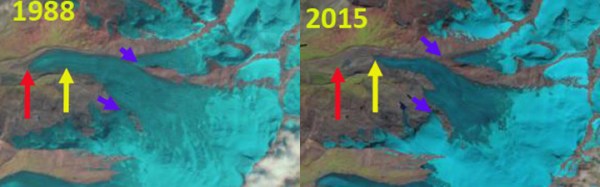
Landsat image comparison of Findelengletscher from 1988 to 2015. Red arrow indicating the 1988 terminus location and yellow arrow the 2015 terminus location.  The purple arrows indicate two tributaries connected to the main glacier in 1988 and now disconnected.

Findelengletscher along with Gornergletscher drains the west side of the mountain ridge extending from Lyskamm to Monte Rosa, Cima di Jazzi and Strahlhorn in the Swiss Alps.  It is the headwaters of the Matter Vispa.  This glacier was also the favorite field location for David Collins, British Glaciologist/Hydrologist from University of Salford who passed away last week. David had a wit, persistence and insight that are worth remembering. This post examines both David’s findings reaching back to the 1970’s gained from a study of glaciers in this basin and changes of the glacier since 1988 as evident in Landsat images. Findelengletscher drains into the Vispa River which supports for hydropower project, with runoff diverted into two hydropower reservoirs, Mattmarksee  operated by the Kraftwerke Mattmark producing 650 Gwh annually, and Lac de Dix operated by Grande Dixence that produces 2000 Gwh annually. There are two smaller run of river projects as well.

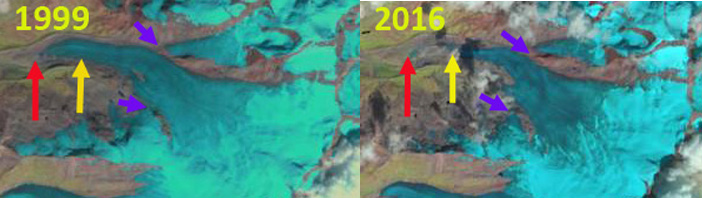
The Swiss Glacier Monitoring Network has monitored the terminus change of Findelengletscher since the 1890’s.  The glacier advanced 225 m from 1979-1986, retreated 450 m from 1988-1999 and retreated 850 m from 1999-2015. This is illustrated above with the red arrow indicating the 1988 terminus location and the yellow arrow the 2015 terminus location.  The purple arrows indicate two tributaries connected to the main glacier in 1988 and now disconnected.  The more limited retreated from 1988-1999 is evident in images below. The retreat is driven by mass losses with Huss et al (2012) noted as 1 m/year in the alps from 2001-2011. The snowline has typically been above 3250 m too high for equilibrium in the last decade. Melt at the terminus has typically been 7-8 m (WGMS).

Collins (1979) in work funded through hydropower looked at the chemistry of glacier runoff and found that glacier meltwater emerging in the outlet stream was enriched in Calcium, Magnesium and Potassium in particular versus non-glacier runoff, this led to a much higher conductivity. Collins (1982) noted the reduction in streamflow below Gornergletscher from summer streamflow events that reduced ablation for up to a week after the event. Collins (1998) noted that  a progressive rise of the transient snow line in summer increases the snow-free area, and hence the area of basin which rapidly responds to rainfall. Rainfall-induced floods are therefore most likely to be largest between mid-August and mid-September and in this period of warmer temperatures and higher snowlines. Collins (2002) Mean electrical conductivity of meltwater in 1998 was reduced by 40%. In the same 60 day period in 1998, however, solute flux was augmented by only 2% by comparison with 1979. Year-to-year climatic variations, reflected in discharge variability, strongly affect solute concentration in glacial meltwaters, but have limited impact on solute flux.  Collins (2006) identified that in highly glacier covered basins, over 60%, year-to-year variations in runoff mimic mean May–September air temperature, rising in the warm 1940s, declining in the cool 1970s, and increasing by 50% during the warm dry 1990s/2000s. In basins with between 35–60% glacier cover, flow also increased into the 1980s, but declined through the 1990s/2000s. With less than 2% glacier cover, the pattern of runoff was inverse of temperature and followed precipitation, dipping in the 1940s, rising in the cool-wet late 1960s, and declining into the 1990s/2000s.. On large glaciers melting was enhanced in warm summers but reduction of overall ice area through glacier recession led to runoff in the warmest summer (2003) being lower than the previous peak discharge recorded in the second warmest year 1947. Collins (2008)  examined records of discharge of rivers draining Alpine basins with between 0 and ∼70% ice cover, in the upper Aare and Rhône catchments, Switzerland, for the period 1894-2006  together with climatic data for 1866-2006 and found that glacier runoff had peaked in the late 1940s to early 1950s.

These observations have played out further with warming, retreat and more observations. Finger et al (2012) examine the impact of future warming on glacier runoff and hydropower in the region.  They observe that total runoff generation for hydropower production will decrease during the 21st century by about one third due glacier retreat. This would result in a decrease in hydropower production after the middle of the 21st century to keep Mattmarksee full under current hydropower production. Farinotti et al (2011) noted that the timing of maximal annual runoff is projected to occur before 2050 in all basins and that the maximum daily discharge date is expected to occur earlier at a rate of ~4 days/decade. Farinotti et al (2016) further wondered if replacing the natural storage of glacier in the Alps could be done with more alpine storage behind dams.
findelen

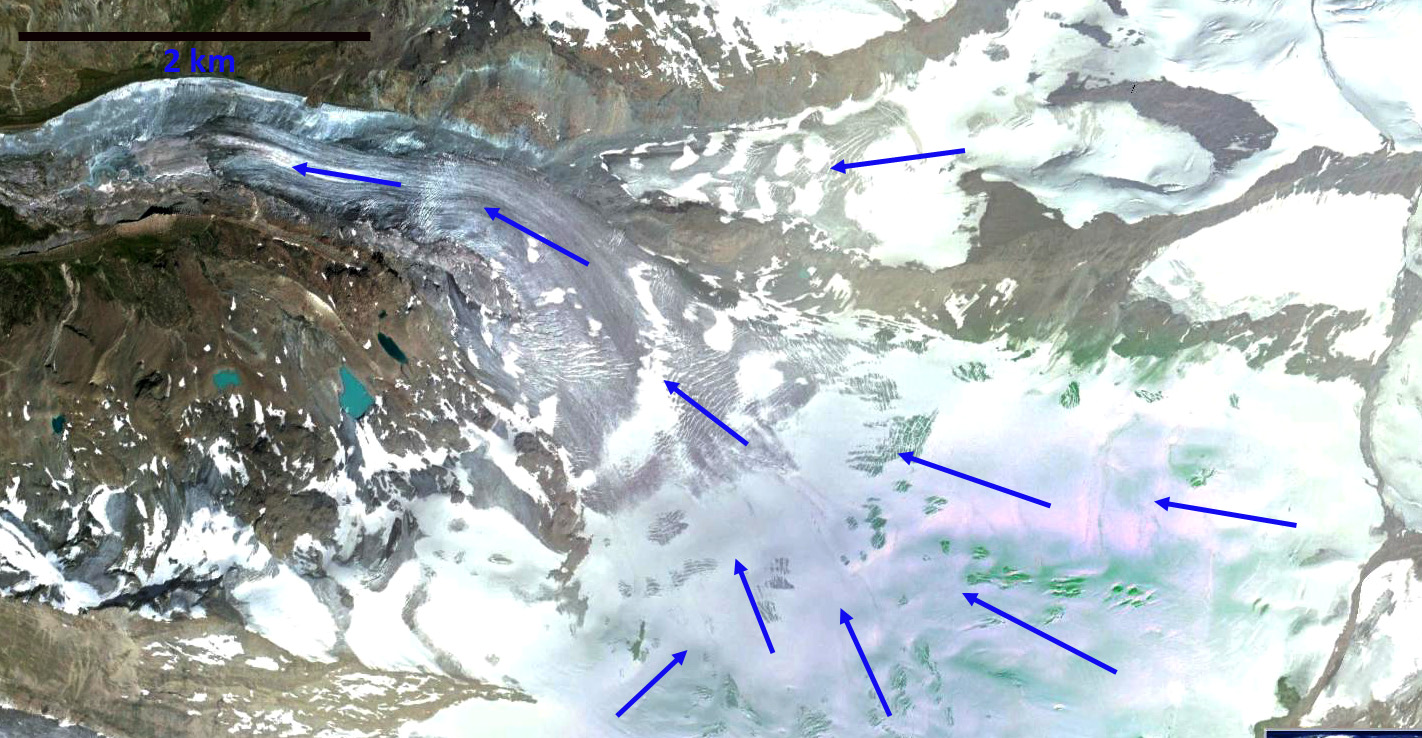
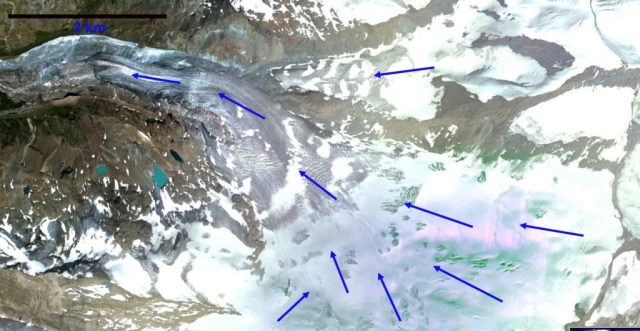
Google Earth image indicating flow of the Findelengletscher.

fiindelen 2 compare

Landsat image comparison of Findelengletscher from 1999 to 2016. Red arrow indicating the 1988 terminus location and yellow arrow the 2015 terminus location.  The purple arrows indicate two tributaries connected to the main glacier in 1988 and now disconnected.

Findelen terminus

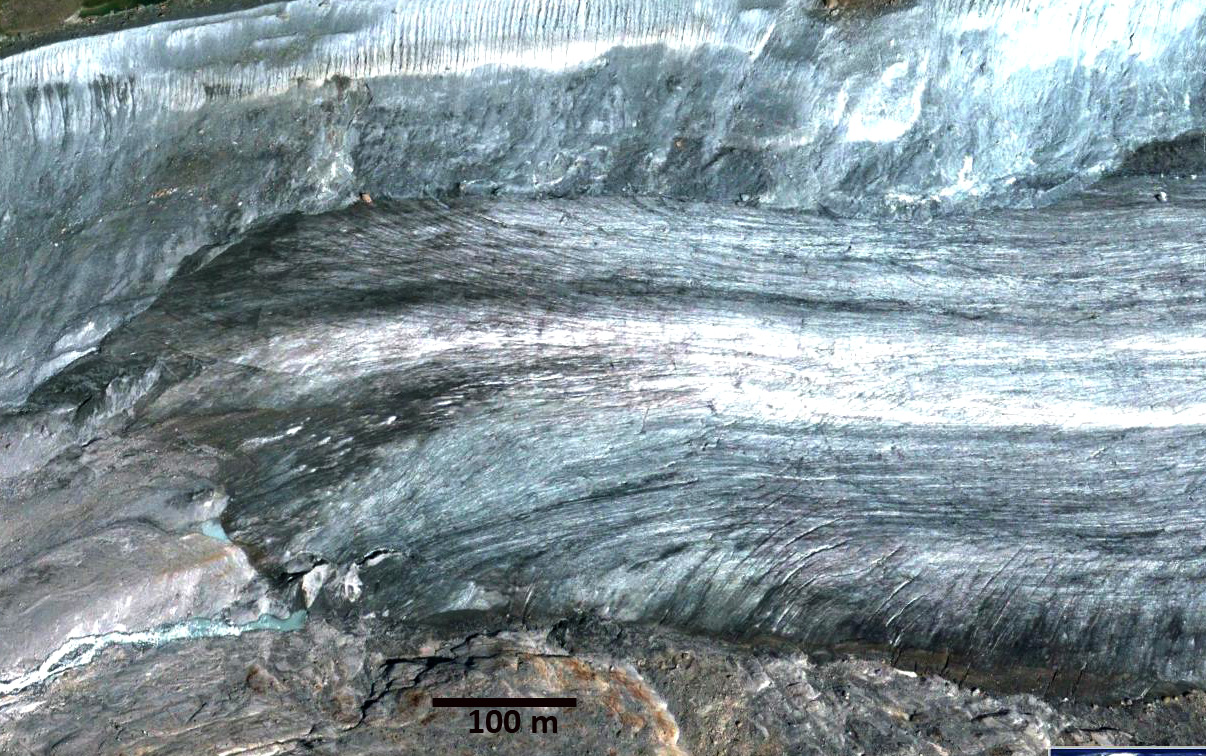
Terminus of Findelengletscher in Google Earth.  The lower several hundred meters has limited crevasses, but is not particularly thin. 


Cavagnoli Glacier Retreat, Swiss Alps

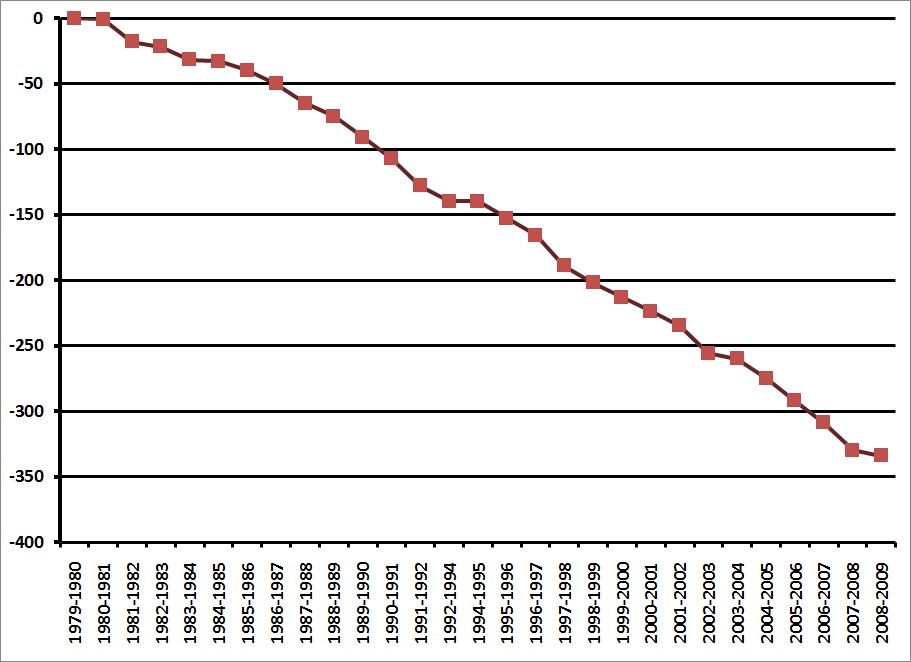
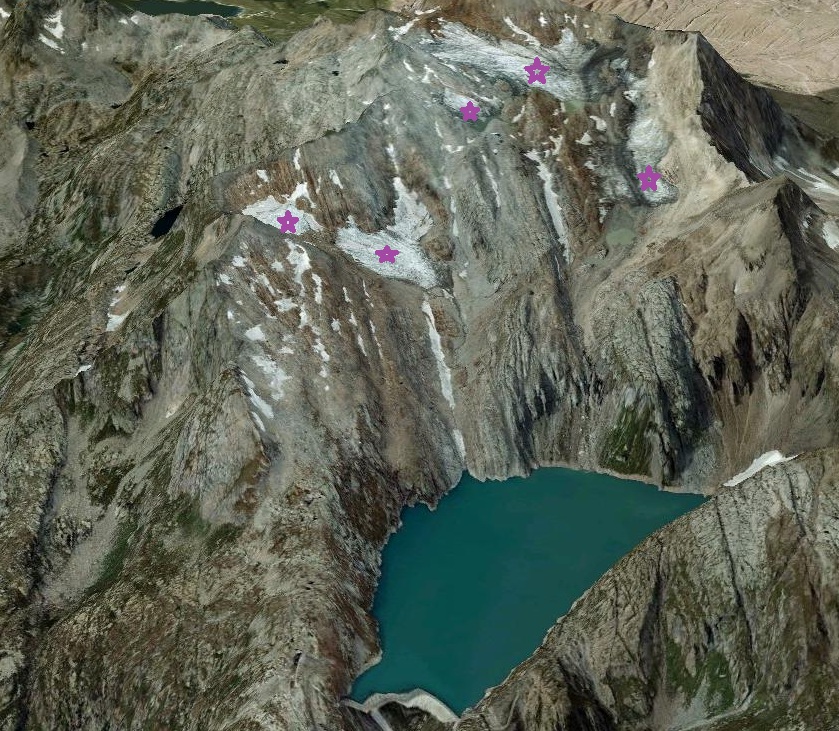
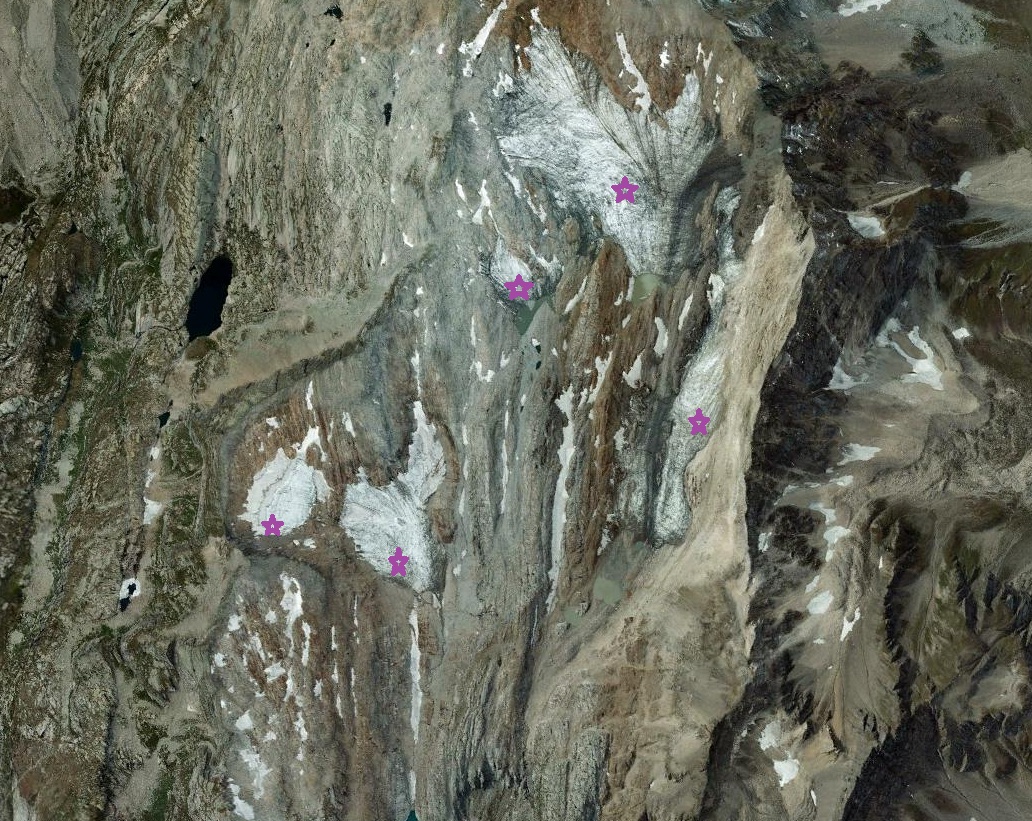
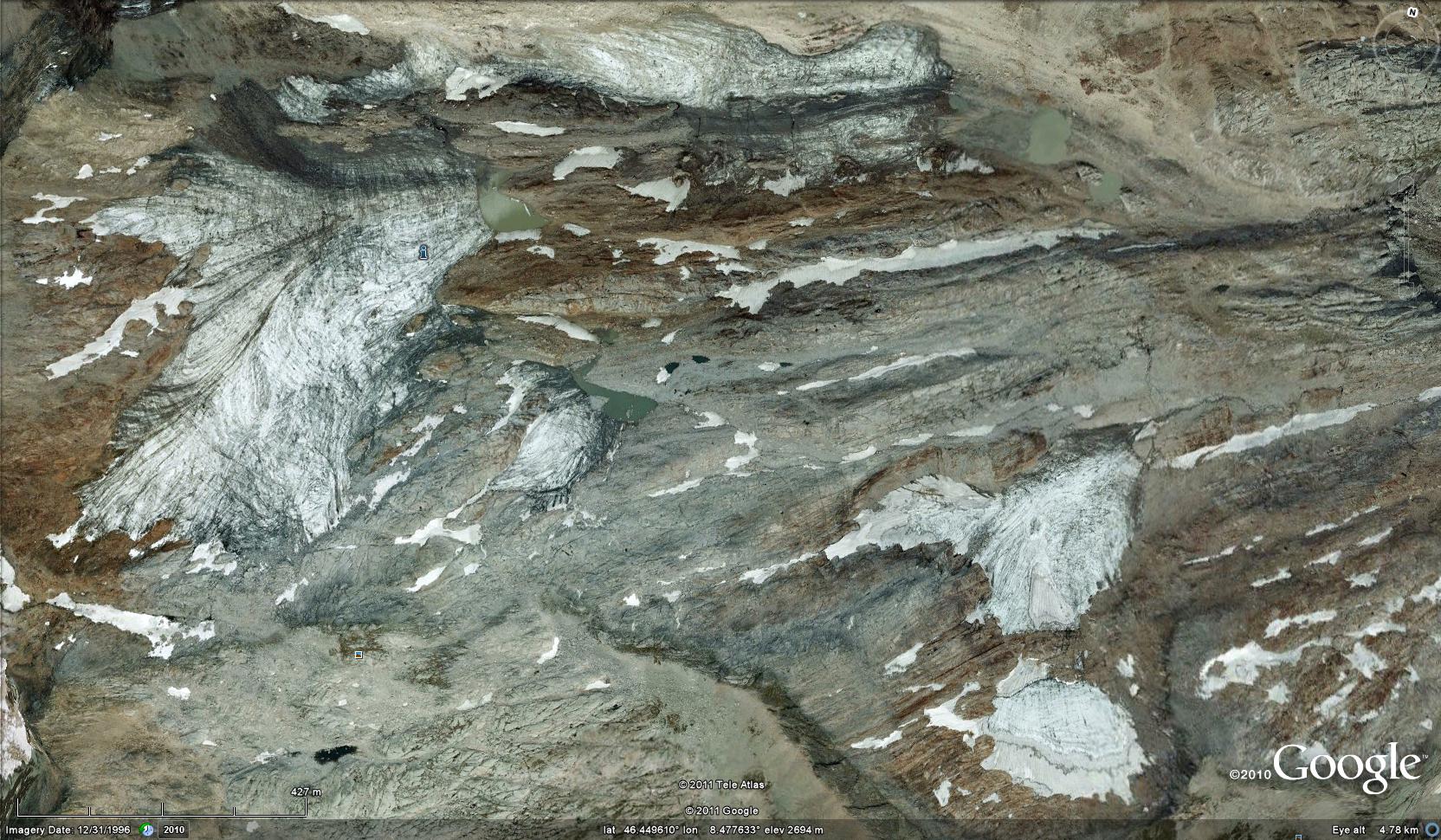
Ghiacciaio dei Cavagnoli (Ghiacciaio dei Cavagnöö) drains south into Lago dei Cavagnoli (Lago dei Cavagnöö), which is impounded by a dam that was 111 meters high. This hydropower plant provides 174 MW of power. The glacier itself has separated into five separate ice masses that are each melting quickly away. The Swiss Glacier Monitoring Network has observed the annual retreat of this glacier since 1980. A chart of this retreat from the data of the Swiss Glacier Monitoring Network is below. The total retreat of the main ice mass has been 343 meters. The top of the glacier has also been retreating this is a symptom of a glacier that will not survive (Pelto, 2010). The glacier as viewed from below and from directly above in Google Earth Imagery indicates a thin glacier with few crevasses. The five separate ice masses are all indicated by stars. This glacier has no accumulation zone in 2009. This has become a reoccurring pattern for this glacier, and also is a sign of a glacier that cannot survive. This glacier is a small relic of its former mapped extent. when the glacier was a single ice mass. Today the largest ice mass is 0.4 square kilometers and none of the ice masses appear destined for surviving. On the main ice mass there is a meltwater stream from the top to the bottom of the glacier indicating that even the top of the glacier is usually snow free by summer’s end. This glacier is in similar shape to the glaciers in the Rotondo area just to the north

Chüebodengletscher and Ghiacciaio del Pizzo Rotondo, Switzerland nearly gone

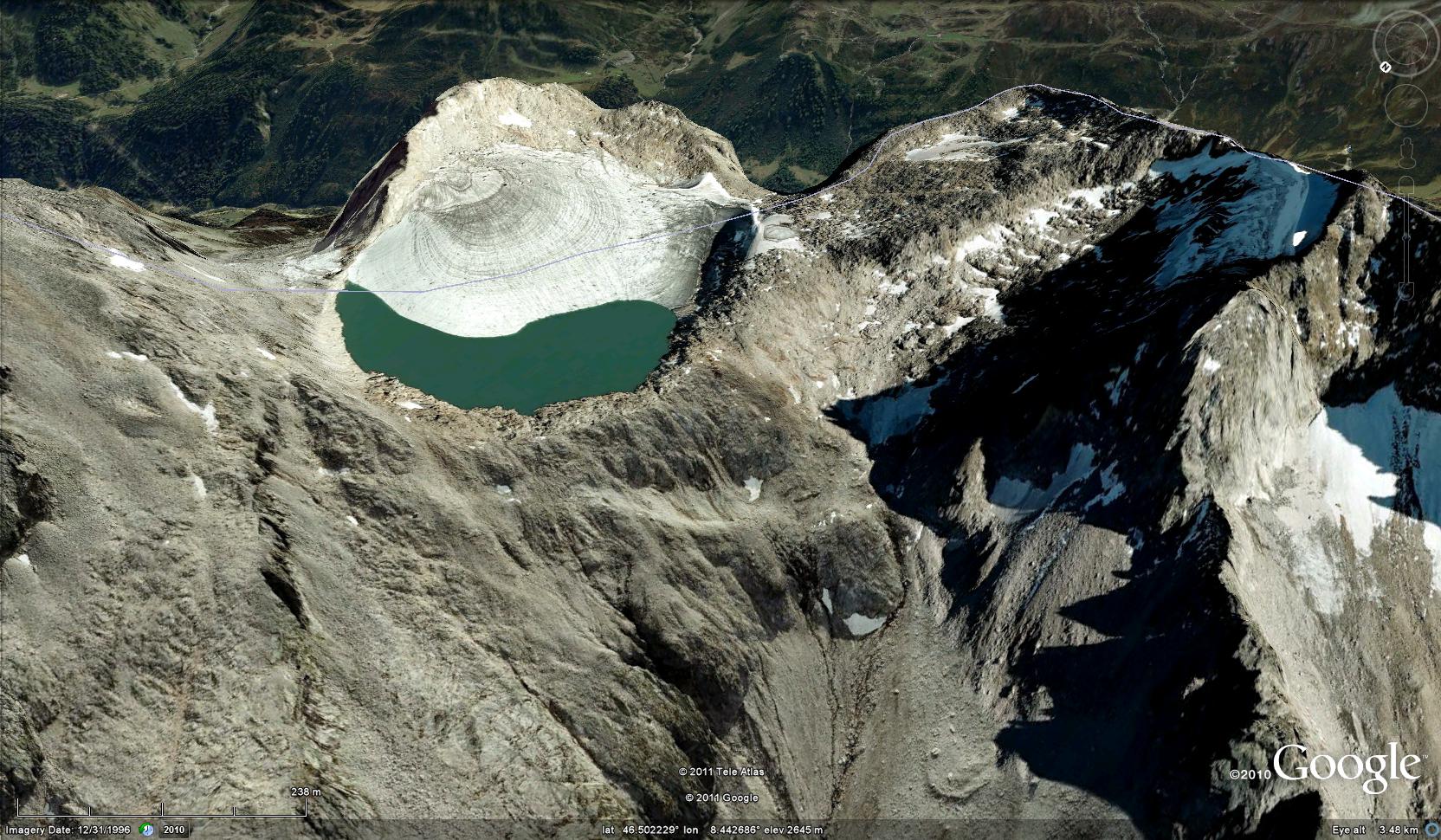
Chüebodenhorn is 3,070 meter high in the Lepontine Alps. The Ghiacciaio del Pizzo Rotondo lies at the foot of its north face and Chüebodengletscher is on its south side. Chüebodengletscher is confined to a small cirque, and currently ends in a lake . In several recent years including 2010 the glacier lost all of its snowcover. The glacier is currently 500 meters long and has an elevation range of 75 meters. The lake which fringes the glacier will turn into a circular alpine lake as the glacier melts away. At present the crescent shaped lake is 140 meters wide. The annual layers in this glacier are evident much like tree rings, that the are all emergent at the surface indicates that all the snow and firn that is supposed to cover most of a glacier at the end of the summer, has been lost from all of the glacier. There are at least 75 annual layers evident. The youngest layer (y) is at the top of the glacier and oldest (o) at the bottom.
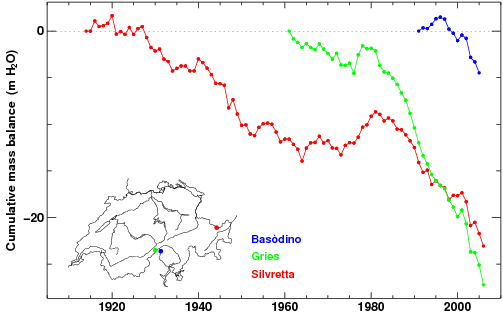
Ghiacciaio del Pizzo Rotondo is a thin slope glacier. This glacier also has a short elevation span of 80 meters from the terminus to its head in a distance of 500 meters. The glacier is a slope glacier that has little apparent thickness. The glacier will be lost faster than the thicker Chüebodengletscher. Ghiacciaio del Pizzo Rotondo also has lost all of its snowcover, and without a persistent and consistent accumulation zone it cannot survive. These two glaciers are losing mass like many neighboring such as the large Gries Glacier monitored by the In the graph below From the Swiss Glacier Monitoring Network the cumulative mass loss of Gries Glacier has been 20 meters. Swiss Glacier Monitoring Network. This mass loss of Swiss Glaciers led to 86 of the 95 glacier observed to retreat, while six were stationary and three advanced. The lack of an accumulation zone indicates that the glaciers will follow the path of Presena Glacier and Dosde Glacier unlike Oberaar Glacier which retains an accumulation zone.

Ried Glacier Rapid Glacier loss, Switzerland

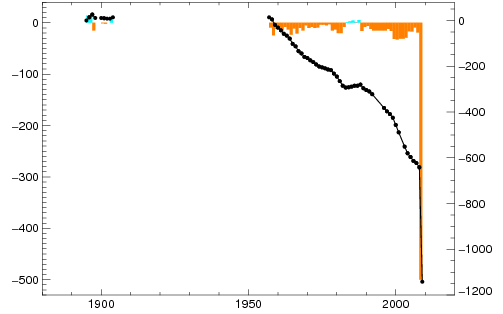
Ried Glacier is beneath the Durrenhorn in the Pennine Alps of Switzerland. The glacier was 6.3 km long in 1973. In 2010 the glacier is 5.1 km long. From the Swiss Glacier Monitoring Network annual measurements, Ried Glacier retreated 300 m from 1955-1990, 8 meters/year. From 1990-2008 retreated an additional 300 m, 30 m/year. Than in 2009 the glacier retreated 500 m. A comparison of a 2004 image taken by M. Funk and a Sept. 2008 image from D. Gara indicate why the change was so abrupt. The glacier had been retreating upvalley with a long gentle terminus tongue. This section of the glacier separated from the glacier in late 2008, with the terminus now ending on a steep rock slope. There is still stagnant ice in the valley below the end of the current glacier. It is heavily debris covered and no longer connected to the glacier system. This glaciers recent rapid retreat parallels that of Dosde Glacier, Italy and Triftgletshcer, Switzerland and Rotmoosferner, Austria. A look at the glacier system and the terminus in Google Earth imagery provides a broader view of the glacier behavior. The terminus in this image still extends downvalley with the low sloping tongue that is now separated. Current terminus marked with red-T.
In the imagery above the glacier is still connected to the terminus tongue. It is evident that the glacier has two primary icefalls at that time. The upper icefall is the location of the annual snowline, where accumulation tends to persist throughout the year. Below this point only seasonal snowfall is retained. The retreat history from the Swiss Glacier Monitoring Network is seen below.