Mammoth Glacier, Wyoming Ongoing Retreat


mammoth compare

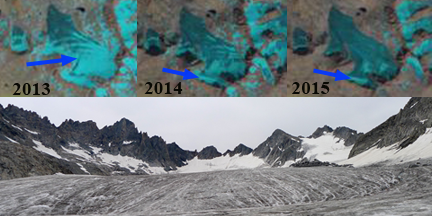
At top Landsat images from September 2013, 2014 and 2015 of Mammoth Glacier.  The blue arrow indicates retained snowcover. A 2013 images of Mammoth Glacier from Sarah Meiser, note low slope and lack of crevassing above

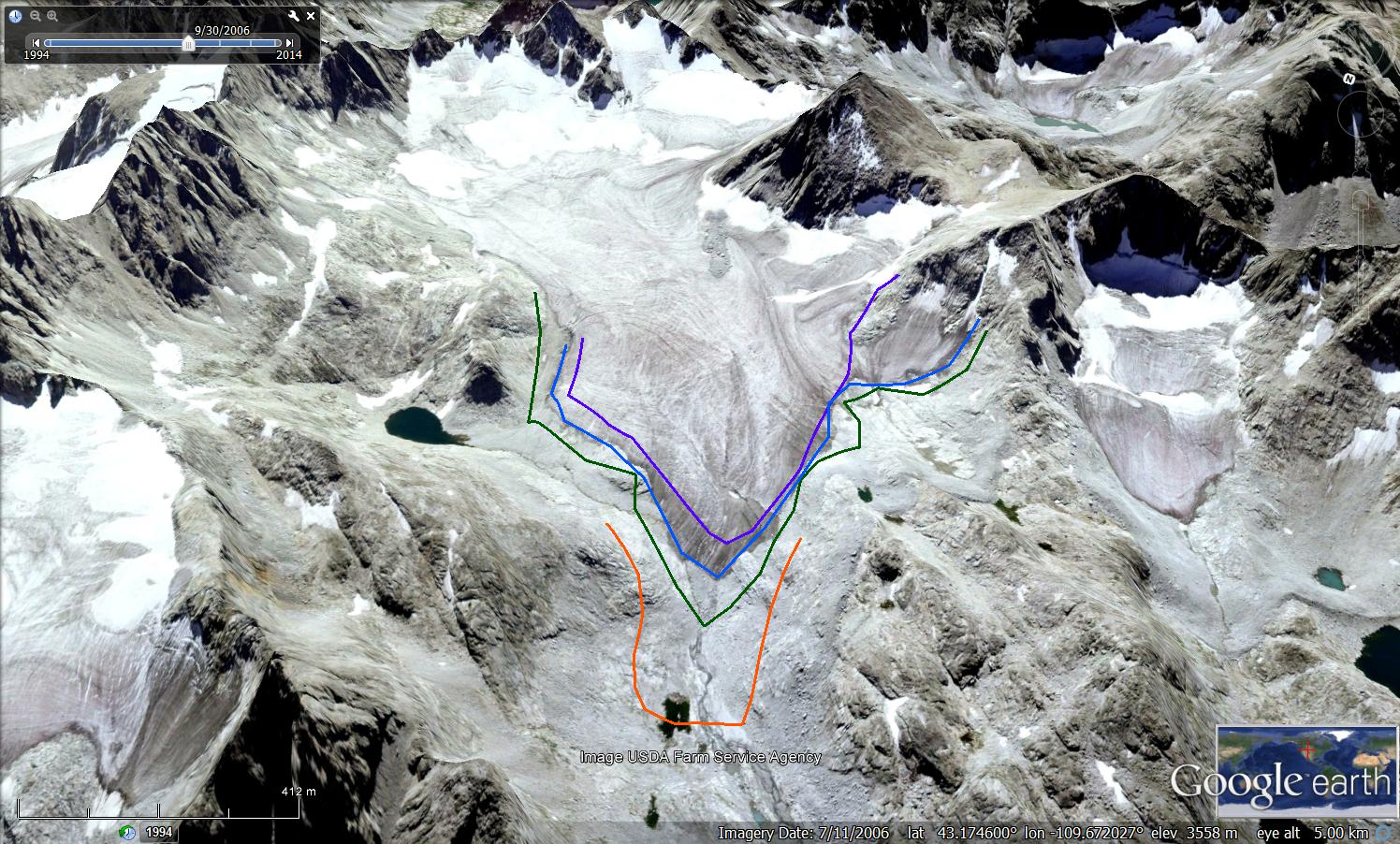
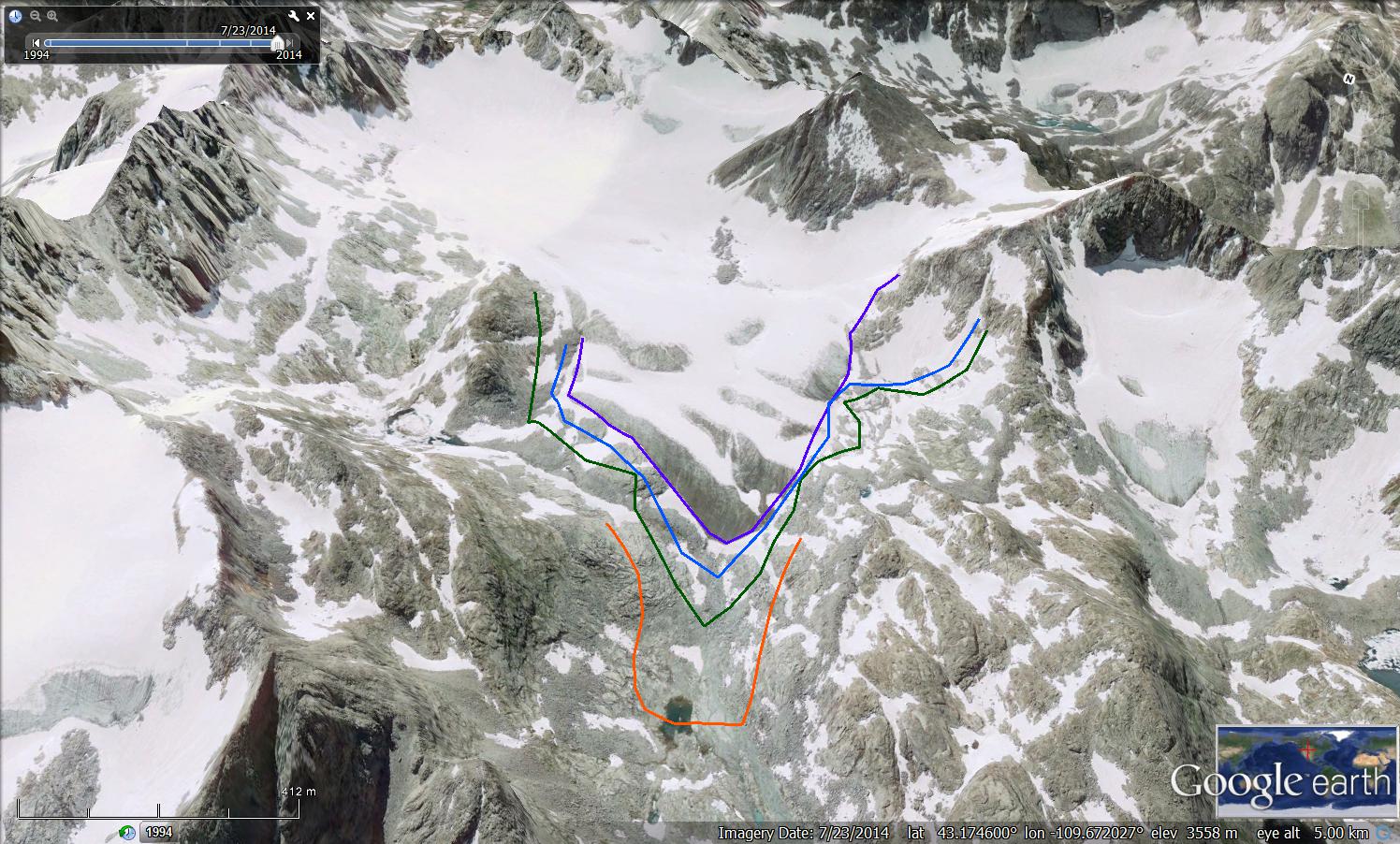
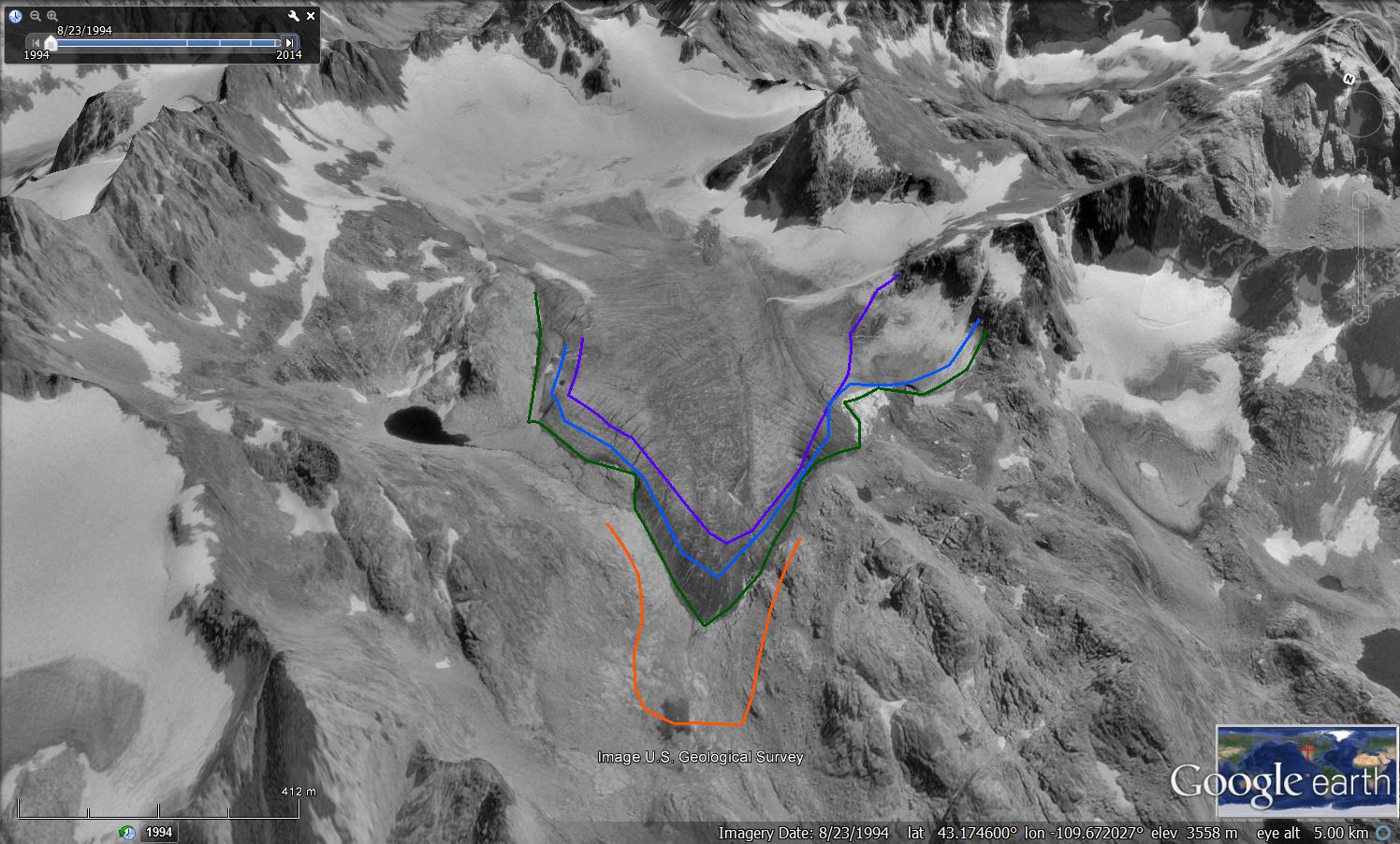
Mammoth Glacier is in the Wind River Range of Wyoming.  The ongoing retreat is leading to a glacier that does not warrant the name mammoth for size, but soon it will for obsolescence.The long and low sloped glacier is the largest west of the Continental Divide in the range. The glacier is at the headwaters of the Green River  and Green River Lakes. The glacier had an area of 4 square kilometers in 1952, 2.1 square kilometers in 2007 and 1.8 square kilometers in 2015.  The Landsat sequence above from 2013, 2014 and 2015 illustrates the problem, insufficient retained snowcover to approach equilibrium, that is also evident in 2006 shown below. The setting is better illustrated with images from Sarah Meiser who I think has the best collection of recent images of Wind River Glaciers. A glacier like Mammoth with limited avalanching needs more than 50% retained snowcover at the end of the summer (accumulation area ratio) to be in equilibrium.  In 2013 with three weeks left in the melt season, the accumulation area ratio (AAR) is slightly below 50%, note Sarah Meisel image below.  In 2014 the AAR is 25 % and in 2015 the AAR is 5-8%.  These periods of sustained bare ice exposure lead to area loss and thinning.  A comparison of Google Earth images illustrate the area loss. In each image the orange line is the 1966 map position, green line 1994 margin, blue line 2006 margin and purple line 2014 margin.  The loss in area at the margin is evident as is the loss on the western side between 2006 and 2014.  Retreat has been 200 m from 1966 to 1994, 95 m from 1994-2006 and 95 m from 2006 to 2014. Area loss after the poor snowcover in 2015 will continue and the glacier will not long be considered mammoth in size.  Pelto (2010) examined glaciers in the Wind River Range and found two-thirds could not survive current climate as they did not have a persistent accumulation zone, including Mammoth Glacier and Sacagawea Glacier. Thompson et al (2011) noted a 38% loss in area of the 44 Wind River Range glaciers from 1966-2006. Maloof et al (2014) noted an even larger drop in volume of 63% of the same glaciers from 1966-2012.
 

mammoth rocks

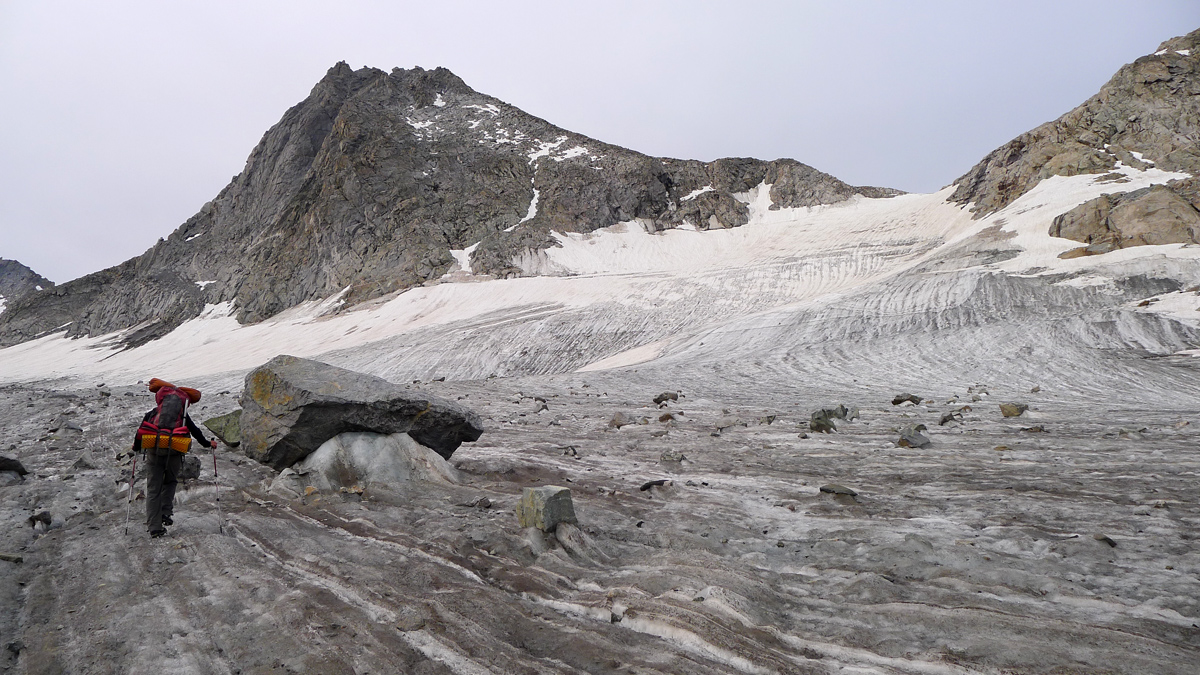
 Sarah Meiser image illustrating how close to the top of the glacier the bare ice extends.  This fact indicates that all of the firn had been lost, thus the area shown has not been a recent accumulation area. 
mammoth 1994a

1994 Google Earth Image

mammoth 2006a

2006 Google Earth Image

mammoth 2014

2014 Google Earth image


Cloud Peak Glacier Retreat, Wyoming

Cloud Peak is the highest peak in the Bighorn range of north central Wyoming, a cirque on its east side hosts the only significant glacier in the range. This glacier was photographed in 1903 and has lost much of its volume since then. Rahn et al. (2006), page 44, estimated that if the melting continues at the rate that determined in 2005, Cloud Peak Glacier would disappear between the years 2020 and 2034. They used repeat photographs to estimate glacier volume as 506 million cubic feet in 1905, 205 million cubic feet in 1966 and 78 million cubic feet in 2005. The latter value is likely too low, as it implies a glacier thickness of just over 10 m on average, yet there is active crevassing, which typically requires 30 meters of thickness. A typical volume-area scaling law also yields a thickness of 30 m (Bahr, 2014).

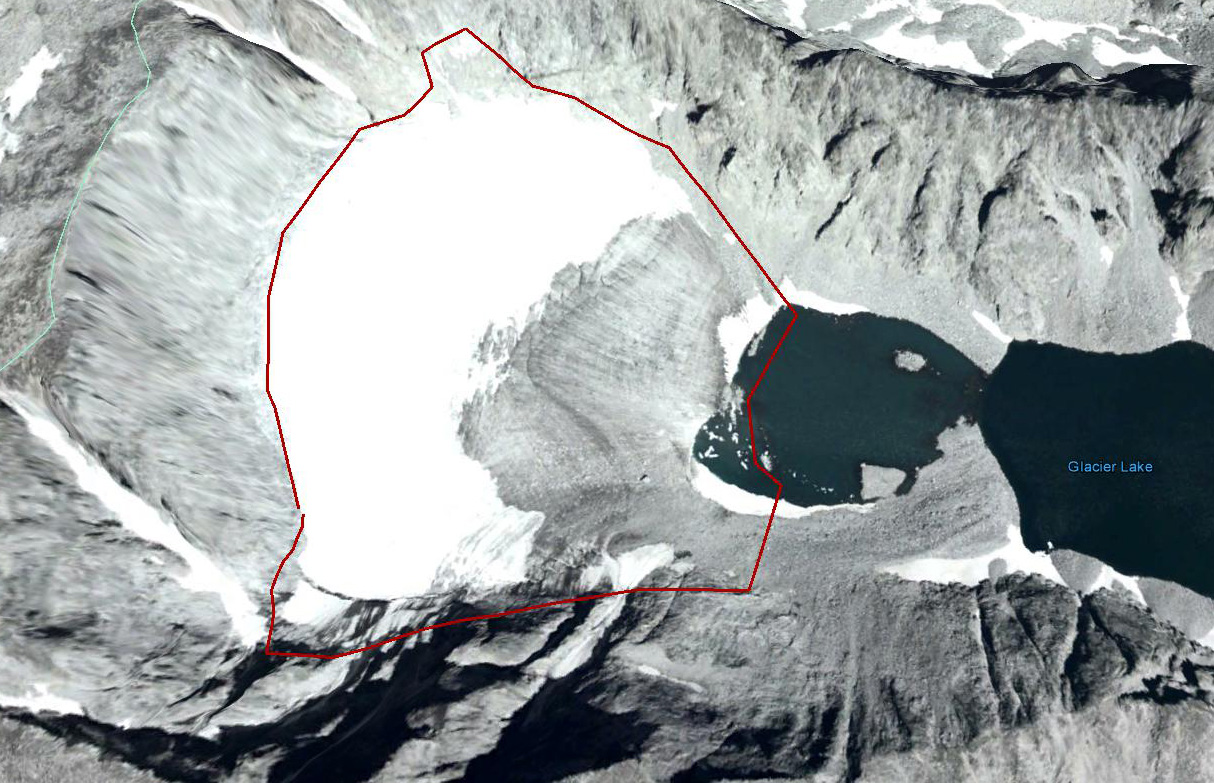
Here we use Google Earth images from 1994, 2006 and 2010 to observe more recent changes. The red line is the outline of the glacier in 1994. In 1994 the glacier had a length of 580 m on average across the glacier front. The glacier had retreated 280 m from the Little Ice Age moraine crosscutting the lake. By 2006 the terminus has retreated 65 m. In 2010 the terminus has retreated an average of 105 m. Just as importantly the top of the glacier has receded 75 m, pink arrows indicate this area. The net results is that total glacier length has declined from 580 m to 380 m on average. The glacier has an area in 2010 of 0.20 square kilometers. Given retreat of the top and bottom of the glacier the glacier will not survive (Pelto, 2010). However, the glacier will not disappear in the next two decades unless the melt conditions increase substantially. This retreat is similar to the nearest glaciers to the north in the Beartooth Mountains of Montana and to the west in the Wind River Range of Wyoming.

cloud peak 1994
1994 Google Earth Image
cloud peak 2006
2006 Google Earth image
cloud peak 2010
2010 Google Earth image

Sacagawea Glacier, Wyoming is Disappearing

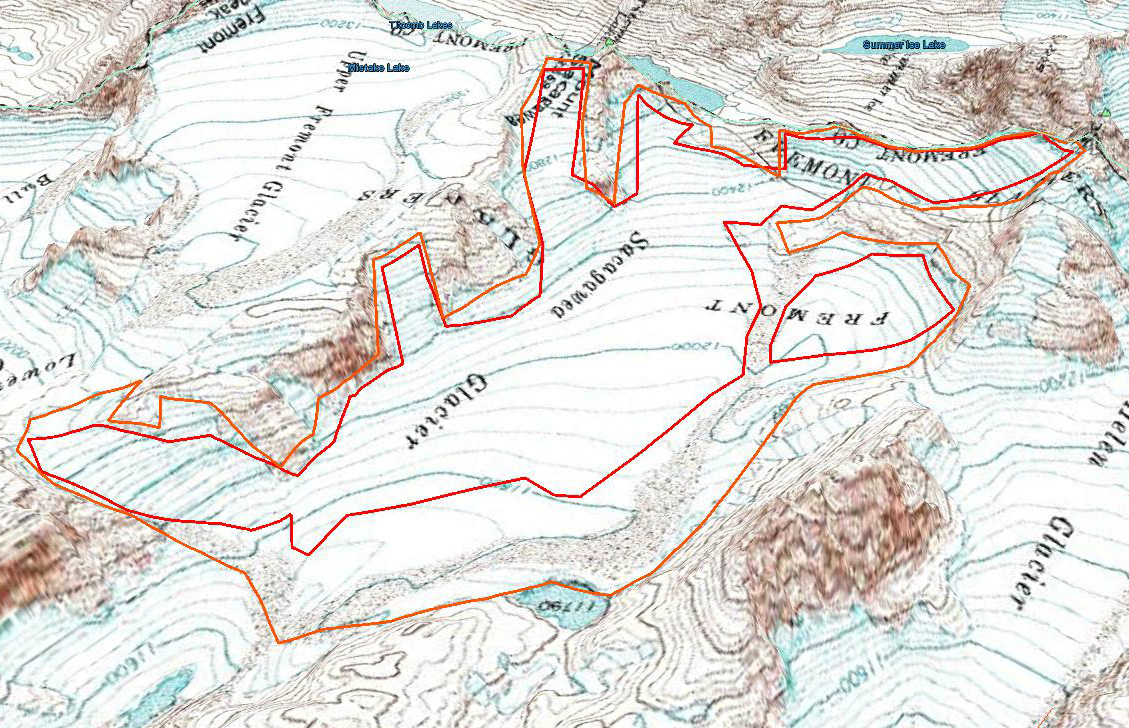
Sacagawea Glacier in the Wind River Range of Wyoming lost 35% of its area between 1966 and 2006. This glacier on the west slope of Sacagawea Peak and Helen Peak and just north of Upper Fremont Glacier. Here we compare Google Earth imagery of the glacier that indicates the change during this forty year period. In 1966 the glacier had an area of square kilometers. The first image is the USGS map of the glacier from 1966 imagery. The orange outline is the glacier margin at this time and the red outline the 2006 glacier boundary. By 1994 Google Earth images indicate a retreat of 270 m along its main terminus. A small lake has also begun to form along the southern section of the terminus. The northern section of the glacier below Helen Peak had by 1994 become practically disconnected from the main section of the glacier. In 1994 the exposed blue ice area is extensive, indicating that most of the glacier was consistently losing its snowcover. With retained snowcover limited to the steeper slopes above 3700 m. By 2006 the lake was 400 m long and 150 wide along the southern section of the terminus. The terminus retreat along the main terminus averaged 350 m since 1966. The northern section of the glacier is fully detached from the rest of the glacier. The fraction of snowcovered area is 10% in 2006, which was typical for the 2003-2006 period. This is insufficient to maintain a glacier, the snowcovered area for temperate alpine glaciers such as the Sacagawea that lacks extensive avalanching is 55-65 % snowcover at the end of the melt season. The locations marked with Point A in red are locations where rock formerly beneath the glacier has been exposed as the glacier melted from that location. By 2013 a Landsat image of the glacier indicates that the glacier is beginning to recede from the terminus lake, further that there is almost no retained snowcover in 2013 and that the glacier is separated into three segments note the yellow arrows. The upper margin of the glacier is receding which indicates thinning in the accumulation zone, an indicator that this glacier does not have a significant accumulation zone and cannot survive current climate (Pelto, 2010). In a Planet Action Project Pelto (2010)reported that 2/3 of the 15 Wind River glaciers examined were not going to survive current climate. This includes Minor Glacier, Sourdough Glacier, Grasshopper Glacier and Lower Fremont Glacier.sacagawea comparison
1966 USGS map

Sacagawea Glacier 1994
1994 Google Earth

sacajawea 2006
2006 Google Earth

sacagawea 2013
2013 Landsat Image

Analysis of Sacagawea Glacier and Upper Fremont Glacier, Wind River Range, Wyoming