West Ganglung Glacier, Tibet Glacier Loses 20% of Length

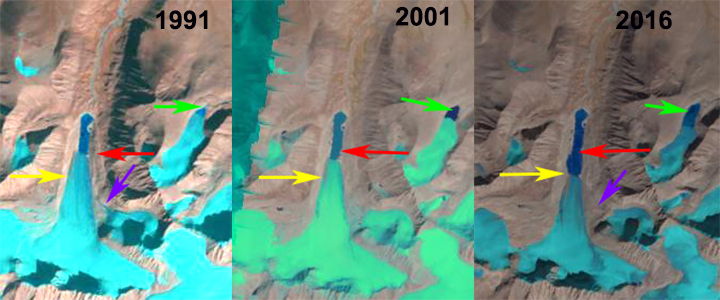
Landsat image comparison from 1991, 2001 and 2016 of West Ganglung Glacier, red arrow is the 1991 terminus, yellow arrow the 2016 terminus, green arrow the eastern glacier proglacial terminus lake and purple arrow expanding zone between a former tributary and West Ganglung Glacier

West Ganglung Glacier is on the China-India border 6 km west of Ganglun Grangri Peak meltwater enters the Sultej River and then Mapam Tso.  the glacier terminates in a proglacial lake at 5200 m with its head on the border at 5750 m. This region is part of the Indus Basin, the second China glacier inventory noted a 23% decline in glacier area from 1970 to 2007 (Guo et al 2015) Assessing the sensitivity of the Sutlej River basin to climate change Miller et al (2012) noted that with a warmer climate melt contributions from lower parts are reduced because of decreased snow cover and a shorter melting season.  Significant glacier area loss will also lead to less runoff despite an increase in rate. Singh et al (2012) noted a decline in runoff from the Sutlej basin after 2000, whereas there had been a rise before that. 

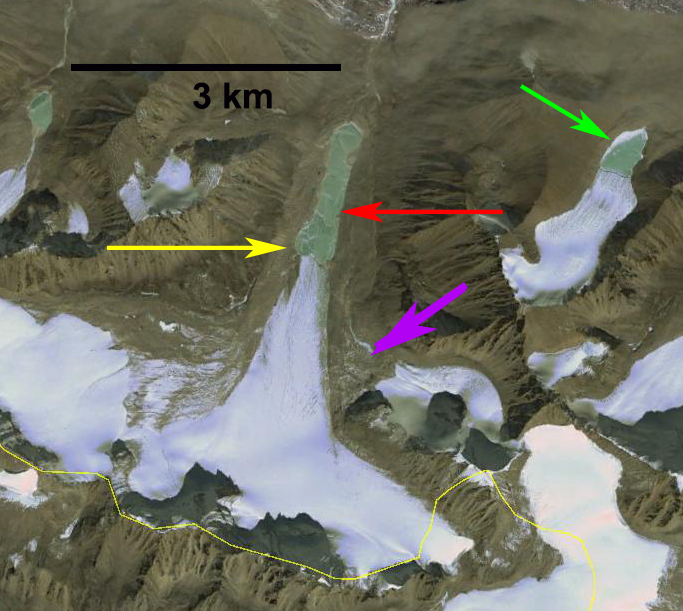
Here we examine teh unnamed West Ganglung Glacier change from 1991 to 2016 in a series of Landsat images. In 1991 the glacier terminates at the red arrow, and the lake is 1050 m long. At the glacier just to the east there is a small proglacial lake 200 m long. By 2001 glacier retreat had led to lake expansion to 1400 m long. The proglacial lake at the end of the eastern glacier is now 350 m long. By 2016 the proglacial lake at the terminus had expanded to a length of 1850 m, a retreat of 800 m in 27 years.  The proglacial lake at the terminus of the eastern glacier in 2016 is 650 m long, indicating a retreat of 450 m.  In both case the retreat is a significant loss of overall glacier length, ~20%.  The purple arrow indicates the increasing separation between a tributary and the West Ganglung Glacier glacier.

Google Earth image of West Ganglung Glacier, red arrow is the 1991 terminus, yellow arrow the 2016 terminus, green arrow the eastern glacier proglacil terminus lake and purple arrow expanding zone between a former tributary and West Ganglung Glacier


Landsat image from2014 of West Ganglung Glacier, red arrow is the 1991 terminus, yellow arrow the 2016 terminus, and green arrow the eastern glacier proglacial terminus lake.

Torfajökull, Iceland Accumulation Zone Demise Drives Recession

Torfajökull in 1994, adn 2014 Landsat images.  Note the lack of retained snowpack in 2014 and emerging bedrock areas within icecap, purple arrows.

Torfajökull is a small ice cap north of  Myrsdaljökull in Iceland.  The glacier’s lowest elevation is 750 m and the highest elevation is 1150 m.  This low of an elevation range in a climate driving higher snowlines places this type of ice cap at great risk for losing its accumulation zone and its ability to survive.   The Iceland Glaciological Society spearheads an annual terminus monitoring program led by Oddur Sigurðsson. In 2013 the report indicates all seven glaciers in the region near Torfajokull were in retreat.  In this post we look at the loss of the accumulation zone in 2014 and the longer term change in size noted by the Iceland Glaciological Society. This is not a good area for acquiring a suntan as the lack of clear imagery indicates for 2015 or 2016. 

In 2006 the Iceland Glaciological Society began monitoring the terminus of this glacier, the measurement is completed at the northeastern terminus.  From 2006-2014 the glacier has retreated 150 m.  The monitored terminus the location where areas of bedrock have begun to emerge from beneath the thinning ice cap, purple arrows. The bedrock areas exposed within the ice cap were not evident in 1994 images or the 2000 glacier outline. The loss of glacier area from 1946-2000 in the Iceland Glaciological Society map indicates area loss around the entire margin of the icecap including the highest elevations, located on the southern margin.  Recession at the head of a glacier suggests a glacier that lacks a persistent accumulation zone.

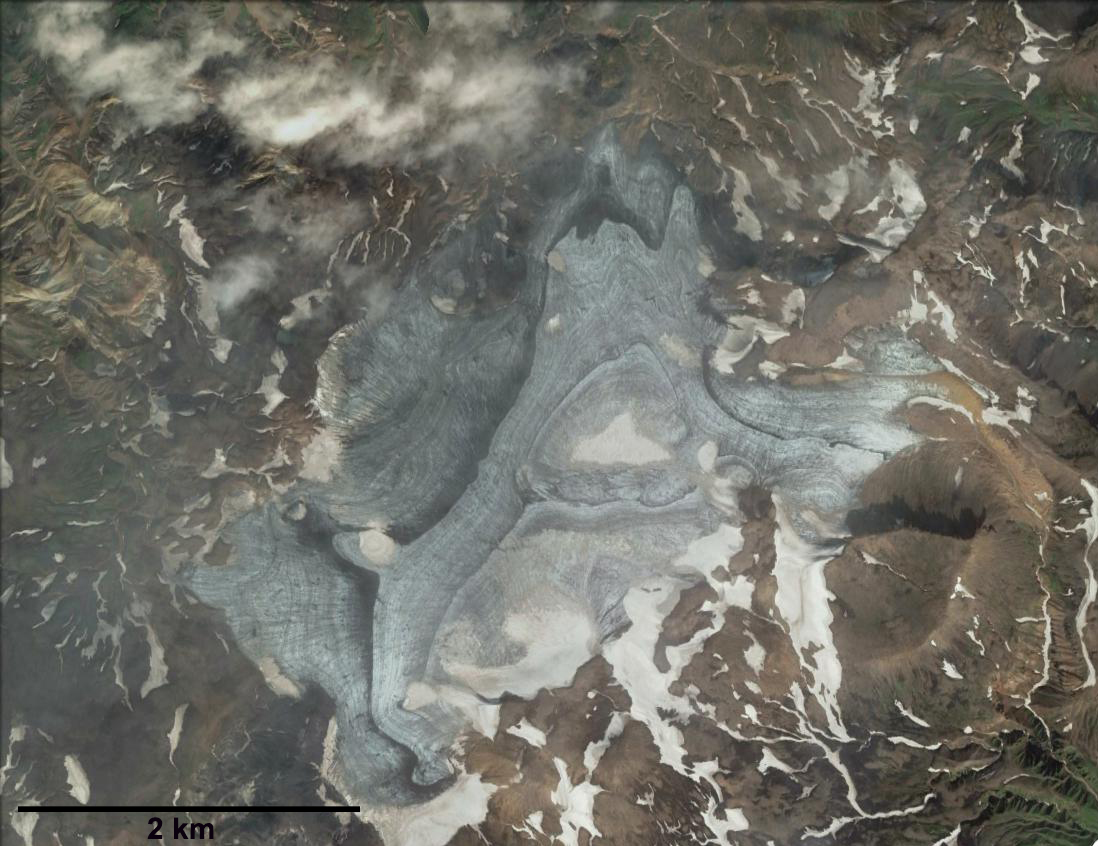
The change from 2000 to 2014 has been more pronounced on the eastern lobes that extend away from the main glacier.  The loss in ice cap area from 2000-2014 is ~10%.  In 2014 the glacier had 12% retained snowcover on August 12th, note Landsat image above and Google Earth below, by Sept.2014 there was no retained snowpack.  There is some retained firn the lightest blue, but even this is limited indicating that the snowpack from the previous few winters had not survived over most of the glacier either.

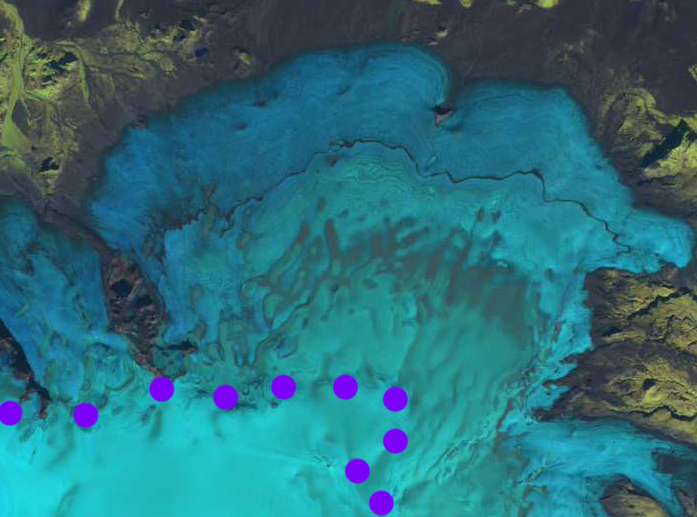
This is a recipe for glacier loss. The snowline on Aug. 12, 2014 shown below on Myrsdaljökull was at 1225 m, well above the top elevation of Torfajökull.  This glacier lacks the higher accumulation zone of some smaller Icelandic ice caps such as Eiriksjökull.


Iceland Glaciological Society map of glacier boundaries in 1890, 1946 and 2000, with the 2014 boundary added from the Landsat images above.  

Landsat image of Myrdalsjokull on 8/12/2014 with snowline at purple dots., 1225 m.

Sabbione Glacier, Italy Retreat & Fragmentation

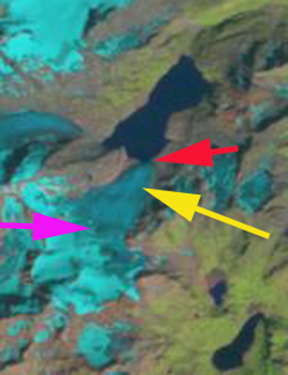
Sabbione Glacier in 1999, 2001 and 2016 Landsat images.  Red arrow is 1999 terminus location, red arrow the 2016 terminus location and the purple area new rock outcrops emerging in the midst of the glacier.

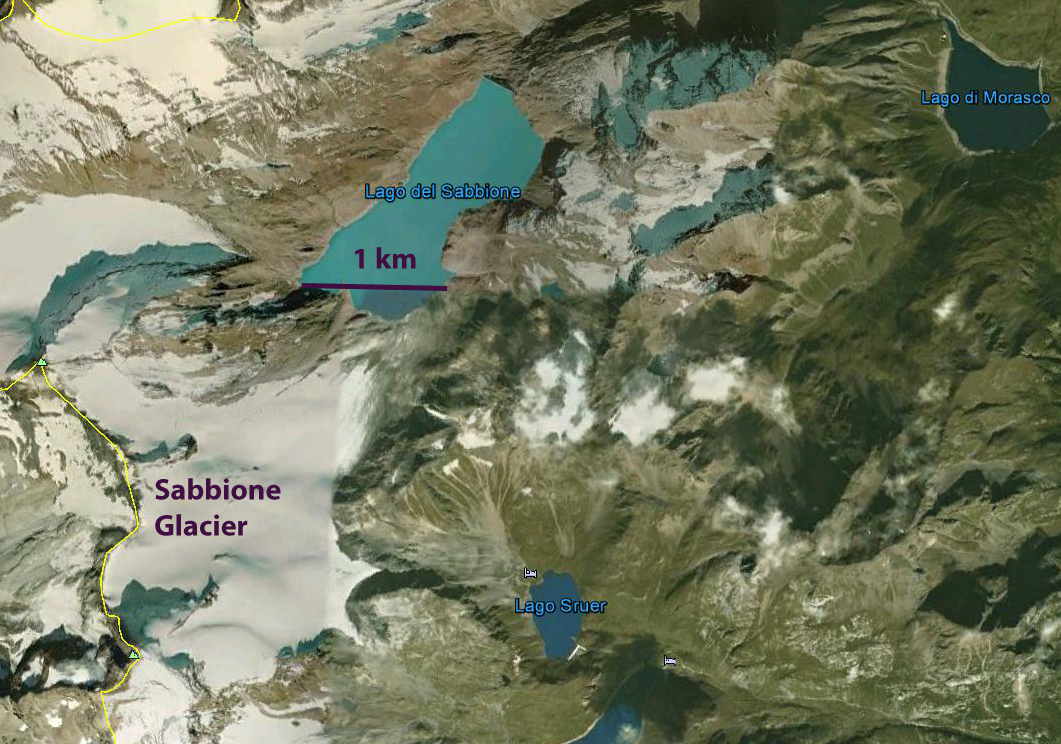
Sabbione Glacier is on the Swiss-Itlaian border.  The glacier drains into Lago Sabbione an artificial lake that in turn drains into Lago Morasco, which is a 29MW hydropower facility. The lake also has good fishing. This glacier in 1988 reached the shore of Lago Sabbione. Today glacier retreat has changed its nature dramatically.  It is not as close to disappearance as nearby Cavagnoli Glacier or Careser Glacier.  Huss and Fischer (2016) indicate that the majority of the small alpine glaciers, less than 0.5 square kilometers will disappear in the next 25 years.
In a series of Landsat images from 1999, 2001 and 2016 and a picture from Lago Sabbione in 2007, the retreat from the lake is evident. The 1988 terminus in an image below is indicated by a red arrow, the 2010 terminus by a yellow arrow, the new outcrop in the midst of the glacier by a magenta arrow. The retreat from 1988 to 1999 is 240 m, there is no rock outcrops emerging in 1999 or 2001. The glacier is 2.5 km long beginning at 3200 m and terminating at 2550 m in 1999. By 2007 image below the rock outcrop has become apparent. By 2016 the glacier has retreated 950 m from the lake and 700 m since 1999 and is now less than 2 km long.  The outcrop in the glacier center is 200 m wide. Of greater concern for the future of the glacier than retreat is the emergence of rock outcrops in the midst of the middle portion of the glacier, and smaller ones on the upper glacier. In 2016 the glacier only has 15% snow cover in this late August image, much less than the 50-60% needed for equilibrium balance. This indicates a glacier that is not in equilibrium lacks a persistent accumulation zone, indicating it will not survive current climate  (Pelto, 2010). In the most recent survey published by the Italian Glacier Commission indicates all glaciers in this region of Italy retreated in 2015.

Google Earth image of Sabbione Glacier and Lago Sabbione.


1988 Landsat image of Sabbione Glacier

Llewellyn Glacier, BC Proglacial Lake Merging From Retreat

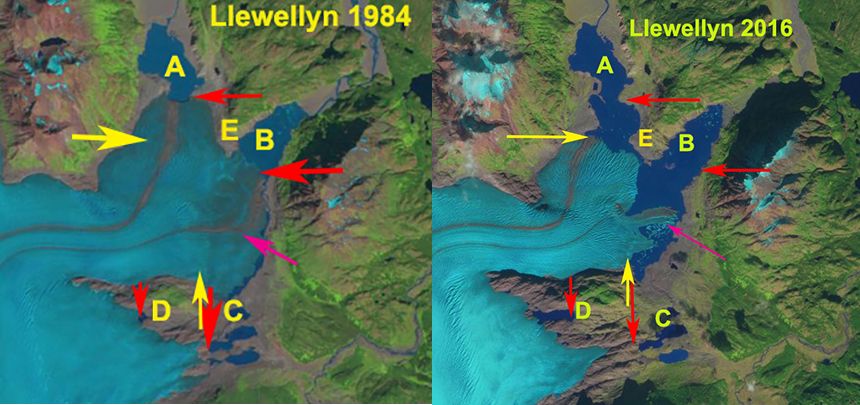
Llewellyn Glacier comparison in 1984 Landsat and 2016 Sentinel images.  Red arrows the 1984 terminus locations for proglacial lakes A-D, yellow arrows the 2016 terminus locations for A and B. Point E was the peninsula separating proglacial lakes A and B, which are now joined due to glacier retreat. 

The second largest glacier of the Juneau Icefield is the Llewellyn Glacier which is in British Columbia. The Juneau Icefield Research Program has a research camp, C-26 on this glacier and it is the typical exit route from the icefield at the end of the field season.  Here we examine changes in the terminus from 1984-2016 as a result of higher snowlines indicative of an expanded ablation zone and negative mass balance. 

I first visited the glacier in 1981 and I was also on the icefield in 1984 when the Landsat image was acquired that is used as the start point for comparison. In 1984 the glacier had several termini ending in proglacial lakes A-D. We exited the glacier on the west side of proglacial lake A in 1984 onto a proglacial outwash plain referred to as the ball bearing highway.   At Point B the terminus ended in a deeper wider proglacial lake than Lake A. At Point C and D the glacier ended in a series of small lakes.  Point E is the peninsula separating proglacial lake A and B in 1984. Proglacial Lake B had a surface water level 10-15 m higher than Lake A in 1984. In 2011 the glacier still reached Point E  separating the two lakes, which still had different water levels. In 2013 the gap first opened between the two lakes, and the water level fell in Lake B. In the summer of 2016 and spring of 2017 the gap has persisted and widened to  150 m.  From 1984 to 2016 the terminus in Lake A has retreated 1300 m, the terminus at Lake B 2100 m, terminus at Point C 800 m and terminus at Point D 1100 m. The narrow tongue of ice at the pink arrow will not survive long. The crevasse pattern suggests the glacier has another 1.5- 2 km to retreat before lake development will cease. 

The snowline during the 1998-2013 period averaged 1900 m too high for an equilibrium balance.  In a sequence of images from 2013 illustrates the rise is snowline from  1450 m on June 21,  to 1780 m on August 1 and  1810 m on Sept. 2.   The persistently higher snowlines since 1990 have led substantial thinning, Melkonian et al. (2013) note thinning of more than 1 m per year at the terminus diminishing to little change above 1500 m from 2000-2009. This will drive continued retreat, supplemented by calving into the still growing proglacial Lake at Point A and B.  The retreat of this glacier follows that of other glaciers of the Juneau Icefield including nearby Tulsequah Glacier, noted by Pelto et al (2013) and Pelto (2016) .

[ngg_images source=”recent_images” display_type=”photocrati-nextgen_basic_slideshow” gallery_width=”600″ gallery_height=”400″ cycle_effect=”fade” cycle_interval=”5″ show_thumbnail_link=”1″ thumbnail_link_text=”[Show thumbnails]” order_by=”sortorder” order_direction=”ASC” returns=”included” maximum_entity_count=”4″]

Upernavik, NW Greenland New Islands, Nunataks and Former Glacier Base Exposed

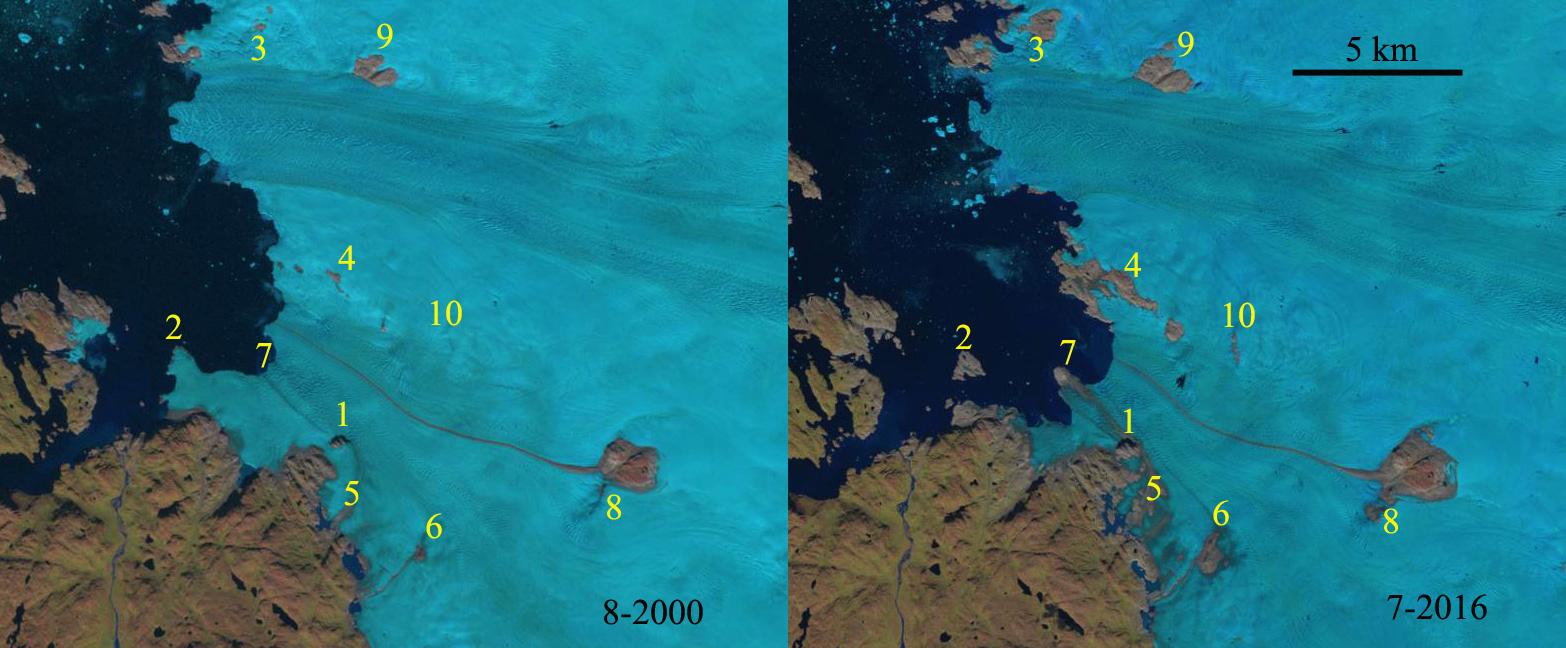
Upernavik Glacier in Landsat images from August 2000 and August 2016.  Each Point is at the same location in both image, and the changes are noted in the discussion below.  The same locations are also identified in the July 2001 and Aug. 2016 image below. 

Upernavik Glacier is on the NW Greenland Coast the next major outlet north of Rinks Glacier.  Today the glacier has four separate main calving termini, that was a single terminus until 1980. The retreat of this glacier is exposing new islands, nunataks etc that is examined in Landsat images from 2000 to 2016.   Howat and Eddy (2011) observed the terminus change of 71 outlet glaciers in NW Greenland from 2000-2010 and found that 98% had retreated. The retreat has occurred irrespective of the different characteristics of various glaciers (Bailey and Pelto, SkS).  Box and Decker (2011) note that ice loss for Upernavik Glacier’s combined termini was 7.9 square kilometers per year from 2000-2010.   Larsen et al (2016) observed asynchronous changes in dynamic behavior of four outlets of Upernavik between 1992 and 2013. Velocities were stable for all outlets at between 1992 and 2005. The northernmost glacier began acceleration and thinning in 2006 -2011. The second most northerly outlet began acceleration and thinning in 2009 and this continued through at least  2013. The southern glaciers showed little change.  They observed that the southernmost which is the focus here underwent a small deceleration between 1992 and 2013.  Velocity data for the 1999-2014 period of the southernmost outlet is available using an online map browser (Rosenau et al; 2015), indicates the highest velocity of the southernmost branch occurred in 2013 and 2014,  which would also lead to enhanced thinning.  Moon et al (2014) observed the velocity of the southernmost arm of Upernavik to have a velocity of 2-3 km per year with a modest seasonal velocity fluctuation of ~15%. They note that Upernavik Glacier is a type 2 glacier, exhibiting relatively stable velocity from late summer through winter into spring, followed by a  strong early summer speedup and midsummer slow down. 

Here we examine the changes from 2000 to 2016 at ten locations near the front of the southern most of the main outlets of Upernavik Glacier.  This reveals the formation of new islands, exposure of the former glacier bed and expansion of nunataks. 

Point 1: In 2000 and 2001 this is a nunatak just below the number that is separated by 500 m of glacier from the edge of the ice sheet.  In 2016 this point is a knob at the edge of the glacier.

Point 2: This is an area of bedrock, just below the number where the glacier terminates in 2000 and 2001.  In 2016 this is an island that is 2.5 km from the ice front.

Point 3: In 2000 and 2001 this indicates a small area of bedrock just above the number, that is less than 300 m across. In 2016 this is a large area of bedrock that is over 1 km across and is merging with other bedrock areas near the glacier front.

Point 4: Is a small area of bedrock just west of the number that is 2 km from the ice front in 2000 and 2001. In 2016 this area of bedrock has merged with bedrock at the terminus of glacier and extends 3 km from the ice front inland.

Point 5.  This is a region surround the number that is under ice in 2000 and 2001, there is a narrow rib of rock extending from the edge of the glacier to Point 5.  In 2016 a large area of the former glacier bed is exposed with numerous streamlined bedrock features.

Point 6 is a small area of bedrock in 2000 and 2001 that is 2 km from the glacier edge. In 2016 this has become an area that extends 1 km from north to south and has a narrow bedrock connection to the glacier edge.  The former glacier bed will continue to be expose between Point 5 and Point 6.

Point 7: In 2000 and 2001 this point marks the ice front where a medial moraine reaches the terminus.  In 2016 this is an area of bedrock that will either become a new island or merge with bedrock at Point 1.

Point 8: Just west of the number in 2000 and 2001 is a single small outcrop of bedrock less than 200 m across. In 2016 the area of bedrock extends south for 1 km from the main nunatak that is also expanding.

Point 9:  In 2000 and 2001 this location is covered by ice 500 m north of a nunatak.  In 2016 a new bedrock knob has emerged that will soon join the main nunatak.

Point 10: In 2000 and 2001 this location is covered by ice 5 km from the ice front. In 2016 a one kilometer long bedrock rib has emerged due to glacier thinning.

The retreat of this glacier exposing new islands and nunataks is repeated at Steenstrup Glacier, Alison Gletscher and Kong Oscar Glacier

Upernavik Glacier in Landsat images fromJuly 2001 and Aug. 2016.  Each Point is at the same location in both image, and the changes are noted in the discussion above.

View of the Upernavik four main calving fronts.  The focus here is on what is deemed the south trunk.  This is from the University of Dresden velocity map portal.


Nizkiy Glacier Embayment Expands Island Forms, Novaya Zemlya

Nizkiy Glacier in 1990 and 2016 Landsat images.  red arrows indicate locations of the 1990 terminus and yellow arrows the 2016 terminus.  Purple arrow indicates an expanding bedrock rib amidst the glacier and purple dots indicate the snowline.

Nizkiy  Glacier is on the west coast of the island reaching the Barents Sea Coast. The glaciers of northern Novaya Zemlya, Russia are truly generally out of sight out of mind. There remoteness and lack of importance as a water resource being the key reasons. It is particularly important to pay attention to these glaciers due to the recent changes in sea ice cover that have left a much longer duration of open water around the island particularly to the west in the Barents Sea.  Nizkiy lost 1.2  km2 in area  from 1990-2000  (LEGOS, 2006).  Carr et al (2014) identified an average retreat rate of 52 meters/year for tidewater glaciers on Novaya Zemlya from 1992 to 2010 and 5 meters/year for land terminating glaciers. Here we compare a Landsat image from 1990 and 2016.

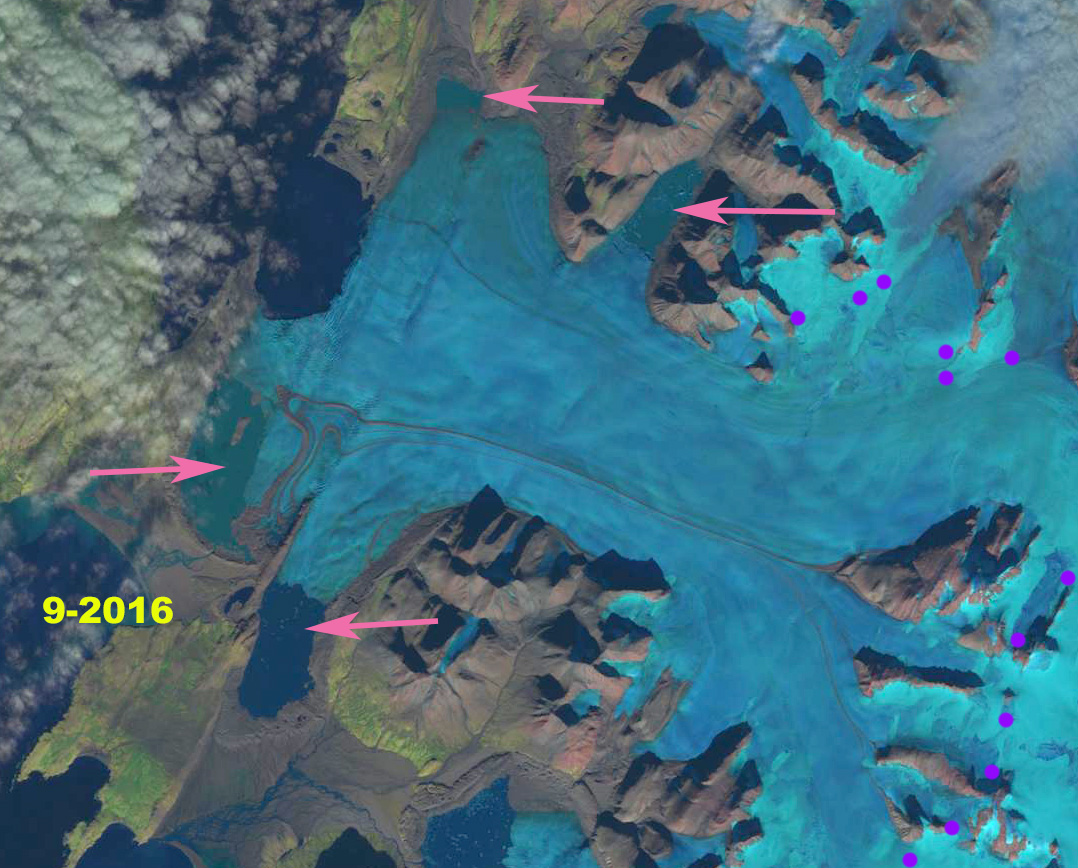
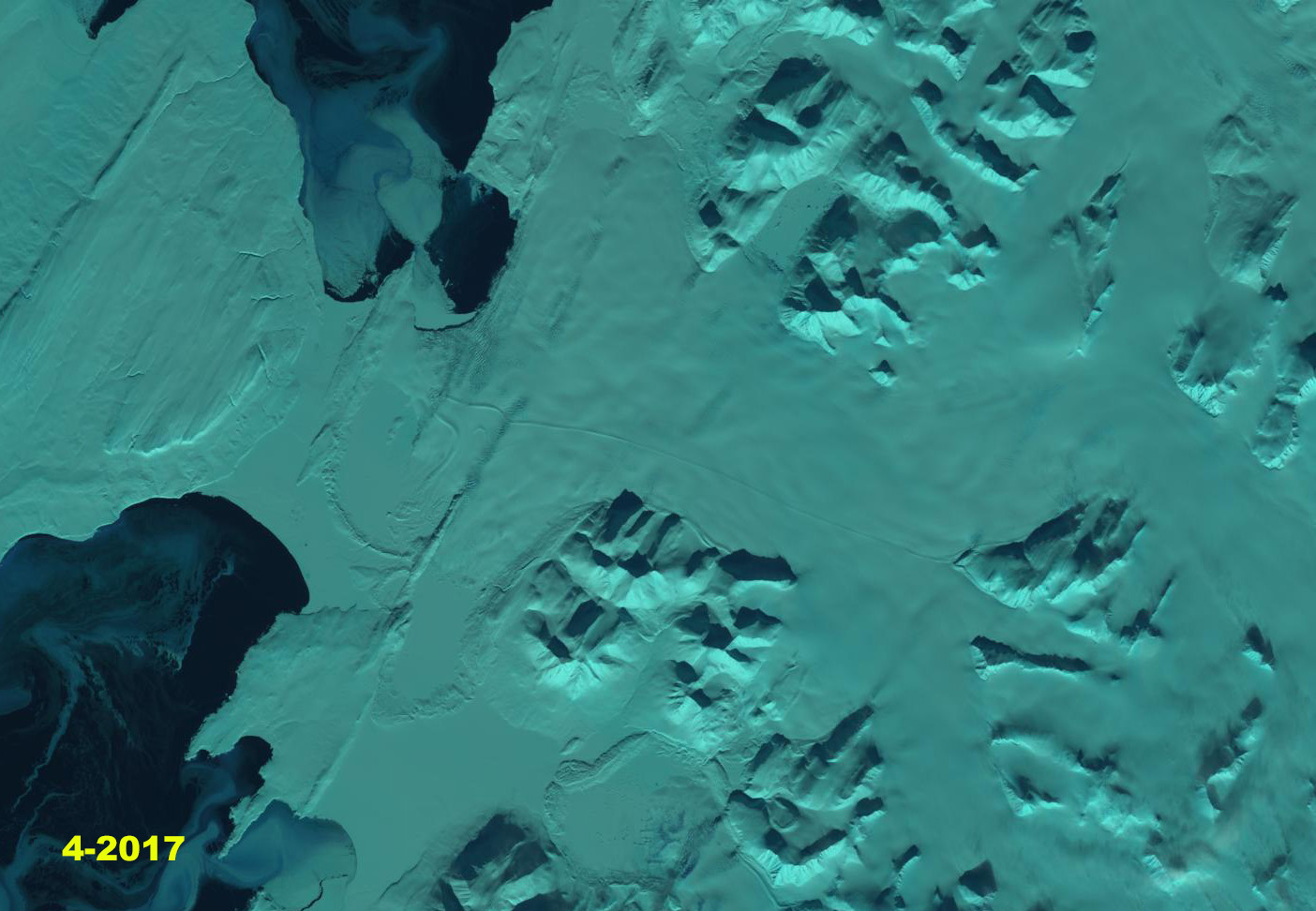
The Nizkiy Glacier has several termini in lakes and one in the Barents Sea. The main terminus juts north out to the end of a peninsula in 1990, with an embayment developing from the peninsula across to the northern edge of the terminus. The middle terminus ends in a proglacial lake and in 1990 the terminus largely envelops an island in the lake. The southernmost terminus is in a proglacial lake shown is indicated by a red arrow as well. The 2016 Landsat image indicates the continued reduction in Nizkiy Glacier width reaching the peninsula at the yellow arrow, having retreated 1200 m from the 1990 position.  Hence, It will likely be quite soon when the proglacial lake with the island joins with the Barents Sea. The northern edge of the terminus has retreated little, but the size of the embayment between the northern edge and the peninsula has doubled since 1990.   A new island has been exposed in the proglacial lake between the main terminus and the peninsula.  The expansion of the proglacial lake on the north side of the glacier just inland of the main terminus has retreated 600 m.  The southernmost terminus has retreated 1100 m in an expanding proglacial lake. The purple arrow in the comparison image indicates an expanding rib of bedrock amidst the glacier. In 1990 the snowline is at  550 m.  In 2015 the snowline is at 450 m.  In July of 2016 the snowline is at  525 and in September is at 600 m. This glacier fits the pattern of other Novaya Zemlya glaciers (Pelto, 2016), such as Krayniy and Tasija.  The lack of sea ice off the west coast of Novaya Zemlya in April of 2017, seen below, is a continuation of the pattern of open water early in the melt season, enhancing frontal melt. Note the pattern of sea ice in mid-April of 2004-2012 below

2015 Landsat Image, pink arrows indicate a bedrock rib that thinning ice is making evident. Purple dots indicate the snowline.

September 2016 Landsat image indicating the snowline is at a high elevation late in the summer.  Pink arrows are proglacial lakes. 

April 2017 Landsat image, note the lack of sea ice in front of the glacier. 

April Sea ice around Novaya Zemlya 2004-2012. 

Besselsbreen Retreat Glacier Wide Thinning , Svalbard

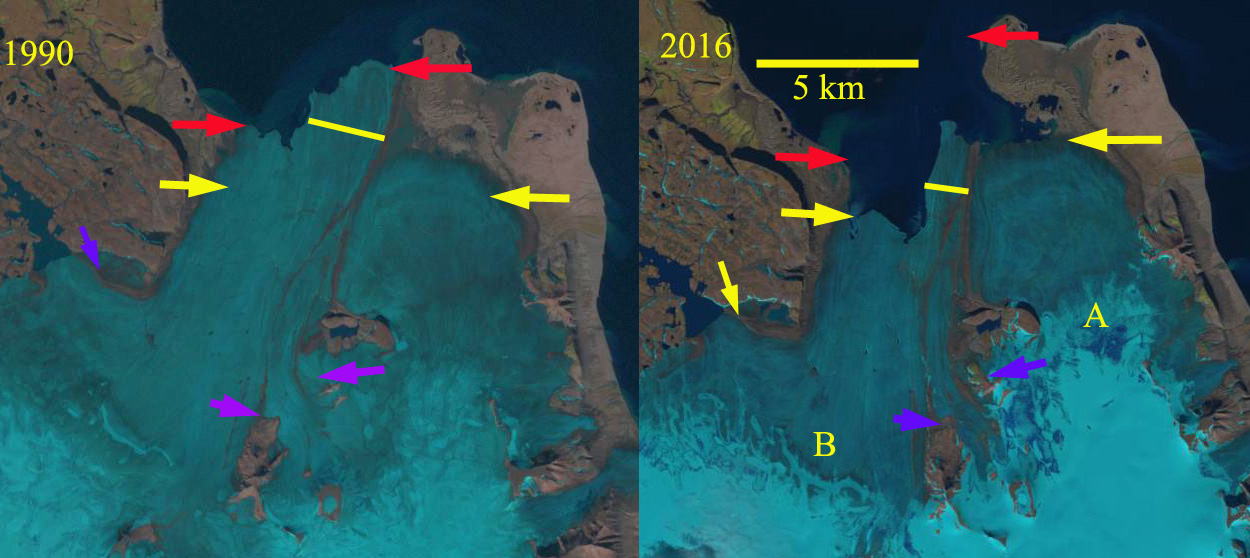
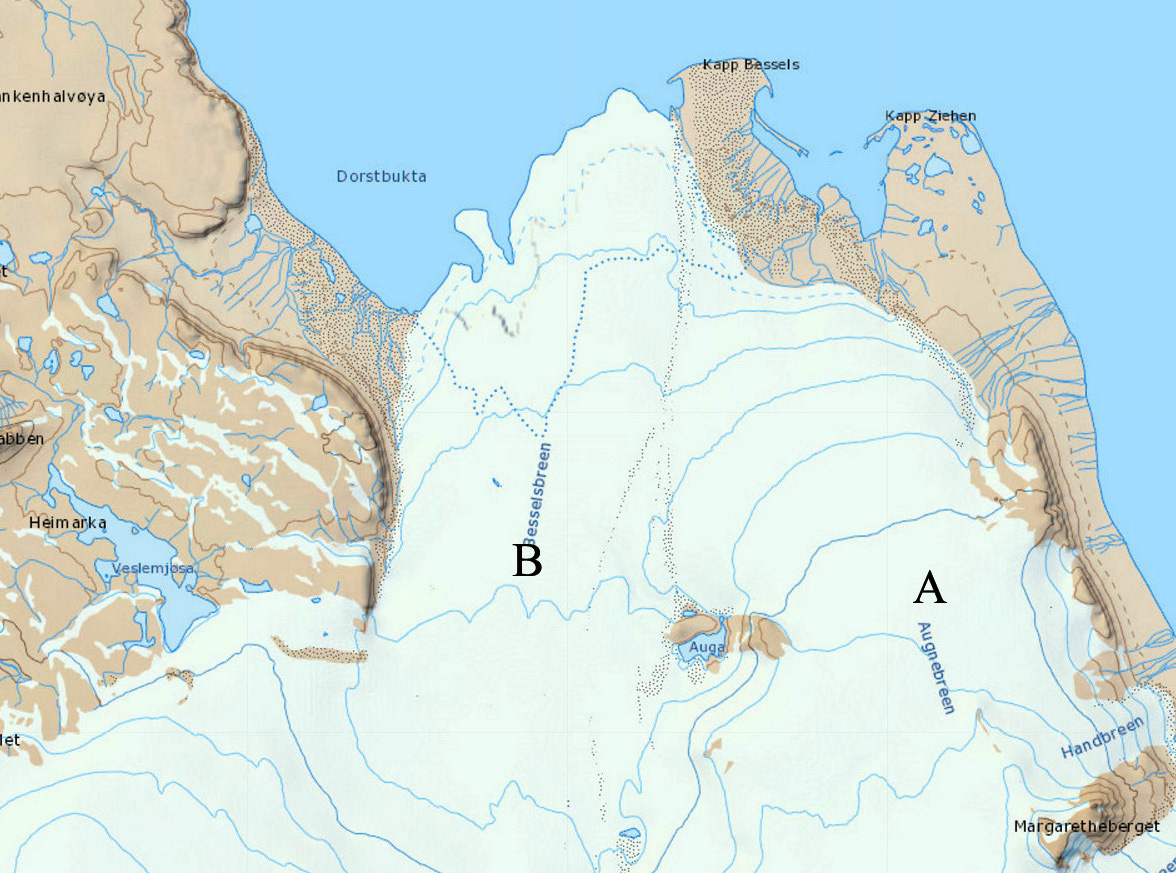
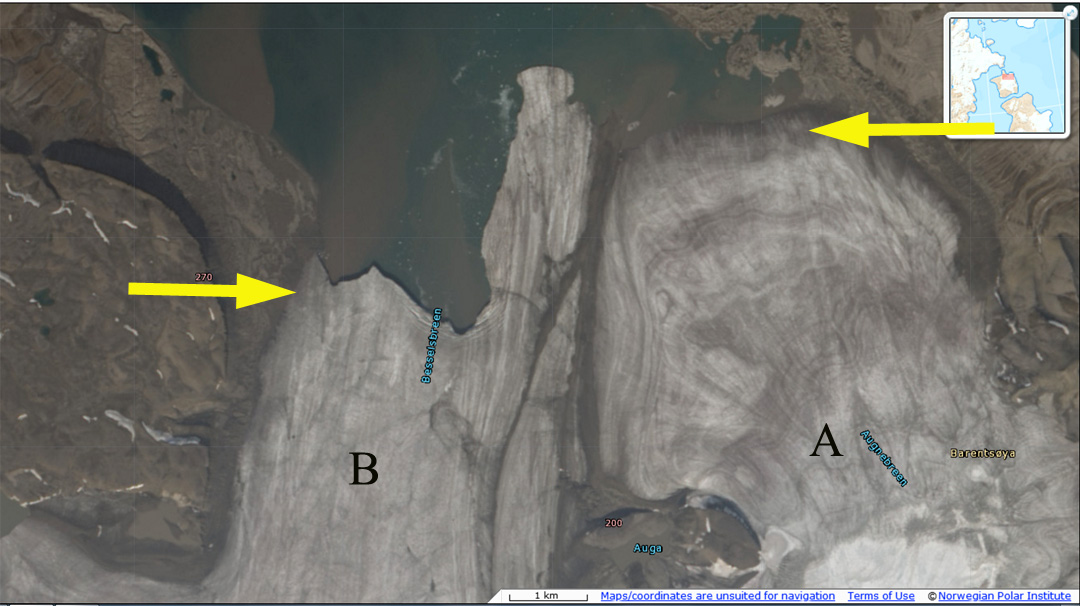
Besselsbreen (B) and Augnebreen (A) comparison in a 1990 and 2016 Landsat image. Red arrows indicate terminus position in 1990, yellow arrow indicates terminus in 2016, purple arrows indicate locations of upglacier thinning from 1990 to 2016 and the yellow line indicates the width of the tongue on the eastern side of Besselsbreen to the medial moraine with Augnebreen

Besselsbreen Glacier flows north to  tidewater from the Barents Icecap on Barentsoya Island in Svalbard.  The glacier has a low slope with the surface elevation reaching 250 m 10 km from the glacier front. The result is limited velocity and crevassing.  The lack of crevasses and flow enables formation of interesting surface stream networks as well. Here we examine Landsat imagery from 1990 to 2016 and Google Earth imagery from 2013 to identify key glacier changes. Dowdeswell and Bamber (1995) indicate the glacier has not surged since its Little Ice Age maximum and that the lowest 4 km of the glacier has a bed that is below sea level.  Gruell et al (2017) mapped the albedo of the glacier using MODIS and found it quite low all the way to the crest in the summer of 2003.  This suggests limited retained snowpack. The recent ocean and atmospheric warming (Isaksen et al , 2016) driving increased summer melt.

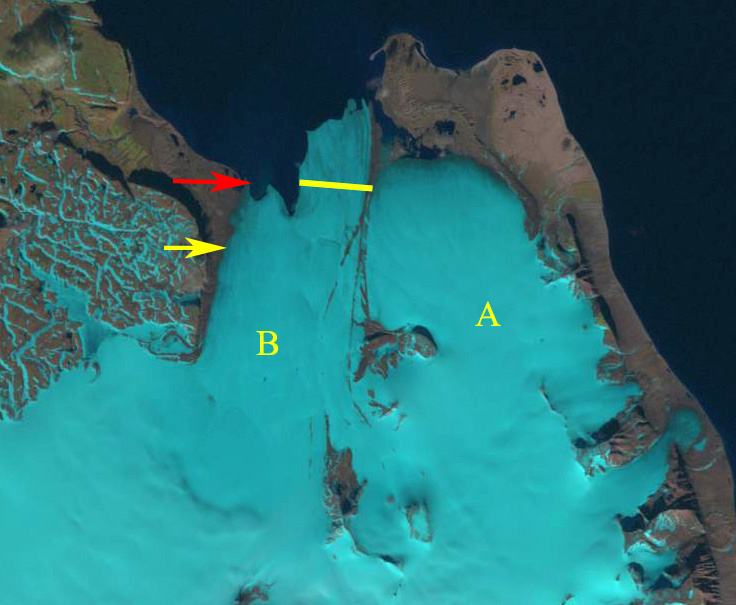
In 1990 Besselsbreen extended to within 1.2 km of Kap Bessels on the east side of the glacier and to the embayment widening on the west. The east side of the terminus had a 2.4 km wide tongue that extends beyond the rest of the terminus. There is no lake or tidewater at the terminus of Augnebreen.  The snowline is at 500 m near the top of the glacier. In 2000 the eastern tongue of the glacier is 2.0 km wide, the glacier has retreated a minor amount.  By 2016 the terminus on the west side of the inlet has retreated 1.9 km and 2.6 km on the east side of Besselsbreen.  The eastern tongue of the glacier is now 1.2 km wide.  The snowline in mid-August is at 400 m. Significant thinning has exposed substantial new bedrock areas at the purple arrows which are between 250 m and 350 m in elevation.   This is indicative of higher annual snowlines leading to significant surface melt driven thinning.  The glacier terminus has crevassing only near the embayment where the eastern tongue extends north from the rest of the terminus.  This suggest limited calving, no icebergs are noted in any images used. Warming sea temperatures and reduced sea ice are likely playing a role in enhanced near terminus melt rates. The lack of crevasses and extensive melting has led to substantial stream networks and surface ponds on the lower glacier as seen in Google Earth images below.  The low albedo of the relatively dark surface of the glacier even near the top underscores the failure to retain snow/firn through the summer allowing dust to accumulate on the surface. The medial moraine between Augnebreen and Besselsbreen will be a continuing location of separation.  Augnebreen is retreating less rapidly, 1.2 km from 1990-2016, but now has a significant tidewater embayment at the glacier front that should enhance retreat. 

The retreat here is less than the more calving dominated tidewater glaciers such as Hinlopenbreen, Kronebreen or Svitjodbreen.  In the case of Kronebreen that glacier has also been separating from Kongsvegen. 

Besselsbreen (B) and Augnebreen (A) comparison in a 2000 Landsat image. Red arrows indicate terminus position in 1990, yellow arrow indicates terminus in 2016 and the yellow line indicates the width of the tongue on the eastern side of Besselsbreen to the medial moraine with Augnebreen

Besselsbreen (B) and Augnebreen (A) comparison from TopoSvalbard map

Besselsbreen (B) and Augnebreen (A) comparison from TopoSvalbard image of 2013, yellow arrows indicate 2016 terminus. Note dark color of ice surface.

Besselsbreen in a Google Earth image indicating melt ponds and supraglacial streams.  Yellow dots indicate the ice front. 


Hinlopenbreen, Svalbard 7 km Retreat 1990-2016.

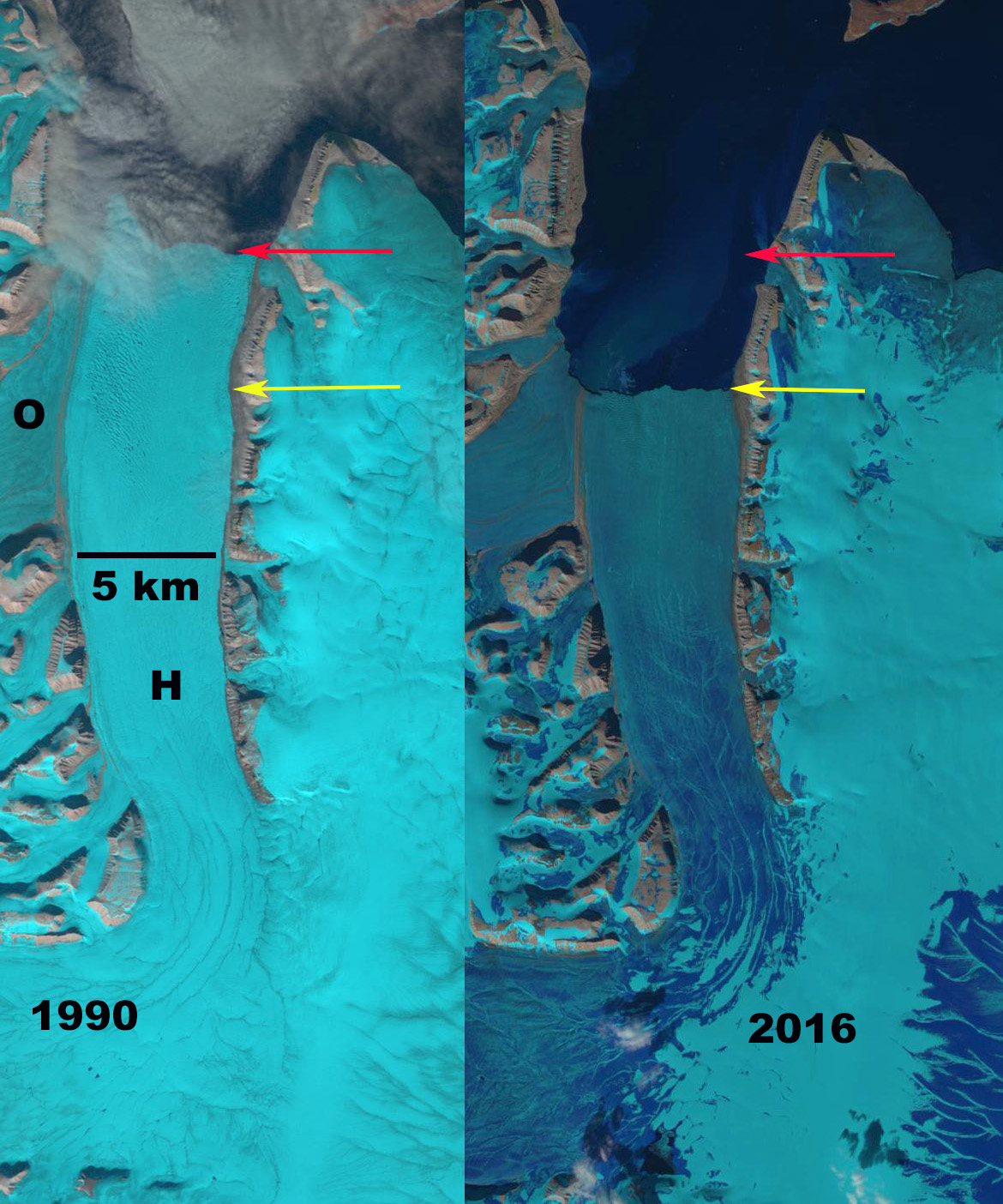
Hinlopenbreen, Svalbard in 1990 and 2016 Landsat imagery.  red arrow is 1990 terminus, yellow arrow is 2016 terminus,and Oslobreen is noted by Point O

Hinlopenbreen is a large tidewater glacier in northern Svalbard.  The glacier has a periodic history of surging, with the last surge occurring in 1970 (Nuth et al 2010). The glacier has the largest negative balance of -0.58 m/year from 1965-2005 (Nuth et al 2010).   The mass loss is ongoing including thinning on the upper glacier, which should be a build up period on a surge glacier.   Here we examine changes from 1990-2016 in Landsat images.

In 1990 Hinlopenbreen extended north terminating adjacent to a small tributary from the east, red arrow.  On the west side the terminus extended past the northern margin of Oslobreen (O) to a small tributary from the west.  The meltwater network is evident, though not as mature as in 2016. By 2016 the terminus has retreated 7 km south of the eastern tributary and several kilometers south of the northern edge of Oslobreen  merging from the west. The terminus of Hinlopenbreen is 5.6 km wide, exclusive of Oslobreen.  The width remains consistent for 10 km upglacier of the calving front. The retreat from 1990-2016 occurring two decades after the last surge is also indicative of a climate driven retreat not surge driven response. A surge driven retreat would feature accumulation zone thickening, such as noted by Murray et al (2012).  The meltwater network in 2016 indicates water flow through saturated firn, green arrows. The bare glacier ice is further down glacier.  Some of this meltwater will refreeze and not escape the glacier.  The snowline marks the region where the firn/snow is not saturated.  This is another glacier where we have to question whether a future surge is possible, as is the case at Fridtjovbreen.  The retreat of Hinlopenbreen Glacier is similar to that of most tidewater glaciers in Svalbard such as,  Paierbreen, Hornbreen and Svitjodbreen   Nuth et al (2013) determined that the glacier area over the entire archipelago has decreased by an average of 80 km2 per year over the past 30 years, a 7% reduction. 

Hinlopenbreen, Svalbard in TopoSvalbard aerial imagery.  red arrow is 1990 terminus and yellow arrow is 2016 terminus.

Hinlopenbreen, Svalbard in TopoSvalbard map, blue arrow indicate flow direction.  

August 20-16 Landsat imagery with the saturated firn in darker blue with meltwater channels evident. 

Azaubashi Glacier Fragmenting, Mount Elbrus, Russia

Azaubashi Glacier (W) and Azau Glacier (A) in 1985 Landsat and 2016 Sentinel Image. Orange arrows indicate particular areas of fragmentation and bedrock expansion.  Pink arrows indicate connection  with Azau Glacier the terminus of which in 1985 is at red arrow and in 2016 is at yellow arrow. 

Azaubashi Glacier is on the southwest side of Mount Elbrus, Caucasus Mountains of Russia, merging with the Greater Azau Glacier. The glacier drains east from Gora Azaubashi (3600 m).  The glacier is west of the ski complex at Prielbrusye, that has lifts from Azau at 2300 m to Krugozor at 3000 m and Mir at 3500 m.  Shahgedanova et al (2014)  report  glaciers on the mountain experienced a 5% loss in area from 1999-2012, with the Azaubashi Glacier losing a much higher percentage.

Azaubashi Glacier (W) and Azau Glacier (A) in 1998 and 2013 Landsat Images. Orange arrows indicate particular areas of fragmentation and bedrock expansion.  Pink arrows indicate connection  with Azau Glacier the terminus of which in 1985 is at red arrow and in 2016 is at yellow arrow. 
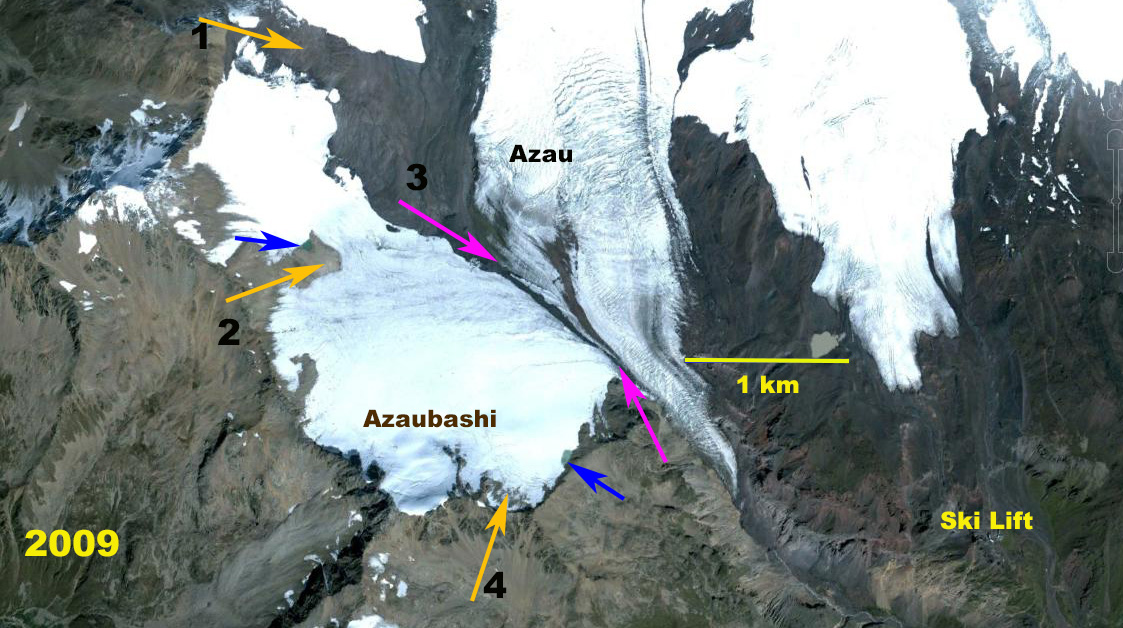
Here we examine Landsat images from 1985 to 2016 to quantify the substantial change. In 1985 the glacier extends north from Azaubashi to join with glaciers on the upper slopes of Elbrus in a 4 km continuous sweep.  At Arrow 1 and 2 the glacier is continuous and extends at least 800 m from top to bottom.  At Arrow 3 the glacier connection with Azau Glacier is extensive.  At Arrow 4 the glacier extends to the ridge.  By 1998 At Arrow 1 a bedrock arrow has nearly separated the glacier.  At Arrow 2 the glacier remains at least 700 m from top to bottom. The connection between Azaubashi and Azau Glacier remains extensive.  At Arrow 4 the glacier extends to the ridge.  By 2013, the bedrock exposed at Arrow 1 is 300 m wide.  At Arrow 2 the glacier is nearly severed with a connection of just 300 m.  At Arrow 3 the connection between glaciers is now discontinuous and tenuous.  At Arrow 4 the glacier no longer extends to the ridgeline,  The snowline on the south side of Mount Elbrus is at 3700 m. In 2016 the main change is the continued disconnection between Azaubashi Glacier and Azau Glacier, the connection that in 1985 was 1500 m long is now just 500 m long. The glacier will soon be split into three sections. The glacier did not retain any snowcover in 2016, in 1998 and 2013 less than 10% of the glacier retained snowcover.  The snowline in 2016 was at 3700 m on Aug. 28th. This indicates a glacier that cannot survive current climate as it lacks a consistent significant accumulation zone.  The retreat from 1985 to 2016 of the Azau Glacier noted at the red and yellow arrows has been 650 m.   The Azau Glacier still has an extensive accumulation zone.  TheAzaubashi Glacier is similar to the Dzhikiugankez Glacier in losing mass across nearly its entire surface.

Azaubashi Glacier in 2009 Google Earth image. Orange arrows indicate particular areas of fragmentation and bedrock expansion.  Pink arrows indicate connection  with Azau Glacier, blue arrows indicate two small lakes developing in previously glacier covered areas. 

Borden Peninsula Ice Caps, Baffin Island Snowcover Where Art Thou

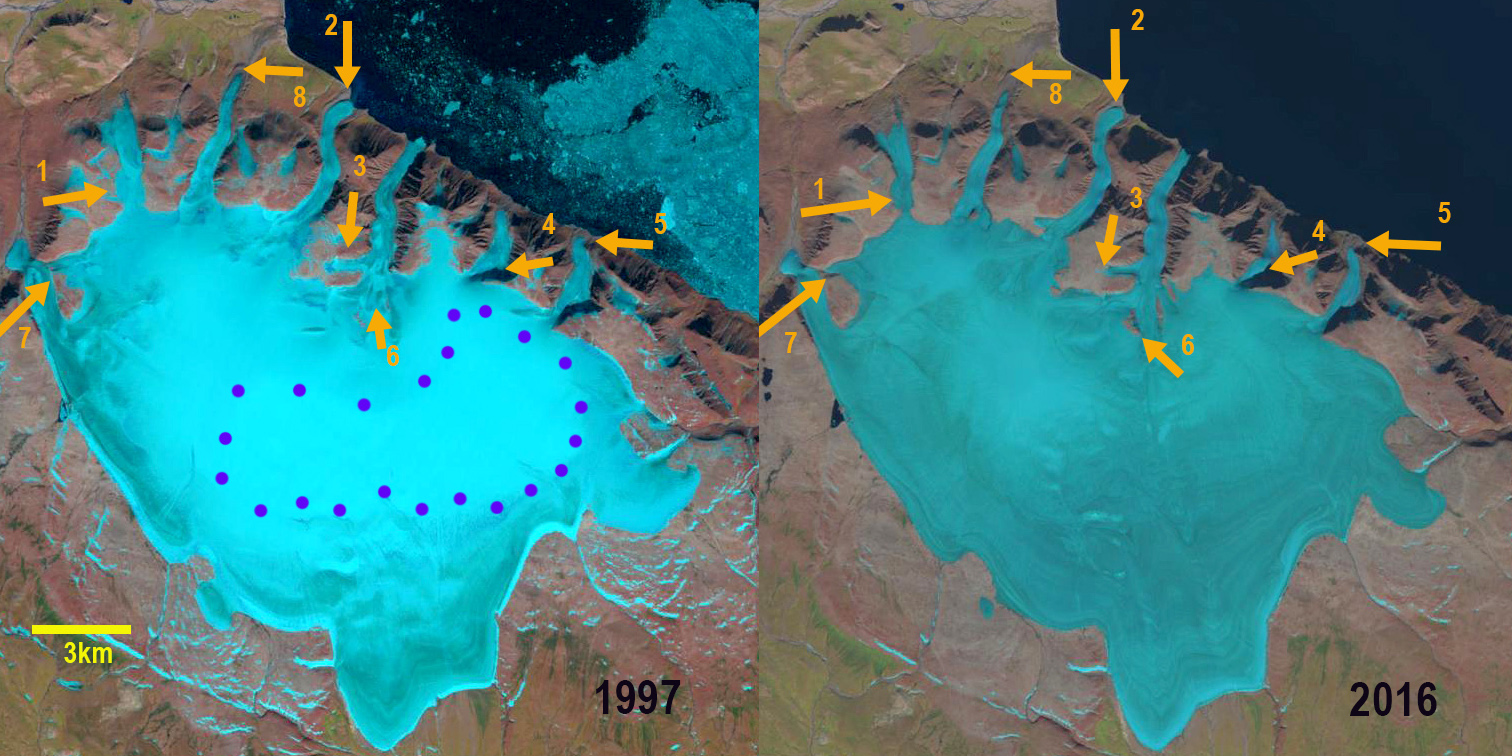
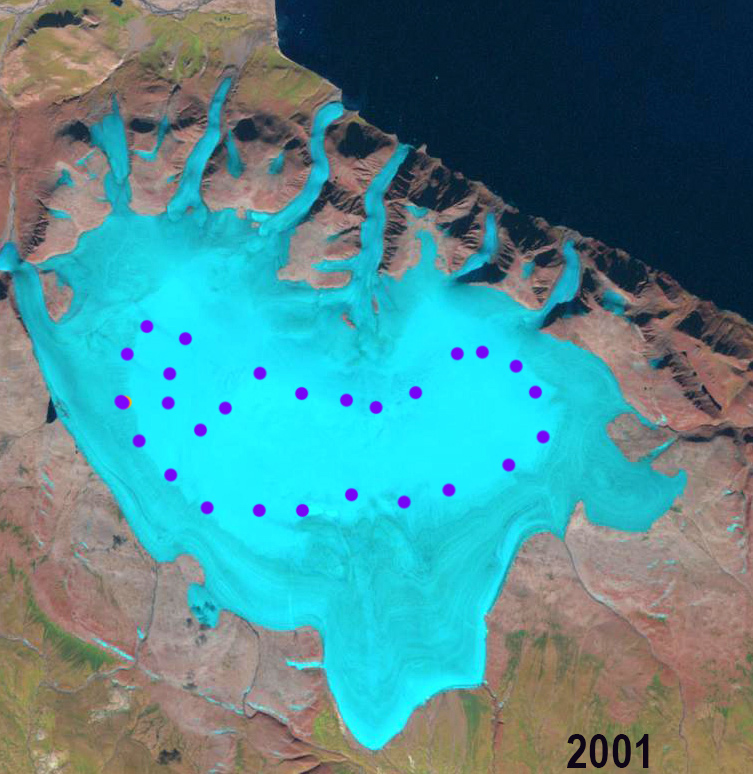
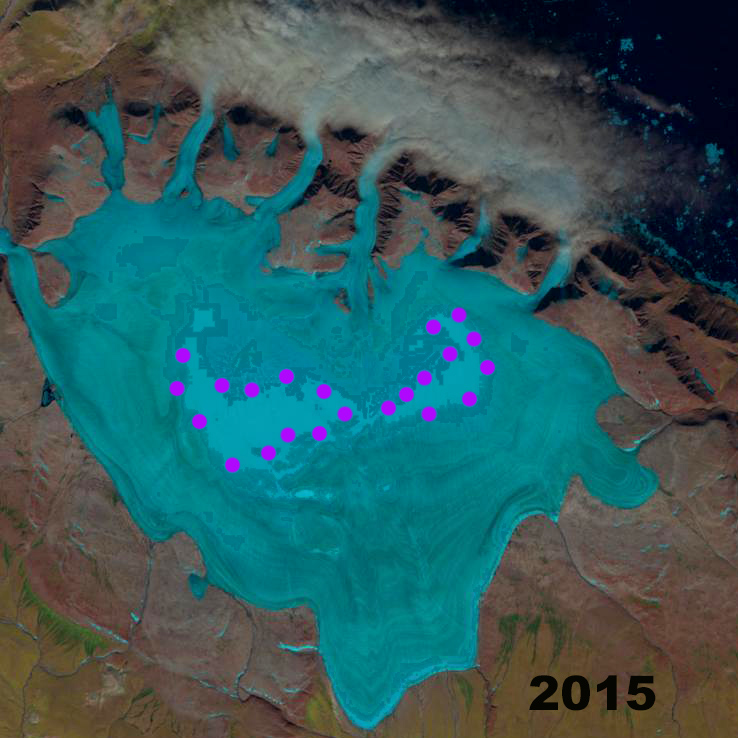
Borden Peninsula Ice Cap in 1997 and 2016 Landsat images.  Purple dots indicate the transient snowline.  Orange arrows indicate specific location of glacier thinning, retreat or area loss. 

The Borden Peninsula is in the northeastern most section of Baffin Island.  Here we examine an ice cap that is on the edge of Lancaster Sound in Sirmilik National Park.  We use Landsat imagery from 1997 through 2016 to identify change.  This compliments the examination of other Baffin Island Ice Caps: Dexterity, Clephane Bay, Grinnell, Barnes and Penny.  Gardner et al (2012) and Sharp et al (2011) both note that the first decade of the 21st century had the warmest temperatures of the last 50 years, the period of record and they identified that the mass loss had doubled in the last decade versus the previous four for Baffin Island.  

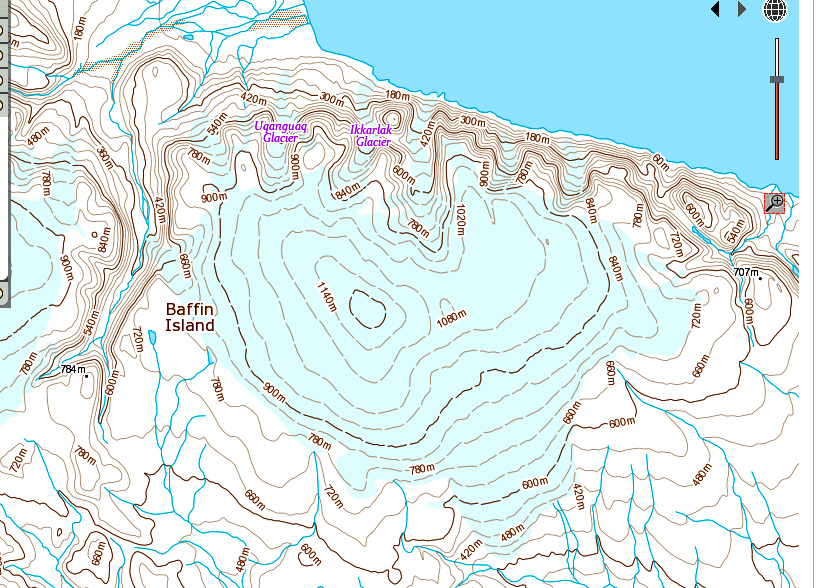
In 1997 the transient snowline late in the ablation season is averages 1020 m.  Two glaciers the Ikkarlak Glacier  Point 2 and the next glacier to the southeast, downstream of Point 6 both reached tidewater. lat in the ablation season of 2001 the transient snowline again average 1020 m. In 2016 there is no retained snowpack.  At Point 1 the arrow indicates an outlet glacier than has thinned where it connects to the main ice cap from 600 m to 250 m. At Point 2 the Ikkarlak Glacier that had reached tidewater in 1997 and 2001 no longer reaches the coast. At Point 3 a tributary glacier has been reduced in length and width.  At Point 4 the width of the outlet glacier has been reduced by 50%. At Point 5 in 1997 the glacier reached within 200 m of the coast and in 2016 the glacier terminates 500 m from the coast.  At Point 6 areas of new bedrock amidst the icecap have developed and expanded.  At Point 7 two outlet glaciers merged ain 1997 and in 2016 are now separated with an expanding bedrock region between the glacier tongues. The Uqanguaq Glacier at Point 8 has retreated from a terminal moraine, indicating a retreat of 600 m from this moraine with 300 m of retreat since 1997.  The lack of retained snowcover is similar to that seen at other Baffin Island Ice Caps recently Dexterity, Clephane Bay, and Grinnell.  Way (2015) noted that summer temperatures have warmed more than 1 C after 1990 in the region and that has led to disequilibrium with climate for Grinnell and Terra Nivea Ice Cap. The Borden Peninsula Ice Cap is retreating less than the ice caps noted in the southern part of Baffin Island. 

Borden Peninsula Ice Cap in 2001 Landsat image.  Purple dots indicate the transient snowline.  


Borden Peninsula Ice Cap in  July 31, 2015 Landsat image.  Purple dots indicate the transient snowline at 1060 m.


Schlatenkees Accelerating Retreat, Austria 1988-2016

Schlatenkees comparison in 1999 and 2016 Landsat images.  Red arrow is the 1988 terminus position, yellow arrow is the 2016 terminus location, purple dots indicate the snowline. 

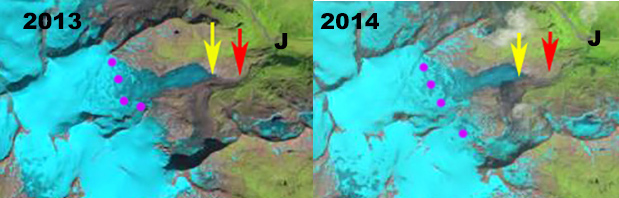
Schlatenkess (Glacier) is in the Venediger Alps draining into the Innergschlöss a tributary of the Isel River. The glacier is part of the network of glaciers examined by the Austrian Alpine Club annual glacier terminus survey supervised by Andrea Fisher.  Schlaten Glacier was one of the fastest of the 97 glaciers examined in 2015 and 2016 retreating 115 m in those two years. Fishcer, (2017) report that 84 of 88 glaciers observed were in retreat during 2015, and that 87 of 90 glaciers observed in 2016 were in retreat. . Bender et al (2012) provide a photo comparison of the glacier from 1890 and 2010 illustrating the loss of glacier ice.  Here we examine Landsat and Google Earth images from 1988 to 2016. In each image the red arrow is the 1988 terminus position, yellow arrow is the 2016 terminus location, purple dots indicate the snowline and J is the Innergschlöss River junction. 

Schlaten Glacier drains east from Grossvenediger and was approximately 5.4 km long terminating at 2220 m in 1988.  The snowline in 1988 is at 3050 m.  In the 1999 Google Earth image the lower 400 m of the glacier lacks significant crevassing indicating stagnation.  In 2000 the snowline is at 3000 m. In 2013 the snowline is at 3000 m, at 3050 m in 2014, at 3150 m in 2015 and 2016.  The terminus has retreated 600-650 m from 1988 to 2016 in the Landsat images, this is 12% of the glacier length gone.  The retreat rate for this periods is ~20 m/year rising to over ~55 m/year in the last two years, which also featured highs snowlines. The glacier now terminates at 2350 m , the lower 600 m has a low slope, few crevasses and one area of concentric crevasses, indicating a basin.  The basin indicates thin ice, suggesting this section of the glacier will soon be lost.  The regional retreat has been particularly fast since 1998 as Fischer et al (2015) noted with a 20% area loss in the Venediger area.  The retreat is similar to Gepatsch Glacier and Obersulzbach Kees

Schlatenkees comparison in 2000 and 2015 Landsat images.  Red arrow is the 1988 terminus position, yellow arrow is the 2016 terminus location, purple dots indicate the snowline.

Google Earth Image from 1999, above and 2015 below.  Point A and B respectively indicate the 1999 and 2015 terminus locations. 

Terminus of Schalten Glacier in 2015 note concentric crevasses indicating a basin. 

Schlatenkees comparison in 2013 and 2014 Landsat images.  Red arrow is the 1988 terminus position, yellow arrow is the 2016 terminus location, purple dots indicate the snowline.

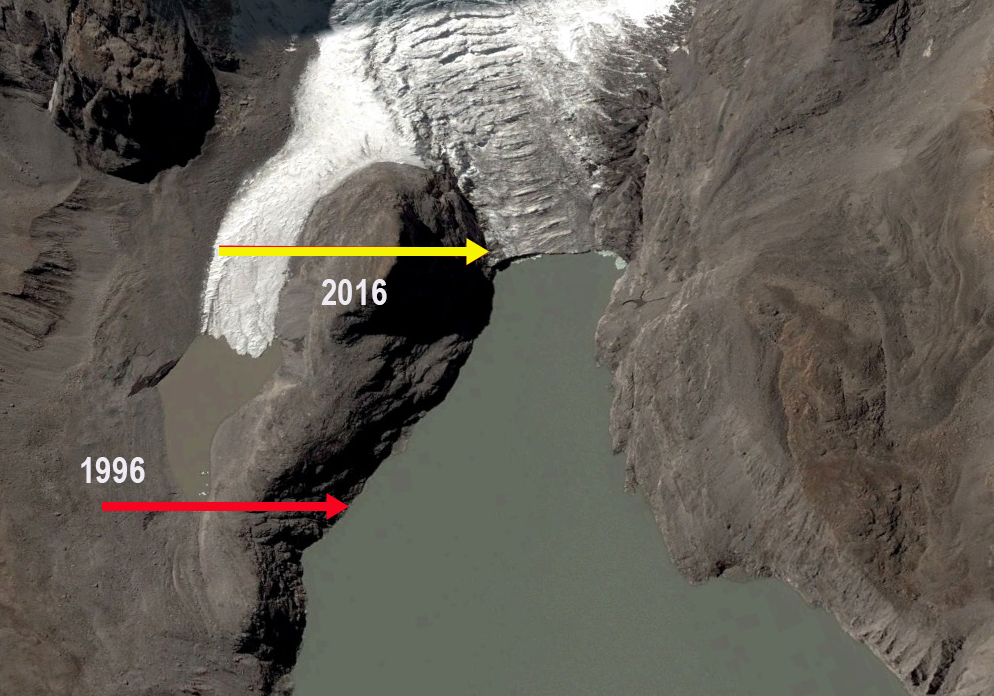
Gurudongmar Glacier Retreat and Teesta River Hydropower, Sikkim

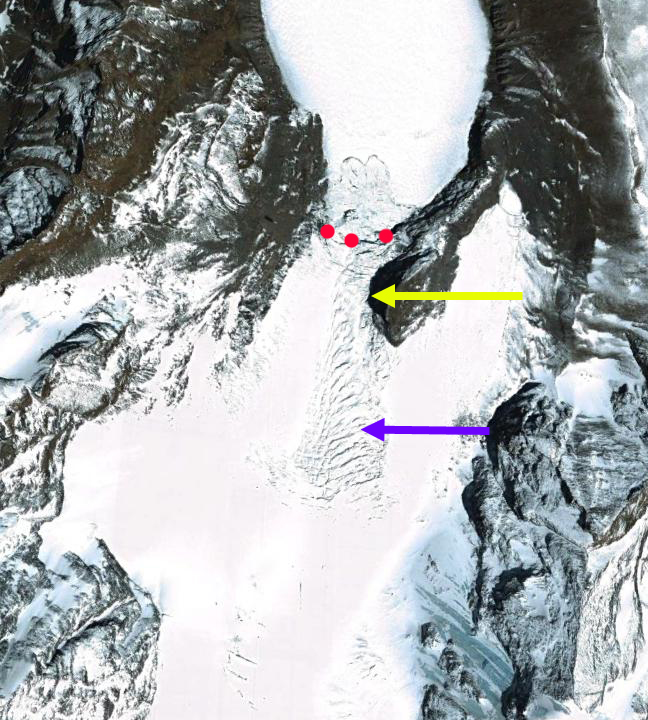
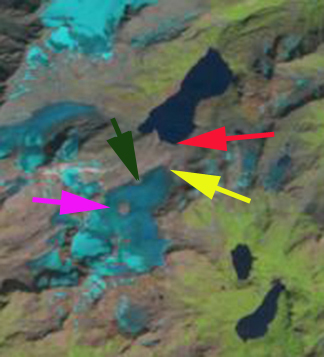
Gurudongmar Glacier draining ton Gurudongmar Lake B in Landsat images from 1996 and 1998 and Sentinel image from 2016.Red arrow is the 1996 terminus and yellow arrow the 2016 terminus.Point M indicates a terminal moraine belt, impounding the lake

Teesta Urja Limited is this month finishing the 1200 MW Teesta Stage III hydro power project on. The project is a run of the river scheme in the North Sikkim district. The dam is at the Chugthang Village just below the confluence of the Lachen River and Lachung River and the power house is 15 km downstream at Singhik. The project utilizes the fall of head in the River course, of about 800 meters between these two villages.  This project is a part of overall development of Teesta basin being undertaken by Sikkim Government. The project is run of the river designed to generate 5,214 Million kWh (units) annually in 90 per cent dependable year, as per the information provided. This project adds to the existing hydropower on the Teesta River, such as the  510 MW Teesta V, also highly dependent on glacier runoff.  The area of lake “B” in the Gurudongmar Cho Complex has increased nearly 4 times between 1965 and 1989. The significant increase in the areas of lakes “B” and adjacent “C” is a clear indicator of the glacier retreat/melt. Between 1989 and 2010, Gurudongmar Cho “B” has grown by one-sixth of its size in 1989 (Kumar and Prabhu, 2012). An inventory of Sikkim glacier lakes shows the existence of 320 glacial lakes,  85 are new ones in the study area compared to 2003 inventory, due to the ongoing retreat (Govindha Raj et al, 2012)

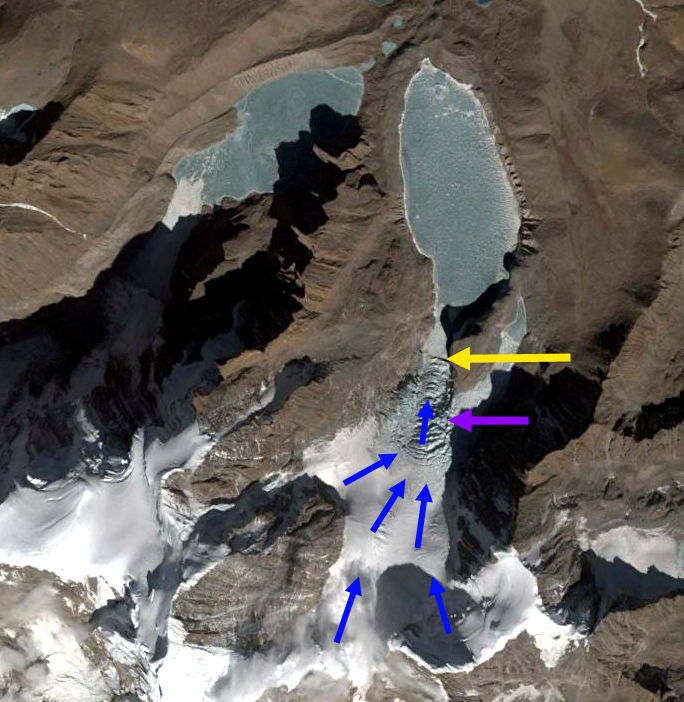
Like all glaciers in this region Gurudongmar Glacier is a summer accumulation type glacier. This means that the glacier receives most ~80% of its snowfall during the summer monsoon. This is also the period when ablation low on the glacier is highest. Following the summer monsoon which ends in early September there is a transition period with some colder storm events where the snowline drops. Than from November-February is the dry winter monsoon with limited precipitation. Thus, strange compared to most glaciers as winter proceeds often the lower glacier remains snow free.  Here we examine 1996 to 2016 Landsat and Sentinel images to identify change.  In 1996 the glacier terminates in the lake, just where the lake narrows significantly.  In 1998 the terminus remains at the same location, the shading better identifies the calving front.  Point M is the wide and stable moraine belt that impounds the lake.  This suggests a limited GLOF risk. By 2016 the terminus has retreated  600 m since 1987 through a narrow lake extension.  The glacier terminus based on the icefall that almost reaches the terminus, is nearing the upglacier end of the lake.  This should lead to a reduction in the retreat rate.  The retreat distance is substantial given the length of the glacier is 25% of the 1996 glacier length of 2.4 km.  The retreat of this glacier is similar to that of other glaciers in the basin such as Middle Lhonak Glacier, South Lhonak Glacier  and Changsang Glacier.

Google Earth image of Gurudongmar Glacier, indicating terminus location. Note icefall almost reaching shore.

Google Earth image from 2004 indicating s, terminus position in 2014 yellow arrow and icefall purple arrow.

Google Earth image from 2014 indicating glacier flow blue arrows, terminus position yellow arrow and icefall purple arrow.