Penny Ice Cap NW Thinning and Retreat Evident

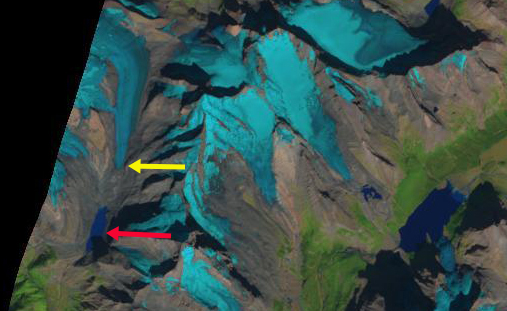
The Northwest (NW) and Northnorthwest (NNW) outlet of the Penny Ice Cap in 1991 and 2019 Landsat images. Red arrow indicates the 1991 terminus location. Point 1 is a large proglacial, Point 2-4 are areas of emerging and expanding bedrock amidst the ice cap.

The two largest outlet glaciers of the NW quadrant of the Penny Ice Cap feed the Isurtuq River.  In 1991 both outlet glaciers terminated at 600 m. Schaffer et al. (2017) noted a substantial reduction in velocity of the six largest outlet glaciers of the Penny Ice Cap from 1985-2011, 12% per decade. This is driven by mass balance losses, which drive thinning and retreat as well. Here we examine the changes from 1991-2019 of the Northwest (NW) and Northnorthwest (NNW) outlet of the Penny Ice Cap. The summer of 2019 is shaping up to feature substantial mass balance losses.

In the 1991 Landsat image the NW outlet reaches the Isurtuq River. The large 7 km2 proglacial lake #1 is impounded by the glacier, it is mostly covered by lake ice in this image.  At Point #3 there is no bedrock that has emerged.  The NNW outlet terminates 1 km south of the Isurtuq River, upglacier Point #2 is a single bedrock outcrop and Point #4 is barely evident.  In 2000 the NW outlet has receded from the river, the proglacial lake is still 7 km2 and Point #3 has no evident bedrock. The NNW outlet has receded 100-200 m and bedrock at Point #2 and 4 are more evident.  In 2016 the proglacial lake has diminished and now is several small lakes.  At Point 3 bedrock is evident.  At Point #2 there are two areas of bedrock covering 0.25 km2. The snowline in 2016 is above this portion of the icecap. In 2019 the NW outlet has retreated 500 m, proglacial lake #1 has three separate parts that total less than 2 km2. Bedrock at Point #2-4 has expanded significantly indicating ice cap thinning.  On June 30 2019 the snowline is already above this section of the ice cap, +1100 m with two months of melting to come.  Point #2 has an exposed bedrock area of 0.8 km2. Look for a merging of the bedrock at Point 2 and further expansion at 3 and 4. The high snowline at +1100 m, for this early in the summer was also observed at Fork Beard Glacier just east of Penny Ice Cap and is due to very warm temperatures in June in the region.

Way (2015) noted that the Grinnell Ice Cap also on Baffin Island, has lost 18% of its area from 1974 to 2013 and that the rate of loss has greatly accelerated due so summer warming. Grinnell Ice Cap also has seen a loss of snowpack even at its crest.

The Northwest and Northnorthwest outlet of the Penny Ice Cap in 2000 and 2016 Landsat images. Red arrow indicates the 1991 terminus location. Point 1 is a large proglacial, Point 2-4 are areas of emerging and expanding bedrock amidst the ice cap.

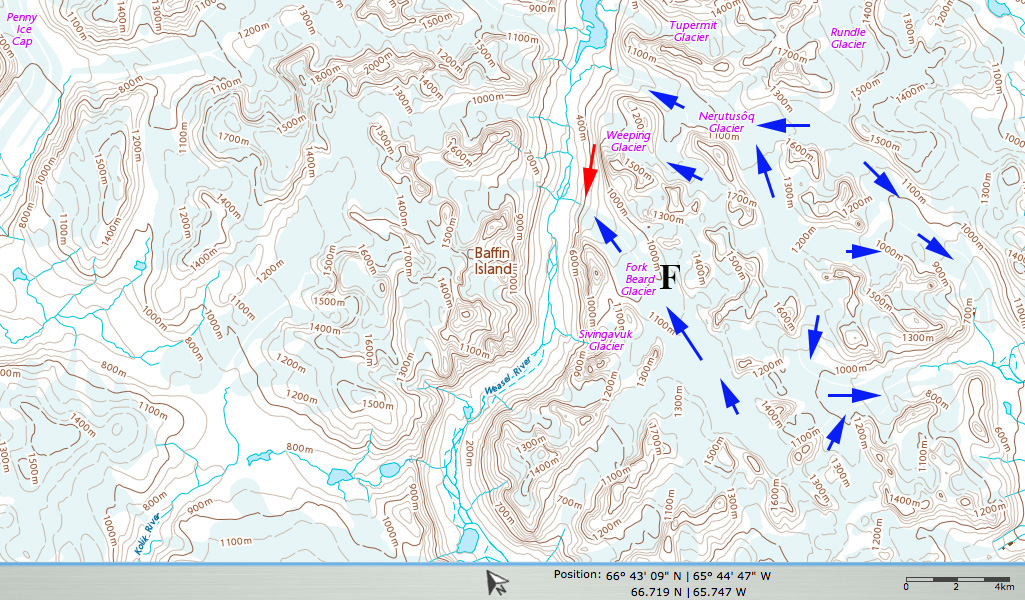
Map of the region

Fork Beard Glacier, Baffin Island High June 2019 Temperatures and Snowline

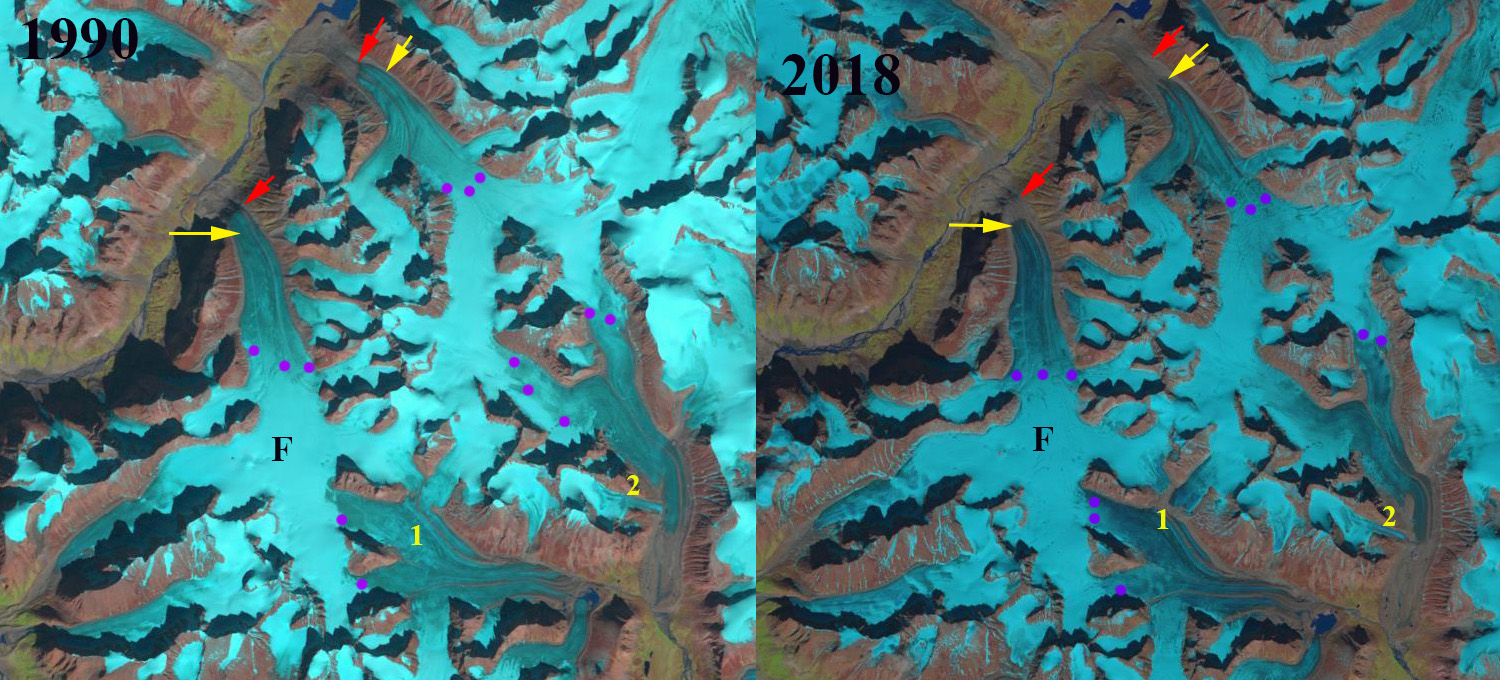
Fork Beard (F) and Nerutusoq Glacier (N) Baffin Island on June 1, 2019,  June 18, 2019 Sentinel images and June 30 Landsat image. Purple dots indicate the snowline. 

Fork Beard Glacier (F) is an outlet glacier of a mountain glacier complex just southeast of Penny Ice Cap on Baffin Island.  Nerutusoq Glacier  (N) also drains from the same complex. Here we examine the rapid rise of the snowline from June 1 to June 30, 2019.  This 30-day period at nearby Pangnirtung featured four days with record temperatures for that date June 5 (15.1), June 11 (13.5) and June 12 (13.6), and June 19 (14.4). There were 14 days with a maximum temperature above 10 C. Landsat images are utilized to identify the retreat and separation of Fork Beard Glacier and Nerutusoq Glacier and several neighboring glaciers from 1990-2018.  Gardner et al (2012) and Sharp et al (2011) both note that the first decade of the 21st century had the warmest temperatures of the last 50 years in the region, the period of record, and they identified that the mass loss had doubled in the last decade versus the previous four for Baffin Island. This has led to fragmentation of Coutts Ice Cap and loss of snowpack at Borden Ice Cap and disappearance of ice caps near Clephane Bay all on Baffin Island.

In late July of 1990 Fork Beard Glacier terminates near the top of a steep slope at 650 m, red arrow. At Point 1 and 2 tributaries connect to the main stem of two unnamed glaciers adjacent to Fork Beard Glacier. Nerutusoq Glacier terminates at 700 m. The snowline in mid August of 1990 on Fork Beard and its adjacent glacier to the southeast is 1050 m. In 2000 at Point 1 and 2 the tributaries still connect.  The terminus of Fork Beard and Nerutusoq Glacier have retreated 200-300 m since 1990. The snowline in this mid-August image is at 1150 m. By 2018 Fork Beard Glacier has retreated 600-700 m and now terminates at an elevation of 750 m. Nerutusoq Glacier has retreated 600-700 m and now terminates at an elevation of 825 m. In this late July image the snowline on Fork Beard and the adjacent glacier to the southeast (S) is again at 1050 m.  At Point 1 and 2 tributary glaciers have separated from the main stem glaciers. In Sentinel images from 2019 the snowline on Fork Beard Glacier and Nerutusoq Glacier  is at 800 m on June 1 rising rapidly to 1100 m by June 18.  On June 30 the snowline has risen to 1150 m. from This is a higher elevation than typically seen a month or two months later in the melt season during other years.  The retreat in  the region is driven by warmer temperatures and rising snowlines.  The glacier of Baffin Island are already primed for another poor year in 2019.

Fork Beard (F) and Nerutusoq Glacier (N), Baffin Island in 1990 and 2018 Landsat images. Red arrow indicates 1990 terminus, yellow arrow 2018 terminus, purple dots the snowline. 


Map of the region indicating flow on Fork Beard, Nerutusoq and two unnamed adjacent glaciers. Red arrow indicates 1990 terminus of Fork Beard at top of steep bench.

Fork Beard (F) and Nerutusoq Glacier (N), Baffin Island in 2000 Landsat image. Red arrow indicates 1990 terminus and purple dots the snowline. 

Yelverton Glacier, Ellesmere Island Extensive Retreat and Sikussak loss 1999-2018

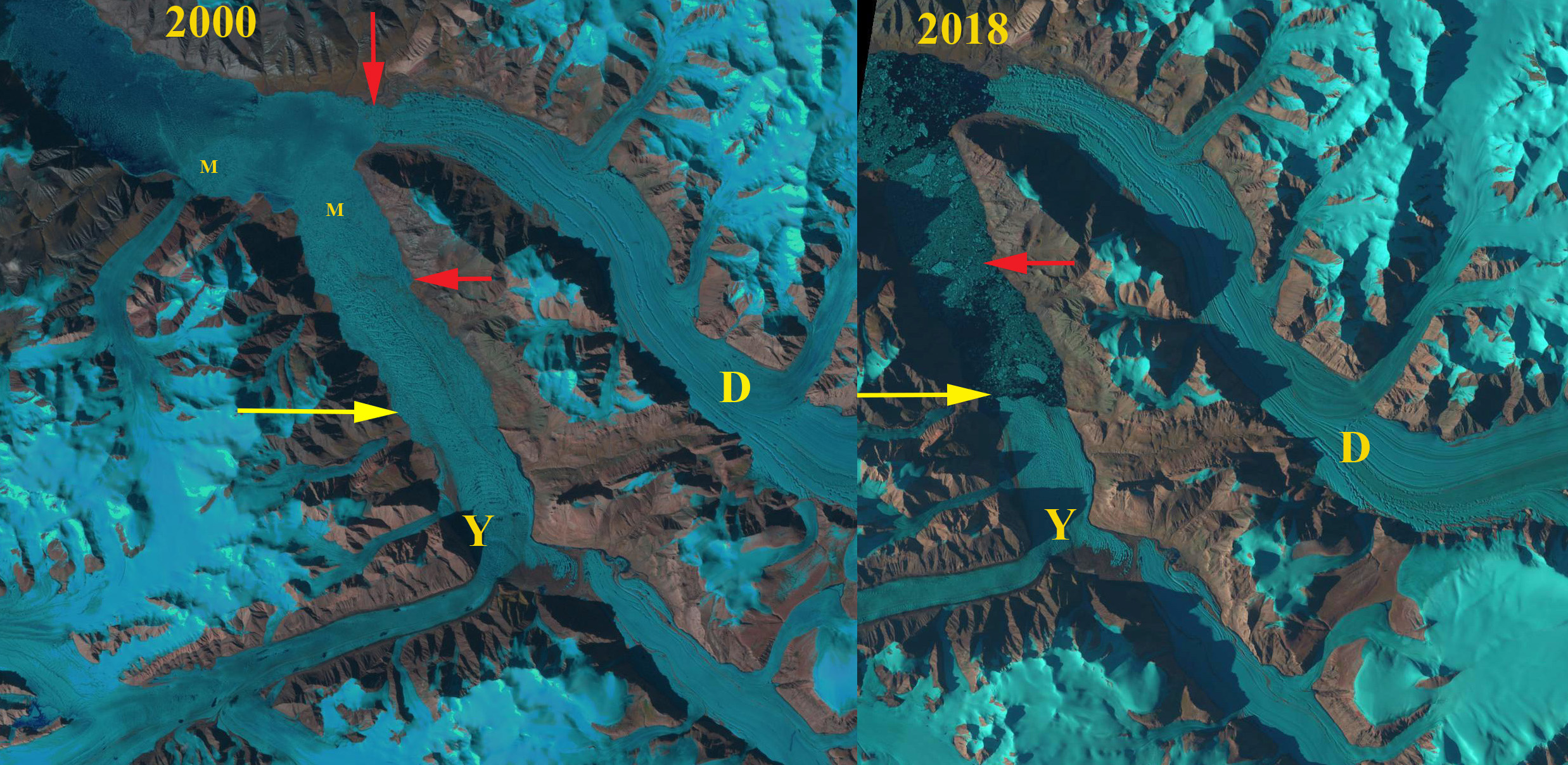
Yelverton Glacier (Y) and De Vries Glacier (D) in 1999 and 2018 Landsat images.  Red arrows and red dots indicate the 1999 terminus and yellow arrow the 2018 terminus.  Point M indicates the area of melange or sikussak, the boundary of this area is marked by orange dots. Purple dots mark the snowline.

Yelverton Glacier is an outlet glacier from an ice cap on Northern Ellesmere Island. White and Copland (2019) identified an 85% reduction in are of eight floating ice tongues in the Yelverton Bay area.  They further observed that many of the glacier including Yelverton lost a substantial area of melange that had protected the glacier fronts from contact with open water.  The melange is comprised of icebergs and mulit-year sea ice and is referred to as sikussak. Here we examine Landsat images from 1999-2018 to identify the retreat of Yelverton Glacier and the loss of sikussak.

In 1999, the sikussak extends to the end of the Yelverton Glacier inlet, while the glacier terminus is 4.5 km up the inlet.  De Vries Glacier terminates adjacent to the northern tip of the peninsula separating De Vries and Yelverton.  In 2000, there is no change in the terminus or sikussak, the snowline is at 900 m.  In 2002, the terminus region and sikussak remain unchanged, the snowline is again close to 900 m. By 2015, Yelverton Glacier has retreated to its grounding line.  The sikussak that had existed is gone. In 2018, the terminus is exposed to open water and has retreated 8 km since 1999, the snowline is at 900 m. The area of sikussak that had been 6 km long has not returned and persisted since it disappeared. Pope and Copland (2012) noted the loss of multi-year land fast sea ice in the region beginning in 2005 and concluding with total loss by 2010 driven by warming.  This same climate change has also driven the retreat of Trinity Wickeham Glacier and Devon Ice Cap that also released new islands.  The Canadian Arctic Islands have seen widespread glacier area/mass balance loss particularly during the last two decades ( Noël, 2018).

Yelverton Glacier (Y) and De Vries Glacier (D) in 2002 and 2015 Landsat images.  Red arrows indicate the 1999 terminus and yellow arrow the 2018 terminus.  Point M indicates the area of melange or sikussak. 

Yelverton Glacier (Y) and De Vries Glacier (D) in 2000 and 2015 Landsat images.  Red arrows indicate the 1999 terminus and yellow arrow the 2018 terminus.  Point M indicates the area of melange or sikussak. 

Croker Bay Glacier, Nunavut Canada Poised for Further Retreat

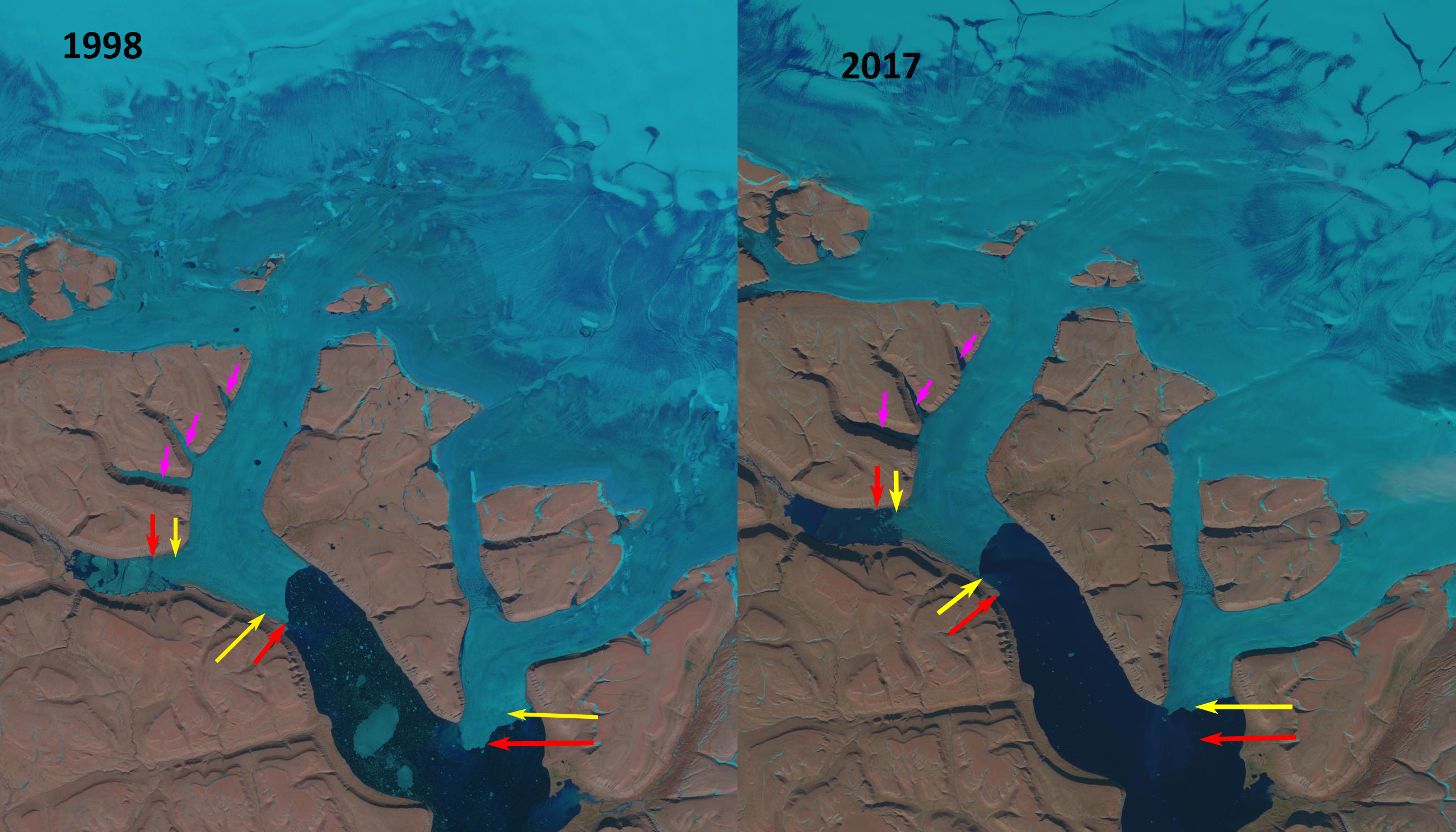
Croker Bay Glacier, Devon Ice Cap, Nunavut in Landsat images from 1998 and 2017.  The red arrows indicate the 1998 terminus location, yellow arrows the 2017 terminus location.  The pink arrows indicate three inlet on the north glacier. 

Croker Bay Glacier drains the southwest quadrant of the Devon Ice Cap, Nunavut.  A study by Van Wychen et al (2012) focused on velocity changes of the Devon ice Cap. They identify that Croker Bay Glacier has two main termini, the south and north terminus and that the region of higher velocity +100 m/year for these glaciers penetrates further into the ice cap than other outlets.  This is on the opposite side of the ice cap from where three new islands have emerged due to retreat.

In 1998 the south terminus of Croker Glacier extends 1.2 km beyond the tip of the peninsula on its west margin. In 1998 the northern terminus has both an east and a west terminus. The west terminus extends up a side valley.  The pink arrows indicate three side channels into which the glacier flows into the southern two.  The transient snowline in 1998 is ~1100 m, with the crest of the ice cap at 1800 m.  In 2001 there is limited change and a recent snowfall has covered most of the glacier. By 2017 the southern terminus has retreated to approximately parallel with the western margin peninsula, a distance of 1700 m.  The northern terminus has retreated 1400 m on the eastern side and 1100 m on the western side. The result is a much thinner ice connection reaching the southern side of the Croker Bay fjord. The transient snowline is high at ~1100 m again.  The 2018 image is from 2018. The snowline has already begun to decline due to a late summer snow event. There are a number of small icebergs in Croker Bay, particularly trapped in front of the western most terminus indicating continued calving retreat.  The observations here are a local example resulting from the ongoing mass losses  found on Canadian Arctic ice caps that have been losing mass for decades and that mass loss accelerated in 1996,  Noel  et al (2018).  This has led to widespread area losses.  White and Copland (2018) quantify the change in the areal extent of 1773 glaciers on Northern Ellesmere Island from 1999 to 2015. They found regional glacier area decreased by ∼6%, with not a single glacier increasing in areal extent.

Croker Bay Glacier, Devon Ice Cap, Nunavut in a Landsat image from 2001 and a Sentinel image from 2018.  The red arrows indicate the 1998 terminus location, yellow arrows the 2017 terminus location.  The pink arrows indicate three inlet on the north glacier. 

Velocity Map of Devon Ice Cap, which is Figure 1 from Van Wychen et al (2012)

Three New Islands Released from Devon Ice Cap, Canada

The northern coast of the Devon Ice Cap with Lady Ann Strait at the top in a 2000 and 2017 Landsat image indicating the development of islands at Cape Caledon, at yellow arrows. See map below. 

The Devon Ice Cap on Devon Island in the Canadian Arctic ice cap’s area has an area of 15,000 km², with a volume of 3980 km³. The ice cap has been the focus of an ongoing research program led by the University of Alberta Arctic and Alpine Research Group. The mass balance from 1960-2009 was cumulatively -5.6 m, with nine of the eleven most negative years occurring since 1998.  Noel  et al (2018) update this observation noting that Canadian Arctic ice caps have been losing mass for decades and that mass loss accelerated in 1996. This followed a significant warming (+1.1∘C), which increased the production of meltwater. This has led to widespread area losses.  White and Copland (2018) quantify the change in the areal extent of 1773 glaciers on Northern Ellesmere Island from 1999 to 2015. They found regional glacier area decreased by ∼6%, with not a single glacier increasing in areal extent.

East of Belcher Glacier, a large retreating tidewater outlet of the Devon Ice Cap, maps indicate a glacier terminating at Cape Caledon, a series of rocky Points on the southern side of the Lady Ann Strait.  Today the Cape Caledon Glacier no longer reaches these rocky Points that have now become islands.  Here we examine Landsat images from 2000 to 2018 to illustrate the changes.

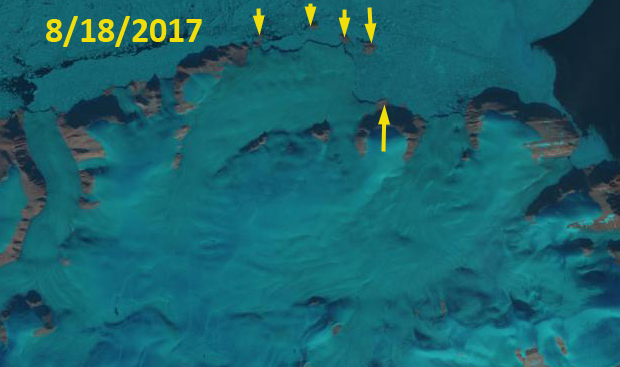
In 2000 the Cape Caledon Glacier terminates along its north side on three rocky points, yellow arrows, while the eastern margin is pinned on the northeastern most of the Points and extends nearly due south to another rocky Point, yellow arrow.  In 2002 little has changed on the northern or eastern margin.  By 2017 the glacier has separated from the three rocky Points on the northern margin, each is now a new island.  The mid-August 2017 image indicates that the snowline is particularly high, with none of the Cape Caledon Glacier in the accumulation zone.  This supports what has been observed in terms of significant changes in the nature of the firn due to increased meltwater infiltration in the region (Gascoin et al 2013). The eastern margin has retreated along most of its length, but remains attached to the rocky Point on the southern margin. In 2018 the islands remain separated from the glacier, but have some sea ice still around them.  The eastern margin that had terminated at the northeast most rocky Point has retreated from 500-700 m along nearly the entire front, except for the very southern margin. The generation of new islands is a process occurring across the Arctic as glaciers recede (Ziaja and Ostafin, 2018).

The northern coast of the Devon Ice Cap with Lady Ann Strait at the top in a 2002 and 2018 Landsat image indicating the development of islands at Cape Caledon, at yellow arrows. 

Map of Cape Caledon on the north coast of the Devon Ice Cap

The northern coast of the Devon Ice Cap with Lady Ann Strait at the top in a 2017 Landsat image indicating the development of islands at Cape Caledon, at yellow arrows, surrounded by some sea ice. 


Coutts Ice Cap, Baffin Island Fragmentation

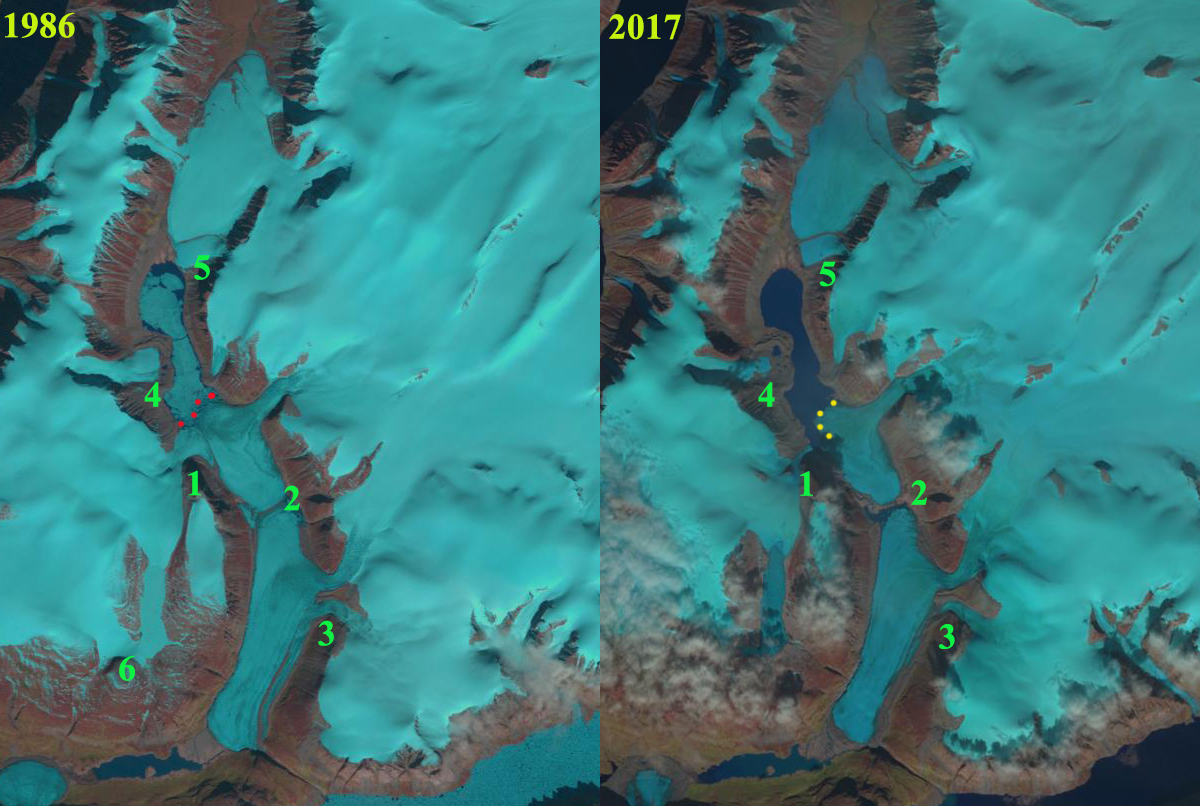
Coutts Ice Cap in  Landsat images from 1986 and 2017.  The terminus location of the main glacier terminating in the large lake is indicated by dots.  Tributary Glaciers 1-6 represent locations where glaciers have separated or a glacier has retreated from a lake. 

Coutts Ice Cap is on between Coutts Inlet to the west and Buchan Gulf to the east on the north shore of Baffin Island near its northeastern tip (see map below).  Here we are focused on a group of glacier that descend into a basin, that I refer to as Coutts Basin and Coutts Basin Lake. Gardner et al (2012) and Sharp et al (2011) both note that the first decade of the 21st century had the warmest temperatures of the last 50 years in the region, the period of record, and they identified that the mass loss had doubled in the last decade versus the previous four for Baffin Island. This led to surface lowering of up to 1 m/year on all ice masses on Baffin Island and Bylot Island between 1963 and 2006 (Gardner et al. 2012).

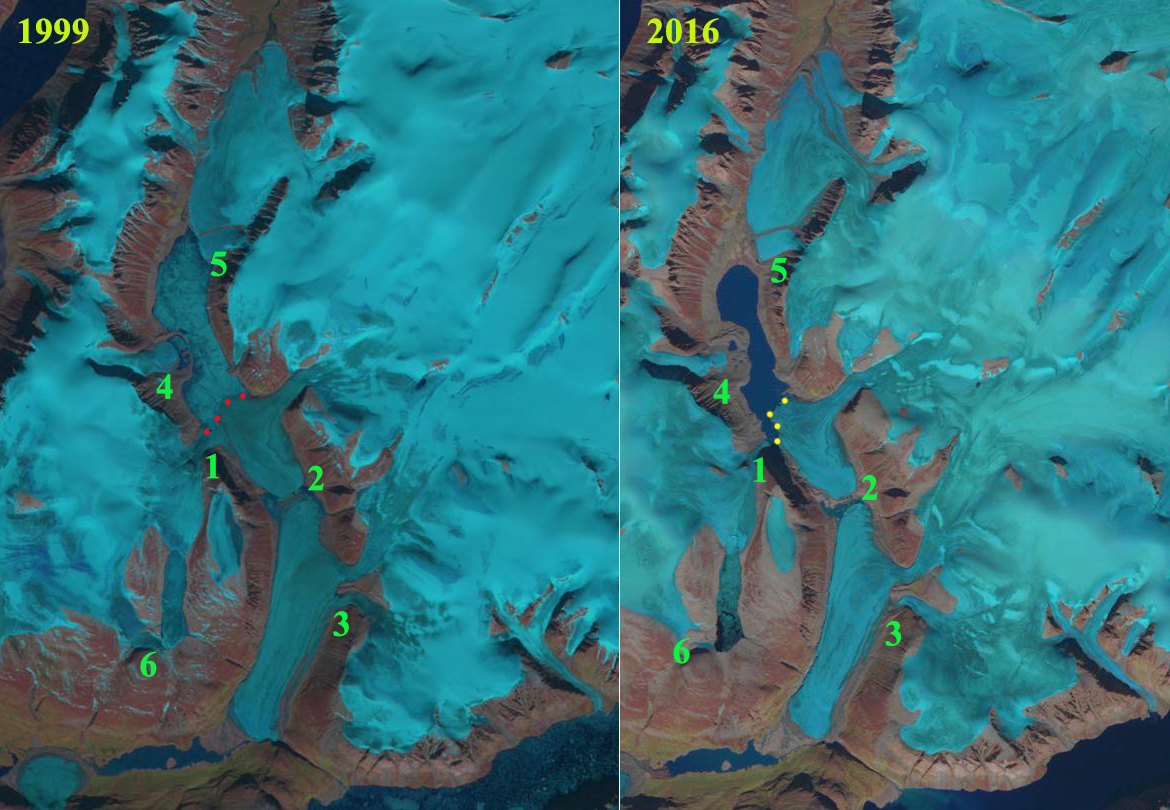
In 1986 the Tributary Glacier 1 (TG1), flows into the Coutts Lake basin joining with TG2.  TG3 feeds into the Coutts Basin glacier system.  TG4 has a significant piedomont lobe but terminates short of the Coutts Basin Lake. TG5 reaches the northern shore of Coutts Basin lake. TG6 drains into a secondary lake above the main Coutts Basin.  The main terminus of the Coutts Basin Glacier, red dots extends east to west across the lake. In 1999 the snowline is higher and there are minor changes, but retreat is limited and none of the glaciers have separated.  In 2016 the snowline is very high at 1500 m, leaving only a small part of the ice cap with snowcover. The high snowline in August 2016 have observed on Borden Ice Cap and Penny Ice Cap and have driven thinning and retreat there as well. TG1 no longer merges with TG2.  There is a separation of the glacier lobes at TG2.  TG3 no longer substantially feeds the Coutts Basin.  TG4 has thinned and retreated from near the short of Coutts Basin Lake. TG5 has receded from the lake shore.  TG6 has retreated from the upper lake. In 2017 the margin of the main Coutts Basin Glacier no longer extends across the lake, yellow dots. The snowline in August 2017 is at 1100 m lower than 2016.

Way (2015) noted that summer temperatures have warmed more than 1 C after 1990 on the Cumberland Peninsula at the south end of Baffin leading to a 18-22% decline of  Grinnell and Terra Nivea Ice Cap.

Coutts Ice Cap in  Landsat images from 1999 and 2016.  The terminus location of the main glacier terminating in the large lake is indicated by dots.  Locations 1-6 represent locations where glaciers have separated or a glacier has retreated from a lake. 

Map of the region indicating Cape Jameson (CJ), Coutts Inlet (CI), Buchan Gulf (BG), North Arm (NA), Coutts Basin Lake (CBL) and Coutts Ice Cap (CIC). 
Klinaklini Glacier, British Columbia Retreat Generates Large Icebergs

Klinaklini Glacier comparison in Landsat images from 1987 and 2017.  Red arrow 1987 terminus, yellow arrow 2017 terminus and snowline at purple dots.

Klinaklini Glacier is the largest glacier in the Coast Mountains of British Columbia between Vancouver and Prince Rupert.  The glaier drains west and south from Mt. Silverthrone.  There is significant accumulation area above 2500 m and the glacier terminates at 300 m.  GLIMS noted the area in 2004 as ~470 km2.  Glaciers in this region are retreating and losing volume, Schiefer et al (2007) noted that the rate of volume loss had doubled in  the most recent decade.  Clarke et al (2015) modeled a 70% loss in volume of all glacier in western BC by 2100. Here we examine Landsat imagery from 1987-2017, to identify changes.  In particular examining the area of large icebergs in 2015-2017 generated from a rapid calving retreat that has occurred since 2010. The glacier drains in to Knight Inlet a famous area for salmon fishing. 

I first saw this glacier in 1982 and at that time it ended on an outwash plain with a narrow lake/wide river leading from the terminus.  In 1987 the terminus was at this same location, red arrow, with no significant lake at the terminus.  The snowline in 1987 is at 1500 m.  By 1995 a lake had formed across the width of the terminus.  The lake was than 600 m long and the snowline was at 1600 m. In 2010 the glacier had retreated more than 1 km across its entire 1.3  km width.  The lake at the terminus had a surface area greater than 1.5 km2 and was largely filled with icebergs.  The snowline in 2010 is at 1500 m.  By 2013 the main proglacial lake has expanded to a length of over 2 km and remained largely filled with icebergs.  Retreat from 2010-2013 was as great as the retreat from 1995 to 2010.  The snowline in 2013 was at 1600 m.  From 2013 to 2014 there was no real change in the terminus position and the largest iceberg remained the same, pink (1).  In 2015 the snowline is at 1600 m and is at 1700 m in 2016.  In the side by side comparison of the terminus in 2015, 2016 and 2017 it is apparent that there was limited retreat from 2013, and a large calving event in 2017 generating an iceberg with an area of 0.7-0.9 square kilometers, pink (2), along with other smaller icebergs.  The lake is now 4 km long, yielding a retreat rate of 130 m/year from 1987-2017.  Nearly 50% of the retreat occurred in 2017.  In 2017 the snowline is at 1700 m as well.  The high snowlines each year are leading to mass loss, which leads to reduced flow through the ablation zone.  The thinning terminus due to higher ablation and less flux from above is then more prone to breakup.  The Klinaklini Glacier wins the prize for the largest observed iceberg produced by a glacier in Western Canada. The retreat is similar to other valley glaciers in the region Bishop GlacierJacobsen Glacier, Bridge Glacier and  Klippi Glacier.
Comparison of the terminus, pink dots in 2015, 2016 and 2017.  The red arrow is the 1987 terminus, yellow arrow the 2017 terminus and the largest icebe

rgs also labelled. 


Bishop Glacier Retreat, British Columbia Generates Substantial Alpine Lake

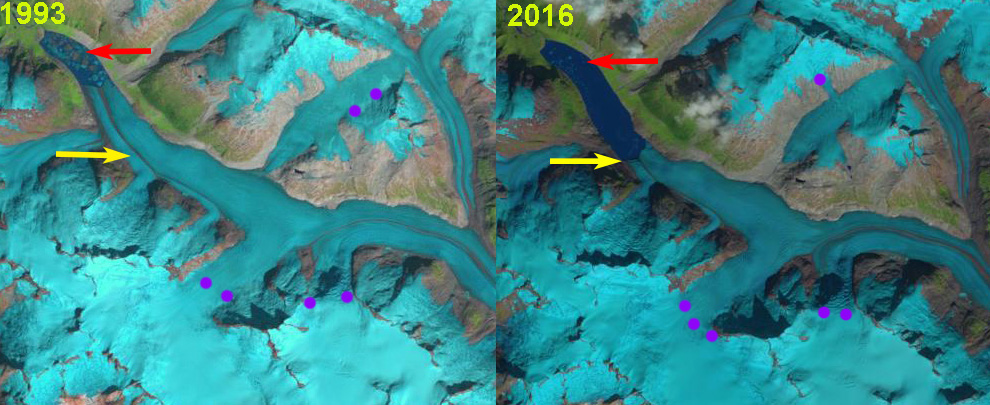
Bishop Glacier retreat in Landsat images from 1985 and 2017, 3000 m retreat. Red arrow is the 1985 terminus, yellow arrow is the 2017 terminus, purple dots is the snowline. B=Bishop, R=Ring, L=Lillooet.

Bishop Glacier is a 10.5  km long western outlet glacier of the Lillooet Icefield in British Columbia. The glacier shares a divide with the eastern outlet Lillooet Glacier at 1750 m.  The glacier from 1985-2017 has ended in a rapidly expanding glacial lake.  Here we examine the retreat using Landsat imagery from 1985-2017.  Bridge Glacier drains east from the same icefield and after a period of sustained retreat, 30 m per year from 1981-2005 (Allen and Smith, 2007), calving enhanced the retreat from 2004-2016 averaging 250 m/year (Pelto, 2017).  Chernos (2016) observed that as Bridge Glacier neared the upglacier end of the developing lake basin retreat would slow. 

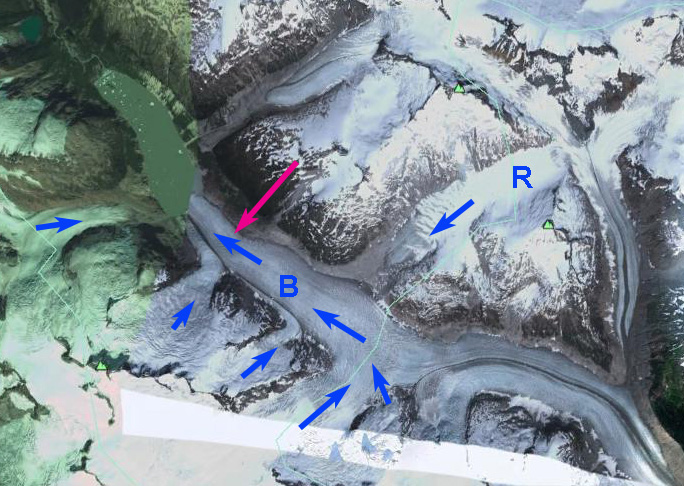
In 1985 Bishop Glacier terminated in a 1 km long proglacial lake at 1300 m. Ring Glacier was the main tributary, joining from the north.  The snowline averaged 2000 m. By 1993 the lake had expanded to a length of 2.25 km, the snowline was at 2150 m and Ring Glacier was barely connected to the main glacier.  From 1993-2002 retreat was slower with the lake expanding to 2.5 km in length, the snowline was at 1950 m and Ring Glacier had detached from Bishop Glacier.  In 2016 the snowline was at 2300 m and the lake was relatively free of icebergs.  In 2017 the proglacial lake is 4 km with a glacier retreat of 3000 m in 32 years.  Ring Glacier has retreated 800 m from Bishop Glacier. The lake is relatively free of icebergs in 2017 as well, suggesting a reduced calving rate in recent years.  There is an increase in slope 1 km above the terminus, pink arrow in Google Earth image suggesting this is the maximum distance the lake will extend upvalley.   Retreat should slow due to reduced calving, but will continue as indicated by the Ring Glacier and others retreating that are not calving glaciers. The snowline in 2017 despite a snowy winter is quite high at 2300 m.   The retreat is similar to other valley glaciers in the region Jacobsen Glacier  Klippi Glacier.
Bishop Glacier retreat in Landsat images from 1993 and 2016. Red arrow is the 1985 terminus, yellow arrow is the 2017 terminus, purple dots is the snowline.


Google Earth image of Bishop and Ring Glacier, pink arrow shows the change in slope.

Bishop Glacier retreat in Landsat images from 2002. Red arrow is the 1985 terminus, yellow arrow is the 2017 terminus, purple dots is the snowline.


Llewellyn Glacier, BC Proglacial Lake Merging From Retreat

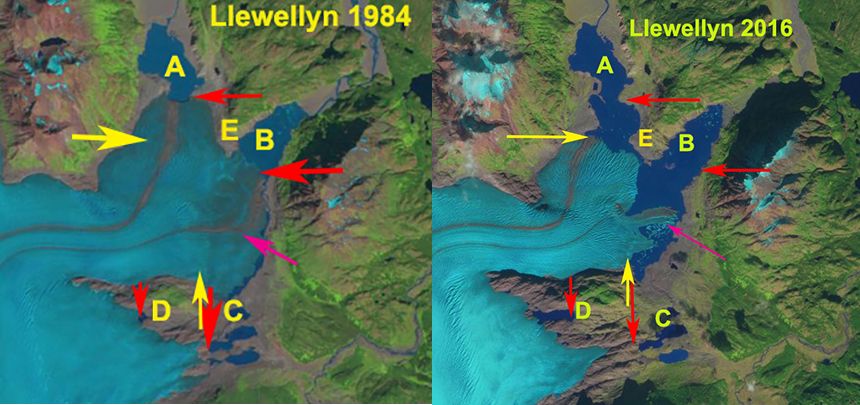
Llewellyn Glacier comparison in 1984 Landsat and 2016 Sentinel images.  Red arrows the 1984 terminus locations for proglacial lakes A-D, yellow arrows the 2016 terminus locations for A and B. Point E was the peninsula separating proglacial lakes A and B, which are now joined due to glacier retreat. 

The second largest glacier of the Juneau Icefield is the Llewellyn Glacier which is in British Columbia. The Juneau Icefield Research Program has a research camp, C-26 on this glacier and it is the typical exit route from the icefield at the end of the field season.  Here we examine changes in the terminus from 1984-2016 as a result of higher snowlines indicative of an expanded ablation zone and negative mass balance. 

I first visited the glacier in 1981 and I was also on the icefield in 1984 when the Landsat image was acquired that is used as the start point for comparison. In 1984 the glacier had several termini ending in proglacial lakes A-D. We exited the glacier on the west side of proglacial lake A in 1984 onto a proglacial outwash plain referred to as the ball bearing highway.   At Point B the terminus ended in a deeper wider proglacial lake than Lake A. At Point C and D the glacier ended in a series of small lakes.  Point E is the peninsula separating proglacial lake A and B in 1984. Proglacial Lake B had a surface water level 10-15 m higher than Lake A in 1984. In 2011 the glacier still reached Point E  separating the two lakes, which still had different water levels. In 2013 the gap first opened between the two lakes, and the water level fell in Lake B. In the summer of 2016 and spring of 2017 the gap has persisted and widened to  150 m.  From 1984 to 2016 the terminus in Lake A has retreated 1300 m, the terminus at Lake B 2100 m, terminus at Point C 800 m and terminus at Point D 1100 m. The narrow tongue of ice at the pink arrow will not survive long. The crevasse pattern suggests the glacier has another 1.5- 2 km to retreat before lake development will cease. 

The snowline during the 1998-2013 period averaged 1900 m too high for an equilibrium balance.  In a sequence of images from 2013 illustrates the rise is snowline from  1450 m on June 21,  to 1780 m on August 1 and  1810 m on Sept. 2.   The persistently higher snowlines since 1990 have led substantial thinning, Melkonian et al. (2013) note thinning of more than 1 m per year at the terminus diminishing to little change above 1500 m from 2000-2009. This will drive continued retreat, supplemented by calving into the still growing proglacial Lake at Point A and B.  The retreat of this glacier follows that of other glaciers of the Juneau Icefield including nearby Tulsequah Glacier, noted by Pelto et al (2013) and Pelto (2016) .

[ngg_images source=”recent_images” display_type=”photocrati-nextgen_basic_slideshow” gallery_width=”600″ gallery_height=”400″ cycle_effect=”fade” cycle_interval=”5″ show_thumbnail_link=”1″ thumbnail_link_text=”[Show thumbnails]” order_by=”sortorder” order_direction=”ASC” returns=”included” maximum_entity_count=”4″]

Borden Peninsula Ice Caps, Baffin Island Snowcover Where Art Thou

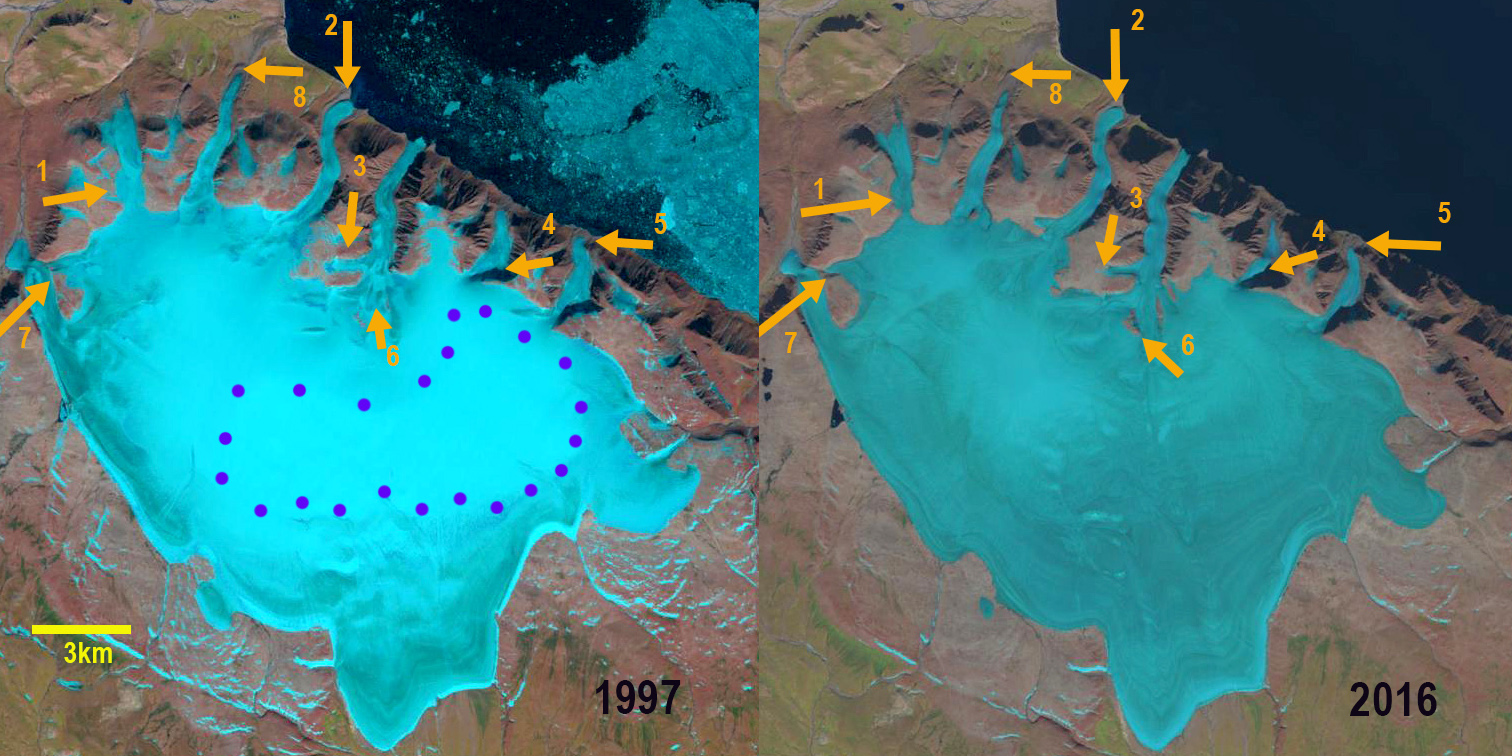
Borden Peninsula Ice Cap in 1997 and 2016 Landsat images.  Purple dots indicate the transient snowline.  Orange arrows indicate specific location of glacier thinning, retreat or area loss. 

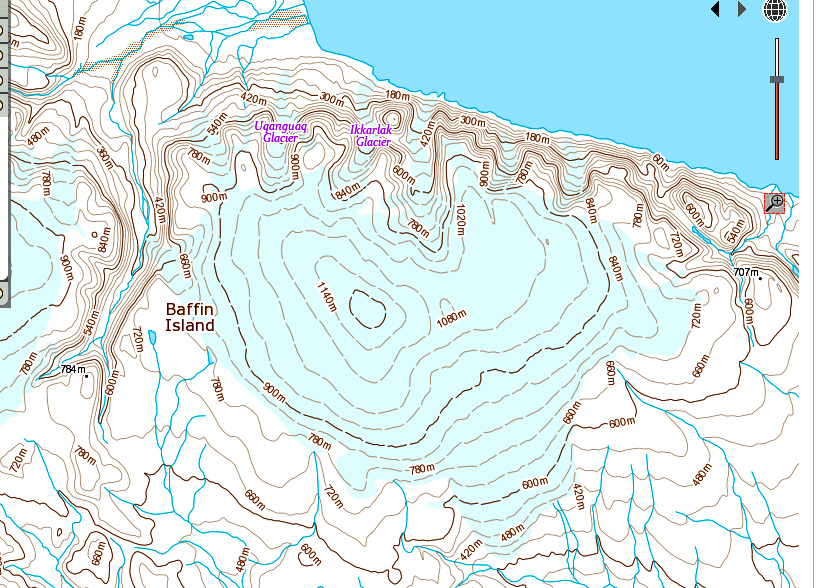
The Borden Peninsula is in the northeastern most section of Baffin Island.  Here we examine an ice cap that is on the edge of Lancaster Sound in Sirmilik National Park.  We use Landsat imagery from 1997 through 2016 to identify change.  This compliments the examination of other Baffin Island Ice Caps: Dexterity, Clephane Bay, Grinnell, Barnes and Penny.  Gardner et al (2012) and Sharp et al (2011) both note that the first decade of the 21st century had the warmest temperatures of the last 50 years, the period of record and they identified that the mass loss had doubled in the last decade versus the previous four for Baffin Island.  

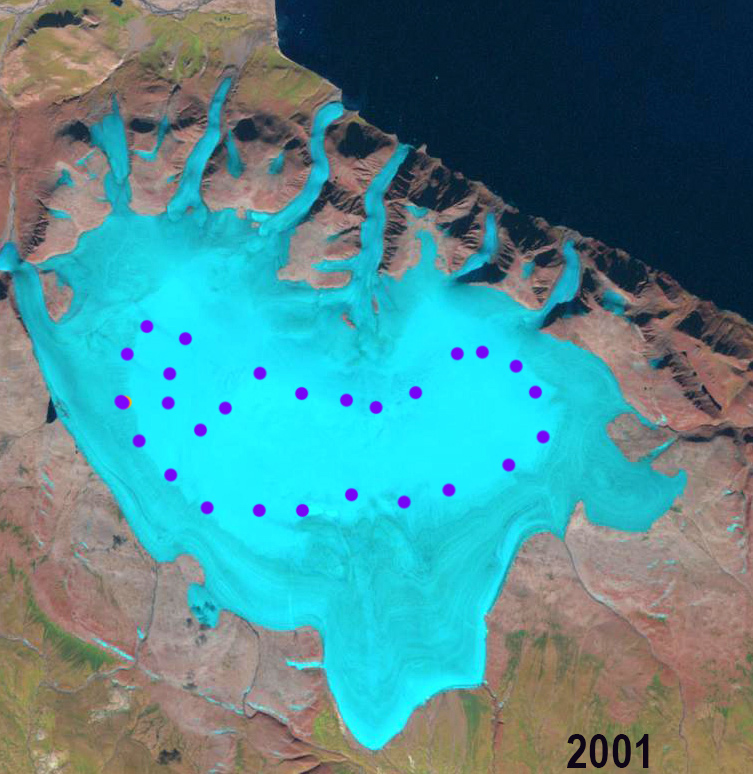
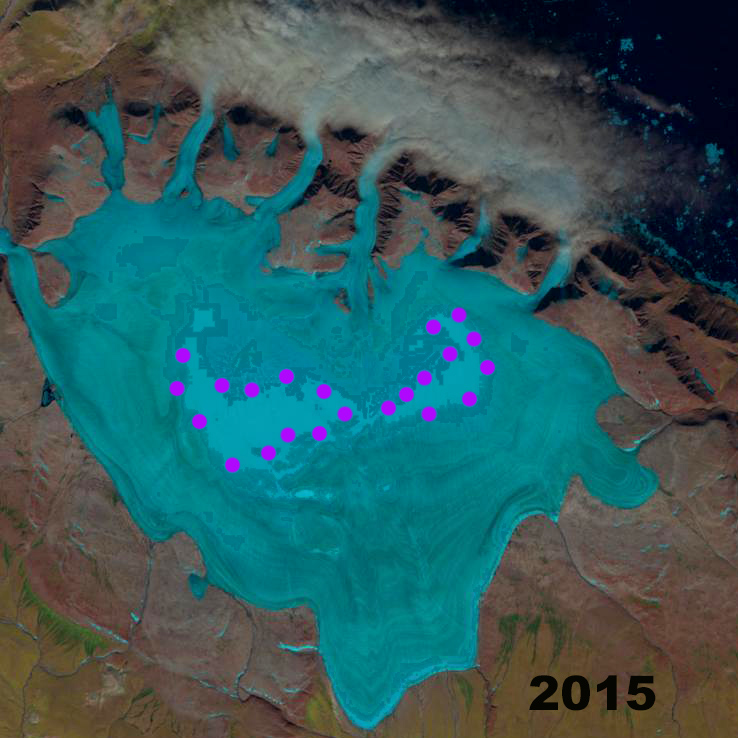
In 1997 the transient snowline late in the ablation season is averages 1020 m.  Two glaciers the Ikkarlak Glacier  Point 2 and the next glacier to the southeast, downstream of Point 6 both reached tidewater. lat in the ablation season of 2001 the transient snowline again average 1020 m. In 2016 there is no retained snowpack.  At Point 1 the arrow indicates an outlet glacier than has thinned where it connects to the main ice cap from 600 m to 250 m. At Point 2 the Ikkarlak Glacier that had reached tidewater in 1997 and 2001 no longer reaches the coast. At Point 3 a tributary glacier has been reduced in length and width.  At Point 4 the width of the outlet glacier has been reduced by 50%. At Point 5 in 1997 the glacier reached within 200 m of the coast and in 2016 the glacier terminates 500 m from the coast.  At Point 6 areas of new bedrock amidst the icecap have developed and expanded.  At Point 7 two outlet glaciers merged ain 1997 and in 2016 are now separated with an expanding bedrock region between the glacier tongues. The Uqanguaq Glacier at Point 8 has retreated from a terminal moraine, indicating a retreat of 600 m from this moraine with 300 m of retreat since 1997.  The lack of retained snowcover is similar to that seen at other Baffin Island Ice Caps recently Dexterity, Clephane Bay, and Grinnell.  Way (2015) noted that summer temperatures have warmed more than 1 C after 1990 in the region and that has led to disequilibrium with climate for Grinnell and Terra Nivea Ice Cap. The Borden Peninsula Ice Cap is retreating less than the ice caps noted in the southern part of Baffin Island. 
Borden Peninsula Ice Cap in 2001 Landsat image.  Purple dots indicate the transient snowline.  


Borden Peninsula Ice Cap in  July 31, 2015 Landsat image.  Purple dots indicate the transient snowline at 1060 m.


Swiftcurrent Glacier, British Columbia, Swiftly Retreating 1986-2015

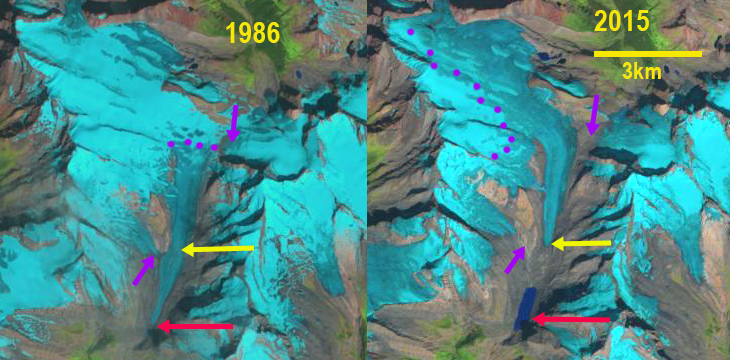
Swifttcurrent Glacier Comparison from 1986 and 2015 Landsat images.  Red arrow is the 1986 terminus, yellow arrow 2015 terminus, purple arrow significant tributaries in 1986, and purple dots the snowline.

Swiftcurrent Glacier drains the southeast side of Mount Longstaff 15 km NW of Mount Robson.  The glacier is near the headwaters of the Fraser River, and its retreat since 1986 has led to the formation of a new alpine lake. Here we examine glacier change from 1986 to 2015 in Landsat images.  Bolch et al (2010) found that from 1985-2005  BC glaciers lost 11% of their area.  Jiskoot et al (2009) examined the behavior of Clemenceau Icefield and found that from the mid 1980’s to 2001 the nearby Clemenceau Icefield glaciers had lost 42 square kilometers, or 14% of their area.  Tennant and Menounos (2012) examined changes of the Rocky Mountain glaciers in Alberta and BC finding that from 1919 to 2006 that glacier cover decreased by 590 square kilometers, 17 of 523 glaciers disappeared and 124 glaciers fragmented into multiple ice masses. 

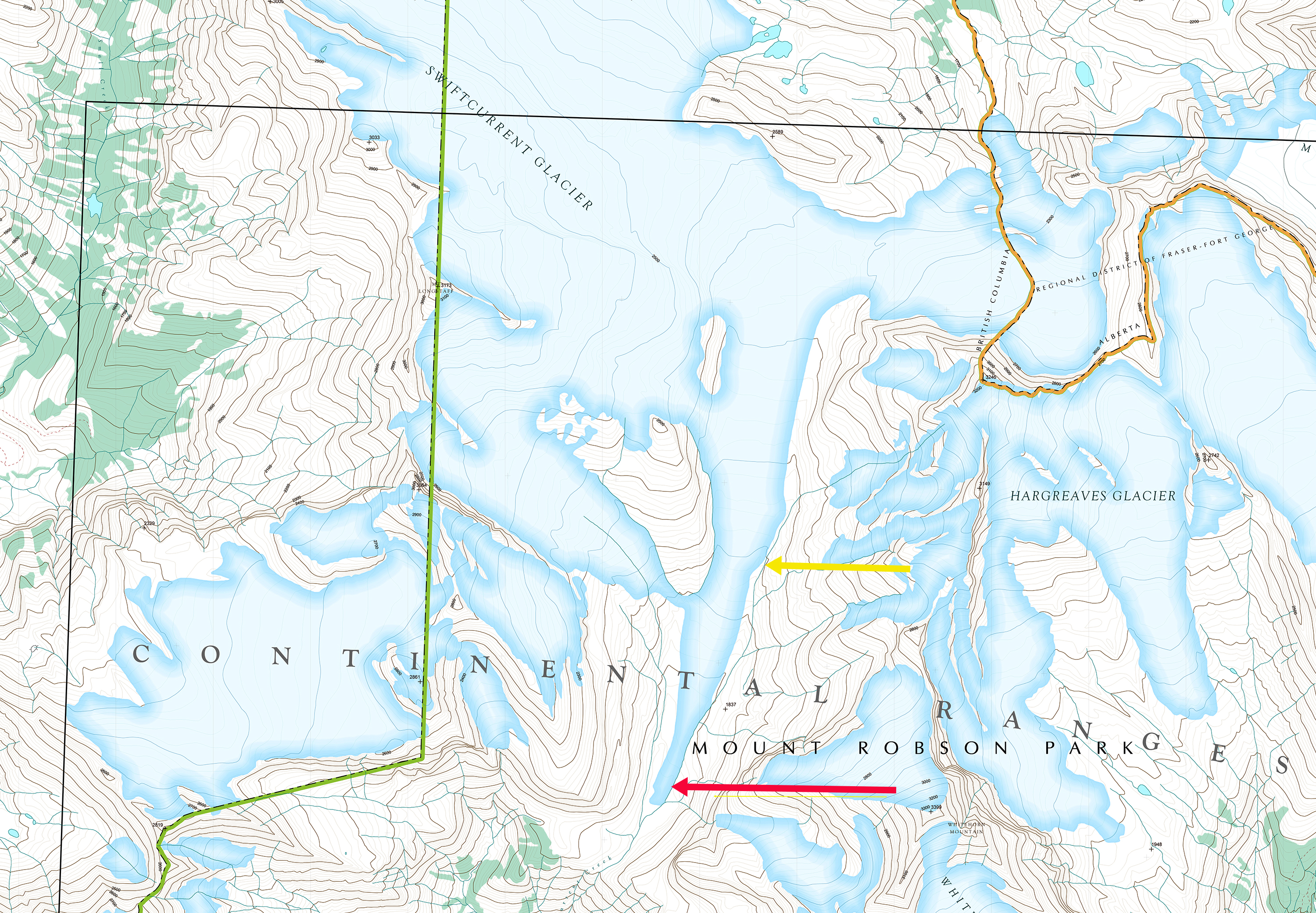
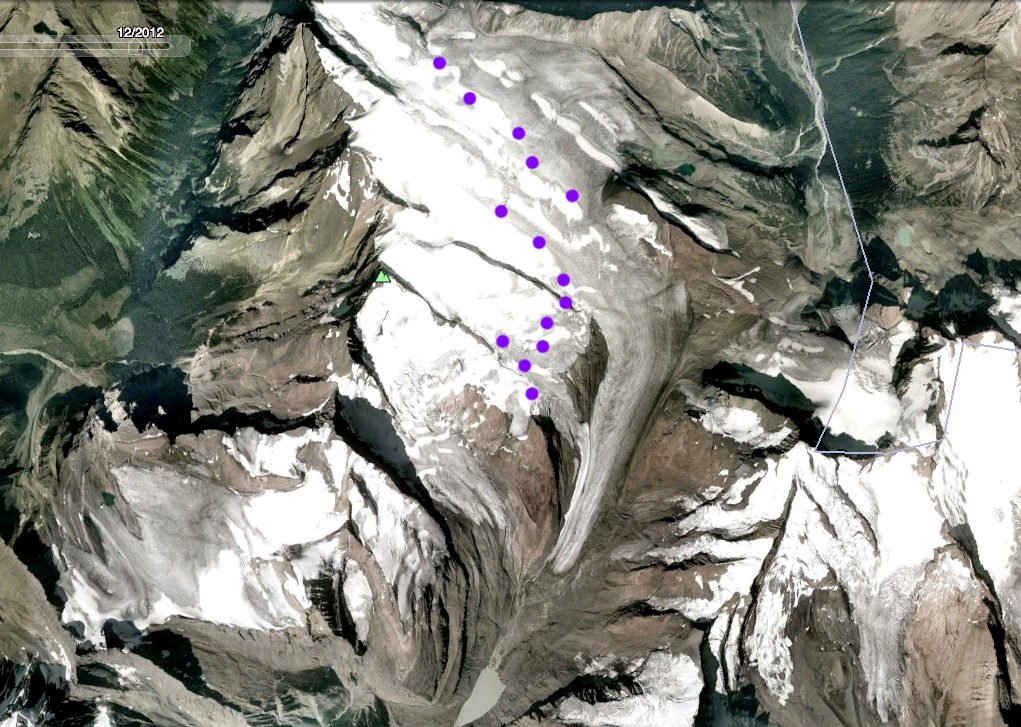
In 1986 Swiftcurrent Glacier terminated at 1715 m, red arrow and had a snowline of 2300 m.  There is not an alpine lake at the terminus or in the map of the region.  There are two prominent tributaries evident, purple arrows. In a Google Earth image from 2005, a new alpine lake had formed and the snowline was at 2500 m.  In the 2013 Landsat image only the eastern side of the glacier is seen, the snowline is above 2600 m. In 2015 the new alpine lake is 1100 m long, the glacier terminates at the yellow area at 2000 m.  This represents a 2.8 km retreat from 1986-2015.  The snowline in 2015 is at 2650-2700 m.  The two significant tributaries have separated from the glacier at the purple arrow. The high end of summer snowlines in recent decades indicate an expanded melt zone and mass loss.  This is and will continue to drive terminus retreat.  The retreat is similar to two other headwaters glaciers in the region; Kiwa Glacier and Robson Glacier.


Map of the Swiftcurrent Glacier  region  from GeoBC, this is a 1983 base map.

2005 Google Earth image of Swiftcurrent glacier, purple dots indicate snowline.

2013 Landsat image of Swiftcurrent Glacier.

Beautiful British Columbia Land of Many Mountains & Dwindling Glaciers

[ngg_images source=”galleries” container_ids=”4″ display_type=”photocrati-nextgen_basic_imagebrowser” ajax_pagination=”1″ template=”/nas/wp/www/sites/blogsorg/wp-content/plugins/nextgen-gallery/products/photocrati_nextgen/modules/ngglegacy/view/imagebrowser-caption.php” order_by=”sortorder” order_direction=”ASC” returns=”included” maximum_entity_count=”500″]

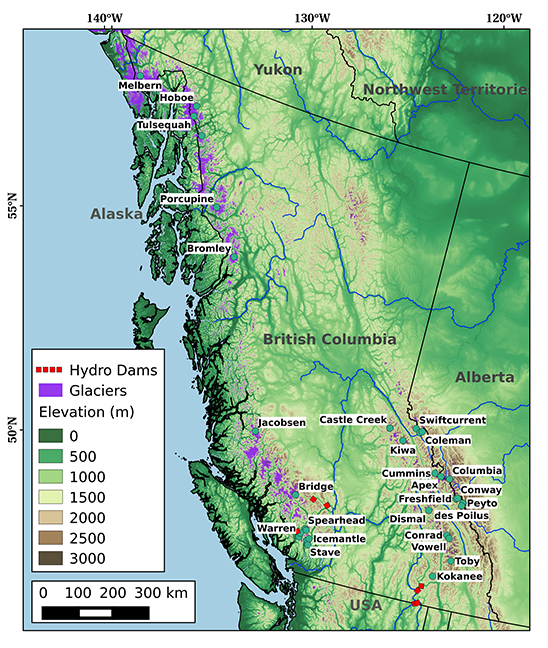
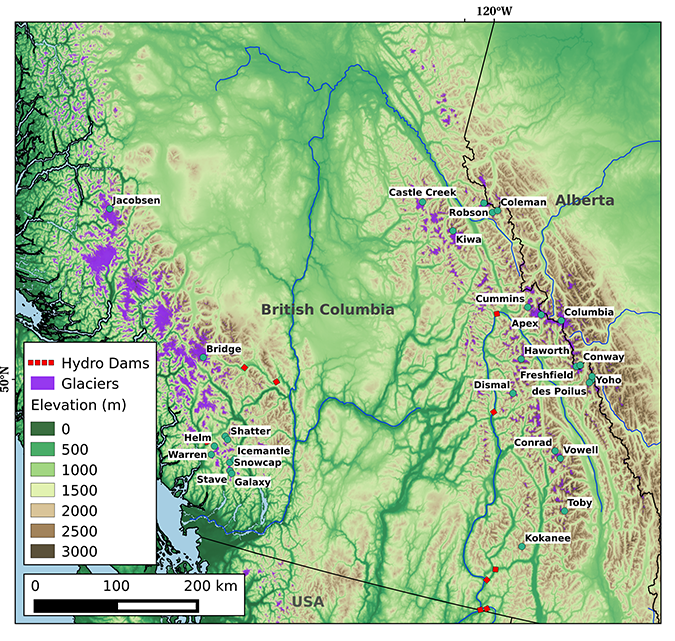
British Columbia is host to many mountain ranges; Purcell, Monashee, Bugaboo, Selkirk, Cariboo, Coat Range, Kootenay, Kwadacha are just some of the diverse mountain ranges  that host glaciers and span climate zone. A shared characteristic today regardless of climate zone or mountain range is dwindling glacier size and volume.  Bolch et al (2010) found that from 1985-2005 Alberta glaciers lost 25% of their area and BC glaciers 11% of their area.  Tennant and Menounos (2012) examined changes of the Rocky Mountain glaciers including Alberta finding that between 1919 and 2006 glacier cover decreased by 590 square kilometers, 17 of 523 glaciers disappeared and 124 glaciers fragmented into multiple ice masses.  Jiskoot et al (2009) examined the behavior of glaciers of the Clemenceau and Chaba Icefield and found that from the mid 1980’s to 2001 the Clemenceau Icefield glaciers had lost 42 square kilometers, or 14% of their area. Pelto (2016) reported on specific retreat of many of these BC glaciers. Below are links to 31 detailed post examining the changes in recent decades of British Columbia glaciers in response to climate change.

In the summer glaciers in many ranges are crucial water resources for aquatic life and hydropower.   In BC 92% of electricity is generated by hydropower mainly from large projects.  BC Hydro has 31 such large projects, including several heavily fed by glaciers: Bridge River, Mica, Cheakamus, Ruskin and Stave Falls. There are also run of river hydroprojects with a new one constructed by AltaGas, the 195 MW Forrest Kerr Project on Tahltan First Nation land on the Iskut River. The Iskut River like the Stikine River is heavily glacier fed. As spring begins glaciologists will be heading out to measure glacier mass balance a critical input to understanding current and future glacier runoff, such as the Columbia Basin Trust sponsored project overseen by Brian Menounos at UNBC, and field operation direct by Ben Pelto at UNBC.


Forrest Kerr Hydro is a run of river project relying on a weir instead of a dam to divert water into the intake.
There are also numerous salmon fed streams with critical glacier input, such as the Skeena River and Rivers Inlet. Stahl and Moore (2006) identified that discharge from glacierized and nonglacierized basins in British Columbia indicates the negative August streamflow trends illustrate that the initial phase of increase runoff causing by climate warming has passed and runoff is now declining. This is similar to further south in the North Cascades of Washington (Pelto, 2015).

Shatter and Shudder Glacier
Snowcap Creek Glacier
Stave Glacier
Helm Glacier
Warren Glacier
Galaxy Glacier
Icemantle Glacier
Big Bend Glacier
Kokanee Glacier
Toby Glacier
Conrad Glacier
Vowell Glacier
Bridge Glacier
Klippi Glacier
Yoho Glacier
Des Poilus Galcier
Haworth Glaciers

Apex Glacier
Kiwa Glacier
Dismal Glacier
Cummins Glacier
Coleman Glacier
Swiftcurrent Glacier
Bromley Glacier
Sittakanay Glacier
Nass Peak Glacier
Porcupine Glacier
Great Glacier
Hoboe Glacie
Tulsequah Glacier
Melbern Glacier