Soler Glacier Retreat and Lake Expansion

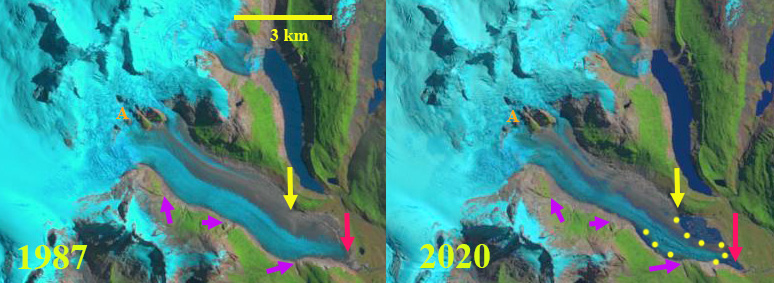
Soler Glacier in 1987 and 2020 Landsat images.  Red arrow indicates 1987 terminus location, yellow arrow indicates 2020 terminus location on north side of glacier.  Yellow dots indicate margin of lake and purple arrows indicate specific locations where glacier thinning is evident.

Soler Glacier is an outlet glacier on the east side of the Northern Patagonia Icefield (NPI). The terminus response of this glacier has been slower and more limited than on most NPI glaciers.  Aniya and Fujita (1986)  reported a total retreat of 200-350 m from 1944 to 1984.  Glasser et al (2016) note the recent 100 m rise in snowline elevations for the NPI, which along with landslide transport explains the large increase in debris cover since 1987 on NPI from 168 km2 to 306 km2 .  Loriaux and Casassa (2013) examined the expansion of lakes on the Northern Patagonia Ice Cap reporting that from 1945 to 2011 lake area expanded 65%, 66 km2. For Soler Glacier lake formation did not occur until the last decade and debris cover has changed little as well. Willis et al, (2012) identified thinning of ~2 m/year in the ablation zone from 1987-2011. This thinning is now leading to the development of a significant proglacial lake that is examined using Landsat images from 1987-2020.

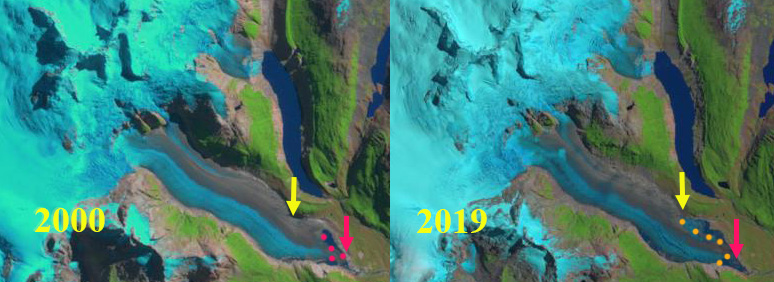
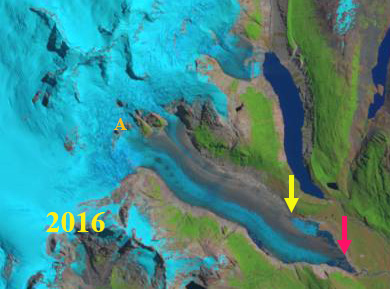
In 1987 the glacier is still up against the Little Ice Age moraine, though it had thinned considerably resulting in retreat down the slope of this vast moraine. By 2000 a small lake had developed both on the north and south side of the main terminus with a total area of ~0.3 km2, red dots. In 2016 and 2019 this lake had expanded, with the northern arm mostly filled with ice, orange dots.  In October 2020 the lake has an area of ~1 km2 and is mostly open water. The extensive thinning of the terminus tongue continues to drive both retreat and lake expansion.  The thining is evident at Point A where bedrock knobs have emerged from the ice near the snowline.  The three purple arrows on the south side of the glacier indicate thinning as these bedrock features are increasingly distant from the glacier. The terminus has retreated 500 m in the glacier center, 2100 m on the north side and 1300 m on the south side from 1987-2020.  The terminus tongue in its lowest 1.5 km continue to thin and will collapse in the lake in the near future. The end of summer snowline has averaged 1450 m in recent years leading to continued mass loss without calving in the lake (Glasser et al 2016).

Lake development here lags that of other glacier around the NPI such as Exploradores, Nef, Steffen and San Quintin.

Soler Glacier in 2000 and 2019 Landsat images.  Red arrow indicates 1987 terminus location, yellow arrow indicates 2020 terminus location on north side of glacier.  Red dots  and orange dots indicate margin of lake.

Soler Glacier in 2016 Landsat image.  Red arrow indicates 1987 terminus location, yellow arrow indicates 2020 terminus location on north side of glacier.  

Darwin Glacier, Chile 1986-2020 Retreat Opens New Fjord Arm

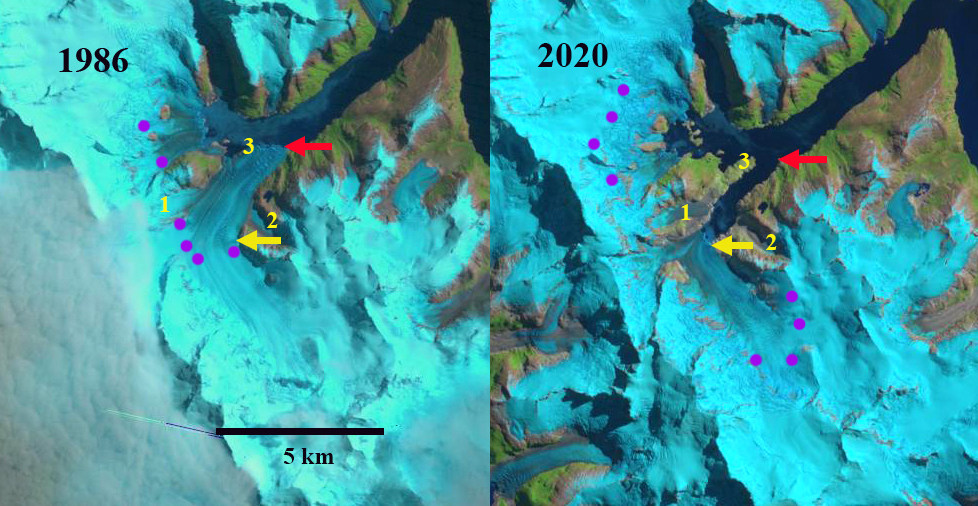
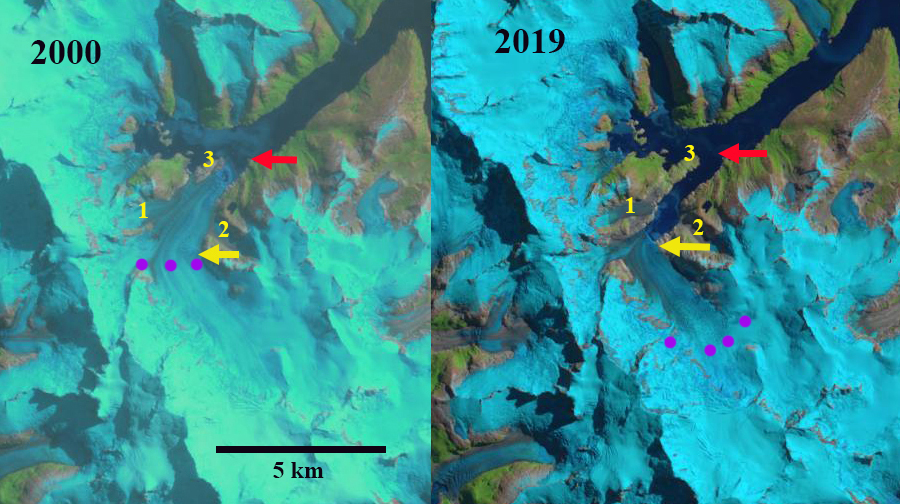
Darwin Glacier in Landsat images from 1986 and 2020. Red arrow indicates 1986 terminus location, yellow arrow 2020 terminus location, purple dots the snowline.  Point 1,2 and 3 indicate the same specific location.

Darwin Glacier flows east from the main divide of the Cordillera Darwin entering the head of Fjord Parry. Here we examine changes illustrated by Landsat images from 1986-2020.   Melkonian et al (2013) note widespread thinning of four large glaciers in the Cordillera Darwin Range from 2000-2011; Ventisquero Grande, Marinelli, Darwin and Roncagli, while the Garibaldi Glacier increased in volume.  They note a maximum velocity of 9.6 m/day at Darwin Glacier and thinning of over 3 m/year during the 2000-2011 period, which emcompasses a period of rapid retreat noted below. Davies and Glasser (2012) note that during the 1870-2011 period the Cordillera Darwin area loss was most rapid from 1986 to 2001. Dussaillant et al (2019) note the mass loss for the central Cordillera Darwin at -0.4 to -0.6 m/year from 2000-2018.

In 1986 Darwin Glacier extended beyond the end of a southwest trending valley (Point 3) and had fully separated from the former tributary flowing eastward. Tributaries at Point 1 and 2 join the main glacier within a 2 km of the current terminus. The snowline is at 500 m. By 2000 the glacier had retreated into the southwest trending valley, with a peninsula emerging on the west side at point 3.  The snowline is at 500 m. By 2019 the glacier had retreated beyond the former tributaries at Point 1 and 2. The snowline in 2018 is at 750 m.  In 2020 the peninsula at Point 3 has greened up with new vegetation, the glacier has retreated 3100 m since 1986 exposing a new fjord arm. Point 2 is largely a glacier free valley bottom.  The snowline is at 800 m.  A further 1 km retreat will lead to another tributary separation much as has happened at Ventisquero Grande.

Darwin Glacier in Landsat images from 2000 and 2019. Red arrow indicates 1986 terminus location, yellow arrow 2020 terminus location, purple dots the snowline.  Point 1,2 and 3 indicate the same specific location.

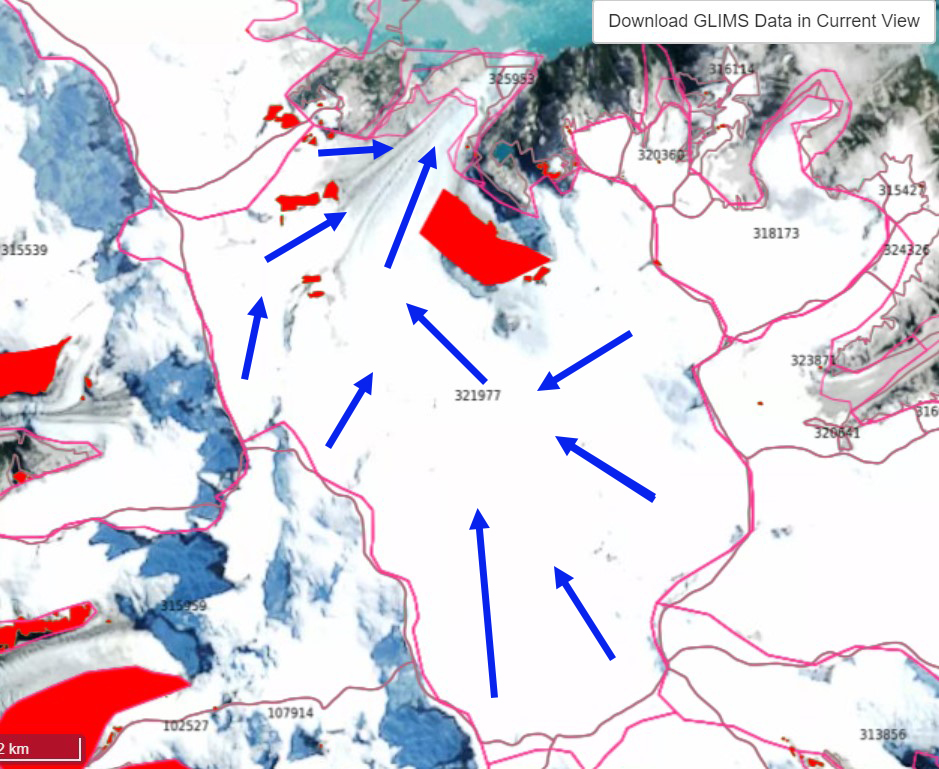
GLIMS view of Darwin Glacier with 1986-2007 margins indicated (Bethan Davies delineated margins).  Flow arrows added.

Fiero Glacier, Chile Retreat Lago Fiero Expansion

Fiero Glacier in 1987 Landsat and 2020 Sentinel images.  Red arrow indicates 1987 terminus location, yellow arrow 2020 terminus lcoation, and purple dots the snowline. Point A,B and C represent locations where bedrock has expanded.

Fiero Glacier is an outlet glacier draining the northeast quadrant of the Northern Patagonia Icefield (NPI) terminating in Lago Fiero. Loriaux and Casassa (2013) examined the expansion of lakes of the Northern Patagonia Ice Cap. From 1945 to 2011 lake area expanded 65%, 66 km2Davies and Glasser (2012) noted the fastest retreat during the 1870-2011 period was from 1975-1986 for Fiero Glacier.  They noted that Fiero Glacier proglacial lake had an area of 6.6 km2.  Glasser et al (2016) note the recent 100 m rise in snowline elevations for the NPI, which along with landslide transport explains the large increase in debris cover since 1987 on NPI including Fiero Galcier. Here we examine the response of the glacier to climate change from 1987 to 2020.

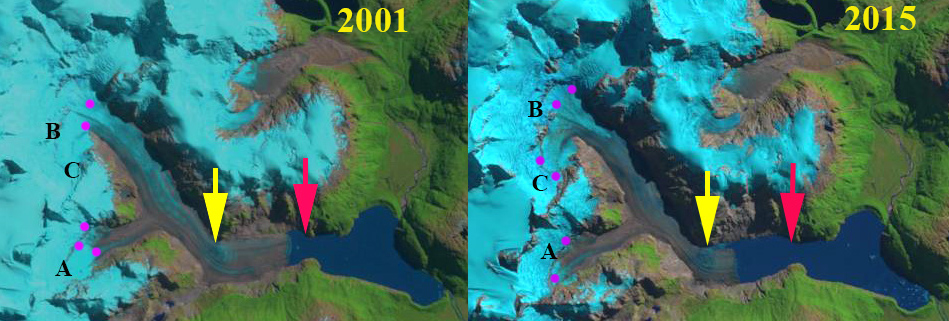
In 1987 the glacier terminated at a narrow point in the 4.2 km long Lago Fiero that has an area of 5.6 km2.  By 2001 the glacier had retreated 500 m and the transient snowline is at 1000 m.  At point A there is a narrow rock rib. at Point B there are isolated rock rib and knobs and at Point C the rock rib is limited.  In 2015 the lake has expanded to an area of 7.3 km2, and the debris cover has also expanded. The transient snowline is at 1200-1300 m.  In 2020 the lake has expanded to an area of 9.5 km2 and a length of 6.5 km.  The 2.3 km retreat has led to a near doubling in the area of the Lago Fiero, the retreat since 2011 is the fastest rate observed. At Point A the rock rib is now a prominent separation, at Point B and C the rock rib has become continuous much like at Point A. The snowline on January 1, 2020 is at 1200 m, midway through the melt season.  The glacier slope increases 500-1000 m from the current terminus near a surface elevation of 600 m, which could mark the expansion limit of Lago Fiero (see map below).

The retreat of this glacier is larger than that of Colonia Glacier and Pared Nord Glacier further south and Verde Glacier to the north of the NPI.  All the outlet glaciers of NPI have retreated significantly in the last 30 years most leading to expanding proglacial lakes (Loriaux and Casassa, 2913;  Pelto, 2017).

Fiero Glacier in 2001 and 2015 Landsat images.  Red arrow indicates 1987 terminus location, yellow arrow 2020 terminus lcoation, and purple dots the snowline. Point A,B and C represent locations where bedrock has expanded.

Terminus of Fiero Glacier from the Randolph Glacier Inventory in 2001 (Green) and 2011 (blue).  the 500 m, 600 m and 700 m contour are indicated.  Note the steeper slope near 600 m which likely is beyond the expansion limit of Lago Fiero. Base map from GLIMS

Northern Patagonia Icefield High Equilibrium Line Altitude in 2019

Northern Patagonia Icefield Landsat view on 4/6/2019. Transient snowline indicated on individual glaciers with purple dots. Clockwise, L=Leones, So=Soler, N=Nef, Ca=Cachet, Co=Colonia,  PN=Pared Nord, PS=Pared Sur, H4=HPN4, St=Steffen, A=Acodado, B=Benito, H1=HPN1, Sq=San Quintin.

The Northern Patagonia Icefield from 1987-2015 decreased in area, while debris cover area expanded and the size of proglacial lakes expanded (Glasser et al 2016).  The icefield area declined from 4113 to 3887 km2, debris cover increased from 168 to 307  km2 and lake area expanded from 112 to 198 km2 In this paper we also examined the recent rise in the transient snow line (TSL). The TSL is the location of the transition from snow cover to bare glacier ice at a particular time during the ablation season, while the Equilibrium Line Altitude (ELA) is the altitude of the snow line at the end of the ablation season. The TSL at the end of the melt season is the ELA.  In recent years the ELA has been rising, and the highest annually observed TSL in the period 2013-2016 averaged 1215 m (Glasser et al 2016). This is an ELA rise of  at least 103 m compared with the  observed  1979-2003 ELA.  Landsat 8 imagery from April 6, 2019 reveals the TSL for most NPI glaciers, this is typically beyond the end of the melt season, but not in 2019, hence the TSL from this date will be the approximate annual ELA.  How does it compare and what does that mean for icefield mass balance in 2019?

On April 6, 2019 the TSL was highest on glaciers on the east side of the icefield decreasing for the western outlet glaciers. Clockwise from Leones Glacier in the Northeast to San Quintin Glacier on the west side the TSL observed ranged from 1525 m on Leones Glacier and Soler Glacier to a low of 1075 m on San Quintin Glacier.  The mean TSL is 1260 m for the glaciers reported by Glasser et al (2016) and 1300 m for all glaciers.  TSL on April 6, 2019 on glaciers on the east side of the icefield averaged 1425 m, while on the east side of the icefield the average was 1200 m.

Willis et al (2012) noted the ELA of NPI glaciers for the 2001-2011 period, a glacier by glacier comparison to 2019  indicates the ELA is  ~150 m higher in 2019.  This is the highest mean TSL observed for the NPI and suggests a strong negative surface mass balance year for the icefield in 2019.  This does not include the calving losses such as observed at San Quintin Glacier.  Dussaillant et al (2018) reported negative mass balances of NPI glaciers of ~-1 m using two different methods for the 2000-2012 period. TSL observations since indicate the ELA has been higher in recent years driving even more negative balances.  As Pelto (2017) noted 19 of the 24 main outlet glaciers of the Northern Patagonia Icefield ended in a lake in 2015, all the lake termini retreated significantly in part because of calving losses. Surface mass balance losses in 2019 will lead to continued retreat such as observed at San Quintin Glacier, Nef Glacier, and Acodado Glacier. This will also increase the debris covered area, which increases albedo and ablation further.

Northern Patagonia Icefield ELA reported by Willis et al (2012), Glasser et al (2016) and for 2019. 

Gualas Glacier (G) and Reichert Glacier (R) TSL on 4/6/2019 in Landsat image.


San Quintin Glacier High Calving Rate Observations in 2018

San Quintin Glacier in 4-16-2017 Sentinel image, red dots indicate terminus location then. Yellow dots the terminus location  on 11-10-2018.

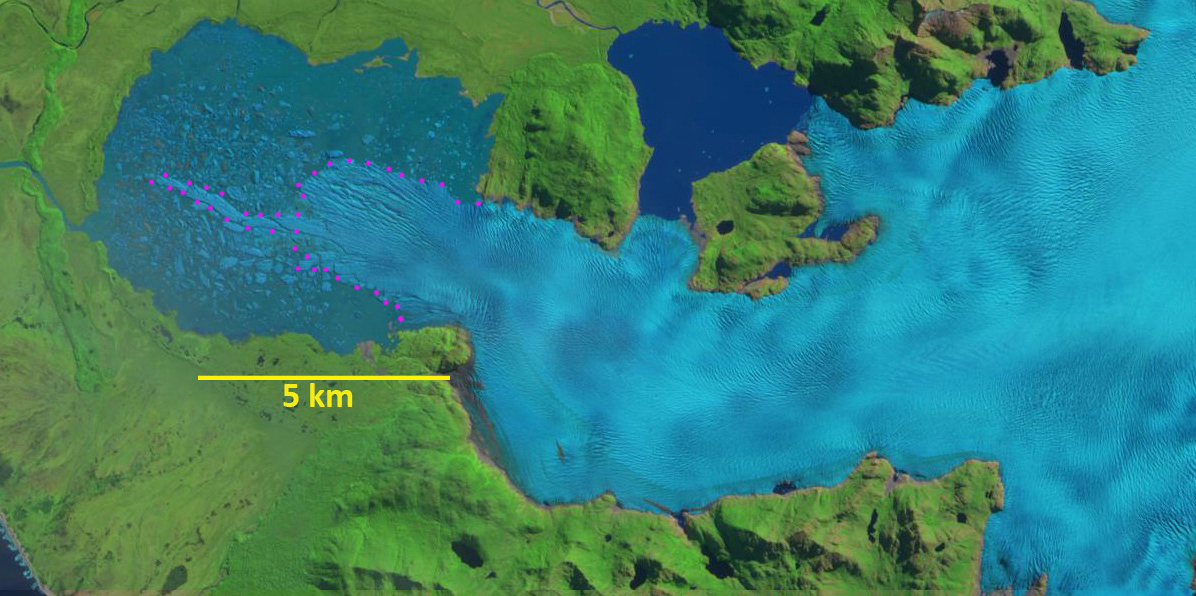
San Quintin Glacier in 3-20-2018 Sentinel image, pink dots indicate terminus position. 

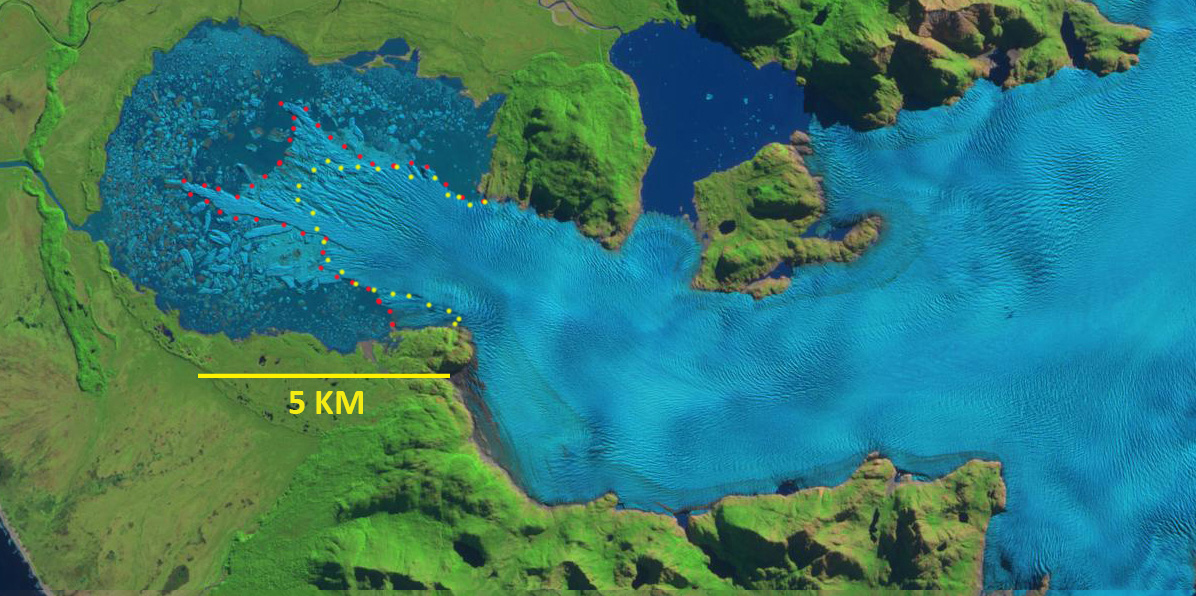
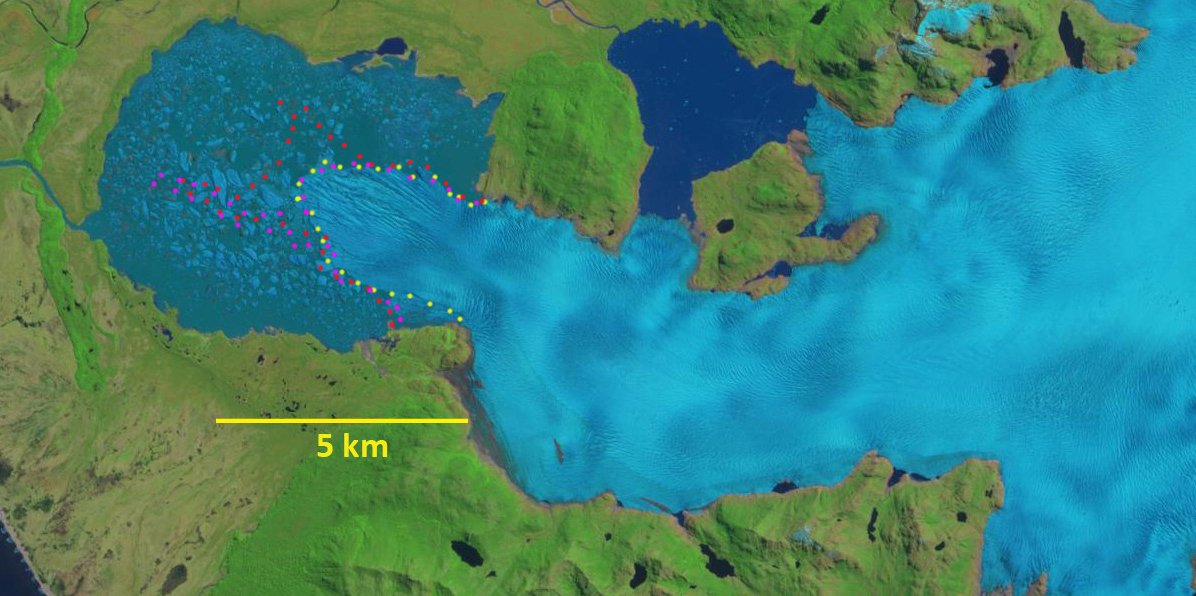
San Quintin Glacier in 11-10-2018 Sentinel image. Yellow dots the terminus location  on 11-10-2018, pink dots from 3-30-2018 and red dots from 4-16-2017. 

San Quintin is the largest glacier of the NPI at 790 km2 in .  The glacier extends 50 km from the ice divide in the center of the ice cap.  The peak velocity is 1100 m/year near the ELA (Rivera et al 2007), declining below 350 m/year in the terminus region.  San Quintin Glacier terminated largely on land until 1991 (Davies and Glasser, 2012). The velocity at the terminus has increased from 1987 to 2014 as the glacier has retreated into the proglacial lake (Mouginot and Rignot, 2015).  The high velocity zone extends more than 40 km inland an even greater distance than at San Rafael (Mouginot and Rignot, 2015).  Thinning rates in the ablation zone of the glacier are 2.3 m/year (Willis et al, 2012).  The glacier has a low slope rising 700 m in the first 22 km.

In 1987 it is a piedmont lobe with evident minimal marginal proglacial lake development beginning (Pelto, 2016).  Progressive retreat of the glacier into the expanding proglacial lake has led to an increasingly chaotic, disintegrating front of the glacier (Willis et al, 2012).  The large evident crevasses/rifts perpendicular to the front suggest the terminus tongue is largely afloat.  Here we examine Sentinel Images from April 2017 to November 2o18 to identify changes. NASA’s Earth Observatory has high resolution images indicating the terminus in June 2014 and April 2017

On April 16, 2017 there were four icebergs with an area greater than 0.1 kmin the San Quintin Lagoon. The narrow terminus tongue extending from the main terminus had an area of 0.6 km2 and extended to within 3.3 km of the lagoons western shore. On March 20, 2018 this tongue remains tenuously connected to the main terminus, and has extended to within 1.5 km of the western shore.  There are six icebergs with an area greater than 0.1 km2.  By November 10, 2018 this narrow tongue had disintegrated.  There are eight icebergs with an area greater than 0.1 km2.  The icebergs are slow to melt in the lagoon compared to a fjord setting. The overall terminus area loss from April 2017 to November 2018 is 1.8 to 2.0  km2. There has been additional detachment on the southern shore where the glacier enters the main lagoon basin.  This should further destabilize the glacier tongue.  In  the coming years the lagoon will continue to expand to a size of at least 40 square kilometers.

As Pelto (2017) noted 19 of the 24 main outlet glaciers of the Northern Patagonia Icefield ended in a lake in 2015, all the lake termini retreated significantly in part because of calving losses. Glasser et al (2016) observed that proglacial and ice-proximal lakes of NPI increased from 112 to 198 km2. A collapse of the terminus tongue on Steffen, Gualas and Reichert Glacier are examples.

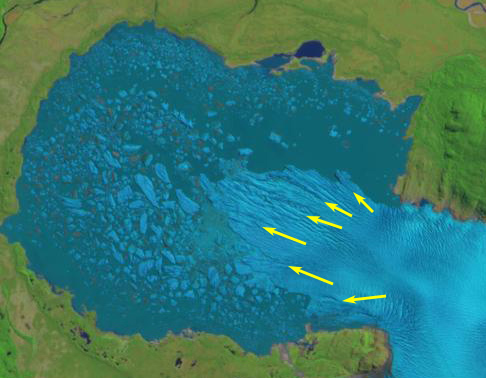
October 31, 2018 Sentinel image indicating extensive rifts that have developed and are areas of weakness for further calving.

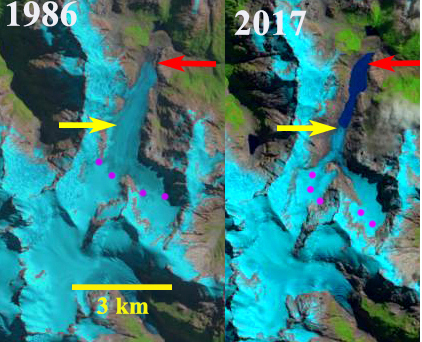
Landsat comparison of San Quintin Glacier in 1987 and 2015: red arrow indicates 1987 terminus location, yellow arrow indicates 2015 terminus location of the three main termini, and the purple arrow indicates upglacier thinning.


Pico Alto Glacier, Chile Retreat New Lake Formed

Pico Alto Glacier, Chile in 1986 and 2017 Landsat images indicating the retreat.  Red arrow indciates 1986 terminus, yellow arrow the 2017 terminus,and purple dots the snowline. 

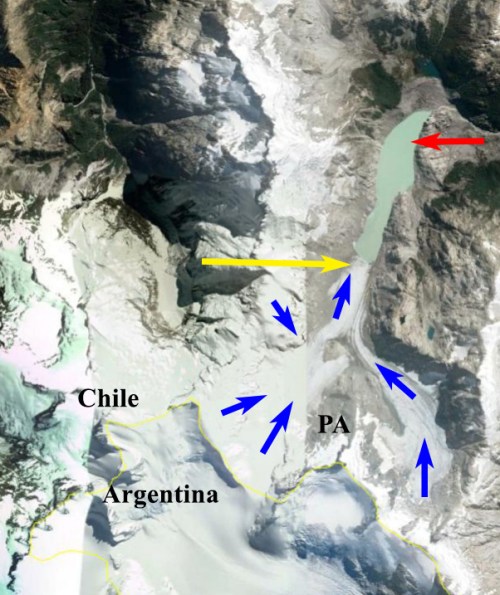
Pico Alto Glacier, Chile drains north from the Argentina-Chile border entering the Rio Puelo and eventually Lago Tagua. The glacier ongoing retreat is similar to the nearby Hornopiren Glacier and Erasmo Glacier.  Davies and Glasser (2012) mapped the glaciers in the Hornopiren region and found a 15 % area loss from 1986 to 2011.

In 1986 there was no lake at the terminus of the glacier and the snowline is near the main junction.  By 2000 the glacier had retreated 1200 m opening a new lake.  The eastern arm of the glacier did not retain significant accumulation. In 2016 the snowline again left the eastern tributary without retained accumulation.  In fact the connection to the larger western tributary has been greatly reduced.  By 2017 the glacier has retreated 2.4 km with a lake of nearly the same length having formed, this is 40% of the total glacier length lost in three decades.  The eastern tributary due to a lack of retained snowpack will continue to wither away.  The main glacier can survive in a reduced state with current climate. Wilson et al (2018) noted a substantial growth in the number of lakes in the central and Patagonian Andes due to the ongoing rapid retreat. Harrison et al (2018) also observed the number of glacier lake outburst floods have declined despite the increase in lakes.

Pico Alto Glacier, Chile in 2000 and 2016 Landsat images indicating the retreat.  Red arrow indicates 1986 terminus, yellow arrow the 2017 terminus,and purple dots the snowline.

Google Earth view of the Pico Alto Glacier (PA) indicating flow, blue arrows, 1986 terminus red arrow and 2017 terminus yellow arrow

Rio Engaño, Chile Headwater Glacier Retreat GLOF Threat Drops

Comparison of glaciers at the headwaters of Rio Engaño in 1984 and 2018 Landsat images. The 1984 terminus location with red arrows, yellow arrows the 2018 terminus location, purple arrows wind drift patterns.

Rio Engaño drains into Lago General Carrera and its headwaters is a group of alpine glaciers.  In March of 1977 one of the glaciers, generated a glacier lake outburst flood (GLOF) that reached a depth of 1.5 m  at the small village of Bahía Murta Viejo 25 km down river (Anacona, et al 2015).  Davies and Glasser (2012) observe that glaciers just northeast of the Northern Patagonia Icefield lost area at a rate of 0.2% per year from 1986-2011.  Paul and Molg (2014) observed a more rapid retreat of 25% total area lost from glaciers in northern Patagonia from 1985-2011, the study area was north of the Northern Patagonia Icefield, including the Cordillera Lago General Carrera icefield.

Here we examine changes of four glaciers at the headwaters of Rio Engaño using Landsat imagery for the 1984 to 2018 period.

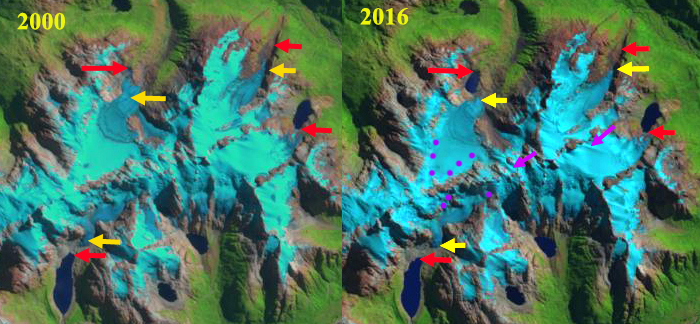
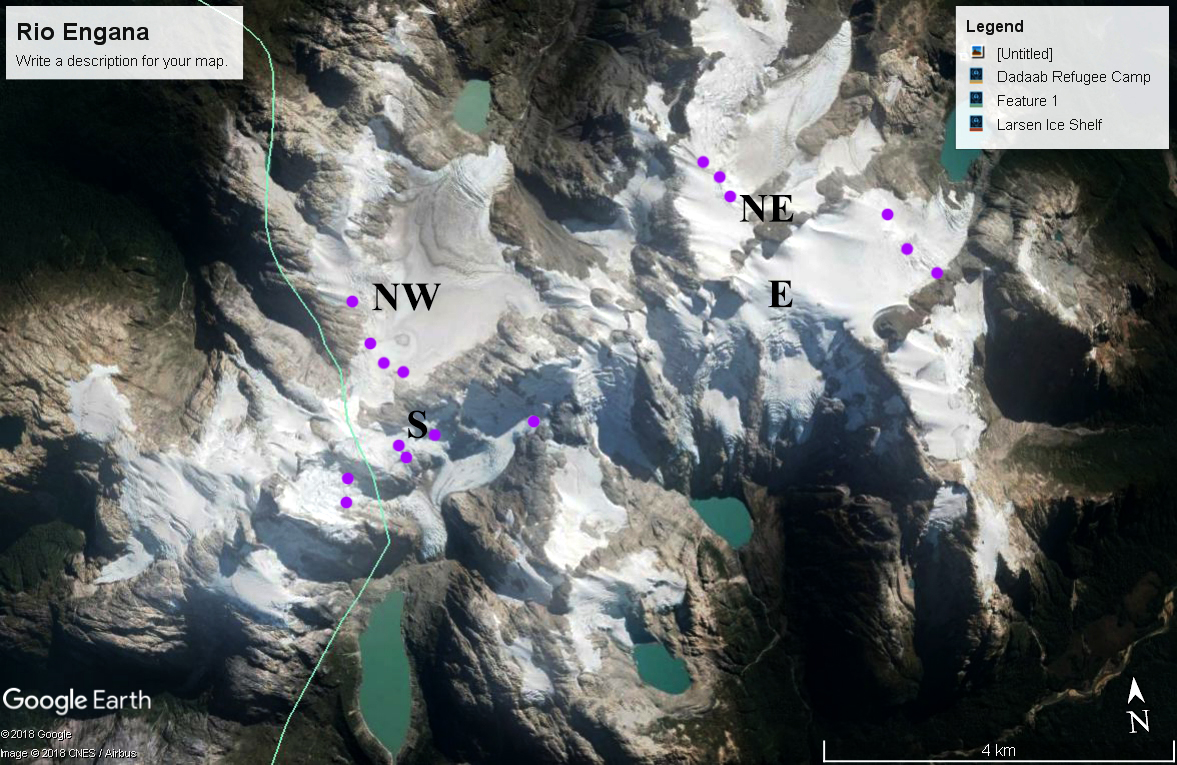
In 1984 the Northwest (NW) glacier had two terminus tongues and no lake at the terminus, red arrow. The Northeast (NE) glacier had a length of 4 km. The East (E) glacier terminated at the margin of a proglacial lake. The South (S) Glacier which experienced the GLOF, terminated on the northern end of a proglacial lake. By 2000 the NW glacier had lost its eastern terminus and a small lake is forming at the western terminus. The NE glacier had retreated 400 m. The S glacier no longer reaches the proglacial lake. In 2016 the snowline is quite high on the NW and S glacier, purple dots. The wind features, purple arrow indicate the strong wind sculpted features from the west winds. In 2018 the NW glacier no longer reaches the proglacial lake that began forming after 1984, total retreat 800 m. The NE Glacier has retreated 700 m and is now 3.3 km long. The E glacier terminates at the base of a steep slope 200 m from the proglacial lake it reached in 1984. The S glacier has retreated 600 m from the lake it reached in 1984. The NE and E glacier have substantial areas above 1600 m and have retained snowpack each year over a significant portion of the glacier. The NW and S glaciers have little area above 1600 m and in several years have retained minimal snowpack and will continue a rapid retreat.

Wilson et al (2018)  documented a 43% increase in the number of glacial lakes and 7% in the area of lakes in the central and Patagonian Andes. In the Rio Engaño headwaters both the area and number of lakes has increased. The threat of GLOF in for these specific glaciers appears to be declining as the glaciers retreat further from the lakes.  Iribarren et al (2014) list that glacier contact and glacier steepness adjacent to the lake are variables that raise GLOF hazards, and these factors are declining at the Rio Engaño headwaters.  They also noted that the GLOF in 1977 had a volume of 7.36 million cubic meters the second largest in their record of 16 GLOF’s.

Comparison of glaciers at the headwaters of Rio Engaño in 2000 and 2016 Landsat images. The 1984 terminus location with red arrows, yellow arrows the 2018 terminus location, purple arrows wind drift patterns and purple dots the snowline in 2016.

Google Earth image from 2017 indicating the snowline leaving limited snowcovered area on NW and S glacier. 

Pared Nord Glacier, Chile Retreat & Landslide Transport 1987-2018

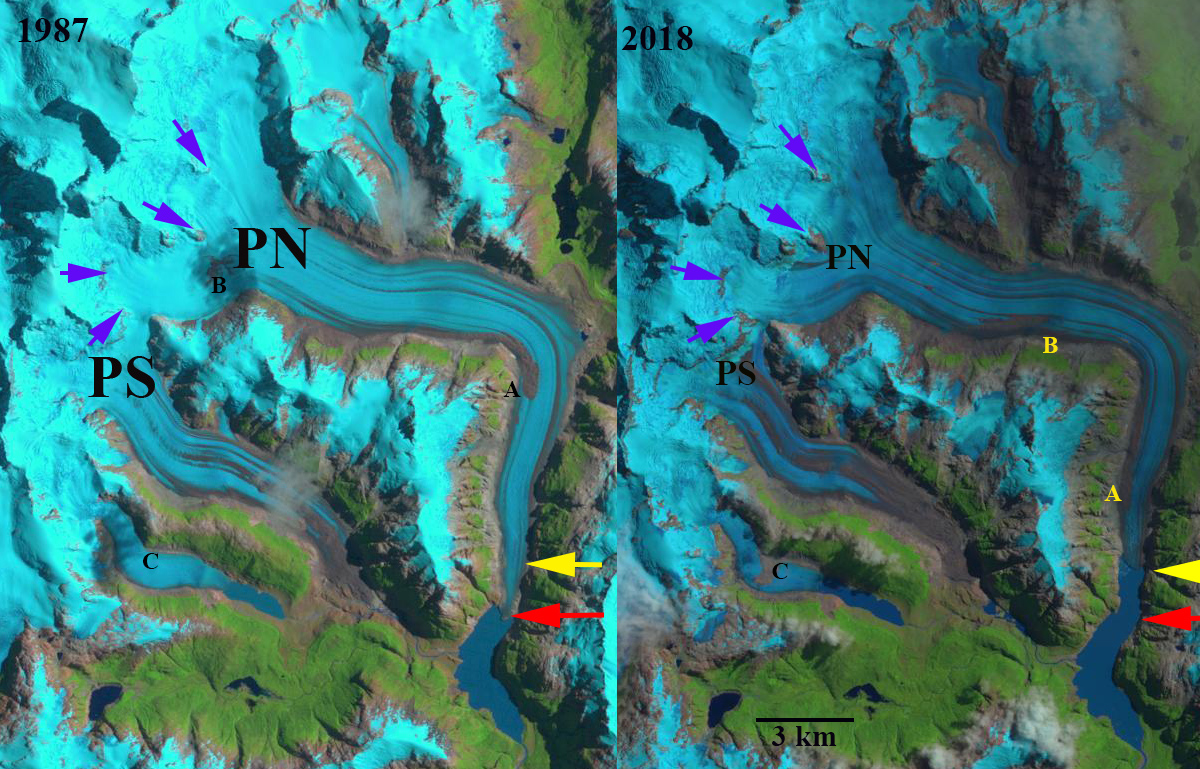
Pared Nord Glacier, Chile in 1987 and 2018 Landsat images.  The red arrow indicates the 1987 terminus location, yellow arrow the 2018 terminus location and purple arrows areas of expanding rock in the lower accumulation zone.  Point A is the front of a wide debris zone from a former landslide, Point B is the front of another landslide deposited debris zone. Point C is a recent landslide deposit on a an unnamed glacier.  The movement f debirs at Point A and B indicate glacier velocity

Pared Nord (Norte) Glacier is a southeast outlet glacier of the Northern Patagonia Icefield (NPI).  Davies and Glasser, (2012)  identify this region of the icefield as retreating faster from 1975-1986 than during any measured period since 1870, the retreat since 2001 has been relatively rapid.   Loriaux and Casassa (2013) examined the expansion of lakes of the Northern Patagonia Ice Cap. From 1945 to 2011 lake area expanded 65%, 66 square kilometers.   Glasser et al (2016) note on Pared Nord that ice-surface debris was transported and redistributed down-ice by glacier flow merging with marginal supraglacial debris.

In 1987 Pared Nord Glacier terminates at a narrow point in the proglacial lake, red arrow.  The debris band at Point A has just turned the corner south towards the terminus and the debris at Point B is near the snowline at the base of the icefall. By 2001 Point B had shifted 4 km downglacier entering the main glacial valley and Point A had shifted 2.5 km towards the terminus.  The terminus had retreated some but was still at the narrow pinning point of the valley.  In 2015 at Point C a landslide had spread across the unnamed glacier. The debris band at Point B had reached the head of a valley from the south side of  the glacier.  In 2018 the purple arrows indicate substantial expansion of bedrock areas near the snowline indicating a rising snowline and glacier thinning.  Glasser et al (2016) note the recent 100 m rise in snowline elevations for the NPI, which along with landslide transport explains the large increase in debris cover since 1987 on Pared Nord.  The main glacier terminus has retreated 1400-1500 m and is currently one kilometer from a widening of the valley, which should lead to an increased calving retreat. The glacier  in 2013 has numerous glacial drainage features, purple arrow in Google Earth image below and substantial crevassing which will lead to calving at the terminus, green arrow. The movement of Point B has been ~4.8 km in 31 years, and of Point A ~3.3 km in 31 years, a velocity of 160 m/year and ~100 m/year respectively.

The retreat of this glacier is less than that of Colonia Glacier to the north and  more than HPN4 glacier to the west.  All the outlet glaciers of NPI have retreated in the last 30 years most leading to expanding proglacial lakes (Pelto, 2017).
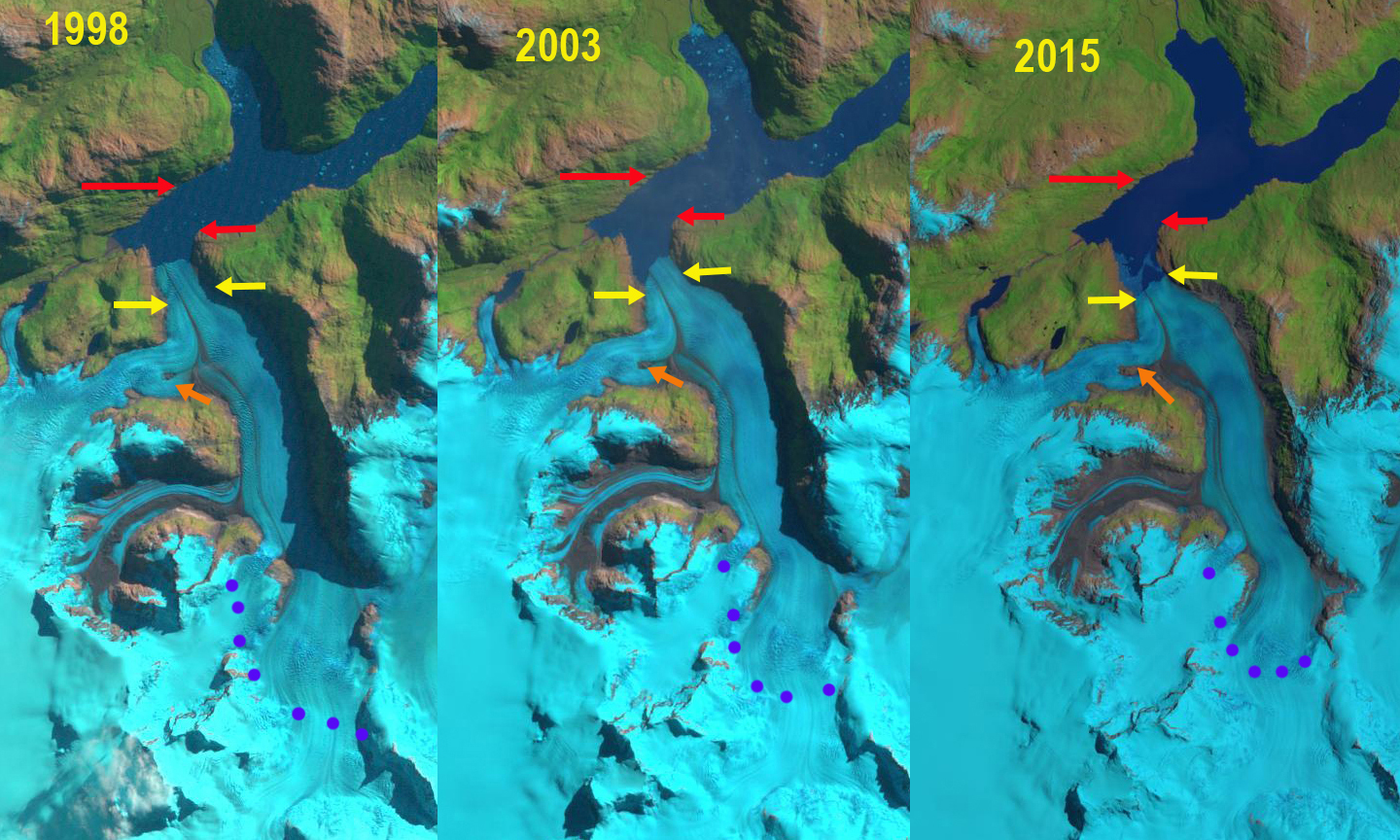
Pared Nord Glacier, Chile in 2001 and 2015 Landsat images.  The red arrow indicates the 1987 terminus location and yellow arrow the 2018 terminus location. Point A is the front of a wide debris zone from a former landslide, Point B is the front of another landslide deposited debris zone. Point C is a recent landslide deposit on a an unnamed glacier.  The movement of debris at Point A and B indicate glacier velocity.

Pared Nord terminus in 2013 Google Earth image.  Purple arrows indicate relict glacial drainage features and green arrow large crevasses near the calving front.

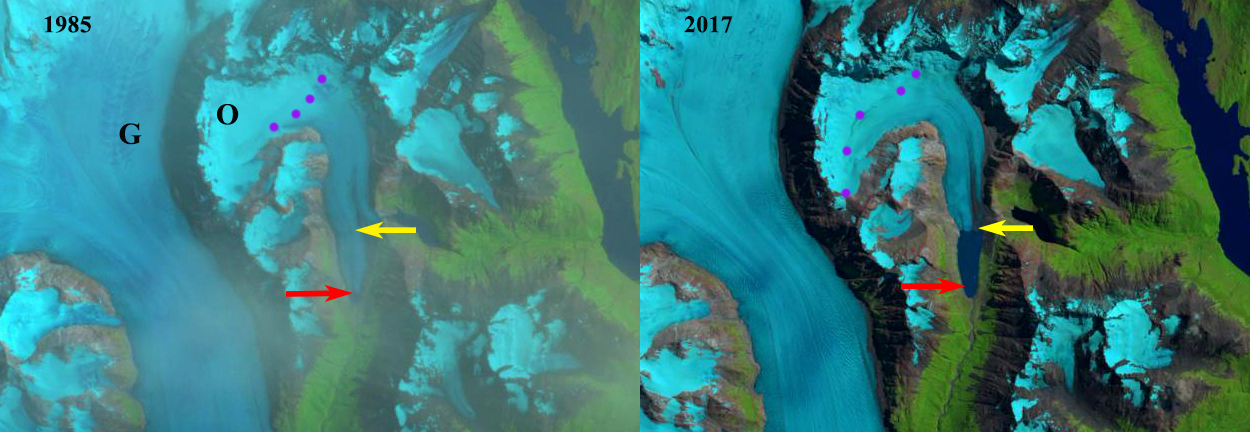
Glaciar Olvidado, Chile Retreat Lake Expansion 1985-2017

Glaciar Olvidado (O) retreat illustrated in 1985 and 2017 Landsat images.  Red arrow is 1985 terminus location, yellow arrow is 2017 terminus location and purple dots are the snowline.  This illustrates an 1800 m retreat. 

Glaciar Olvidado (G) is a glacier in the southeast portion of the Southern Patagonia Icefield (SPI), adjacent to Grey Glacier (G).  The glacier terminates in a proglacial lake. Rivera and Casassa (2004) report the glacier terminating in a newly formed lake in 1986 and retreating slowly from 1986 to 2000.  Here we examine changes in the glacier from 1985 to 2017 using Landsat imagery.

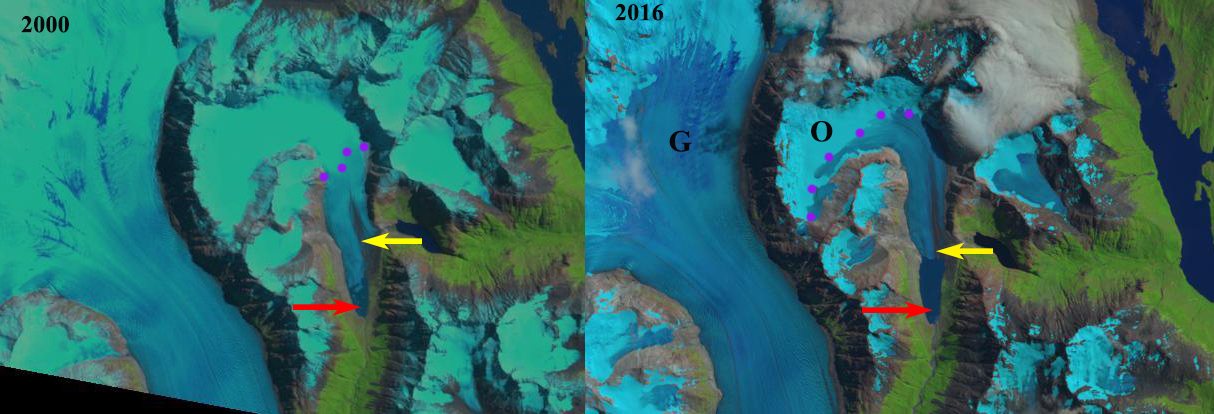
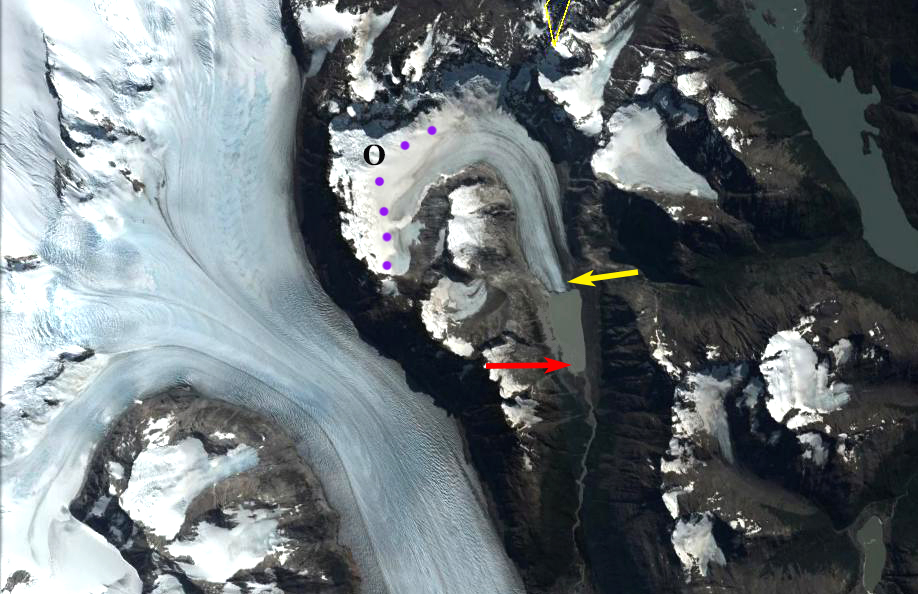
In 1985 the glacier terminates in small newly formed proglacial lake that is just 200 m long.  The snowline in 1985 is at 1050 m. In 2000 the lake has expanded to a length of 900 m.  The snowline in 2000 is at 950 m.  By 2016 the proglacial lake has expanded to  a length of 2 km.  The snowline in 2016 is at 1100 m.  In 2017 the glacier has retreated 1800 m since 1986.  The snowline is at the base of the steep slopes at 1150 m.  The high snowline leaves less than 30% of the glacier in the accumulation zone.  The high snowlines indicate a limited accumulation zone, which generates a negative mass balance and drives retreat.  The glacier continues to calve into this terminus lake adding to the negative mass balance and consequent retreat.  This glacier adds to the growth of proglacial lakes seen in the Northern Patagonia Icefield  (Glasser et al 2016) and SPI (Iribarren et al 2014).  Olvidado Glacier retreat in terms of distance is similar to the adjacent Grey Glacier, but does represent 20% of its total length.  The retreat is much less than the HPS-12 glacier on the west side of the SPI. 

Glaciar Olvidado retreat illustrated in 2000 and 2016 Landsat images.  Red arrow is 1985 terminus location, yellow arrow is 2017 terminus location and purple dots are the snowline. 

Olvidado Glacier in 2016 Google Earth image. 


Queulat Norte Glacier, Chile Retreat Creates Two Lakes

 Queulat Norte Glacier in 1987, 2000 and 2016 Landsat images indicating retreat from 1987 (red arrow) to 2016 (yellow arrow). Green arrow indicates former tributary, orange arrow area of  new bedrock exposure and pink arrow expanding medial moraine. Two new lakes have formed due to the 1950 m retreat. 

Nevado Queulat, Chile is the centerpiece of the Queulat National Park in the Aysen Region.  The largest glacier draining the substantial ice cap on this mountain flows north draining into Lago Rosselot and then the Rio Palena.  Here we examine 1987 to 2016 Landsat imagery to identify changes in this glacier.    Paul and Molg (2014) observed a rapid retreat in general of 25% total area lost from glaciers in the Palena district of northern Patagonia from 1985-2011.

In 1987 the glacier terminates against the valley where the valley turns to the east, red arrow.  There is no lake at the terminus. The tributary at the green arrow connects to the main glacier.  There is no evident medial moraine at pink arrow.  There is no exposed bedrock in the accumulation zone at orange arrow.  In 2000 glacier retreat has exposed a new lake that is 900 m across.  The tributary at the green arrow is no longer connected.  A medial moraine s evident at the pink arrow and bedrock is exposed at orange arrow. By 2016 the glacier has retreated south of a second lake that is 700 m across.  Total retreat from 1987-2016 has been 1950 m, 65 m per year.  This is the loss of  15% of the entire glacier length.  The medial moraine has expanded up and downglacier indicating greater melting and an upward shift of the snowline.  The area at the orange arrow is a significant band of bedrock, indicating that this is no longer an accumulation zone. This bedrock is at 1700 m, the current terminus is at 600 m and the top of the glacier is at 2000 m, leaving only a 300 m elevation band in the accumulation zone. Examination of the region just above the terminus indicates significant ablation hollows/depressions indicative of stagnant ice, green arrows.  There is also an area of debris from a subglacial stream emerging at the surface yellow arrow. The retreat is as significant as that of Erasmo Glacier as a percentage of glacier size.


2016 Google Earth image of Queulat Norte Glacier indicating retreat from 1987 (red arrow) to 2016 (yellow arrow). Green arrow indicates former tributary, orange arrow area of  new bedrock exposure and blue arrows indicating flow. 

Stagnant nature of the lower glacier in 2016 with ablation hollows/depressions at green arrows and yellow arrow indicating sub-glacial stream that emerges at surface and deposits debris. 


Lucia Glacier, Chile Retreat Opens New Embayment

Lucia Glacier retreat from 1987 to 2016 in Landsat images.  Red arrows mark 1987 terminus, yellow arrows 2016 terminus, orange arrow an emerging bedrock area, pink arrow a tributary with increased debris cover and purple dots the snowline.

Lucia Glacier terminates in Lago Berguez at the northern margin of the Southern Patagonia Icefield.  The lake drains into the Rio Pascua.   Willis et al (2012) observed that between February 2000 and March 2012 the Southern Patagonia Icefield rapidly lost volume and that thinning extends even to high elevations.   Mouginot and Rignot (2014) illustrate that velocity peaks at 1 km/year and reamins above 500 m/year  from the terminus to the accumulation zone on Lucia Glacier. The overall retreat has been driven by increasing calving rates from the 1975-2000 to the 2000-10 period (Schaefer et al, 2015). The pattern of retreat is consistent between these glaciers and the region as noted by Davies and Glasser (2012).  They note Lucia Glacier terminus retreat rate from 1870 to 2011 was highest from 1986-2001.  Glasser et al (2016) observed both an increase in glacier proximal lakes and in debris cover on glaciers with glacier retreat from 1987-2015. In this case the glacier is now terminating in an expanding proglacial lake, and except for one western tributary that has had increased significant debris cover, the glacier has limited debris cover.

In 1987 the glacier terminated in a north south front in the lake, at red arrows.  The snowline was at 1050 m.  The western tributary at the pink arrow had 25% debris cover, while the orange arrow indicates a location covered by ice. By 1998 the glacier has retreated into a new arm of Lake Berguez and has an east west front. The snowline is at  1275 m.  The western tributary now has 55% debris cover.  In 2003 the snowline is at 1250 m and the orange arrow indicates and emerged bedrock area forming a new lateral moraine. By 2016 the glacier has retreated 3600 m on the west side and 1700 m on the east side.  The mean frontal retreat is ~2700 m in the 30 year period, 90 m/year   The snowline is at 1150 m in 2015 and 1300 m in 2016.  The western tributary is now 80% debris covered.  The terminus itself in 2003 was 1.3 km wide.  In 2016 the calving front is 1.1 km wide.  Upglacier of the current terminus the calving front will expand to 2 km in width  with a ~1.5 km  retreat.  This indicates the glacier is at a narrow point now that minimizes calving and that continued retreat will soon lead to an increase in calving.  The retreat has exposed steep unstable slopes particularly on the east side of the glacier note below and NASA image.  The retreat is greater than neighboring Gabriel Quiroz Glacier and less than Bernardo Glacier.

Lucia Glacier retreat from 1987 to 2016 in Landsat images.  Red arrows mark 1987 terminus, yellow arrows 2016 terminus, orange arrow an emerging bedrock area, and purple dots the snowline.


Google Earth image indicating the front of Lucia Glacier (yellow dots) and slopes destabilized by glacier retreat and thinning, pink arrows.

Gabriel Quiroz Glacier, Chile Retreat Forms New Lake

Gabriel Quiroz Glacier, Chile in 1987 and 2016 Landsat images illustrates the retreat.  Red arrow is 1987 terminus, yellow arrow the 2016 terminus, purple arrow a retreating northern tributary and purpe dots the snowline.

Gabriel Quiroz Glacier is a northern outlet glacier of the Southern Patagonia Icefield that drains into the Rio Pascua.  The glacier in 1987 terminated within 250 m of Lago Gabriel Quiroz.  Willis et al (2012) observed that between February 2000 and March 2012 that the Southern Patagonia Icefield is rapidly losing volume and that thinning extends even to high elevations.  The overall retreat has been driven by increasing calving rates from the 1975-2000 to the 2000-10 period (Schaefer et al, 2015). The pattern of retreat is consistent between these glaciers and the region as noted by Davies and Glasser (2012), annual rates of shrinkage in the Patagonian Andes increased in from 0.10% year from 1870-1986, 0.14% year from 1986-2001, and 0.22% year from 2001-2011, though they note Gabriel Quiroz Glacier retreat rate from 1870-2011 was low.  Glasser et al (2016) observed both an increase in glacier proximal lakes and in debris cover on glaciers with glacier retreat from 1987-2015. In this case the glacier is now terminating in a new and expanding proglacial lake, but has limited debris cover.

In 1987 the glacier terminates 250 m beyond the western shore of Lago Gabriel Quiroz there is no sign of a proglacial lake at the terminus.  The snowline is at 950 m in 1987,  A tributary from the north almost joins the main glacier, purple arrow.  In 2000 a small proglacial lake is evident at the terminus, which has retreated 300 m. The snowline is at 950 m. By 2015 a substantial proglacial lake has formed with an island in it.  The lake is 1.6 km long, which represents the retreat of the glacier since 1987. The snowline in 2015 is at 1050 m.  In 2016 the proglacial lake is filled with icebergs indicating continue calving driven terminus retreat totaling 2.1 km since 1987. The snowline in 2016 is at 950 m. The terminus remains poised for additional calving retreat, though the calving front has narrowed.  The upper limit of the lake basin is not evident.  The northern tributary has retreated up valley away from the main glacier.  This indicates that even without calving the mass balance of the glacier would be negative and there would be retreat. The retreat is similar to that seen at Balmaceda Glacier,  Bernardo Glacier and Glacier Onelli.   

Gabriel Quiroz Glacier, Chile in 2000 and 2015 Landsat images illustrates the retreat.  Red arrow is 1987 terminus, yellow arrow the 2016 terminus, purple arrow a retreating northern tributary and purpe dots the snowline.