Rio Frio Glacier, Chile Retreat-Lake Formation 1990-2020

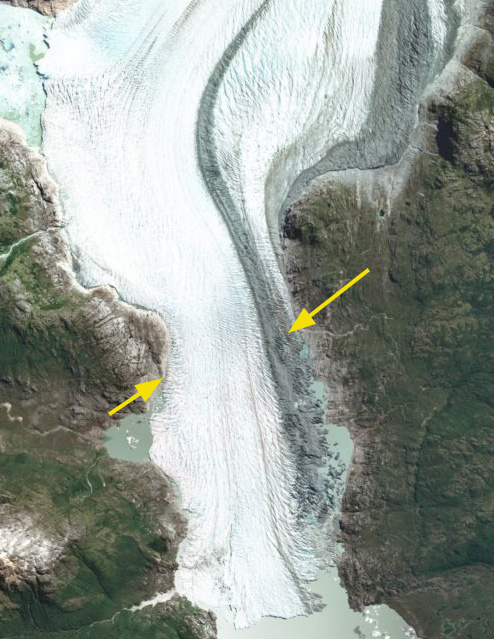
Rio Frio Glacier (RF) in 1990 and 2020 Landsat images. Red arrow 1990 terminus, yellow arrow 2020 terminus, orange arrow new lakes formed after 2000, purple dots snow line.

The “Rio Frio” Glacier is at the headwaters of the Rio Frio a tributary to Rio Palena in Parque Nacionale Corcovado of Palena Province of Chile.  Davies and Glasser (2012) noted that overall glaciers in the region lost 14% of their area from 1986 to 2011. Paul and Molg (2014)  assessed changes of glaciers in the Palena district, Chile revealing a  total area loss of 25% from 1985 to 2011.  Area loss below 1000m elevation was 50–100% and the number of proglacial lakes increased from 223 to 327. Carrivick et al (2016) reported the glaciers in the region had an average thickness of 41 m, this is relatively thin allowing for the rapid area loss. Here we examine glacier change from 1990 to 2020 using Landsat imagery.

The Rio Frio Glacier terminated in a proglacial lake in 1990 at 720 m and the snowline is at 1100 m.  The next glacier to the south has two arms terminating at 900 m with no proglacial lakes at the terminus see orange arrows. In 2000 there is limited retreat and Rio Frio Glacier still terminates in the lake, and the snowline is at 1150 m. At the next glaciers south there is no proglacial lakes evident at the terminus. By 2019 Rio Frio Glacier has retreated from the lake and the snow line is at 1100 m at the start of February.  The next glacier south two new proglacial lakes have developed at orange arrows. By 2020 the glacier terminus has retreated 500 m to an elevation of ~880 m.  Rio Frio glacier has lost more than 50% of its area below 1000 m.  The glacier still has maintained an accumulation zone each year indicating that without further warming it can survive. The next glacier south has retreated exposing two new proglacial lakes that now are no longer reached by the glacier.

The large scale loss of these two glaciers is typical for the region as noted by the references above and by the examples of Tic Toc Glacier, Erasmo Glacier and Hornopiren Glacier. In this case the two new proglacial lakes are small and no longer in contact with the glacier, result they pose little glacier outburst flood risk. The lake beyond the terminus of Rio Frio Glacier has neither adjacent significant steep slopes or ice in contact and poses little risk as well.

Rio Frio Glacier in 2000 and 2019 Landsat images. Red arrow 1990 terminus, yellow arrow 2020 terminus, orange arrow new lakes formed after 2000, purple dots snow line.

Is San Quintin Glacier Lake the fastest expanding lake this century in South America?

Landsat images of San Quintin Glacier from 2001 and 2020 indicate the expansion of both Lake A and Lake B due to glacier retreat. The Lake A basin as defined by the transect at the eastern narrow point, yellow line, has a total area of 41 km2 with the lake surface area now comprising 35.1 km2.

San Quintin is the largest glacier of the Northern Patagonia Icefield (NPI) at 790 km2 in 2001, flowing ~50 km west from the ice divide in the center of the ice cap.  San Quintin Glacier terminated largely on land until 1991 (Davies and Glasser, 2012). The velocity at the terminus has increased from 1987 to 2014 as the glacier has retreated rapidly into the expanding proglacial lake (Mouginot and Rignot, 2015).  As Pelto (2016) noted 19 of the 24 main outlet glaciers of the Northern Patagonia Icefield ended in a lake in 2015, all the lake termini retreated significantly in part because of calving losses leading to lake expansion in all cases. Glasser et al (2016) observed that proglacial and ice-proximal lakes of NPI increased from 112 to 198 km2. Loriaux and Cassasa (2013) reported that the combined area of the multiple San Quintin Glacier lakes expanded the most of any NPI from 1945-2011 increasing by 18 km2. The large evident crevasses/rifts perpendicular to the front indicate the terminus tongue has been partially afloat since at least 2014  Here we examine Landsat images from 1987-2020 to illustrate the changes. NASA’s Earth Observatory has high resolution images indicating the terminus in June 2014 and April 2017

In 1987 it is a piedmont lobe with evident minimal marginal proglacial lake development beginning, with an area in Lake A of  3.2 km2 and Lake B of 2.2 km2.  The main lake, Lake A, in 2001 had expanded to an area of 14 km2, while Lake B had expanded to 6.5 km2. The main lake, Point A, had an area of 23.8 km2 in 2011 (Loriaux and Cassasa, 2013) . Lake B developing on the north side of the glacier, due to a 3500 m retreat, by 2015 had an area of 9.2 km2.  For Lake A the main terminus retreat of  2200 m from 1987-2015 and led to lake expansion to 34.3 km2. The southern terminus at Point C, has a narrow fringing lake and a retreat of 1100 meters from 1987-2015.

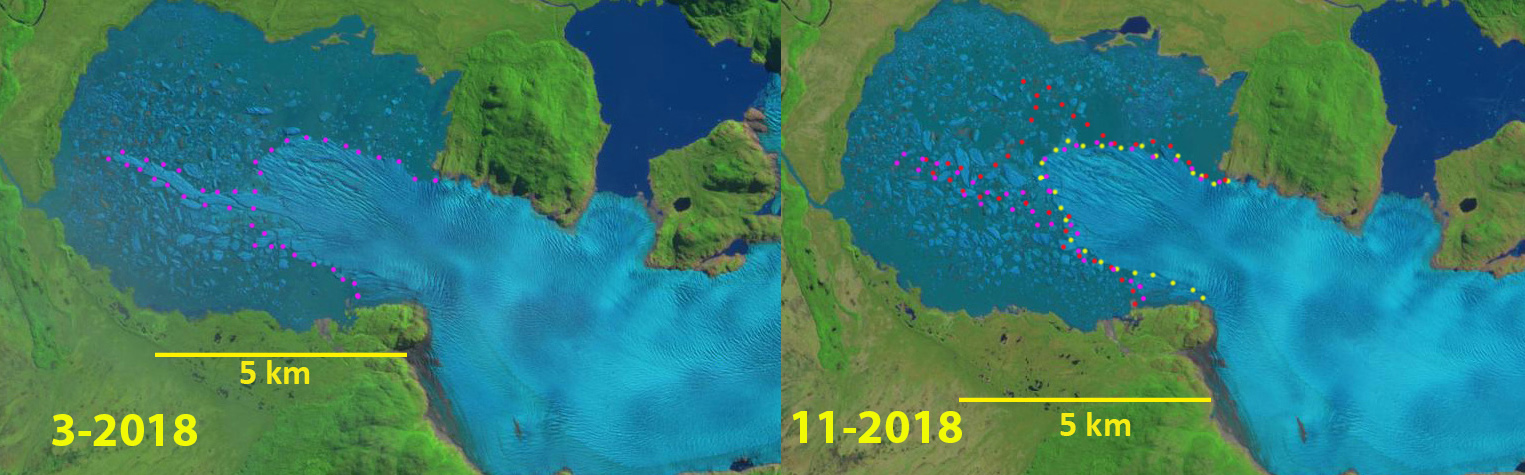
A narrow terminus tongue extending from the main terminus had an area of 0.6 km2 and extended to within ~1.5 km of  the Lake A western shore in March 2018.   By November 10, 2018 this narrow tongue had disintegrated.   In February 2020 the area of Lake A is 35.1 km2 and Lake B is 9.7 km2, a combined area of 44.8 km2 vs 20.5 km2 in 2001.  Gourlet et al (2015) examined the thickness across sections of the NPI, weather prevented the survey of the terminus area of San Quintin Glacier, but there results do hint that the bed is below sea level between Lake A and B basins, and they should connect. In the Landsat images of 2001 and 2015 a transect across the narrow point at the east end of Lake A indicates an area of 41 km2 if the entire main terminus tongue collapses. The ~24 km2 lake expansion at the two main terminus locations of San Quintin Glacier from 2001-2020 represent the fastest lake expansion from glacier retreat, is it the fastest overall for South America? Steffen Glacier is another example of rapid retreat and lake expansion. The retreat is much less than at HPS-12, but that is an example of fjord expansion.

Landsat images of San Quintin Glacier from 1987 and 2015 indicate the expansion of both Lake A and Lake B due to glacier retreat as well as retreat at Point C.

San Quintin in  March and November 2018 Landsat images indicating loss of narrow terminus tongue pink dots.

Soler Glacier Retreat and Lake Expansion

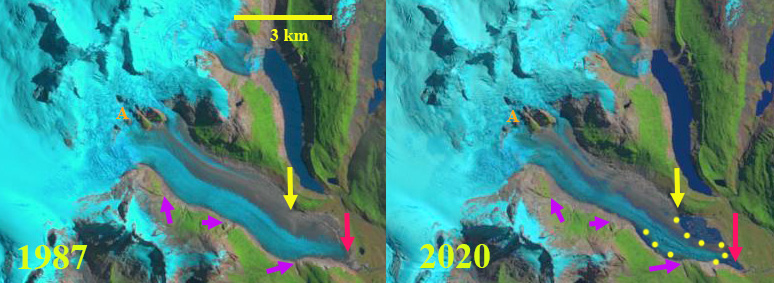
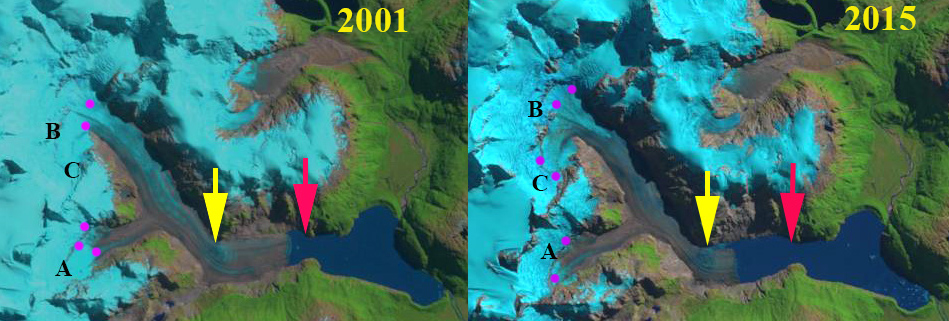
Soler Glacier in 1987 and 2020 Landsat images.  Red arrow indicates 1987 terminus location, yellow arrow indicates 2020 terminus location on north side of glacier.  Yellow dots indicate margin of lake and purple arrows indicate specific locations where glacier thinning is evident.

Soler Glacier is an outlet glacier on the east side of the Northern Patagonia Icefield (NPI). The terminus response of this glacier has been slower and more limited than on most NPI glaciers.  Aniya and Fujita (1986)  reported a total retreat of 200-350 m from 1944 to 1984.  Glasser et al (2016) note the recent 100 m rise in snowline elevations for the NPI, which along with landslide transport explains the large increase in debris cover since 1987 on NPI from 168 km2 to 306 km2 .  Loriaux and Casassa (2013) examined the expansion of lakes on the Northern Patagonia Ice Cap reporting that from 1945 to 2011 lake area expanded 65%, 66 km2. For Soler Glacier lake formation did not occur until the last decade and debris cover has changed little as well. Willis et al, (2012) identified thinning of ~2 m/year in the ablation zone from 1987-2011. This thinning is now leading to the development of a significant proglacial lake that is examined using Landsat images from 1987-2020.

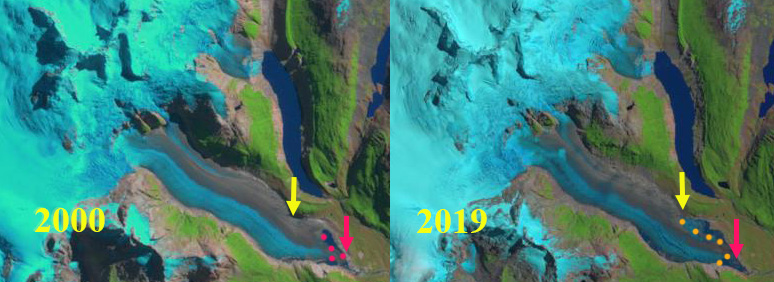
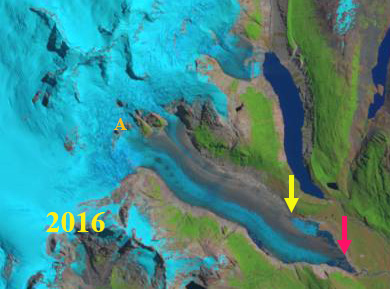
In 1987 the glacier is still up against the Little Ice Age moraine, though it had thinned considerably resulting in retreat down the slope of this vast moraine. By 2000 a small lake had developed both on the north and south side of the main terminus with a total area of ~0.3 km2, red dots. In 2016 and 2019 this lake had expanded, with the northern arm mostly filled with ice, orange dots.  In October 2020 the lake has an area of ~1 km2 and is mostly open water. The extensive thinning of the terminus tongue continues to drive both retreat and lake expansion.  The thining is evident at Point A where bedrock knobs have emerged from the ice near the snowline.  The three purple arrows on the south side of the glacier indicate thinning as these bedrock features are increasingly distant from the glacier. The terminus has retreated 500 m in the glacier center, 2100 m on the north side and 1300 m on the south side from 1987-2020.  The terminus tongue in its lowest 1.5 km continue to thin and will collapse in the lake in the near future. The end of summer snowline has averaged 1450 m in recent years leading to continued mass loss without calving in the lake (Glasser et al 2016).

Lake development here lags that of other glacier around the NPI such as Exploradores, Nef, Steffen and San Quintin.

Soler Glacier in 2000 and 2019 Landsat images.  Red arrow indicates 1987 terminus location, yellow arrow indicates 2020 terminus location on north side of glacier.  Red dots  and orange dots indicate margin of lake.

Soler Glacier in 2016 Landsat image.  Red arrow indicates 1987 terminus location, yellow arrow indicates 2020 terminus location on north side of glacier.  

Darwin Glacier, Chile 1986-2020 Retreat Opens New Fjord Arm

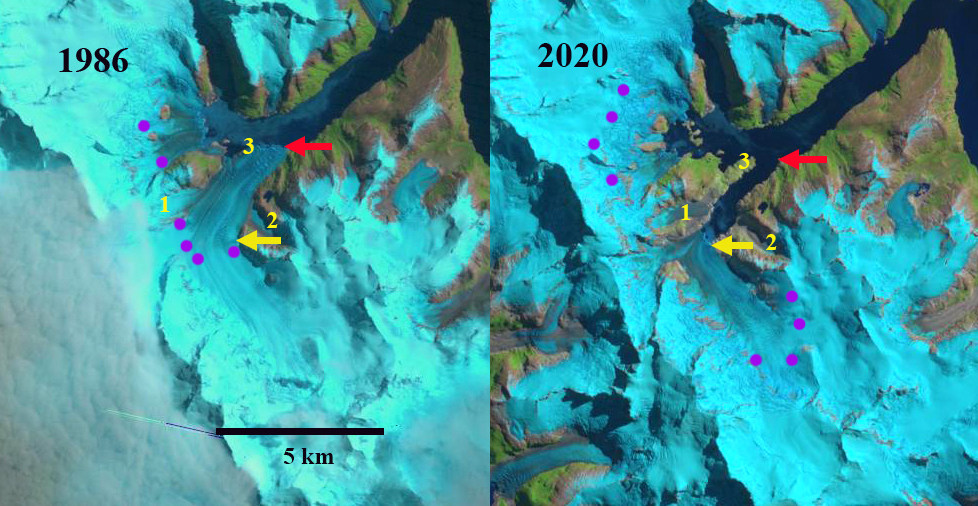
Darwin Glacier in Landsat images from 1986 and 2020. Red arrow indicates 1986 terminus location, yellow arrow 2020 terminus location, purple dots the snowline.  Point 1,2 and 3 indicate the same specific location.

Darwin Glacier flows east from the main divide of the Cordillera Darwin entering the head of Fjord Parry. Here we examine changes illustrated by Landsat images from 1986-2020.   Melkonian et al (2013) note widespread thinning of four large glaciers in the Cordillera Darwin Range from 2000-2011; Ventisquero Grande, Marinelli, Darwin and Roncagli, while the Garibaldi Glacier increased in volume.  They note a maximum velocity of 9.6 m/day at Darwin Glacier and thinning of over 3 m/year during the 2000-2011 period, which emcompasses a period of rapid retreat noted below. Davies and Glasser (2012) note that during the 1870-2011 period the Cordillera Darwin area loss was most rapid from 1986 to 2001. Dussaillant et al (2019) note the mass loss for the central Cordillera Darwin at -0.4 to -0.6 m/year from 2000-2018.

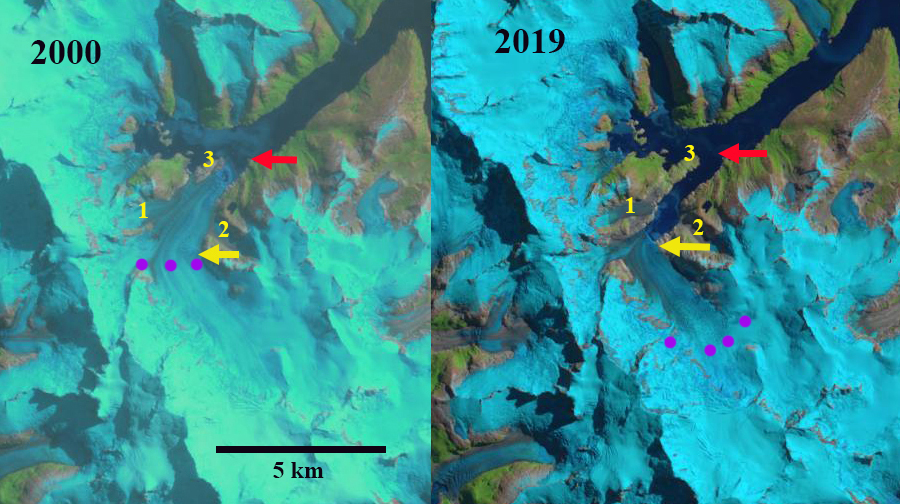
In 1986 Darwin Glacier extended beyond the end of a southwest trending valley (Point 3) and had fully separated from the former tributary flowing eastward. Tributaries at Point 1 and 2 join the main glacier within a 2 km of the current terminus. The snowline is at 500 m. By 2000 the glacier had retreated into the southwest trending valley, with a peninsula emerging on the west side at point 3.  The snowline is at 500 m. By 2019 the glacier had retreated beyond the former tributaries at Point 1 and 2. The snowline in 2018 is at 750 m.  In 2020 the peninsula at Point 3 has greened up with new vegetation, the glacier has retreated 3100 m since 1986 exposing a new fjord arm. Point 2 is largely a glacier free valley bottom.  The snowline is at 800 m.  A further 1 km retreat will lead to another tributary separation much as has happened at Ventisquero Grande.

Darwin Glacier in Landsat images from 2000 and 2019. Red arrow indicates 1986 terminus location, yellow arrow 2020 terminus location, purple dots the snowline.  Point 1,2 and 3 indicate the same specific location.

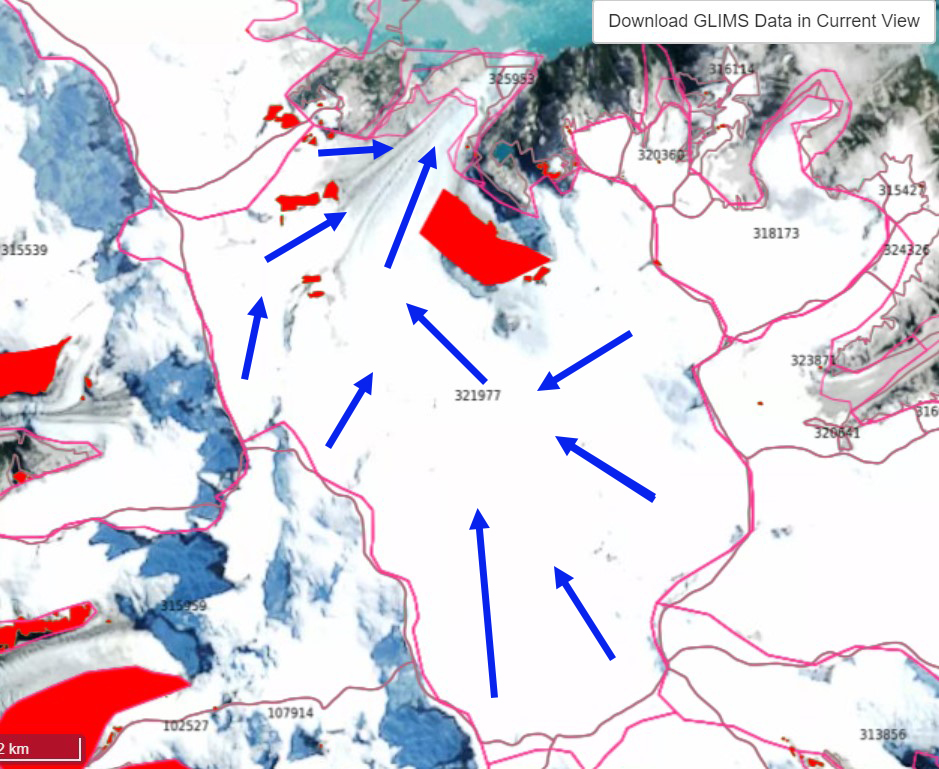
GLIMS view of Darwin Glacier with 1986-2007 margins indicated (Bethan Davies delineated margins).  Flow arrows added.

Calluqueo Glacier, Chile Retreat 1986-2020

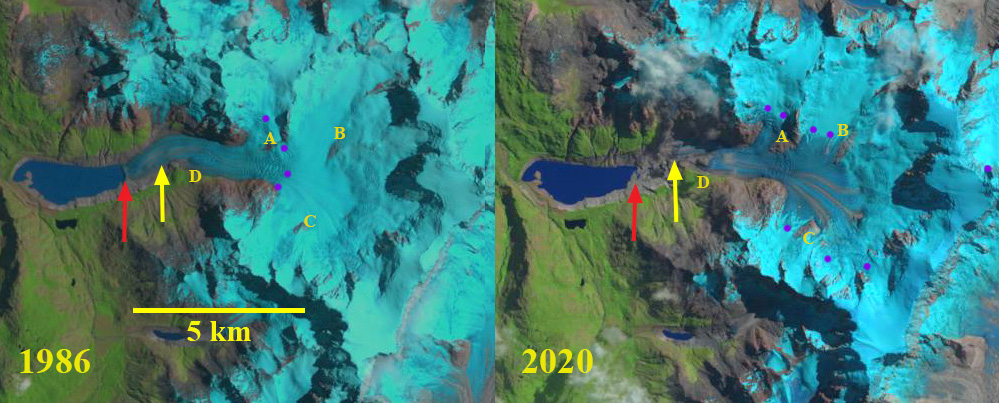
Calluqueo Glacier in Landsat images from 1986 and 2020.  Yellow arrow is the 2020 terminus location, red arrow the 1986 terminus location, purple dots indicate the snowline. Point A-D indicate bedrock areas that have expanded with glacier thinning.

Calluqueo Glacier is the largest glacier of the Monte San Lorenzo range on the Chile-Argentina border. This Chilean glaciers flows west from the border and in 1986 terminated in Lago “Calluqueo”. From 1985 to 2005/2008 Monte San Lorenzo glaciers lost 18.6% of their area (Falaschi et al 2013). In this region glaciers thinned by ~0.5 m/year from 2000-2012 with most of the thinning on Calluqueo Glacier occurring below 1300 m (Falaschi et al 2017). The glacial history of the region has been documented with excellent visual depictions including moraines and trimlines encircling Lago Calluqueo by Davies et al (2020), see below example. Here we examine the changes in Calluqueo Glacier from 1986-2020 using Landsat images.

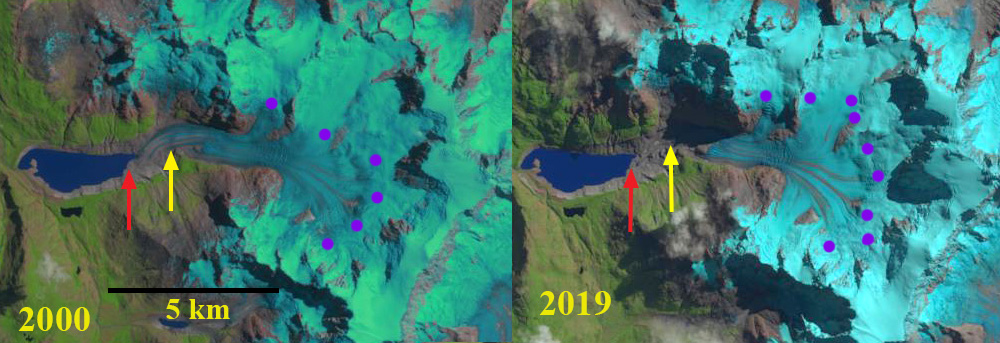
In 1986 Calluqueo Glacier terminated in Lago Calluqueo at an elevation of 450 m, with a 750 m wide calving front in the 1.7 km 2 glacial lake.  Lago Calluqueo is impounded by a stabilized moraine complex, see map below. The snowline was at 1400 m with Point A, B and C locations of limited bedrock exposure in 1986. By 2000 the glacier had retreated to the western shore of the lake that had expanded to 3.0 km2.  The snowline in 2000 was at 1700 m.  In 2019 the glacier has receded from the lake shore far enough so it no longer has any direct interaction or avalanche potential into the lake. The snowline in 2019 is at 1750-1800 m.  By 2020 the glacier has retreated 1500 m since 1986 to an elevation of 700 m, in the vicinity of bedrock knob Point D that emerged from beneath the ice. The bedrock ribs at Point A, B and C have all expanded by more than 100% since 1986 as the glacier thins. The snowline in 2020 is at 1750-1800 m.

Calluqueo Glacier will continue to retreat given the ongoing thinning and recent persistently high snowline +1700 m elevations. The glacial history and landforms generated in this region are illustrated by Davies (2018). Retreat here follows that of the Sierra de Sangra region, Argentina and glaciers of the Northern Patagonia Icefield, such as Fiero Glacier and Acodado Glacier.

Calluqueo Glacier in Landsat images from 2000 and 2019.  Yellow arrow is the 2020 terminus location, red arrow the 1986 terminus location, purple dots indicate the snowline.

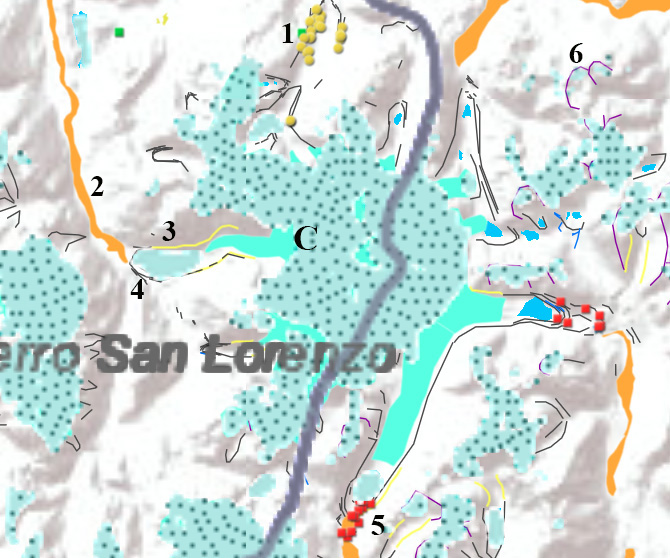
In the map above from Davies et al (2020) GIS app.  1) Cosmogenic Be10 based dates, 2) Sandur, 3) Glacial Trimline, 4) Glacial Moraine, 5) Lichenometry based dates, 6) Empty Cirque. Martin et al (2019) identify 3 and 4 as being of Holocene age formation.

 2) Sandur, 3) Glacial Trimline, 4) Glacial Moraine.  Point A-D same as in top image.

Acodado Glacier, Chile Retreat Yields Tripling in Lake Area 1987-2020

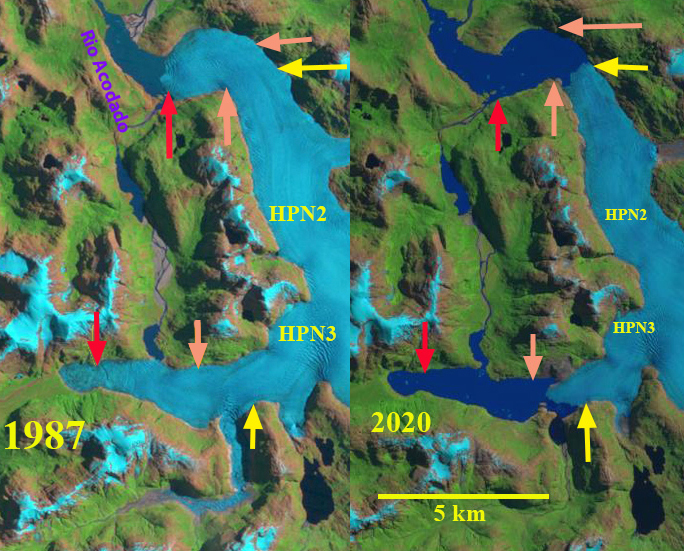
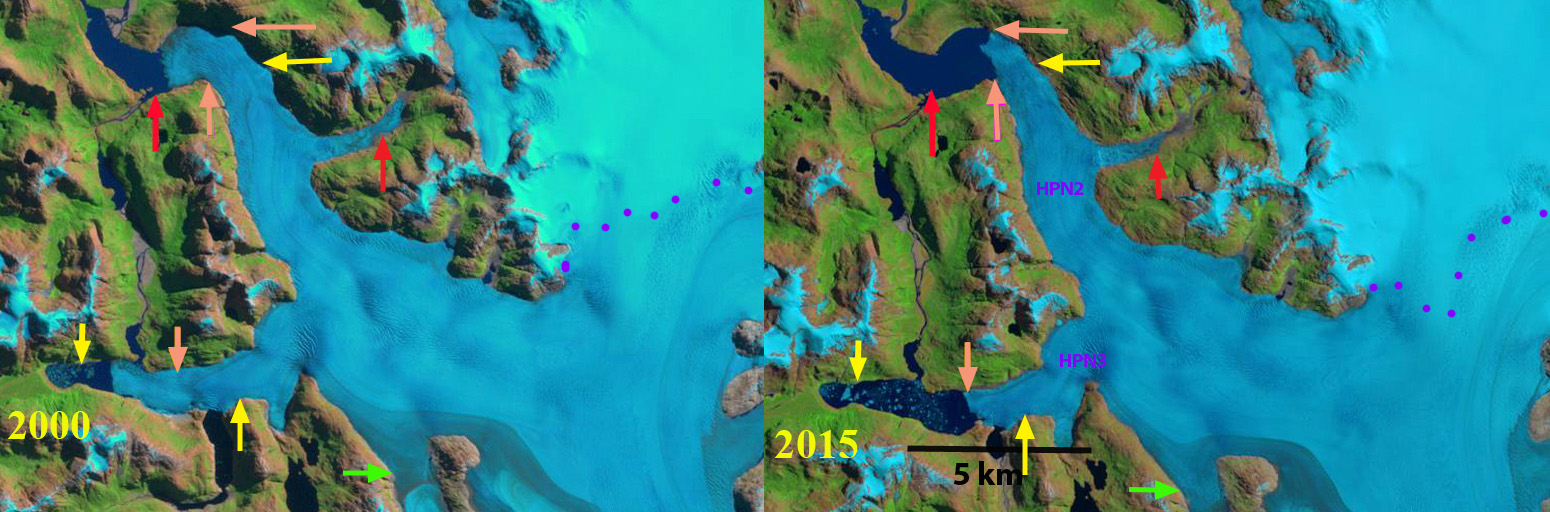
Acodado Glacier retreat and lake expansion observed in 1987 and 2020 Landsat images.  Red arrow is the 1987 terminus locations, orange arrows the 2015 terminus and yellow arrows the 2020 terminus location.  

Loriaux and Casassa (2013) examined the expansion of lakes of the Northern Patagonia Ice Cap (NPI). From 1945 to 2011 lake area expanded 65%, 66 km2. Rio Acodado has two large glacier termini at its headwater, HPN2 and HPN3. that are fed by the same accumulation zone and comprise the Acodado Glacier. The glacier separates from Steffen Glacier at 900 m. The lakes at the terminus of each were first observed in 1976 and had an area of 2.4 and 5.0 km2 in 2011 (Loriaux and Casassa, 2013).  Willis et al (2012) noted a 3.5 m thinning per year from 2001-2011 in the ablation zone of the Acodado Glacier, they also note annual velocity is less than 300 m/year in the ablation zone. Davies and Glasser (2012) noted that the Acodado Glacier termini, HPN2 and HPN3, had retreated at a steadily increasing rate from 1870 to 2011. Here we examine the substantial changes in Acodado Glacier from 1987 to 2020 using Landsat imagery.  Pelto, 2017 reported a retreat from 1987-2015 of 2100 m for HPN2 and 3200 m for HPN3.

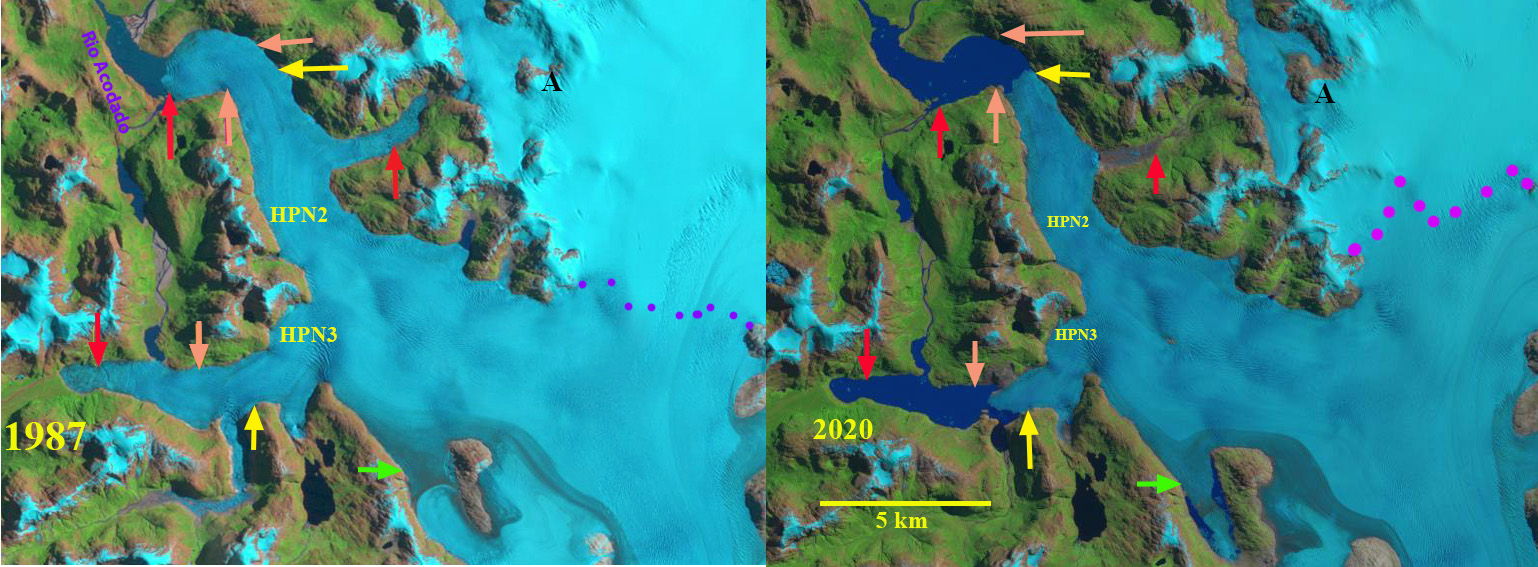
In HPN2 and HPN3 terminate at the red arrow in 1987 , the snowline is at the purple dots at 1000 m. By 2000 the glacier has retreated from the red and yellow arrow by 400 m and 900 m respectively, and the snowline is at 1100 m.  In 2015 it is apparent that HPN2 has retreated 2100 m from the red arrow to the orange arrow.   The snowline was again at 1100 m. In 2020 the snowline in early February was at 1100 m. From 1987-2020 Acodado Glacier terminus HPN2 has retreated 2700 m and HPN3 has retreated 4100 m.  The result of this retreat is an increase in lake area at HPN2 from 2.1 km2 in 1987 to 7.1 km2 in 2020.  At HPN3 lake area expanded from 1.4 km2 to 4.8 km2 . Glasser et al (2016) identified a 40% increase in lake area for the NPI from 1987-2015, much less than the increase at Acodado Glacier. They also note the recent 100 m rise in snowline elevations for the NPI.  The higher snowline indicates warmer temperatures generating high ablation rates, which will leads to reduced ice flux from the accumulation zone to the terminus, which will drive more retreat. Near Point A there are three locations noted in the accumulation zone image below that indicate the reduced ice flow from the accumulation zone into an adjacent outlet glacier. HPN3 has a sharp rise in elevation ~1.5 km above the terminus, before it joins the main Acodado Glacier, it should retreat rapidly toward this point and then calving will end and retreat will slow.  HPN2 has a more gradual slope indicating substantial potential for lake expansion, with a slope significant increase 3 km above the 2020 terminus ,just beyond the former tributary on the east margin.

The retreat here is synonymous with the pattern observed at other NPI outlet glaciers each with rapid calving retreats in expanding proglacial lakes (Glasser et al 2016); Fraenkel Glacier, Benito Glacier and Reichert Glacier and Steffen Glacier. All the outlet glaciers of NPI have retreated significantly in the last 30 years most leading to expanding proglacial lakes (Loriaux and Casassa, 2013;  Pelto, 2017).

Acodado Glacier retreat and lake expansion observed in 1987 and 2020 Landsat images.  Red arrow is the 1987 terminus locations, orange arrows the 2015 terminus and yellow arrows the 2020 terminus location.  The transient snowline is purple dots, the green arrow marks upglacier proglacial lake and Point A is the area of focus of detailed accumulation image below.

Acodado Glacier retreat and lake expansion observed in 2000 and 2015 Landsat images.  Red arrow is the 1987 terminus locations, orange arrows the 2015 terminus and yellow arrows the 2020 terminus location.  The transient snowline is purple dots, the green arrow marks upglacier proglacial lake and Point A is the area of focus of detailed accumulation image below.

Note the expansion of bedrock at points 1,2 and 3 indicating reduced flow from the accumulation to the ablation zone near Point A

Exploradores Glacier Lake Development, Chile

Exploradores Glacier  (EX) in 1987 Landsat and 2020 Sentinel image.  Points A-E are consistent locations discussed.  B=Bayo Glacier.

Exploradores Glacier is an outlet glacier at the northeast corner fo the Northern Patagonia Icefield (NPI).  Glasser et al (2016) note the recent 100 m rise in snowline elevations for the NPI, which along with landslide transport explains the large increase in debris cover since 1987 on NPI from 168 km2 to 306 km2  On  Exploradores  Glacier debris cover expanded by 5.5 km2 from 1987-2015.   Loriaux and Casassa (2013) examined the expansion of lakes on the Northern Patagonia Ice Cap. From 1945 to 2011 lake area expanded 65%, 66 km2Davies and Glasser (2012) noted the fastest retreat during the 1870-2011 period was from 1975-1986 for Exploradores Glacier. Here we examine the response of the glacier to climate change from 1987 to 2020.

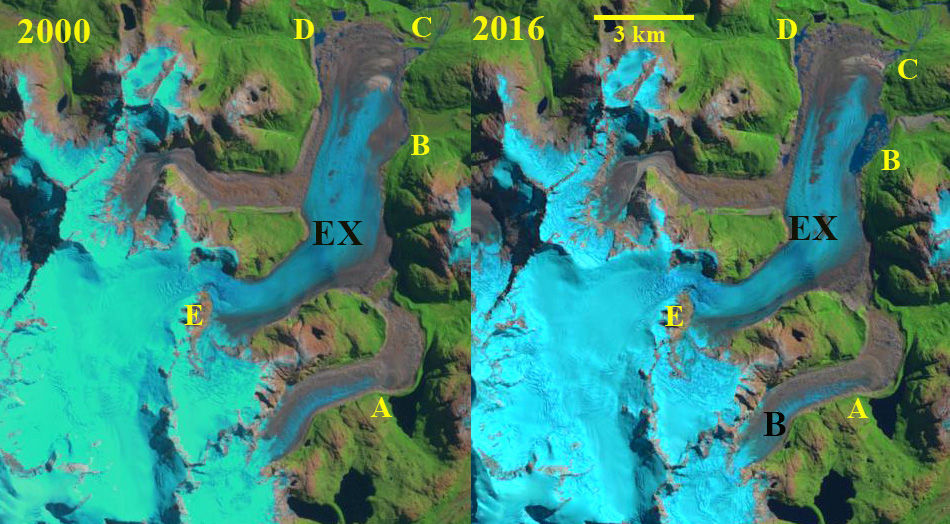
In 1987 Exploradores Glacier has a 12 km2 terminus lobe with a couple of small proglacial pond with a total area under 0.2 km2 near Point D.  The snowline is at 1400 m near Point E.  A small lake is impounded by a lateral moraine of Bayo Glacier at Point A.   In 2000 there is now a single small pond near Point D and a small proglacial pond 0.1 km2 near Point C.  The snowline is at  1400 m near Point E. In 2016 small fringing proglacial ponds exist near Point C and D.  A substantial proglacial lake has developed at Point B with an area of ~1 km2 on the east margin of the glacier.  The impounded lake at Point A has not changed. In 2020 the proglacial ponds have expanded at Point C and D.  At Point B the proglacial lake has expanded to ~1.4 km2.  The snowline is above Point E at 1500 m. At Point A the impounded lake has drained somewhat and is now at a lower lake level.  The lake breached the lateral moraine, which had been increasing in relief from the thinning Bayo Glacier.  The snowline on January 1, in the middle of the melt season is already above Point E at 1500 m. The debris cover has extended 5 km up the middle of the glacier from the terminus.

The terminus lobe of the Exploradores Glacier is now collapsing, this is a process that has already occurred at Steffen Glacier, San Quintin Glacier and Colonia Glacier.  The terminus lobe is relatively stagnant as indicated by the minimal surface slope.  The retreat has been slow compared to adjacent Fiero Glacier. The result will be a new substantial proglacial lake.

Exploradores Glacier  (EX) in 2000 and 2016 Landsat images.  Points A-E are consistent locations discussed.  B=Bayo Glacier.

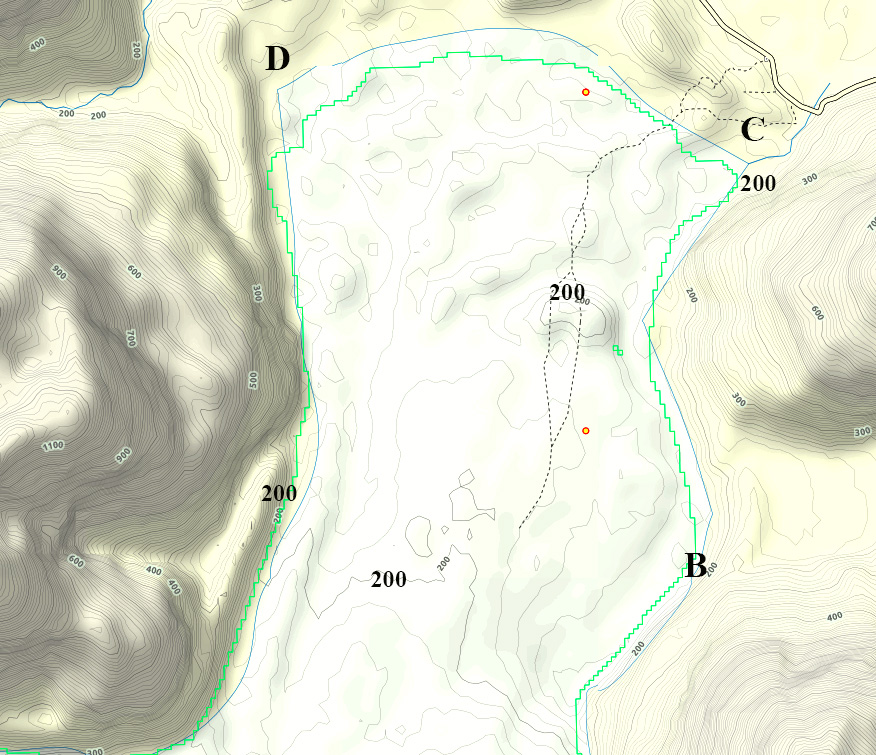
GLIMS view of the terminus indicating the 200 m contour and Point B-D in same location as on images.


Fiero Glacier, Chile Retreat Lago Fiero Expansion

Fiero Glacier in 1987 Landsat and 2020 Sentinel images.  Red arrow indicates 1987 terminus location, yellow arrow 2020 terminus lcoation, and purple dots the snowline. Point A,B and C represent locations where bedrock has expanded.

Fiero Glacier is an outlet glacier draining the northeast quadrant of the Northern Patagonia Icefield (NPI) terminating in Lago Fiero. Loriaux and Casassa (2013) examined the expansion of lakes of the Northern Patagonia Ice Cap. From 1945 to 2011 lake area expanded 65%, 66 km2Davies and Glasser (2012) noted the fastest retreat during the 1870-2011 period was from 1975-1986 for Fiero Glacier.  They noted that Fiero Glacier proglacial lake had an area of 6.6 km2.  Glasser et al (2016) note the recent 100 m rise in snowline elevations for the NPI, which along with landslide transport explains the large increase in debris cover since 1987 on NPI including Fiero Galcier. Here we examine the response of the glacier to climate change from 1987 to 2020.

In 1987 the glacier terminated at a narrow point in the 4.2 km long Lago Fiero that has an area of 5.6 km2.  By 2001 the glacier had retreated 500 m and the transient snowline is at 1000 m.  At point A there is a narrow rock rib. at Point B there are isolated rock rib and knobs and at Point C the rock rib is limited.  In 2015 the lake has expanded to an area of 7.3 km2, and the debris cover has also expanded. The transient snowline is at 1200-1300 m.  In 2020 the lake has expanded to an area of 9.5 km2 and a length of 6.5 km.  The 2.3 km retreat has led to a near doubling in the area of the Lago Fiero, the retreat since 2011 is the fastest rate observed. At Point A the rock rib is now a prominent separation, at Point B and C the rock rib has become continuous much like at Point A. The snowline on January 1, 2020 is at 1200 m, midway through the melt season.  The glacier slope increases 500-1000 m from the current terminus near a surface elevation of 600 m, which could mark the expansion limit of Lago Fiero (see map below).

The retreat of this glacier is larger than that of Colonia Glacier and Pared Nord Glacier further south and Verde Glacier to the north of the NPI.  All the outlet glaciers of NPI have retreated significantly in the last 30 years most leading to expanding proglacial lakes (Loriaux and Casassa, 2913;  Pelto, 2017).

Fiero Glacier in 2001 and 2015 Landsat images.  Red arrow indicates 1987 terminus location, yellow arrow 2020 terminus lcoation, and purple dots the snowline. Point A,B and C represent locations where bedrock has expanded.

Terminus of Fiero Glacier from the Randolph Glacier Inventory in 2001 (Green) and 2011 (blue).  the 500 m, 600 m and 700 m contour are indicated.  Note the steeper slope near 600 m which likely is beyond the expansion limit of Lago Fiero. Base map from GLIMS

Steffen Glacier, Chile Calving Retreat Acceleration 2019

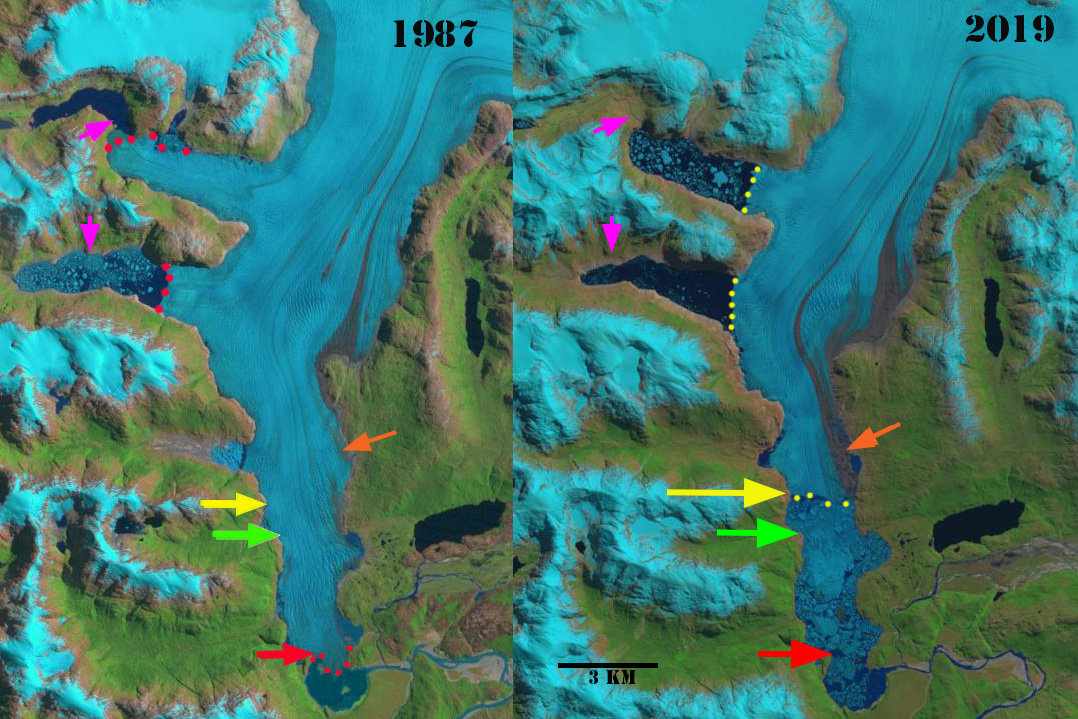
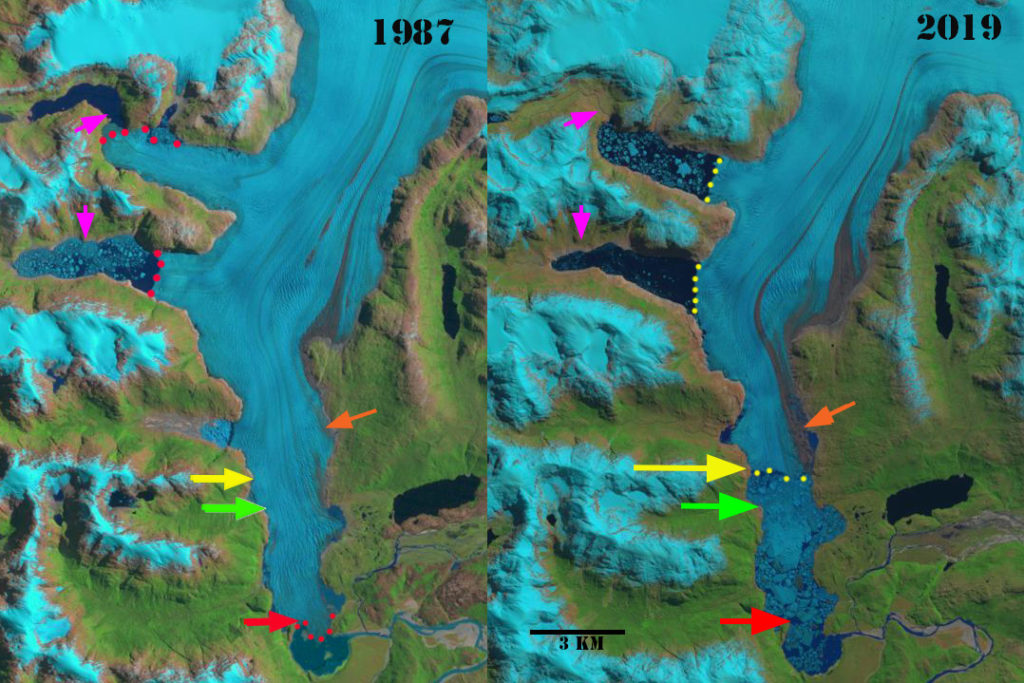
Steffen Glacier in 1987 and 2019 Landsat images.  Red arrow is 1987 terminus location, green arrow 2015 terminus location, yellow arrow 2019 terminus location, orange arrow an area of expanding debris cover and the pink arrow locations indicating water level decline in proglacial lakes by the northwest and midwest secondary terminus. The terminus locations are also noted by red dots for 1987 and yellow dots for 2019.

Steffen Glacier is the south flowing glacier from the 4000 square kilometer Northern Patagonia Icefield (NPI). Several key research papers have reported on the spectacular retreat of this glacier in recent years. Here we update those results using Landsat imagery from 1987-2019 to fully illustrate the changes. Rivera et al (2007) reported that Glaciar Steffen lost 12 km2 and had an average thinning of 1.5 m in the ablation zone from 1979-2001. A JAXA EORC, 2011 report compared parts of the Glaciar Steffen terminus change from 1987 to 2010. They noted a retreat of approximately 2.1 km of the main stem and 870 m of a western terminus.  Davies and Glasser (2012) in examining changes in Patagonian glaciers that the rate of area loss of the NPI increased dramatically after 2001, and has been 9.4 km2/year.  Glasser et al (2016) report that NPI proglacial lake area expanded from 112 km2 to 198 km2 from 1987 to 2015, debris cover area expanded from 4.1% of the NPI to 7.9% during the same period. After 2003 the snowline was noted to have risen ~100 m.  Dussaillant et al (2018) determined the annual mass loss of NPI at ~-1 m/year for the 2000-2012 period, with Steffen Glacier at -1.2-1.6 m/year.

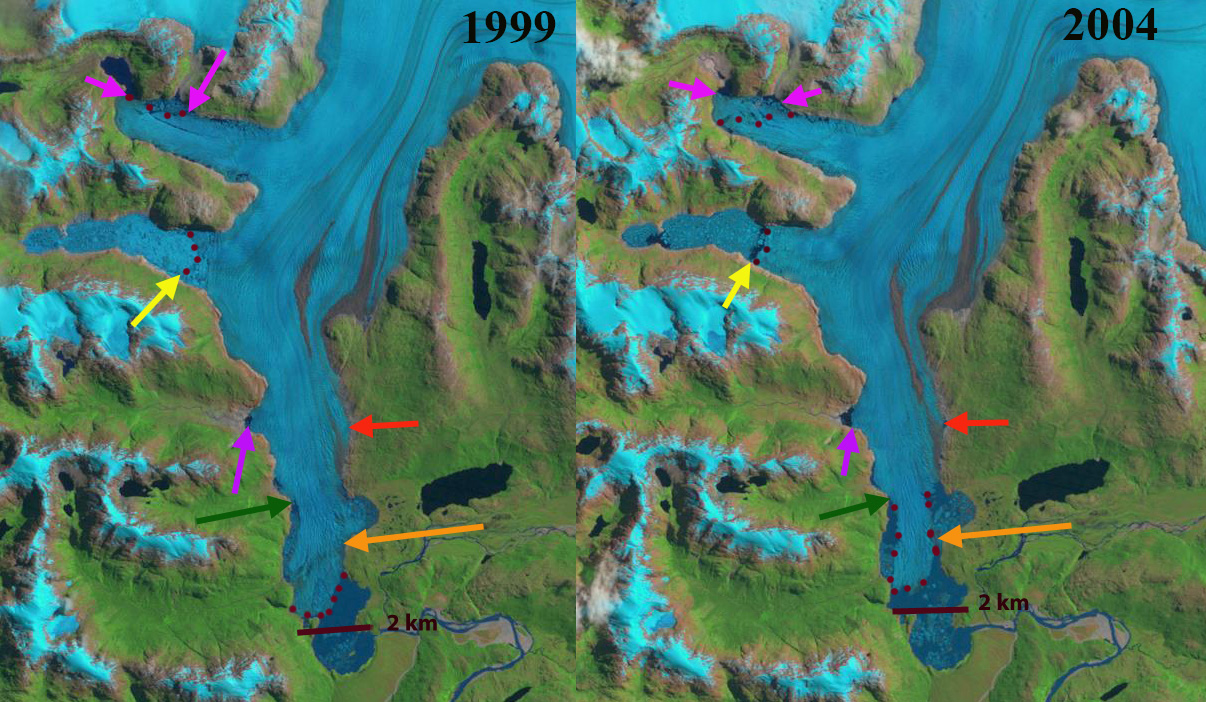
In 1987 the lake at the terminus of the glacier was 1.3 km long from north to south. There are two substantial proglacial lakes with secondary termini on the west side of the glacier, the northwest extends 4 km west from the main trunk, the midwest tongue extends 1.7 km from the main trunk. In  1999 there is little retreat on the west side of the main terminus, but the east side has retreated 700 m.  The northwest secondary terminus has changed little, but the glacier tongue is showing signs of rifting.  The midwest tongue has retreated to within 0.5 km of the main trunk.  In 2004 the west side of the main terminus has retreated 600 m from a peninsula that had buttressed the terminus.  The entire last 3 km of the terminus tongue is in the proglacial lake with no buttressing by the shore, and is poised for breakup.

By 2015 the unbuttressed portion of the terminus had been lost with a 3.4 km retreat since 1987.  The northwest tongue has collapsed a retreat of 3.8 km, while the midwest termini has retreated 1.3 km since 1987. There are four large icebergs more than 0.2 km2 in the proglacial lake. From 2015-2018 the terminus is relatively stable and extends across the entire lake and on the west side is buttressed by a small peninsula.  In 2018 there are three large icebergs more than 0.2 km2 in the proglacial lake.  In 2019 the terminus has retreated 1 km from the 2018 position with  proglacial lake areas along the lowest 2 km on both the west and east margin.  This suggests this section of the terminus is similar to the main terminus in 1987 and 1999 that was poised for further calving retreat.  The 2019 image is from early in the melt season and the proglacial lake is filled with an extensive melange and one large iceberg. The retreat from 1987-2019 of 4.4 km, ~137 m/year, is driven by the 100 m rise in the snowline, resultant thinning, which then drives calving (Glasser et al 2016). Millan et al (2019) indicate the area of tributary glacier convergence near the northwest terminus and above the glacier is 700 m thick, and that the glacier has been retreating along an area where the glacier bed is below sea level, though the terminus now is close to sea level.  Note the Digital Globe image below with the yellow arrows indicating the end of the main lake basin and potentially end of the lake, the eastern margin of the glacier is fringed by proglacial lake up to that point.  Above this point there is another basin that may or may not connect to the current lake. The high snowline elevation in 2019 that is an indicator of increased melt area has led to an expansion of debris cover as well, note orange arrows for 1987 and 2019.

Steffen Glacier in 1999 and 2004 Landsat images. The red dots indicate terminus position, orange arrow where the terminus was buttressed on the eastern shore in 1999, green arrow where the glacier is buttressed on the western shore, the pink arrow indicates the northwest secondary terminus and yellow arrow the midwest secondary terminus.
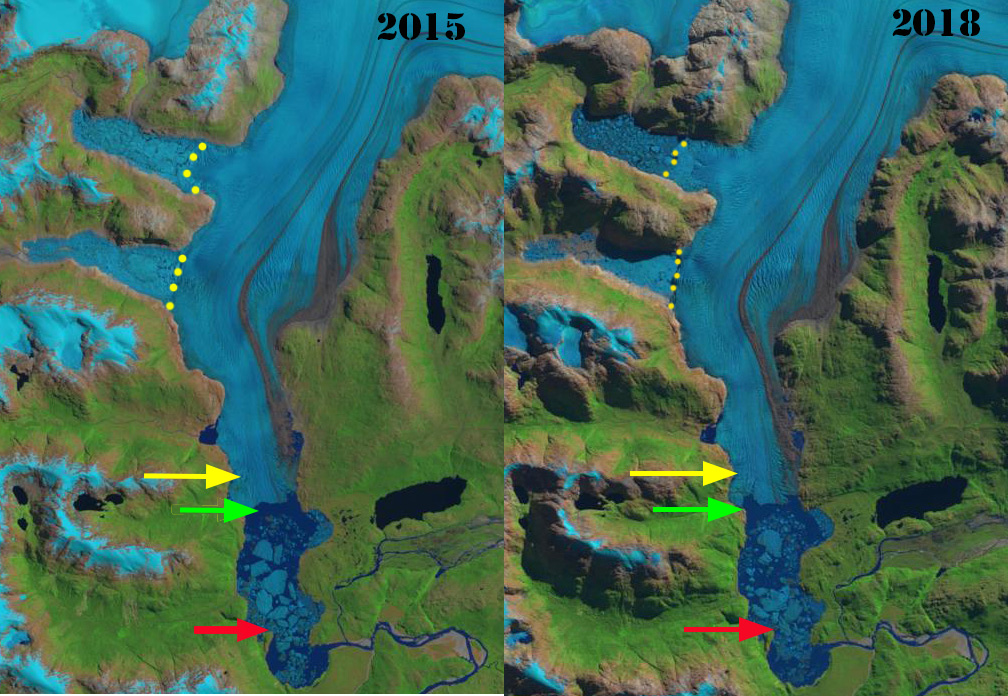
Steffen Glacier in 2015 and 2018 Landsat images.  Red arrow is 1987 terminus location, green arrow 2015 terminus location, yellow arrow 2019 terminus location, orange arrow an area of expanding debris cover and the yellow dots the margin of the northwest and midwest secondary terminus.
Digital Globe image of lower reach of Steffen Glacier. Yellow arrows indicate an area where the bed rises as indicated by the increased crevassing and steeper surface slope. Note the extent of detachment of the glacier along the eastern margin up to that point.

Ofhidro Glacier, Chile Retreat 1986-2019

Ofhidro Glacier glacier terminus change an accumulation zone changes from 1986-2019 in Landsat images.  Red arrow=1986 terminus, yellow arrow=2019 terminus change, orange arrows expanding bedrock areas and purple dots snowline. 

Ofhidro Glacier is an outlet glacier on the northwest corner of the Southern Patagonia Icefield (SPI), that has a northern and southern arm terminating in a proglacial lake. Sakakibara and Sugiyama (2014)a examine the terminus change and velocity of SPI glaciers the northern arm retreating 50 m per year from 1985-2011 and the southern arm 100 m/year 1985-2011.  They also noted a decline in velocity Here we examine Landsat imagery from 1986-2019 to identify the change.

In 1986 the southern arm extended across the proglacial lake to the shallows of the western shore. The northern arm had been retreating in a narrower valley with a comparatively consistent width.   In 1998 the southern arm in the broader lake reach had collapsed, a retreat of 1800 m.  The northern arm had a retreat of 200 m.  The snowline was at m.  In 2015 the southern arm has retreated into a narrower valley, and the northern arm has retreated to a turn to the south in the valley.  The orange arrows indicate the expansion of bedrock as the glacier thins.  By 2019 the southern arm has retreated 2800 m (88 m/year) and the northern arm has retreated 1800 m (56 m/year).   Jaber et al (2019)  noted a thinning of 0.5 m/year from 2000-2012 increasing to 1.2 m/year from 2012-2016.  Most of the thinning being in the valley tongues of each arm. There is an area of continuous exposed bedrock more than 3 km long.  This fits the observations of  Willis et al (2012) who observed that between February 2000 and March 2012 that SPI was rapidly losing volume and that thinning extends even to high elevations.   The retreat of this glacier is similar to that of Lucia Glacier and Gabriel Quiroz Glacier to the east.

Ofhidro Glacier glacier terminus change an accumulation zone changes from 1998-2015 in Landsat images.  Red arrow=1986 terminus, yellow arrow=2019 terminus change, orange arrows expanding bedrock areas and purple dots snowline.

Ofhidro Glacier image from 2015. Notice the trimlines and narrowing of both terminus tongues.  Orange arrow indicates new bedrock knob.

Northern Patagonia Icefield High Equilibrium Line Altitude in 2019

Northern Patagonia Icefield Landsat view on 4/6/2019. Transient snowline indicated on individual glaciers with purple dots. Clockwise, L=Leones, So=Soler, N=Nef, Ca=Cachet, Co=Colonia,  PN=Pared Nord, PS=Pared Sur, H4=HPN4, St=Steffen, A=Acodado, B=Benito, H1=HPN1, Sq=San Quintin.

The Northern Patagonia Icefield from 1987-2015 decreased in area, while debris cover area expanded and the size of proglacial lakes expanded (Glasser et al 2016).  The icefield area declined from 4113 to 3887 km2, debris cover increased from 168 to 307  km2 and lake area expanded from 112 to 198 km2 In this paper we also examined the recent rise in the transient snow line (TSL). The TSL is the location of the transition from snow cover to bare glacier ice at a particular time during the ablation season, while the Equilibrium Line Altitude (ELA) is the altitude of the snow line at the end of the ablation season. The TSL at the end of the melt season is the ELA.  In recent years the ELA has been rising, and the highest annually observed TSL in the period 2013-2016 averaged 1215 m (Glasser et al 2016). This is an ELA rise of  at least 103 m compared with the  observed  1979-2003 ELA.  Landsat 8 imagery from April 6, 2019 reveals the TSL for most NPI glaciers, this is typically beyond the end of the melt season, but not in 2019, hence the TSL from this date will be the approximate annual ELA.  How does it compare and what does that mean for icefield mass balance in 2019?

On April 6, 2019 the TSL was highest on glaciers on the east side of the icefield decreasing for the western outlet glaciers. Clockwise from Leones Glacier in the Northeast to San Quintin Glacier on the west side the TSL observed ranged from 1525 m on Leones Glacier and Soler Glacier to a low of 1075 m on San Quintin Glacier.  The mean TSL is 1260 m for the glaciers reported by Glasser et al (2016) and 1300 m for all glaciers.  TSL on April 6, 2019 on glaciers on the east side of the icefield averaged 1425 m, while on the east side of the icefield the average was 1200 m.

Willis et al (2012) noted the ELA of NPI glaciers for the 2001-2011 period, a glacier by glacier comparison to 2019  indicates the ELA is  ~150 m higher in 2019.  This is the highest mean TSL observed for the NPI and suggests a strong negative surface mass balance year for the icefield in 2019.  This does not include the calving losses such as observed at San Quintin Glacier.  Dussaillant et al (2018) reported negative mass balances of NPI glaciers of ~-1 m using two different methods for the 2000-2012 period. TSL observations since indicate the ELA has been higher in recent years driving even more negative balances.  As Pelto (2017) noted 19 of the 24 main outlet glaciers of the Northern Patagonia Icefield ended in a lake in 2015, all the lake termini retreated significantly in part because of calving losses. Surface mass balance losses in 2019 will lead to continued retreat such as observed at San Quintin Glacier, Nef Glacier, and Acodado Glacier. This will also increase the debris covered area, which increases albedo and ablation further.

Northern Patagonia Icefield ELA reported by Willis et al (2012), Glasser et al (2016) and for 2019. 

Gualas Glacier (G) and Reichert Glacier (R) TSL on 4/6/2019 in Landsat image.


Cachalote Glacier, Chile Retreats From Lake and Separates

Cachalote Glacier in a 1984 Landsat image and 2019 Sentinel Image.  Red arrow is 1984 terminus location, yellow arrow the 2019 terminus location and the pink arrow a tributary to the glacier in 1984 that separates.

Cachalote Glacier is on the western edge of the Southern Patagonia Icefield, Chile. The glacier is not fed by the main icefield, but is connected to glaciers that are.  The glaciers of the SPI have been experiencing significant mass loss and overall retreat. Willis et al (2012) observed significant mass loss from 2000-2012 of −20.0  Gt per year. Davies and Glasser (2012) indicate this area had its most rapid retreat of the 1870-2011 period after 1986.

In 1984 Cachalote Glacier terminated in a proglacial that was ~600 m long, red arrow.  The glacier was joined by a tributary from the west ~1 km from the terminus, pink arrow.  By 2001 the tributary had separated from the main glacier. The glacier still terminated in the proglacial lake, but had retreated 1.5 km and the proglacial lake was now just over 2 km long.  In 2017 the glacier no longer reached the proglacial lake. In 2019 the glacier has retreated 2.6 km from its 1984 position, 30% of its entire length lost in the span of 35 years. The glacier no longer terminates in a lake and ends near the top of a steep slope, both suggest that retreat should decline for the near future.

This is a less spectacular retreat than at HPS-12 Glacier which is a short distance to the norther and is the fastest retreating glacier in the region or Dickson Glacier on the east side of the icefield, but as a percent of glacier length lost is as substantial.

Cachalote Glacier in a 2001 and 2017 Landsat images.  Red arrow is 1984 terminus location, yellow arrow the 2019 terminus location and the pink arrow a tributary to the glacier in 1984 that separates by 2001.

Cachalote Glacier with flow lines indicated.